
Medicare Annual Wellness Visit Cognitive Screening in Different
- Slides: 1
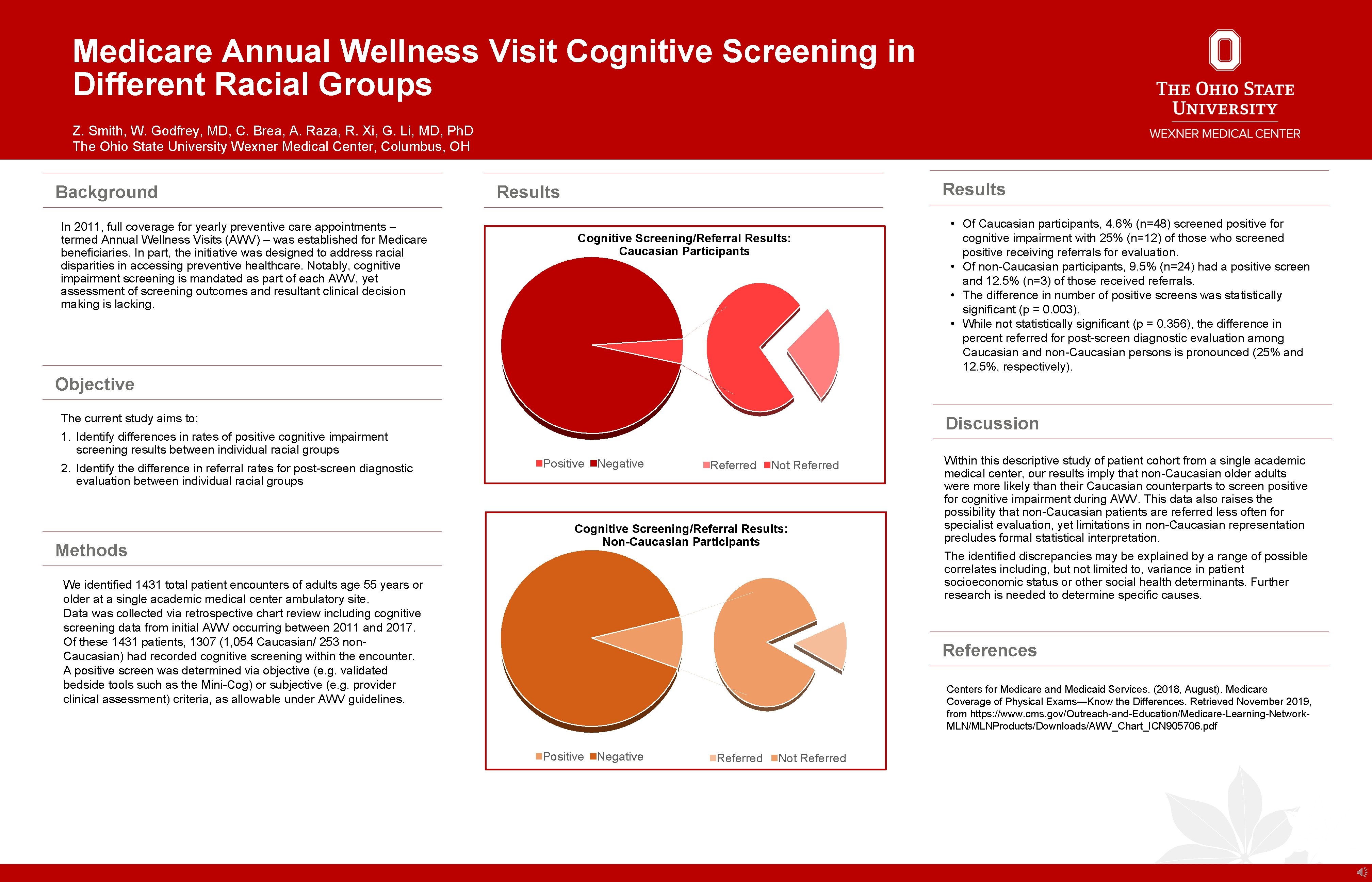
Medicare Annual Wellness Visit Cognitive Screening in Different Racial Groups Z. Smith, W. Godfrey, MD, C. Brea, A. Raza, R. Xi, G. Li, MD, Ph. D The Ohio State University Wexner Medical Center, Columbus, OH Background In 2011, full coverage for yearly preventive care appointments – termed Annual Wellness Visits (AWV) – was established for Medicare beneficiaries. In part, the initiative was designed to address racial disparities in accessing preventive healthcare. Notably, cognitive impairment screening is mandated as part of each AWV, yet assessment of screening outcomes and resultant clinical decision making is lacking. Results Cognitive Screening/Referral Results: Caucasian Participants • Of Caucasian participants, 4. 6% (n=48) screened positive for cognitive impairment with 25% (n=12) of those who screened positive receiving referrals for evaluation. • Of non-Caucasian participants, 9. 5% (n=24) had a positive screen and 12. 5% (n=3) of those received referrals. • The difference in number of positive screens was statistically significant (p = 0. 003). • While not statistically significant (p = 0. 356), the difference in percent referred for post-screen diagnostic evaluation among Caucasian and non-Caucasian persons is pronounced (25% and 12. 5%, respectively). Objective The current study aims to: Discussion 1. Identify differences in rates of positive cognitive impairment screening results between individual racial groups 2. Identify the difference in referral rates for post-screen diagnostic evaluation between individual racial groups Methods Positive Negative Referred Not Referred Cognitive Screening/Referral Results: Non-Caucasian Participants Within this descriptive study of patient cohort from a single academic medical center, our results imply that non-Caucasian older adults were more likely than their Caucasian counterparts to screen positive for cognitive impairment during AWV. This data also raises the possibility that non-Caucasian patients are referred less often for specialist evaluation, yet limitations in non-Caucasian representation precludes formal statistical interpretation. The identified discrepancies may be explained by a range of possible correlates including, but not limited to, variance in patient socioeconomic status or other social health determinants. Further research is needed to determine specific causes. We identified 1431 total patient encounters of adults age 55 years or older at a single academic medical center ambulatory site. Data was collected via retrospective chart review including cognitive screening data from initial AWV occurring between 2011 and 2017. Of these 1431 patients, 1307 (1, 054 Caucasian/ 253 non. Caucasian) had recorded cognitive screening within the encounter. A positive screen was determined via objective (e. g. validated bedside tools such as the Mini-Cog) or subjective (e. g. provider clinical assessment) criteria, as allowable under AWV guidelines. References Centers for Medicare and Medicaid Services. (2018, August). Medicare Coverage of Physical Exams—Know the Differences. Retrieved November 2019, from https: //www. cms. gov/Outreach-and-Education/Medicare-Learning-Network. MLN/MLNProducts/Downloads/AWV_Chart_ICN 905706. pdf Positive Negative Referred Not Referred