
Medical Xray Imaging System Imaging Science Fundamentals Chester







- Slides: 18
Medical X-ray Imaging System Imaging Science Fundamentals Chester F. Carlson Center for Imaging Science
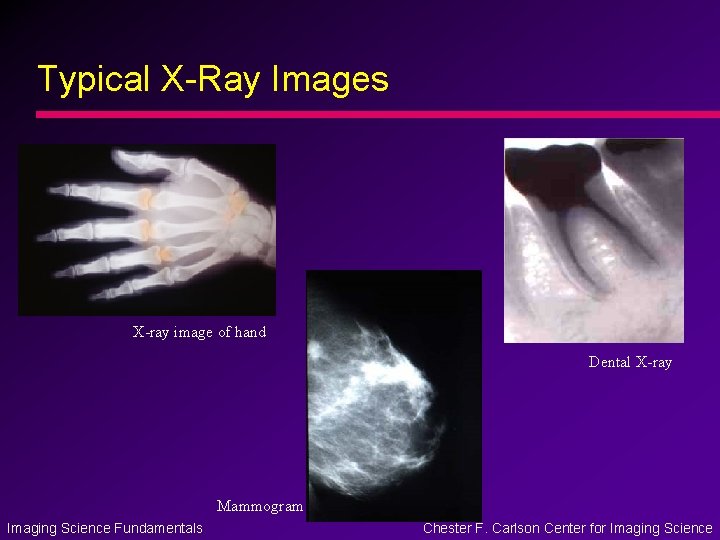
Medical X-ray Systems u Chest x-rays (Abnormalities in lungs, heart, other abdominal organs, broken ribs) u Mammography (Calcifications/abnormalities in breast tissues) u Dental x-ray (Cavities, wisdom teeth) u Others include detecting broken bones. Imaging Science Fundamentals Chester F. Carlson Center for Imaging Science
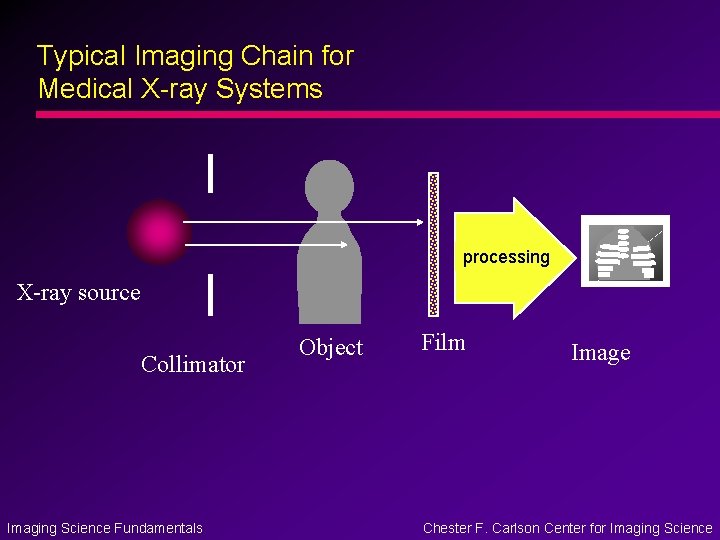
Typical Imaging Chain for Medical X-ray Systems processing X-ray source Collimator Imaging Science Fundamentals Object Film Image Chester F. Carlson Center for Imaging Science
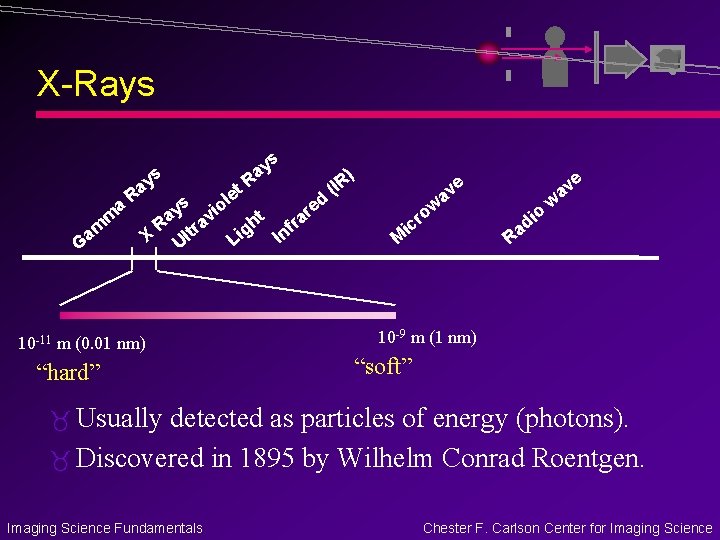
Electromagnetic Radiation s a m G u u u am y Ra ys a t. R le d s o e i y r t v h ra Ra tra f g X Ul In Li ) (IR e e v a M ow r ic o di av w Ra EM radiation can be thought of as oscillating electric field which generates oscillating magnetic field which generates oscillating electric field…and so on. Can also be thought of as photons (particles), as in CCD detection of visible light. This is called the “wave-particle duality” of EMR. Imaging Science Fundamentals Chester F. Carlson Center for Imaging Science
Wavelength (lambda) is called wavelength, the distance between two identical points on a wave. Imaging Science Fundamentals Chester F. Carlson Center for Imaging Science
Frequency time unit of time (nu) is called frequency, the number of cycles per unit of time. It is inversely proportional to the wavelength. Imaging Science Fundamentals Chester F. Carlson Center for Imaging Science
Wavelength and Frequency Relation: review v Wavelength is proportional to the velocity, v. Wavelength is inversely proportional to the frequency. eg. AM radio wave has a large wavelength (~200 m), therefore it has a low frequency (~KHz range). In the case of EM radiation, the equation becomes c Where c is the speed of light: 3 x 10⁸ m/s Imaging Science Fundamentals Chester F. Carlson Center for Imaging Science
Photons: review Photons are little “packets” of energy. Each photon’s energy is proportional to its frequency. A photon’s energy is represented by “h ” E = h Energy = (Planck’s constant) x (frequency of photon) Imaging Science Fundamentals Chester F. Carlson Center for Imaging Science
X-Rays a s ay R m G am ys a t. R le d s o e i y r t v h ra Ra tra f g X Ul In Li 10 -11 m (0. 01 nm) “hard” ) R (I e av w ro ic M o di e av w Ra 10 -9 m (1 nm) “soft” Usually detected as particles of energy (photons). Discovered in 1895 by Wilhelm Conrad Roentgen. Imaging Science Fundamentals Chester F. Carlson Center for Imaging Science
X-Ray Production Cathode(-) ee. Anode (+) h h Electrons are accelerated from cathode to anode. When high energy electrons hit atoms of heavy metals, the atoms produce X-ray photons. Imaging Science Fundamentals Chester F. Carlson Center for Imaging Science
Object What can happen to an X-ray when it encounters the object to be imaged? Passes right through the object. Absorbed completely by the object. Scattered by the object Imaging Science Fundamentals Chester F. Carlson Center for Imaging Science
Attenuation Coefficient Imaging Science Fundamentals Chester F. Carlson Center for Imaging Science
Attenuation Coefficient u Coefficient depends on the property of the material. u Density (Bone has a high density compared to soft tissues) u Chemical Make-up (Lead blocks x-rays; lead screening used to protect patient & technicians) Imaging Science Fundamentals Chester F. Carlson Center for Imaging Science
Detector Exposure (Capture) Processing Image u. A special photographic film is used to capture the x-ray photons which passed through the object. u The film is then processed. u Film turns dark where it was exposed to xray photons. Imaging Science Fundamentals Chester F. Carlson Center for Imaging Science
Typical X-Ray Images X-ray image of hand Dental X-ray Mammogram Imaging Science Fundamentals Chester F. Carlson Center for Imaging Science
Image Quality Factors u Source u Energy of the photons u Collimation u Object u Attenuation coefficient u Source-object geometry u Detector u Object-detector geometry u Efficiency Imaging Science Fundamentals Chester F. Carlson Center for Imaging Science
Advantages of Standard Diagnostic Medical X-ray Imaging Systems u Readily available u Reasonably cheap u Simple systems to maintain u Many experienced and trained personnel due to the fact that technology has existed for a while Imaging Science Fundamentals Chester F. Carlson Center for Imaging Science
Disadvantages of Diagnostic Medical X-ray Imaging Systems u Exposure to harmful radiation. u Not much contrast between different soft tissues. u Image is a shadowgram (projection image) with no depth information. Imaging Science Fundamentals Chester F. Carlson Center for Imaging Science