
Medical Update for School Staff 2015 Emergencies Allergies

- Slides: 19
Medical Update for School Staff 2015 Emergencies, Allergies & Epinephrine and Seizures Gina Milne Segars, RN, BSN Area 4 Consulting Nurse Regina. Milne. Segars@cobbk 12. org RM Segars, RN, BSN 1
A Few Reminders in Emergency Situations • REMAIN CALM!! Calm responders are effective responders. • Call THE NURSE and front office immediately. • State EXACT nature of emergency so nurse knows what equipment to bring to the emergency location. ***Remember to identify the name of the student involved in the incident. RM Segars, RN, BSN 2
During an Emergency…. NEVER carry an injured child to the clinic (unless the accident scene is unsafe for you and the child). More harm may be done in picking up and carrying a child from the playground to the clinic than in calling the nurse to respond to the accident location. RM Segars, RN, BSN 3
During an Emergency… Do not probe, touch or remove student’s clothing; no invasive procedures – do not remove impaled items or try to realign dislocated joints. Do not move (victim’s) neck especially if there might be a head or neck/back injury. Moving an injured person may transform a simple injury into a serious injury. RM Segars, RN, BSN 4
Remember: • Remain Calm • Think before you act – do not move injured persons • Call your NURSE to the accident location • Follow school protocol for calling 911 • Remove bystanders RM Segars, RN, BSN 5
Other Clinic information…. • Allow the NURSE (or, if appropriate the administrator) contact parents of sick children or for health-related issues. • Cobb County School District has a policy on when a student should be excluded from school for illness – please see JGC-6 for more information. RM Segars, RN, BSN 6
A Few Words on LICE • Lice are not a health hazard. Children with nits do NOT need to leave school (except in certain situations, per principal). Children with LIVE lice should be sent home. • Once a child is treated, he may return to school, EVEN if it’s the same day. • Unless 10% of the class has live lice, the nurse does not need to check the entire class or grade level. • Nits are eggs, not live lice! RM Segars, RN, BSN 7
LICE… • Siblings of children with LIVE lice should be checked for evidence of infestation. • Lice do NOT fly, hop or jump – they are transmitted by direct head-to-head contact and only rarely through inanimate objects. • (Children are placing themselves at risk for lice transmission when taking “selfies”!!!) RM Segars, RN, BSN 8
LICE Reminders • Unless you place your head directly next to the head of a child with LIVE lice, you will not “catch” the lice. • Nits (eggs) are NOT transmitted, just the adult lice. • Letters regarding health issues in school are sent home only after the Nursing Supervisor has given permission to do so. RM Segars, RN, BSN 9
LICE Reminders…. . • You may opt to send home a general informational letter about lice with your backto-school papers – check with your nurse for more information. • Check out the Cobb County School District Student Health website for more information. RM Segars, RN, BSN 10
Allergies & Epinephrine Auto-injectors in School • Allergic reaction from over-reaction of the immune system to the presence of an allergen. • Allergens can be food, medications, insect venom, animals, rubber (latex) or cosmetics/fragrance • Allergens can be breathed in, swallowed, touched or injected (insect bites) or via contact with the skin, eyes, nose, respiratory or GI tracts. • Reaction occurs within seconds to hours after exposure. RM Segars, RN, BSN 11
Serious life threatening reactions can happen very suddenly or develop slowly over hours. YOU can help your student survive! Recognize the symptoms: Abdominal pain, nausea, vomiting, diarrhea, difficulty breathing, coughing, wheezing, stuffy nose, feeling of a lump in the throat/throat tightness, itchy throat, hives, redness of skin, pallor, swelling of neck/face, itchy tongue, mouth or lips, chest tightness/discomfort, anxiety or feeling of impending doom, sensation of warmth RM Segars, RN, BSN 12
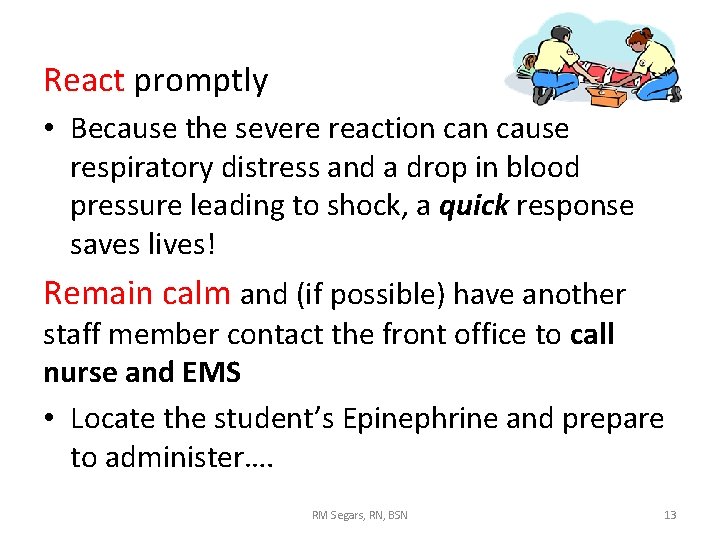
React promptly • Because the severe reaction cause respiratory distress and a drop in blood pressure leading to shock, a quick response saves lives! Remain calm and (if possible) have another staff member contact the front office to call nurse and EMS • Locate the student’s Epinephrine and prepare to administer…. RM Segars, RN, BSN 13
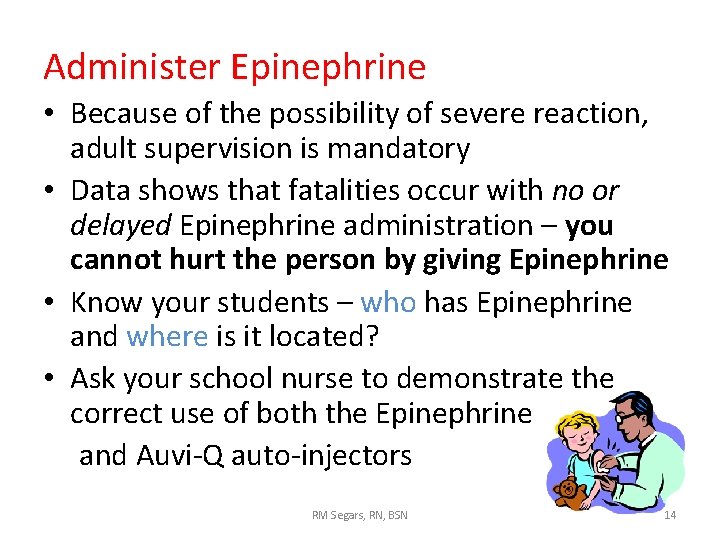
Administer Epinephrine • Because of the possibility of severe reaction, adult supervision is mandatory • Data shows that fatalities occur with no or delayed Epinephrine administration – you cannot hurt the person by giving Epinephrine • Know your students – who has Epinephrine and where is it located? • Ask your school nurse to demonstrate the correct use of both the Epinephrine and Auvi-Q auto-injectors RM Segars, RN, BSN 14
• Call 911 and tell them you are using an Epinephrine auto-injector (use the Epinephrine without delay – then call 911). • County policy requires 911 call for all Epinephrine administration in the school – if the parents refuse transport, have the EMS personnel document parent refusal. • Call parents (after EMS) and follow school emergency protocol. • Stay with student until 911 arrives (after administration of Epinephrine, student may feel shaky, nauseated, frightened, short of breath, palpitations – all are normal reactions to Epinephrine). RM Segars, RN, BSN 15
You have just saved a life! • Remember: • You cannot do harm with Epinephrine, even though the needle hurts, it beats the alternative! • All reactions need to be taken seriously and treated promptly. • The sooner the Epinephrine is given, the better the outcome. • Benadryl does not substitute for Epinephrine. RM Segars, RN, BSN 16
Seizures at School • Seizure results from a temporary disruption in normal electrical brain activity. It can effect any part of the body depending on where the electrical disruption occurs. • Look for: – abnormal movements, uncontrolled muscle spasms, blank stare or unusual disorientation or lack of responsiveness. • Recognize seizure activity. • React by getting the student to safety, monitor the student, call 911 for any new seizure or for seizures lasting more than 5 minutes in a student with a known history of seizures or for seizures involving injury. RM Segars, RN, BSN 17
While waiting for help… • Remain calm and remove the other students to safety. • Do NOT try to restrain the seizing child, rather move him away from objects and protect from further injury. • Do NOT place anything in his mouth (you may get bitten). They cannot swallow their tongue! • Care for child after seizure by turning him on his side until he is either fully alert or help arrives. • Do not give anything by mouth (choking hazard). • Protect from further embarrassment. • Call 911 and begin care for respiratory distress. • Follow your school’s emergency protocols. RM Segars, RN, BSN 18
Thank YOU You are precious to our students – you are valued and we appreciate all you do!! RM Segars, RN, BSN 19