
Medical Terminology Meds B 60 Sarah Baron MPH
Medical Terminology Meds B 60 Sarah Baron, MPH, Ed. D. Sarah. baron@bakersfieldcollege. edu
Medical Terminology For Health Care Professionals 8 th ed. Chapters 1 -3

Learning Outcomes n Overview of Med Term goals n Differences between signs/symptoms, prognosis and diagnosis n Understand the method of breaking words apart – decodable and nondecodable n Prefix, root, suffix, combining vowels n Identify one tool to assist with studying n Begin learning a least 10 vocabulary words a day
MEDS B 60 Goals n Recognize and identify basic word parts relating to medical terminology. n Analyze word parts to define and build medical terms. n Discuss the anatomy and function of each body system relating to medical terminology. n Identify and define common pathological conditions including signs and symptoms related to medical terminology. n Demonstrate proficiency in the spoken and written language of medicine
Learning medical terminology n Is imperative if you want to work in the medical field n Will help you decipher medical reports and information n Will enable you to help your family and friends with health issues
The 5 Medical Language Skills n Listening Understanding what language you hear and relaying the information n Reading Medical words and medical reports You need to practice reading medical language and thinking about it to become proficient
The 5 Medical Language Skills n Thinking and Analyzing How does it apply to your patient or situation Need to think about the meaning Learn how and why questions n Speaking Learn to say the correct pronunciations Communicate without mistaking your meaning n Writing Learn to spell correctly Misspelling could result in mistakes such as a wrong procedure done. –

Introduction to Healthcare Terminology n Derivation of Healthcare Terms – mostly from n Greek and Latin (page 3) n Develop large vocabulary by learning decodable word parts and rules that join them together
Pathology n Diagnosis and Prognosis Diagnosis is the disease or condition named after evaluating the patient n n Acute –begins abruptly and severely and ends after a short time Chronic –develops slowly and lasts a long time Prognosis is the prediction of the probable outcome of the disease Turn to the person next to you and use this in a sentence
Pathology n Signs and Symptoms n Symptoms are subjective indications of disease n n Signs are objective findings seen or measured n n Pain Fever Take one minute and think of a few others.
Diagnosis and Treatment n Diagnostic Procedures n lab tests, x-rays, ultrasounds, CAT scan, MRI, others n Therapeutic Interventions – n appropriate treatment for condition, surgical, medication n Instruments – many terms to describe health care instruments or diagnostic instruments such as: -graph = instrument to record, -meter, instrument to measure
Nondecodable Terms n Cannot be divided into component parts, entire definition must be memorized n Asthma (Greek = panting) n Definition: Respiratory disorder characterized by recurring episodes of paroxysmal dyspnea (difficulty breathing) n Cataract (Greek = waterfall) n Definition: Progressive opacification of the lens
Eponyms n Named after person who first identified the condition, procedure or devised object. n Example: Cesarean Section Alzheimer Disease
Abbreviations n Shortened terms to a number of letters for the sake of convenience n Examples: CABG – Coronary Artery Bypass Graft CAD - Coronary Artery Disease MI – Myocardial Infarction ABG’s – Arterial Blood Gases CBC – Complete Blood Count n Check Appendix III page 811 in the back of your book n Many abbreviations are no longer acceptable in healthcare due to confusion and medical mistakes
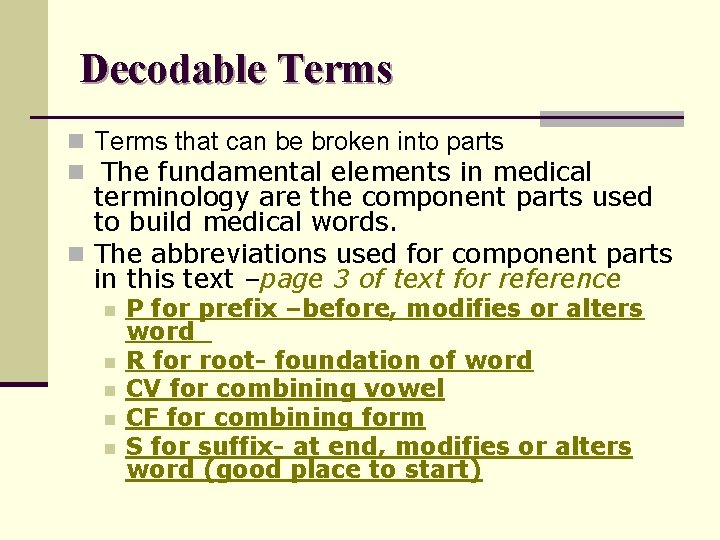
Decodable Terms n Terms that can be broken into parts n The fundamental elements in medical terminology are the component parts used to build medical words. n The abbreviations used for component parts in this text –page 3 of text for reference n n n P for prefix –before, modifies or alters word R for root- foundation of word CV for combining vowel CF for combining form S for suffix- at end, modifies or alters word (good place to start)
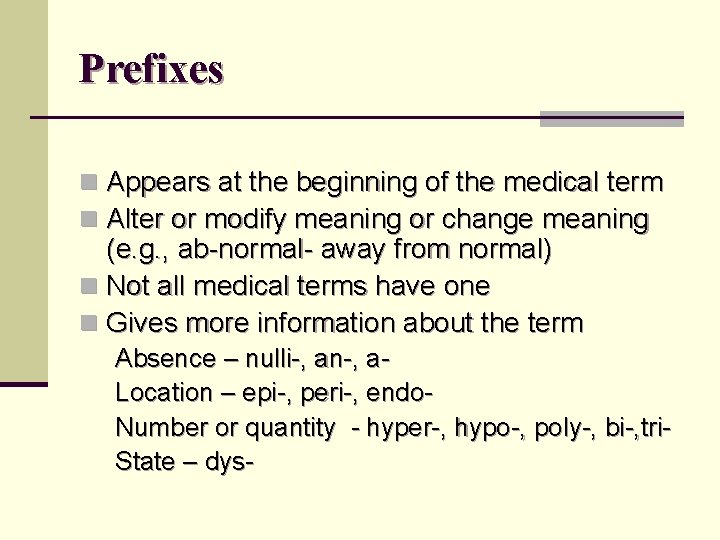
Prefixes n Appears at the beginning of the medical term n Alter or modify meaning or change meaning (e. g. , ab-normal- away from normal) n Not all medical terms have one n Gives more information about the term Absence – nulli-, an-, a. Location – epi-, peri-, endo. Number or quantity - hyper-, hypo-, poly-, bi-, tri. State – dys-
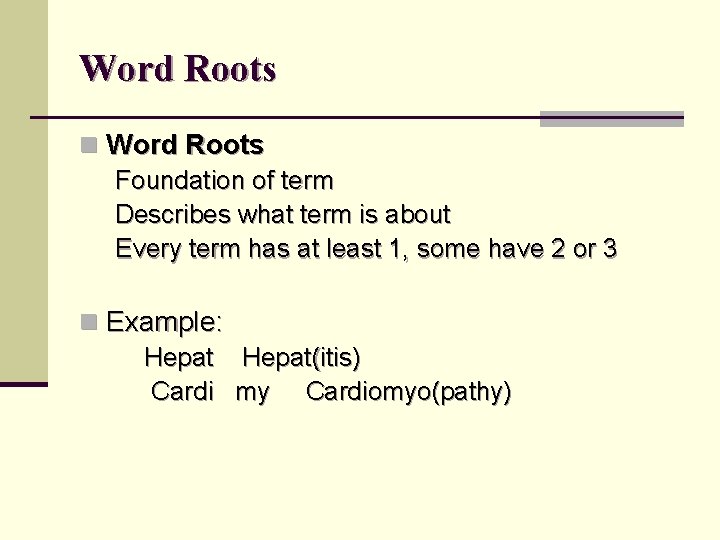
Word Roots n Word Roots Foundation of term Describes what term is about Every term has at least 1, some have 2 or 3 n Example: Hepat(itis) Cardi my Cardiomyo(pathy)
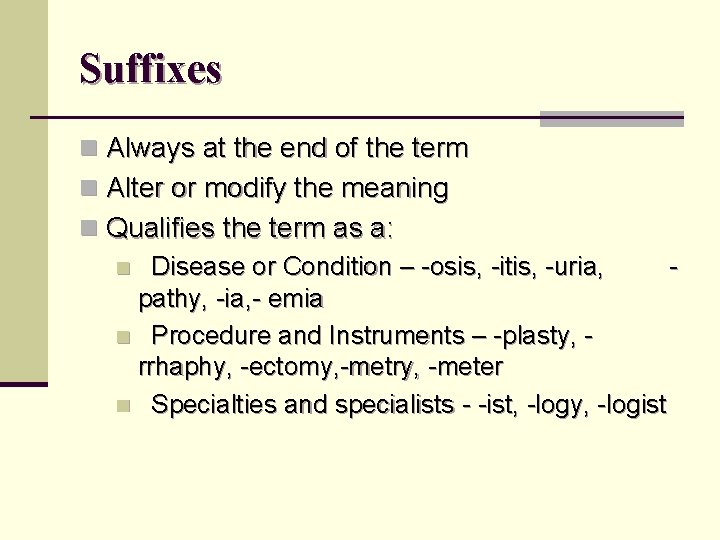
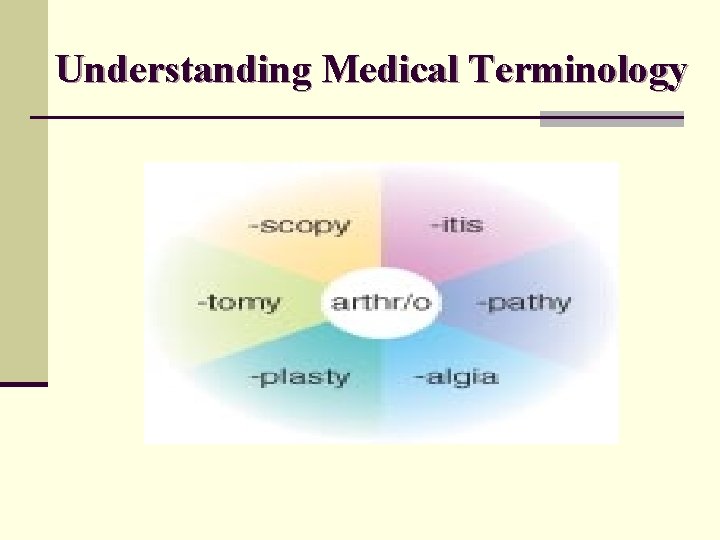
Suffixes n Always at the end of the term n Alter or modify the meaning n Qualifies the term as a: n Disease or Condition – -osis, -itis, -uria, pathy, -ia, - emia n Procedure and Instruments – -plasty, rrhaphy, -ectomy, -metry, -meter n Specialties and specialists - -ist, -logy, -logist
Suffixes – a good place to start n All suffixes, when written, are preceded by a hyphen (–) to signify that they are to be linked to the end of a root or combining form. n Suffixes are used to denote: Pathological conditions n Surgical or diagnostic procedures n Conditions, treatments or specialists n Size or measurement n Noun or adjective n

Combining Forms n Word roots plus combining vowel n Example: Cardi/o My/o Hepat/o n Medical Term Cardi/o + my/o + pathy = cardiomyopathy n Disease of heart muscle Hepat/o + itis + hepatitis n Inflammation of liver
Combining Vowels n Usually an o, occasionally an i (rarely a, e, u) Used between multiple word roots or word roots and suffixes to join words by making them easier to pronounce n Example: Cardiomyopathy (correct) Cardimypathy (incorrect)
Understanding Medical Terminology
Spelling Rules n If Suffix Starts With a Vowel, a combining vowel is not needed (arthritis) If Suffix Starts With a Consonant, a combining vowel is needed (cardiology)
Spelling Rules n Joining Word Roots A combining vowel is used regardless of whether the word roots start with vowels or consonants osteoarthritis oste/o arthritis cardiomyopathy cardi/o + my/o + pathy
Spelling Rules n Sequencing Word Roots Combining forms are joined in logical order or as they are studied Study of ear, nose, throat –otorhinolaryngology Break these words apart above
Pronunciation n Pronunciation of Unusual Letter Combinations n Medical Dictionary Online Is My BEST FRIEND n Eu – (u) - eupnea n Ph – (f) - phalanges n Pn – (n) - pnemonia n Ps – (s) - psychlogy n Pt – (t) - ptosis n Rh, rrh – (r) - rhinitis n X – (z) - xeroderma

Flashcard Challenge • Prefix and Suffix • If you don’t have a book, share • Will post a flashcard challenge in either study blue or quizlet • Quizlet • Studyblue • Pages, 5, 31, 33, 35, and 47 • Activity PPT
- Slides: 27