
Medical Statistics Why should we study Medical Statistics


- Slides: 13
Medical Statistics
• Why should we study Medical Statistics? • A lot of medical data are random event, so when the tools of statistics are employed in many medicine fields such as clinical medicine, basic medicine, psychology, preventive medicine and etc, we can find the regular pattern.
• Publish or perish. • If you want get a dream job 1
What is Medical Statistics • • 1, How to collect medical data 2, How to organize medical data 3, How to summarize medical data 4, Make inference according to the medical data.
Some basic concepts • Variable This term is a characteristic of observation units. A set or subset for data. As we observe a characteristic, if we find that it takes different values in different persons, places, or things, we will label this characteristic a variable. • For example heights. doc
Quantitative Variables • A quantitative variable is one that can be measured in the usual sense. We can, for example, obtain measurements on the height of adult males, the weight of preschool children, and the ages of patients seen in a dental clinic. These are examples of quantitative variables. Measurements made on quantitative variables convey the concept of amount
Qualitative Variables • Many characteristics can be categorized only, for example. We refer to variables of this kind as qualitative variables. Measurements made on qualitative variables convey the concept of attribute.
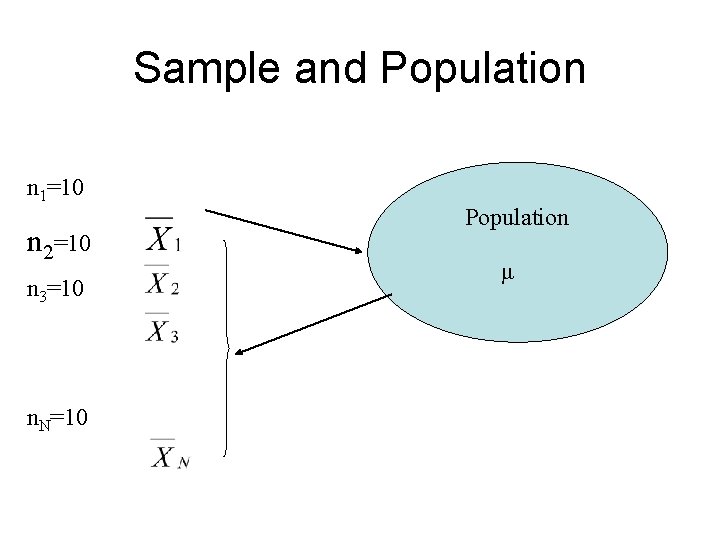
Population • In the statistics sense a population is a theoretical concept used to describe an entire group of objects which information is wanted. Sample • Samples are taken from populations according to some statistical principle to provide estimates of population parameters. A sample may be defined simply as a part of a population.
Parameter • Parameters are quantities used to describe characteristics of such populations. Statistic • A statistic is an indicator used to evaluate characteristics of sample. A descriptive measure computing the data of a sample is called a statistic.
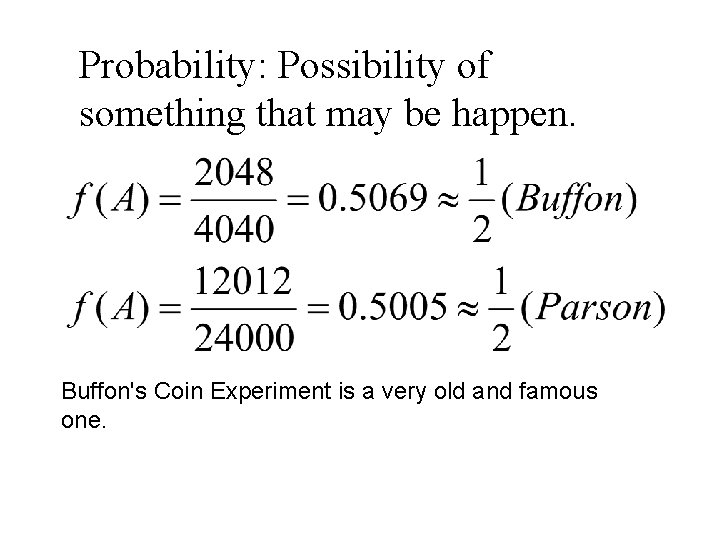
Probability: Possibility of something that may be happen. Buffon's Coin Experiment is a very old and famous one.
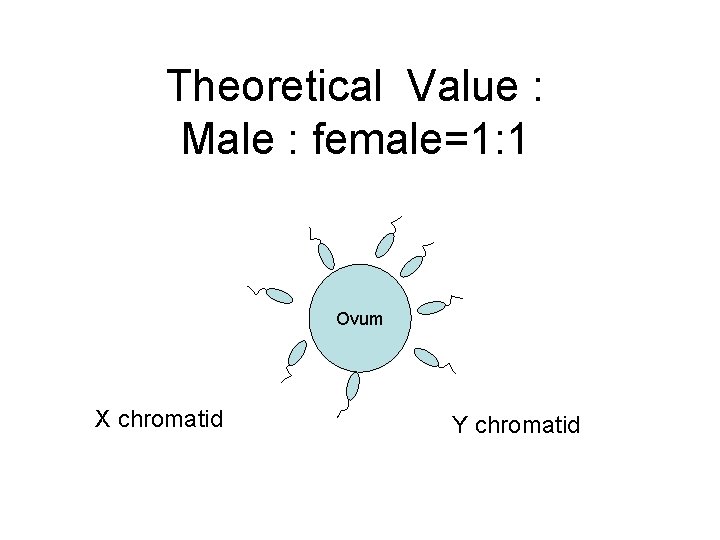
Theoretical Value : Male : female=1: 1 Ovum X chromatid Y chromatid
Sample and Population n 1=10 n 2=10 n 3=10 n. N=10 Population μ
• Sampling errors: Sample errors caused by the facts of taking a sample. They cause sample results to be different from the results of census (population).