
Medical Statistics Exam Technique and Coaching Part 1

- Slides: 18
Medical Statistics Exam Technique and Coaching, Part 1 Richard Kay Statistical Consultant RK Statistics Ltd 28/10/2020 1
Agenda � � � Randomisation Intention to Treat and Missing Data Standard Deviation and Standard Error Confidence Interval p-Value Type I and Type II Errors Odds Ratio Hazard Ratio Multiplicity Interim Analysis Equivalence and Non-Inferiority 28/10/2020 © RK Statistics Ltd 2
Randomisation �Block randomisation – forces balance in terms of numbers of patients: optimises the statistical efficiency (power) �Stratified randomisation - forces balance in terms of mix of patients: avoids confounding between risk factors and treatment 28/10/2020 © RK Statistics Ltd 3
Intention to Treat �Principle of ITT says include all randomised patients and all data in the analysis �Avoids bias; analysis then complies with the randomisation �Randomisation ensures valid comparison, leaving out patients destroys randomisation and validity of statistical tests undermined �Following ITT compares treatment policies rather than the ‘pure’ effect of treatment 28/10/2020 © RK Statistics Ltd 4
Intention to Treat �Full Analysis Set – get as close as possible to the ITT ideal of including all randomised subjects �For practical reasons; those failing to satisfy inclusion/exclusion criteria and those without data generally excluded �Per-protocol Set – those patients satisfying the protocol to a defined extent (potential for bias) 28/10/2020 © RK Statistics Ltd 5
Missing Data �Missing data causes problems, so design the study to minimise it �In order to comply with ITT need to ‘impute’ data for patients with missing data ◦ LOCF for continuous data ◦ Success/failure categorisation ◦ NRI – non-responder imputation 28/10/2020 © RK Statistics Ltd 6
Standard Deviation and Standard Error �Standard deviation measures the patient to patient variability in the sample or population �Standard error is a measure of the inherent variability in a summary statistic as the trial is repeated under identical conditions 28/10/2020 © RK Statistics Ltd 7
Confidence Interval (CI) � 95% Confidence Interval (CI) for difference in mean fall in diastolic blood pressure (2. 7, 9. 4) �We can be 95% sure that the true difference in the means is between 2. 7 mm. Hg and 9. 4 mm. Hg �Approximate general formula for a statistic +/- 2*standard error 28/10/2020 © RK Statistics Ltd CI is 8
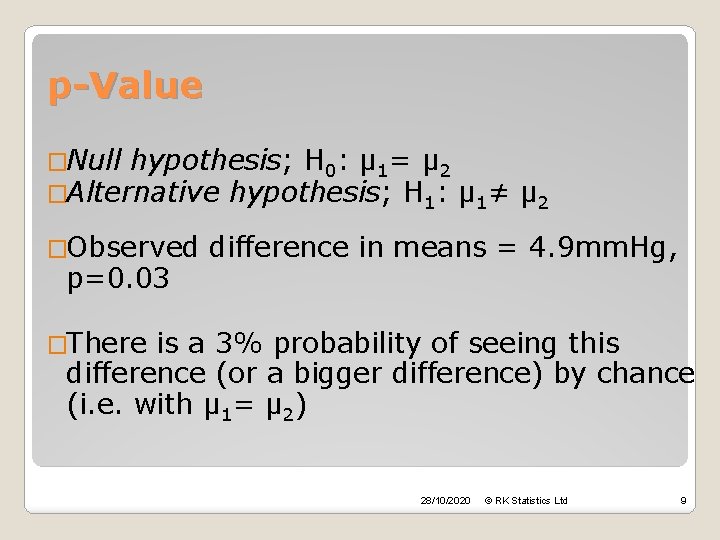
p-Value �Null hypothesis; H 0: μ 1= μ 2 �Alternative hypothesis; H 1: μ 1≠ �Observed p=0. 03 μ 2 difference in means = 4. 9 mm. Hg, �There is a 3% probability of seeing this difference (or a bigger difference) by chance (i. e. with μ 1= μ 2) 28/10/2020 © RK Statistics Ltd 9
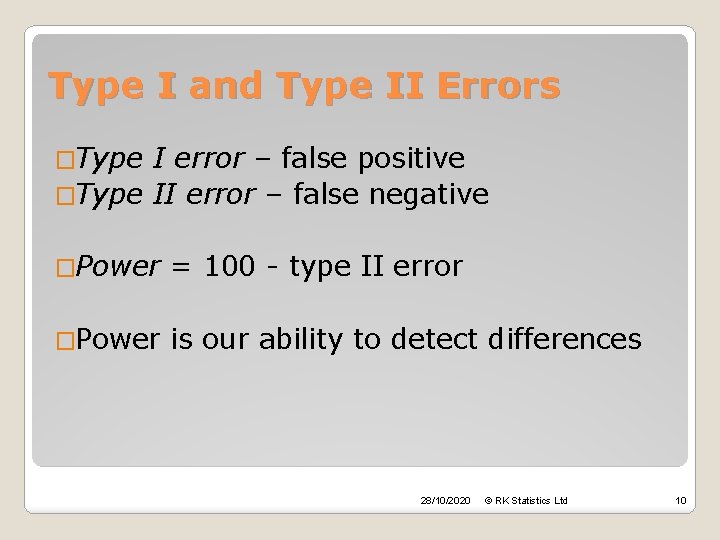
Type I and Type II Errors �Type I error – false positive �Type II error – false negative �Power = 100 - type II error �Power is our ability to detect differences 28/10/2020 © RK Statistics Ltd 10
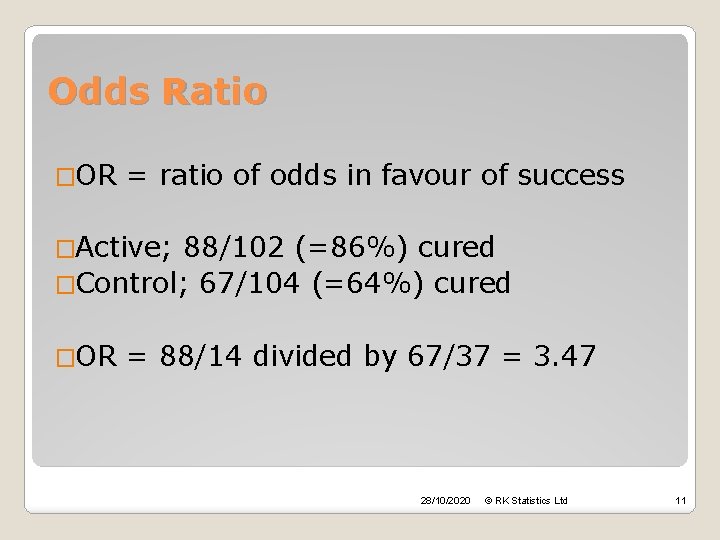
Odds Ratio �OR = ratio of odds in favour of success �Active; 88/102 (=86%) cured �Control; 67/104 (=64%) cured �OR = 88/14 divided by 67/37 = 3. 47 28/10/2020 © RK Statistics Ltd 11
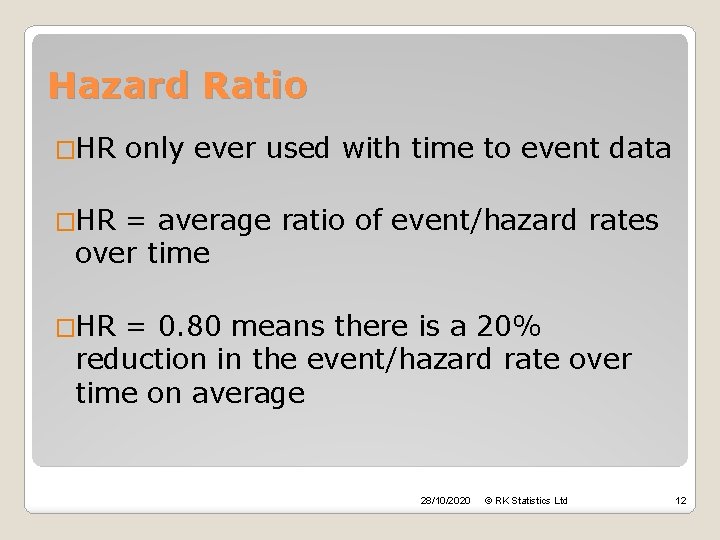
Hazard Ratio �HR only ever used with time to event data �HR = average ratio of event/hazard rates over time �HR = 0. 80 means there is a 20% reduction in the event/hazard rate over time on average 28/10/2020 © RK Statistics Ltd 12
Multiplicity �Significance level = 0. 05 (type I error) means that the false positive will occur 1 in 20 times when treatments identical �Multiple testing will lead to inflation of this rate �May need to pay a price for multiple testing(eg Bonferroni; 0. 05 divided by m for m tests) 28/10/2020 © RK Statistics Ltd 13
Multiplicity �Ways of avoiding paying a price on alpha �Most useful approach - define hierarchy; can only claim significance down to the first NS result �Alternatively can pay a price on the alpha – Bonferroni for example 28/10/2020 © RK Statistics Ltd 14
Interim Analysis �Form of multiplicity �Pay price by having significance level <0. 05 at each interim look; pay small price early on, leave most of 0. 05 over for final analysis �O’Brien-Fleming provide suitable schemes 28/10/2020 © RK Statistics Ltd 15
Equivalence and Non-Inferiority �Equivalence has margins generally equidistant around a zero difference ◦ Bioequivalence ◦ Biosimilars �Non-Inferiority has just a single margin �Using confidence intervals rather than pvalues �Switching between non-inferiority and superiority possible 28/10/2020 © RK Statistics Ltd 16
Reading ICH E 9 ‘Statistical Principles for Clinical Trials’ Statistical Thinking for Non-Statisticians in Drug Regulation, 2 nd Edition Chapters 1 to 5, 7 to 10 and 12 28/10/2020 © RK Statistics Ltd 17
QUESTIONS 28/10/2020 © RK Statistics Ltd 18