
Medical Staff Credentialing and Peer Review Common Mistakes
- Slides: 18
Medical Staff Credentialing and Peer Review – Common Mistakes Debbie Comerford RN BSN CNOR CASC
OBJECTIVES • DISCUSS CREDENTIALING AND WHY IT IS IMPORTANT • DRILL DOWN ON SOME ASPECTS OF CREDENTIALING THAT ARE PROBLEMATIC DURING SURVEY • DISCUSS PEER REVIEW
INTRODUCTION • Credentialing files are reviewed by every agency: o Accreditation o State licensing o CMS • Important that files be up to date at all times • Organized • Separate out discoverable items from confidential items that you don’t want anyone to see • Always keep original application and approval documents in the current file • Consider thinning the file every 3 years • Accreditation requirement is that no lapse has occurred during the cycle.
What is credentialing and why do we do it? • § 416. 45(a) Standard: Membership and Clinical Privileges • Members of the medical staff must be legally and professionally qualified for the positions to which they are appointed and for the performance of privileges granted. The ASC grants privileges in accordance with recommendations from qualified medical personnel.
CREDENTIALING • Credentialing is a three-phase process of assessing and validating the qualifications of an individual to provide services. • The objective of credentialing is to establish that the applicant has the specialized professional background that he or she claims and that the position requires. 1. Establishes minimum training & experience 2. Establishes a process to follow to evaluate an individual’s qualifications 3. Carries out the governing body approved review process as described
1. Establish Minimum Training, : Experience, and Other Requirements • Medical Staff Bylaws o Defines the specific process for credentialing in your organization • Process for initial appointment & reappointment • Process of granting privileges • Process for suspending or Terminating clinical privileges • Appeal process
2. Establish a process to follow to evaluate an individual’s qualifications • The bylaws should describe how the application and requested privileges are handled: o Who reviews it? • Medical Director o Who approves it? • Governing board o Timeframe to approval • Not specific, but timely o What happens if the application is denied • Written process for appeals
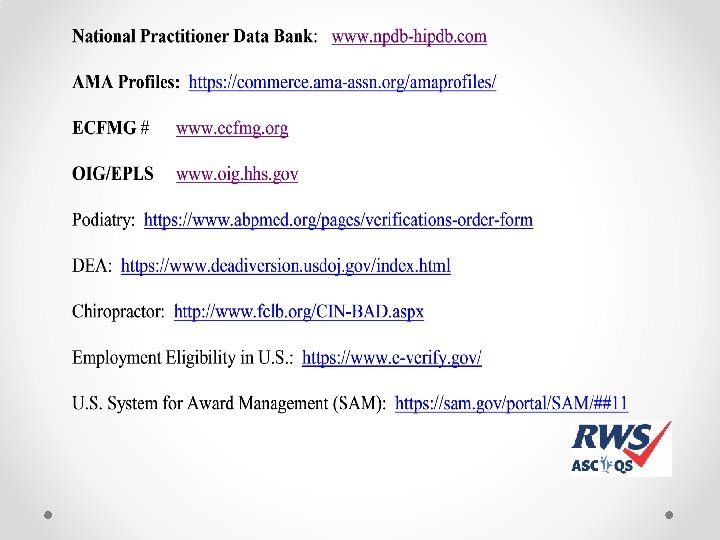
3. Carries out the review process as described • This is the actual “credentialing” and completes the process o Verify all of the submitted documentation o Primary sources of verification for licenses: • http: //www. op. nysed. gov/opsearches. htm#nme o Primary Source verification of DEA • https: //apps. deadiversion. usdoj. gov/webforms/validate. Login. jsp o Medicare/Medicaid Sanctions: • SAM – now requires a notarized letter to authorize your entity • https: //www. fsd. gov/fsd-gov/home. do • OIG/EPLS (Prevent fraud & abuse in Medicare/Medicaid) • https: //exclusions. oig. hhs. gov/ o Contact insurance carrier to provide a claim history
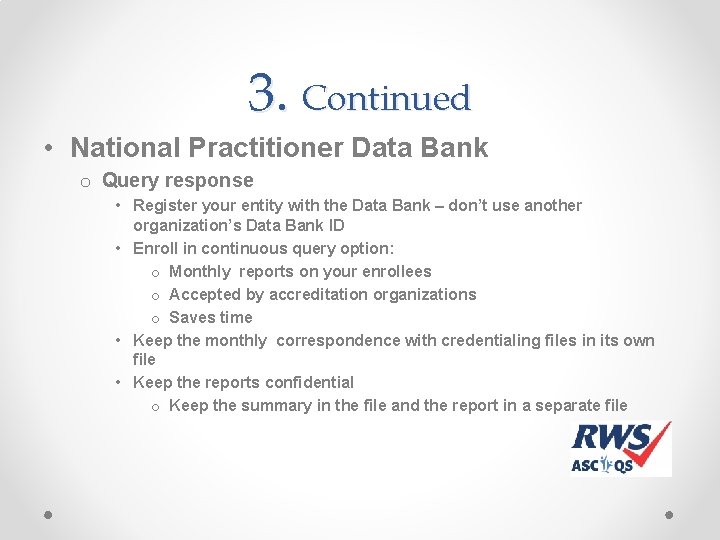
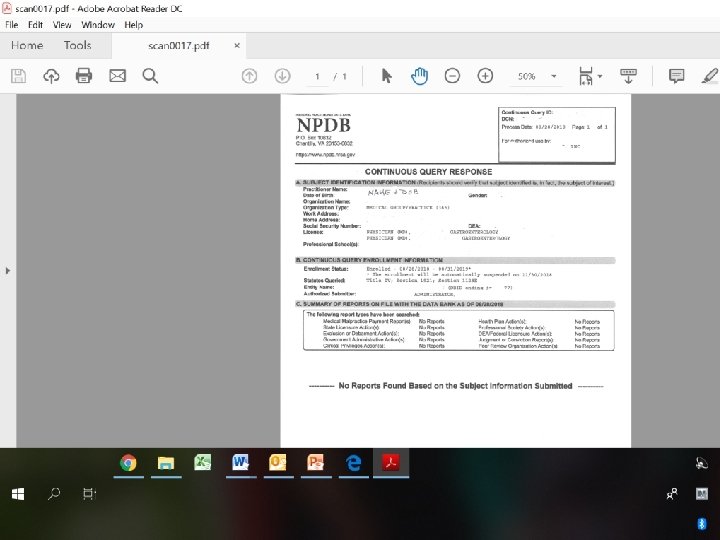
3. Continued • National Practitioner Data Bank o Query response • Register your entity with the Data Bank – don’t use another organization’s Data Bank ID • Enroll in continuous query option: o Monthly reports on your enrollees o Accepted by accreditation organizations o Saves time • Keep the monthly correspondence with credentialing files in its own file • Keep the reports confidential o Keep the summary in the file and the report in a separate file
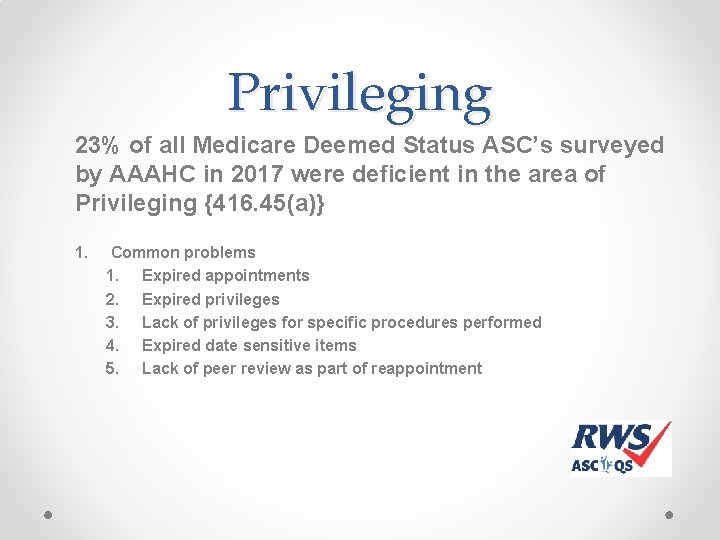
Privileging 23% of all Medicare Deemed Status ASC’s surveyed by AAAHC in 2017 were deficient in the area of Privileging {416. 45(a)} 1. Common problems 1. Expired appointments 2. Expired privileges 3. Lack of privileges for specific procedures performed 4. Expired date sensitive items 5. Lack of peer review as part of reappointment
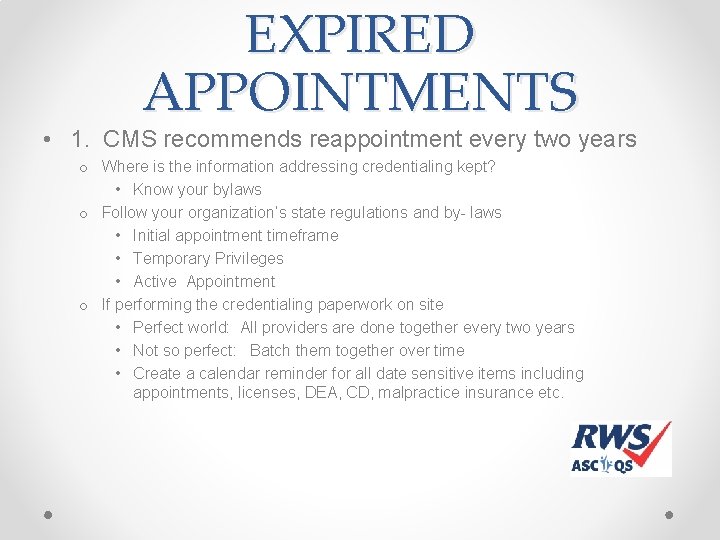
EXPIRED APPOINTMENTS • 1. CMS recommends reappointment every two years o Where is the information addressing credentialing kept? • Know your bylaws o Follow your organization’s state regulations and by- laws • Initial appointment timeframe • Temporary Privileges • Active Appointment o If performing the credentialing paperwork on site • Perfect world: All providers are done together every two years • Not so perfect: Batch them together over time • Create a calendar reminder for all date sensitive items including appointments, licenses, DEA, CD, malpractice insurance etc.
PEER REVIEW • Initial appointment should require at least 2 peer references. o Follow your written bylaws when obtaining peer references. If your bylaws state you will obtain three, then you should have three. o Obtain a written reference using a standardized format o Send out at least one more request than you need o Obtain peer references’ emails on the application o Follow up with the references as needed
PEER REVIEW FOR REAPPOINTMENT • Each physician or dentist receives peer-based review from at least one similarly-licensed peer. • The organization provides ongoing monitoring of important aspects of care provided by physicians, dentists, and other health care professionals. • The results of peer review are used as part of the process for granting continuation of clinical privileges.
Summary of Peer Review • It is helpful to use a one page summary sheet at each reappointment cycle to indicate : o the number of cases performed during the period o number of cases reviewed randomly o number of cases requiring review due to complications, infections, and other problems o any practice concerns that have been addressed o Review and approval by the Governing Board and Medical Director of the peer review summary
PEER REVIEW • Ongoing chart review completed by peers, not the nursing staff, is one part of peer review, but not the only part • 100% of all complications, infections, unexpected occurrences should be reviewed • Criteria is determined by your organization’s physicians
CONCLUSION • • • Keep files neat Follow your bylaws and policy for credentialing Keep date sensitive items current Perform peer review on an ongoing basis Summarize peer review for reappointment Create a reminder for date sensitive items so they do not expire, including privileges, appointment, licenses, and malpractice insurance coverage