
Medical School Histology Basics Urinary System VIBS 243
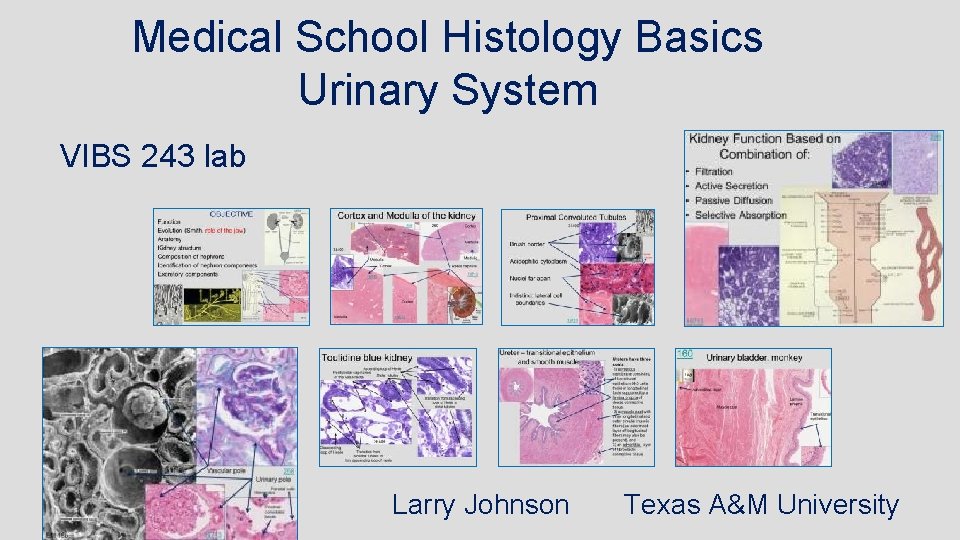
Medical School Histology Basics Urinary System VIBS 243 lab Larry Johnson Texas A&M University
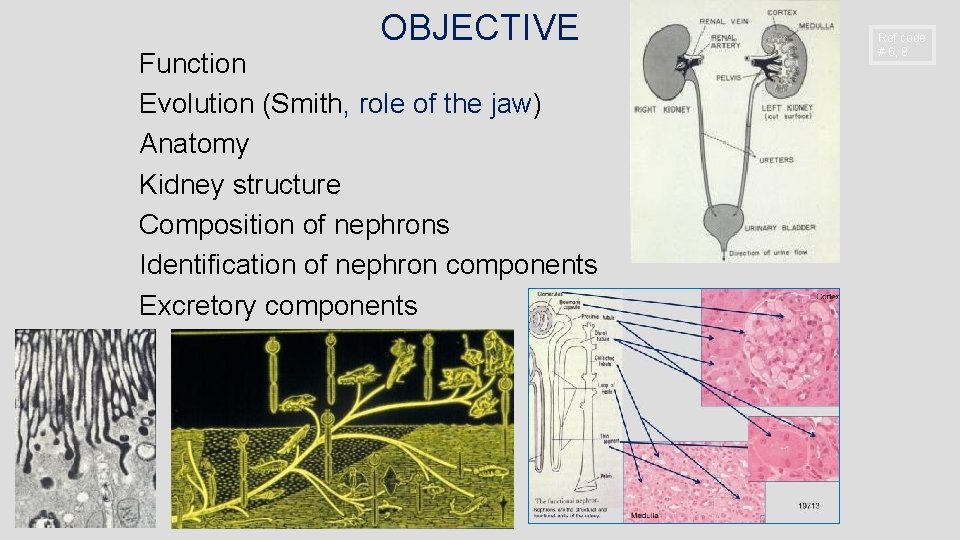
OBJECTIVE Function Evolution (Smith, role of the jaw) Anatomy Kidney structure Composition of nephrons Identification of nephron components Excretory components Ref code # 6, 8
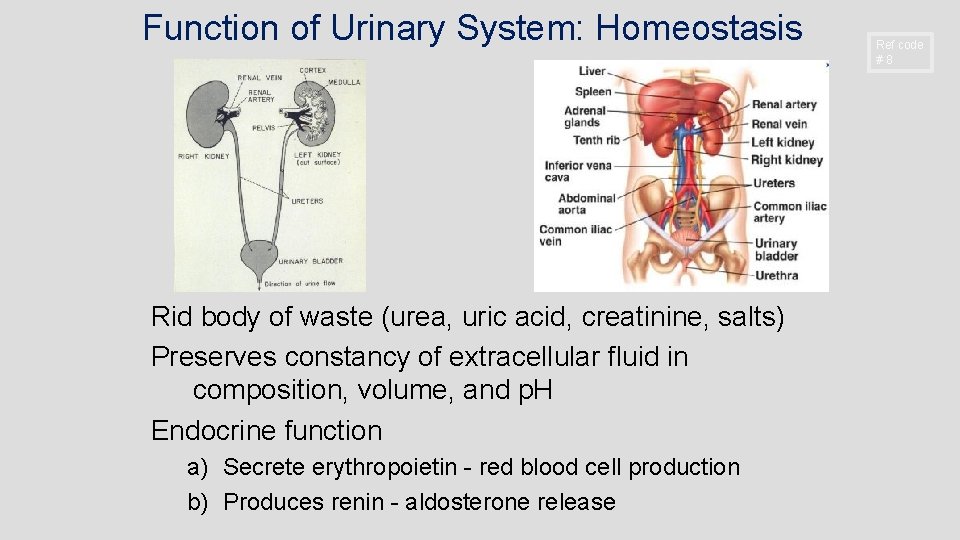
Function of Urinary System: Homeostasis Rid body of waste (urea, uric acid, creatinine, salts) Preserves constancy of extracellular fluid in composition, volume, and p. H Endocrine function a) Secrete erythropoietin - red blood cell production b) Produces renin - aldosterone release Ref code #8
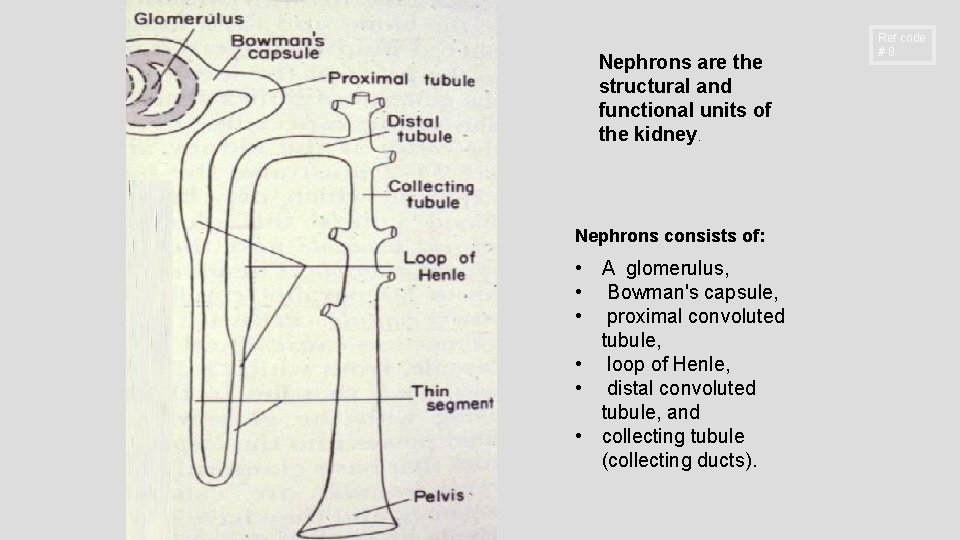
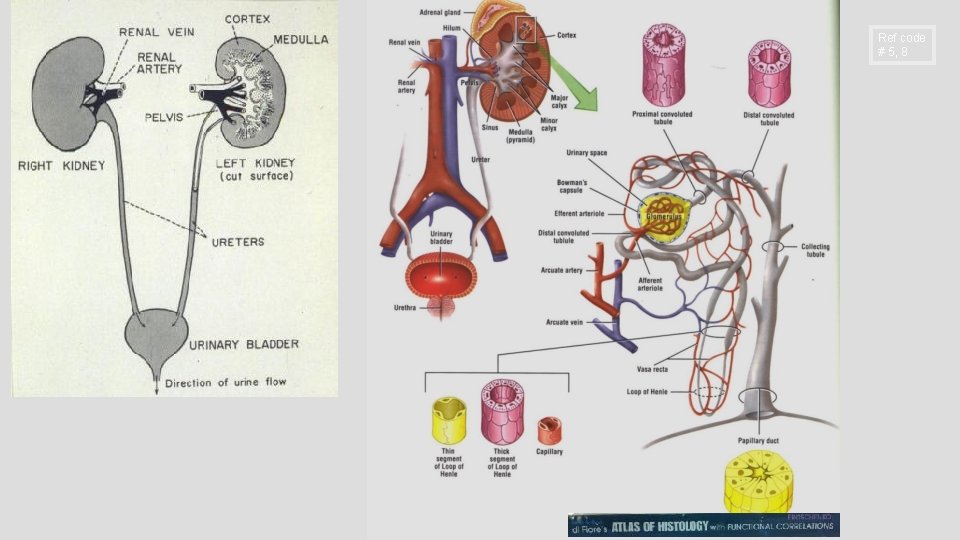
Nephrons are the structural and functional units of the kidney. Nephrons consists of: • A glomerulus, • Bowman's capsule, • proximal convoluted tubule, • loop of Henle, • distal convoluted tubule, and • collecting tubule (collecting ducts). Ref code #8
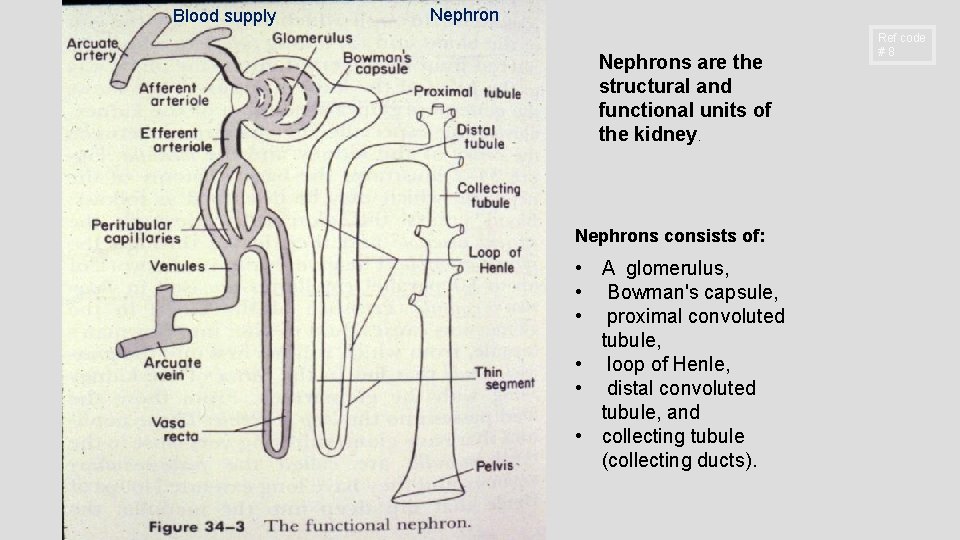
Blood supply Nephrons are the structural and functional units of the kidney. Nephrons consists of: • A glomerulus, • Bowman's capsule, • proximal convoluted tubule, • loop of Henle, • distal convoluted tubule, and • collecting tubule (collecting ducts). Ref code #8
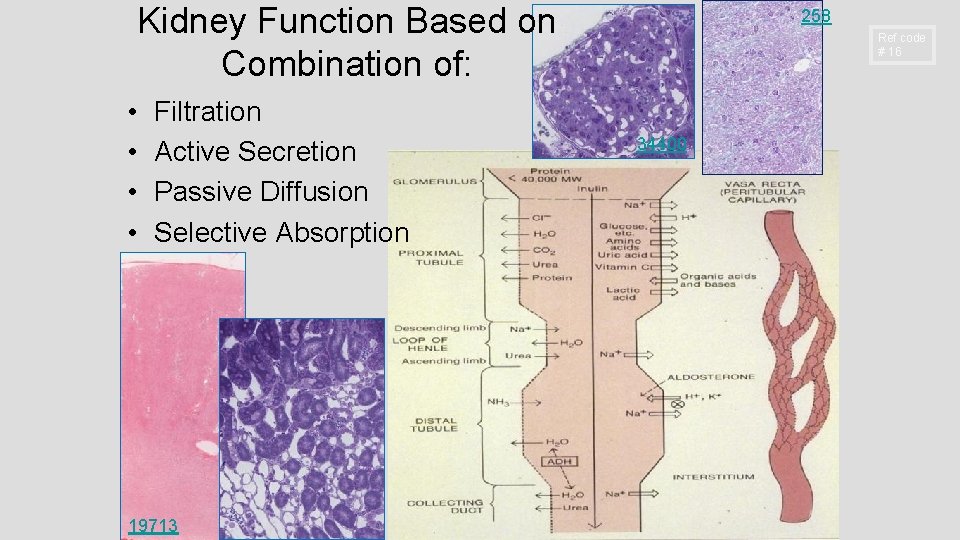
Kidney Function Based on Combination of: • • Filtration Active Secretion Passive Diffusion Selective Absorption 19713 258 Ref code # 16 34400
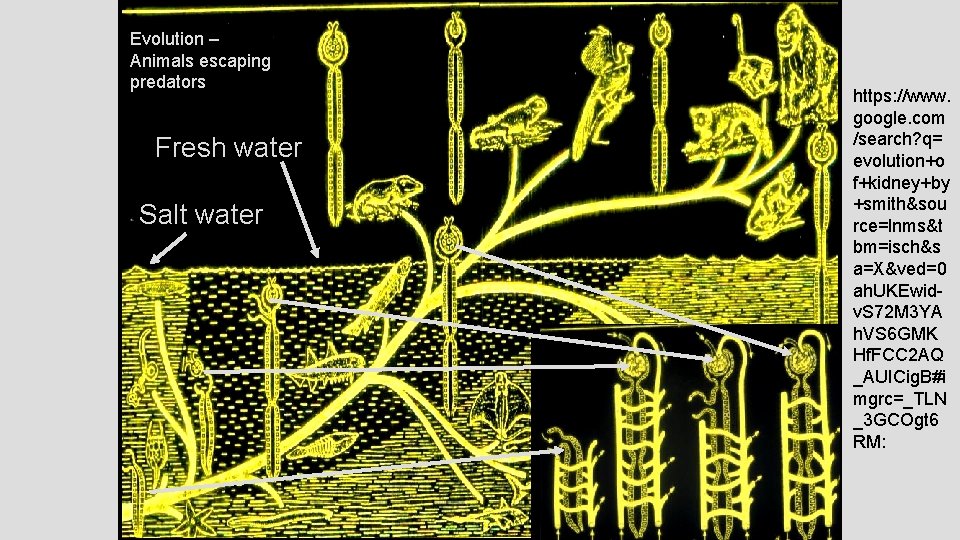
Evolution – Animals escaping predators Fresh water Salt water https: //www. google. com /search? q= evolution+o f+kidney+by +smith&sou rce=lnms&t bm=isch&s a=X&ved=0 ah. UKEwidv. S 72 M 3 YA h. VS 6 GMK Hf. FCC 2 AQ _AUICig. B#i mgrc=_TLN _3 GCOgt 6 RM:
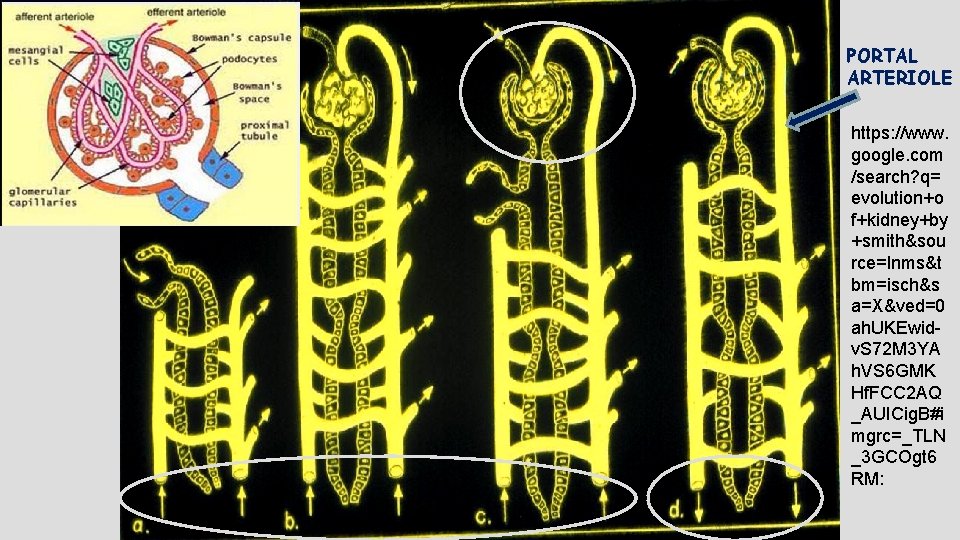
PORTAL ARTERIOLE https: //www. google. com /search? q= evolution+o f+kidney+by +smith&sou rce=lnms&t bm=isch&s a=X&ved=0 ah. UKEwidv. S 72 M 3 YA h. VS 6 GMK Hf. FCC 2 AQ _AUICig. B#i mgrc=_TLN _3 GCOgt 6 RM:
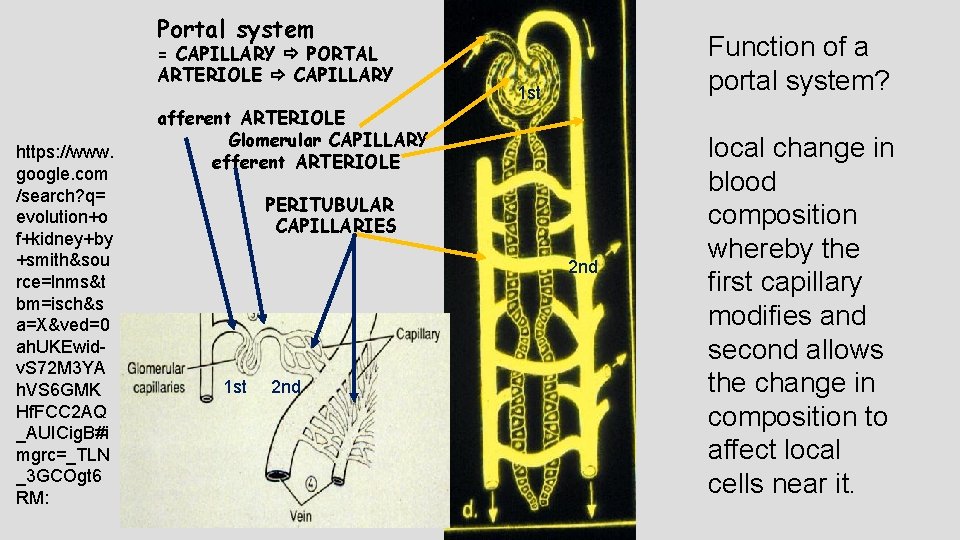
ARTERIAL PORTAL SYSTEM Portal system = CAPILLARY PORTAL ARTERIOLE CAPILLARY https: //www. google. com /search? q= evolution+o f+kidney+by +smith&sou rce=lnms&t bm=isch&s a=X&ved=0 ah. UKEwidv. S 72 M 3 YA h. VS 6 GMK Hf. FCC 2 AQ _AUICig. B#i mgrc=_TLN _3 GCOgt 6 RM: Function of a portal system? 1 st afferent ARTERIOLE Glomerular CAPILLARY efferent ARTERIOLE and PERITUBULAR CAPILLARIES 2 nd 1 st 2 nd local change in blood composition whereby the first capillary modifies and second allows the change in composition to affect local cells near it.
Ref code # 5, 8
Cortex Medulla Cortex 19713 Ref code # 5, 14, 16
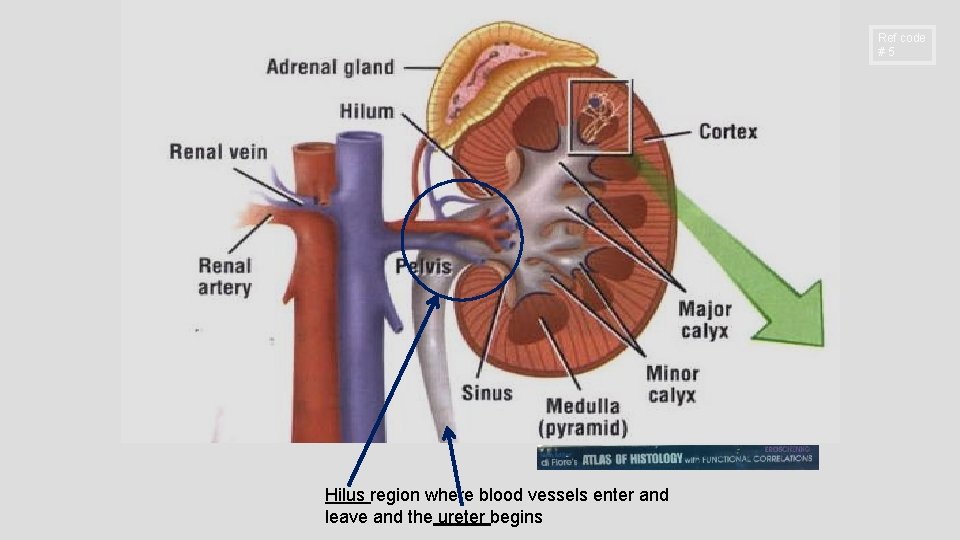
Ref code #5 Hilus region where blood vessels enter and leave and the ureter begins
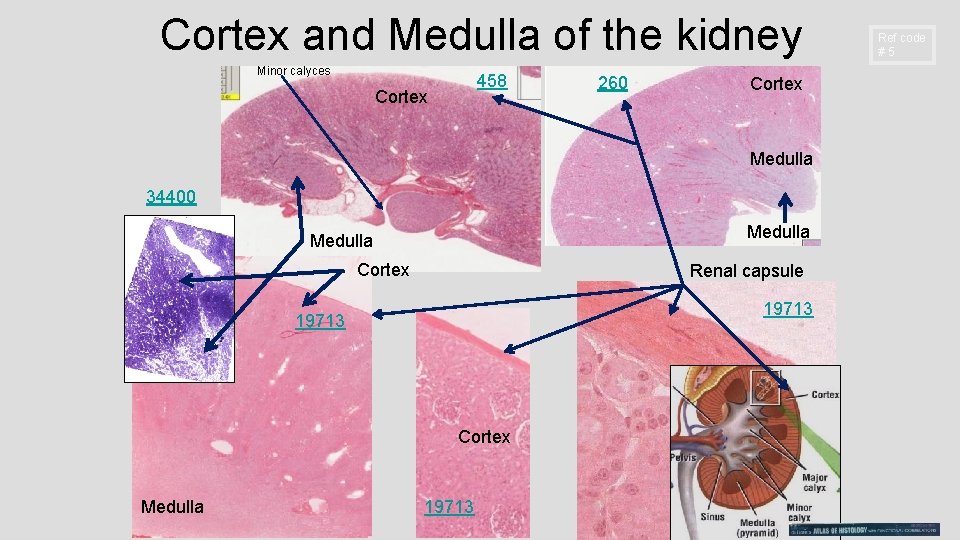
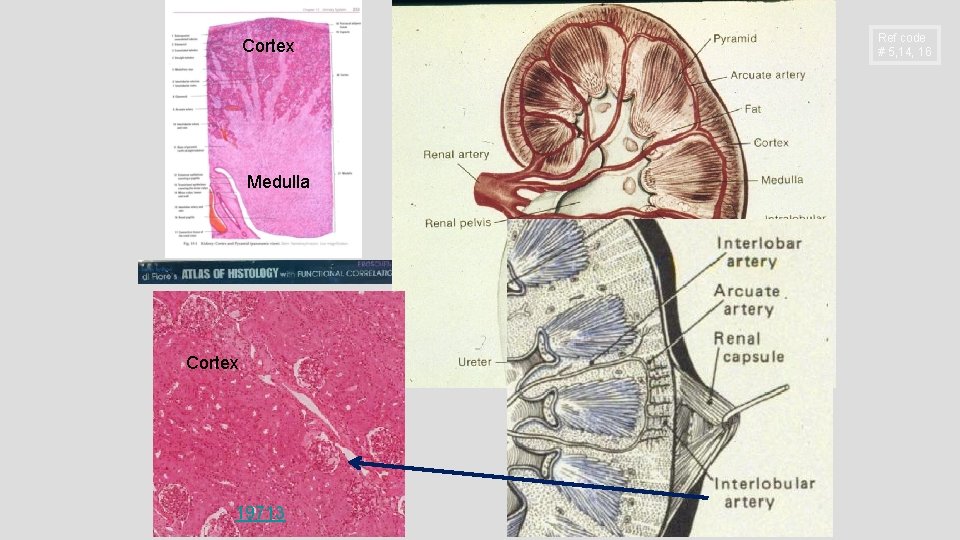
Cortex and Medulla of the kidney Minor calyces 458 Cortex 260 Cortex Medulla 34400 Medulla Cortex Renal capsule 19713 Cortex Medulla 19713 Ref code #5
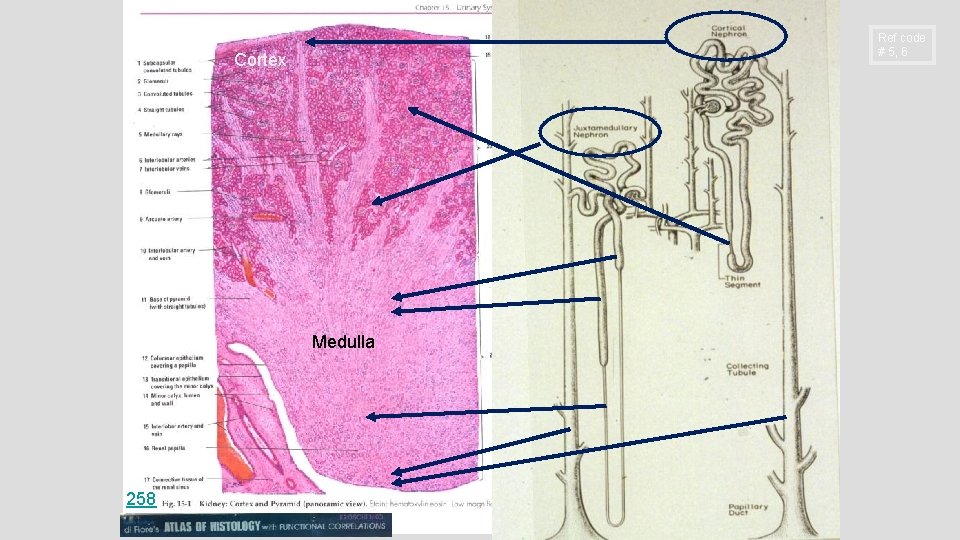
Ref code # 5, 6 Cortex Medulla 258
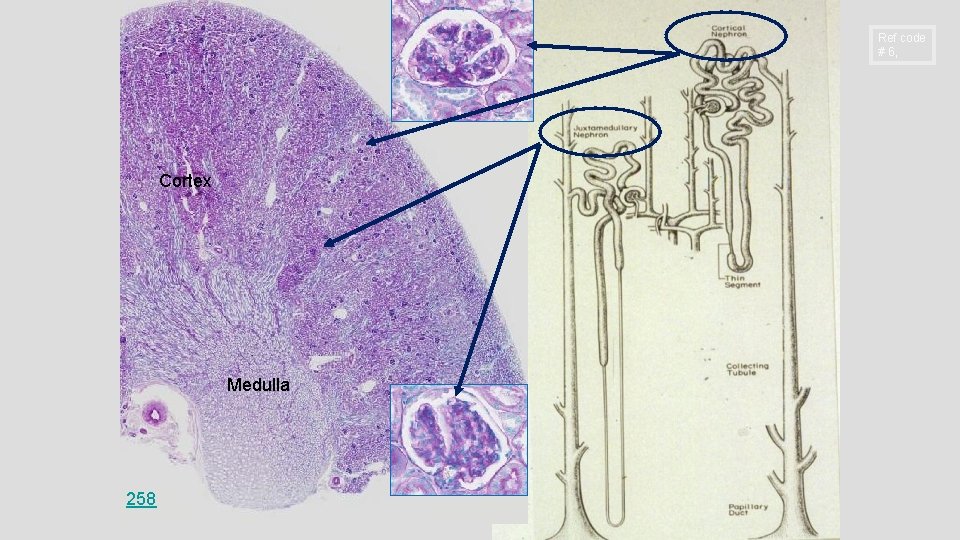
Ref code # 6, Cortex Medulla 258
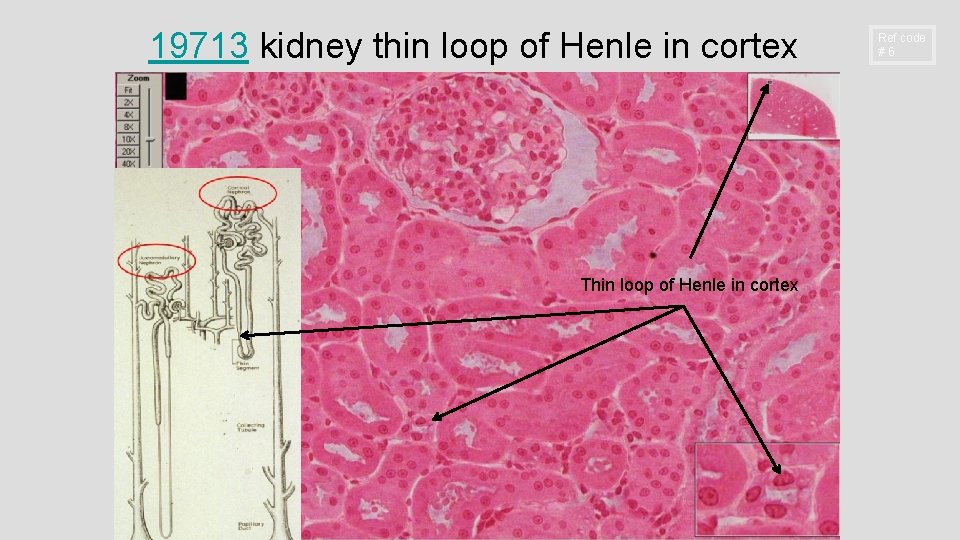
19713 kidney thin loop of Henle in cortex Thin loop of Henle in cortex Ref code #6

Portal Nephrons are the structural and functional units of the kidney. Nephrons consists of: • A glomerulus, • Bowman's capsule, • proximal convoluted tubule, • loop of Henle, • distal convoluted tubule, and • collecting tubule (collecting ducts). Ref code #8
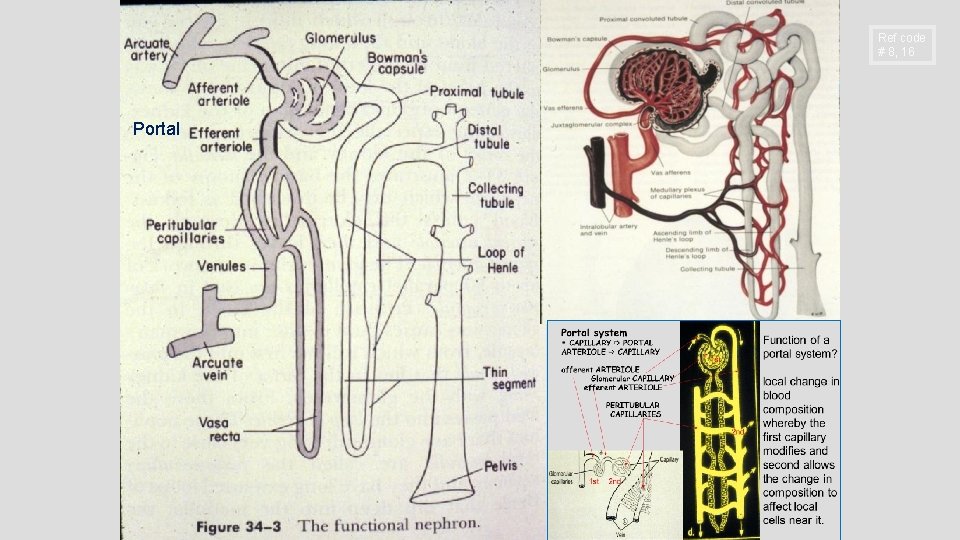
Ref code # 8, 16 Portal
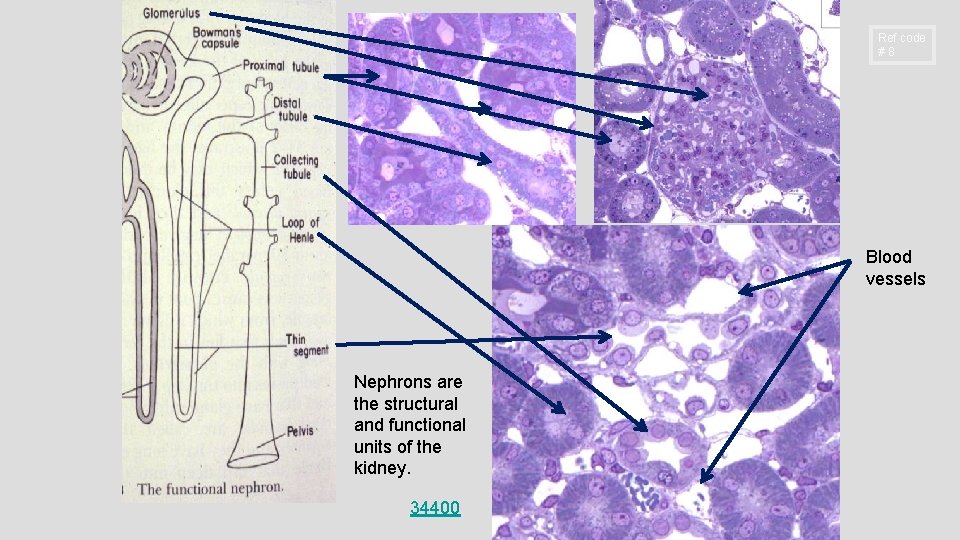
Ref code #8 Blood vessels Nephrons are the structural and functional units of the kidney. 34400
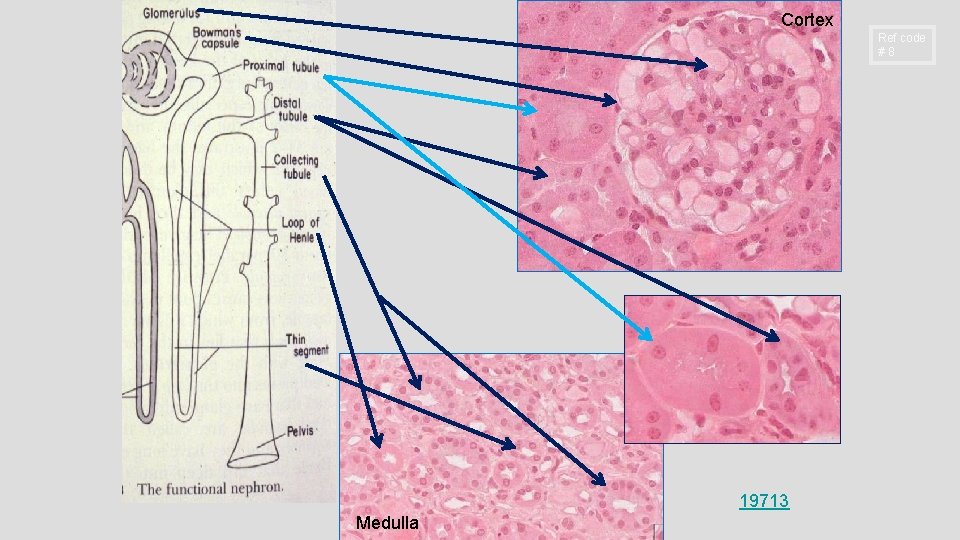
Cortex Ref code #8 19713 Medulla
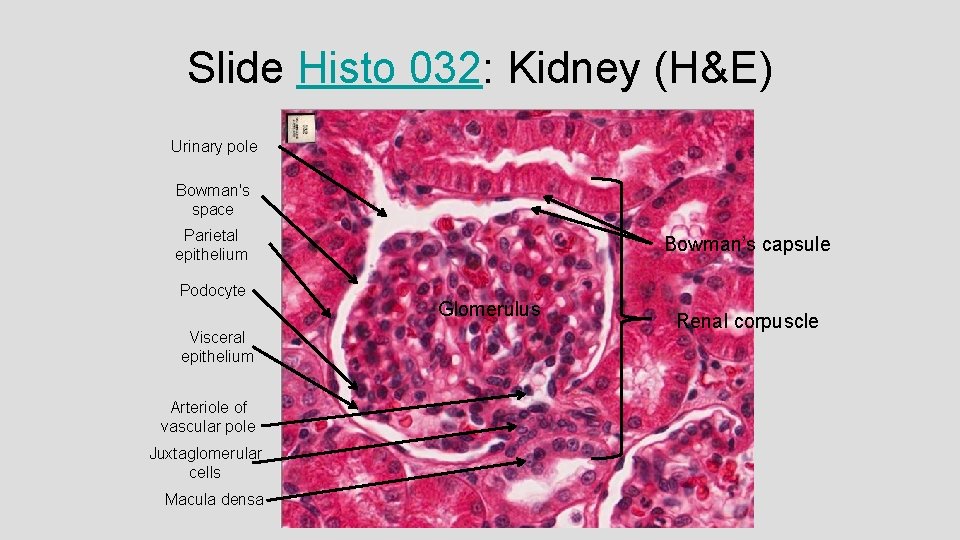
Slide Histo 032: Kidney (H&E) Urinary pole Bowman's space Parietal epithelium Podocyte Visceral epithelium Arteriole of vascular pole Juxtaglomerular cells Macula densa Bowman’s capsule Glomerulus Renal corpuscle
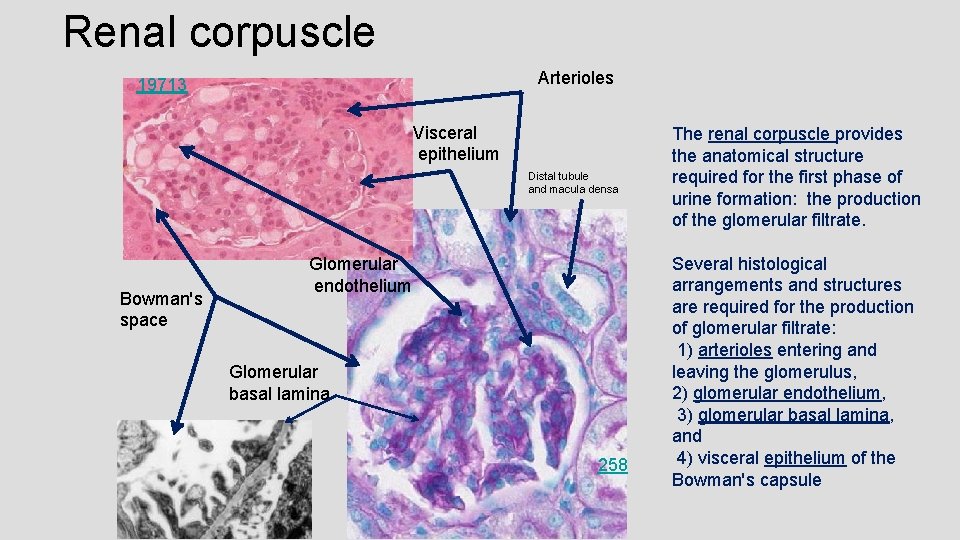
Renal corpuscle Arterioles 19713 Visceral epithelium Distal tubule and macula densa Bowman's space Glomerular endothelium Glomerular basal lamina 258 The renal corpuscle provides the anatomical structure required for the first phase of urine formation: the production of the glomerular filtrate. Several histological arrangements and structures are required for the production of glomerular filtrate: 1) arterioles entering and leaving the glomerulus, 2) glomerular endothelium, 3) glomerular basal lamina, and 4) visceral epithelium of the Bowman's capsule
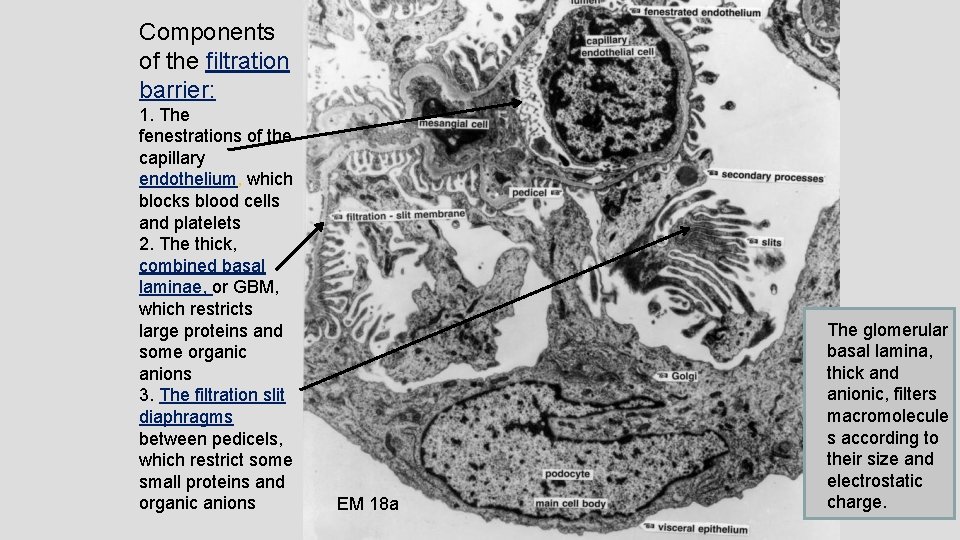
Components of the filtration barrier: 1. The fenestrations of the capillary endothelium, which blocks blood cells and platelets 2. The thick, combined basal laminae, or GBM, which restricts large proteins and some organic anions 3. The filtration slit diaphragms between pedicels, which restrict some small proteins and organic anions EM 18 a The glomerular basal lamina, thick and anionic, filters macromolecule s according to their size and electrostatic charge.
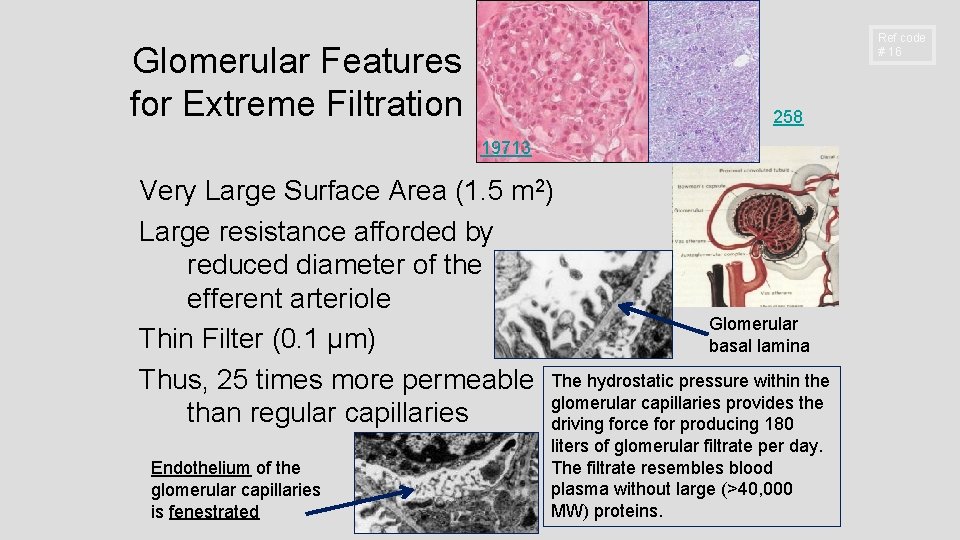
Ref code # 16 Glomerular Features for Extreme Filtration 258 19713 Very Large Surface Area (1. 5 m 2) Large resistance afforded by reduced diameter of the efferent arteriole Glomerular Thin Filter (0. 1 µm) basal lamina Thus, 25 times more permeable The hydrostatic pressure within the glomerular capillaries provides the than regular capillaries driving force for producing 180 Endothelium of the glomerular capillaries is fenestrated liters of glomerular filtrate per day. The filtrate resembles blood plasma without large (>40, 000 MW) proteins.
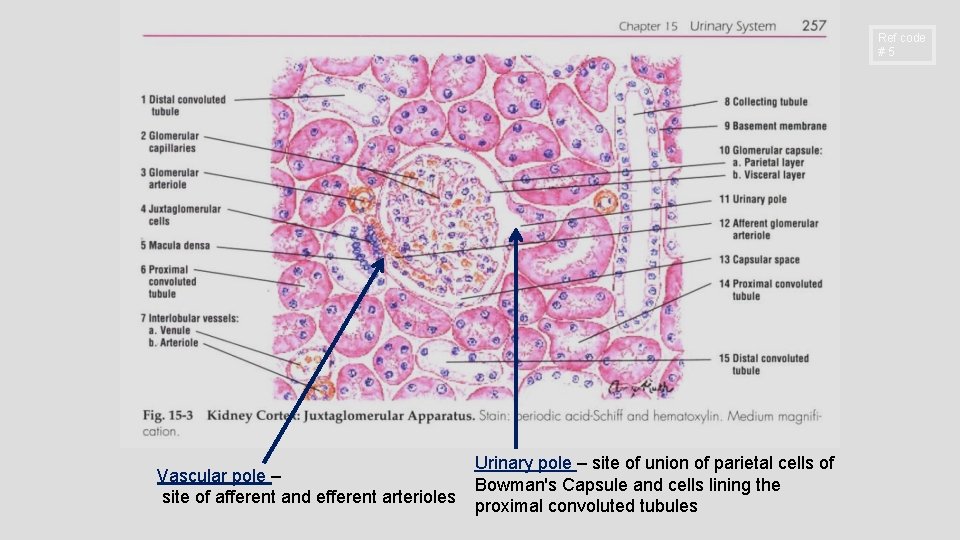
Ref code #5 Vascular pole – site of afferent and efferent arterioles Urinary pole – site of union of parietal cells of Bowman's Capsule and cells lining the proximal convoluted tubules
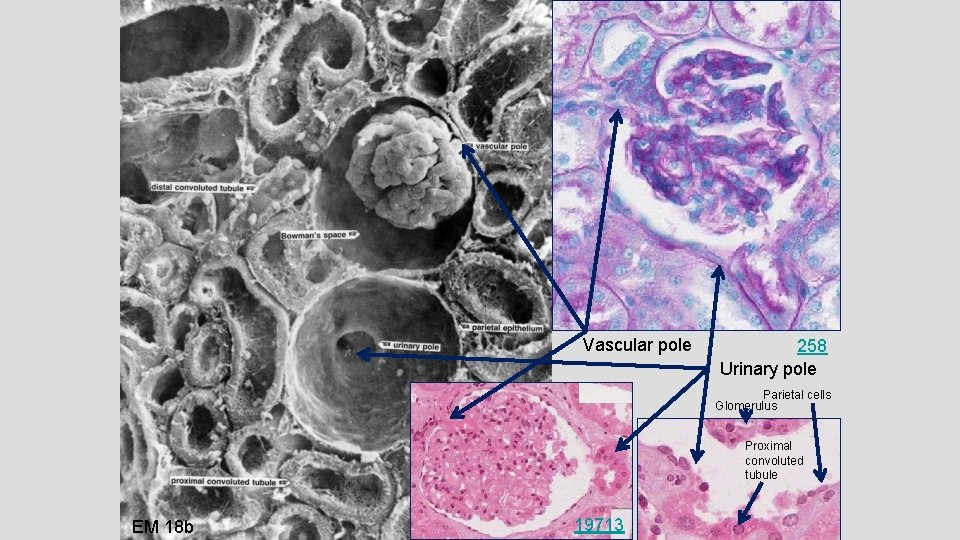
Vascular pole 258 Urinary pole Parietal cells Glomerulus Proximal convoluted tubule EM 18 b 19713
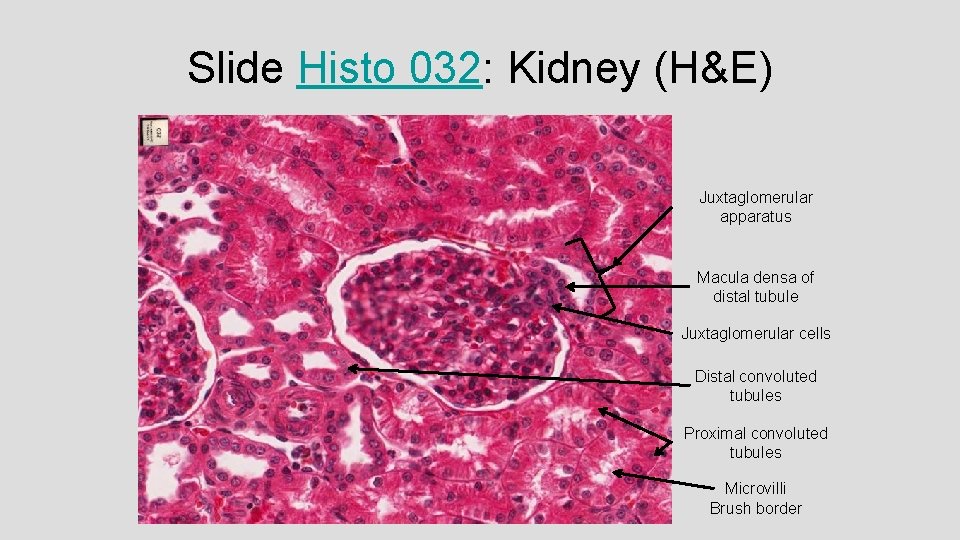
Slide Histo 032: Kidney (H&E) Juxtaglomerular apparatus Macula densa of distal tubule Juxtaglomerular cells Distal convoluted tubules Proximal convoluted tubules Microvilli Brush border
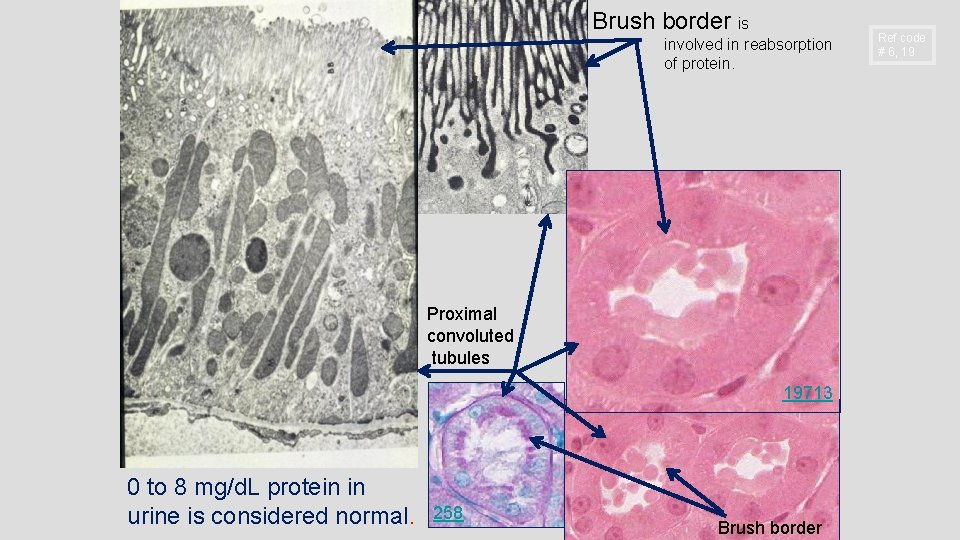
Brush border is involved in reabsorption of protein. Proximal convoluted tubules 19713 0 to 8 mg/d. L protein in urine is considered normal. 258 Brush border Ref code # 6, 19
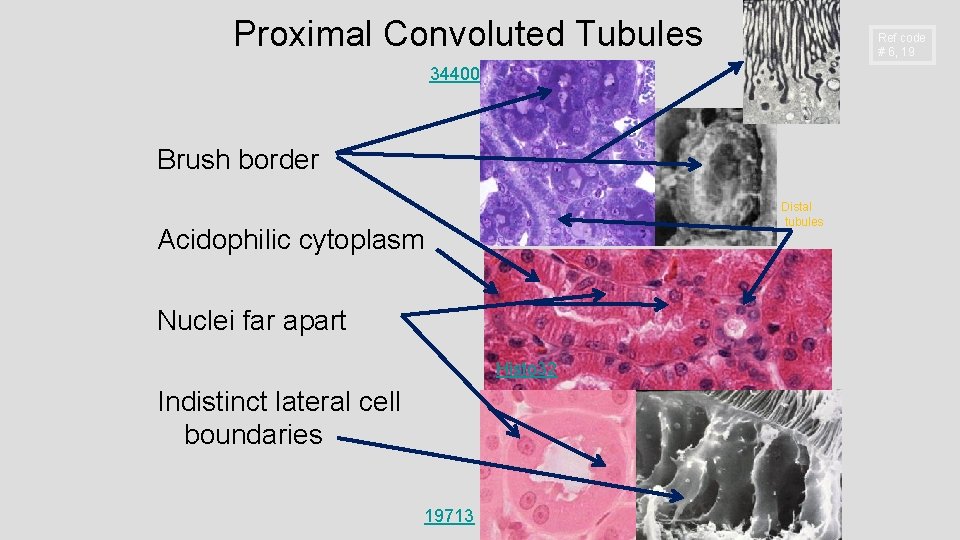
Proximal Convoluted Tubules Ref code # 6, 19 34400 Brush border Distal tubules Acidophilic cytoplasm Nuclei far apart Histo 32 Indistinct lateral cell boundaries 19713
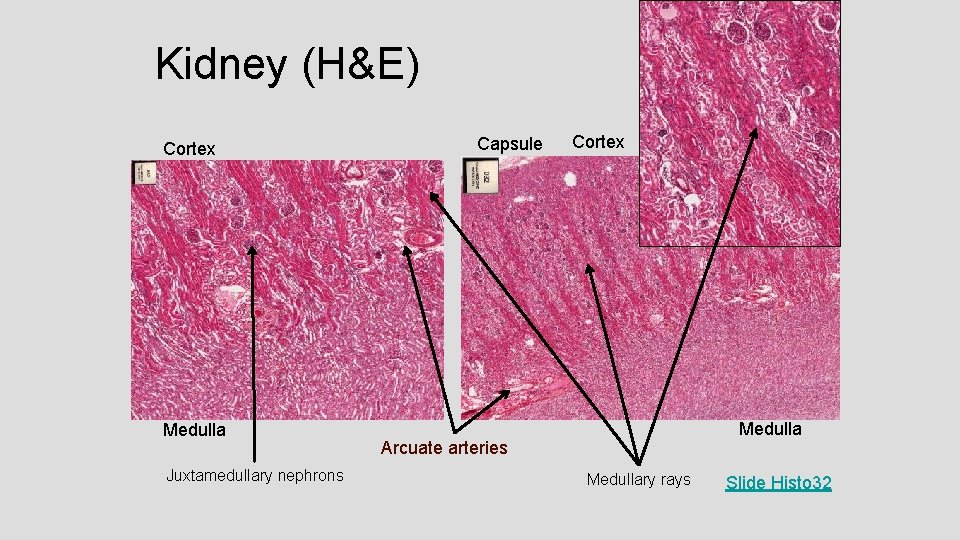
Kidney (H&E) Cortex Medulla Juxtamedullary nephrons Capsule Cortex Medulla Arcuate arteries Medullary rays Slide Histo 32
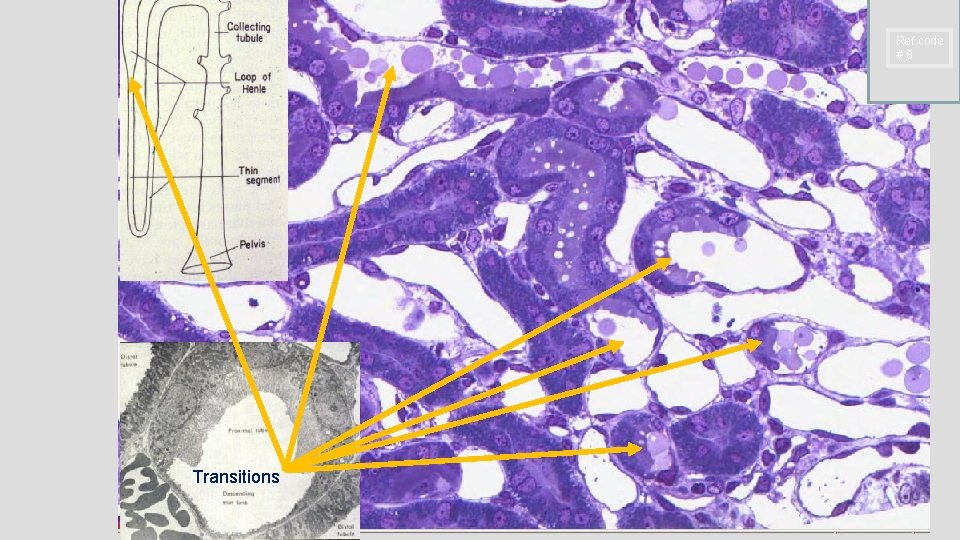
Ref code #8 Transitions
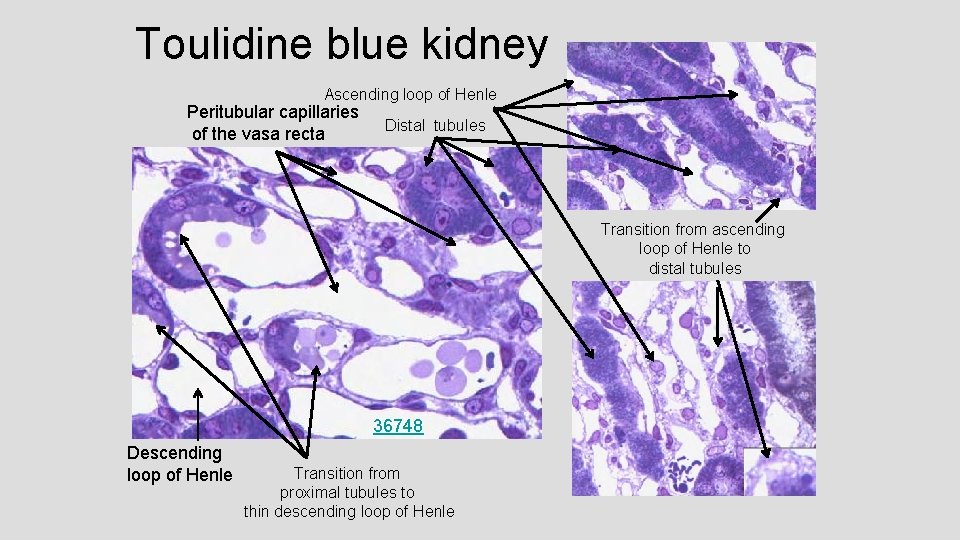
Toulidine blue kidney Ascending loop of Henle Peritubular capillaries of the vasa recta Distal tubules Transition from ascending loop of Henle to distal tubules 36748 Descending loop of Henle Transition from proximal tubules to thin descending loop of Henle
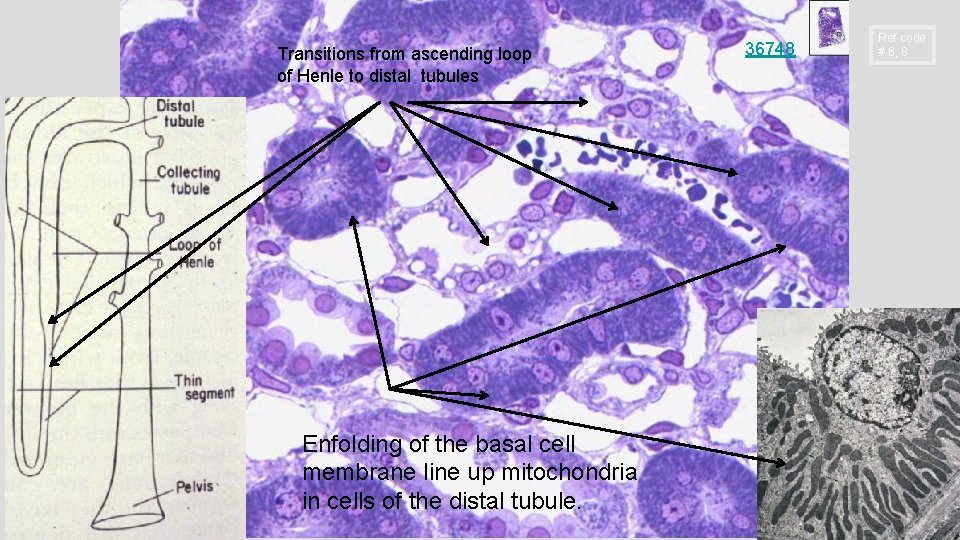
Transitions from ascending loop of Henle to distal tubules Enfolding of the basal cell membrane line up mitochondria in cells of the distal tubule. 36748 Ref code # 6, 8
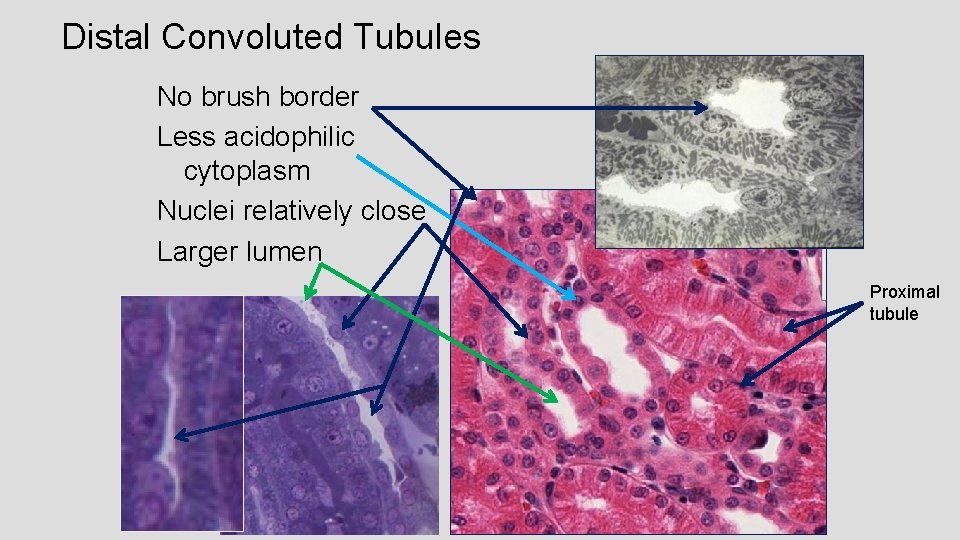
Distal Convoluted Tubules No brush border Less acidophilic cytoplasm Nuclei relatively close Larger lumen Proximal tubule
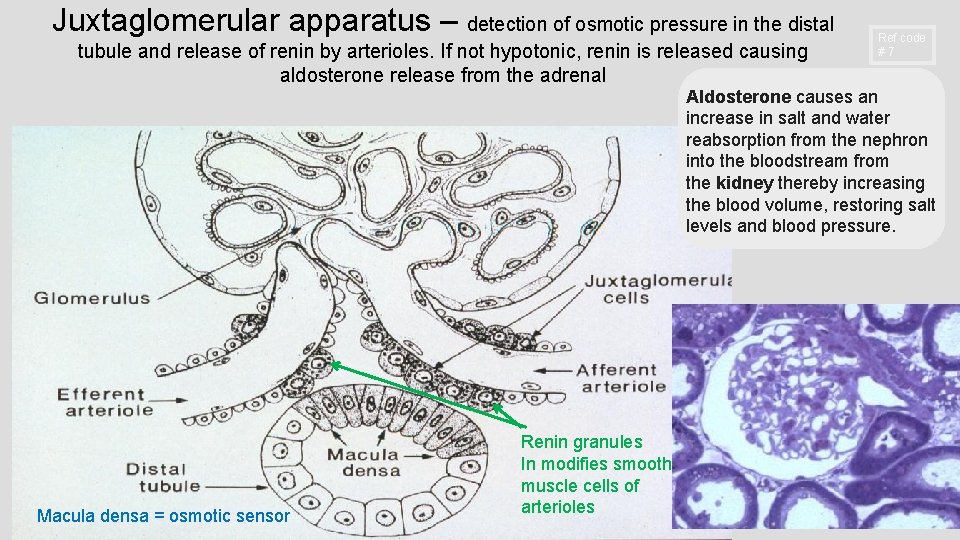
Juxtaglomerular apparatus – detection of osmotic pressure in the distal tubule and release of renin by arterioles. If not hypotonic, renin is released causing aldosterone release from the adrenal Ref code #7 Aldosterone causes an increase in salt and water reabsorption from the nephron into the bloodstream from the kidney thereby increasing the blood volume, restoring salt levels and blood pressure. Macula densa = osmotic sensor Renin granules In modifies smooth muscle cells of arterioles
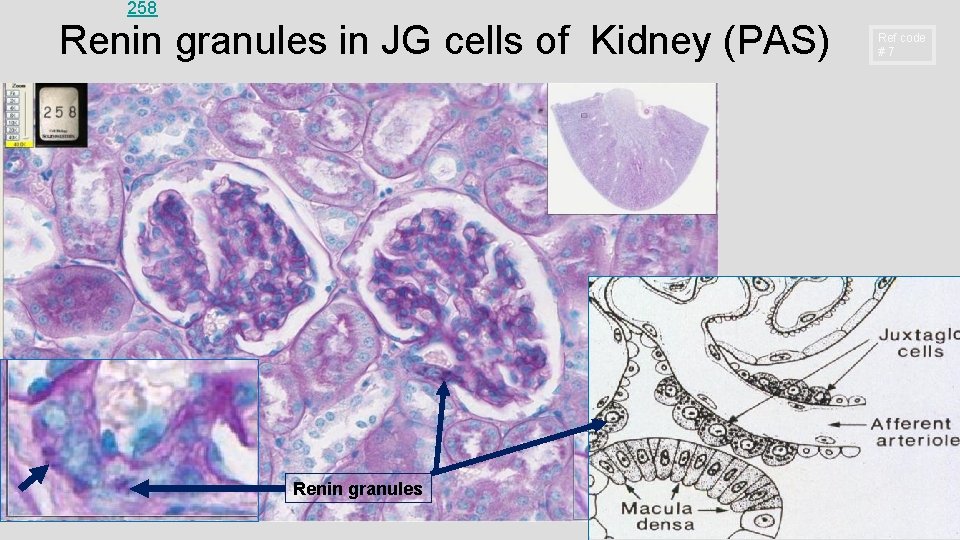
258 Renin granules in JG cells of Kidney (PAS) Renin granules Ref code #7
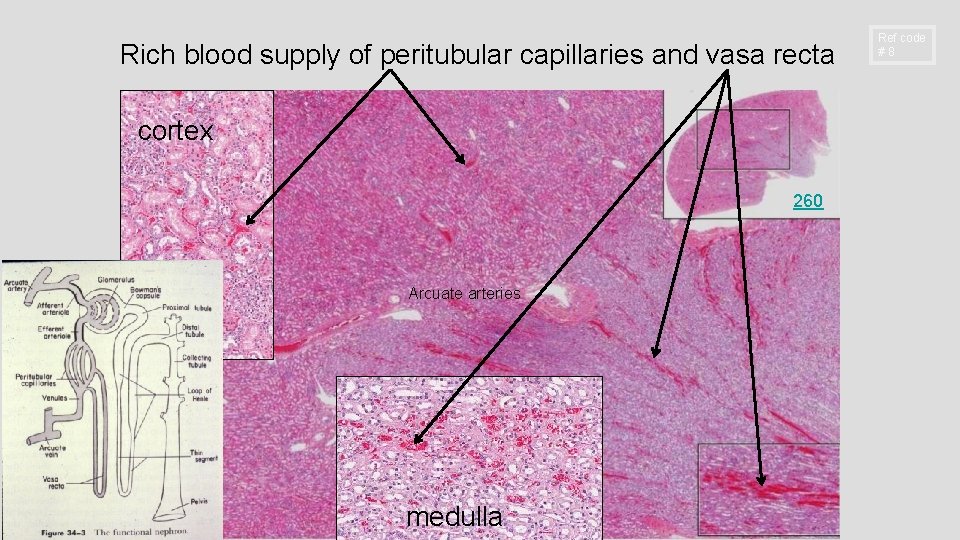
Rich blood supply of peritubular capillaries and vasa recta cortex 260 Arcuate arteries medulla Ref code #8
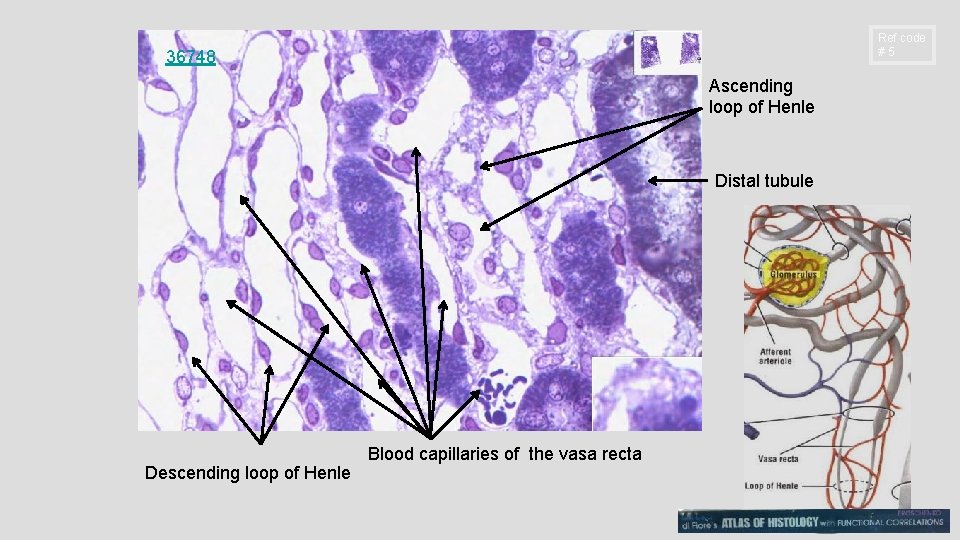
Ref code #5 36748 Ascending loop of Henle Distal tubule Descending loop of Henle Blood capillaries of the vasa recta
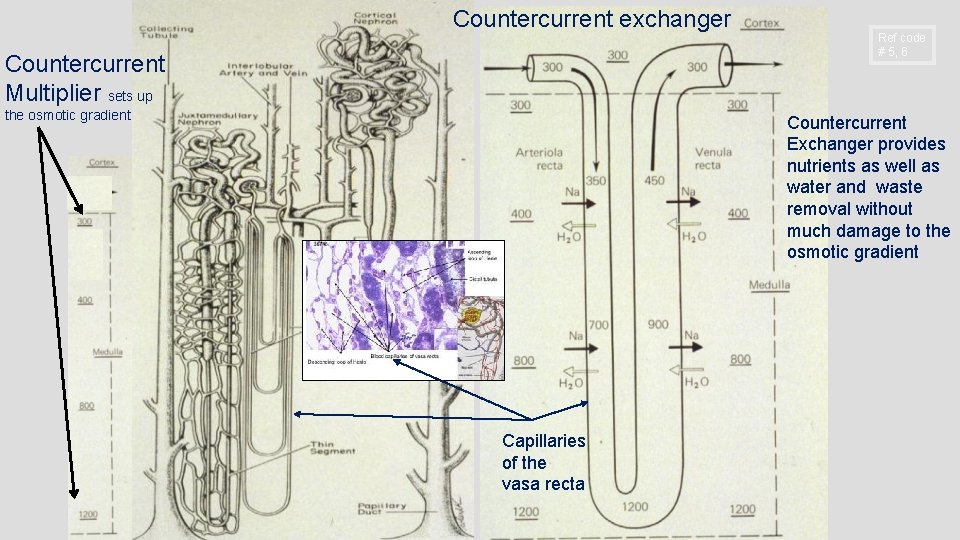
Countercurrent exchanger Countercurrent Multiplier sets up the osmotic gradient Ref code # 5, 6 Countercurrent Exchanger provides nutrients as well as water and waste removal without much damage to the osmotic gradient Capillaries of the vasa recta
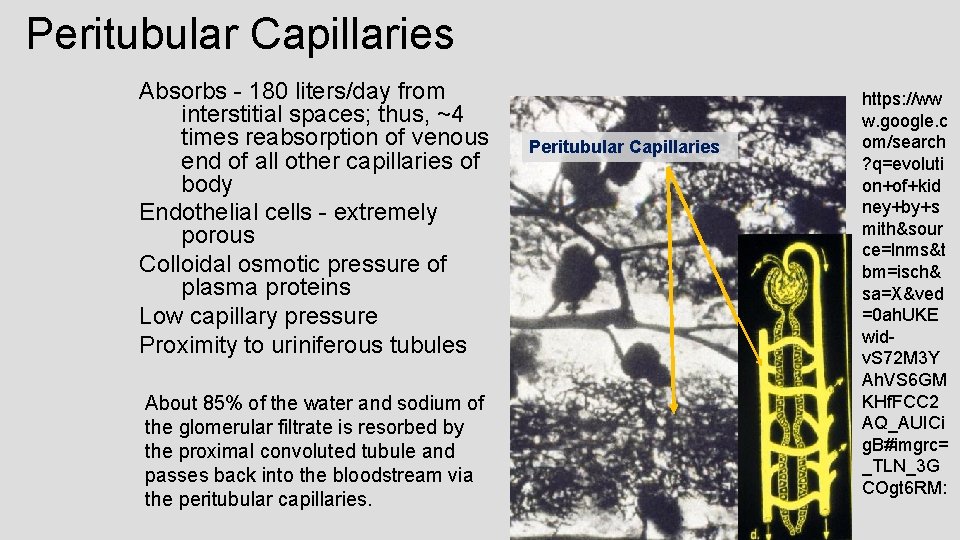
Peritubular Capillaries Absorbs - 180 liters/day from interstitial spaces; thus, ~4 times reabsorption of venous end of all other capillaries of body Endothelial cells - extremely porous Colloidal osmotic pressure of plasma proteins Low capillary pressure Proximity to uriniferous tubules About 85% of the water and sodium of the glomerular filtrate is resorbed by the proximal convoluted tubule and passes back into the bloodstream via the peritubular capillaries. Peritubular Capillaries https: //ww w. google. c om/search ? q=evoluti on+of+kid ney+by+s mith&sour ce=lnms&t bm=isch& sa=X&ved =0 ah. UKE widv. S 72 M 3 Y Ah. VS 6 GM KHf. FCC 2 AQ_AUICi g. B#imgrc= _TLN_3 G COgt 6 RM:
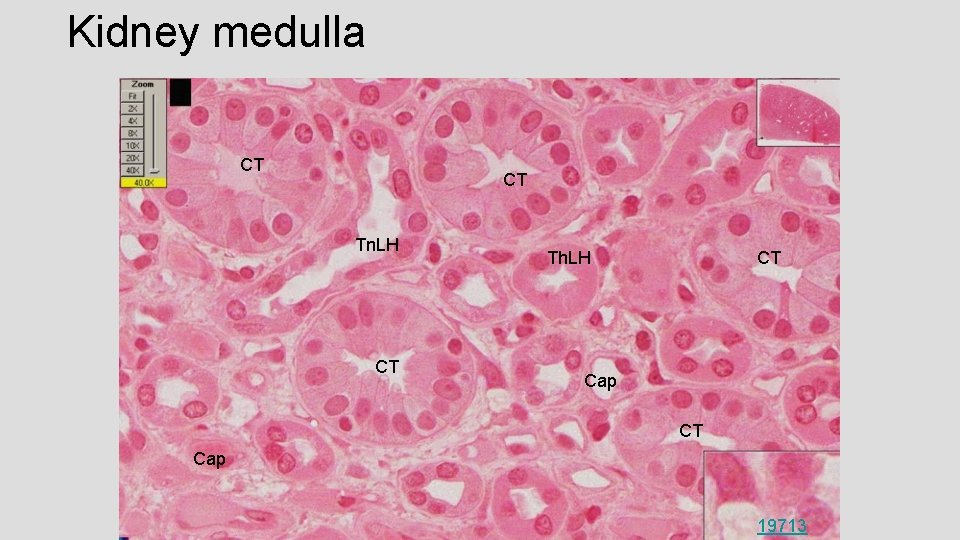
Kidney medulla CT CT Tn. LH CT Th. LH CT Cap 19713
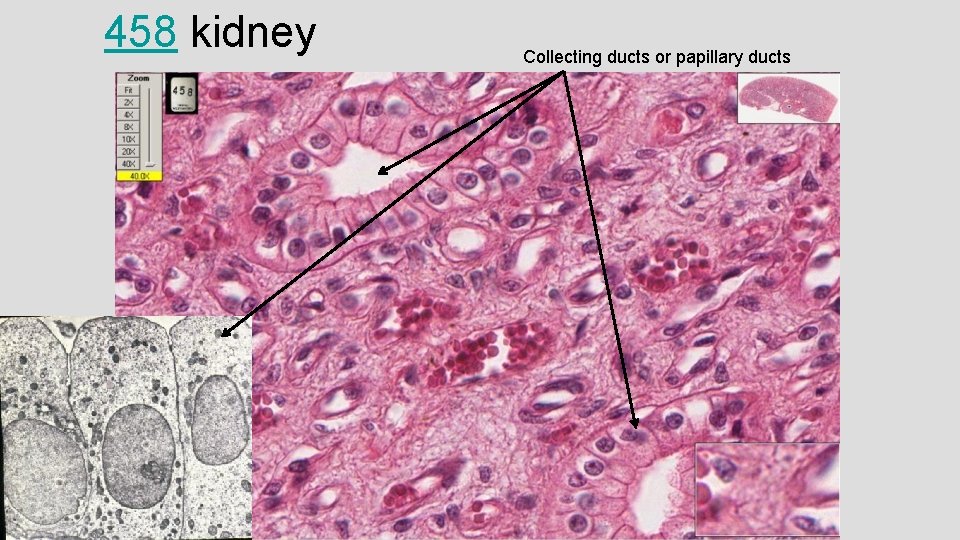
458 kidney Collecting ducts or papillary ducts
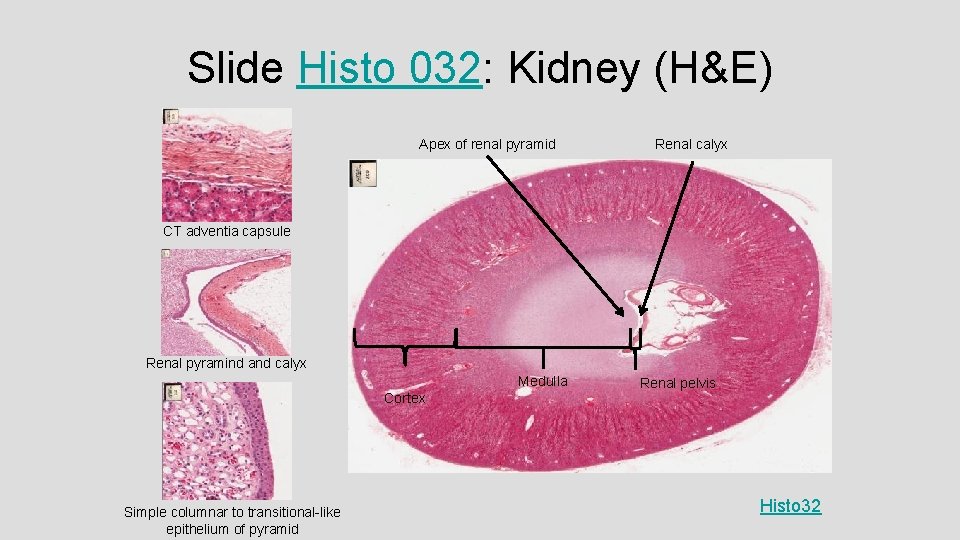
Slide Histo 032: Kidney (H&E) Apex of renal pyramid Renal calyx CT adventia capsule Renal pyramind and calyx Medulla Cortex Simple columnar to transitional-like epithelium of pyramid Renal pelvis Histo 32
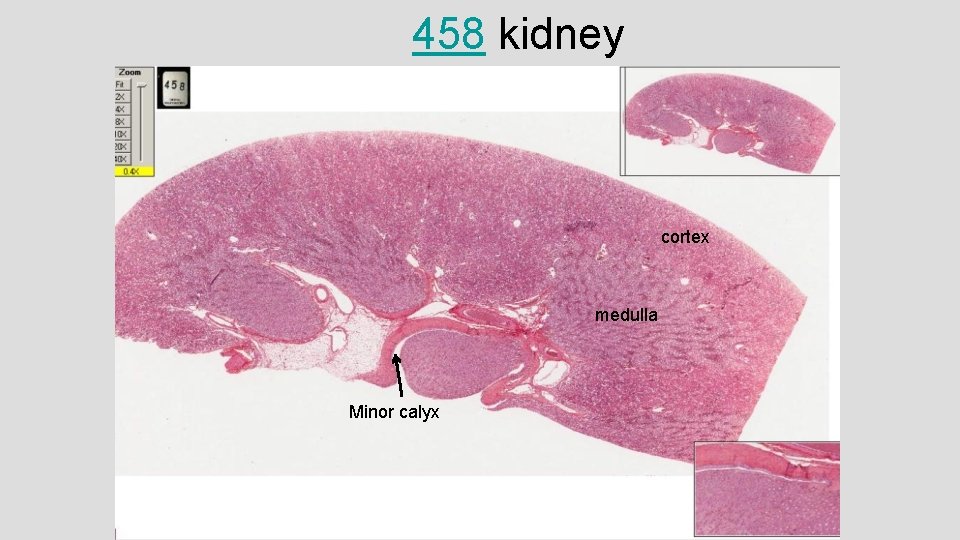
458 kidney cortex medulla Minor calyx

Ref code # 4, 5, 14, 19
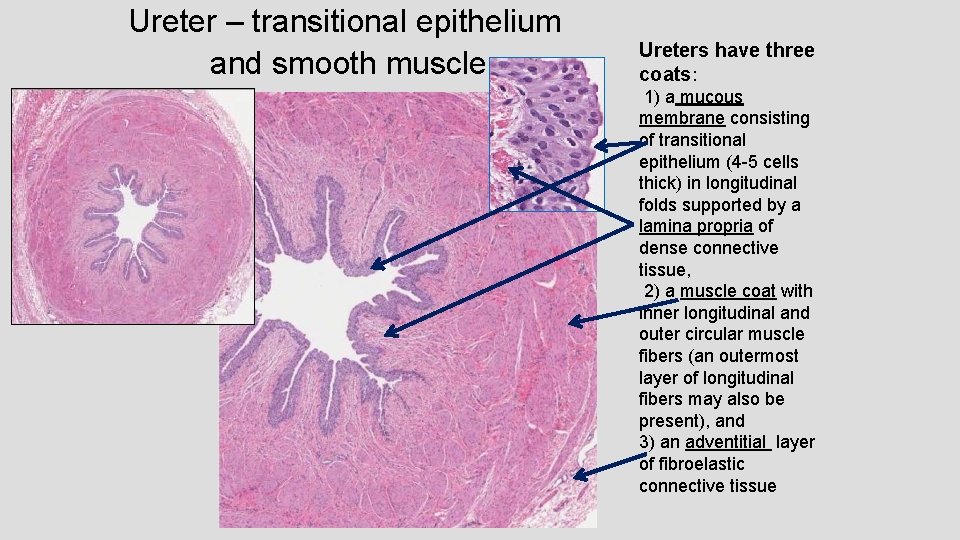
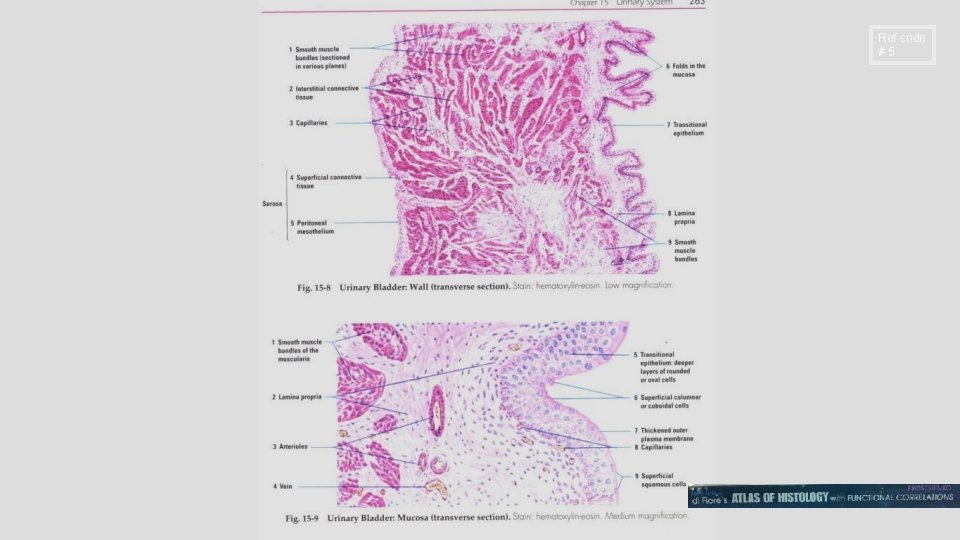
Ureter – transitional epithelium and smooth muscle Ureters have three coats: 1) a mucous membrane consisting of transitional epithelium (4 -5 cells thick) in longitudinal folds supported by a lamina propria of dense connective tissue, 2) a muscle coat with inner longitudinal and outer circular muscle fibers (an outermost layer of longitudinal fibers may also be present), and 3) an adventitial layer of fibroelastic connective tissue
Ref code #5
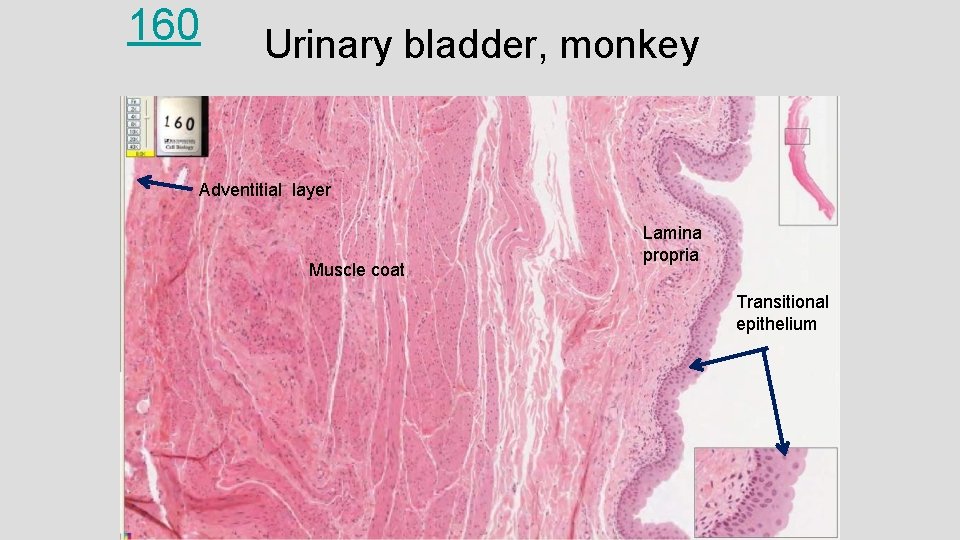
160 Urinary bladder, monkey Adventitial layer Muscle coat Lamina propria Transitional epithelium
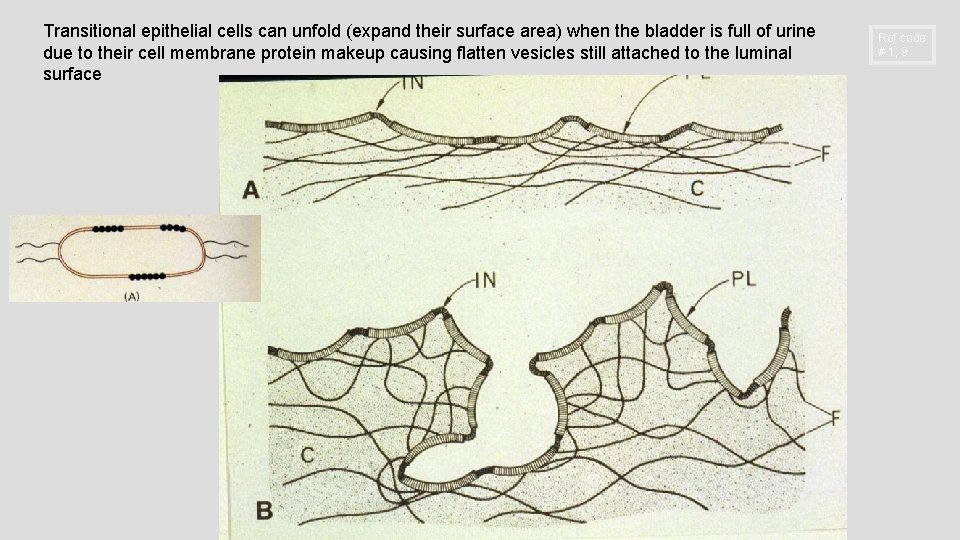
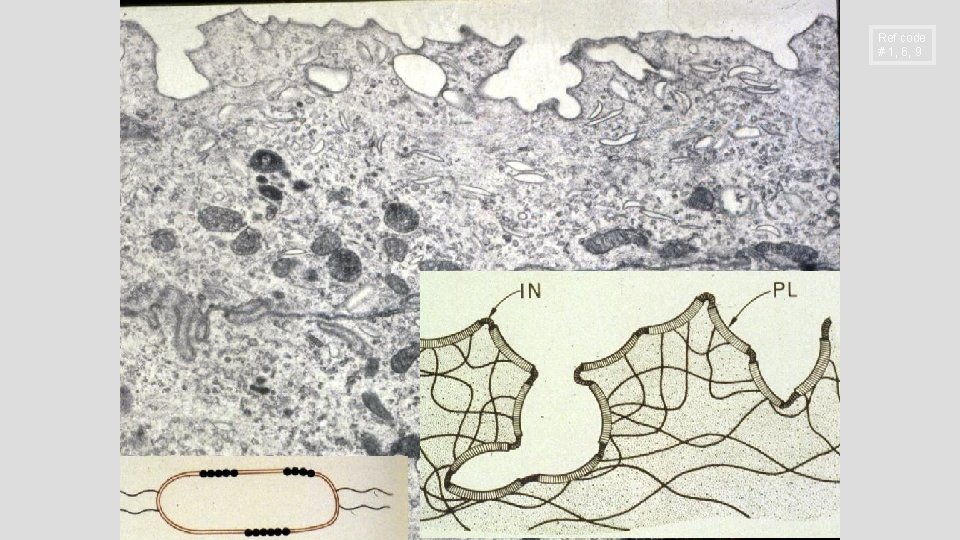
Transitional epithelial cells can unfold (expand their surface area) when the bladder is full of urine due to their cell membrane protein makeup causing flatten vesicles still attached to the luminal surface Ref code # 1, 9
Ref code # 1, 6, 9
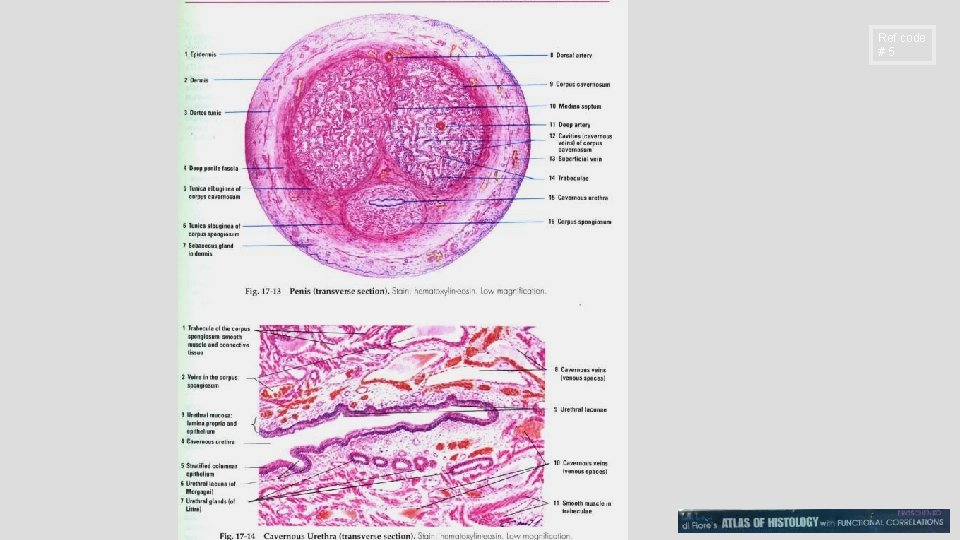
Ref code #5
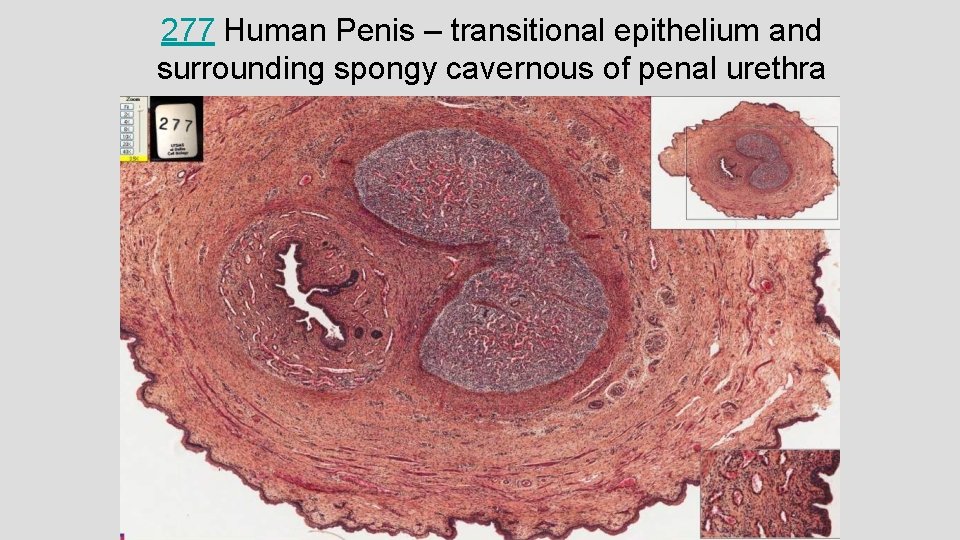
277 Human Penis – transitional epithelium and surrounding spongy cavernous of penal urethra
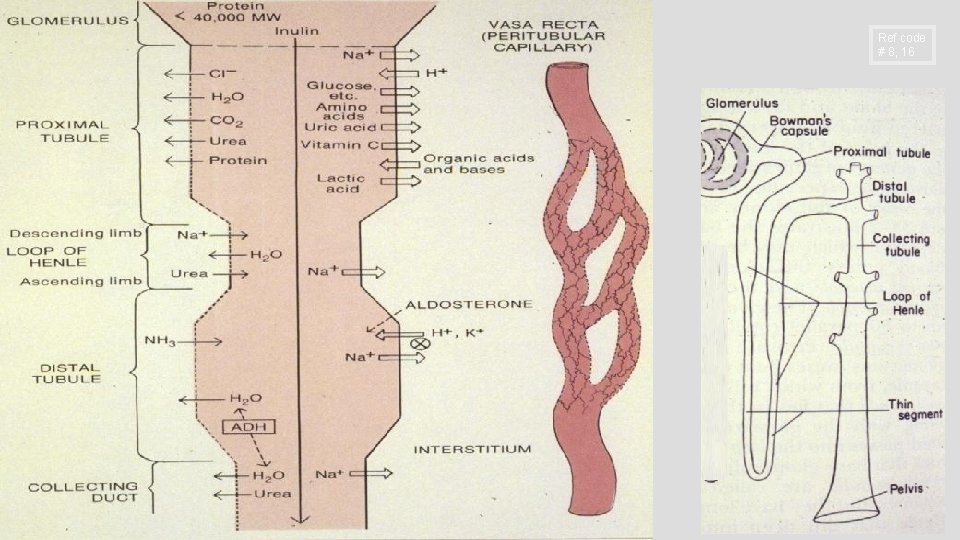
Ref code # 8, 16
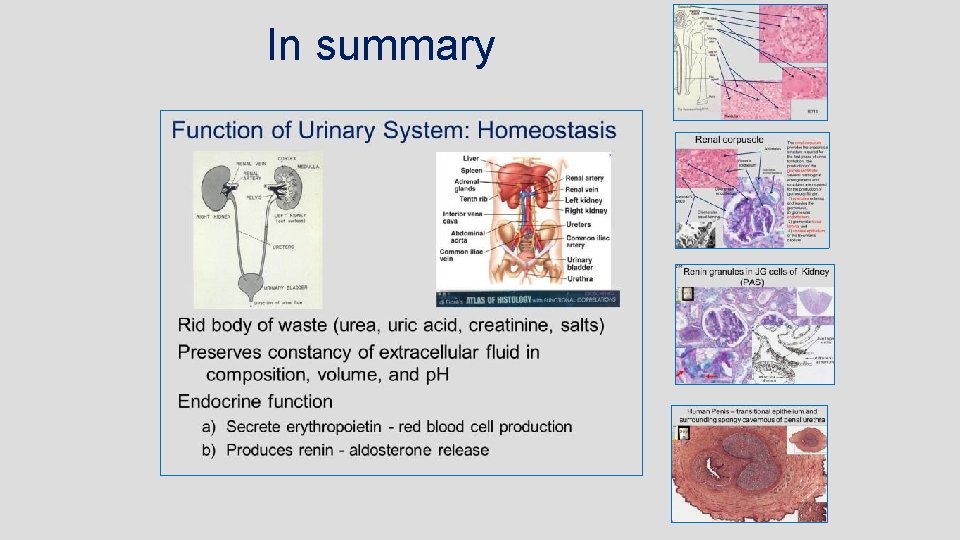
In summary
Many illustrations in these VIBS Histology You. Tube videos were modified from the following books and sources: Many thanks to original sources! 1. Alberts, et al. , 1989. Molecular Biology of the Cell. 2 nd Edition. Garland Publishing, Inc. New York. ISBN 0 -8240 -3695 -6. 2. Alberts, et al. , 1994. Molecular Biology of the Cell. 3 nd Edition. Garland Publishing, Inc. New York. ISBN 0 -8153 -1619 -4. 3. Bloom, W. and Fawcett, D. W. , 1968. A Textbook of Histology. 9 th Edition. W. B. Saunders Company. Philadelphia. Library of Congress #67 -17445. 4. Elias, H. et al. , 1978. Histology and Human Microanatomy. A Wiley Medical Publication. John Wiley & Sons, New York. ISBN 0 -47104929 -8. 5. Eroschenko, V. 2000. Di Fiore’s Atlas of Histology with Functional Correlations. 9 th Edition. Lippincott Williams & Wilkins. Philadelphia. ISBN 07817 -2676 -X. 6. Fawcett, D. W. , 1986. Bloom and Fawcett. A Textbook of Histology. 11 th Edition. W. B. Saunders Company. Philadelphia. ISBN 0 -72161729 -8. 7. Fawcett, D. W. , 1994. Bloom and Fawcett. A Textbook of Histology. 12 th Edition. Chapman and Hall. New York. ISBN 0 -412 -04691 -1. 8. Guyton, A. C. 1971. Textbook of Medical Physiology. 4 th Edition. W. B. Saunders Company. Philadelphia. Library of Congress # 74118589. 9. Ham, A. W. 1974. Histology. 7 th Edition. J. B. Lippincott Company. Philadelphia. ISBN 0 -397 -52062 -X. 10. Ham, A. W. and Cormack, D. H. 1979. Histology. 8 th Edition. J. B. Lippincott Co. Philadelphia. ISBN 0 -397 -52089 -1. 11. Junqueria, et al. , 1995. Basic Histology. 8 th Edition. Appleton and Lange. Norwalk, Connecticut. ISBN 08385 -0567 -8. 12. Junqueira, et al. , 1998. Basic Histology. 9 th Edition. Appleton and Lange. Stamford, Connecticut. ISBN 0 -8385 -0590 -2. 13. Knobil, E. et al. 1988. The Physiology of Reproduction. Volume 1. Raven Press. New York. ISBN 0 -88167 -281 -5. 14. Langley, et al. , 1974. Dynamic Anatomy and Physiology. 4 th Edition. Mc. Graw-Hill Book Company. New York. ISBN 0 -07 -036274 -2. 15. Mescher, A. L. , 2010. Junqueira’s Basic Histology Text and Atlas. 12 th Edition. Mc. Graw Hill Medical. New York. ISBN 978 -0 -07 -1604314. 16. Tuttle, W. W. and Schottelius, B. A. 1969. Textbook of Physiology. 16 th Edition. The C. V. Mosby Company. Saint Louis. Library of Congress # 7589848. 17. Varner, D. et al. 1991. Diseases and Management of Breeding Stallions. American Veterinary Publications. Goleta, California. ISBN 0939674 -33 -5. 18. Von Hagens, Gunther and A. Whalley, 2007. Body Worlds – The Anatomical Exhibition of Real Human Bodies. ISBN 978 -3 -937256 -04 -7 19. Weiss, L. 1983. Histology: Cell and Tissue Biology. 5 th Edition. Elsevier Biomedical. New York. ISBN 0 -444 -00716 -4. 20. Weiss, L. and Greep, R. 1977. Histology. 4 th Edition. Mc. Graw-Hill Book Company. New York. ISBN 0 -07 -069091 -X.
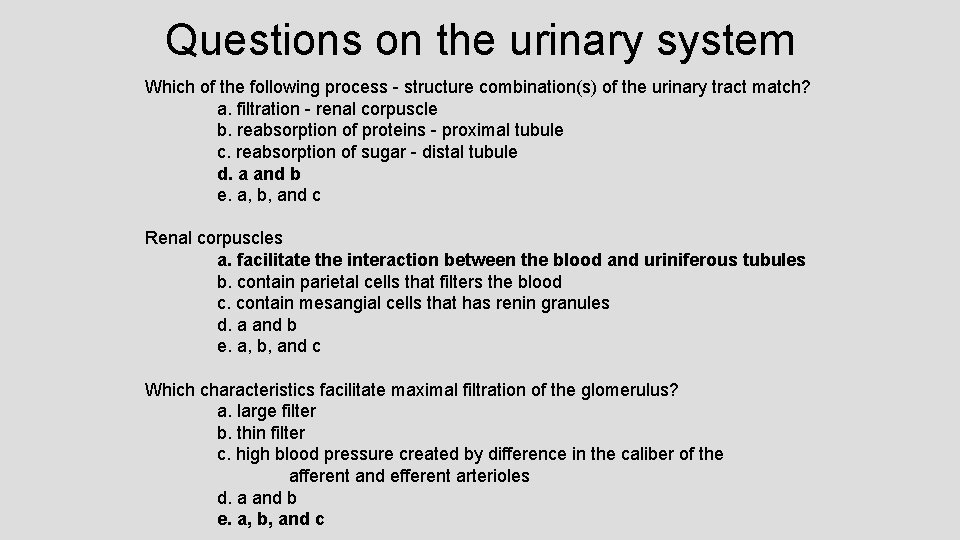
Questions on the urinary system Which of the following process - structure combination(s) of the urinary tract match? a. filtration - renal corpuscle b. reabsorption of proteins - proximal tubule c. reabsorption of sugar - distal tubule d. a and b e. a, b, and c Renal corpuscles a. facilitate the interaction between the blood and uriniferous tubules b. contain parietal cells that filters the blood c. contain mesangial cells that has renin granules d. a and b e. a, b, and c Which characteristics facilitate maximal filtration of the glomerulus? a. large filter b. thin filter c. high blood pressure created by difference in the caliber of the afferent and efferent arterioles d. a and b e. a, b, and c
The end of
- Slides: 58