
Medical School Histology Basics Liver gallbladder salivary glands
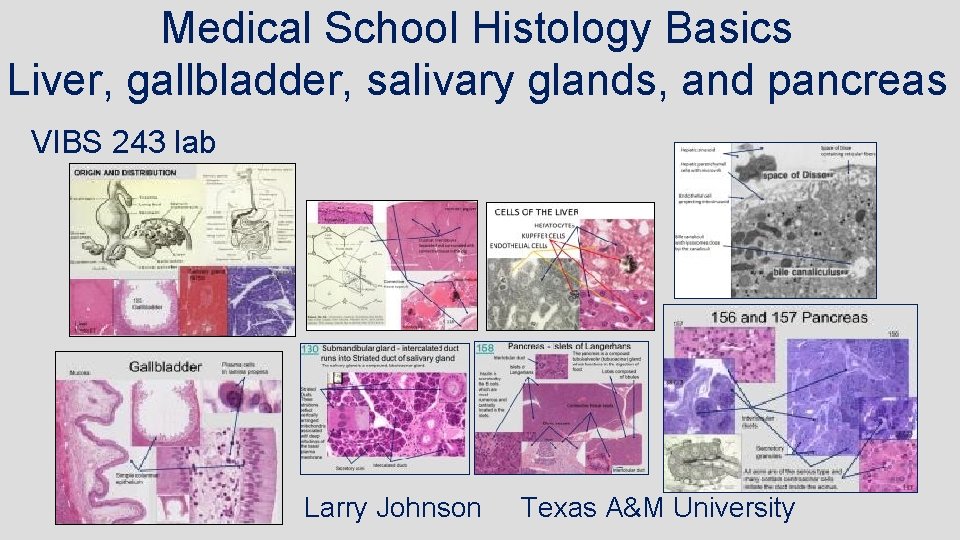
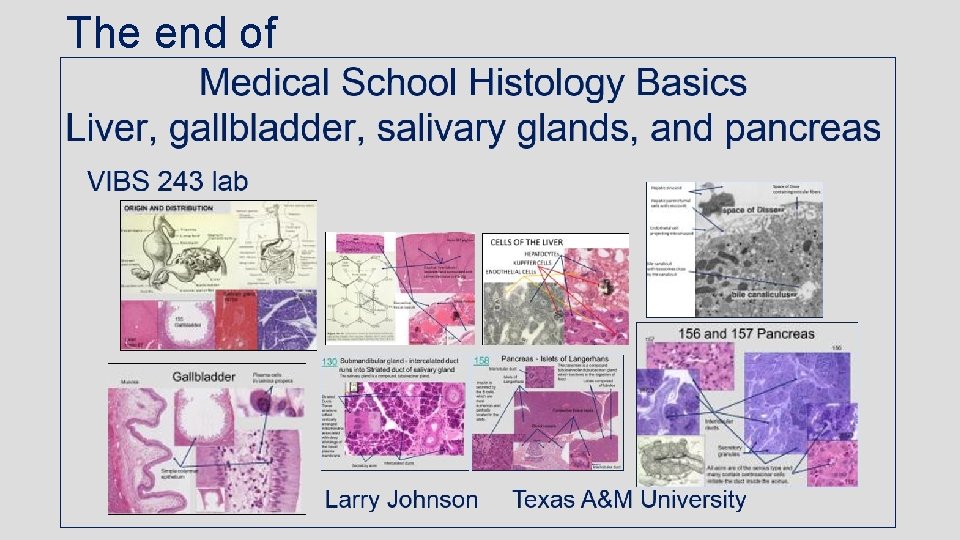
Medical School Histology Basics Liver, gallbladder, salivary glands, and pancreas VIBS 243 lab Larry Johnson Texas A&M University
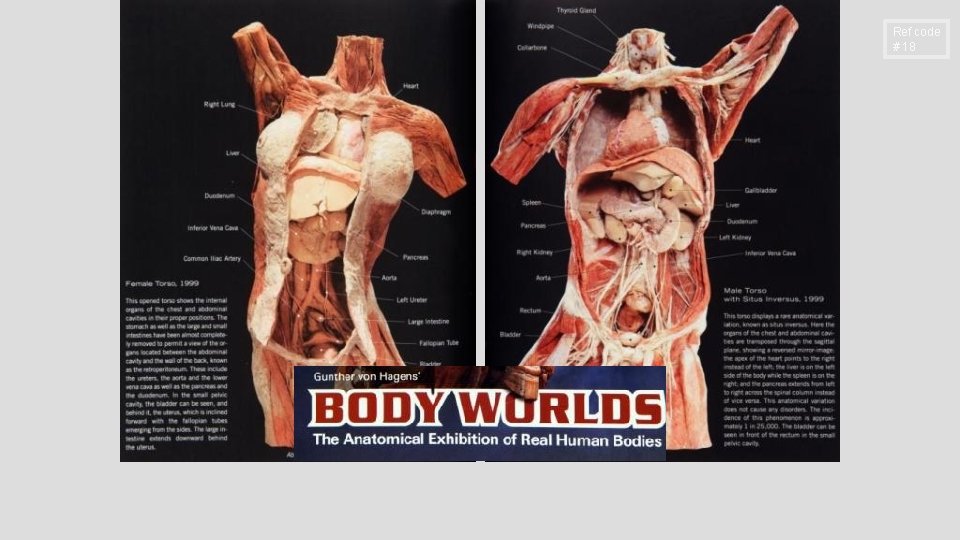
Ref code # 18

Objectives To understand the general organization of the accessory organs of the digestive system and how they contribute to obtaining metabolites necessary for growth and energy for the body. To learn the origin of these glands and how structural features of these glands contribute to their function in digestion and absorption of food stuffs Ref code # 16
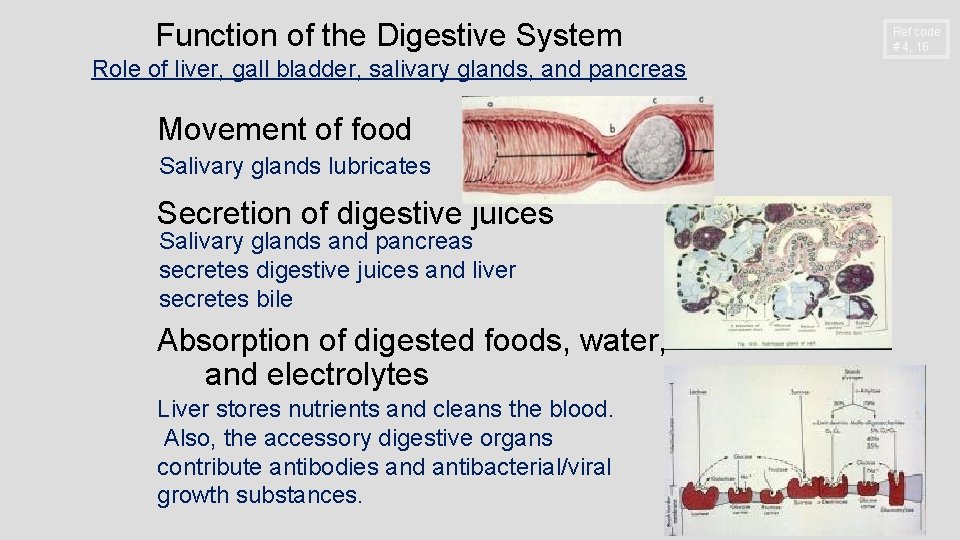
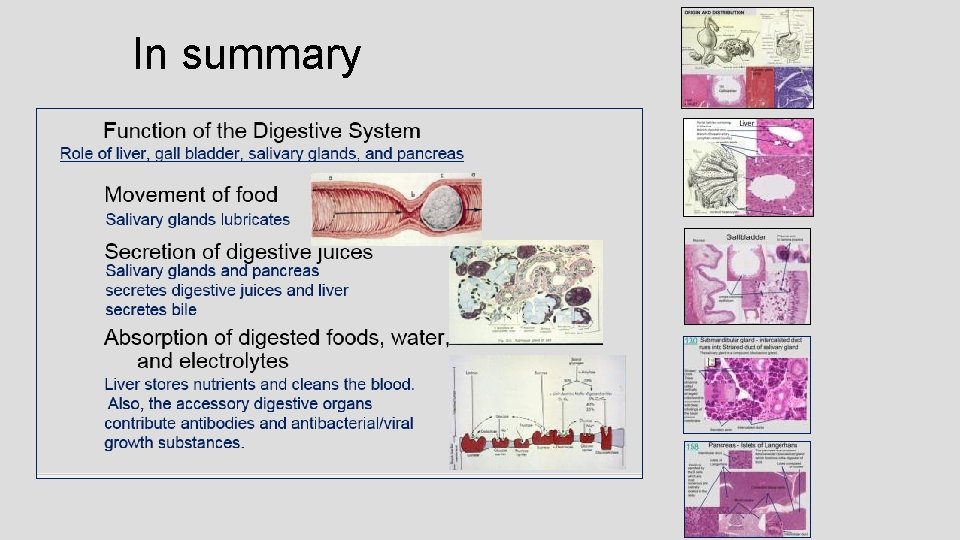
Function of the Digestive System Role of liver, gall bladder, salivary glands, and pancreas Movement of food Salivary glands lubricates Secretion of digestive juices Salivary glands and pancreas secretes digestive juices and liver secretes bile Absorption of digested foods, water, and electrolytes Liver stores nutrients and cleans the blood. Also, the accessory digestive organs contribute antibodies and antibacterial/viral growth substances. Ref code # 4, 16
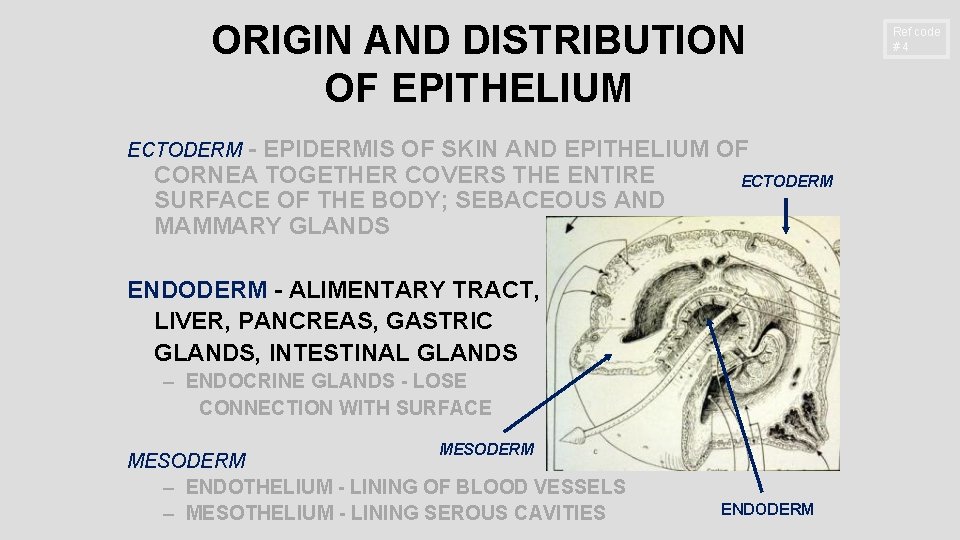
ORIGIN AND DISTRIBUTION OF EPITHELIUM - EPIDERMIS OF SKIN AND EPITHELIUM OF CORNEA TOGETHER COVERS THE ENTIRE ECTODERM SURFACE OF THE BODY; SEBACEOUS AND MAMMARY GLANDS ECTODERM ENDODERM - ALIMENTARY TRACT, LIVER, PANCREAS, GASTRIC GLANDS, INTESTINAL GLANDS – ENDOCRINE GLANDS - LOSE CONNECTION WITH SURFACE MESODERM – ENDOTHELIUM - LINING OF BLOOD VESSELS – MESOTHELIUM - LINING SEROUS CAVITIES ENDODERM Ref code #4
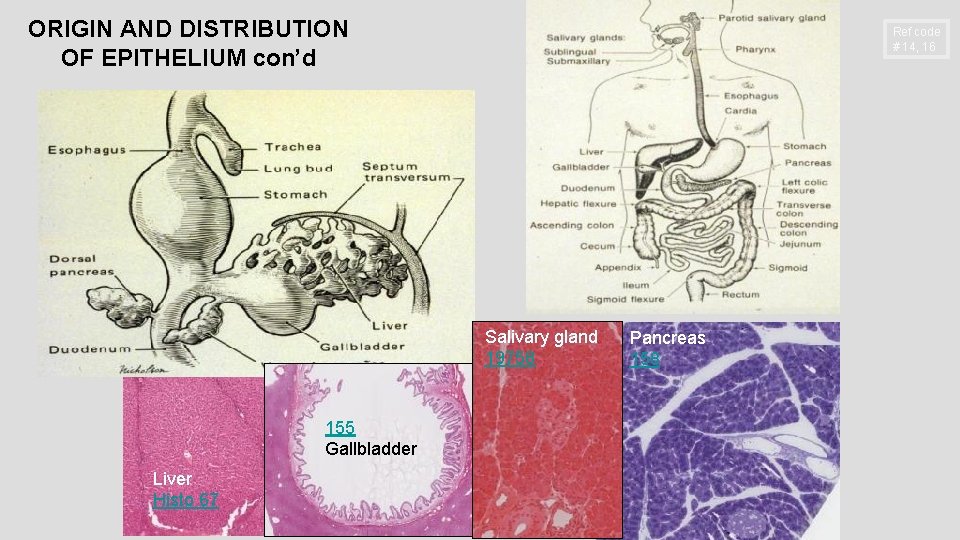
ORIGIN AND DISTRIBUTION OF EPITHELIUM con’d Ref code # 14, 16 Salivary gland 19758 155 Gallbladder Liver Histo 67 Pancreas 158
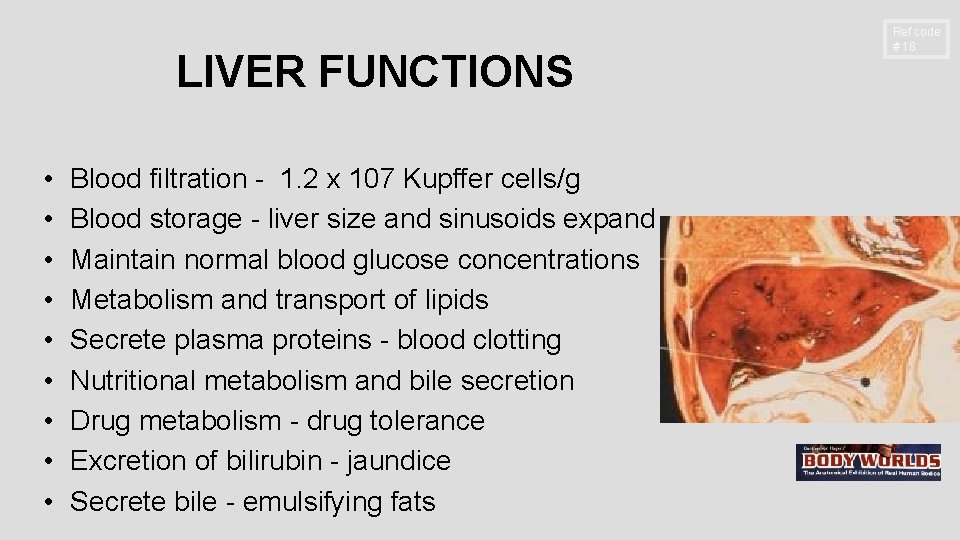
LIVER FUNCTIONS • • • Blood filtration - 1. 2 x 10⁷ Kupffer cells/g Blood storage - liver size and sinusoids expand Maintain normal blood glucose concentrations Metabolism and transport of lipids Secrete plasma proteins - blood clotting Nutritional metabolism and bile secretion Drug metabolism - drug tolerance Excretion of bilirubin - jaundice Secrete bile - emulsifying fats Ref code # 18
Ref code #5
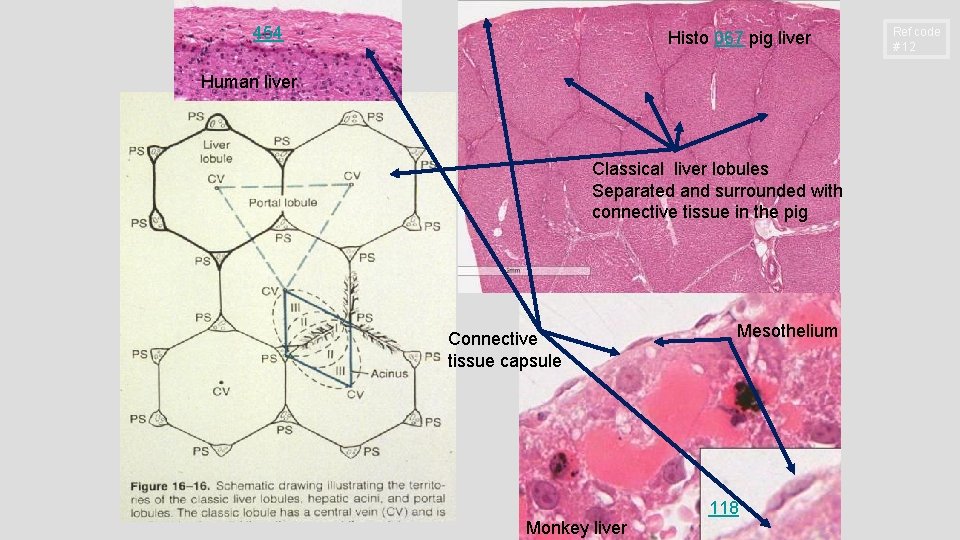
454 Histo 067 pig liver Human liver Classical liver lobules Separated and surrounded with connective tissue in the pig Connective tissue capsule Monkey liver Mesothelium 118 Ref code # 12
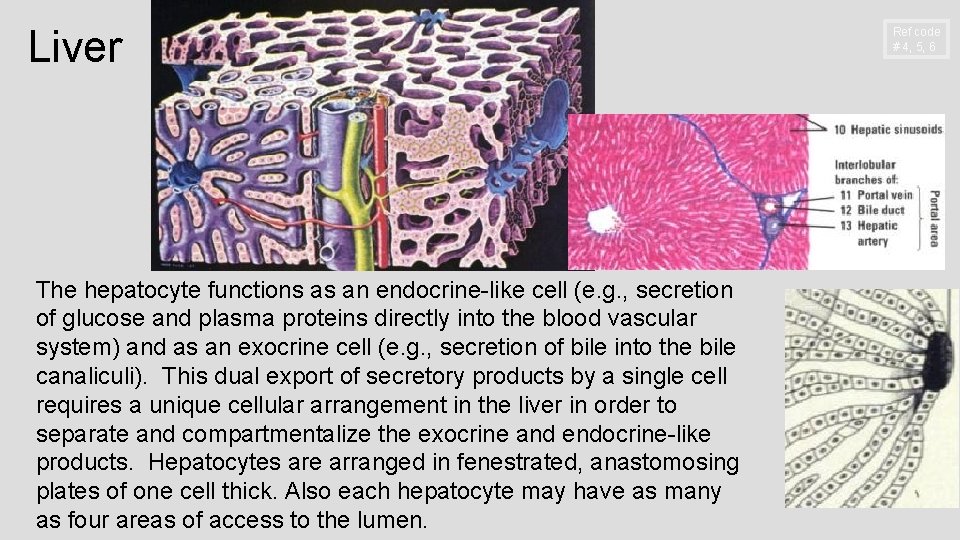
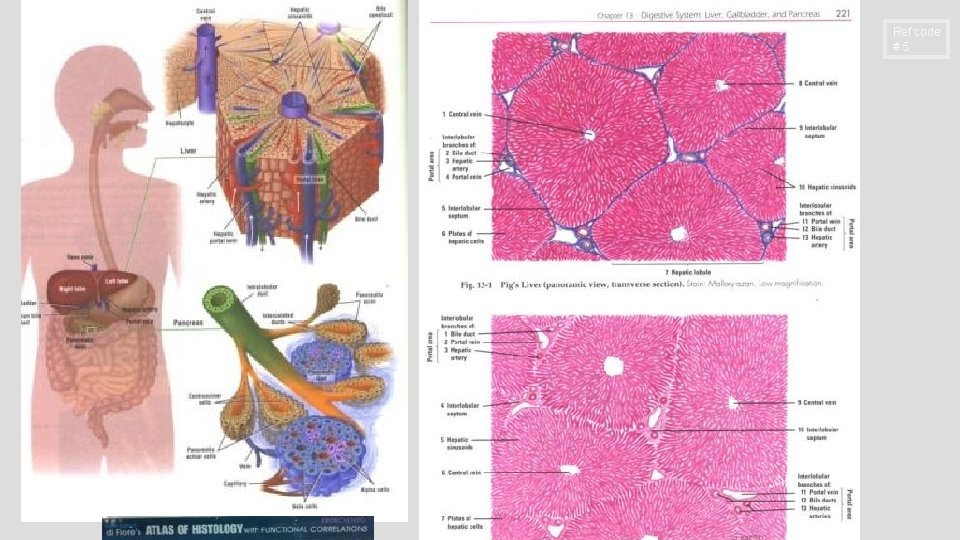
Liver The hepatocyte functions as an endocrine-like cell (e. g. , secretion of glucose and plasma proteins directly into the blood vascular system) and as an exocrine cell (e. g. , secretion of bile into the bile canaliculi). This dual export of secretory products by a single cell requires a unique cellular arrangement in the liver in order to separate and compartmentalize the exocrine and endocrine-like products. Hepatocytes are arranged in fenestrated, anastomosing plates of one cell thick. Also each hepatocyte may have as many as four areas of access to the lumen. Ref code # 4, 5, 6
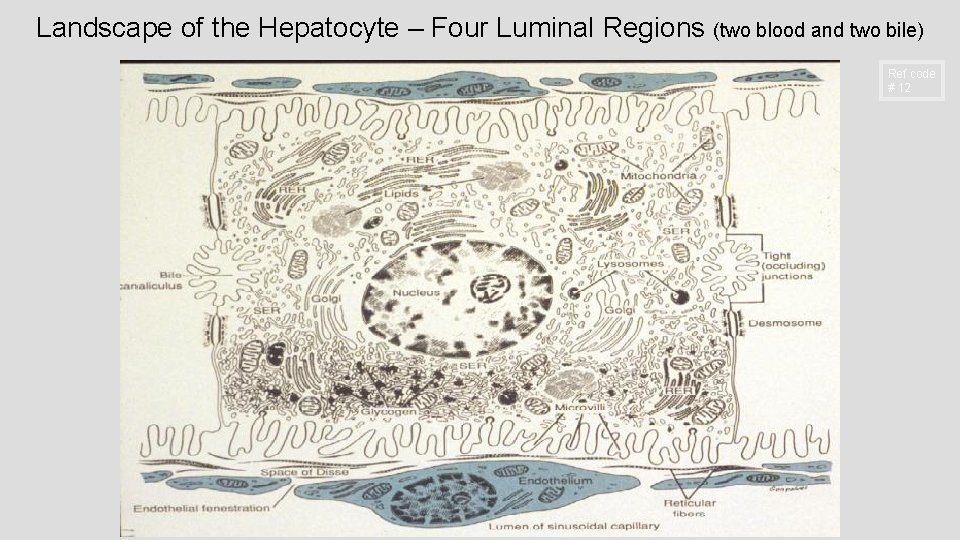
Landscape of the Hepatocyte – Four Luminal Regions (two blood and two bile) Ref code # 12
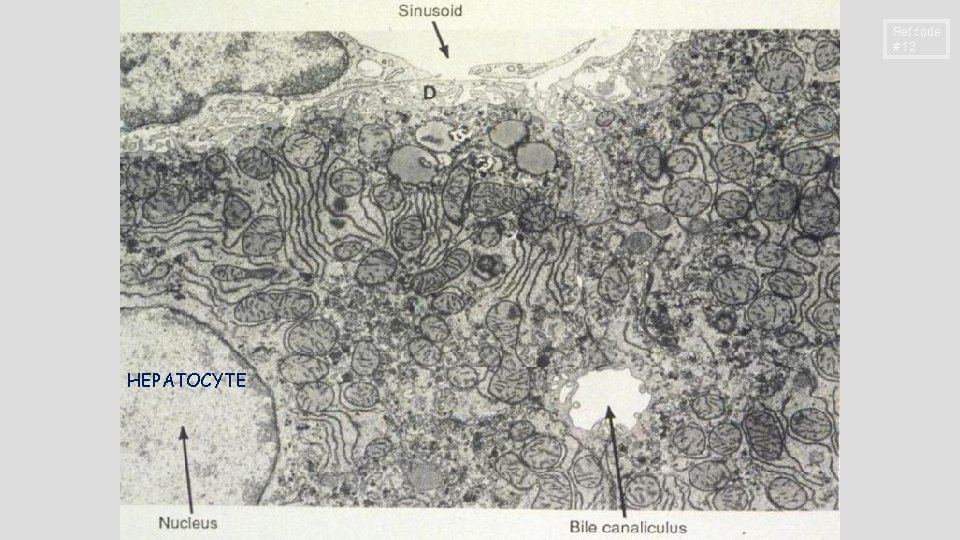
Ref code # 12 HEPATOCYTE
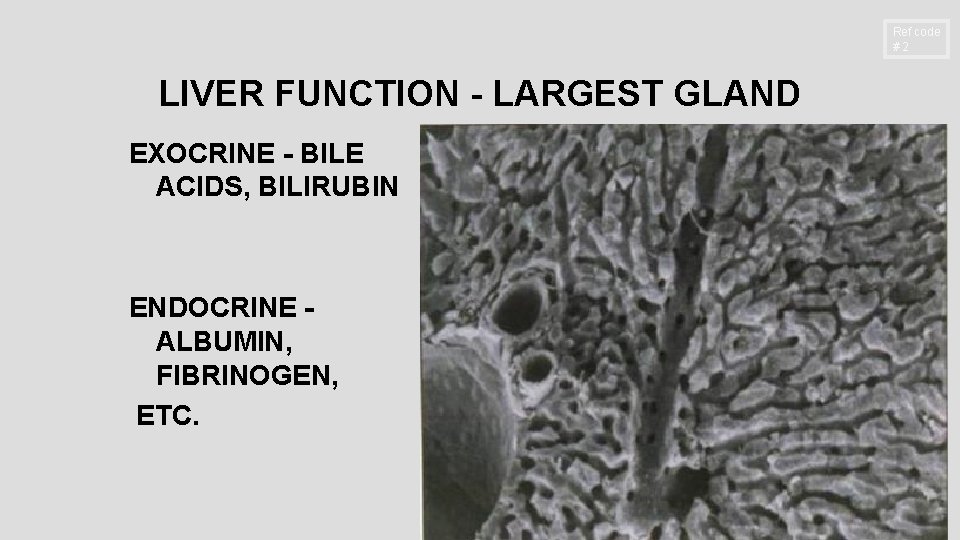
Ref code #2 LIVER FUNCTION - LARGEST GLAND EXOCRINE - BILE ACIDS, BILIRUBIN ENDOCRINE ALBUMIN, FIBRINOGEN, ETC.
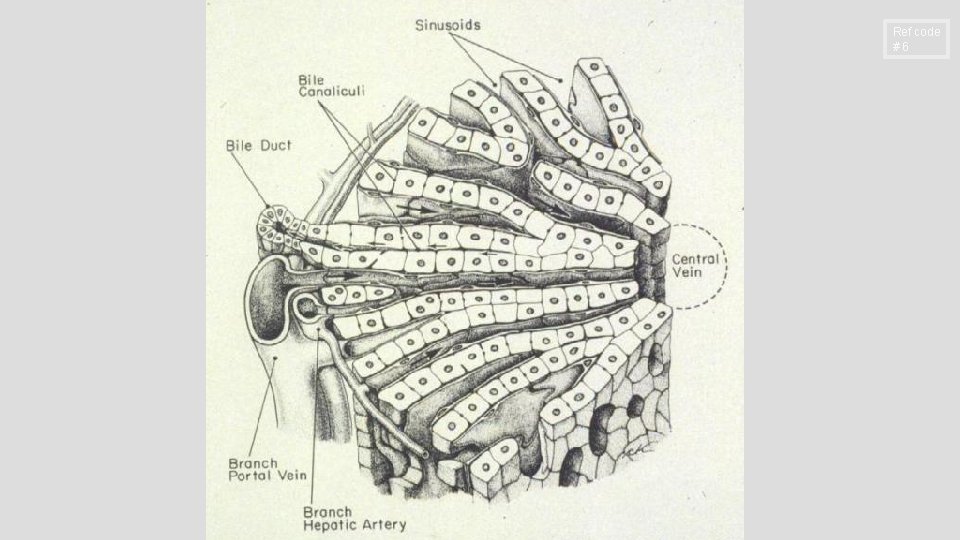
Ref code #6
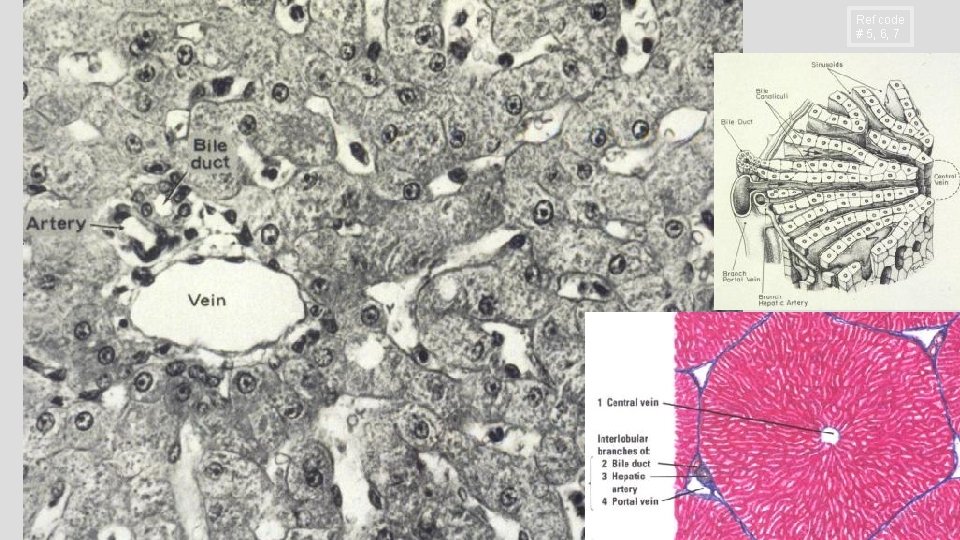
Ref code # 5, 6, 7

Liver Portal radicles containing: A bile duct 155 Branch of portal vein, Branch of hepatic artery Lymphatic vessel (usually) or portal canals Ref code #6 155 Cords of hepatocytes
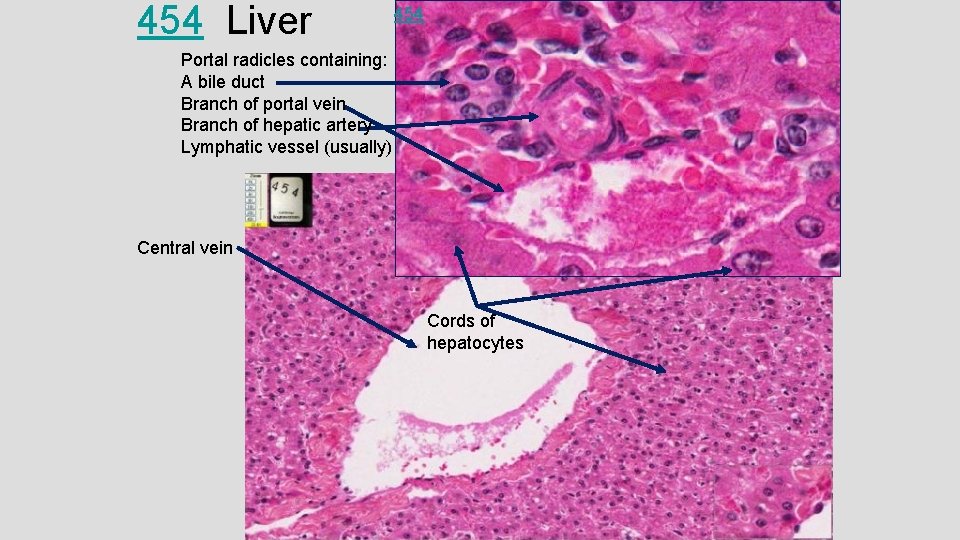
454 Liver 454 Portal radicles containing: A bile duct Branch of portal vein Branch of hepatic artery Lymphatic vessel (usually) Central vein Cords of hepatocytes
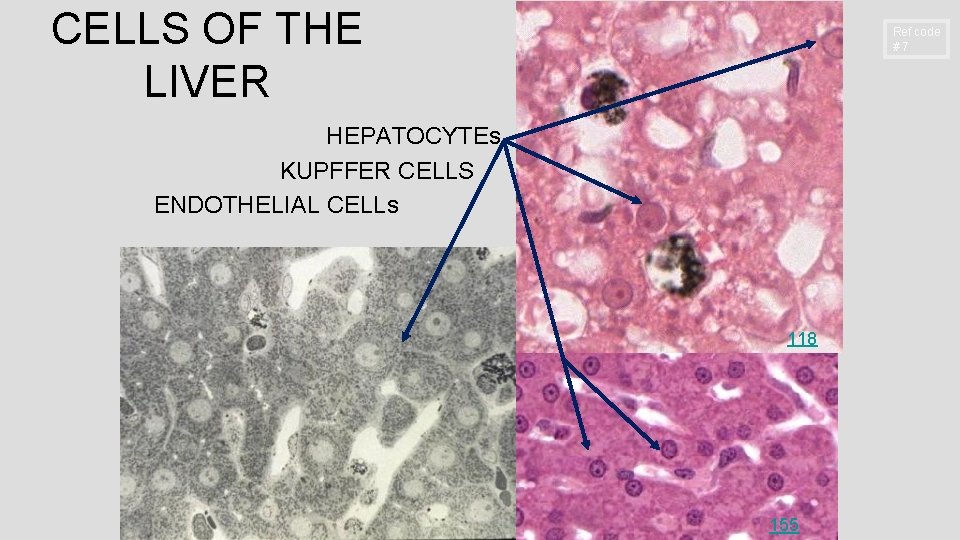
CELLS OF THE LIVER Ref code #7 HEPATOCYTEs KUPFFER CELLS ENDOTHELIAL CELLs 118 155
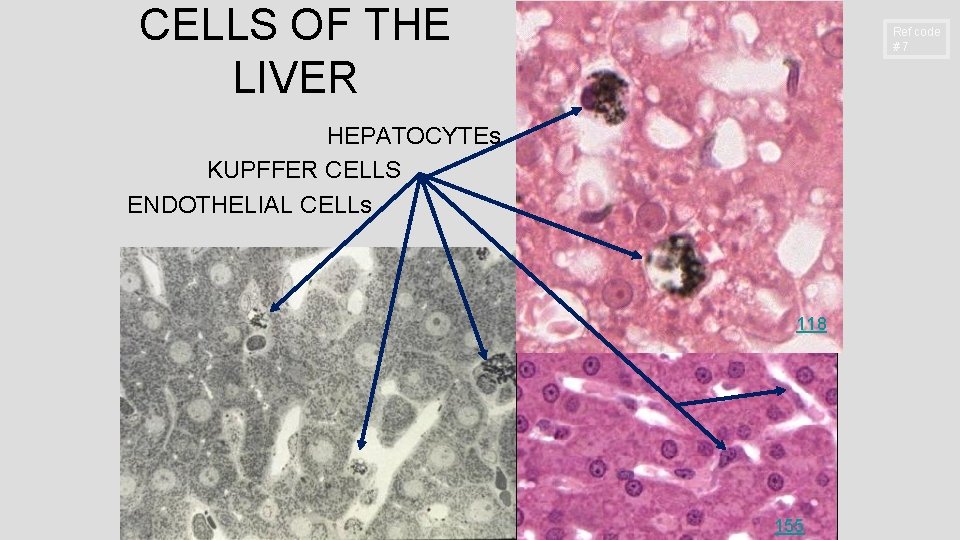
CELLS OF THE LIVER Ref code #7 HEPATOCYTEs KUPFFER CELLS ENDOTHELIAL CELLs 118 155
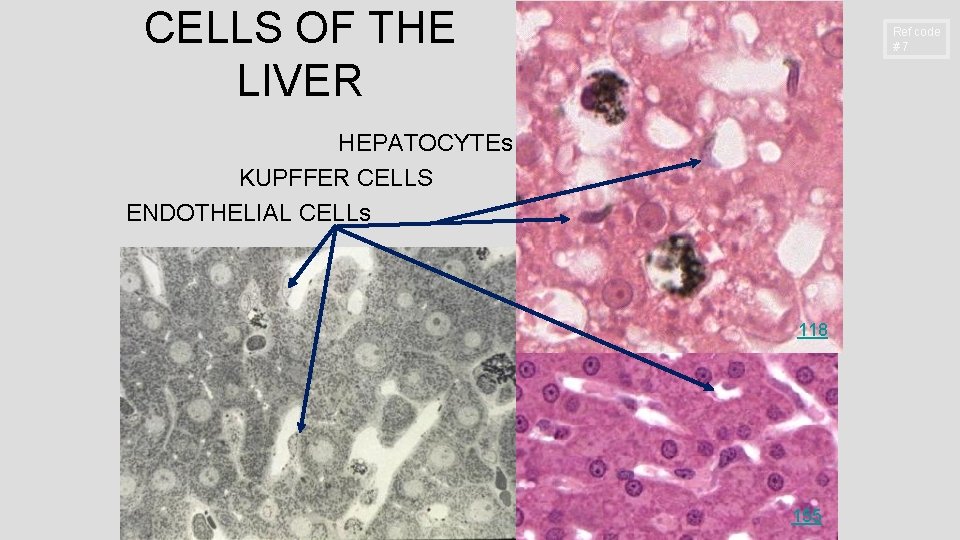
CELLS OF THE LIVER Ref code #7 HEPATOCYTEs KUPFFER CELLS ENDOTHELIAL CELLs 118 155
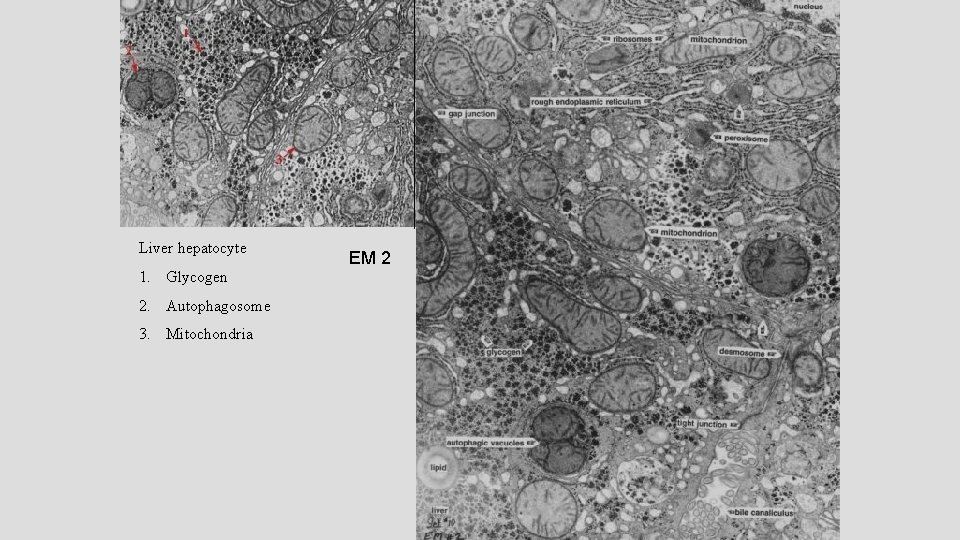
Liver hepatocyte 1. Glycogen 2. Autophagosome 3. Mitochondria EM 2
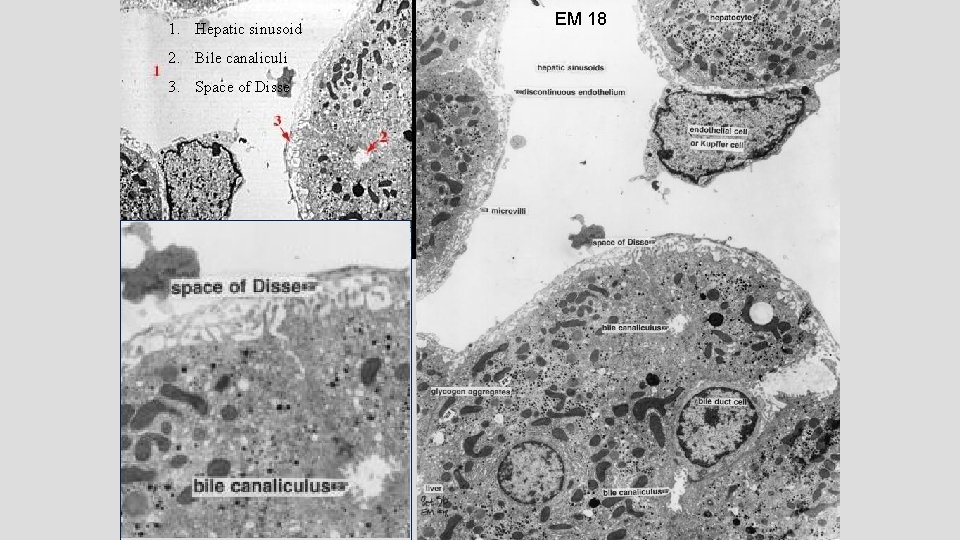
1. Hepatic sinusoid 2. Bile canaliculi 3. Space of Disse EM 18
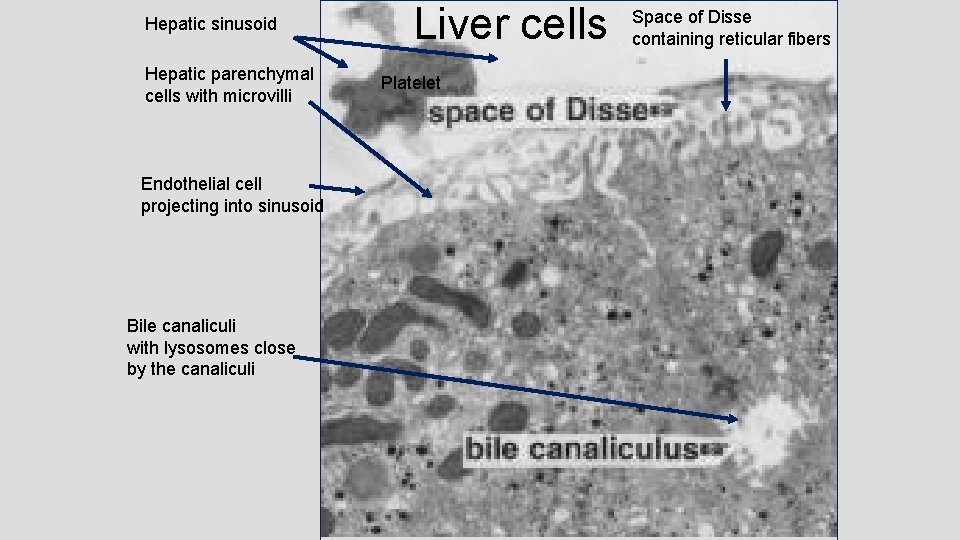
Hepatic sinusoid Hepatic parenchymal cells with microvilli Endothelial cell projecting into sinusoid Bile canaliculi with lysosomes close by the canaliculi Liver cells EM 18 Platelet Space of Disse containing reticular fibers
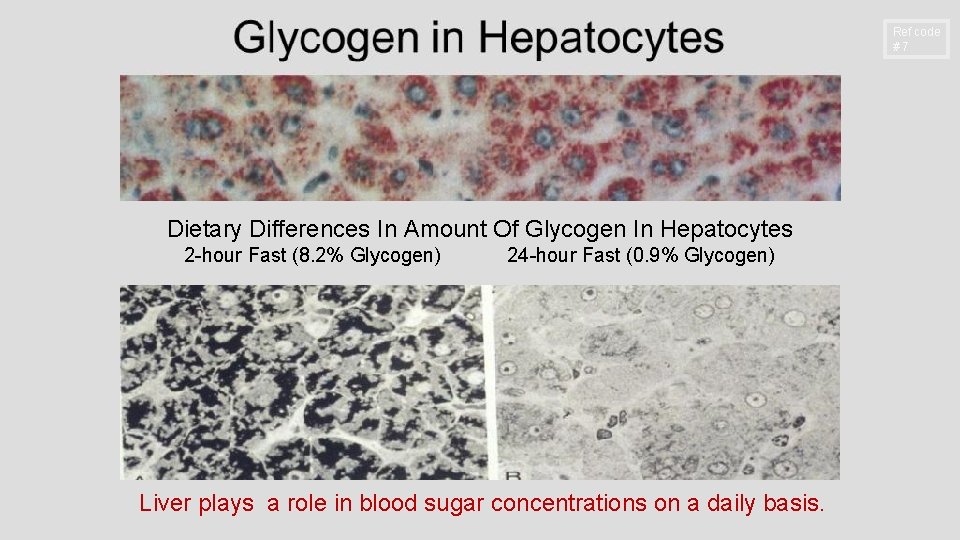
Ref code #7 Dietary Differences In Amount Of Glycogen In Hepatocytes 2 -hour Fast (8. 2% Glycogen) 24 -hour Fast (0. 9% Glycogen) Liver plays a role in blood sugar concentrations on a daily basis.
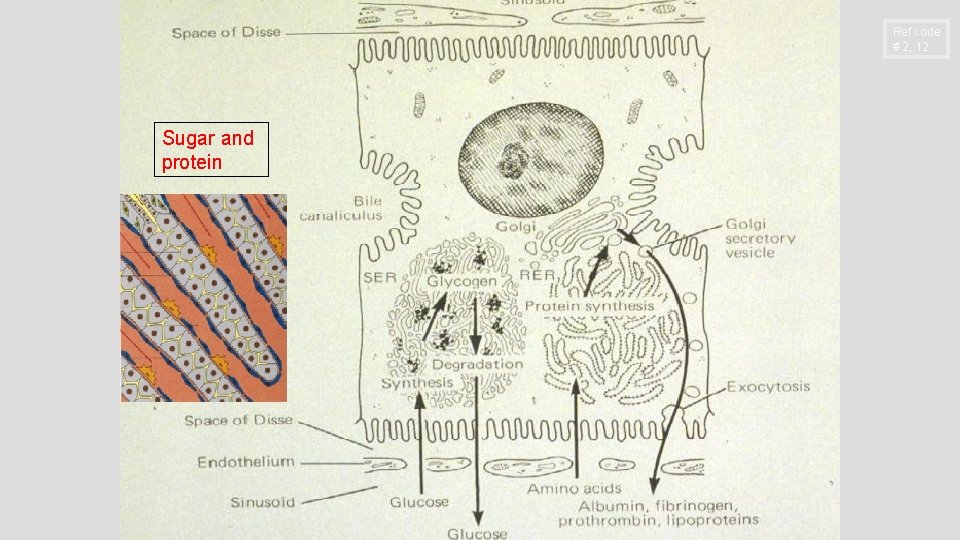
Ref code # 2, 12 Sugar and protein

Acinus with portal Ref code # 12 vein and artery in center ZONATION OF THE LIVER 1. Classical lobule 2. Portal lobule with triad in center 3. Acinus layers between two central veins
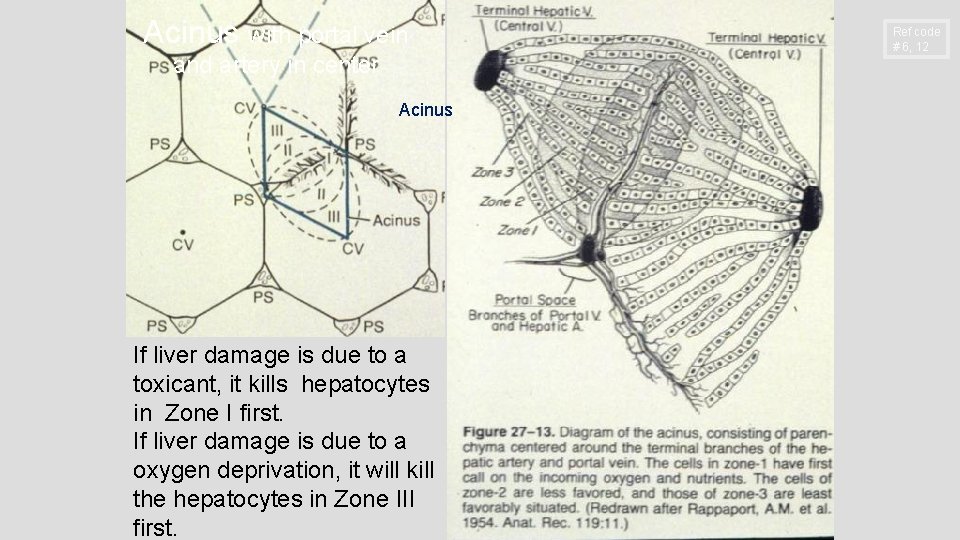
Acinus with portal vein and artery in center Acinus If liver damage is due to a toxicant, it kills hepatocytes in Zone I first. If liver damage is due to a oxygen deprivation, it will kill the hepatocytes in Zone III first. Ref code # 6, 12
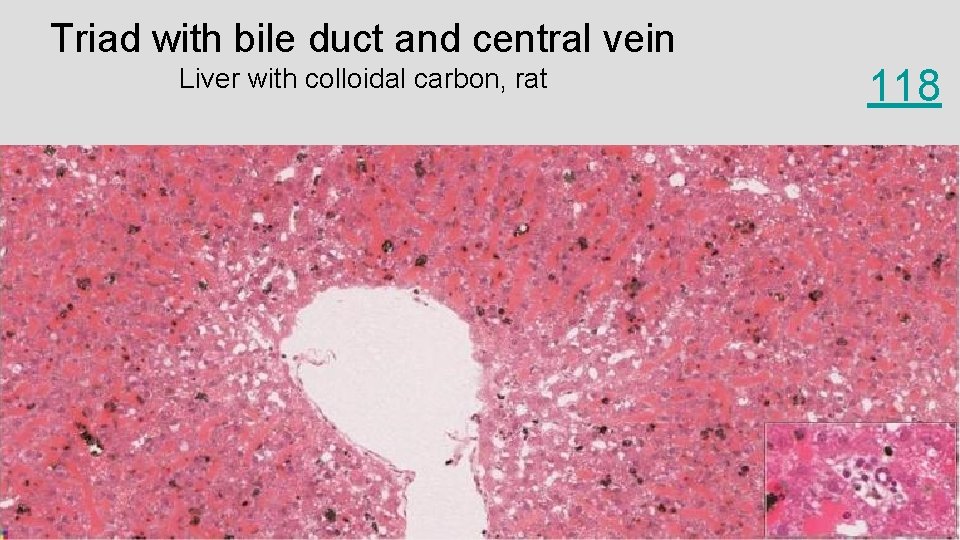
Triad with bile duct and central vein Liver with colloidal carbon, rat 118

155 Gallbladder & liver, monkey – Triad with bile duct in Liver Portal radicles : A bile duct Branch of portal vein Branch of hepatic artery HEPATOCYTEs KUPFFER CELLS ENDOTHELIAL CELLs Ref code #5
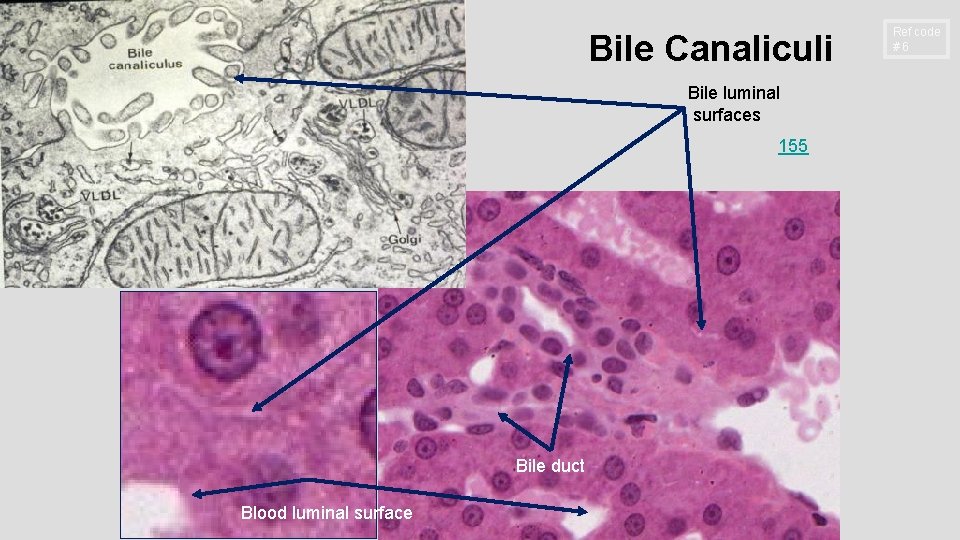
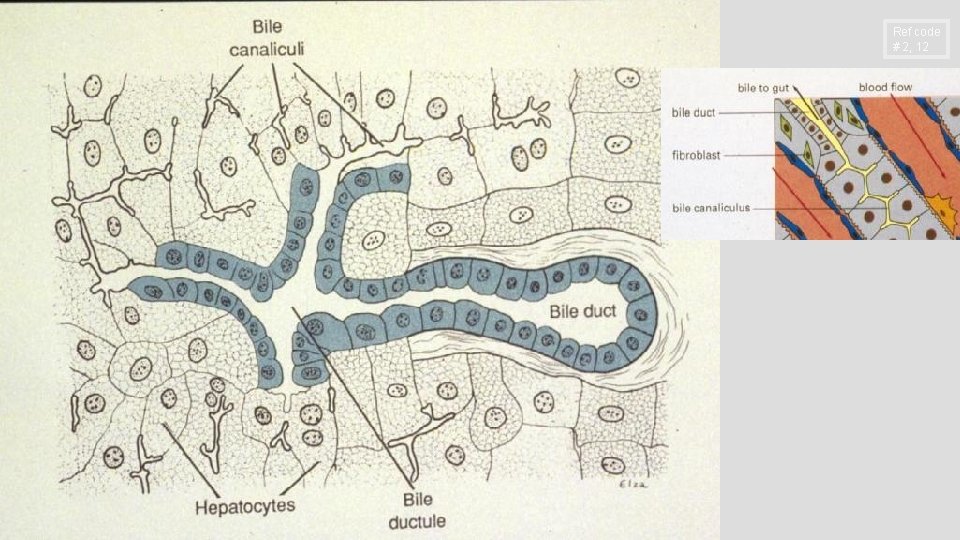
Bile Canaliculi Bile luminal surfaces 155 Bile duct Blood luminal surface Ref code #6
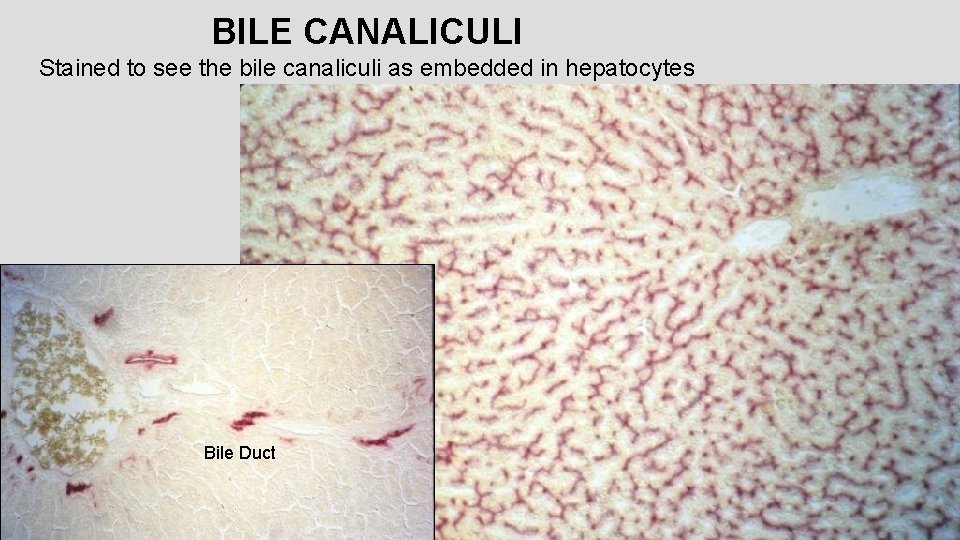
BILE CANALICULI Stained to see the bile canaliculi as embedded in hepatocytes Bile Duct
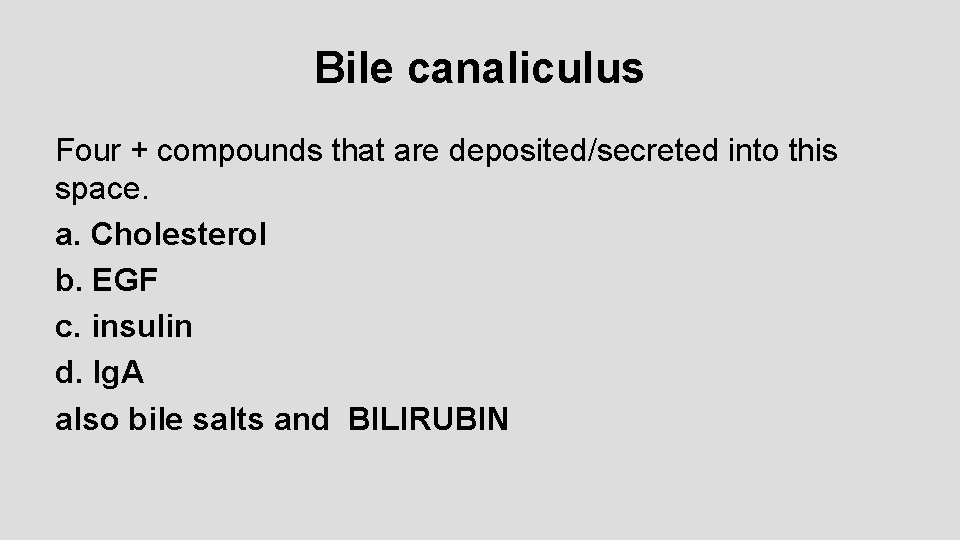
Bile canaliculus Four + compounds that are deposited/secreted into this space. a. Cholesterol b. EGF c. insulin d. Ig. A also bile salts and BILIRUBIN
Ref code # 2, 12
Ref code # 16 Cystic duct Portal vein
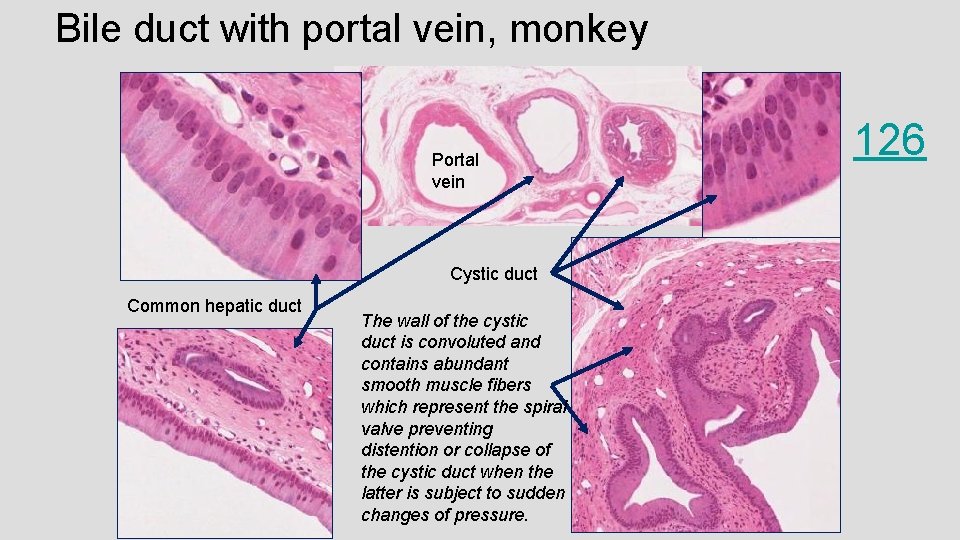
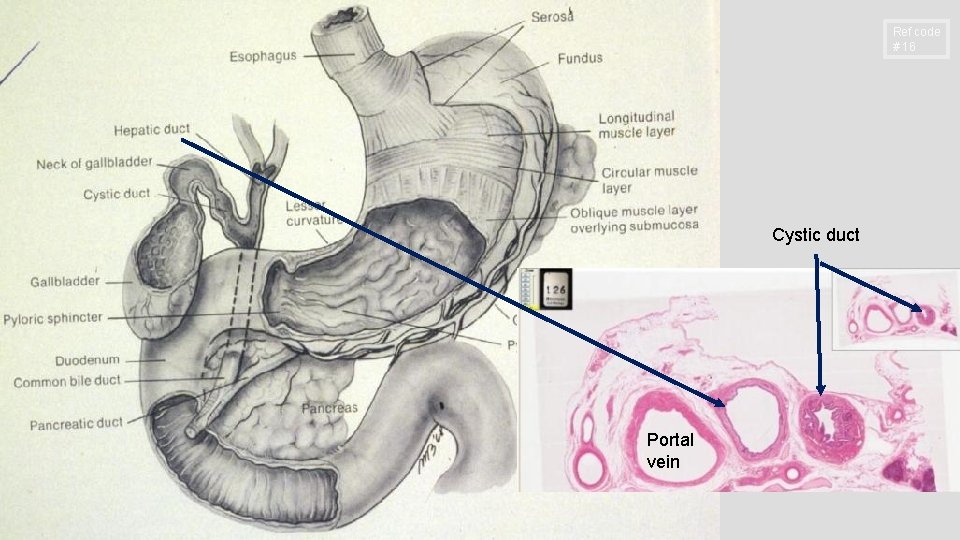
Bile duct with portal vein, monkey Portal vein Cystic duct Common hepatic duct The wall of the cystic duct is convoluted and contains abundant smooth muscle fibers which represent the spiral valve preventing distention or collapse of the cystic duct when the latter is subject to sudden changes of pressure. 126
Ref code #5
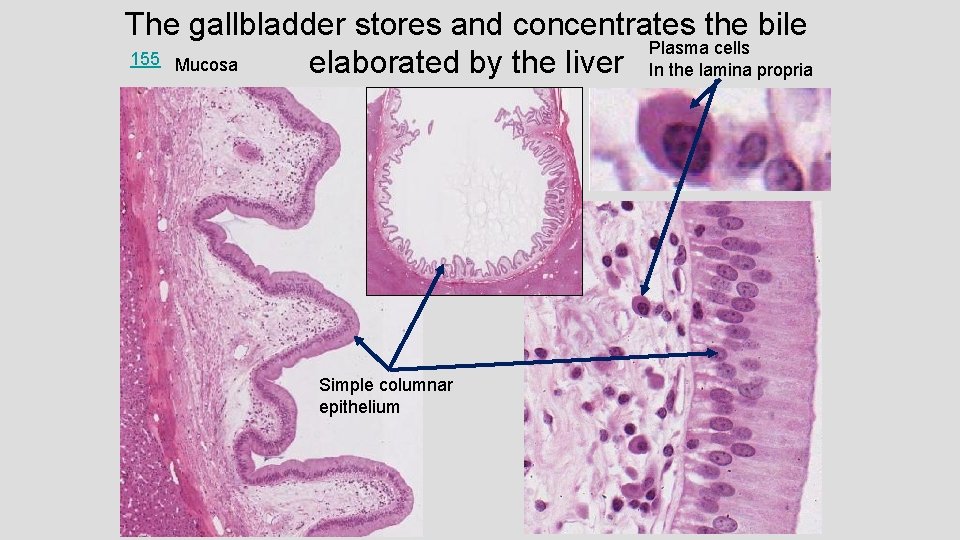
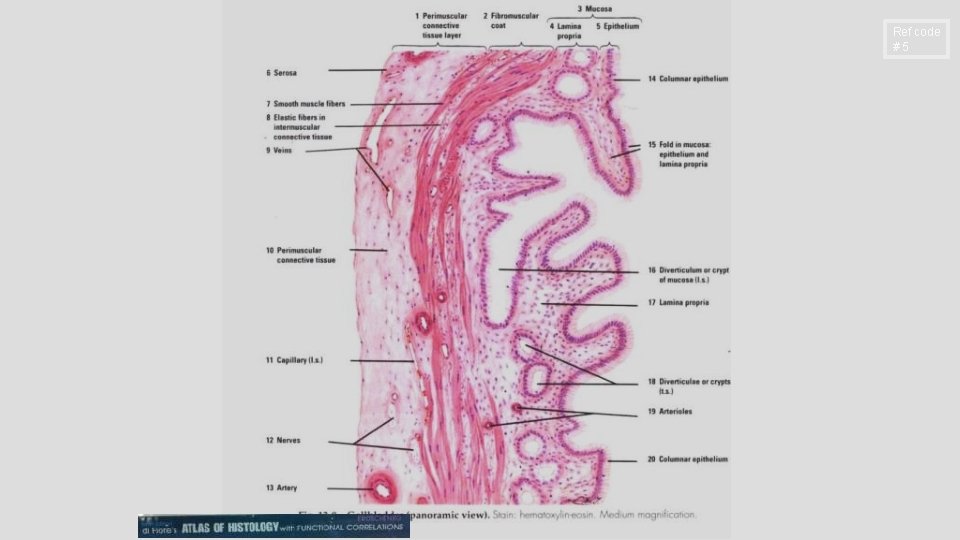
The gallbladder stores and concentrates the bile Plasma cells 155 Mucosa elaborated by the liver In the lamina propria Simple columnar epithelium

Gallbladder The mucosa is thrown into folds which project into the lumen of the gallbladder. 155 Smooth muscle layer or branching layers Lamina propria. A thick perimuscular layer of connective tissue. Simple columnar epithelium Peritoneal serosal layer
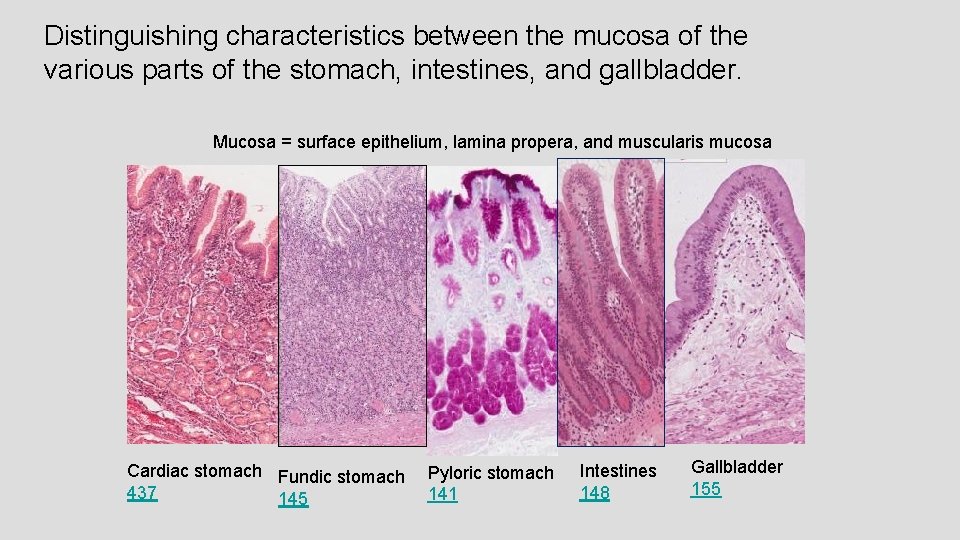
Distinguishing characteristics between the mucosa of the various parts of the stomach, intestines, and gallbladder. Mucosa = surface epithelium, lamina propera, and muscularis mucosa Cardiac stomach Fundic stomach 437 145 Pyloric stomach 141 Intestines 148 Gallbladder 155
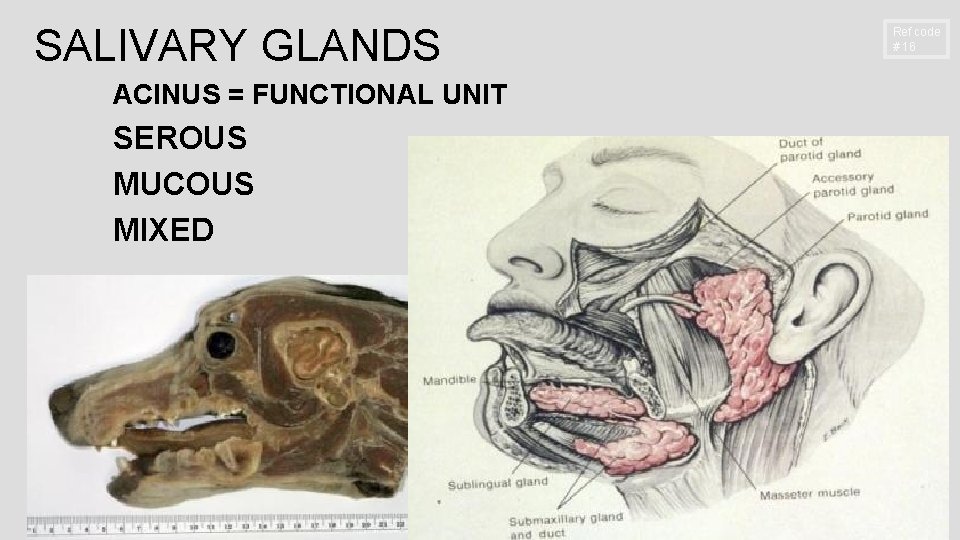
SALIVARY GLANDS ACINUS = FUNCTIONAL UNIT SEROUS MUCOUS MIXED Ref code # 16
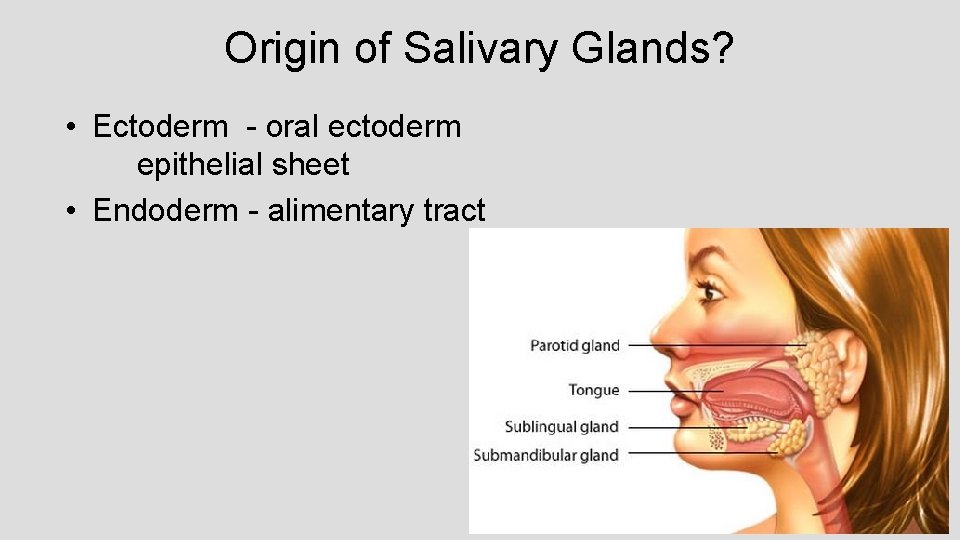
Origin of Salivary Glands? • Ectoderm - oral ectoderm epithelial sheet • Endoderm - alimentary tract
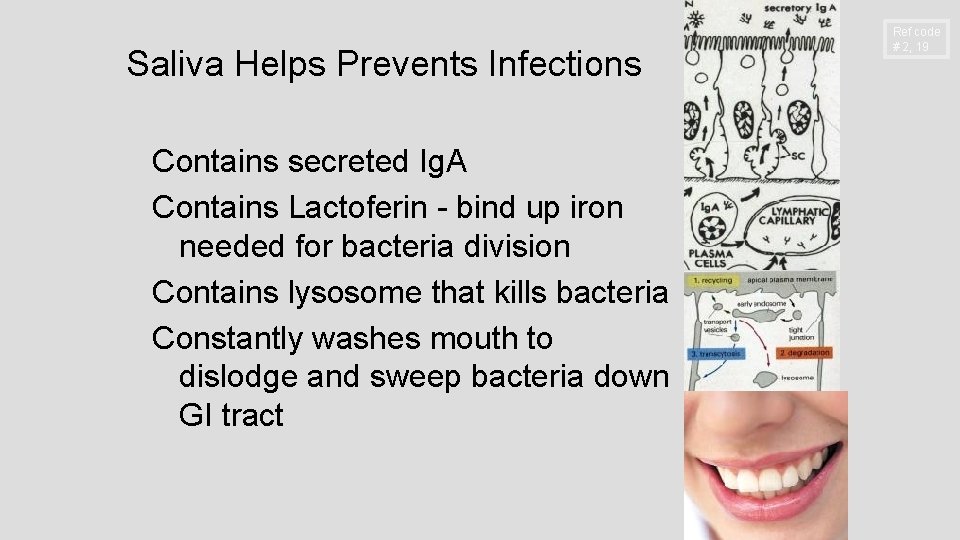
Saliva Helps Prevents Infections Contains secreted Ig. A Contains Lactoferin - bind up iron needed for bacteria division Contains lysosome that kills bacteria Constantly washes mouth to dislodge and sweep bacteria down GI tract Ref code # 2, 19
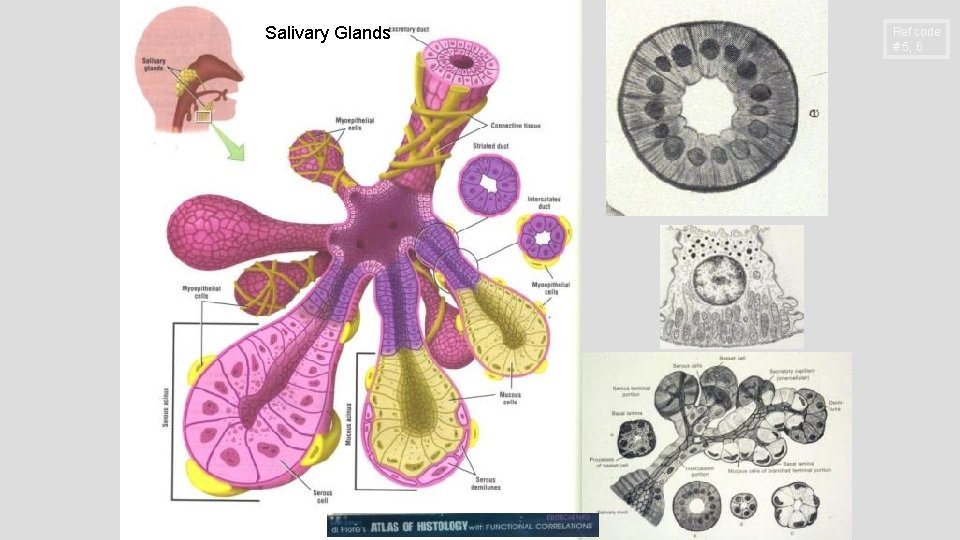
Salivary Glands Ref code # 5, 6
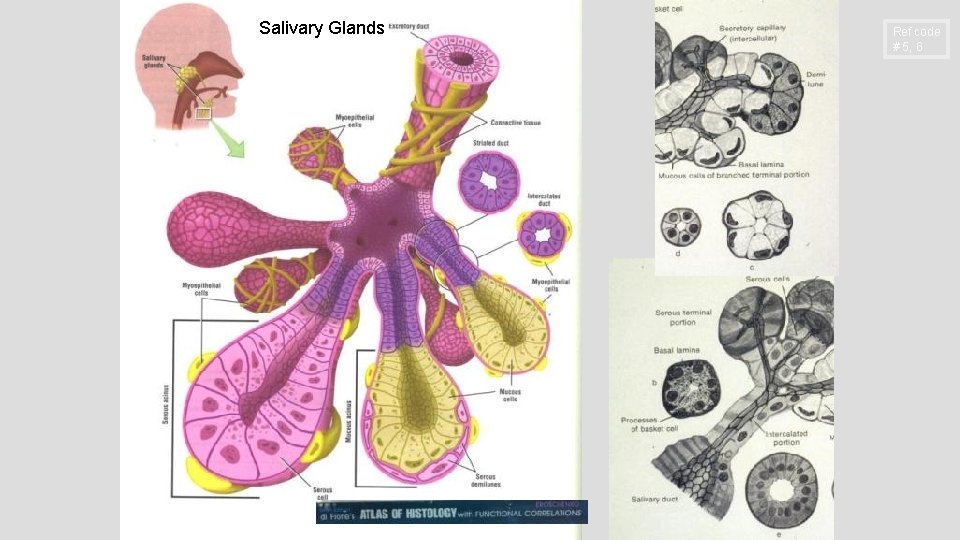
Salivary Glands Ref code # 5, 6
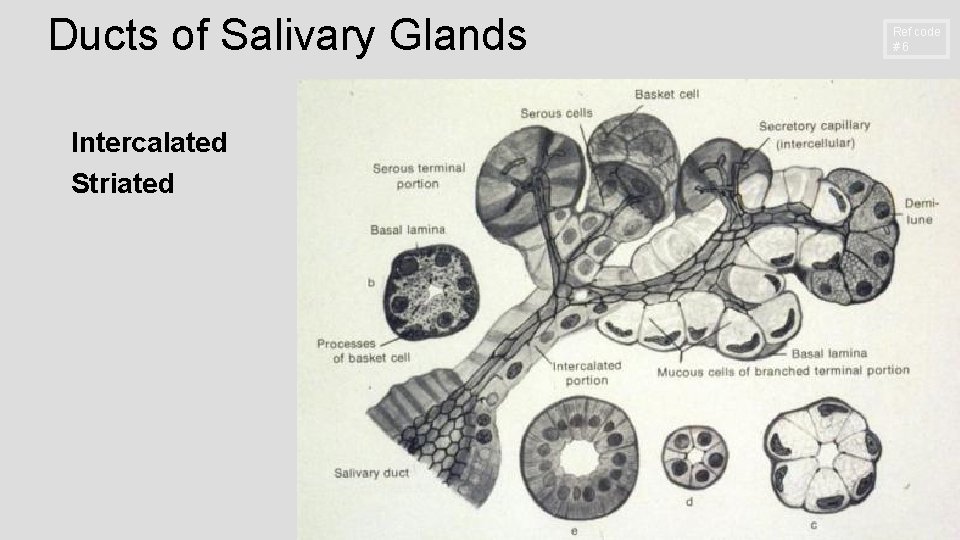
Ducts of Salivary Glands Intercalated Striated Ref code #6
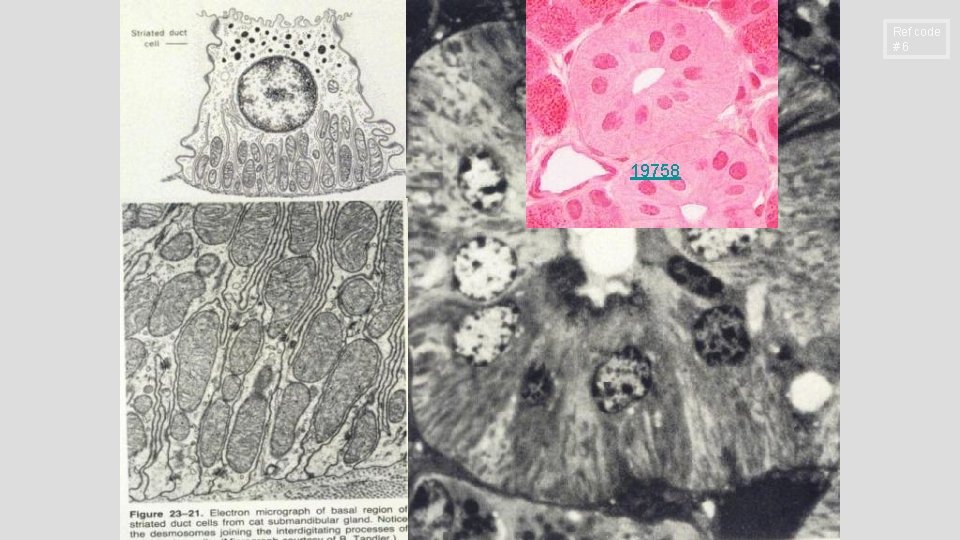
Ref code #6 19758
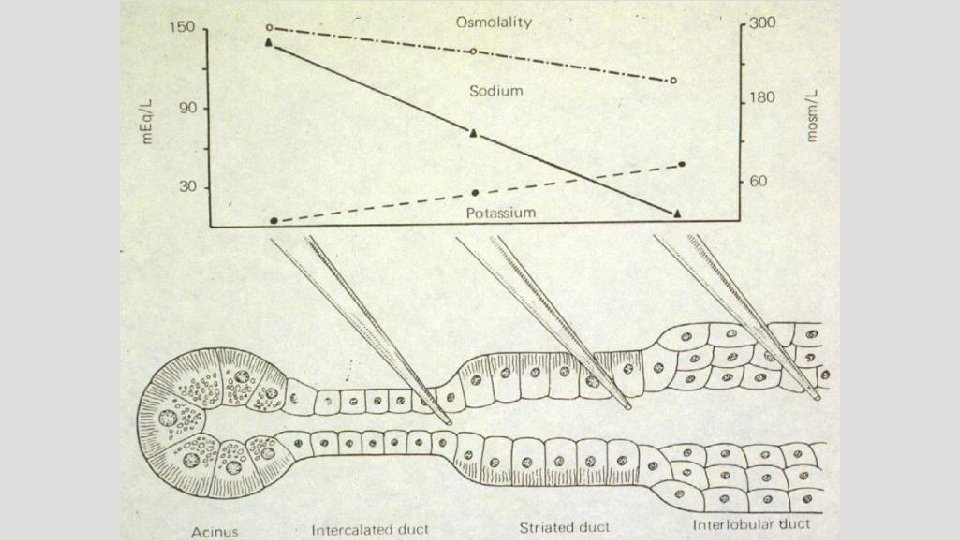
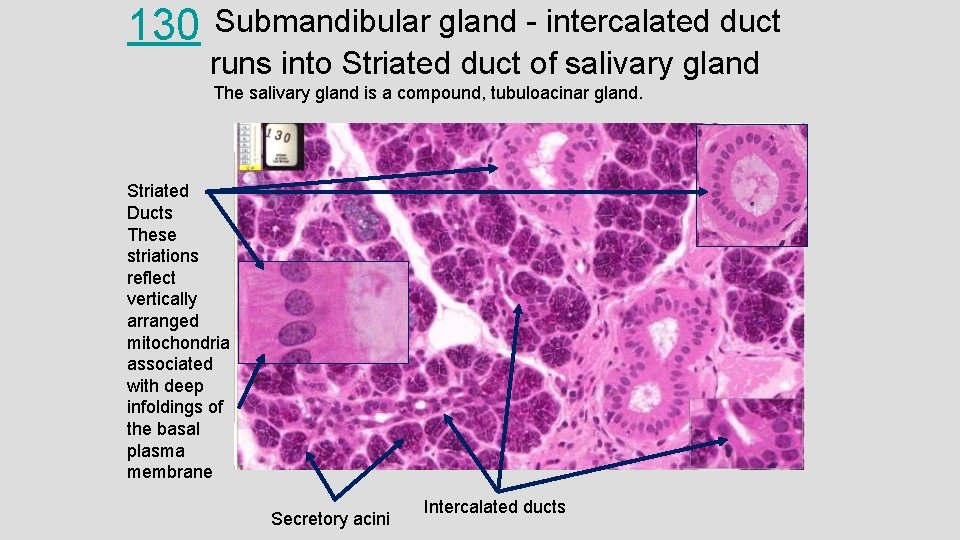
130 Submandibular gland - intercalated duct runs into Striated duct of salivary gland The salivary gland is a compound, tubuloacinar gland. Striated Ducts These striations reflect vertically arranged mitochondria associated with deep infoldings of the basal plasma membrane Secretory acini Intercalated ducts

130 Salivary gland Secretory acini are drained by intercalated ducts and join striated ducts Serous and mucous acini Myoepithelial cells
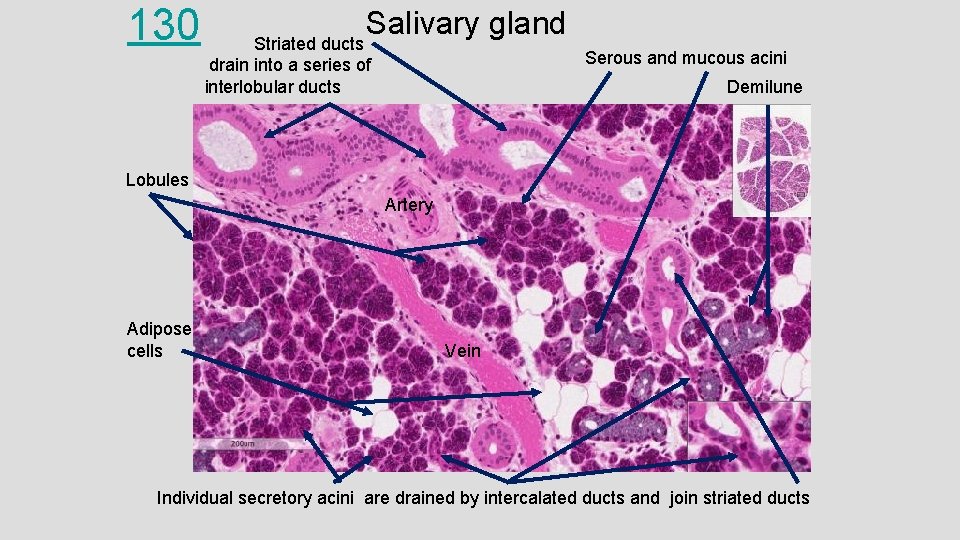
130 Salivary gland Striated ducts drain into a series of interlobular ducts Serous and mucous acini Demilune Lobules Artery Adipose cells Vein Individual secretory acini are drained by intercalated ducts and join striated ducts
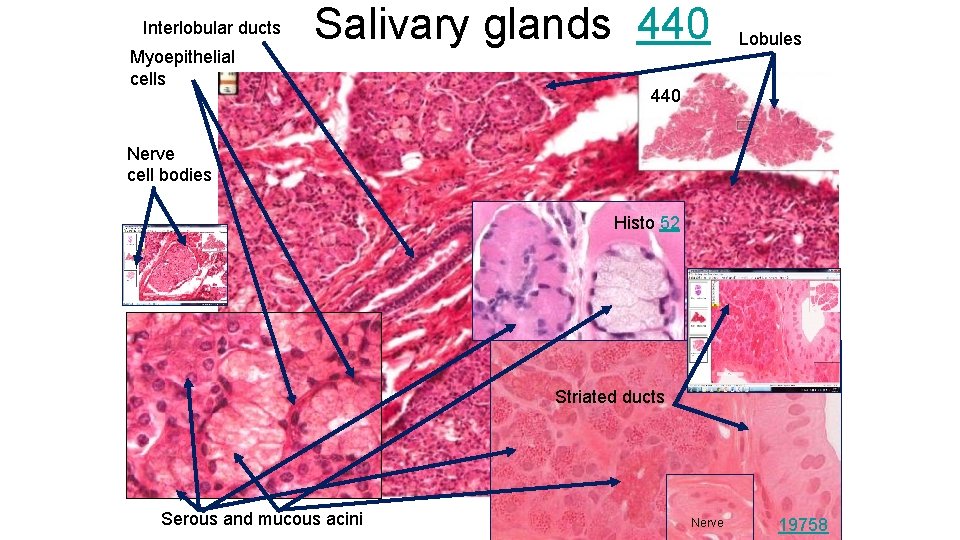
Interlobular ducts Myoepithelial cells Salivary glands 440 Lobules 440 Nerve cell bodies Histo 52 Striated ducts Serous and mucous acini Nerve 19758
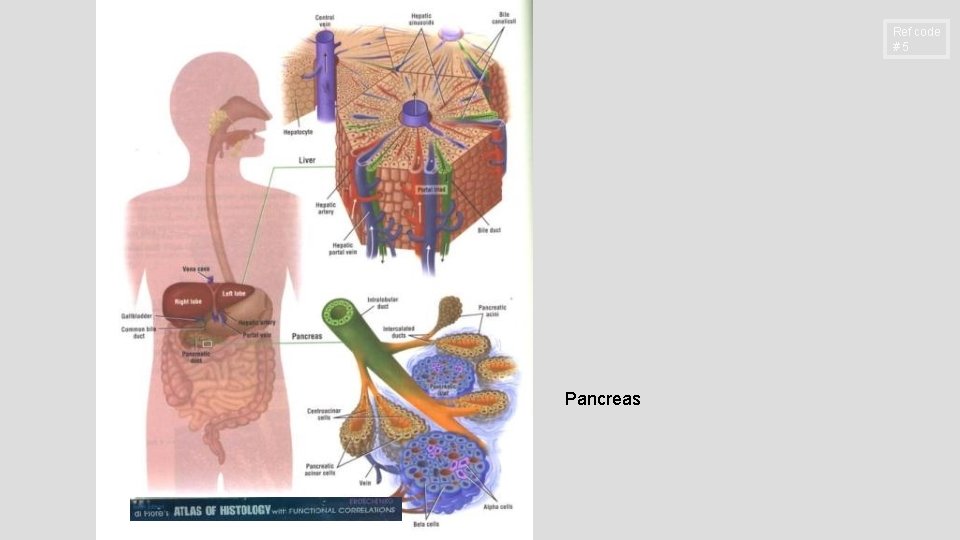
Ref code #5 Pancreas

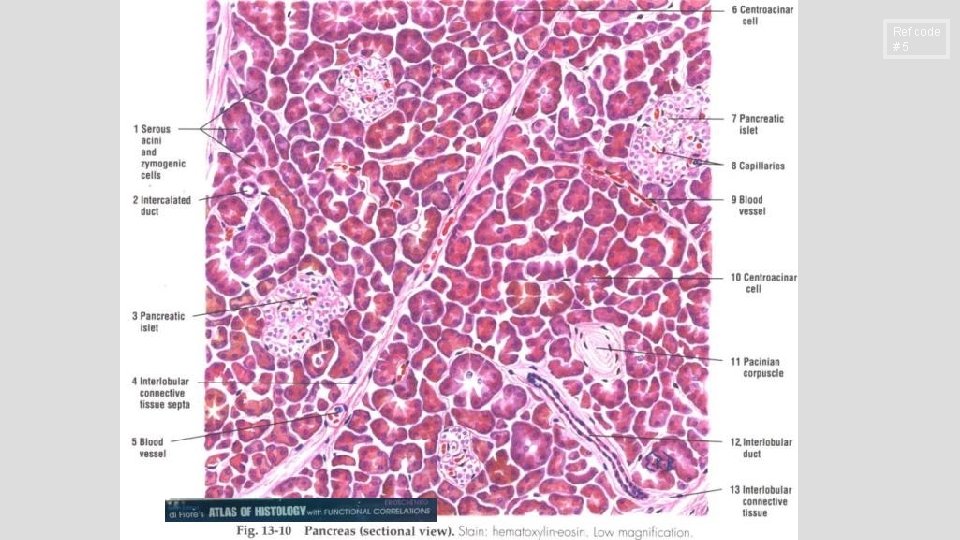
PANCREAS FUNCTION 1. EXOCRINE 2. ENDOCRINE HISTOLOGICAL ORGANIZATION, EXOCRINE PORTION 1. ACINI 2. DUCTS ENDOCRINE PORTION • ISLETS OF LANGERHANS HISTOPHYSIOLOGY
Ref code #5
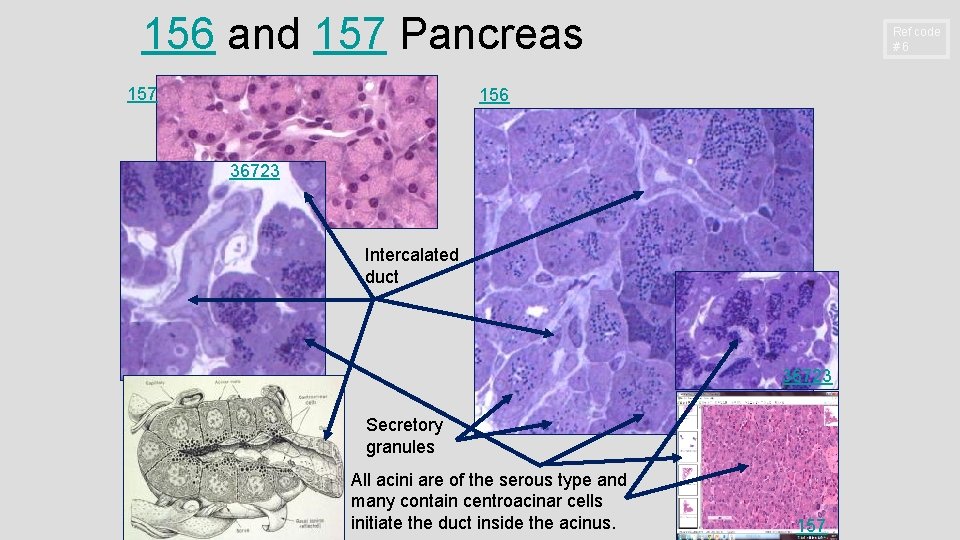
156 and 157 Pancreas 157 Ref code #6 156 36723 Intercalated duct 36723 Secretory granules All acini are of the serous type and many contain centroacinar cells initiate the duct inside the acinus. 157
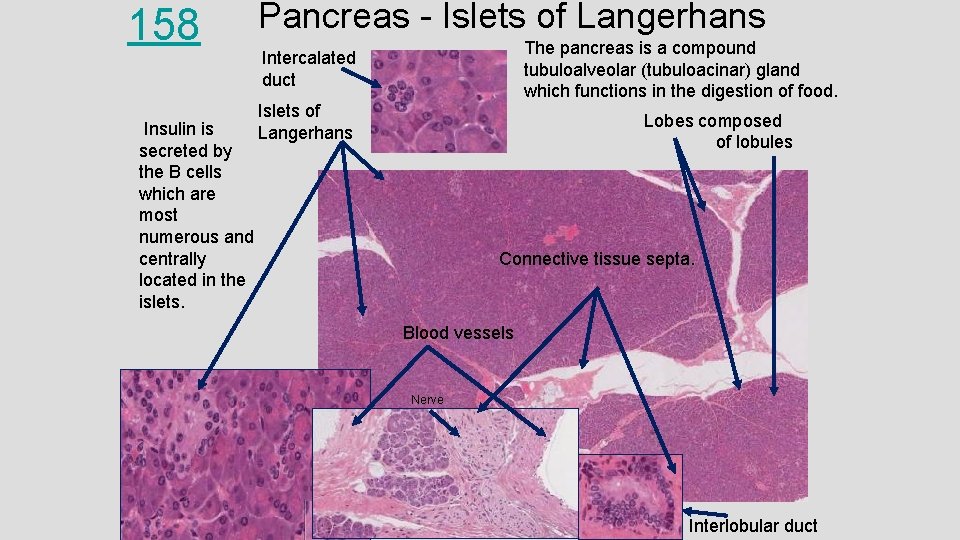
158 Insulin is secreted by the B cells which are most numerous and centrally located in the islets. Pancreas - Islets of Langerhans The pancreas is a compound tubuloalveolar (tubuloacinar) gland which functions in the digestion of food. Intercalated duct Islets of Langerhans Lobes composed of lobules Connective tissue septa. Blood vessels Nerve Interlobular duct
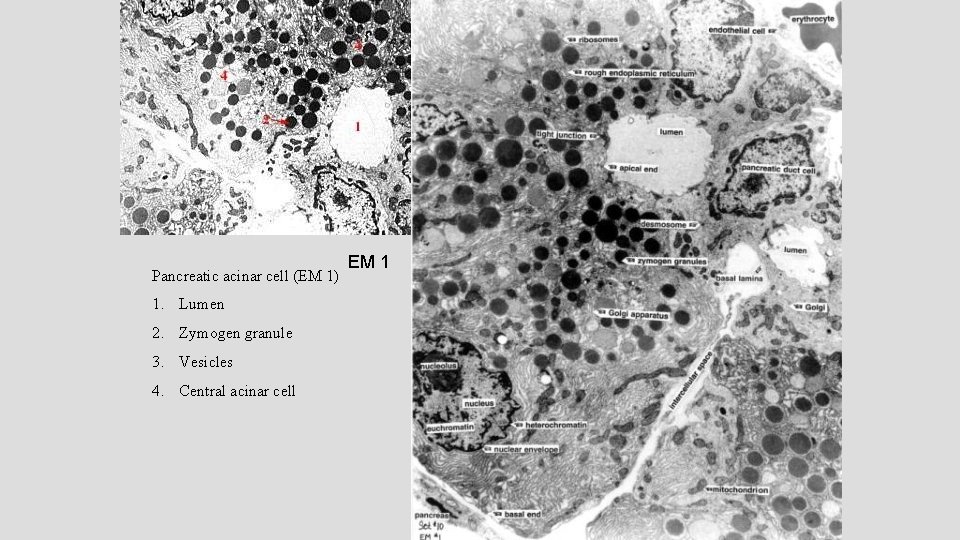
Pancreatic acinar cell (EM 1) 1. Lumen 2. Zymogen granule 3. Vesicles 4. Central acinar cell EM 1
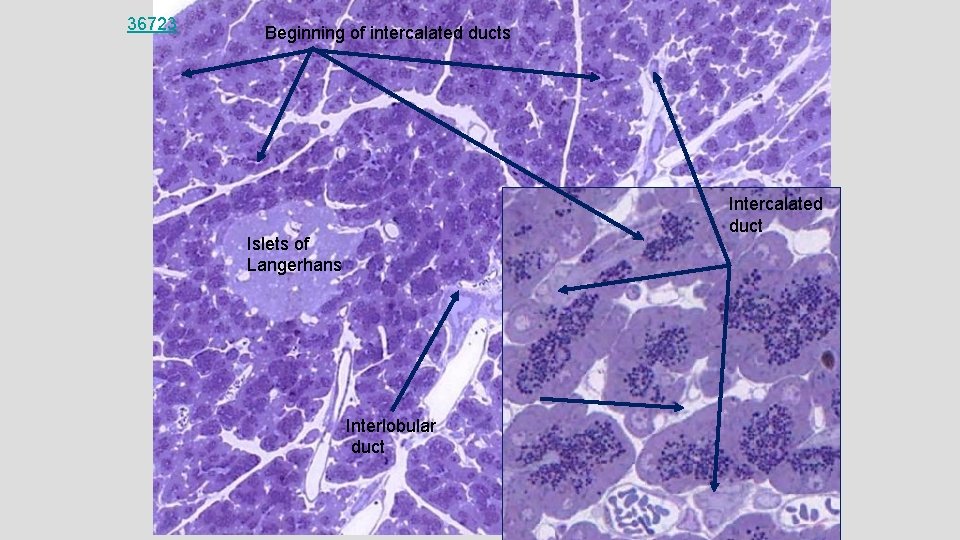
36723 Beginning of intercalated ducts Intercalated duct Islets of Langerhans Interlobular duct
In summary
Many illustrations in these VIBS Histology You. Tube videos were modified from the following books and sources: Many thanks to original sources! 1. Alberts, et al. , 1989. Molecular Biology of the Cell. 2 nd Edition. Garland Publishing, Inc. New York. ISBN 0 -8240 -3695 -6. 2. Alberts, et al. , 1994. Molecular Biology of the Cell. 3 nd Edition. Garland Publishing, Inc. New York. ISBN 0 -8153 -1619 -4. 3. Bloom, W. and Fawcett, D. W. , 1968. A Textbook of Histology. 9 th Edition. W. B. Saunders Company. Philadelphia. Library of Congress #67 -17445. 4. Elias, H. et al. , 1978. Histology and Human Microanatomy. A Wiley Medical Publication. John Wiley & Sons, New York. ISBN 0 -47104929 -8. 5. Eroschenko, V. 2000. Di Fiore’s Atlas of Histology with Functional Correlations. 9 th Edition. Lippincott Williams & Wilkins. Philadelphia. ISBN 07817 -2676 -X. 6. Fawcett, D. W. , 1986. Bloom and Fawcett. A Textbook of Histology. 11 th Edition. W. B. Saunders Company. Philadelphia. ISBN 0 -72161729 -8. 7. Fawcett, D. W. , 1994. Bloom and Fawcett. A Textbook of Histology. 12 th Edition. Chapman and Hall. New York. ISBN 0 -412 -04691 -1. 8. Guyton, A. C. 1971. Textbook of Medical Physiology. 4 th Edition. W. B. Saunders Company. Philadelphia. Library of Congress # 74118589. 9. Ham, A. W. 1974. Histology. 7 th Edition. J. B. Lippincott Company. Philadelphia. ISBN 0 -397 -52062 -X. 10. Ham, A. W. and Cormack, D. H. 1979. Histology. 8 th Edition. J. B. Lippincott Co. Philadelphia. ISBN 0 -397 -52089 -1. 11. Junqueria, et al. , 1995. Basic Histology. 8 th Edition. Appleton and Lange. Norwalk, Connecticut. ISBN 08385 -0567 -8. 12. Junqueira, et al. , 1998. Basic Histology. 9 th Edition. Appleton and Lange. Stamford, Connecticut. ISBN 0 -8385 -0590 -2. 13. Knobil, E. et al. 1988. The Physiology of Reproduction. Volume 1. Raven Press. New York. ISBN 0 -88167 -281 -5. 14. Langley, et al. , 1974. Dynamic Anatomy and Physiology. 4 th Edition. Mc. Graw-Hill Book Company. New York. ISBN 0 -07 -036274 -2. 15. Mescher, A. L. , 2010. Junqueira’s Basic Histology Text and Atlas. 12 th Edition. Mc. Graw Hill Medical. New York. ISBN 978 -0 -07 -1604314. 16. Tuttle, W. W. and Schottelius, B. A. 1969. Textbook of Physiology. 16 th Edition. The C. V. Mosby Company. Saint Louis. Library of Congress # 7589848. 17. Varner, D. et al. 1991. Diseases and Management of Breeding Stallions. American Veterinary Publications. Goleta, California. ISBN 0939674 -33 -5. 18. Von Hagens, Gunther and A. Whalley, 2007. Body Worlds – The Anatomical Exhibition of Real Human Bodies. ISBN 978 -3 -937256 -04 -7 19. Weiss, L. 1983. Histology: Cell and Tissue Biology. 5 th Edition. Elsevier Biomedical. New York. ISBN 0 -444 -00716 -4. 20. Weiss, L. and Greep, R. 1977. Histology. 4 th Edition. Mc. Graw-Hill Book Company. New York. ISBN 0 -07 -069091 -X.
Questions on the Liver, pancreas, and salivary glands The humoral activity of the immune system is illustrated by the transfer of Ig. A immunoglobin by epithelial cells into which of the following body fluids? a. saliva b. milk c. bile d. a and b e. a, b, and c Which function(s) do the gallbladder and urinary bladder have in common? a. temporary storage of waste products b. concentration of their respective luminal contents c. similar type of luminal epithelium d. a and b e. a, b, and c Characteristics of the pancreas include: a. a portal blood vascular system b. endocrine cells of the islets of Langerhans c. acinar cells and striated ducts d. a and b e. a, b, and c
The end of
- Slides: 63