
Medical School DDP MED 6950 Literature review Vikki


- Slides: 31
Medical School DDP MED 6950 (Literature review) Vikki Ridger v. c. ridger@sheffied. ac. uk Julie Simpson julie. simpson@sheffield. ac. uk http: //www. sheffield. ac. uk/medicine/current/postgraduates/ ddp/med 6950
Literature Review • An account or description of a research area/topic which is supported by previously published work • A review of the literature that relates to YOUR research topic • Not simply a summary of the literature, but an indepth discussion and critical analysis of the topic • Should identify questions and gaps in the field, thus justifying the need for your research 28/11/2020 © The University of Sheffield
Purpose of writing this review • Understand the field and gain a firm grasp of competing hypotheses • Gain ‘ownership’ of your project • Clarify why your research project is important • Much of it can be utilised in the Introduction to your confirmation report and form the core structure of the Introduction to your thesis • Scientific writing, literature searching, use of reference manager & contents page tools, figure construction • Important skill for anyone with a scientific career • Mandatory for confirmation on Ph. D track 28/11/2020 © The University of Sheffield
Literature Review Content • Discuss content with supervisor at outset • Should contain factual information that can be referenced and therefore verified • Should cover entire scope of your study • Conflicting arguments should be equally weighted and discussed – it is a review! • You may express an “evaluated opinion” or speculate on controversial data after full discussion of the literature 28/11/2020 © The University of Sheffield
Information sources 1 • Your supervisor • Your colleagues/team members • Online databases (Pubmed/Scopus) • Library ejournals • Books - good, but can be out of date • Websites – careful, best avoided • Peer reviewed published work is more reliable… 28/11/2020 © The University of Sheffield
Information Sources 2 • Reviews are useful to familiarise yourself with the field but. . . avoid referencing reviews except to refer reader elsewhere • Aim for recent reviews • Use original peer-reviewed research articles – make sure you read and understand them 28/11/2020 © The University of Sheffield
Structure • Position and set the scene: why is it an important area? • Body – contains the detail - use sections to keep it clear • Use figures to help illustrate points raised in the text (better to use your own) • Finish with a conclusion/summary to round it off – take home message • Provide a link to your research question 28/11/2020 © The University of Sheffield
Figures 1 • Actively encouraged - minimum of 3 • Graphs – Pictures – Diagrams • Colour is acceptable • Do not make text too small to read • Tailor your figures to your own review • Inset figures in a box that also contains the legend (make separation from text obvious or use a separate page) • Try to construct an original summary figure 28/11/2020 © The University of Sheffield
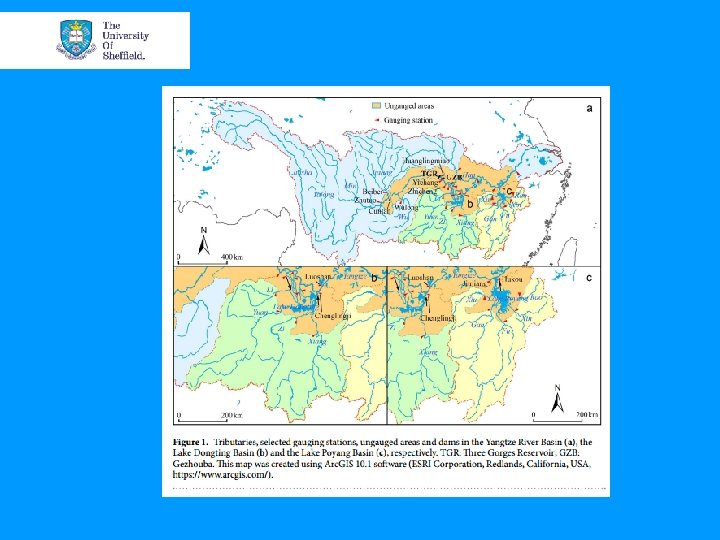
Figures - 2 • Include a title line that succinctly describes what the figure shows (do not begin the legend with ‘This figure shows…’) • Legend – describe what is in the figure – exempt from the word count • Do not use headings above the figure • If it is not yours, reference it • If you have adapted a figure, reference the original source 28/11/2020 © The University of Sheffield
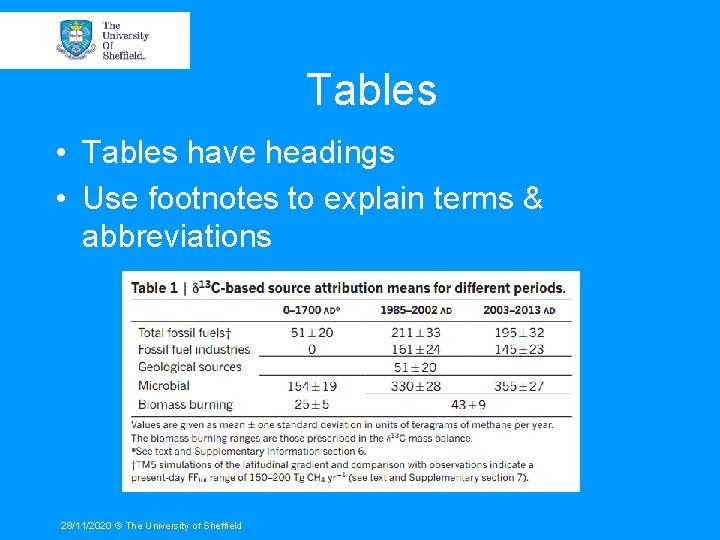
Tables • Tables have headings • Use footnotes to explain terms & abbreviations 28/11/2020 © The University of Sheffield
Figures & Tables • Refer to ALL figures and tables in the text before the point at which they appear 28/11/2020 © The University of Sheffield
Practicalities - 1 • Approximately 4000 words (guideline – flexible, 20 -30 pages) • Use 12 point font (e. g. Arial) • Spacing at 1. 5 lines • Title Page including DDP number, supervisor, department, registration number and your name 28/11/2020 © The University of Sheffield
Practicalities - 2 • Break into sections for each subject area – keeps a good structure • Include a contents page • Meaning of abbreviations should be given in the text or a list provided after contents 28/11/2020 © The University of Sheffield
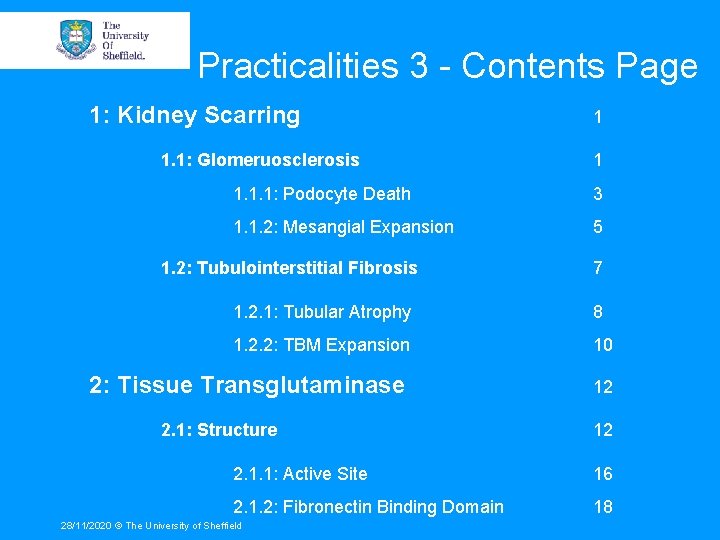
Practicalities 3 - Contents Page 1: Kidney Scarring 1. 1: Glomeruosclerosis 1 1 1. 1. 1: Podocyte Death 3 1. 1. 2: Mesangial Expansion 5 1. 2: Tubulointerstitial Fibrosis 7 1. 2. 1: Tubular Atrophy 8 1. 2. 2: TBM Expansion 10 2: Tissue Transglutaminase 12 2. 1: Structure 12 2. 1. 1: Active Site 16 2. 1. 2: Fibronectin Binding Domain 18 28/11/2020 © The University of Sheffield
Contents Page cont. • Word automated table of contents function will save a lot of time when writing your thesis – automatically updates • Use link below or search for instructions https: //support. office. com/en-gb/article/Create-a-table-of-contents-or-update-a-table-of-contents-1 bee 8114 -2 c 58 -46 fb-a 884 -64 c 6 dfecaeca • Takes time to master – learn now • Don’t go too deep with numbering e. g. 4. 1. 2. 1. 1 28/11/2020 © The University of Sheffield
Practicalities 4 - References • References must be done using a ‘reference manager’ (i. e. Endnote, Mendeley) • University supplies & supports Endnote. Online and PC based versions • Use ‘Author-date’ or ‘Harvard’ to aid the marker to validate your references easily • Bibliography in alphabetical order • References are not included in the word count 28/11/2020 © The University of Sheffield
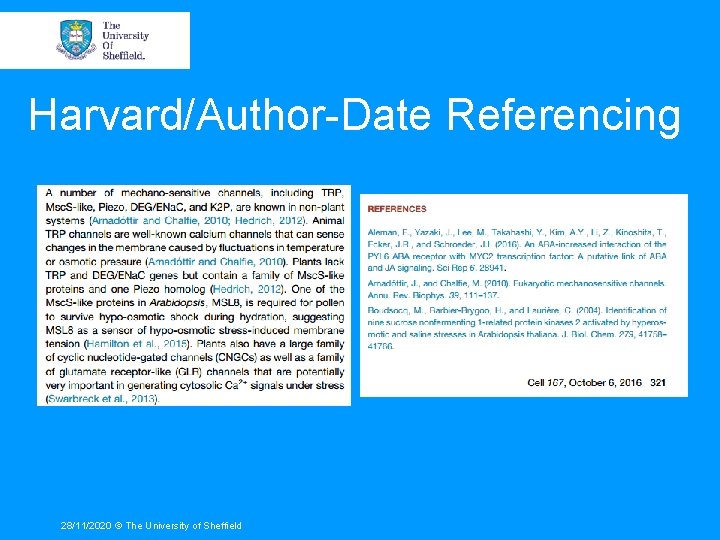
Harvard/Author-Date Referencing 28/11/2020 © The University of Sheffield
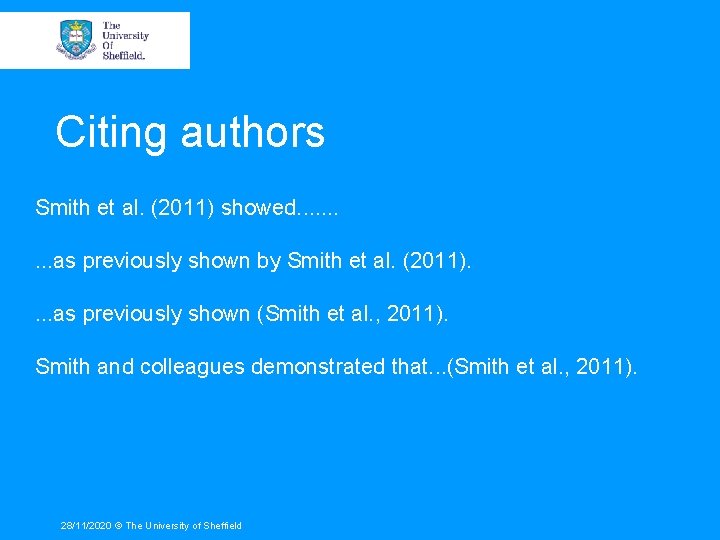
Citing authors Smith et al. (2011) showed. . as previously shown by Smith et al. (2011). . as previously shown (Smith et al. , 2011). Smith and colleagues demonstrated that. . . (Smith et al. , 2011). 28/11/2020 © The University of Sheffield
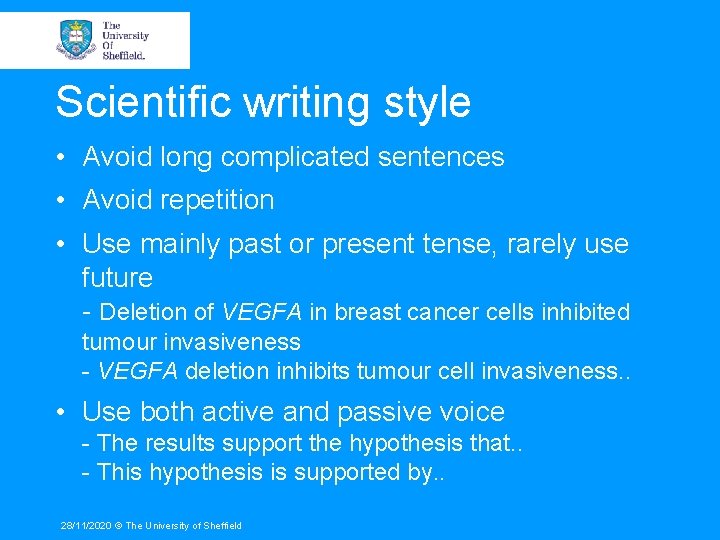
Scientific writing style • Avoid long complicated sentences • Avoid repetition • Use mainly past or present tense, rarely use future - Deletion of VEGFA in breast cancer cells inhibited tumour invasiveness - VEGFA deletion inhibits tumour cell invasiveness. . • Use both active and passive voice - The results support the hypothesis that. . - This hypothesis is supported by. . 28/11/2020 © The University of Sheffield
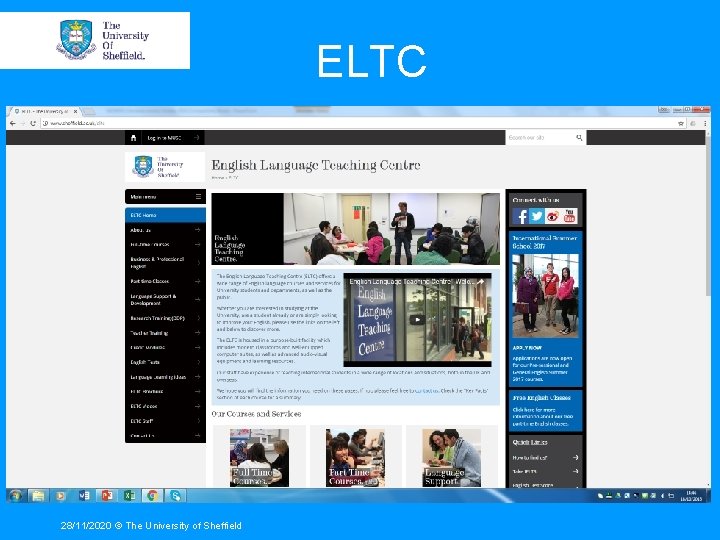
ELTC 28/11/2020 © The University of Sheffield
Plagiarism • Plagiarism is “passing off others’ work as your own, whether intentionally or unintentionally, to your benefit. The work can include ideas, compositions, designs, images, computer code, and, of course, words”. • You must avoid cutting and pasting, and close paraphrasing (switching words around) of sentences, paragraphs, etc. • http: //www. sheffield. ac. uk/polopoly_fs/1. 334794! /file/Use_of_Unfair_Means_Advice_to_Students. pdf 28/11/2020 © The University of Sheffield
Plagiarism • Is taken very seriously by the SGRC • You may use Turnitin to check your first draft - use the information in the report • Turnitin detects word strings, but identifies grammatical switching and word substitution in all published & local documents • A Plagiarism Committee exists and makes formal warnings to plagiarists • No excuses so talk to supervisor if in doubt 28/11/2020 © The University of Sheffield
In practice • Don’t copy chunks of text from reviews, papers or previous students’ literature reviews, transfer reports and theses • These are all logged in Turnitin (includes MSc theses) • You will be caught by Turnitin or markers • Reference figures, images and diagrams you have recreated or modified - Copyright 28/11/2020 © The University of Sheffield
Plagiarism - Summary • It is wrong • Do not do it • If you are caught, the penalty will be severe • Many cases are blamed on time pressure – not a valid excuse - don’t leave it to the last minute • Develop the habit of making notes in your own words instead of paraphrasing 28/11/2020 © The University of Sheffield
How to go about it • Discuss plan with supervisor – bullet point headings, key points and studies • Seek early feedback on writing style (one to two pages) • Obtain feedback from supervisor on full draft and act on it 28/11/2020 © The University of Sheffield
Submission - 1 • Thursday 7 th February 2019 by 5. 00 pm (unless part time) • Submit via MOLE to course MED 6950 Research Training - Literature Review (GRADUATE YEAR 2018~19) AND email one electronic copy to Carol Fidler (medicine-pgr@sheffield. ac. uk) • You must also email you reference manager library file to Carol so that she can verify its usage 28/11/2020 © The University of Sheffield
Submission - 2 • Your review will be checked for plagiarism before marking via Turnitin • Your supervisor and another member of staff knowledgeable in the area will mark your work • The mark is either Pass or Fail • If you fail, you will have only one more chance – pass mandatory for confirmation 28/11/2020 © The University of Sheffield
Top tips • Don’t summarise studies in a long list – synthesise, compare and contrast • Make sure you use linking sentences at the end of paragraphs that lead into the next topic • Make sure you have introduced a novel topic before going into detail • Give specific suggestions for future research – relate to your project • Original summary figure • Novel topic and title? – publishable 28/11/2020 © The University of Sheffield
Slides available at: http: //www. sheffield. ac. uk/medicine/current/postgraduates/ddp/med 6950 Any questions? 28/11/2020 © The University of Sheffield