
Medical Practitioners Assurance Framework MPAF Template slides for











- Slides: 30
Medical Practitioners Assurance Framework (MPAF) Template slides for Registered Managers training January 2020 v 1
Overview • The Independent Healthcare Providers Network • Context and ambition of the MPAF • MPAF Governance • Regulatory alignment, scope and application of the MPAF • Structure of the MPAF • Content of the MPAF – four sections, 11 key expectations • Action by multiple organisations • MPAF implementation & supporting resources
Independent Healthcare Providers Network (IHPN) • [NAME] is a member of IHPN. • IHPN is the UK wide membership association representing independent healthcare providers of NHS and privately funded clinical services • Members deliver a diverse range of services - acute, primary, community, homecare, diagnostic & dental • Members are both ‘for profit’ and ‘not for profit’ – from large international hospital groups to small specialist providers
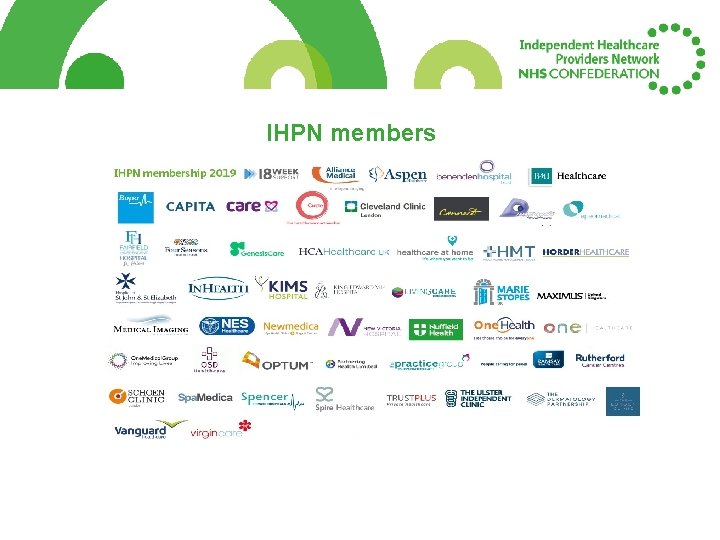
IHPN members
Context of the MPAF 2018
Ambition of the MPAF • The MPAF seeks to drive patient safety and quality through an approach aligned to the Kings Fund’s Three Lines of Defence. • It recognises the need to work together as an aligned healthcare system, working with medical practitioners and corporate boards and leaders within clearly defined, open governance structures. • It articulates the standards through which medical practitioners operate and through which healthcare providers hold and are held to account. Download the MPAF from the IHPN website
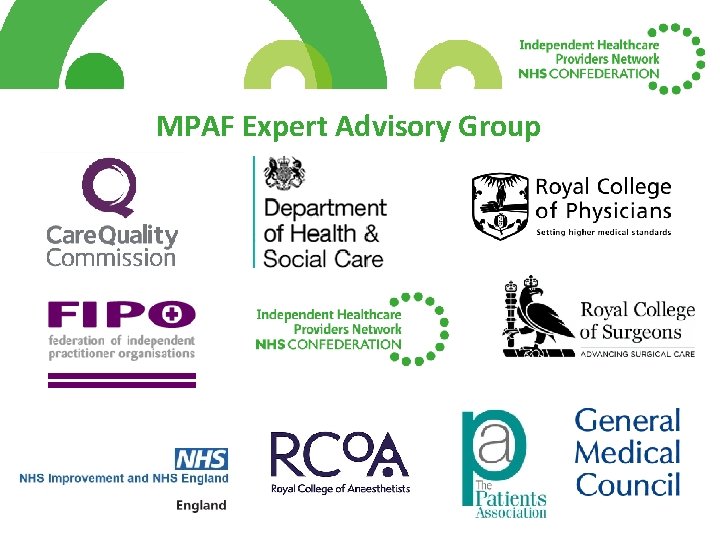
MPAF Governance • MPAF Expert Advisory Group developed the framework üChaired by Sir Bruce Keogh üIHPN member and external stakeholder representatives üInput from wider IHPN members üWidespread consultation with additional stakeholders
MPAF Expert Advisory Group
Timelines & Review process • Final draft signed off by IHPN Board in July 2019. • MPAF (England) formally launched at IHPN Summit on 23 October 2019. • The Chief Executives of 30 IHPN members wrote to the Secretary of State for Health and Social Care in October 2019 to underline their commitment to implementing the MPAF in their organisations. • MPAF is being adapted for Scotland, Wales and Northern Ireland. • The MPAF is consensus view of expected practice and will evolve as expected practice evolves and has an inbuilt annual review process. • IHPN and the MPAF Expert Advisory Group will conduct a “One Year On” Impact study by October 2020.
Regulatory Alignment • MPAF aligns with existing legal and regulatory frameworks: GMC’s Good Medical Practice, Responsible Officer Regulations and CQC’s Well led Key Line of Enquiry. • CQC formally welcomed the MPAF as follows: “This framework is a welcome development and an important step forward in addressing the need for stronger medical governance across the independent sector. While sign up to the framework is not mandatory or something CQC has the power to enforce, where providers can demonstrate effective and robust implementation of its principles, this will be considered as evidence of good governance and will inform the judgement we make about how well led services being provided by that organisation are. ”
Scope of the MPAF The MPAF applies to all medical practitioners working in independent healthcare settings through practising privileges or on an employed basis.
Application of the MPAF “One size will not fit all” and the MPAF recognises that organisations have different structures. Providers should be able to demonstrate how their individual systems and processes meet the expectations of the MPAF. The framework does not require providers to replace structures.
Video Input from Sir Bruce Keogh – click on the image to play video
Structure of the MPAF The framework is divided into four sections and sets out the following in each. A. What are we trying to achieve? B. What are provider responsibilities? C. What are medical practitioners responsibilities?
Four sections of the MPAF 1. Creating an effective medical governance structure for medical practitioners 2. Monitoring patient safety, clinical quality and encouraging continuous improvement 3. Supporting whole practice appraisal 4. Raising and responding to concerns The MPAF sets out 11 Key Expectations of providers and medical practitioners across the four areas.
Creating an effective medical governance structure for medical practitioners What are we trying to achieve? “Independent providers should have transparent and, as far as possible, consistent approaches to clinical governance for doctors in their organisations that support high quality patient care and are well understood by doctors and independent providers. ”
Creating an effective medical governance structure for medical practitioners – Expectations 1 -4 1. Have a “ward to board” clinical governance structure with clear lines of accountability up and down the organisation. [In the document we suggest minimum requirements. ] 2. Move towards more consistency in clinical governance for medical practitioners by developing an IHPN practising privileges template documentation
Creating an effective medical governance structure for medical practitioners – Expectations 1 -4 3. Standardise the following key aspects of practising privileges: • dataset required on application for and renewal of practising privileges; • data requested about scope of practice; • how and when there is a review of practising privileges; • approval requirements for medical practitioners to use new procedures and treatments. [More detail on each of these in the document. ] In respect of directly employed medical practitioners there should be a consistent approach in using similar or overlapping datasets to those above when considering: • the implementation of recruitment processes to ensure the individual is able to meet the skills and capabilities of the role as identified in the job description and person specification; and • the policies which will be applicable as regards ongoing performance management, appraisal and review of employed medical practitioners to ensure adherence to the standards expected.
Creating an effective medical governance structure for medical practitioners – Expectations 1 -4 4. Define the role of the Medical Advisory Committee (or other structures in the provider organisation carrying out similar functions) with particular respect to clinical governance of medical professionals, this should be clearly understood by the independent provider, the members of the committee and medical practitioners practising in the organisation. [More detail on each of these in the document. ]
Monitoring patient safety, clinical quality and encouraging continuous improvement What are we trying to achieve? “Independent providers and doctors must be assured that they are providing good quality care to their patients. This requires transparent assurance processes in all independent provider organisations that provide insight into medical practice and includes a framework for the publication of activity and results. ”
Monitoring patient safety, clinical quality and encouraging continuous improvement – Expectations 5 -7 5. Submit, and require medical practitioners to submit relevant national registries available to the sector and to the Private Healthcare Information Network (PHIN). 6. Providers should seek assurance from medical practitioners that they are participating in quality improvement activities on application for, or review of, practising privileges. 7. Where it is widely established as standard practice, formalise arrangements for multi-disciplinary team review, including how relevant clinical data is transferred, and how the teams are reviewed, and outcomes audited.
Supporting whole practice appraisal What are we trying to achieve? “Annual whole practice appraisals should cover a doctor’s whole scope of practice. Doctors working in the independent sector frequently work in multiple organisations so the effective sharing of information between independent providers and the NHS ensures that a doctor only practises within their area of expertise, wherever they work. It can enable early identification of doctors whose practice needs attention and allow for governance and support measures to be put in place to ensure a doctor remains up to date and fit to practice. ”
Supporting whole practice appraisal – Expectations 8 -9 8. Ensure there is a system in place (via their Responsible officers) to share relevant governance information about the performance of medical practitioners working in their settings (including activity data). 9. Require medical practitioners to share as a minimum their summary appraisal outcomes and Personal Development Plan to inform the practising privileges review. If this does not provide sufficient information to make a decision, additional relevant information from the whole practice appraisal should be requested by the provider and made available by the medical practitioner.
Raising and responding to concerns What are we trying to achieve? “Independent providers set the standard of medical practice, behaviour and probity expected of doctors in their organisations over and above the requirements of the professional and systems regulators, and they have a duty to protect patients and safeguard their needs. Providers should have systems in place to give early warning of any failure, or potential failure, in the clinical performance and outcomes, behaviour, conduct and health of doctors working in their organisations and a defined framework for responding to any concerns raised. ”
Raising and responding to concerns – Expectation 10 10. Have a transparent clinical governance framework that outlines responsibility for medical performance and how performance issues are identified, managed, escalated and communicated. Corporates with multiple, geographically dispersed providers should appoint a clinician as a national lead for clinical governance. Ideally, this person should be on the executive team and report directly to the Board or relevant board sub-committee. To support the national lead for clinical governance they should consider appointing local or regional designated lead consultants for clinical governance of medical practitioners with clearly defined responsibilities.
Raising and responding to concerns – Expectation 11 11. Have effective processes in place that support speaking up, with a Speaking-up/Whistle-blowing process as well as Freedom to Speak Up Guardians. Providers should follow the guidance, expectations and best practice set out by the National Guardian’s Office and should ensure that medical practitioners’ voices can be reflected by processes that support Freedom to Speak up Guardians.
Action by multiple organisations Where clinical governance for medical practitioners spans NHS organisations and other agencies this is highlighted as an interdependency requiring action by multiple organisations: 1. Development of a Consultant Information Sharing System. 2. Independent providers contributing to PSIMS, relevant national audits and registries. 3. Joined up multi-disciplinary team working across the NHS and independent sector. 4. Information sharing between NHS Responsible Officers and independent sector ROs/providers. 5. Alignment of complaints procedures between the NHS and independent sector.
Supporting Resources for Registered Mangers • This slide pack • Frequently Asked Questions (FAQs) re the MPAF • IHPN joint letter to Registered Managers and Medical Advisory Committee Chairs • Two face training sessions in Q 1 2020 in London and Leeds. • Briefing note on Medical Advisory Committees
Additional supporting resources • Executive Teams and Boards training pack • Practising privileges template documentation for corporate and single site use • Patient animation video re the MPAF
MPAF on the IHPN website Email for queries: ihpn@nhsconfed. org