
Medical Parasitology lab 4 II The flagellates The
Medical Parasitology lab. 4

II The flagellates The flagellate protozoa that are parasites of man are conveniently discussed as: (A) flagellates of the digestive tract and genital organs (B) flagellates of the blood and tissues Giardia lamblia Trichomonas vaginalis Leishmania ssp. Trypanosoma ssp. Classification Kingdom : Animalia Phylum : Protozoa Sub-phylum: Mastigophora Class : Zoomastigophorea
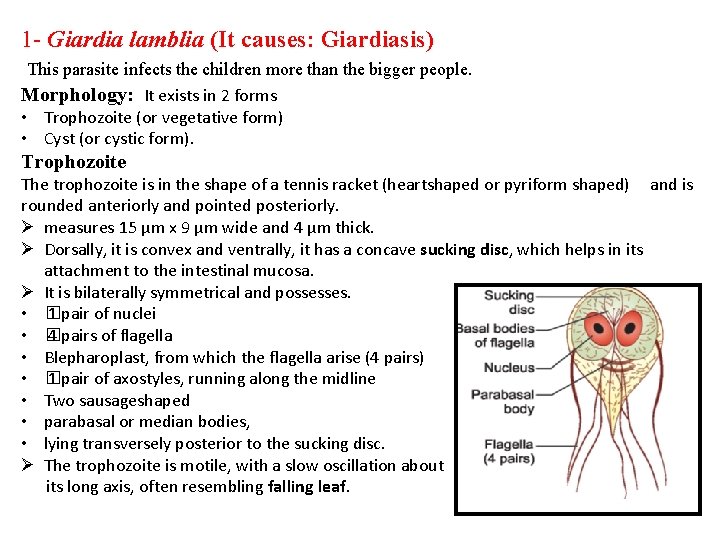
1 - Giardia lamblia (It causes: Giardiasis) This parasite infects the children more than the bigger people. Morphology: It exists in 2 forms • Trophozoite (or vegetative form) • Cyst (or cystic form). Trophozoite The trophozoite is in the shape of a tennis racket (heartshaped or pyriform shaped) and is rounded anteriorly and pointed posteriorly. Ø measures 15 μm x 9 μm wide and 4 μm thick. Ø Dorsally, it is convex and ventrally, it has a concave sucking disc, which helps in its attachment to the intestinal mucosa. Ø It is bilaterally symmetrical and possesses. • � 1 pair of nuclei • � 4 pairs of flagella • Blepharoplast, from which the flagella arise (4 pairs) • � 1 pair of axostyles, running along the midline • Two sausageshaped • parabasal or median bodies, • lying transversely posterior to the sucking disc. Ø The trophozoite is motile, with a slow oscillation about its long axis, often resembling falling leaf.
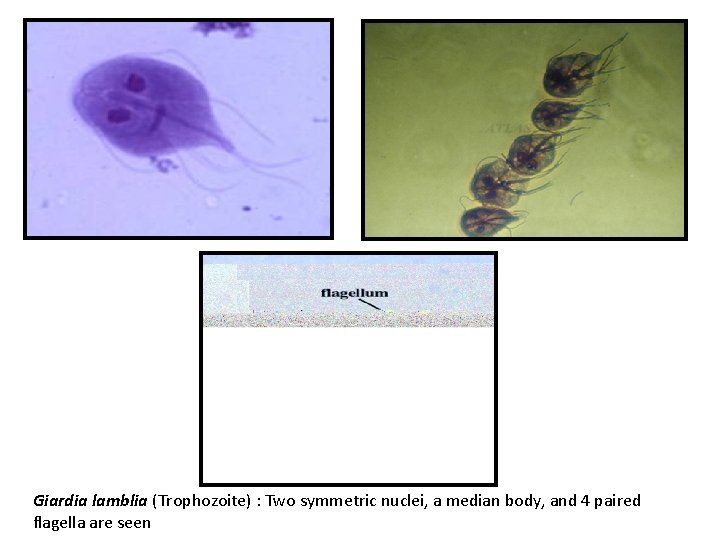
Giardia lamblia (Trophozoite) : Two symmetric nuclei, a median body, and 4 paired flagella are seen
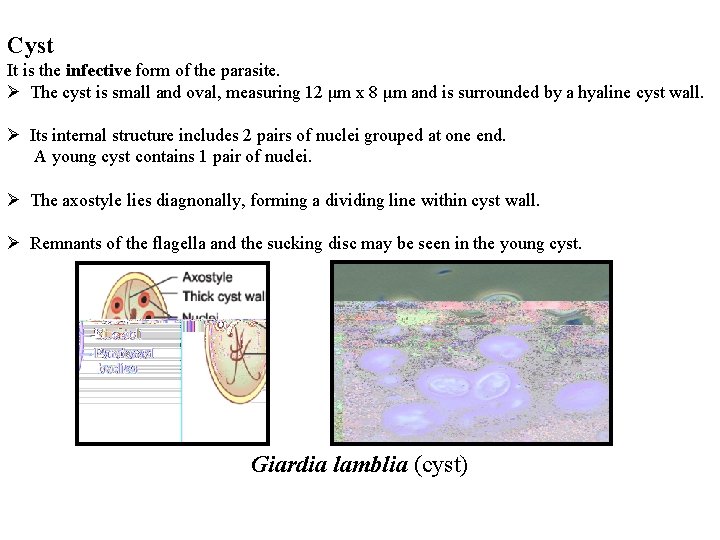
Cyst It is the infective form of the parasite. Ø The cyst is small and oval, measuring 12 μm x 8 μm and is surrounded by a hyaline cyst wall. Ø Its internal structure includes 2 pairs of nuclei grouped at one end. A young cyst contains 1 pair of nuclei. Ø The axostyle lies diagnonally, forming a dividing line within cyst wall. Ø Remnants of the flagella and the sucking disc may be seen in the young cyst. Giardia lamblia (cyst)
Life Cycle Giardia passes its life cycle in 1 host. Infective form: Mature cyst. Mode of transmission: • � Man acquires infection by ingestion of cysts in contaminated water and food. • � Direct persontoperson transmission may also occur in children, male homosexuals. • � Within half an hour of ingestion, the cyst hatches out into two trophozoites, which multiply successively by binary fission and colonize in the duodenum. • The trophozoites live in the duodenum and upper part of jejunum, feeding by pinocytosis. • During unfavorable conditions, encystment occurs usually in colon. • Cysts are passed in stool and remain viable in soil and water for several weeks. • There may be 200, 000 cysts passed per gram of feces. • Infective dose is 10– 100 cysts.
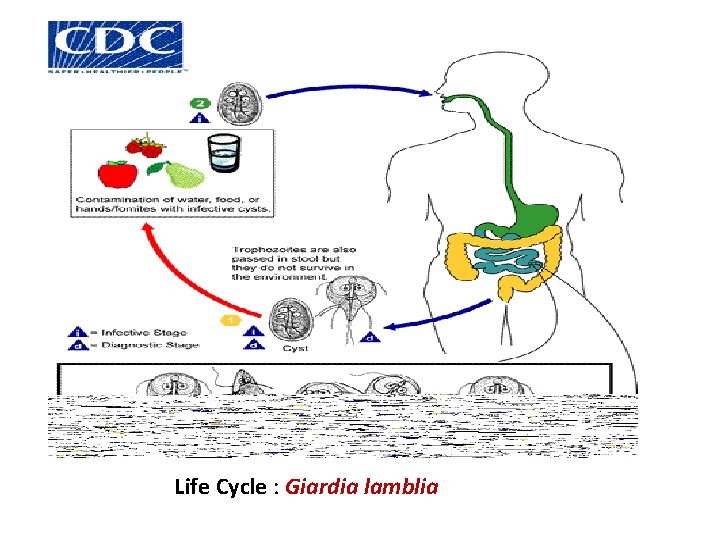
Life Cycle : Giardia lamblia
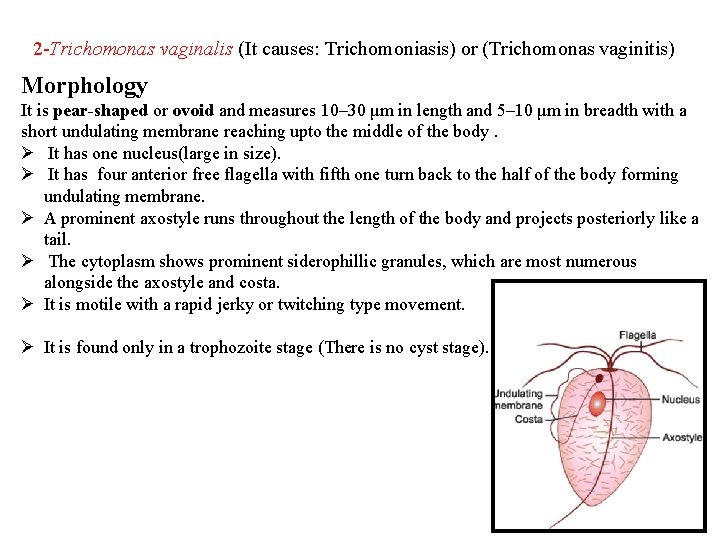
2 -Trichomonas vaginalis (It causes: Trichomoniasis) or (Trichomonas vaginitis) Morphology It is pear-shaped or ovoid and measures 10– 30 μm in length and 5– 10 μm in breadth with a short undulating membrane reaching upto the middle of the body. Ø It has one nucleus(large in size). Ø It has four anterior free flagella with fifth one turn back to the half of the body forming undulating membrane. Ø A prominent axostyle runs throughout the length of the body and projects posteriorly like a tail. Ø The cytoplasm shows prominent siderophillic granules, which are most numerous alongside the axostyle and costa. Ø It is motile with a rapid jerky or twitching type movement. Ø It is found only in a trophozoite stage (There is no cyst stage).
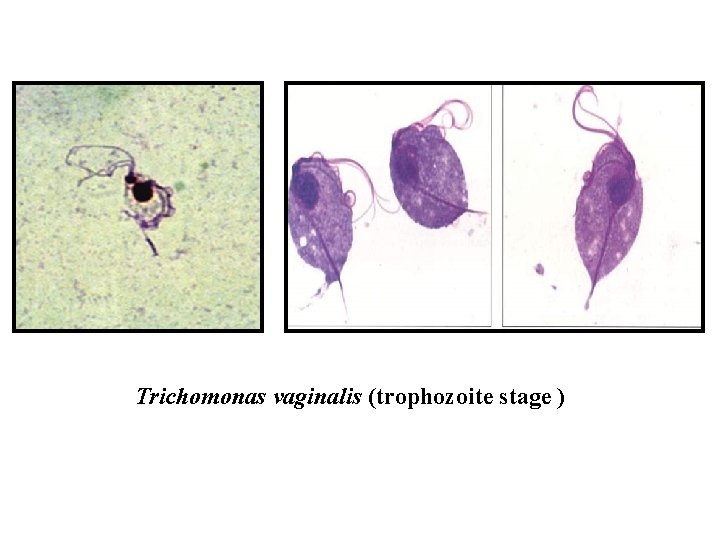
Trichomonas vaginalis (trophozoite stage )
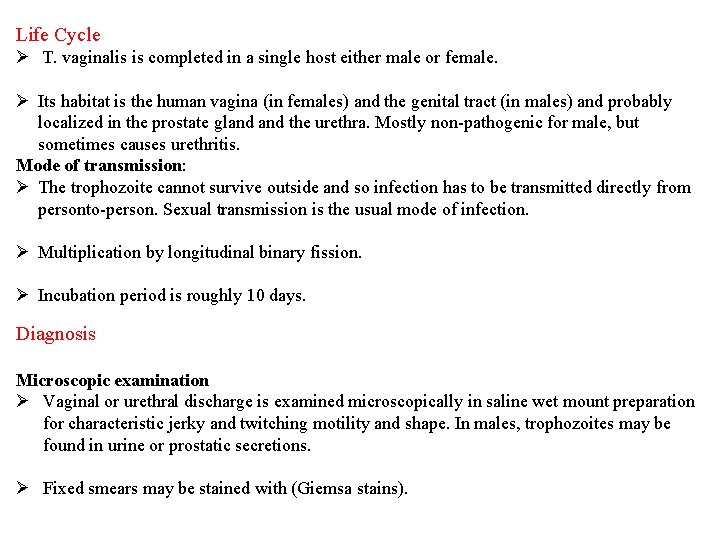
Life Cycle Ø T. vaginalis is completed in a single host either male or female. Ø Its habitat is the human vagina (in females) and the genital tract (in males) and probably localized in the prostate gland the urethra. Mostly non-pathogenic for male, but sometimes causes urethritis. Mode of transmission: Ø The trophozoite cannot survive outside and so infection has to be transmitted directly from personto-person. Sexual transmission is the usual mode of infection. Ø Multiplication by longitudinal binary fission. Ø Incubation period is roughly 10 days. Diagnosis Microscopic examination Ø Vaginal or urethral discharge is examined microscopically in saline wet mount preparation for characteristic jerky and twitching motility and shape. In males, trophozoites may be found in urine or prostatic secretions. Ø Fixed smears may be stained with (Giemsa stains).
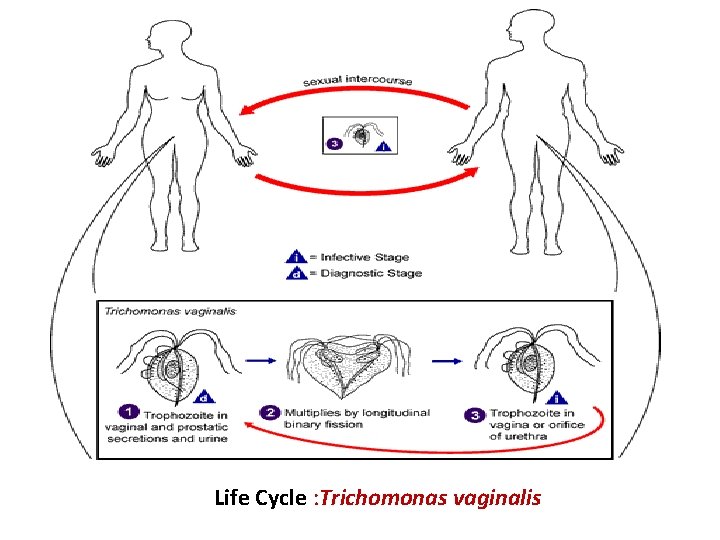
Life Cycle : Trichomonas vaginalis
III Ciliates It constitutes a group characterized by numerous cilia. Classification Kingdom : Animalia Phylum : Protozoa Sub-phylum: Ciliophora Class : Ciliata
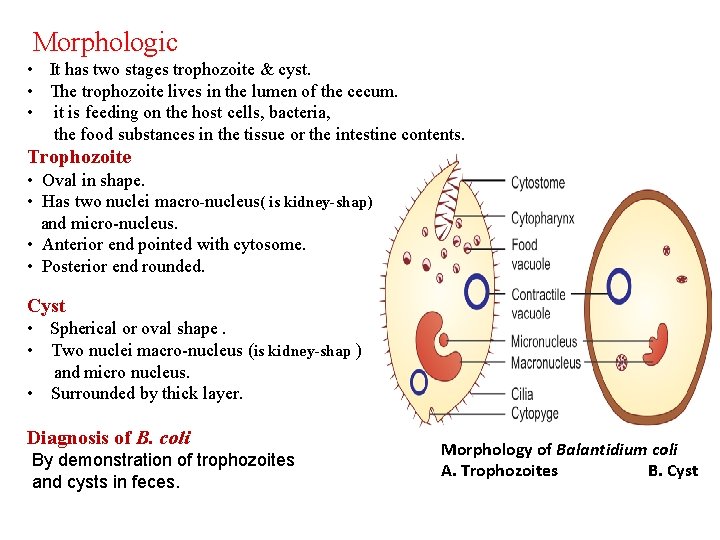
Morphologic • It has two stages trophozoite & cyst. • The trophozoite lives in the lumen of the cecum. • it is feeding on the host cells, bacteria, the food substances in the tissue or the intestine contents. Trophozoite • Oval in shape. • Has two nuclei macro-nucleus( is kidney-shap) and micro-nucleus. • Anterior end pointed with cytosome. • Posterior end rounded. Cyst • Spherical or oval shape. • Two nuclei macro-nucleus (is kidney-shap ) and micro nucleus. • Surrounded by thick layer. Diagnosis of B. coli By demonstration of trophozoites and cysts in feces. Morphology of Balantidium coli A. Trophozoites B. Cyst
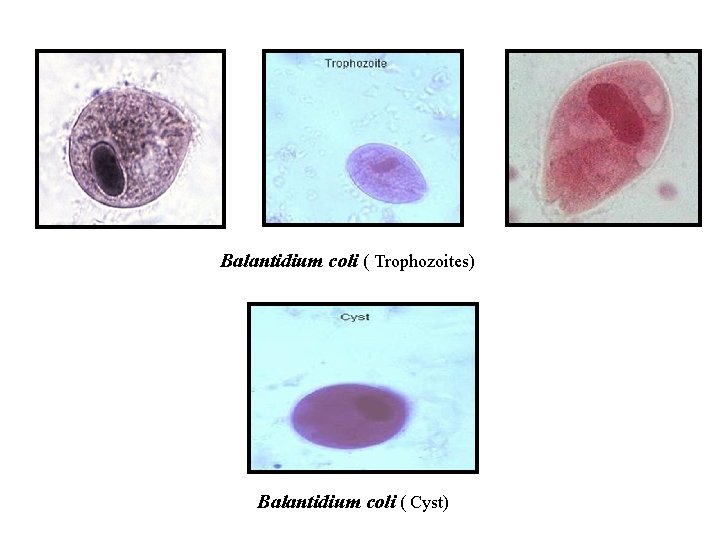
Balantidium coli ( Trophozoites) Balantidium coli ( Cyst)
- Slides: 14