
Medical Math Math is important in healthcare All
- Slides: 42
Medical Math
Math is important in healthcare • All health care workers are required to perform simple math calculations when doing various tasks. • Knowing basic math calculations are essential for all health care professionals to be successful. • Mathematical errors in the healthcare arena may result in injury or a life or death situation.
Number forms • Whole numbers: The counting numbers and zero; they do not contain decimals or fractions. • Non-whole numbers: Numbers that have decimals ex: 12. 25 • Mixed numbers: Whole numbers and a fraction ex: 12 ½ • Percentages: Represents part or all of something ex: 12%
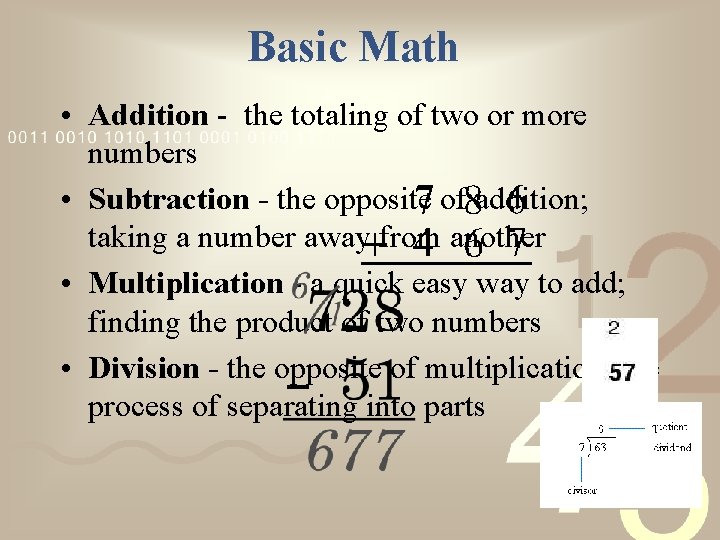
Basic Math • Addition - the totaling of two or more numbers • Subtraction - the opposite of addition; taking a number away from another • Multiplication - a quick easy way to add; finding the product of two numbers • Division - the opposite of multiplication; the process of separating into parts
Averages • The average of a group of numbers is computed by summing all numbers and dividing by the number of observations. – For example, to compute the average of a sample of numbers, such as 19, 20, 21, 23, 18, 25, and 26, first sum the numbers: (19+20+21+23+18+25+26) = 152 – Then calculate the average by dividing this total (152) by the number of observations (7), which gives an average of 21. 7 or about 22.
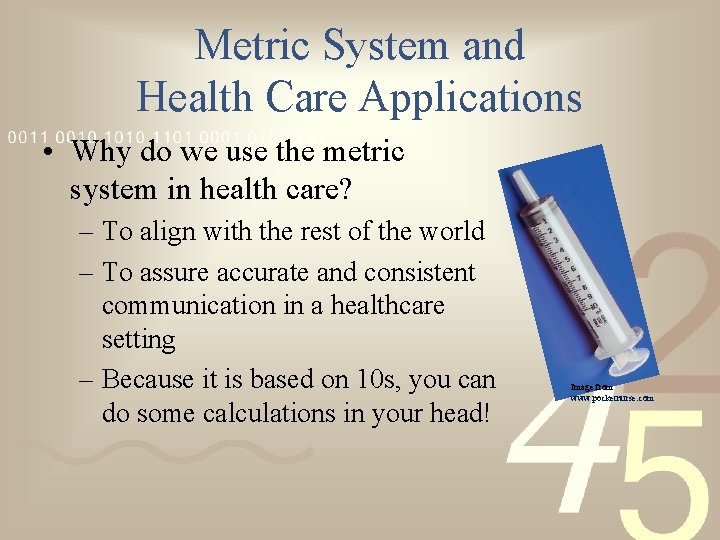
Metric System and Health Care Applications • Why do we use the metric system in health care? – To align with the rest of the world – To assure accurate and consistent communication in a healthcare setting – Because it is based on 10 s, you can do some calculations in your head! Image from www. pocketnurse. com
There are four basic rules to the Metric System 1. Numbers indicating less than one unit are always written in a decimal form, not as a fraction. – Ex: 1/10 = 0. 1 2. When writing decimals, if there is no number before the decimal, always write a 0. – Ex: . 1 is 0. 1 3. Abbreviations for metric terms are never plural; they are always written in singular form. – Ex: grams is g, not gs 4. Leave a space between the number and the abbreviation. – Ex: 8 g or 0. 1 dm
It’s Really Very Simple • • 1 kilometer = 1 hectometer = 1 dekameter = 1 meter 1 decimeter = 1 centimeter = 1 millimeter = 1, 000 meters 10 meters 0. 1 meter 0. 001 meter
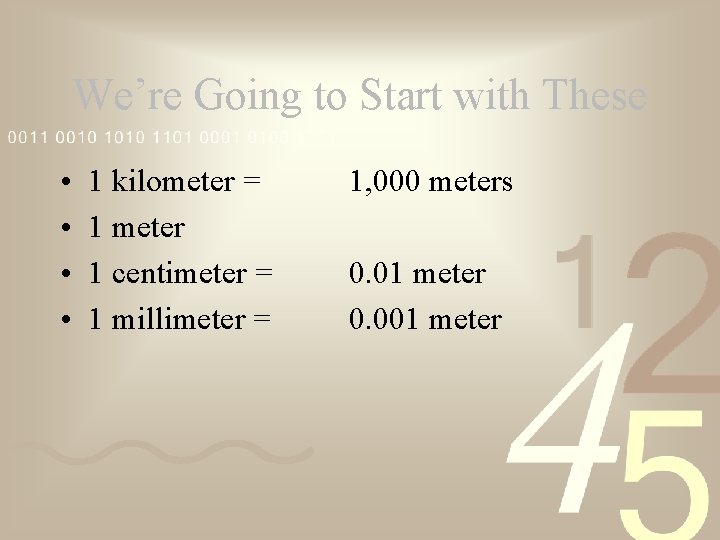
We’re Going to Start with These • • 1 kilometer = 1 meter 1 centimeter = 1 millimeter = 1, 000 meters 0. 01 meter 0. 001 meter
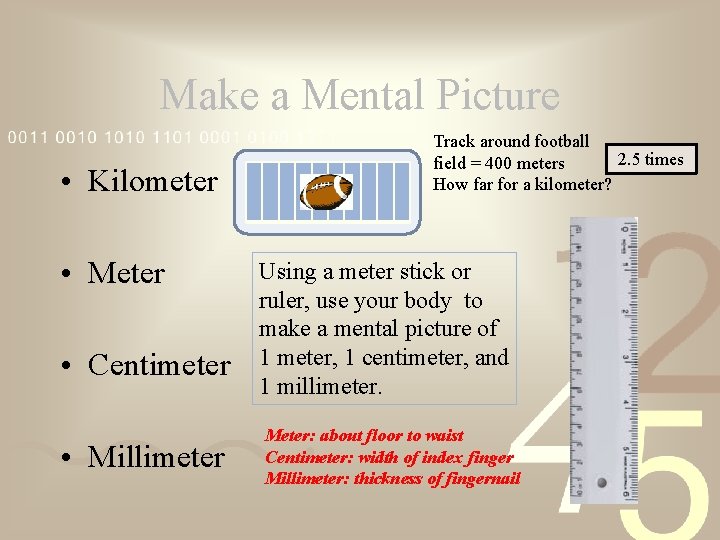
Make a Mental Picture • Kilometer • Meter • Centimeter • Millimeter Track around football 2. 5 times field = 400 meters How far for a kilometer? Using a meter stick or ruler, use your body to make a mental picture of 1 meter, 1 centimeter, and 1 millimeter. Meter: about floor to waist Centimeter: width of index finger Millimeter: thickness of fingernail
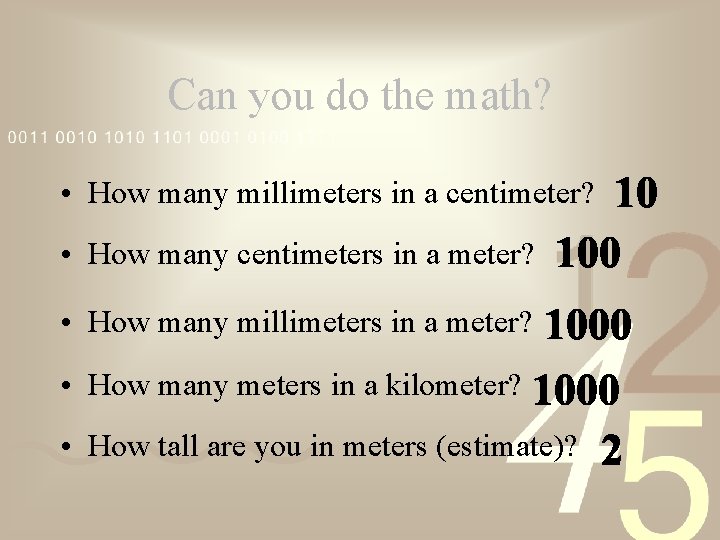
Can you do the math? • How many millimeters in a centimeter? • How many centimeters in a meter? • How many millimeters in a meter? • How many meters in a kilometer? • How tall are you in meters (estimate)?
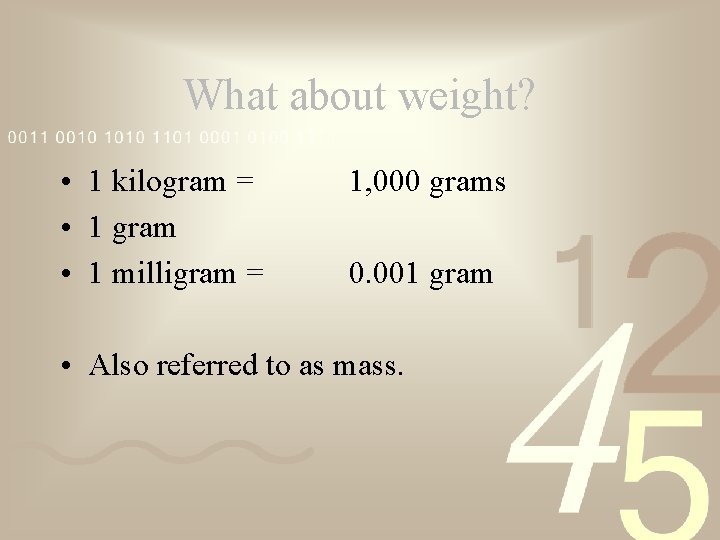
What about weight? • 1 kilogram = • 1 gram • 1 milligram = 1, 000 grams 0. 001 gram • Also referred to as mass.
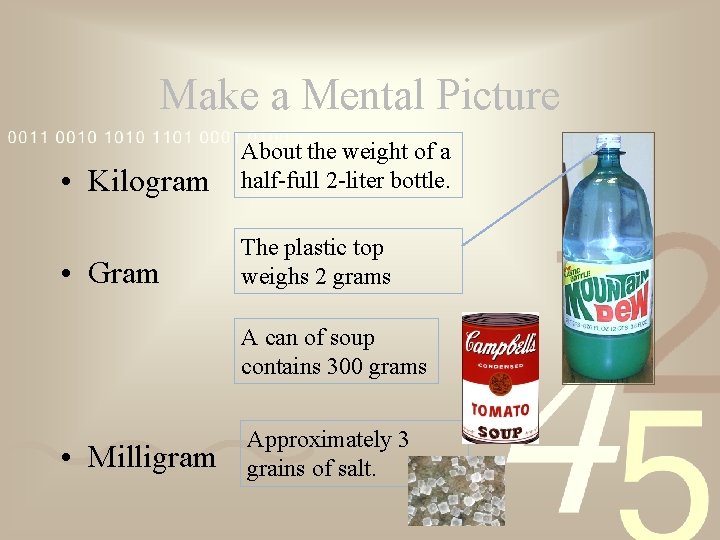
Make a Mental Picture • Kilogram About the weight of a half-full 2 -liter bottle. • Gram The plastic top weighs 2 grams A can of soup contains 300 grams • Milligram Approximately 3 grains of salt.
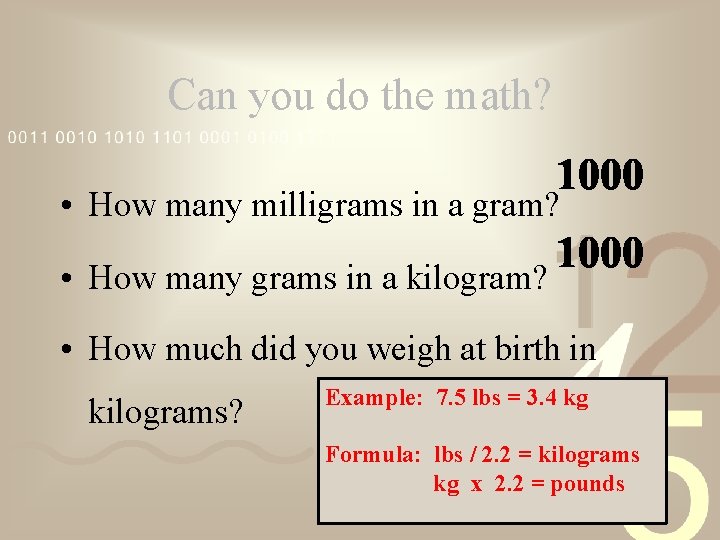
Can you do the math? • How many milligrams in a gram? • How many grams in a kilogram? • How much did you weigh at birth in kilograms? Example: 7. 5 lbs = 3. 4 kg Formula: lbs / 2. 2 = kilograms kg x 2. 2 = pounds
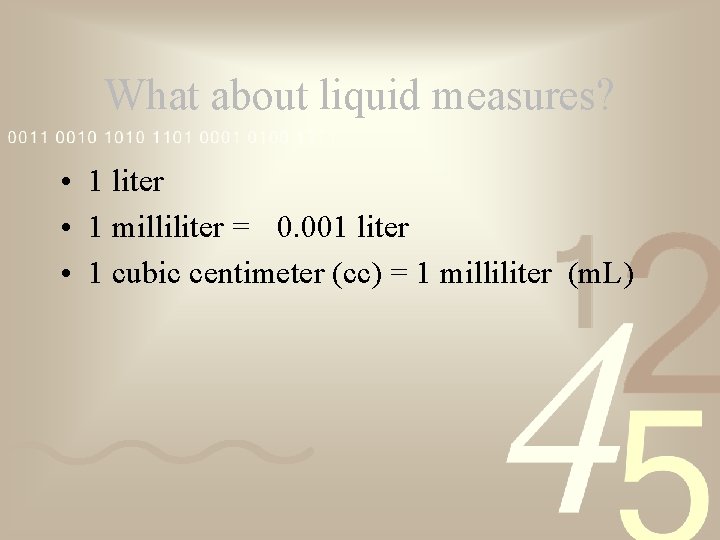
What about liquid measures? • 1 liter • 1 milliliter = 0. 001 liter • 1 cubic centimeter (cc) = 1 milliliter (m. L)
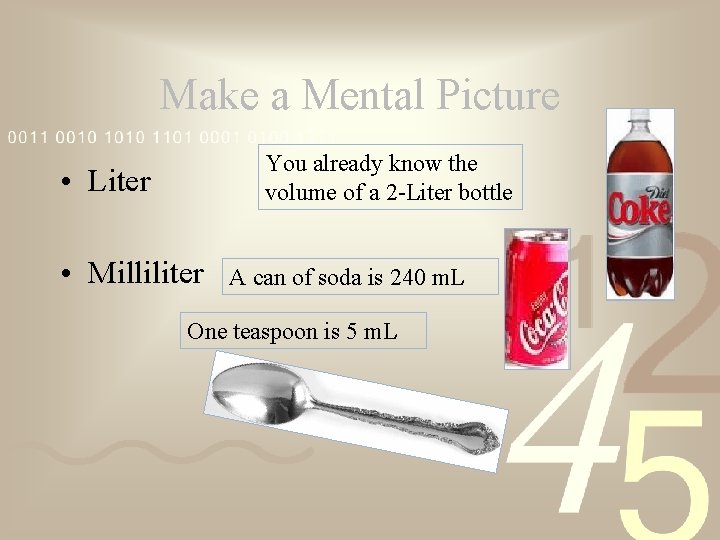
Make a Mental Picture You already know the volume of a 2 -Liter bottle • Liter • Milliliter A can of soda is 240 m. L One teaspoon is 5 m. L
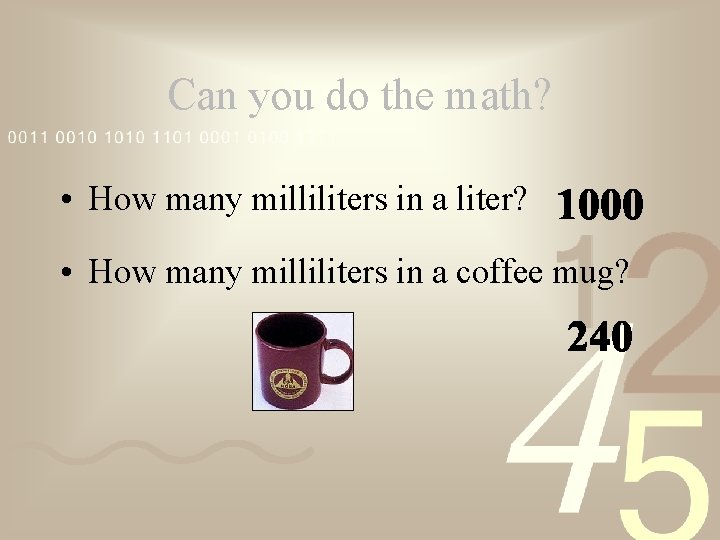
Can you do the math? • How many milliliters in a liter? • How many milliliters in a coffee mug?
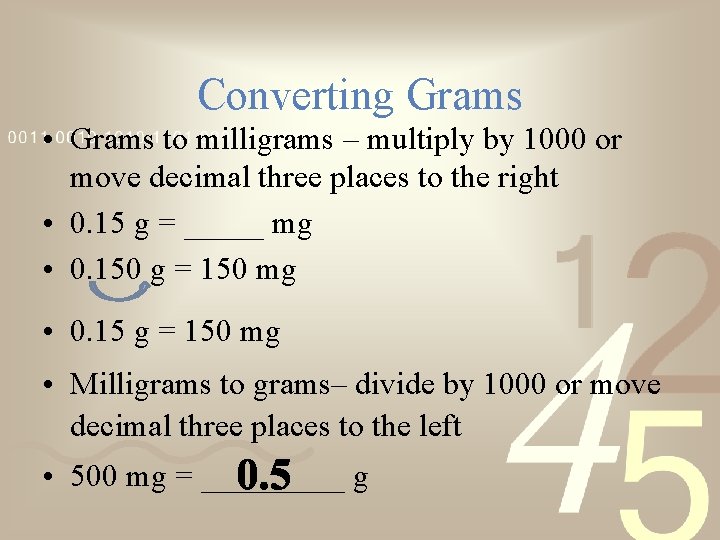
Converting Grams • Grams to milligrams – multiply by 1000 or move decimal three places to the right • 0. 15 g = _____ mg • 0. 150 g = 150 mg • 0. 15 g = 150 mg • Milligrams to grams– divide by 1000 or move decimal three places to the left • 500 mg = _____ g
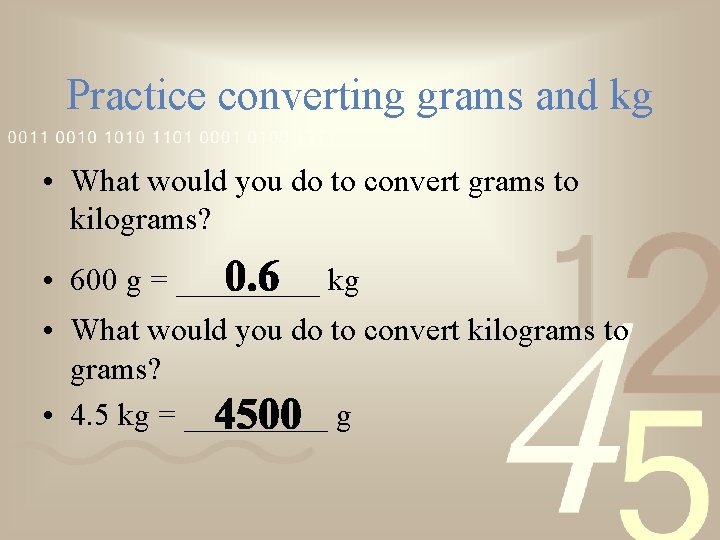
Practice converting grams and kg • What would you do to convert grams to kilograms? • 600 g = _____ kg • What would you do to convert kilograms to grams? • 4. 5 kg = _____ g
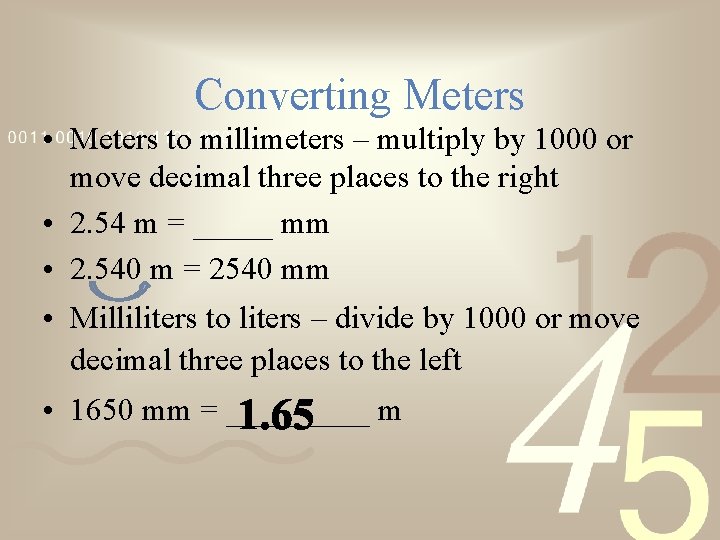
Converting Meters • Meters to millimeters – multiply by 1000 or move decimal three places to the right • 2. 54 m = _____ mm • 2. 540 m = 2540 mm • Milliliters to liters – divide by 1000 or move decimal three places to the left • 1650 mm = _____ m
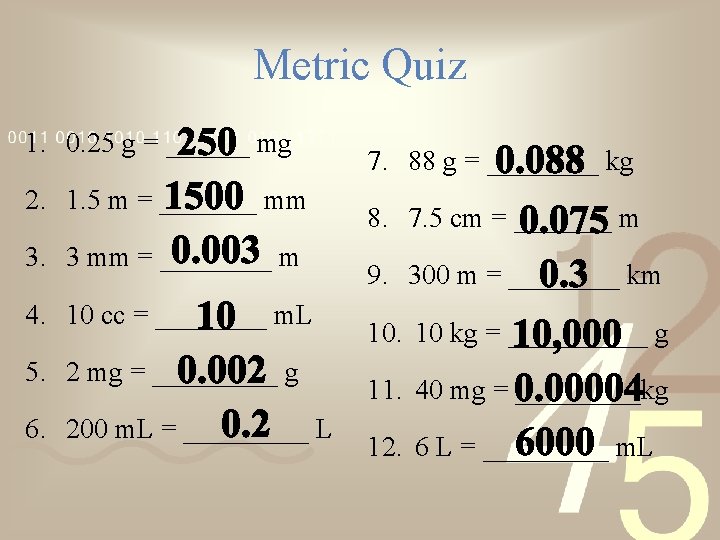
Metric Quiz 1. 0. 25 g = ______ mg 2. 1. 5 m = _______ mm 3. 3 mm = ____ m 4. 10 cc = ____ m. L 5. 2 mg = _____ g 6. 200 m. L = _____ L 7. 88 g = ____ kg 8. 7. 5 cm = _______ m 9. 300 m = ____ km 10. 10 kg = _____ g 11. 40 mg = _____kg 12. 6 L = _____ m. L
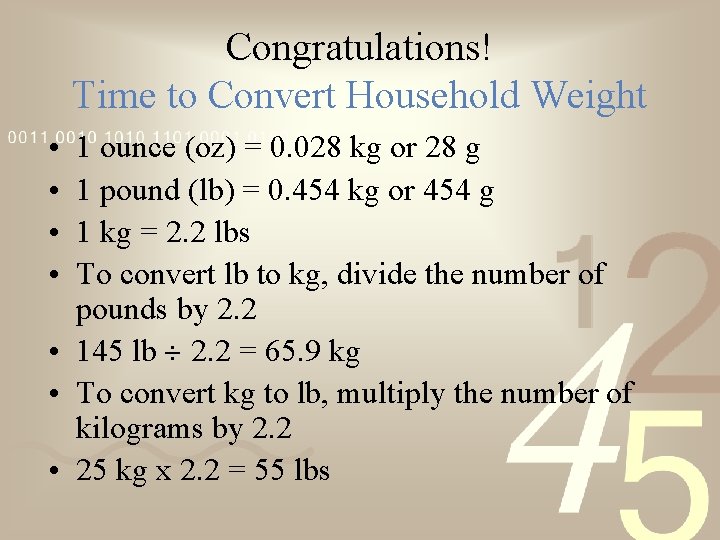
Congratulations! Time to Convert Household Weight • • 1 ounce (oz) = 0. 028 kg or 28 g 1 pound (lb) = 0. 454 kg or 454 g 1 kg = 2. 2 lbs To convert lb to kg, divide the number of pounds by 2. 2 • 145 lb 2. 2 = 65. 9 kg • To convert kg to lb, multiply the number of kilograms by 2. 2 • 25 kg x 2. 2 = 55 lbs
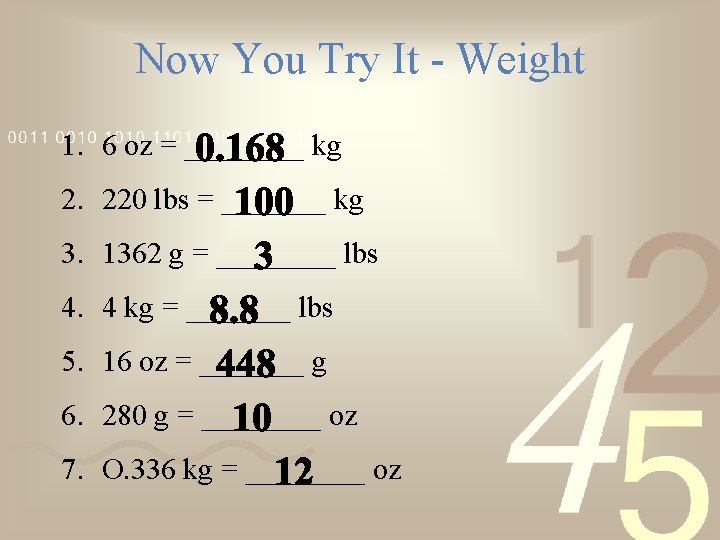
Now You Try It - Weight 1. 6 oz = ____ kg 2. 220 lbs = _______ kg 3. 1362 g = ____ lbs 4. 4 kg = _______ lbs 5. 16 oz = _______ g 6. 280 g = ____ oz 7. O. 336 kg = ____ oz
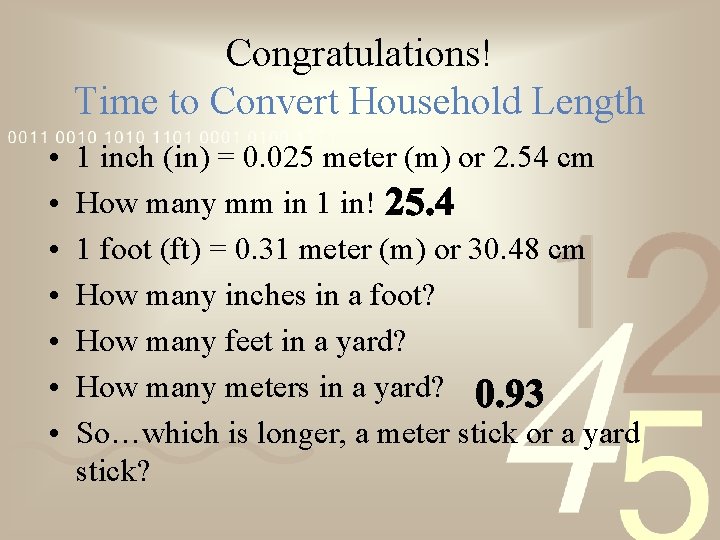
Congratulations! Time to Convert Household Length • • 1 inch (in) = 0. 025 meter (m) or 2. 54 cm How many mm in 1 in! 1 foot (ft) = 0. 31 meter (m) or 30. 48 cm How many inches in a foot? How many feet in a yard? How many meters in a yard? So…which is longer, a meter stick or a yard stick?
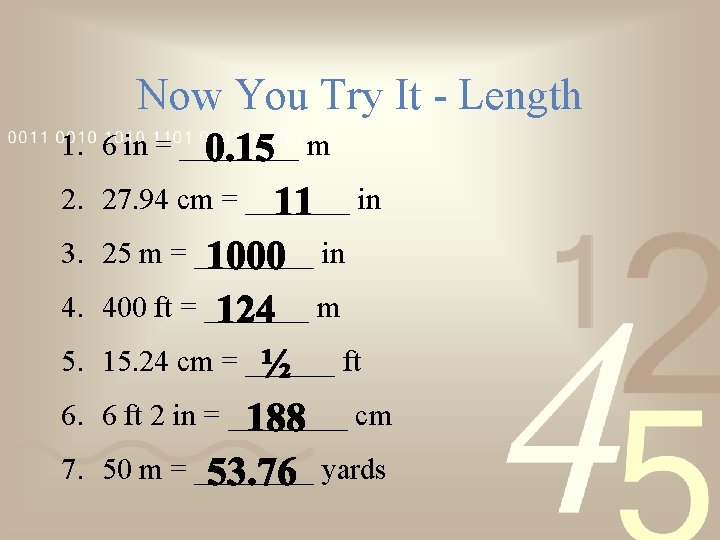
Now You Try It - Length 1. 6 in = ____ m 2. 27. 94 cm = _______ in 3. 25 m = ____ in 4. 400 ft = _______ m 5. 15. 24 cm = ______ ft 6. 6 ft 2 in = ____ cm 7. 50 m = ____ yards
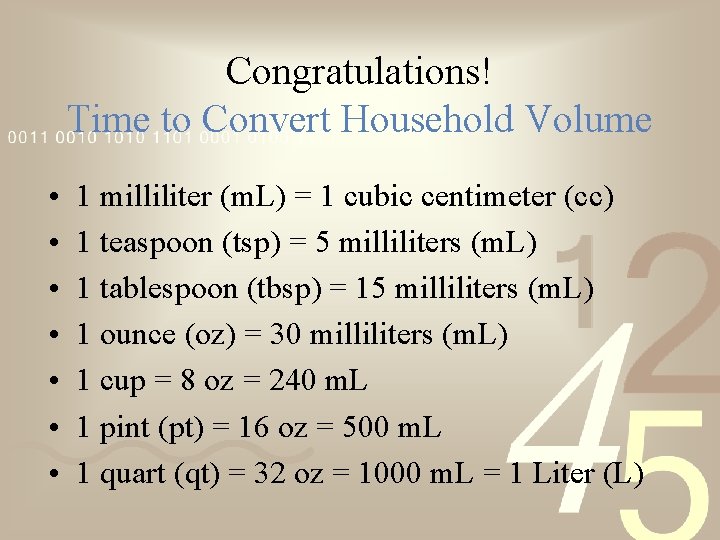
Congratulations! Time to Convert Household Volume • • 1 milliliter (m. L) = 1 cubic centimeter (cc) 1 teaspoon (tsp) = 5 milliliters (m. L) 1 tablespoon (tbsp) = 15 milliliters (m. L) 1 ounce (oz) = 30 milliliters (m. L) 1 cup = 8 oz = 240 m. L 1 pint (pt) = 16 oz = 500 m. L 1 quart (qt) = 32 oz = 1000 m. L = 1 Liter (L)
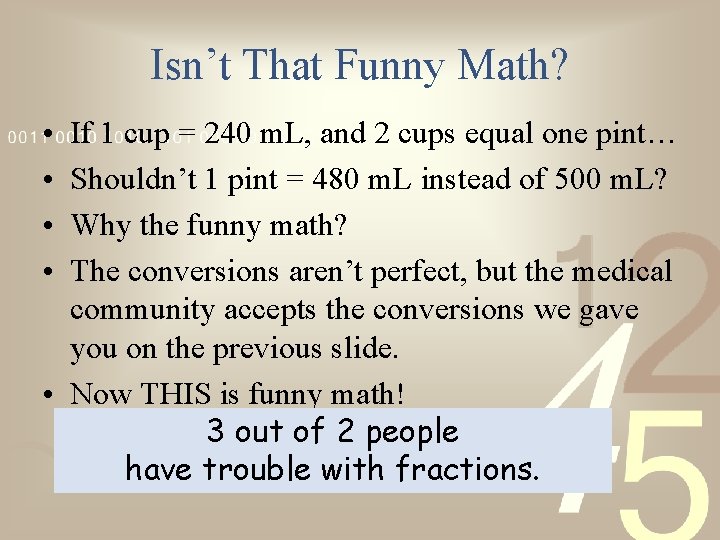
Isn’t That Funny Math? • • If 1 cup = 240 m. L, and 2 cups equal one pint… Shouldn’t 1 pint = 480 m. L instead of 500 m. L? Why the funny math? The conversions aren’t perfect, but the medical community accepts the conversions we gave you on the previous slide. • Now THIS is funny math! 3 out of 2 people have trouble with fractions.
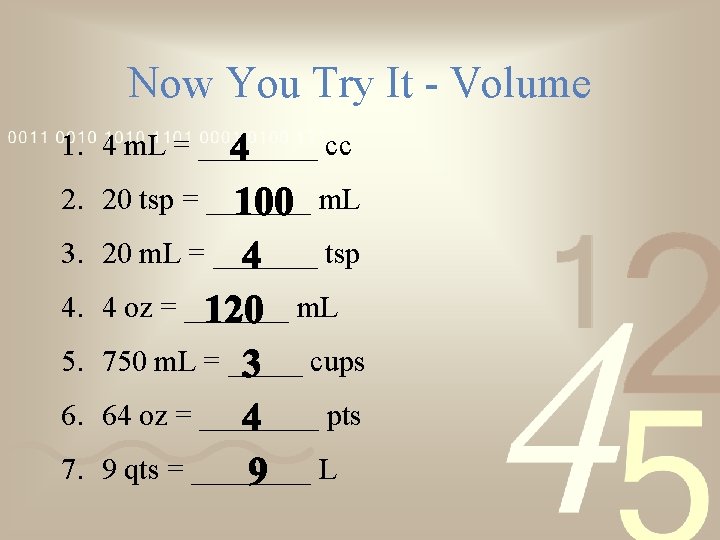
Now You Try It - Volume 1. 4 m. L = ____ cc 2. 20 tsp = _______ m. L 3. 20 m. L = _______ tsp 4. 4 oz = _______ m. L 5. 750 m. L = _____ cups 6. 64 oz = ____ pts 7. 9 qts = ____ L
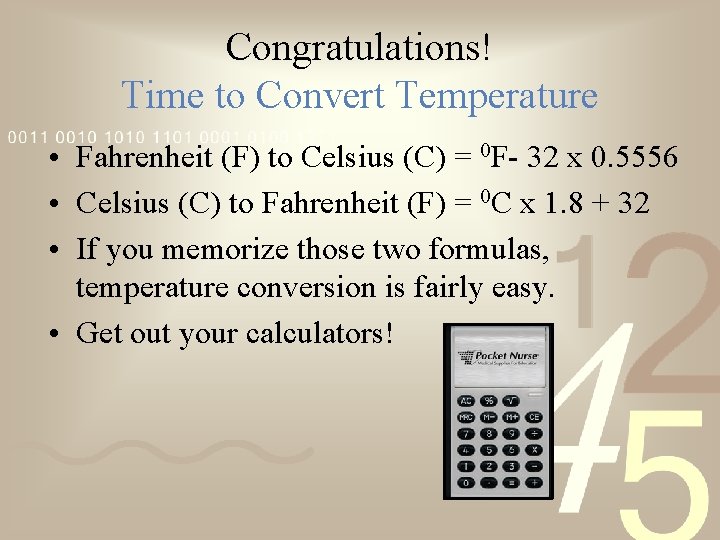
Congratulations! Time to Convert Temperature • Fahrenheit (F) to Celsius (C) = 0 F- 32 x 0. 5556 • Celsius (C) to Fahrenheit (F) = 0 C x 1. 8 + 32 • If you memorize those two formulas, temperature conversion is fairly easy. • Get out your calculators!
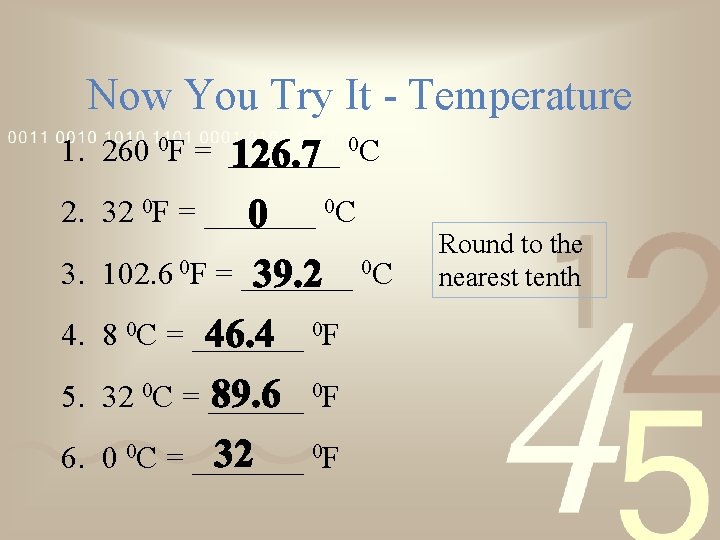
Now You Try It - Temperature 1. 260 0 F = _______ 0 C 2. 32 0 F = _______ 0 C 3. 102. 6 0 F = _______ 0 C 4. 8 0 C = _______ 0 F 5. 32 0 C = ______ 0 F 6. 0 0 C = _______ 0 F Round to the nearest tenth
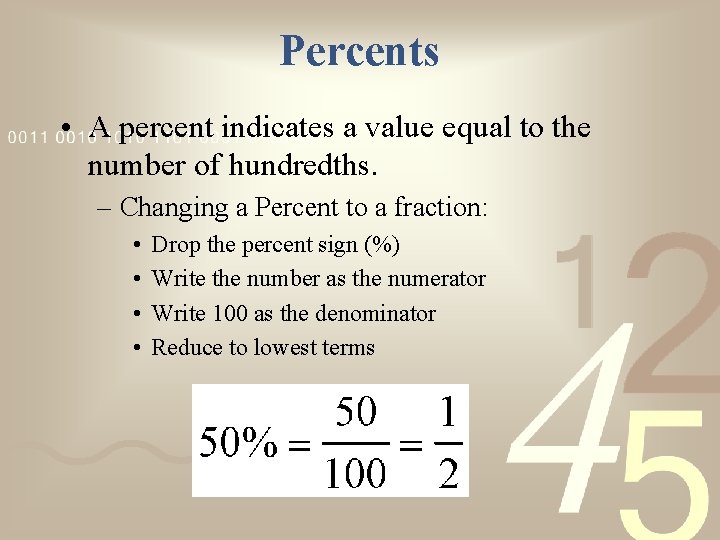
Percents • A percent indicates a value equal to the number of hundredths. – Changing a Percent to a fraction: • • Drop the percent sign (%) Write the number as the numerator Write 100 as the denominator Reduce to lowest terms
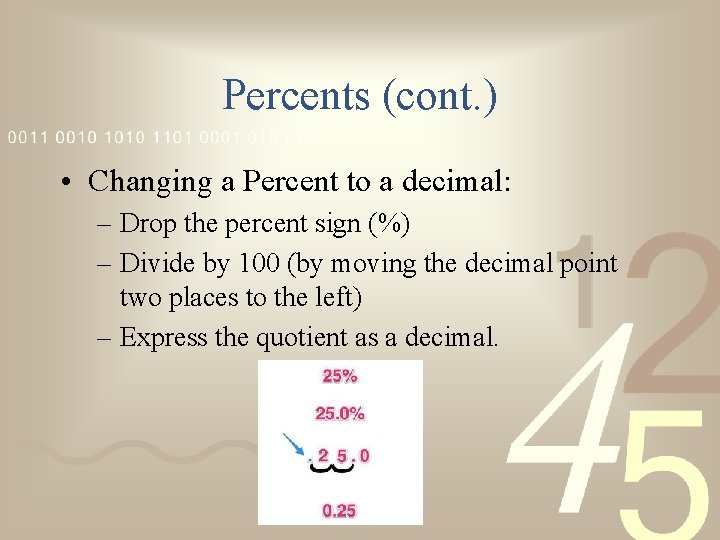
Percents (cont. ) • Changing a Percent to a decimal: – Drop the percent sign (%) – Divide by 100 (by moving the decimal point two places to the left) – Express the quotient as a decimal.
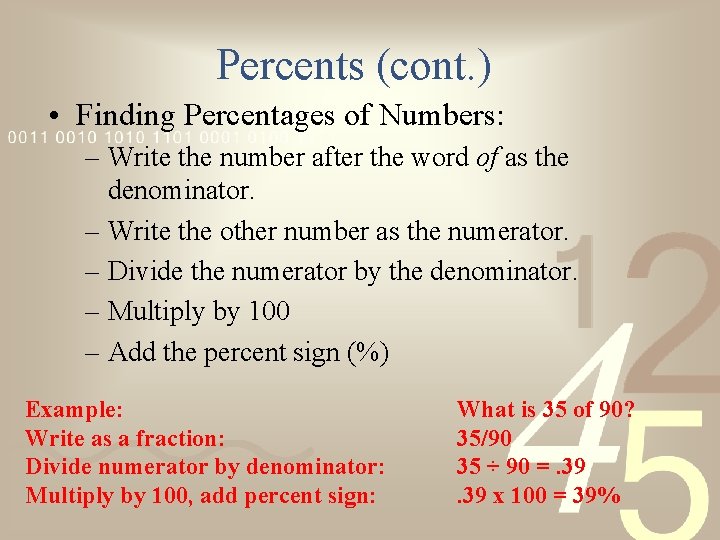
Percents (cont. ) • Finding Percentages of Numbers: – Write the number after the word of as the denominator. – Write the other number as the numerator. – Divide the numerator by the denominator. – Multiply by 100 – Add the percent sign (%) Example: Write as a fraction: Divide numerator by denominator: Multiply by 100, add percent sign: What is 35 of 90? 35/90 35 ÷ 90 =. 39 x 100 = 39%
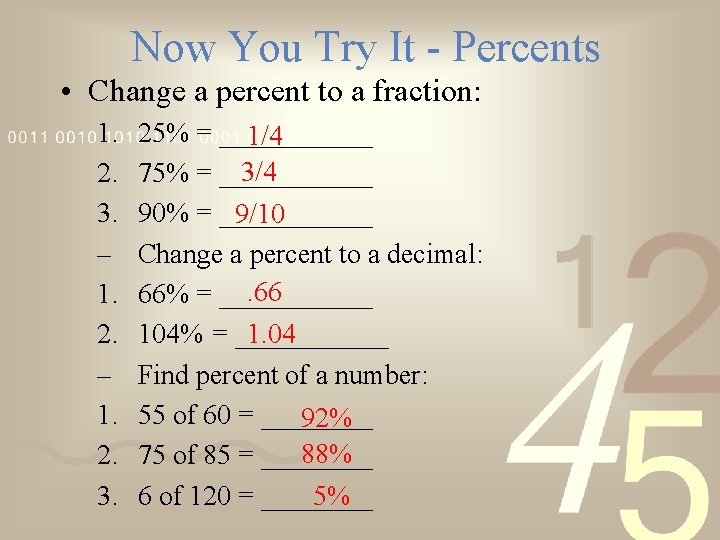
Now You Try It - Percents • Change a percent to a fraction: 1. 2. 3. – 1. 2. 3. 25% = ______ 1/4 3/4 75% = ______ 90% = ______ 9/10 Change a percent to a decimal: . 66 66% = ______ 1. 04 104% = ______ Find percent of a number: 55 of 60 = ____ 92% 88% 75 of 85 = ____ 5% 6 of 120 = ____
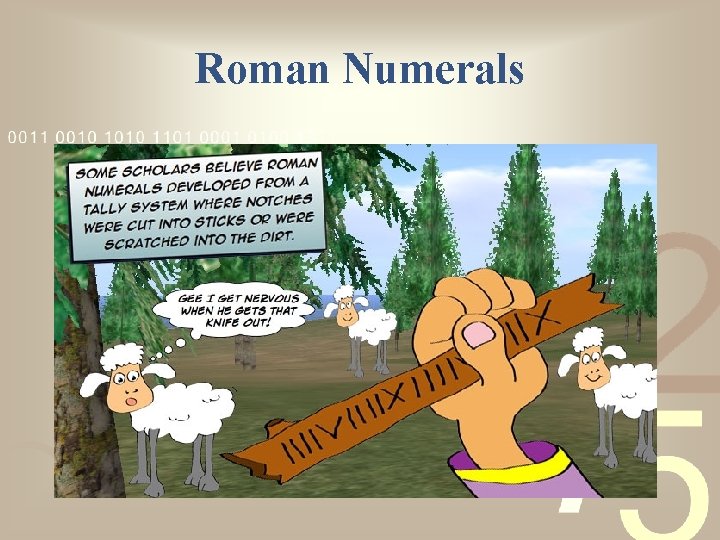
Roman Numerals • Roman Numerals origination – Many people believe Roman Numerals began as a tally system used by shepherds to keep track of how many sheep they had. – Each sheep was counted with a single notch cut into a stick with a knife. Every fifth sheep was recorded with two notches to form a V and then each tenth sheep was denoted by an X.
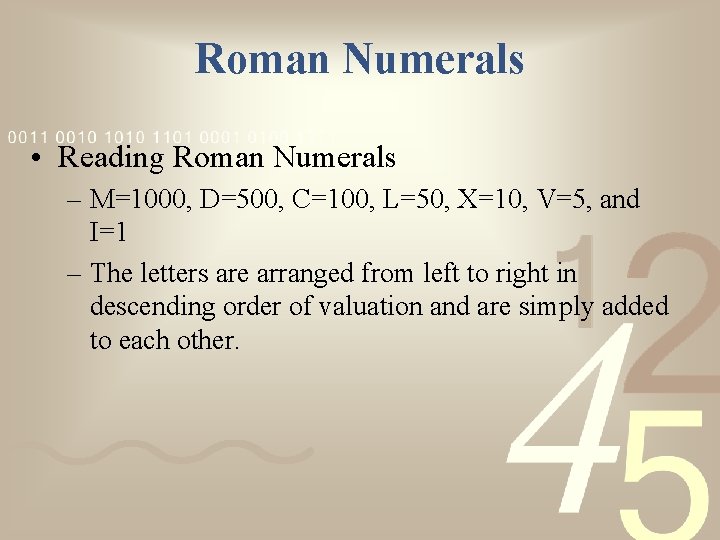
Roman Numerals • Reading Roman Numerals – M=1000, D=500, C=100, L=50, X=10, V=5, and I=1 – The letters are arranged from left to right in descending order of valuation and are simply added to each other.
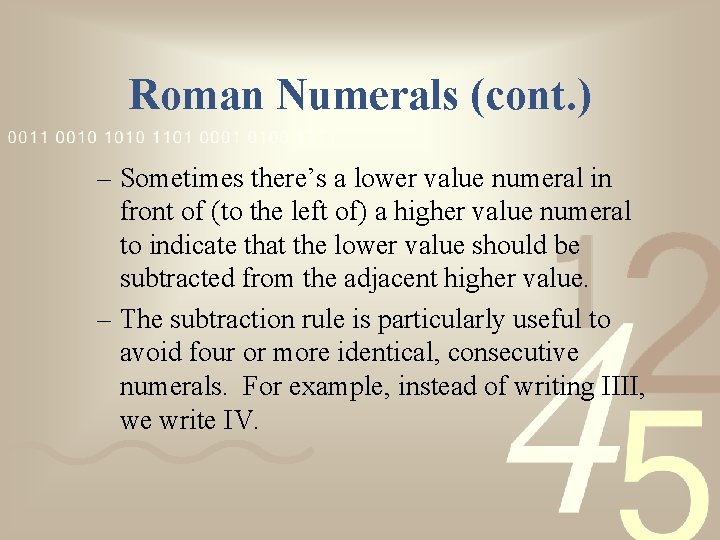
Roman Numerals (cont. ) – Sometimes there’s a lower value numeral in front of (to the left of) a higher value numeral to indicate that the lower value should be subtracted from the adjacent higher value. – The subtraction rule is particularly useful to avoid four or more identical, consecutive numerals. For example, instead of writing IIII, we write IV.
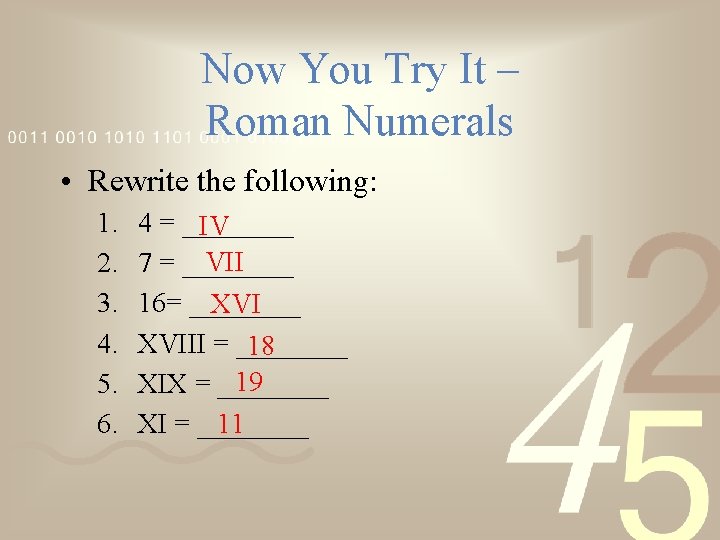
Now You Try It – Roman Numerals • Rewrite the following: 1. 2. 3. 4. 5. 6. 4 = ____ IV VII 7 = ____ 16= ____ XVIII = ____ 18 19 XIX = ____ XI = ____ 11
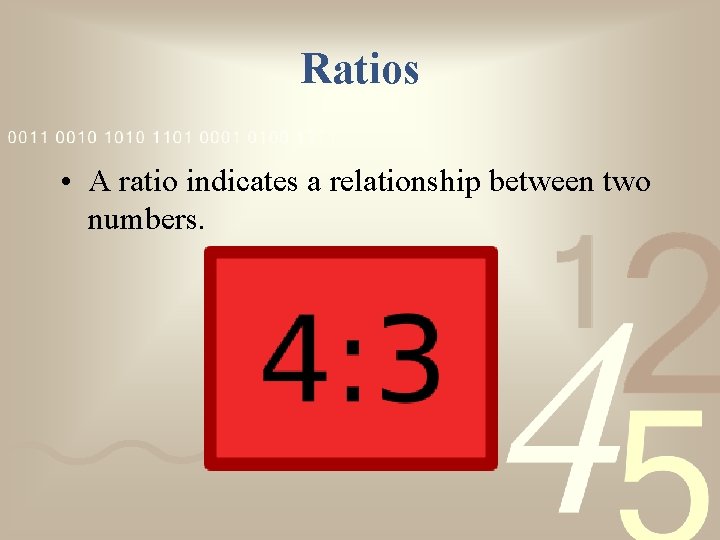
Ratios • A ratio indicates a relationship between two numbers.
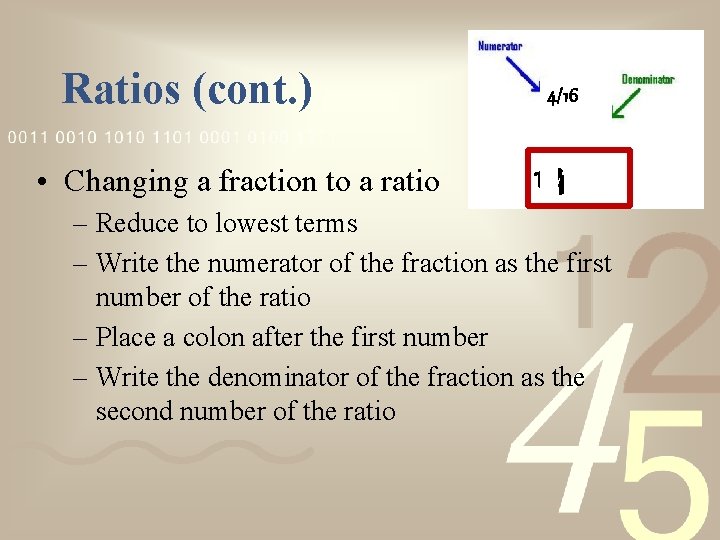
Ratios (cont. ) • Changing a fraction to a ratio 4/16 1: 4 – Reduce to lowest terms – Write the numerator of the fraction as the first number of the ratio – Place a colon after the first number – Write the denominator of the fraction as the second number of the ratio
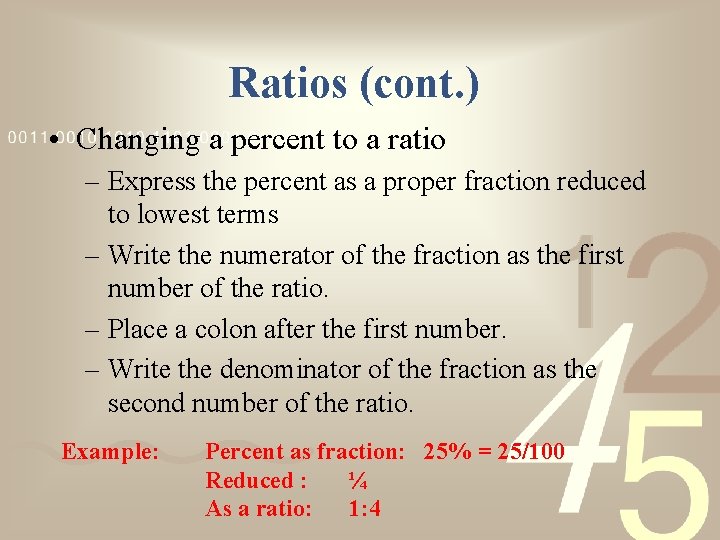
Ratios (cont. ) • Changing a percent to a ratio – Express the percent as a proper fraction reduced to lowest terms – Write the numerator of the fraction as the first number of the ratio. – Place a colon after the first number. – Write the denominator of the fraction as the second number of the ratio. Example: Percent as fraction: 25% = 25/100 Reduced : ¼ As a ratio: 1: 4
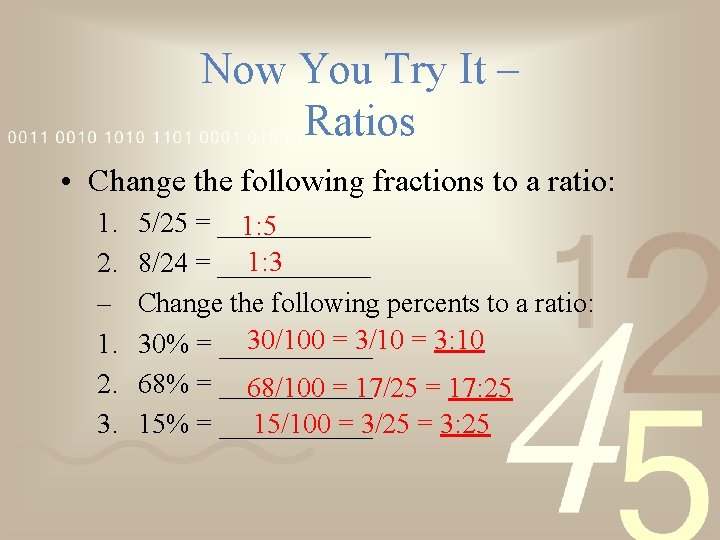
Now You Try It – Ratios • Change the following fractions to a ratio: 1. 2. – 1. 2. 3. 5/25 = ______ 1: 5 1: 3 8/24 = ______ Change the following percents to a ratio: 30/100 = 3/10 = 3: 10 30% = ___________ 68/100 = 17/25 = 17: 25 15/100 = 3/25 = 3: 25 15% = ______