
Medical Math for Healthcare Professionals Medical Math u
- Slides: 21
Medical Math for Healthcare Professionals
Medical Math u All health care workers are required to perform simple math calculations when doing various tasks. u Knowing basic math calculations are essential for all health care professionals to be successful.
Numbers u Numbers forms: are expressed in different – Whole numbers: are the counting numbers and zero; they do not contain decimals or fractions – Nonwhole numbers: are numbers that have decimals ex: 12. 25 – Mixed numbers: are whole numbers and a fraction ex: 12 ½ – Percetages: the whole or all of something ex: 12%
Numbers u Numbers that have more than one digit are defined by their place value. For ex: – The number 7777 u Place value – 7 (thousands) – 7 (hundreds) – 7 (tens) – 7 (ones) *This number is described by saying “seven thousand, seven hundred seventy-seven” *Numbers are written with a comma placed to the left of every third digit. 7, 777
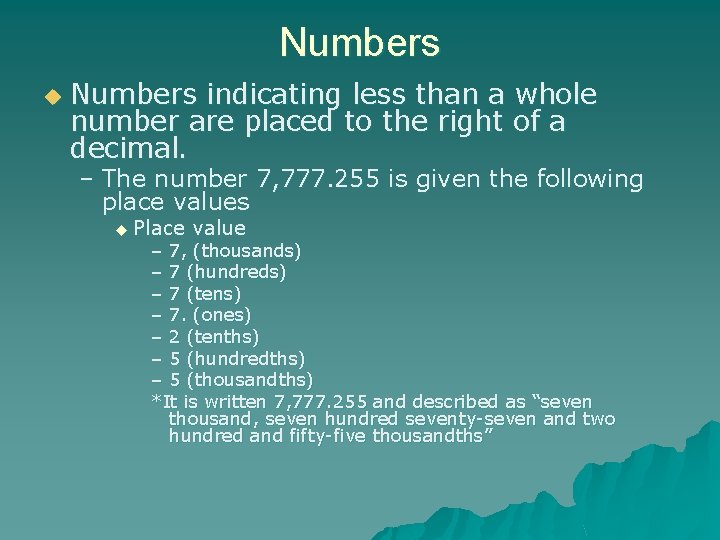
Numbers u Numbers indicating less than a whole number are placed to the right of a decimal. – The number 7, 777. 255 is given the following place values u Place value – 7, (thousands) – 7 (hundreds) – 7 (tens) – 7. (ones) – 2 (tenths) – 5 (hundredths) – 5 (thousandths) *It is written 7, 777. 255 and described as “seven thousand, seven hundred seventy-seven and two hundred and fifty-five thousandths”
Numbers u Additions- the totaling of two or more numbers u Subtraction- the opposite of addition; taking a number away from another number u Multiplication- a quick easy way to add; finding the product of two numbers u Division- the opposite of multiplication; the process of separating into parts
The Metric System u The health care worker is expected to measure and calculate weights, heights, and volume in metric units of measure. u Understanding how to convert standard and metric units of measure is helpful in various settings
Metric System u The health care industry uses the metric system for measuring. It is used by 90% of the world and is known as the International System of Units.
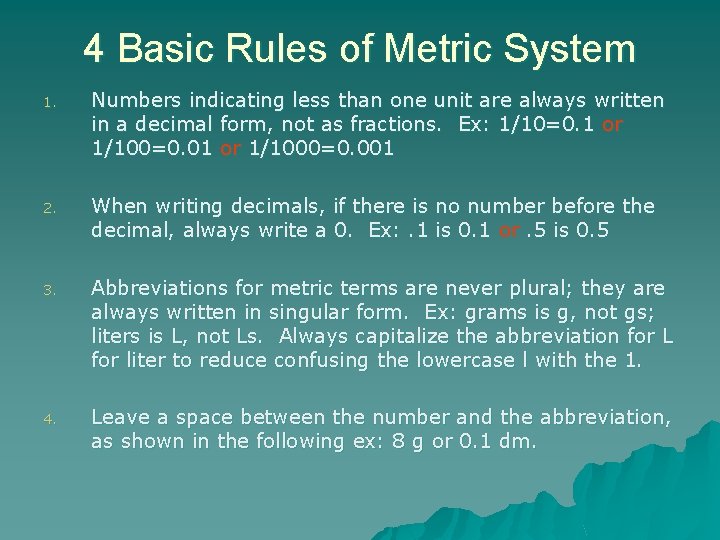
4 Basic Rules of Metric System 1. Numbers indicating less than one unit are always written in a decimal form, not as fractions. Ex: 1/10=0. 1 or 1/100=0. 01 or 1/1000=0. 001 2. When writing decimals, if there is no number before the decimal, always write a 0. Ex: . 1 is 0. 1 or. 5 is 0. 5 3. Abbreviations for metric terms are never plural; they are always written in singular form. Ex: grams is g, not gs; liters is L, not Ls. Always capitalize the abbreviation for L for liter to reduce confusing the lowercase l with the 1. 4. Leave a space between the number and the abbreviation, as shown in the following ex: 8 g or 0. 1 dm.
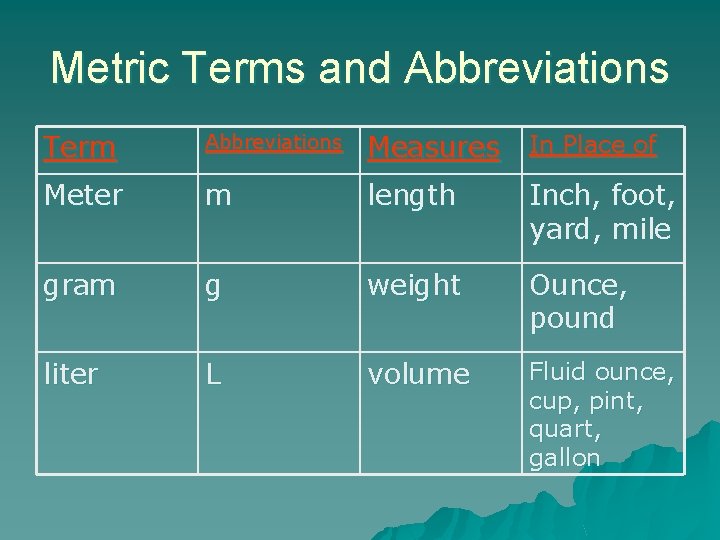
Metric Terms and Abbreviations Term Abbreviations Measures In Place of Meter m length Inch, foot, yard, mile gram g weight Ounce, pound liter L volume Fluid ounce, cup, pint, quart, gallon
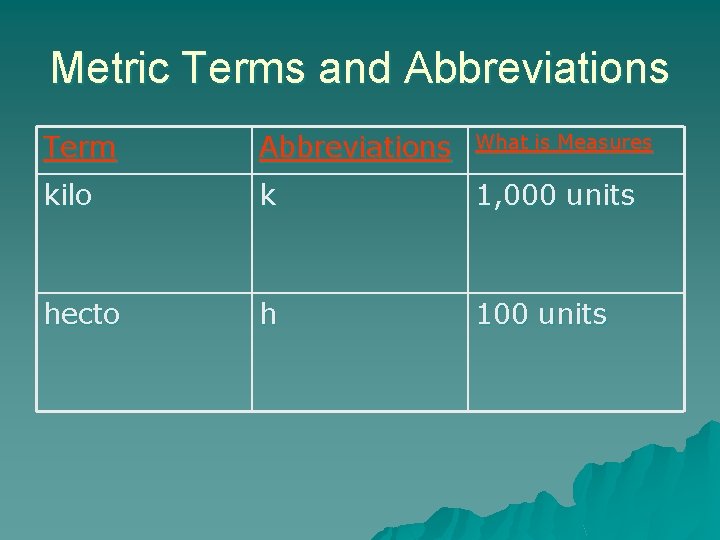
Metric Terms and Abbreviations Term Abbreviations What is Measures kilo k 1, 000 units hecto h 100 units
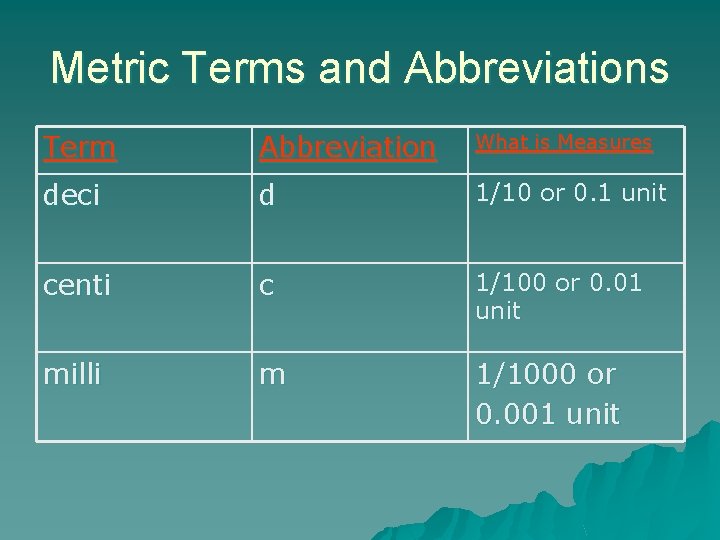
Metric Terms and Abbreviations Term Abbreviation What is Measures deci d 1/10 or 0. 1 unit centi c 1/100 or 0. 01 unit milli m 1/1000 or 0. 001 unit
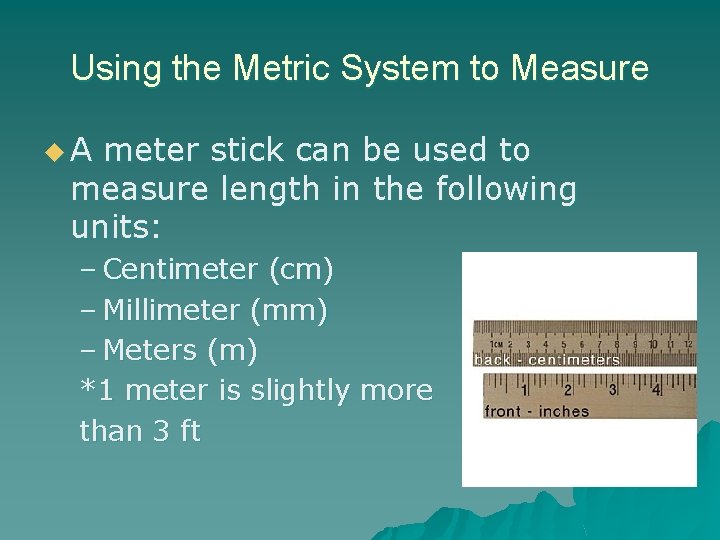
Using the Metric System to Measure u. A meter stick can be used to measure length in the following units: – Centimeter (cm) – Millimeter (mm) – Meters (m) *1 meter is slightly more than 3 ft
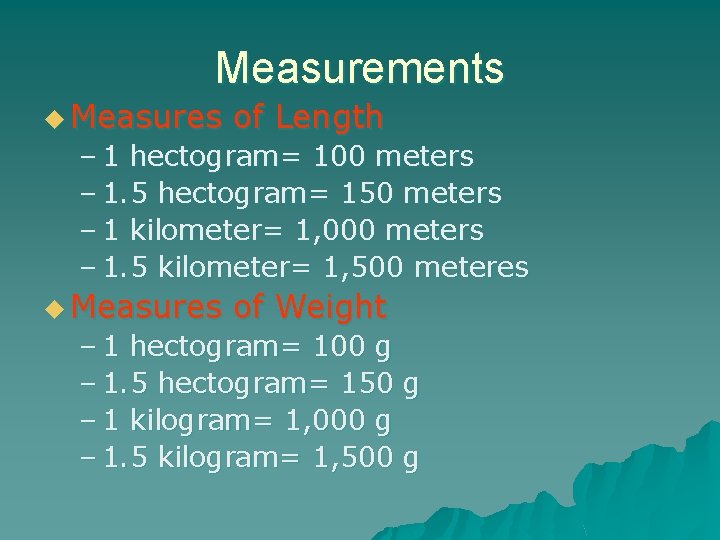
Measurements u Measures of Length – 1 hectogram= 100 meters – 1. 5 hectogram= 150 meters – 1 kilometer= 1, 000 meters – 1. 5 kilometer= 1, 500 meteres u Measures of Weight – 1 hectogram= 100 g – 1. 5 hectogram= 150 g – 1 kilogram= 1, 000 g – 1. 5 kilogram= 1, 500 g
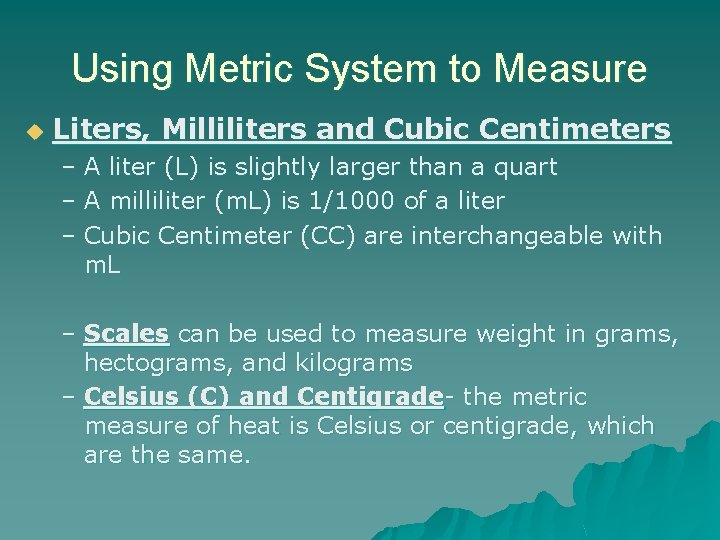
Using Metric System to Measure u Liters, Milliliters and Cubic Centimeters – A liter (L) is slightly larger than a quart – A milliliter (m. L) is 1/1000 of a liter – Cubic Centimeter (CC) are interchangeable with m. L – Scales can be used to measure weight in grams, hectograms, and kilograms – Celsius (C) and Centigrade- the metric measure of heat is Celsius or centigrade, which are the same.
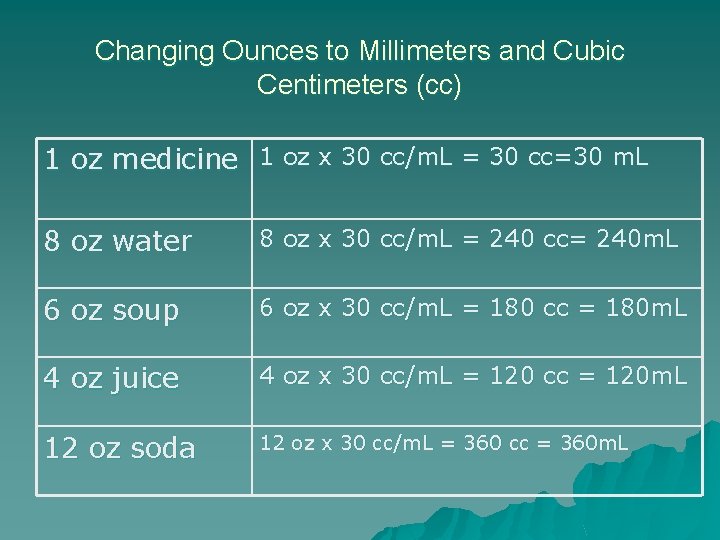
Changing Ounces to Millimeters and Cubic Centimeters (cc) 1 oz medicine 1 oz x 30 cc/m. L = 30 cc=30 m. L 8 oz water 8 oz x 30 cc/m. L = 240 cc= 240 m. L 6 oz soup 6 oz x 30 cc/m. L = 180 cc = 180 m. L 4 oz juice 4 oz x 30 cc/m. L = 120 cc = 120 m. L 12 oz soda 12 oz x 30 cc/m. L = 360 cc = 360 m. L
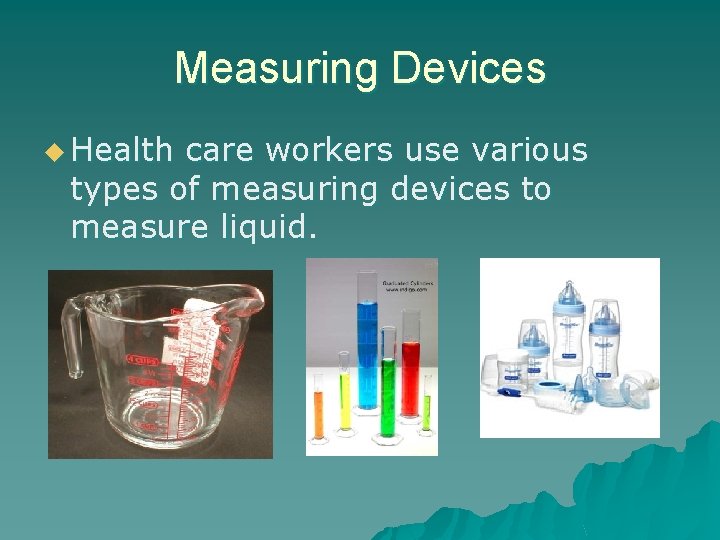
Measuring Devices u Health care workers use various types of measuring devices to measure liquid.
Changing Pounds to Kilograms and Kilograms to Pounds u u u 110 lb changed to kilograms: 110 lb x 0. 45 kg/lb = 49. 5 kg 200 lb changed to kg: 200 lb x 0. 45 x kg/lb = 91 kg 50 kg changed to lb = 50 kg x 2. 2 lb/kg = 110 lb 91 kg changed to lb = 91 kg x 2. 2 lb/kg = 200 lb To change lb to kg, multiply the number of lbs by 0. 45 lb/kg To change kg to lb, multiply the number of kg by 2. 2 lb/kg
Changing Ounces to Grams One ounce (oz) = 30 grams (g). u To change ounces to grams, multiply 30 g/oz by the number of ounces. u To change grams to ounces, divide 30 g/oz into the number of grams u 1 oz changed to grams: 1 oz x 30 g/oz = 30 g u 8 oz changed to grams: 8 oz x 30 g/oz = 240 g u
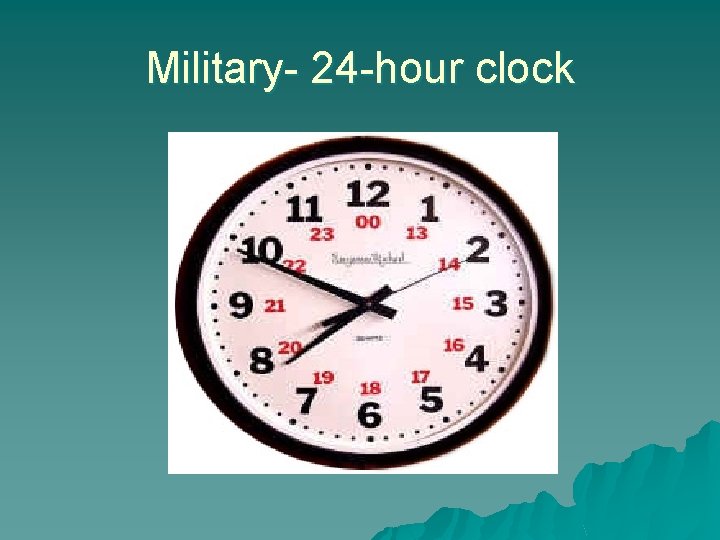
24 hour/Military Time Clock Medical facilities frequently use the 24 -hour clock system. The 24 -hour clock system clearly states time and eliminates confusion on documentation. u Military time is always expressed in four digits and no colons are used to separate hours and minutes. u Always use a 0 to complete the four digit number ex: for 1: 00 am = 0100 u Remember to state the time in hundreds ex: 1: 00 am= 0100= zero one hundred hours; 1100= eleven hundred hours (11 am) *Greenwich time- standard time; a 12 -hour clock u
Military- 24 -hour clock