
Medical Management of Rhinosinusitis in the Clinic Michael




- Slides: 52
Medical Management of Rhinosinusitis in the Clinic Michael A Kaliner, MD Medical Director, Institute for Asthma and Allergy Wheaton and Chevy Chase, MD Professor of Medicine, George Washington University School of Medicine
Conflicts • • Consult with: SRx. A Ista Alcon Teva Dey Mc. Neil
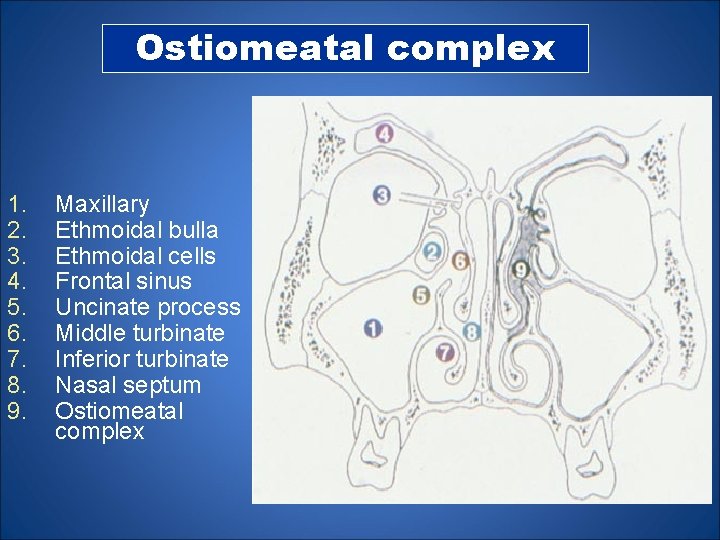
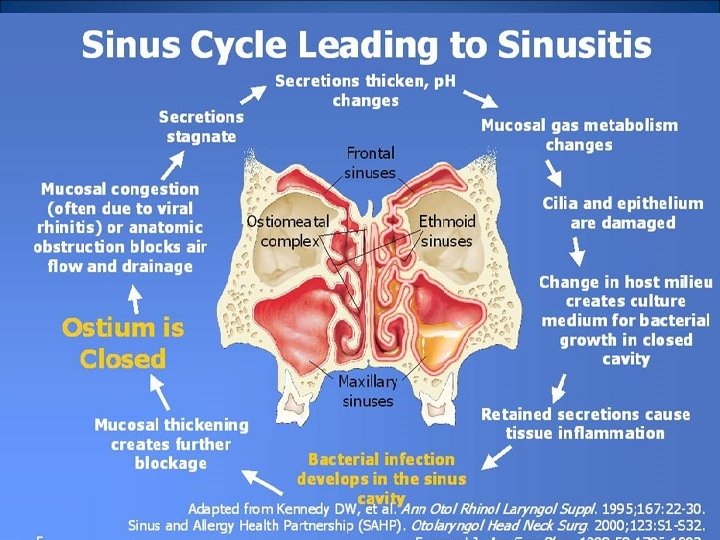
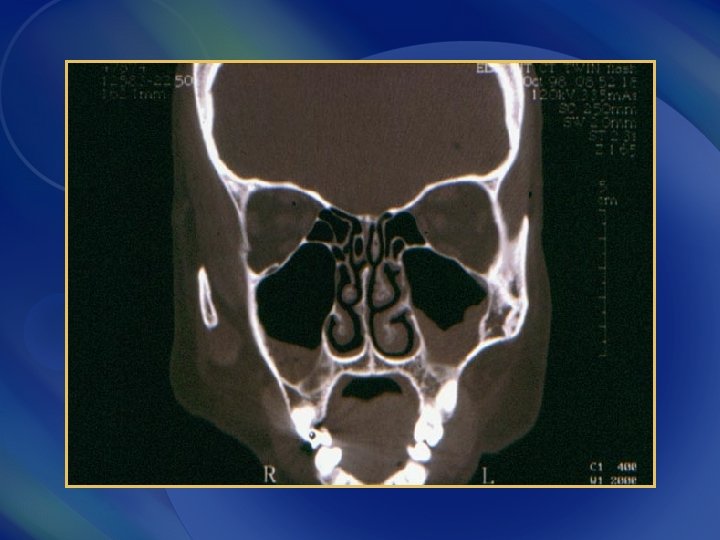
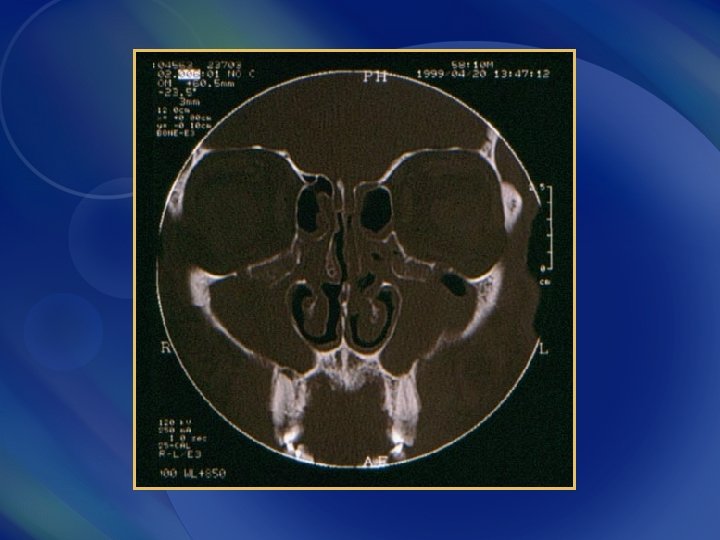
Ostiomeatal complex 1. 2. 3. 4. 5. 6. 7. 8. 9. Maxillary Ethmoidal bulla Ethmoidal cells Frontal sinus Uncinate process Middle turbinate Inferior turbinate Nasal septum Ostiomeatal complex
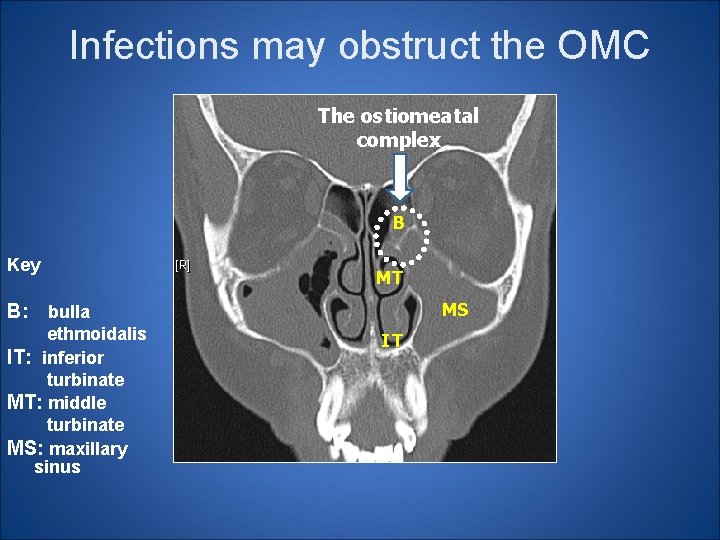
Infections may obstruct the OMC The ostiomeatal complex B Key MT MS B: bulla ethmoidalis IT: inferior turbinate MT: middle turbinate MS: maxillary sinus IT
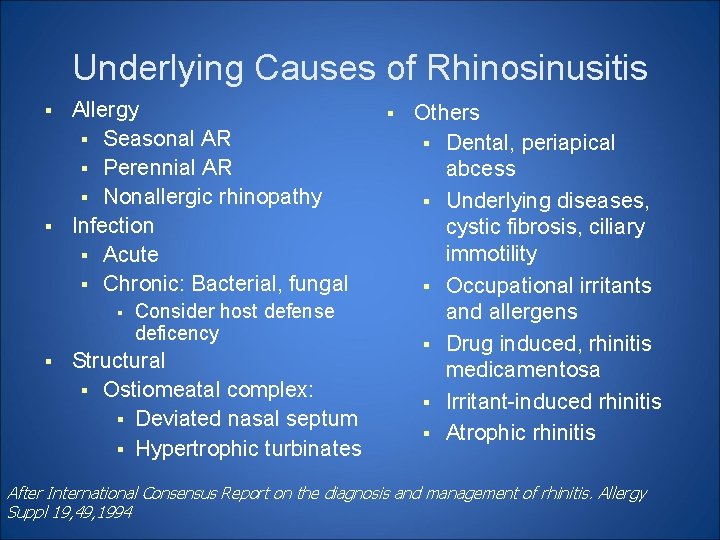
Underlying Causes of Rhinosinusitis § § Allergy § Seasonal AR § Perennial AR § Nonallergic rhinopathy Infection § Acute § Chronic: Bacterial, fungal § § Consider host defense deficency Structural § Ostiomeatal complex: § Deviated nasal septum § Hypertrophic turbinates § Others § Dental, periapical abcess § Underlying diseases, cystic fibrosis, ciliary immotility § Occupational irritants and allergens § Drug induced, rhinitis medicamentosa § Irritant-induced rhinitis § Atrophic rhinitis After International Consensus Report on the diagnosis and management of rhinitis. Allergy Suppl 19, 49, 1994
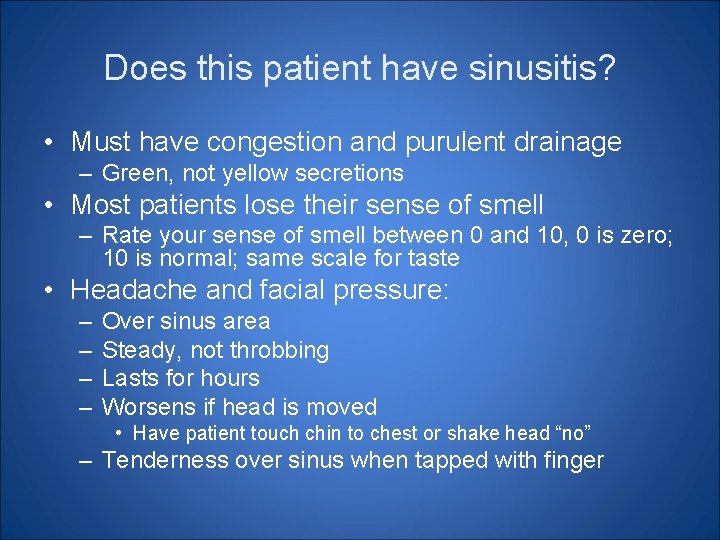
Does this patient have sinusitis? • Must have congestion and purulent drainage – Green, not yellow secretions • Most patients lose their sense of smell – Rate your sense of smell between 0 and 10, 0 is zero; 10 is normal; same scale for taste • Headache and facial pressure: – – Over sinus area Steady, not throbbing Lasts for hours Worsens if head is moved • Have patient touch chin to chest or shake head “no” – Tenderness over sinus when tapped with finger
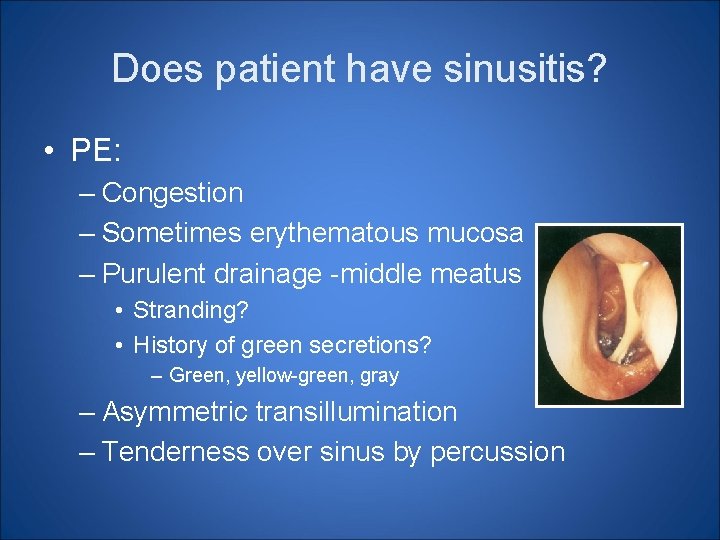
Does patient have sinusitis? • PE: – Congestion – Sometimes erythematous mucosa – Purulent drainage -middle meatus • Stranding? • History of green secretions? – Green, yellow-green, gray – Asymmetric transillumination – Tenderness over sinus by percussion
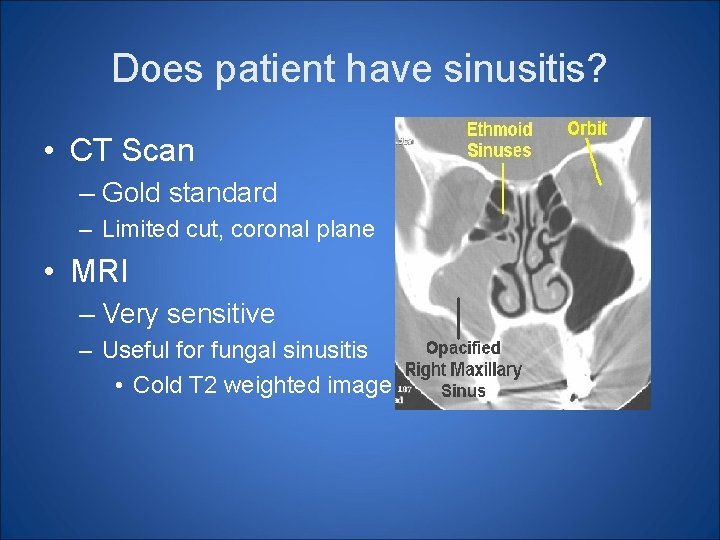
Does patient have sinusitis? • CT Scan – Gold standard – Limited cut, coronal plane • MRI – Very sensitive – Useful for fungal sinusitis • Cold T 2 weighted image level.
Does patient have sinusitis? • Culture of middle meatus – Cotton swab is generally useless – Use Calgiswab • Pediatric urethral culture swab • Calcium alginate on a wire • Allows direct culture from meatus • Overall: of some use, some of the time
Bacterial Rhinitis (local nasal infection) • Doc: I got sinus! • Sick all the time, congestion, headache, green drainage, gets sick a few days after last antibiotic, 5 -10 antibiotics per year • But… Normal sense of smell, normal CT • ENT evaluation and they did NOT recommend surgery
Bacterial Rhinitis (Local nasal infection) • Not currently recognized as specific disease • Local Staph or Strept infections – Crusting, green secretions – Excess drainage • Throat clearing, cough, runny nose – Often young, constantly or recurring sick – But normal CT – No anosmia (often a keen sense of smell) • Culture positive for Staph or Strept species • High degree of suspicion • Often with contact points (septumturbinate, spurs)
Treatment of Bacterial Rhinitis • Topical Bactroban (mupiricin) 2% – Instilled locally (finger, Q-tip) and massaged back – Alternative: Dissolve BB in sinus rinse • Add ½-1 inch strip of BB, add 1 Oz hot water, shake and dissolve BB, QS to 4 -8 Oz, add salt, shake and then wash nose and sinuses
Rhinologic Headaches • Recurring headache and secretions in young, healthy patient (usually female) • Headache is nasal/sinus in location – Steady, lasts hours to days, not affected by head movement • Secretions are yellow or clear; not purulent
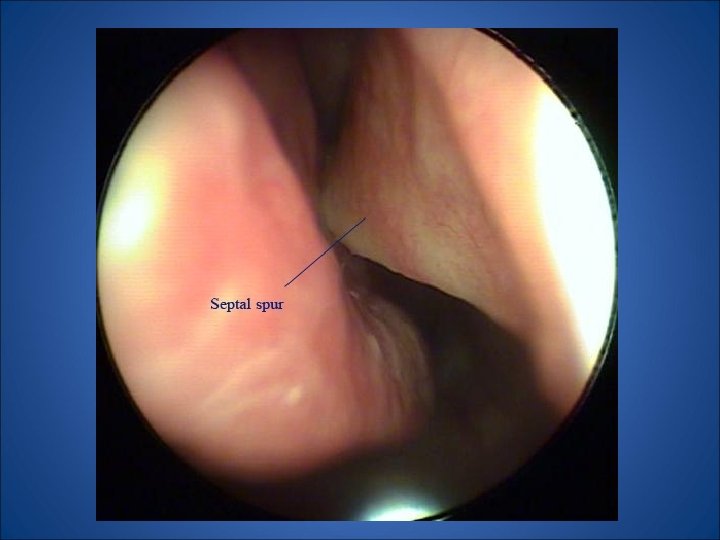
Rhinologic Headaches • PE: – Septal deviation with septum-turbinate contact • Septal spur with spur-turbinate contact – Turbinate-turbinate contact – Posterior valve • Turbinate-turbinate-septal contact – Clear secretions – Adequate middle meatus/ostiomeatal complex
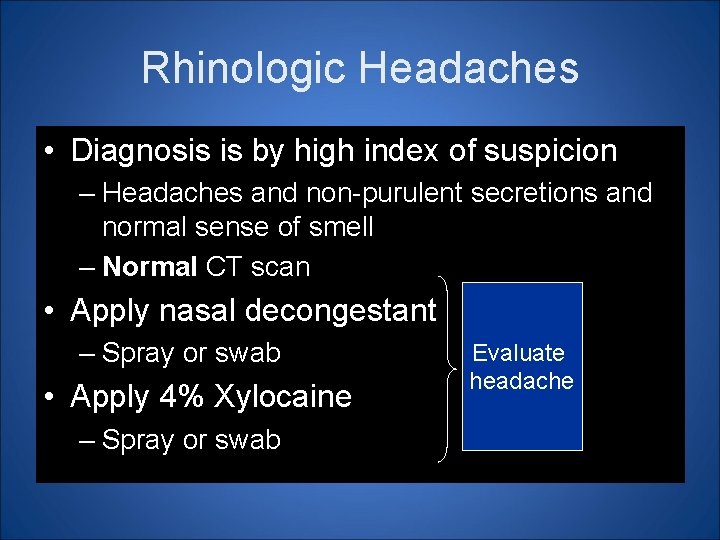
Rhinologic Headaches • Diagnosis is by high index of suspicion – Headaches and non-purulent secretions and normal sense of smell – Normal CT scan • Apply nasal decongestant – Spray or swab • Apply 4% Xylocaine – Spray or swab Evaluate headache
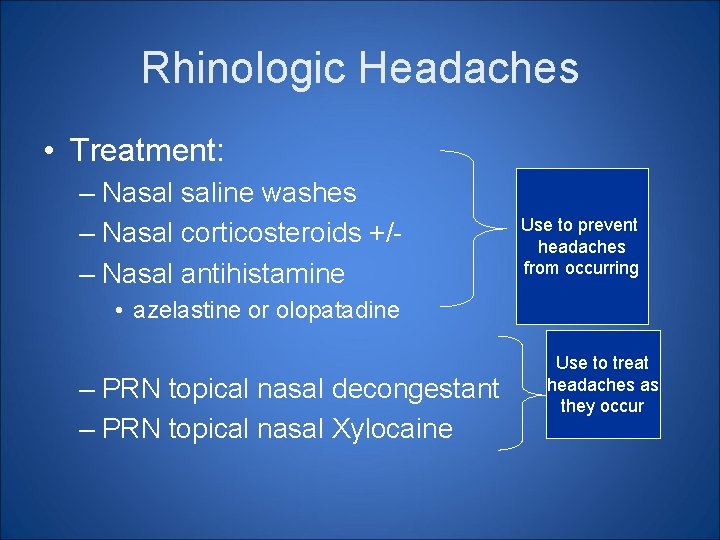
Rhinologic Headaches • Treatment: – Nasal saline washes – Nasal corticosteroids +/– Nasal antihistamine Use to prevent headaches from occurring • azelastine or olopatadine – PRN topical nasal decongestant – PRN topical nasal Xylocaine Use to treat headaches as they occur
Association Between Viral and Bacterial Sinusitis Infections • Viral infections – Self-limiting – 2 to 3 acute viral respiratory infections per year (6 -8 in children) – >80% symptoms resolve in 7 -10 d – Often inciting event for development of sinusitis and other RTIs – 0. 5%– 2% of cases complicated by acute bacterial infection (>20 million cases) RTI=respiratory tract infections. Brook. Primary Care 1998; 25: 633; Gwaltney. Clin Infect Dis 1996; 23: 1209; Gwaltney et al. N Engl J Med 1994; 330: 25.
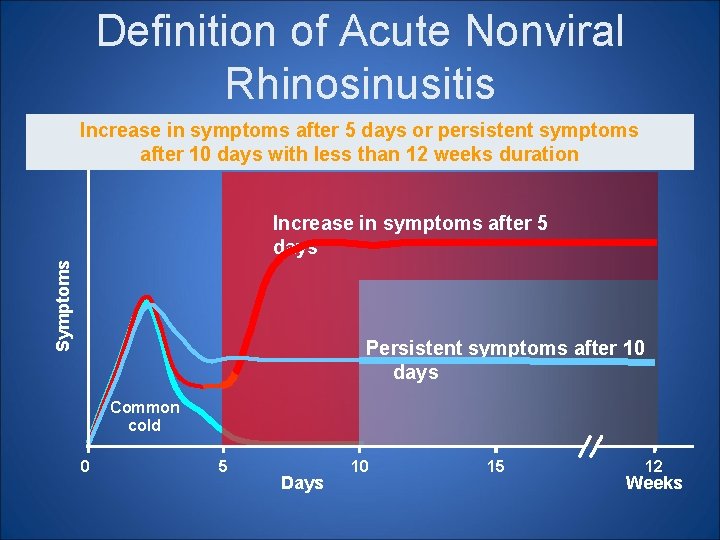
Definition of Acute Nonviral Rhinosinusitis Increase in symptoms after 5 days or persistent symptoms after 10 days with less than 12 weeks duration Symptoms Increase in symptoms after 5 days Persistent symptoms after 10 days Common cold 0 5 Days 10 15 12 Weeks
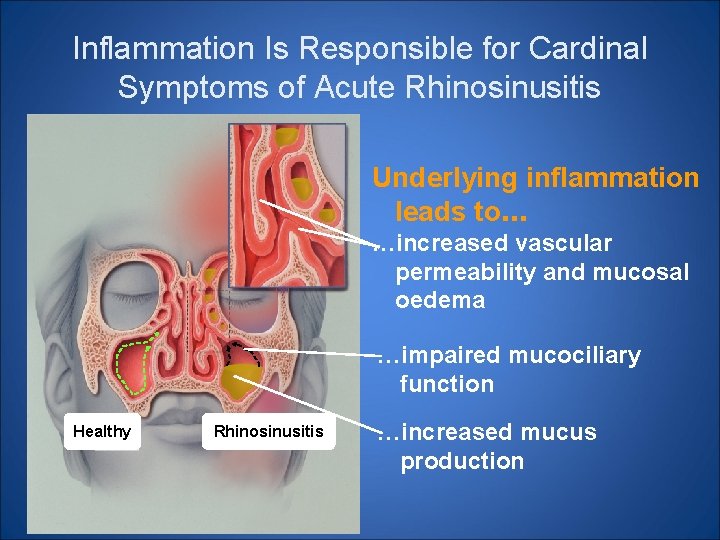
Inflammation Is Responsible for Cardinal Symptoms of Acute Rhinosinusitis Underlying inflammation leads to… …increased vascular permeability and mucosal oedema …impaired mucociliary function Healthy Rhinosinusitis …increased mucus production
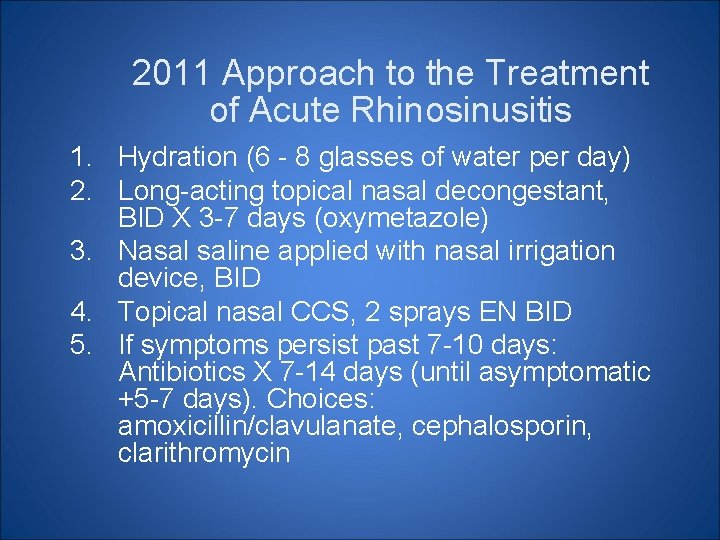
2011 Approach to the Treatment of Acute Rhinosinusitis 1. Hydration (6 - 8 glasses of water per day) 2. Long-acting topical nasal decongestant, BID X 3 -7 days (oxymetazole) 3. Nasal saline applied with nasal irrigation device, BID 4. Topical nasal CCS, 2 sprays EN BID 5. If symptoms persist past 7 -10 days: Antibiotics X 7 -14 days (until asymptomatic +5 -7 days). Choices: amoxicillin/clavulanate, cephalosporin, clarithromycin
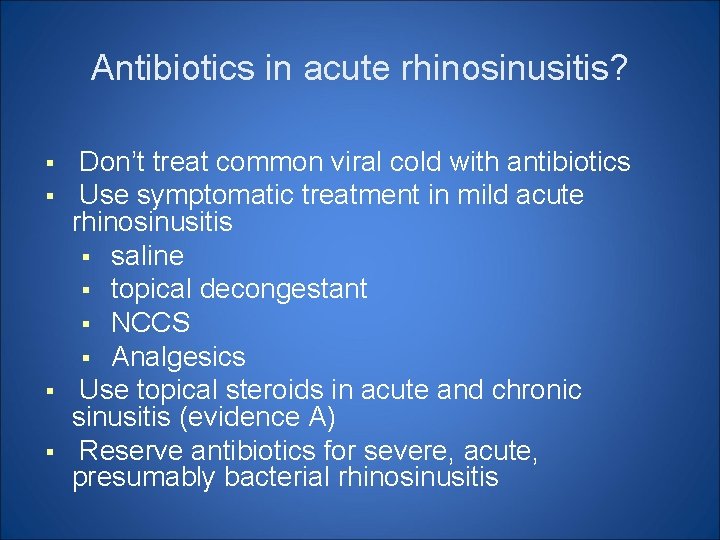
Antibiotics in acute rhinosinusitis? § § Don’t treat common viral cold with antibiotics Use symptomatic treatment in mild acute rhinosinusitis § saline § topical decongestant § NCCS § Analgesics Use topical steroids in acute and chronic sinusitis (evidence A) Reserve antibiotics for severe, acute, presumably bacterial rhinosinusitis
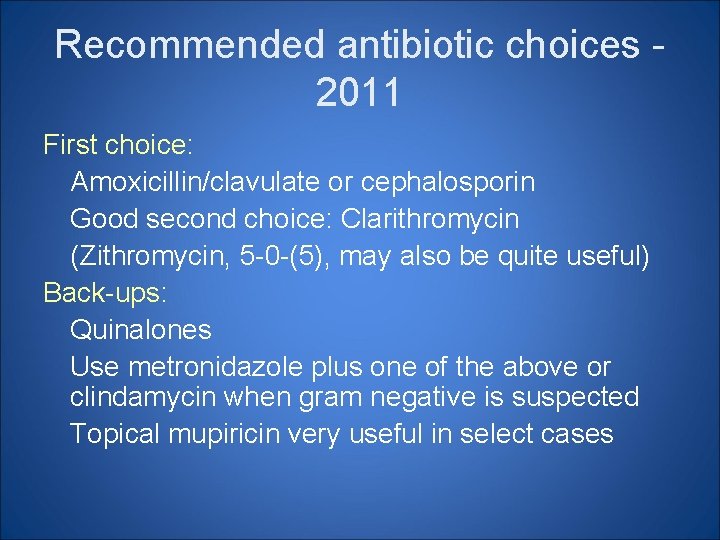
Recommended antibiotic choices 2011 First choice: Amoxicillin/clavulate or cephalosporin Good second choice: Clarithromycin (Zithromycin, 5 -0 -(5), may also be quite useful) Back-ups: Quinalones Use metronidazole plus one of the above or clindamycin when gram negative is suspected Topical mupiricin very useful in select cases
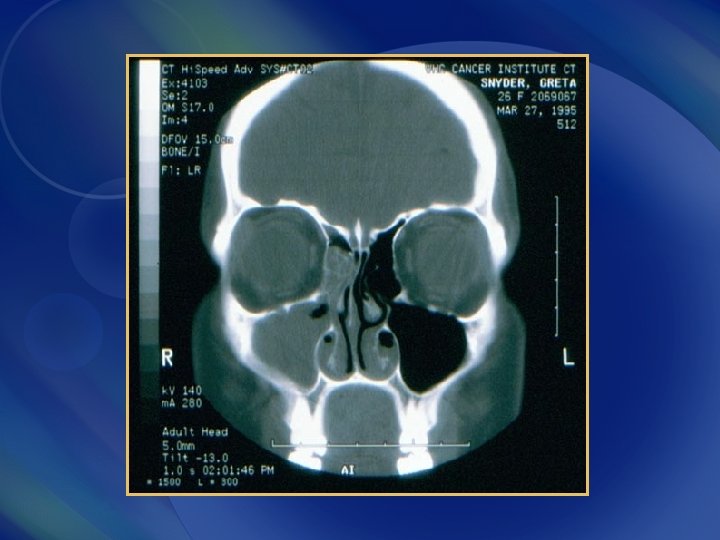
Unilateral Sinusitis • Dental abscess – Foul smelling, evidence of periapical abscess • • Fungal sinusitis Polyp Mucocoele Tumor of the sinus/nose – Inverted papilloma • Congenital aplasia/hypoplasia
Odontogenic Sinusitis (Dental Periapical Abscess) • Unilateral sinusitis – Nearly always in maxillary sinus above the site of the abscess or perforation through the floor of the sinus after dental procedure • Foul smelling – Microaerophilic Strept species • Persistent or recurring
Odontogenic Sinusitis (Dental Periapical Abscess) • Diagnosis is by dental x-ray and confirmation of presence of periapical abscess • Treat by root canal and drainage of abscess • Requires penicillin-type antibiotic
Allergic Fungal Sinusitis • Adolescents, adults, chronic, resistant disease • Nasal polyps Allergic mucus – brown rubbery plugs – Hyphae on smear of mucus • • • Can be unilateral 75 -100% atopic Positive ST or RAST to fungi Increased Ig. E Hyper-attenuation on CT or MRI – Bone loss – Cold T 2 weighted image
AFS: Radiographic Findings • Can be unilateral • Bilateral disease -51%, asymmetrical 78% • Bony erosion – 20% – Expansion, remodeling, thinning, demineralization – Heterogeneous areas on CT (minerals) – Cold T 2 weighted MRI images
How I treat allergic fungal sinusitis • Confirm diagnosis – Ig. E, Eosinophils, MRI, CT • Aggressive nasal Rx – Budesonide nasal washings, 500 ug BID • Itraconazole, oral – 100 mg BID x 6 months – 100 mg QD x 12 months – Monitor LFT, Ig. E Q 3 mos • Consider surgery if unresponsive
The signs and symptoms of chronic sinusitis (symptoms persisting >12 weeks): Prerequisite symptoms § Purulent nasal and posterior pharyngeal discharge § Plus: § Facial pain/pressure § Persistent nasal obstruction § Cough/post-nasal drip/throat clearing Supporting symptoms § Hyposmia, anosmia § Sore throat § Malaise § Fever § Headache, facial pressure, dental pain § Halitosis § Sleep disturbance § Fatigue
Chronic Rhinosinusitis: Why? § § § Chronic inflamed mucosa § Neutrophils and mononuclear cells in CRSs. NP § Eosinophils in CRSw. NP Possible chronic infection § Bacteria § Fungi Superantigens Biofilms Osteitis
Bacteria in Biofilms • May be antibiotic resistant • May be hard to culture • Found in surgical specimens from CRS (44%+) – S aureus, P aeroginosa, H Influenza, S pneumonia • Clinical implications – Saline sinus washes – BKC? – Zwitterionic surfactant? JBS
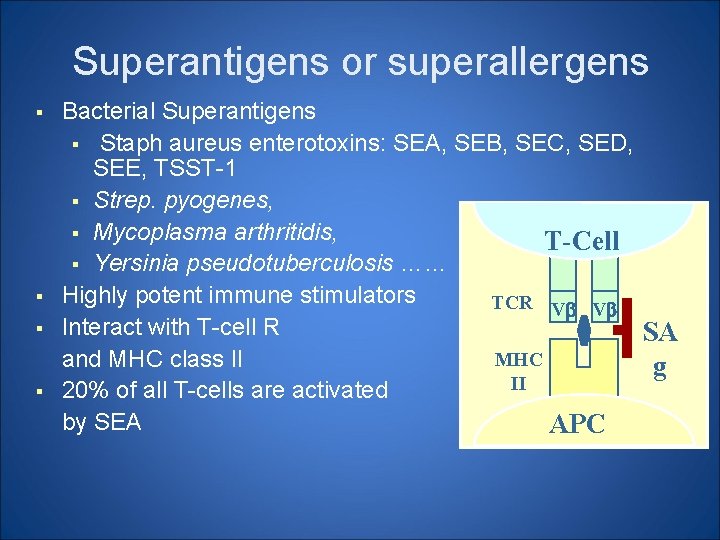
Superantigens or superallergens § § Bacterial Superantigens § Staph aureus enterotoxins: SEA, SEB, SEC, SED, SEE, TSST-1 § Strep. pyogenes, § Mycoplasma arthritidis, T-Cell § Yersinia pseudotuberculosis …… Highly potent immune stimulators TCR V V Interact with T-cell R SA MHC and MHC class II g II 20% of all T-cells are activated by SEA APC
Recommended approach to the treatment of chronic rhinosinusitis 2011 § § § Hydration (6 - 8 glasses of water per day) Antibiotics only if clear evidence of infection: use X 1421+ days (until asymptomatic +7 days). Choices: cephalosporin, amoxicillin/clavulanate, clarithromycin, quinalone Long-acting nasal decongestant, BID X 3 -7 days (oxymetazoline) Nasal saline applied with nasal irrigation device, BID Topical nasal CCS (only Mometasone has FDA approval): § 2 sprays BID, until symptoms resolved § Reduce to lowest effective dose, to maintain remission § Aim towards the eye and away from the nasal septum
Next recommended approaches § § § Intensify use of nasal CCS § Budesonide by nasal irrigation § Fluticasone MDI, 220 ug 2 BID § Budesonide nasal washes, 500 ug BID Switch antibiotics (only if evidence of ongoing bacterial infection) Add metronidazole or clindamycin (especially with foul smell – gram negatives) Consider fungal Rx (itraconazole, not amphotericin) Oral CCS (Daily followed by QOD) Topical antibiotics (tobramycin rarely, mupirocin nasal ointment)
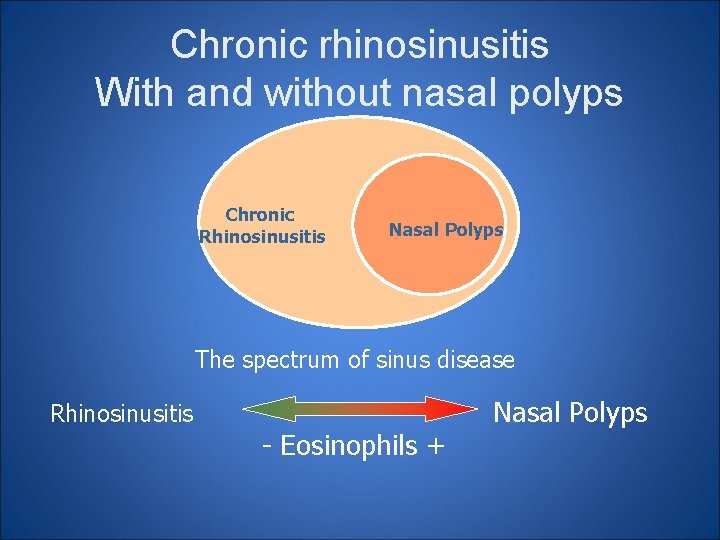
Chronic rhinosinusitis With and without nasal polyps Chronic Rhinosinusitis Nasal Polyps The spectrum of sinus disease Rhinosinusitis - Eosinophils + Nasal Polyps
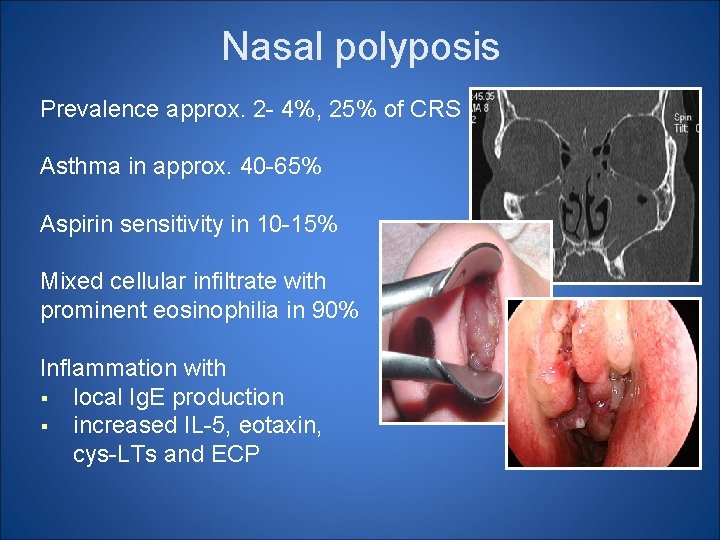
Nasal polyposis Prevalence approx. 2 - 4%, 25% of CRS Asthma in approx. 40 -65% Aspirin sensitivity in 10 -15% Mixed cellular infiltrate with prominent eosinophilia in 90% Inflammation with § local Ig. E production § increased IL-5, eotaxin, cys-LTs and ECP
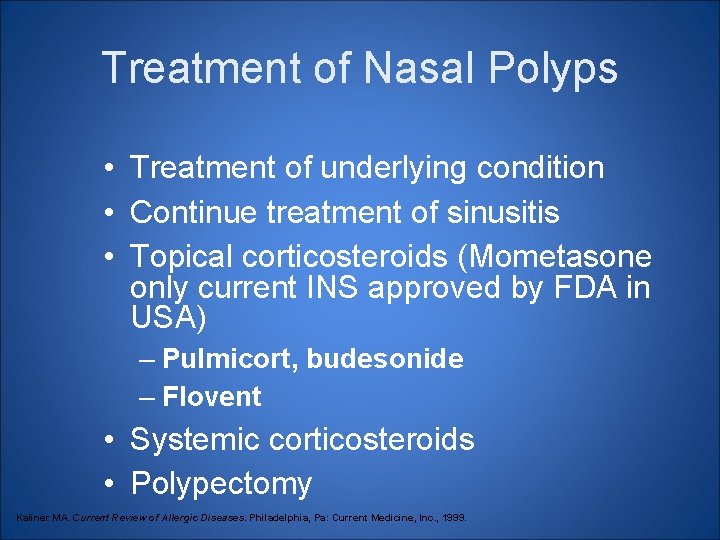
Treatment of Nasal Polyps • Treatment of underlying condition • Continue treatment of sinusitis • Topical corticosteroids (Mometasone only current INS approved by FDA in USA) – Pulmicort, budesonide – Flovent • Systemic corticosteroids • Polypectomy Kaliner MA. Current Review of Allergic Diseases. Philadelphia, Pa: Current Medicine, Inc. , 1999.
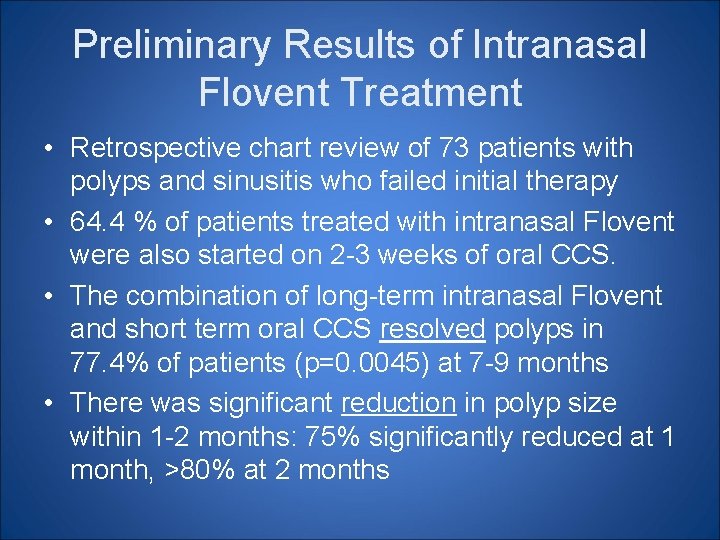
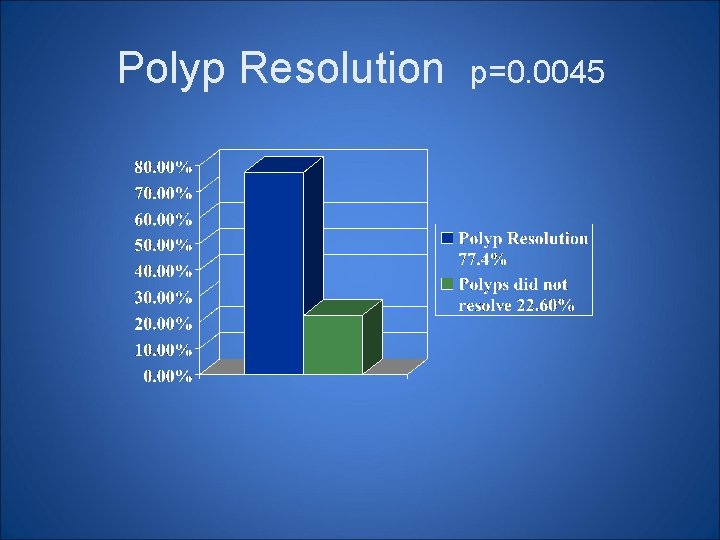
Preliminary Results of Intranasal Flovent Treatment • Retrospective chart review of 73 patients with polyps and sinusitis who failed initial therapy • 64. 4 % of patients treated with intranasal Flovent were also started on 2 -3 weeks of oral CCS. • The combination of long-term intranasal Flovent and short term oral CCS resolved polyps in 77. 4% of patients (p=0. 0045) at 7 -9 months • There was significant reduction in polyp size within 1 -2 months: 75% significantly reduced at 1 month, >80% at 2 months
Polyp Resolution p=0. 0045
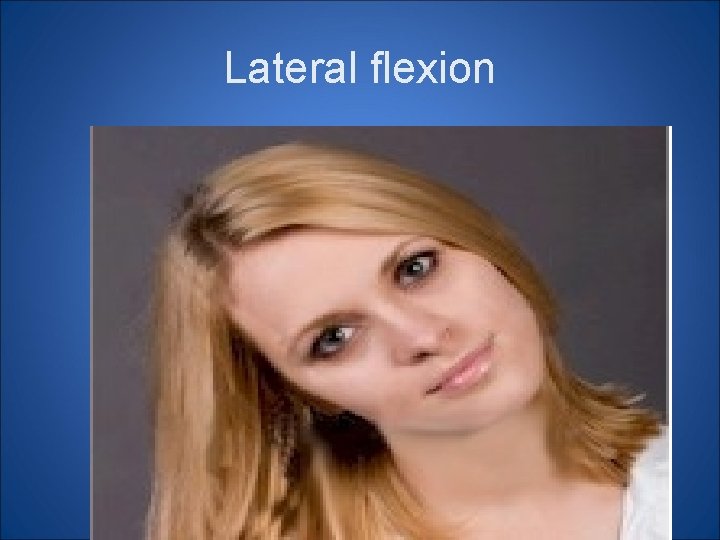
Lateral flexion
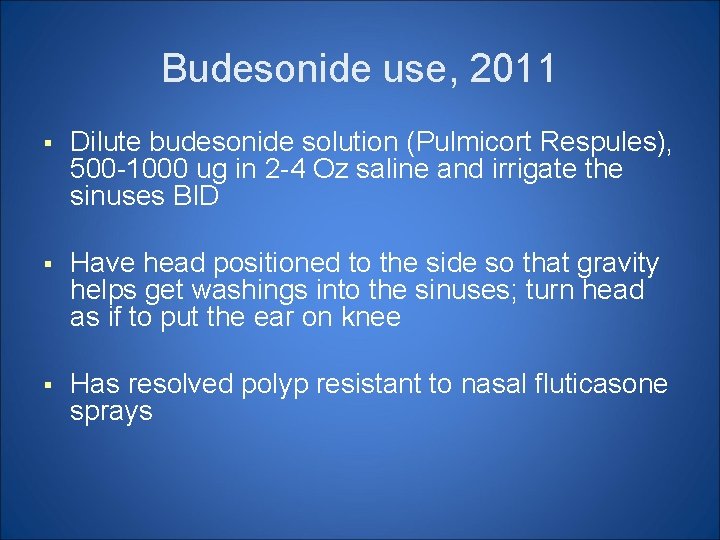
Budesonide use, 2011 § Dilute budesonide solution (Pulmicort Respules), 500 -1000 ug in 2 -4 Oz saline and irrigate the sinuses BID § Have head positioned to the side so that gravity helps get washings into the sinuses; turn head as if to put the ear on knee § Has resolved polyp resistant to nasal fluticasone sprays
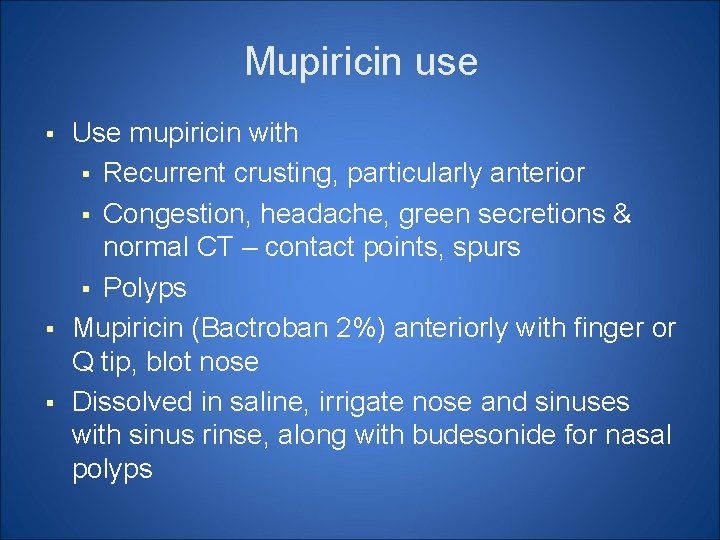
Mupiricin use § § § Use mupiricin with § Recurrent crusting, particularly anterior § Congestion, headache, green secretions & normal CT – contact points, spurs § Polyps Mupiricin (Bactroban 2%) anteriorly with finger or Q tip, blot nose Dissolved in saline, irrigate nose and sinuses with sinus rinse, along with budesonide for nasal polyps
Polyp treatments - 2011 Anticipate <25+% improve with sinus Rx + nasal CCS § About 50% improve with sinus Rx + high dose nasal CCS (nasal lavages with budesonide) § The remainder improve with oral CCS + nasal lavages with budesonide solution Overall medical treatment can get close to 100% success § Mupiricin appears to help prevent polyp regrowth, especially with crusting § Add ½-1 tsp of betadine to sinus wash § Surgery, properly done, is successful short-term but polyps can and do recur and repeated surgery gets progressively more difficult and dangerous! §
Polyps – 2011 recommendations § § § Treat underlying sinusitis High dose nasal CCS § Budesonide solution (Pulmicort Respules) suspended in sinus lavage (+/- betadine) § Wash with the head positioned with ear to the knee § Consider Singulair (QD addition) § Prednisone 20 -30 mg § Daily x 3 weeks, then QOD, then taper to 0 § Fluticasone (Flovent MDI) through baby bottle nipple) Mupiricin ointment topically or dissolved in sinus lavavge Consider careful surgery if polyps are persistent, resistant or recur Consider oral or topical anti-fungal treatment Xolair
Surgery • We do refer for surgery after failing with aggressive medical management • In our experience, surgery is not necessary in most cases, although patients with recurrent disease and obstructed outflow tract may benefit • Patients requiring recurrent oral CCS may need FESS
Surgery • First surgery is easiest – Landmarks in place • Revisions require real expertise – Abnormal land marks • Good surgeons try good medicine first
Whew!! Thank you