
MEDICAL LAW ETHICS DR PAUL CHAN DEPUTY DIRECTOR








- Slides: 61
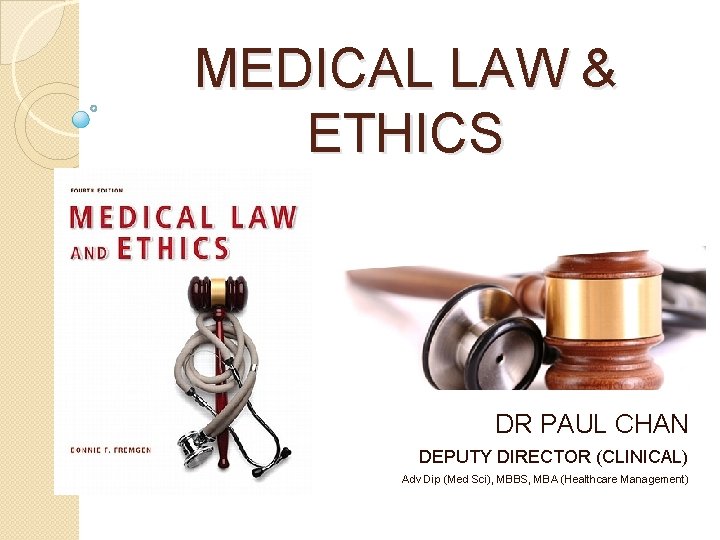
MEDICAL LAW & ETHICS DR PAUL CHAN DEPUTY DIRECTOR (CLINICAL) Adv Dip (Med Sci), MBBS, MBA (Healthcare Management)
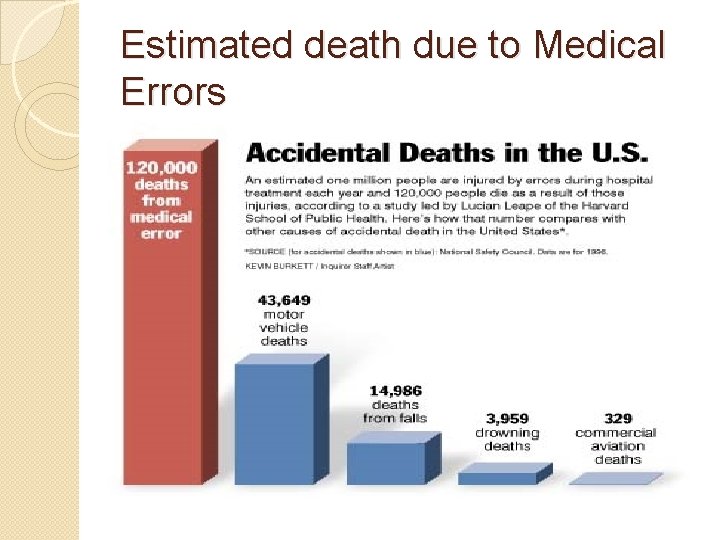
Estimated death due to Medical Errors
Malaysian Primary Care
Professional Negligence and Medical Malpractice �Malpractice: professional misconduct or demonstration of an unreasonable lack of skill with the result of injury, loss, or damage to the patient. �Negligence: unintentional action that occurs when a person performs or fails to perform an action that a reasonable person would or would not have committed in a similar situation
Fraud �Deliberate misrepresentation or concealment of facts from another person for unlawful or unfair gain �Getting more in the healthcare fraternity
Professional Liability �Civil liability cases ◦ Doctors may be sued under a variety of legal theories �Physical conditions of the premises ◦ Institution may be liable when regulatory standards have been violated �Illegal sale of drugs
What can we do?
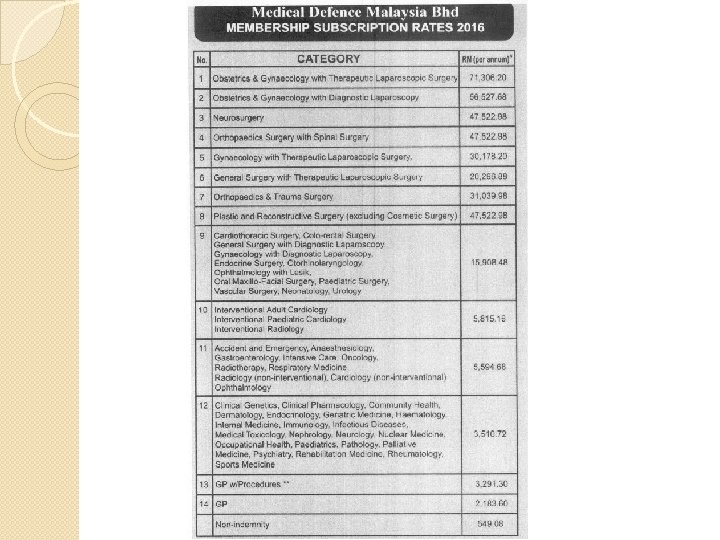
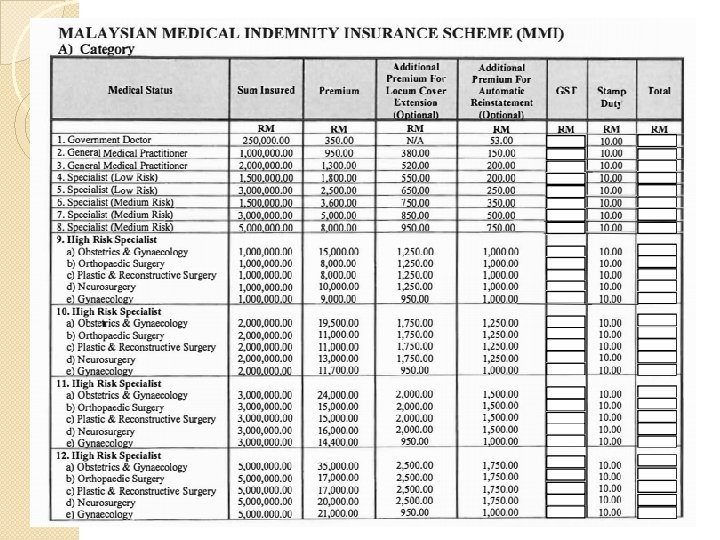
Protect yourself �Liability insurance �Medical Indemnity insurance �Malpractice insurance
Settlement �Out of court ◦ Mediation ◦ Payment (Ex-Gratia) �Court ◦ Judge to decide
Medicolegal History
Bolam Principle �Bolam vs Friern Hospital Committee (1957) �Your are not right when your colleague ‘says’ you are right “I myself would prefer to put it this way, that he is not guilty of negligence if he has acted in accordance with a practice accepted as proper by a responsible body of medical men skilled in that particular art. . . Putting it the other way round, a man is not negligent, if he is acting in accordance with such a practice, merely because there is a body of opinion that would take a contrary view”
Bolam Test �States that a doctor would not be considered negligent if their practice conformed to that of a responsible body of medical opinion skilled in the field. �Medical profession will arbitrate on what was reasonable information to provide or withhold.
Bolitho v City & Hackney Health Authority (1997) “His Lordship further held that ‘if it can be demonstrated that the expert medical opinion is not capable of withstanding logical analysis, the judge is entitled to hold that the body of opinion is not responsible”
Roger v Whitaker (1999) “where it was held that ‘[the standard of care] is not determined solely or even primarily by reference to the practice, followed or supported by a responsible body of opinion in the relevant profession or trade. It has to be decided ‘whether it was reasonable for one or more of the steps to be taken. . [and this] was not for expert medical witnesses to say whether those steps were or were not reasonable”
Cases
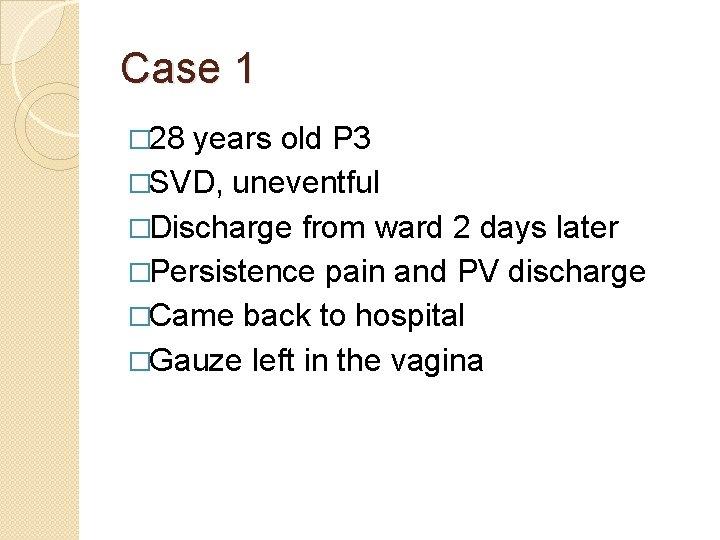
Case 1 � 28 years old P 3 �SVD, uneventful �Discharge from ward 2 days later �Persistence pain and PV discharge �Came back to hospital �Gauze left in the vagina
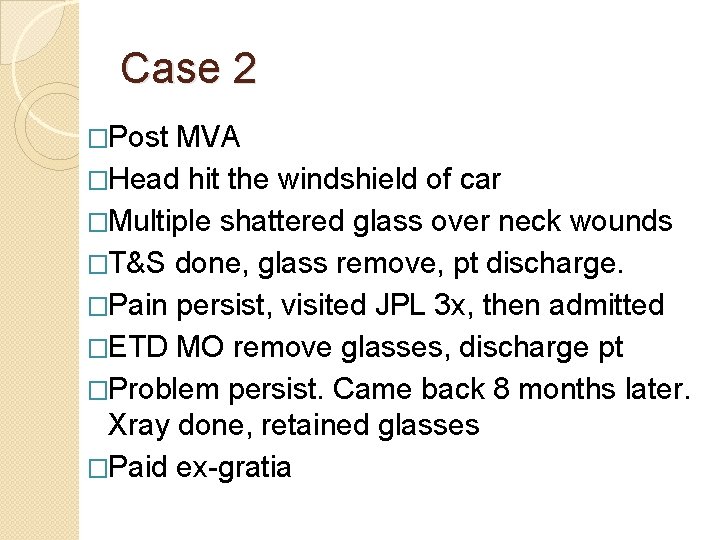
Case 2 �Post MVA �Head hit the windshield of car �Multiple shattered glass over neck wounds �T&S done, glass remove, pt discharge. �Pain persist, visited JPL 3 x, then admitted �ETD MO remove glasses, discharge pt �Problem persist. Came back 8 months later. Xray done, retained glasses �Paid ex-gratia
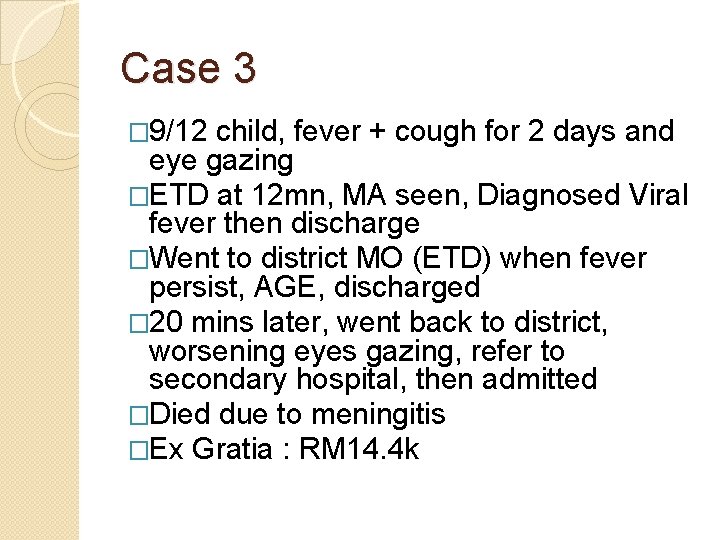
Case 3 � 9/12 child, fever + cough for 2 days and eye gazing �ETD at 12 mn, MA seen, Diagnosed Viral fever then discharge �Went to district MO (ETD) when fever persist, AGE, discharged � 20 mins later, went back to district, worsening eyes gazing, refer to secondary hospital, then admitted �Died due to meningitis �Ex Gratia : RM 14. 4 k
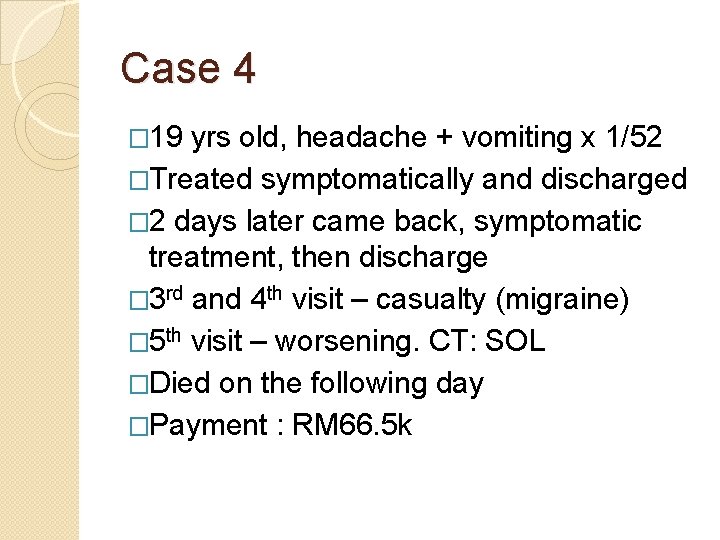
Case 4 � 19 yrs old, headache + vomiting x 1/52 �Treated symptomatically and discharged � 2 days later came back, symptomatic treatment, then discharge � 3 rd and 4 th visit – casualty (migraine) � 5 th visit – worsening. CT: SOL �Died on the following day �Payment : RM 66. 5 k
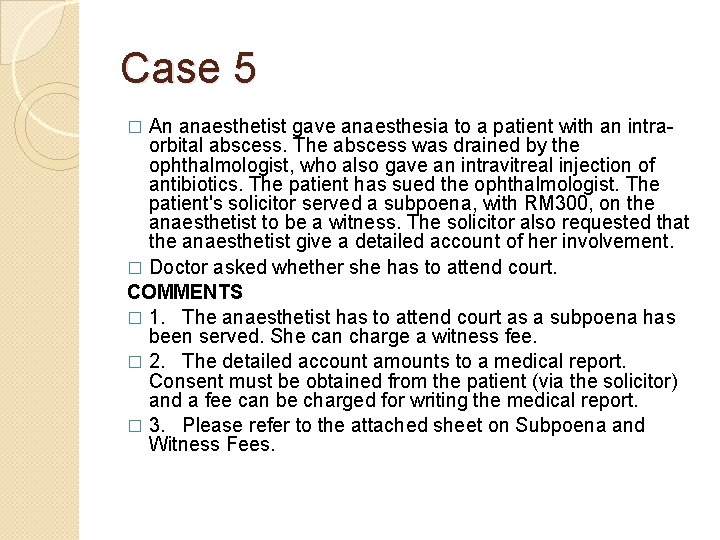
Case 5 An anaesthetist gave anaesthesia to a patient with an intraorbital abscess. The abscess was drained by the ophthalmologist, who also gave an intravitreal injection of antibiotics. The patient has sued the ophthalmologist. The patient's solicitor served a subpoena, with RM 300, on the anaesthetist to be a witness. The solicitor also requested that the anaesthetist give a detailed account of her involvement. � Doctor asked whether she has to attend court. COMMENTS � 1. The anaesthetist has to attend court as a subpoena has been served. She can charge a witness fee. � 2. The detailed account amounts to a medical report. Consent must be obtained from the patient (via the solicitor) and a fee can be charged for writing the medical report. � 3. Please refer to the attached sheet on Subpoena and Witness Fees. �
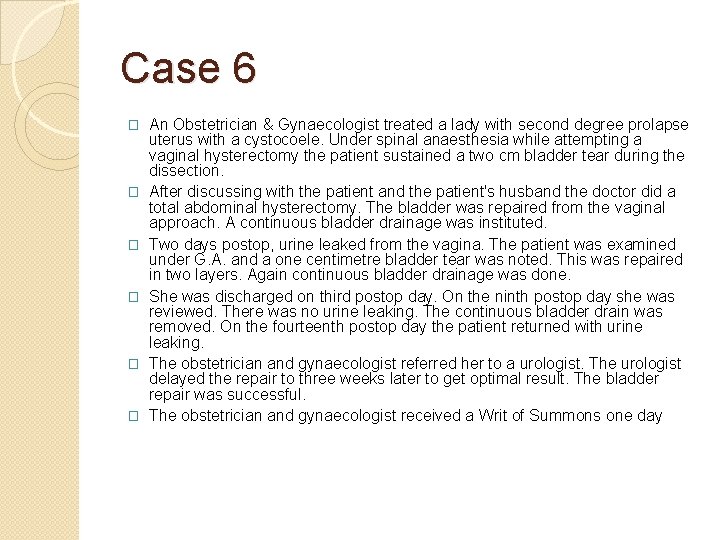
Case 6 � � � An Obstetrician & Gynaecologist treated a lady with second degree prolapse uterus with a cystocoele. Under spinal anaesthesia while attempting a vaginal hysterectomy the patient sustained a two cm bladder tear during the dissection. After discussing with the patient and the patient's husband the doctor did a total abdominal hysterectomy. The bladder was repaired from the vaginal approach. A continuous bladder drainage was instituted. Two days postop, urine leaked from the vagina. The patient was examined under G. A. and a one centimetre bladder tear was noted. This was repaired in two layers. Again continuous bladder drainage was done. She was discharged on third postop day. On the ninth postop day she was reviewed. There was no urine leaking. The continuous bladder drain was removed. On the fourteenth postop day the patient returned with urine leaking. The obstetrician and gynaecologist referred her to a urologist. The urologist delayed the repair to three weeks later to get optimal result. The bladder repair was successful. The obstetrician and gynaecologist received a Writ of Summons one day
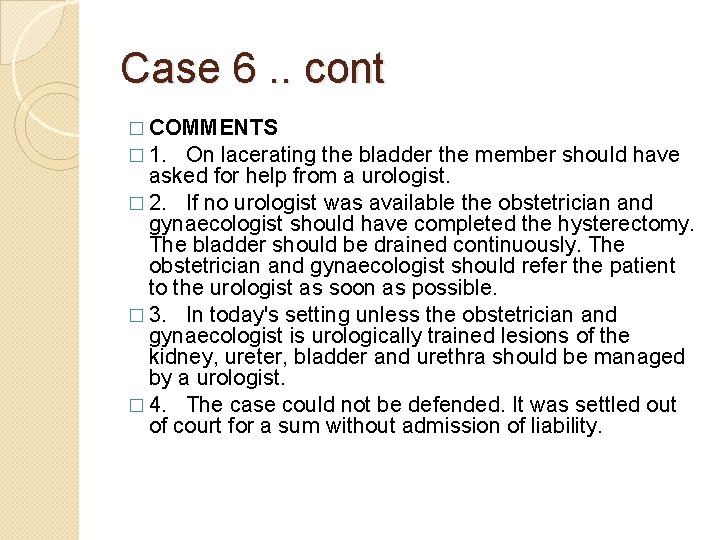
Case 6. . cont � COMMENTS � 1. On lacerating the bladder the member should have asked for help from a urologist. � 2. If no urologist was available the obstetrician and gynaecologist should have completed the hysterectomy. The bladder should be drained continuously. The obstetrician and gynaecologist should refer the patient to the urologist as soon as possible. � 3. In today's setting unless the obstetrician and gynaecologist is urologically trained lesions of the kidney, ureter, bladder and urethra should be managed by a urologist. � 4. The case could not be defended. It was settled out of court for a sum without admission of liability.
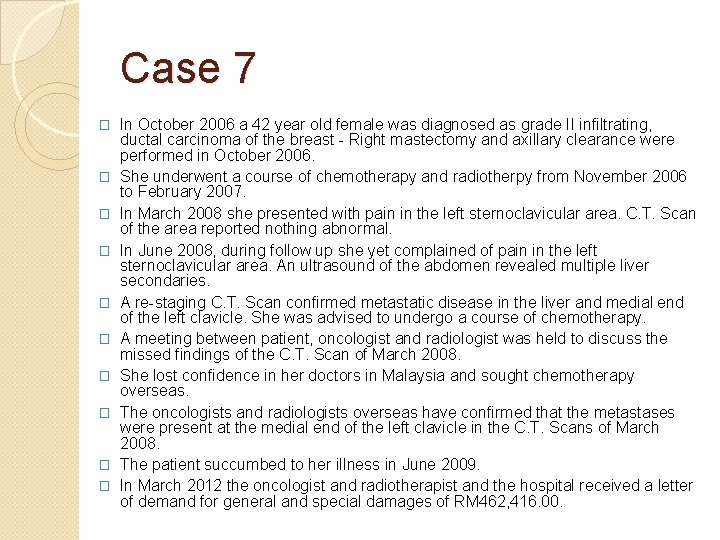
Case 7 � � � � � In October 2006 a 42 year old female was diagnosed as grade II infiltrating, ductal carcinoma of the breast - Right mastectomy and axillary clearance were performed in October 2006. She underwent a course of chemotherapy and radiotherpy from November 2006 to February 2007. In March 2008 she presented with pain in the left sternoclavicular area. C. T. Scan of the area reported nothing abnormal. In June 2008, during follow up she yet complained of pain in the left sternoclavicular area. An ultrasound of the abdomen revealed multiple liver secondaries. A re-staging C. T. Scan confirmed metastatic disease in the liver and medial end of the left clavicle. She was advised to undergo a course of chemotherapy. A meeting between patient, oncologist and radiologist was held to discuss the missed findings of the C. T. Scan of March 2008. She lost confidence in her doctors in Malaysia and sought chemotherapy overseas. The oncologists and radiologists overseas have confirmed that the metastases were present at the medial end of the left clavicle in the C. T. Scans of March 2008. The patient succumbed to her illness in June 2009. In March 2012 the oncologist and radiotherapist and the hospital received a letter of demand for general and special damages of RM 462, 416. 00.
Case 7. . cont � 1. Oncologist and radiologist should have admitted the error in the interpretation of C. T. Scans of March 2008 and apologized immediately. � 2. Giving an apology is not an admission of liability. In many incidents an immediate apology has diffused the situation. In this instance a letter of demand was issued to the radiologist, oncologist and the hospital because of the delay in tendering the apology. � 3. The radiologist has missed the findings in the C. T. Scan of March 2008. He bears the responsibility of the error, but the oncologist cannot be exonerated as he had the clinical advantage of examining the patient and correlating the clinical findings with the C. T. Scan findings. � 4. The deceased's estate has not continued to pursue the matter. If the matter is pursued, an out of court settlement should be considered with the radiologist bearing the bulk of the damages.
Open Disclosure & Apology “If a patient has suffered serious harm for whatever reason, the doctor should act immediately to put matters right. The patient must receive a proper explanation about the short and long term effects. When appropriate the doctor should offer an apology. ” Good Medical Practice, MMC
Ethical Obligation Harm to the patient Take Immediate Action To Put Matters Right Offer Proper Explanation – Short and Long Term Effects Offer an Apology (when appropriate)
Legal Obligation Statute Section 27(1)(a) of the Private Healthcare Facilities and Services (Private Hospitals and Other Private Healthcare Facilities ) Regulations 2006 : “(1) The licensee or person in charge of a private healthcare facility or service shall take reasonable steps to ensure that a patient is – (a) Provided with information about the nature of his medical condition and any proposed treatment, investigation or procedure and the likely costs of the treatment, investigation or procedure; ”
Legal Obligation Common Law “I personally think that in professional negligence cases, and in particular in medical negligence cases, there is a duty of candour resting on the professional man…it is but one aspect of the general duty of care, arising out of the patient/medical practitioner or hospital authority relationship and gives rise to rights both in contract and in tort. ” [emphasis added] per Lord Donaldson MR in Naylor v Preston [1987] 2 All ER 353
Consent
The Law on Consent As a general rule no doctor may treat anyone without his or her consent. Without consent any interference with a person’s body is a trespass to that person.
Case 8 – Landmark Trial Abdul Razak Datuk Abu Samah v Raja Badrul Hisham Raja Zezeman Shah & Ors [2013] 3 CLJ 1130, HC The Parties • • • The Plaintiff – the patient’s husband The 1 st Defendant, a colorectal surgeon, was the doctor in charge of the patient The 2 nd and 3 rd Defendants were consultant anaesthetists The 4 th Defendant was the hospital The 5 th Defendant was the Medical Officer who assisted with the surgery
Case 8 – Landmark Trial Abdul Razak Datuk Abu Samah v Raja Badrul Hisham Raja Zezeman Shah & Ors [2013] 3 CLJ 1130, HC Material Facts Patient got intestinal obstructions diagnosed by CT scan • Patient was in Termeloh Hospital • Referred to HKL for surgery under 1 st Defendant. • Patient reached HKL, 1 st Defendant was in a conference and instructed 2 nd defendant to take consent for surgery •
Case 8 – Landmark Trial Abdul Razak Datuk Abu Samah v Raja Badrul Hisham Raja Zezeman Shah & Ors [2013] 3 CLJ 1130, HC Material Facts 2 nd Defendant wanted to insert ryles tube but patient refused. • Explained the risk of aspiration pneumonia to the patient, patient still refuse. • 1 st defendant saw the patient and talked with plaintiff on the phone about the risk of aspiration without the ryles tube as well as the function of the ryles tube was to decompress the stomach •
Case 8 – Landmark Trial Abdul Razak Datuk Abu Samah v Raja Badrul Hisham Raja Zezeman Shah & Ors [2013] 3 CLJ 1130, HC Material Facts Patient still refuse. 1 st defendant took high risk consent. Patient signed the consent and additional verbal consent over the phone with plaintiff • 2 nd defendant was busy, and 3 rd defendant was called in to help • Rapid sequence induction because of no ryles tube to minimize aspiration •
Case 8 – Landmark Trial Abdul Razak Datuk Abu Samah v Raja Badrul Hisham Raja Zezeman Shah & Ors [2013] 3 CLJ 1130, HC Material Facts Patient died due to aspiration pneumonia • Plaintiff sued for negligience •
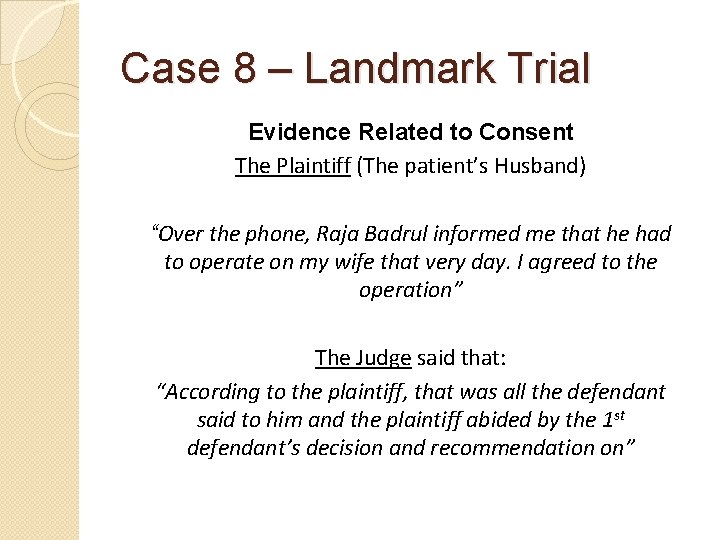
Case 8 – Landmark Trial Evidence Related to Consent The Plaintiff (The patient’s Husband) “Over the phone, Raja Badrul informed me that he had to operate on my wife that very day. I agreed to the operation” The Judge said that: “According to the plaintiff, that was all the defendant said to him and the plaintiff abided by the 1 st defendant’s decision and recommendation on”
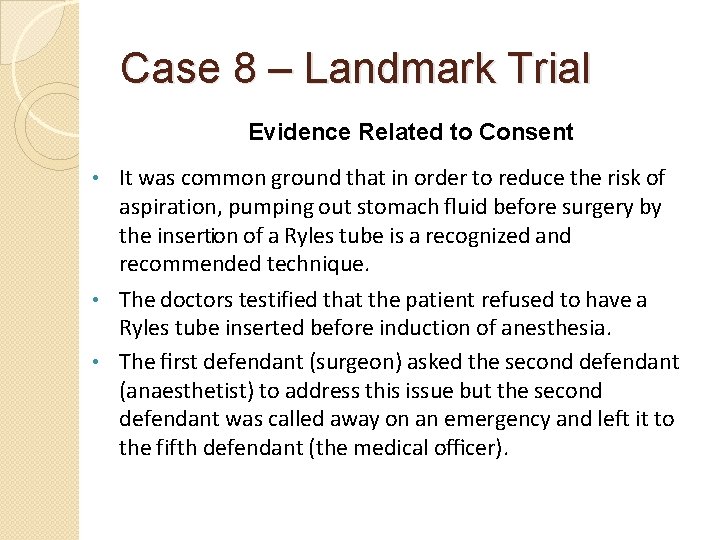
Case 8 – Landmark Trial Evidence Related to Consent It was common ground that in order to reduce the risk of aspiration, pumping out stomach fluid before surgery by the insertion of a Ryles tube is a recognized and recommended technique. • The doctors testified that the patient refused to have a Ryles tube inserted before induction of anesthesia. • The first defendant (surgeon) asked the second defendant (anaesthetist) to address this issue but the second defendant was called away on an emergency and left it to the fifth defendant (the medical officer). •
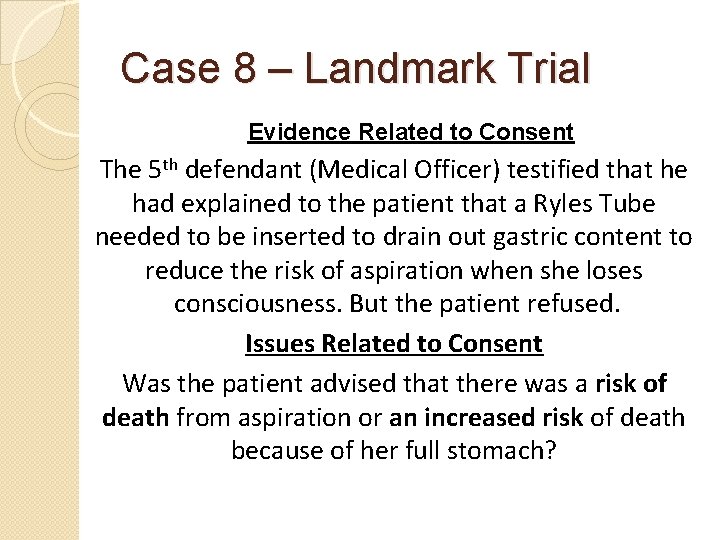
Case 8 – Landmark Trial Evidence Related to Consent The 5 th defendant (Medical Officer) testified that he had explained to the patient that a Ryles Tube needed to be inserted to drain out gastric content to reduce the risk of aspiration when she loses consciousness. But the patient refused. Issues Related to Consent Was the patient advised that there was a risk of death from aspiration or an increased risk of death because of her full stomach?
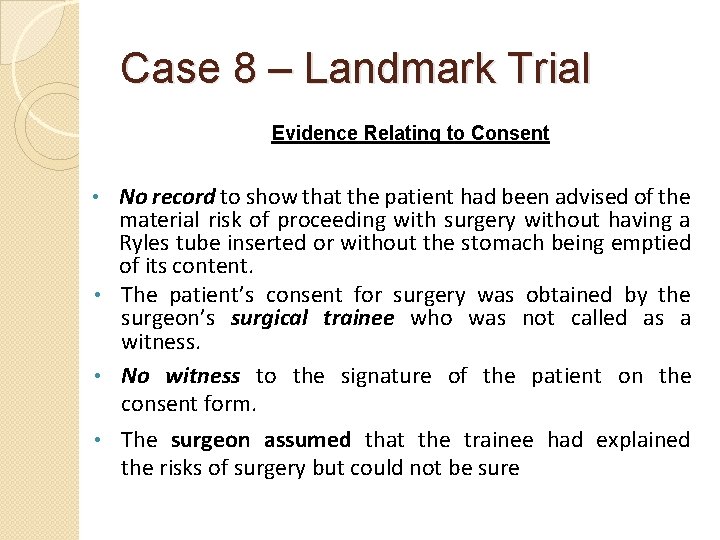
Case 8 – Landmark Trial Evidence Relating to Consent No record to show that the patient had been advised of the material risk of proceeding with surgery without having a Ryles tube inserted or without the stomach being emptied of its content. • The patient’s consent for surgery was obtained by the surgeon’s surgical trainee who was not called as a witness. • No witness to the signature of the patient on the consent form. • The surgeon assumed that the trainee had explained the risks of surgery but could not be sure •
Case 8 – Landmark Trial Evidence Relating to Consent Important : The first, third and fifth defendants agreed that the patient was never informed nor counselled on the risk of death due to aspiration during induction of anaesthesia especially when she refused the insertion of a Ryles tube. When it was suggested to the third defendant that the patient ought to have been counseled, “. . the third defendant after a long pause agreed with counsel’s suggestion. ”
Case 8 – Landmark Trial Findings in Court “. . the failure of the first, third and fifth defendants to inform the patient of the risk of death from aspiration, in fact the increased risk of death because of her full stomach, means that the patient had not been informed of a critical risk factor that would have been necessary for her to take into consideration in making her decision to proceed with general anesthesia and surgery…” The first, third and fifth defendants were found liable for failure to discharge their duty of care.
Case 8 – Landmark Trial The Findings in Court “Ordinarily, in a doctor pa. J ent rela. J onship, the duty of care is owed only to the pa. J ent. However, there are exceptions to this general principle. One such exception arose in the case of Gurmit Kaur a/p Jaswant Singh v Tung Shin Hospital & Anor [2012] 4 MLJ 260 where the High Court held that the consent of the patient herself was insufficient as the consent of the husband was not obtained for a hysterectomy as required under the consent form. I can see the obvious logic for the husband's consent to be obtained in cases of hysterectomy as it involves the joint reproductive rights of husband wife.
Case 8 – Landmark Trial The Findings in Court In other instances, consent of the next of kin may also be required in situations where the patient is incapable of giving consent or incapable of understanding and appreciating the nature of the proposed treatment and the risk involved. Similarly, consent of the spouse may be required when it is evident that the patient is dependent on the spouse to make decisions in regards to the proposed medical treatment or when it is evident to the doctor that the decisions are being made jointly by both spouses in respect of the treatment for one of the spouses. ” - Vazeer Alam Mydin JC at para [45]
A Case Study Gurmit Kaur a/p Jaswant Singh v Tung Shin Hospital [2012] 4 MLJ 260, HC The Parties • The Plaintiff– 38 year old mother of 4 • The 1 st Defendant was the hospital • The 2 nd Defendant was an Obstetrician and Gynecologist with a practice at the 1 st Defendant hospital
A Case Study The Plaintiff’s Case • Patient was referred to the 2 nd Defendant for treatment of a cervical polyp. • 30 April 2002 – Polyp was removed and ultrasound revealed an enlarged uterus due to fibroid. • Patient informed the 2 nd Defendant that she planned to conceive again.
A Case Study The Plaintiff’s Case • 19 September 2002 patient was admitted for removal of fibroid. • Only her name and IC number were filled up in the form. • The contents of the form were not explained. • The operation was done and she was discharged on 22 September 2002. • 30 September 2002 the patient saw the 2 nd Defendant for a follow up and asked him when she can conceive.
A Case Study The Defendant’s Case • Treatment options were discussed including a hysterectomy. • The patient did not tell the 2 nd Defendant she intended to have more children. • The patient telephoned the 2 nd Defendant in mid September 2002 and wanted to get treated as soon as possible. • The 2 nd Defendant advised the patient to undergo a hysterectomy.
A Case Study Defendant’s Case • 19 September 2002 - the patient was admitted and a full explanation of the hysterectomy was provided in the presence of the patient’s husband a nurse. • The patient signed the consent form. • 20 September 2002 - the hysterectomy was carried out and was successful.
A Case Study Did the Doctor explain to the patient that he was recommending a hysterectomy and did the patient know what that meant?
A Case Study The Judge’s Analysis • She believed that the patient did not know that she underwent a hysterectomy on 19 September 2002. • She did not believe that a hysterectomy was even discussed with the patient. • Patient thought surgery was to remove fibroid. • During the follow up on 30 September 2002 : o The patient asked the 2 nd Defendant how long it will take for her to conceive. o The 2 nd Defendant told the patient that he had removed her uterus.
A Case Study Court’s Findings • The High Court found as a fact that the patient did not understand what a hysterectomy was. • The Court held that having a consent form signed without ensuring that the patient understands is not sufficient.
A Case Study Court’s Findings • The Court also held that the husband’s consent should also have been obtained. This is because of the nature of the consent form (“Agreement by Husband/Wife) and the fact that the nature of the operation meant that the wife could no longer conceive.
A Case Study The Court’s Ruling The Judge held that the Defendants were liable for negligence and awarded a sum of RM 120, 000 for general damages and interest
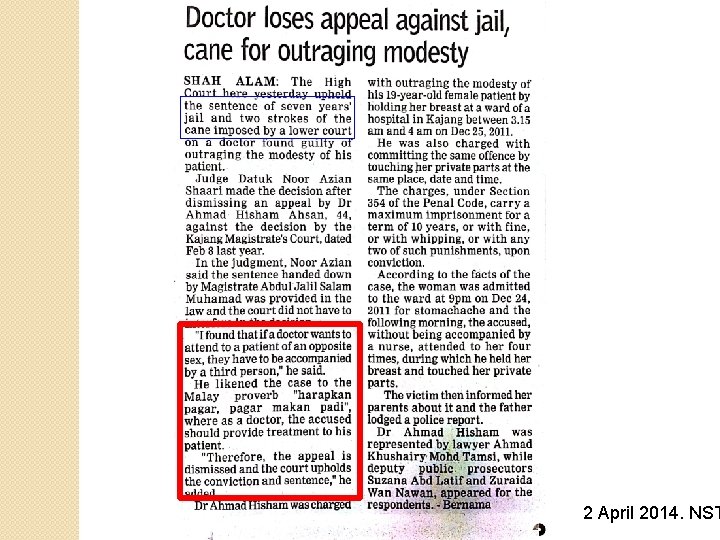
In the News!
2 April 2014. NST
Conclusion �Medico-legal environment heavier �Consent �Code of Professional Conduct �Consent : http: //goo. gl/5 R 1 ai. Z �Confidentiality : http: //goo. gl/e 1 GK 0 F �Good Medical Practice http: //goo. gl/Ttx 0 x. E �www. mmc. gov. my