
Medical Language Immerse Yourself THIRD EDITION CHAPTER 10
- Slides: 84
Medical Language Immerse Yourself THIRD EDITION CHAPTER 10 Neurology Medical Language, Third Edition Susan M. Turley Copyright © 2014, 2011, 2007 by Pearson Education, Inc. All Rights Reserved
Classroom Response System Medical Language, Third Edition Susan M. Turley Copyright © 2014, 2011, 2007 by Pearson Education, Inc. All Rights Reserved
10 -1 The central nervous system consists of the brain and cranial nerves. A. True B. False Medical Language, Third Edition Susan M. Turley Copyright © 2014, 2011, 2007 by Pearson Education, Inc. All Rights Reserved
10 -1 The central nervous system consists of the brain and cranial nerves. A. True B. False Medical Language, Third Edition Susan M. Turley Copyright © 2014, 2011, 2007 by Pearson Education, Inc. All Rights Reserved
10 -1 The functional unit of the nervous system is the: A. nerve. B. neuron. C. brain. D. neuroglia. Medical Language, Third Edition Susan M. Turley Copyright © 2014, 2011, 2007 by Pearson Education, Inc. All Rights Reserved
10 -1 The functional unit of the nervous system is the: A. nerve. B. neuron. C. brain. D. neuroglia. Medical Language, Third Edition Susan M. Turley Copyright © 2014, 2011, 2007 by Pearson Education, Inc. All Rights Reserved
10 -1 The space between the arachnoid and the pia mater is filled with: A. nerves. B. blood. C. cerebrospinal fluid. D. fibers of the pia mater. Medical Language, Third Edition Susan M. Turley Copyright © 2014, 2011, 2007 by Pearson Education, Inc. All Rights Reserved
10 -1 The space between the arachnoid and the pia mater is filled with: A. nerves. B. blood. C. cerebrospinal fluid. D. fibers of the pia mater. Medical Language, Third Edition Susan M. Turley Copyright © 2014, 2011, 2007 by Pearson Education, Inc. All Rights Reserved
10 -1 The largest part of the brain is the: A. cerebrum. B. cerebellum. C. thalamus. D. hypothalamus. Medical Language, Third Edition Susan M. Turley Copyright © 2014, 2011, 2007 by Pearson Education, Inc. All Rights Reserved
10 -1 The largest part of the brain is the: A. cerebrum. B. cerebellum. C. thalamus. D. hypothalamus. Medical Language, Third Edition Susan M. Turley Copyright © 2014, 2011, 2007 by Pearson Education, Inc. All Rights Reserved
The only connection between the right and left hemispheres of the cerebrum is the: 10 -1 A. fissure. B. cerebral cortex. C. corpus callosum. D. thalamus. Medical Language, Third Edition Susan M. Turley Copyright © 2014, 2011, 2007 by Pearson Education, Inc. All Rights Reserved
The only connection between the right and left hemispheres of the cerebrum is the: 10 -1 A. fissure. B. cerebral cortex. C. corpus callosum. D. thalamus. Medical Language, Third Edition Susan M. Turley Copyright © 2014, 2011, 2007 by Pearson Education, Inc. All Rights Reserved
10 -1 The visual cortex is located in the: A. temporal lobe. B. frontal lobe. C. parietal lobe. D. occipital lobe. Medical Language, Third Edition Susan M. Turley Copyright © 2014, 2011, 2007 by Pearson Education, Inc. All Rights Reserved
10 -1 The visual cortex is located in the: A. temporal lobe. B. frontal lobe. C. parietal lobe. D. occipital lobe. Medical Language, Third Edition Susan M. Turley Copyright © 2014, 2011, 2007 by Pearson Education, Inc. All Rights Reserved
10 -1 The olfactory cortex is located in the temporal lobe. A. True B. False Medical Language, Third Edition Susan M. Turley Copyright © 2014, 2011, 2007 by Pearson Education, Inc. All Rights Reserved
10 -1 The olfactory cortex is located in the temporal lobe. A. True B. False Medical Language, Third Edition Susan M. Turley Copyright © 2014, 2011, 2007 by Pearson Education, Inc. All Rights Reserved
10 -1 The CSF formed in the ventricles: A. cushions the brain. B. protects the brain. C. contains glucose. D. does all of the above. Medical Language, Third Edition Susan M. Turley Copyright © 2014, 2011, 2007 by Pearson Education, Inc. All Rights Reserved
10 -1 The CSF formed in the ventricles: A. cushions the brain. B. protects the brain. C. contains glucose. D. does all of the above. Medical Language, Third Edition Susan M. Turley Copyright © 2014, 2011, 2007 by Pearson Education, Inc. All Rights Reserved
10 -1 The cerebellum: A. sets the rhythm for respiration. B. maintains consciousness. C. is the origin for cranial nerves V–VIII. D. monitors muscle tone and body position. Medical Language, Third Edition Susan M. Turley Copyright © 2014, 2011, 2007 by Pearson Education, Inc. All Rights Reserved
10 -1 The cerebellum: A. sets the rhythm for respiration. B. maintains consciousness. C. is the origin for cranial nerves V–VIII. D. monitors muscle tone and body position. Medical Language, Third Edition Susan M. Turley Copyright © 2014, 2011, 2007 by Pearson Education, Inc. All Rights Reserved
10 -1 Does the brain feel pain? A. Yes B. No Medical Language, Third Edition Susan M. Turley Copyright © 2014, 2011, 2007 by Pearson Education, Inc. All Rights Reserved
10 -1 Does the brain feel pain? A. Yes B. No Medical Language, Third Edition Susan M. Turley Copyright © 2014, 2011, 2007 by Pearson Education, Inc. All Rights Reserved
10 -1 The sense of hearing is produced through the: A. cranial B. cranial C. cranial D. cranial nerve Medical Language, Third Edition Susan M. Turley VII (facial). VIII (vestibulocochlear). IX (glossopharyngeal). X (vagus). Copyright © 2014, 2011, 2007 by Pearson Education, Inc. All Rights Reserved
10 -1 The sense of hearing is produced through the: A. cranial nerve VII (facial). B. cranial nerve VIII (vestibulocochlear). C. cranial nerve IX (glossopharyngeal). D. cranial nerve X (vagus). Medical Language, Third Edition Susan M. Turley Copyright © 2014, 2011, 2007 by Pearson Education, Inc. All Rights Reserved
10 -1 There are how many pairs of spinal nerves? A. 12 B. 24 C. 31 D. 48 Medical Language, Third Edition Susan M. Turley Copyright © 2014, 2011, 2007 by Pearson Education, Inc. All Rights Reserved
10 -1 There are how many pairs of spinal nerves? A. 12 B. 24 C. 31 D. 48 Medical Language, Third Edition Susan M. Turley Copyright © 2014, 2011, 2007 by Pearson Education, Inc. All Rights Reserved
10 -1 Nerves that carry impulses from the body toward the spinal cord and brain are: A. afferent. B. efferent. C. sensory. D. both afferent and efferent. Medical Language, Third Edition Susan M. Turley Copyright © 2014, 2011, 2007 by Pearson Education, Inc. All Rights Reserved
10 -1 Nerves that carry impulses from the body toward the spinal cord and brain are: A. afferent. B. efferent. C. sensory. D. both afferent and efferent. Medical Language, Third Edition Susan M. Turley Copyright © 2014, 2011, 2007 by Pearson Education, Inc. All Rights Reserved
10 -1 An involuntary muscle reaction that is controlled by the spinal cord is a: A. root. B. reflex. C. dermatome. D. parenchyma. Medical Language, Third Edition Susan M. Turley Copyright © 2014, 2011, 2007 by Pearson Education, Inc. All Rights Reserved
10 -1 An involuntary muscle reaction that is controlled by the spinal cord is a: A. root. B. reflex. C. dermatome. D. parenchyma. Medical Language, Third Edition Susan M. Turley Copyright © 2014, 2011, 2007 by Pearson Education, Inc. All Rights Reserved
10 -1 The neurotransmitter for voluntary skeletal muscle is: A. dopamine. B. endorphins. C. acetylcholine. D. epinephrine. Medical Language, Third Edition Susan M. Turley Copyright © 2014, 2011, 2007 by Pearson Education, Inc. All Rights Reserved
10 -1 The neurotransmitter for voluntary skeletal muscle is: A. dopamine. B. endorphins. C. acetylcholine. D. epinephrine. Medical Language, Third Edition Susan M. Turley Copyright © 2014, 2011, 2007 by Pearson Education, Inc. All Rights Reserved
10 -1 The body's own natural pain relievers are the neurotransmitters: A. endorphins. B. norepinephrine. C. dopamine. D. acetylcholine. Medical Language, Third Edition Susan M. Turley Copyright © 2014, 2011, 2007 by Pearson Education, Inc. All Rights Reserved
10 -1 The body's own natural pain relievers are the neurotransmitters: A. endorphins. B. norepinephrine. C. dopamine. D. acetylcholine. Medical Language, Third Edition Susan M. Turley Copyright © 2014, 2011, 2007 by Pearson Education, Inc. All Rights Reserved
10 -1 The part of the nervous system that is active when the body is at rest is: A. the sympathetic nervous system. B. the parasympathetic nervous system. C. the somatic nervous system. D. all of the above. Medical Language, Third Edition Susan M. Turley Copyright © 2014, 2011, 2007 by Pearson Education, Inc. All Rights Reserved
10 -1 The part of the nervous system that is active when the body is at rest is: A. the sympathetic nervous system. B. the parasympathetic nervous system. C. the somatic nervous system. D. all of the above. Medical Language, Third Edition Susan M. Turley Copyright © 2014, 2011, 2007 by Pearson Education, Inc. All Rights Reserved
10 -1 The “fight or flight” response to danger, stress, or anxiety is initiated by: A. the somatic nervous system. B. the parasympathetic nervous system. C. the sympathetic nervous system. D. none of the above. Medical Language, Third Edition Susan M. Turley Copyright © 2014, 2011, 2007 by Pearson Education, Inc. All Rights Reserved
10 -1 The “fight or flight” response to danger, stress, or anxiety is initiated by: A. the somatic nervous system. B. the parasympathetic nervous system. C. the sympathetic nervous system. D. none of the above. Medical Language, Third Edition Susan M. Turley Copyright © 2014, 2011, 2007 by Pearson Education, Inc. All Rights Reserved
Which types of activities are processed in the temporal lobe of the brain? 10 -1 A. Conscious control of muscle movements B. Vision C. Emotion and personality D. Hearing and smelling Medical Language, Third Edition Susan M. Turley Copyright © 2014, 2011, 2007 by Pearson Education, Inc. All Rights Reserved
Which types of activities are processed in the temporal lobe of the brain? 10 -1 A. Conscious control of muscle movements B. Vision C. Emotion and personality D. Hearing and smelling Medical Language, Third Edition Susan M. Turley Copyright © 2014, 2011, 2007 by Pearson Education, Inc. All Rights Reserved
10 -3 A traumatic injury to the skull can cause a: A. brain tumor. B. migraine headache. C. radiculopathy. D. subdural hematoma. Medical Language, Third Edition Susan M. Turley Copyright © 2014, 2011, 2007 by Pearson Education, Inc. All Rights Reserved
10 -3 A traumatic injury to the skull can cause a: A. brain tumor. B. migraine headache. C. radiculopathy. D. subdural hematoma. Medical Language, Third Edition Susan M. Turley Copyright © 2014, 2011, 2007 by Pearson Education, Inc. All Rights Reserved
10 -3 A traumatic injury to the neck and spinal cord can result in: A. subdural hematoma. B. quadriplegia. C. stroke. D. Alzheimer's disease. Medical Language, Third Edition Susan M. Turley Copyright © 2014, 2011, 2007 by Pearson Education, Inc. All Rights Reserved
10 -3 A traumatic injury to the neck and spinal cord can result in: A. subdural hematoma. B. quadriplegia. C. stroke. D. Alzheimer's disease. Medical Language, Third Edition Susan M. Turley Copyright © 2014, 2011, 2007 by Pearson Education, Inc. All Rights Reserved
10 -3 Syncope is also known as: A. fainting. B. hydrocephalus. C. a coma. D. epilepsy. Medical Language, Third Edition Susan M. Turley Copyright © 2014, 2011, 2007 by Pearson Education, Inc. All Rights Reserved
10 -3 Syncope is also known as: A. fainting. B. hydrocephalus. C. a coma. D. epilepsy. Medical Language, Third Edition Susan M. Turley Copyright © 2014, 2011, 2007 by Pearson Education, Inc. All Rights Reserved
10 -3 All of the following are congenital problems that are present at birth EXCEPT: A. multiple sclerosis. B. myelomeningocele. C. cerebral palsy. D. hydrocephalus. Medical Language, Third Edition Susan M. Turley Copyright © 2014, 2011, 2007 by Pearson Education, Inc. All Rights Reserved
10 -3 All of the following are congenital problems that are present at birth EXCEPT: A. multiple sclerosis. B. myelomeningocele. C. cerebral palsy. D. hydrocephalus. ` Medical Language, Third Edition Susan M. Turley Copyright © 2014, 2011, 2007 by Pearson Education, Inc. All Rights Reserved
10 -3 All of the following are types of epilepsy EXCEPT: A. grand mal. B. radiculopathy. C. absence. D. petit mal. Medical Language, Third Edition Susan M. Turley Copyright © 2014, 2011, 2007 by Pearson Education, Inc. All Rights Reserved
10 -3 All of the following are types of epilepsy EXCEPT: A. grand mal. B. radiculopathy. C. absence. D. petit mal. Medical Language, Third Edition Susan M. Turley Copyright © 2014, 2011, 2007 by Pearson Education, Inc. All Rights Reserved
People who use computers extensively are prone to get which of these diseases? 10 -3 A. Herniated nucleus pulposus B. Carpal tunnel syndrome C. Dementia D. Hyperesthesia Medical Language, Third Edition Susan M. Turley Copyright © 2014, 2011, 2007 by Pearson Education, Inc. All Rights Reserved
People who use computers extensively are prone to get which of these diseases? 10 -3 A. Herniated nucleus pulposus B. Carpal tunnel syndrome C. Dementia D. Hyperesthesia Medical Language, Third Edition Susan M. Turley Copyright © 2014, 2011, 2007 by Pearson Education, Inc. All Rights Reserved
10 -3 All of the following are types of brain tumors EXCEPT: A. glioblastoma multiforme. B. meningioma. C. schwannoma. D. neurofibroma. Medical Language, Third Edition Susan M. Turley Copyright © 2014, 2011, 2007 by Pearson Education, Inc. All Rights Reserved
10 -3 All of the following are types of brain tumors EXCEPT: A. glioblastoma multiforme. B. meningioma. C. schwannoma. D. neurofibroma. Medical Language, Third Edition Susan M. Turley Copyright © 2014, 2011, 2007 by Pearson Education, Inc. All Rights Reserved
10 -3 All of the following are associated with pain EXCEPT: A. causalgia. B. anesthesia. C. neuralgia. D. CRPS. Medical Language, Third Edition Susan M. Turley Copyright © 2014, 2011, 2007 by Pearson Education, Inc. All Rights Reserved
10 -3 All of the following are associated with pain EXCEPT: A. causalgia. B. anesthesia. C. neuralgia. D. CRPS. Medical Language, Third Edition Susan M. Turley Copyright © 2014, 2011, 2007 by Pearson Education, Inc. All Rights Reserved
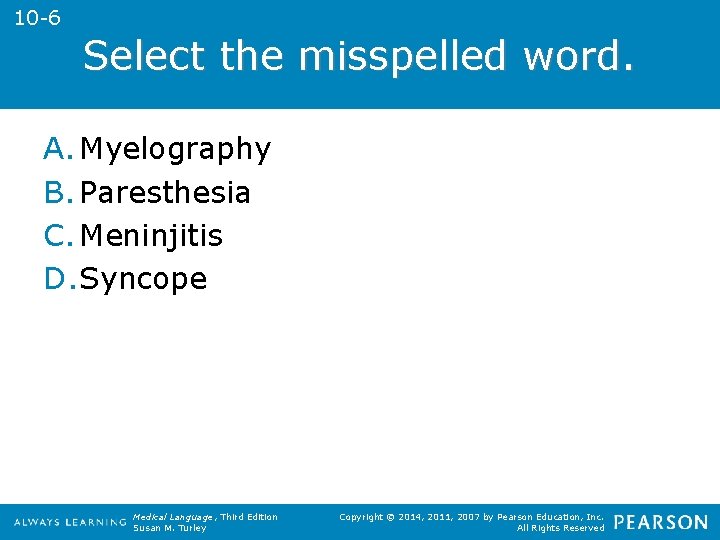
10 -6 Select the misspelled word. A. Myelography B. Paresthesia C. Meninjitis D. Syncope Medical Language, Third Edition Susan M. Turley Copyright © 2014, 2011, 2007 by Pearson Education, Inc. All Rights Reserved
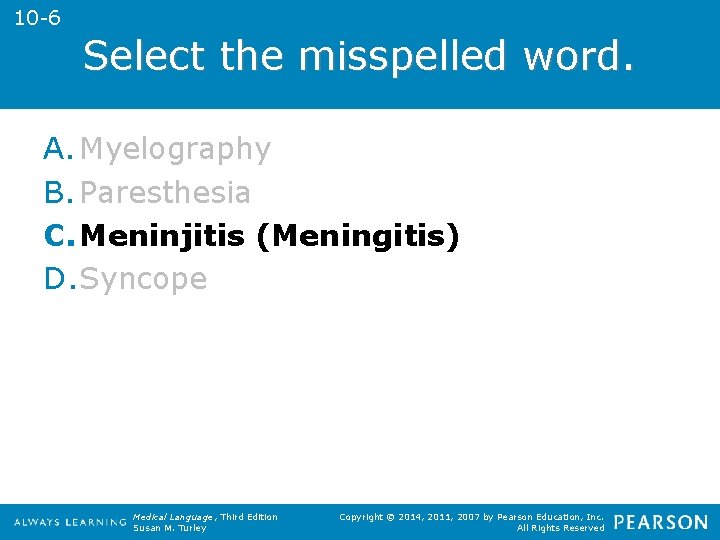
10 -6 Select the misspelled word. A. Myelography B. Paresthesia C. Meninjitis (Meningitis) D. Syncope Medical Language, Third Edition Susan M. Turley Copyright © 2014, 2011, 2007 by Pearson Education, Inc. All Rights Reserved
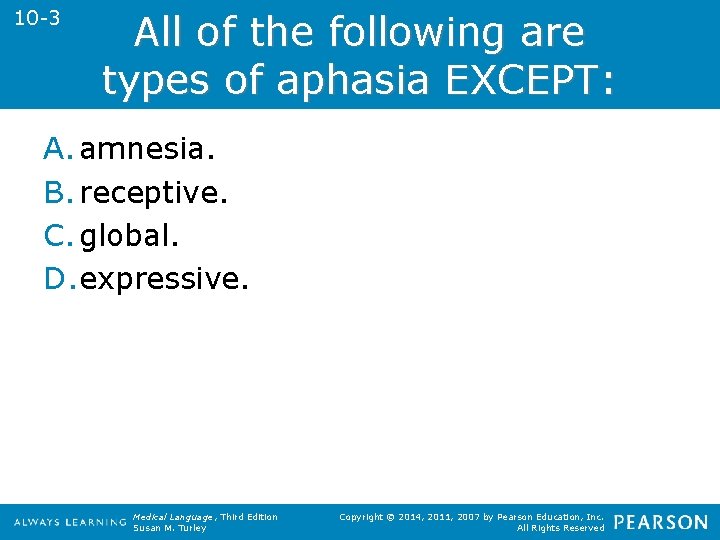
10 -3 All of the following are types of aphasia EXCEPT: A. amnesia. B. receptive. C. global. D. expressive. Medical Language, Third Edition Susan M. Turley Copyright © 2014, 2011, 2007 by Pearson Education, Inc. All Rights Reserved
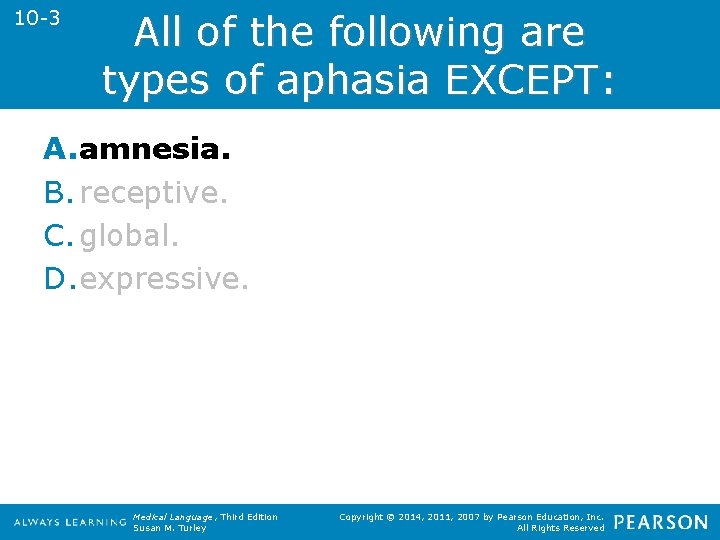
10 -3 All of the following are types of aphasia EXCEPT: A. amnesia. B. receptive. C. global. D. expressive. Medical Language, Third Edition Susan M. Turley Copyright © 2014, 2011, 2007 by Pearson Education, Inc. All Rights Reserved
10 -3 Which medical word means water on the brain? A. Epilepsy B. Meningitis C. Hydrocephalus D. Dementia Medical Language, Third Edition Susan M. Turley Copyright © 2014, 2011, 2007 by Pearson Education, Inc. All Rights Reserved
10 -3 Which medical word means water on the brain? A. Epilepsy B. Meningitis C. Hydrocephalus D. Dementia Medical Language, Third Edition Susan M. Turley Copyright © 2014, 2011, 2007 by Pearson Education, Inc. All Rights Reserved
10 -3 Photophobia is associated with: A. migraine headaches. B. carpal tunnel syndrome. C. myelomeningocele. D. Parkinson's disease. Medical Language, Third Edition Susan M. Turley Copyright © 2014, 2011, 2007 by Pearson Education, Inc. All Rights Reserved
10 -3 Photophobia is associated with: A. migraine headaches. B. carpal tunnel syndrome. C. myelomeningocele. D. Parkinson's disease. Medical Language, Third Edition Susan M. Turley Copyright © 2014, 2011, 2007 by Pearson Education, Inc. All Rights Reserved
10 -3 Complex partial seizures are also known as psychomotor seizures. A. True B. False Medical Language, Third Edition Susan M. Turley Copyright © 2014, 2011, 2007 by Pearson Education, Inc. All Rights Reserved
10 -3 Complex partial seizures are also known as psychomotor seizures. A. True B. False Medical Language, Third Edition Susan M. Turley Copyright © 2014, 2011, 2007 by Pearson Education, Inc. All Rights Reserved
10 -3 Which is true of an EEG? A. Records electrical impulse of a reflex B. Images the brain with contrast material C. Determines nerve strength and deep tendon reflexes D. Records brain wave patterns Medical Language, Third Edition Susan M. Turley Copyright © 2014, 2011, 2007 by Pearson Education, Inc. All Rights Reserved
10 -3 Which is true of an EEG? A. Records electrical impulse of a reflex B. Images the brain with contrast material C. Determines nerve strength and deep tendon reflexes D. Records brain wave patterns Medical Language, Third Edition Susan M. Turley Copyright © 2014, 2011, 2007 by Pearson Education, Inc. All Rights Reserved
Which abbreviation is associated with a test to measure the metabolism in areas of the brain? 10 -4 A. MRI B. PET C. SCI D. CAT Medical Language, Third Edition Susan M. Turley Copyright © 2014, 2011, 2007 by Pearson Education, Inc. All Rights Reserved
Which abbreviation is associated with a test to measure the metabolism in areas of the brain? 10 -4 A. MRI B. PET C. SCI D. CAT Medical Language, Third Edition Susan M. Turley Copyright © 2014, 2011, 2007 by Pearson Education, Inc. All Rights Reserved
10 -3 A rhizotomy is performed to cut the: A. spinal nerves. B. ventricles. C. neurons. D. cerebellum. Medical Language, Third Edition Susan M. Turley Copyright © 2014, 2011, 2007 by Pearson Education, Inc. All Rights Reserved
10 -3 A rhizotomy is performed to cut the: A. spinal nerves. B. ventricles. C. neurons. D. cerebellum. Medical Language, Third Edition Susan M. Turley Copyright © 2014, 2011, 2007 by Pearson Education, Inc. All Rights Reserved
10 -3 Proprioception is the process of having: A. pain. B. nerve damage. C. body position. D. sensation. Medical Language, Third Edition Susan M. Turley Copyright © 2014, 2011, 2007 by Pearson Education, Inc. All Rights Reserved
10 -3 Proprioception is the process of having: A. pain. B. nerve damage. C. body position. D. sensation. Medical Language, Third Edition Susan M. Turley Copyright © 2014, 2011, 2007 by Pearson Education, Inc. All Rights Reserved
10 -3 CSF can be examined by first doing a/an: A. EEG. B. skull x-ray. C. LP. D. CT scan. Medical Language, Third Edition Susan M. Turley Copyright © 2014, 2011, 2007 by Pearson Education, Inc. All Rights Reserved
10 -3 CSF can be examined by first doing a/an: A. EEG. B. skull x-ray. C. LP. D. CT scan. Medical Language, Third Edition Susan M. Turley Copyright © 2014, 2011, 2007 by Pearson Education, Inc. All Rights Reserved
10 -4 The combining form myel/o- means: A. nerve. B. spinal cord. C. vertebra. D. meninges. Medical Language, Third Edition Susan M. Turley Copyright © 2014, 2011, 2007 by Pearson Education, Inc. All Rights Reserved
10 -4 The combining form myel/o- means: A. nerve. B. spinal cord. C. vertebra. D. meninges. Medical Language, Third Edition Susan M. Turley Copyright © 2014, 2011, 2007 by Pearson Education, Inc. All Rights Reserved
10 -4 Which two combining forms mean nerve root? A. neur/o- and nerv/o. B. myel/o- and spin/o. C. esthes/o- and sens/o. D. rhiz/o- and radicul/o- Medical Language, Third Edition Susan M. Turley Copyright © 2014, 2011, 2007 by Pearson Education, Inc. All Rights Reserved
10 -4 Which two combining forms mean nerve root? A. neur/o- and nerv/o. B. myel/o- and spin/o. C. esthes/o- and sens/o. D. rhiz/o- and radicul/o- Medical Language, Third Edition Susan M. Turley Copyright © 2014, 2011, 2007 by Pearson Education, Inc. All Rights Reserved
10 -4 All of the following combining forms refer to a seizure EXCEPT: A. epilept/o. B. convuls/o. C. spin/o. D. ict/o- Medical Language, Third Edition Susan M. Turley Copyright © 2014, 2011, 2007 by Pearson Education, Inc. All Rights Reserved
10 -4 All of the following combining forms refer to a seizure EXCEPT: A. epilept/o. B. convuls/o. C. spin/o. D. ict/o- Medical Language, Third Edition Susan M. Turley Copyright © 2014, 2011, 2007 by Pearson Education, Inc. All Rights Reserved
10 -4 The suffix -cele means hernia. A. True B. False Medical Language, Third Edition Susan M. Turley Copyright © 2014, 2011, 2007 by Pearson Education, Inc. All Rights Reserved
10 -4 The suffix -cele means hernia. A. True B. False Medical Language, Third Edition Susan M. Turley Copyright © 2014, 2011, 2007 by Pearson Education, Inc. All Rights Reserved