
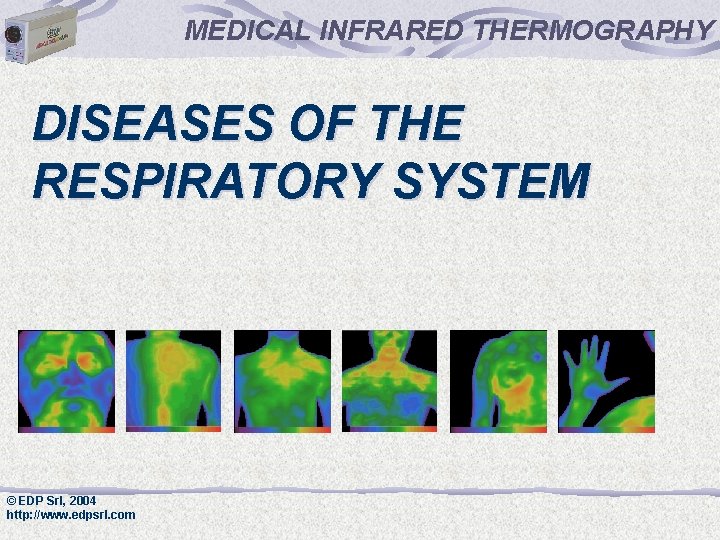
MEDICAL INFRARED THERMOGRAPHY DISEASES OF THE RESPIRATORY SYSTEM
- Slides: 8
MEDICAL INFRARED THERMOGRAPHY DISEASES OF THE RESPIRATORY SYSTEM © EDP Srl, 2004 http: //www. edpsrl. com
MEDICAL INFRARED THERMOGRAPHY Diseases of the Respiratory System Main applications of infrared thermography in diseases of the respiratory system: - early pre-clinical diagnostics of the acute viral infections; - diagnostics of pneumonia and dynamic thermographic control during the treatment; - dynamic thermographic control in chronic bronchitis and asthma; Infrared thermography is a very suitable method, because it’s fast, reliable, non-contact and absolutely safe for patient and doctor. Infrared thermography has no limitations and may be successfully applied in babies, children and pregnant women. © EDP Srl, 2004 http: //www. edpsrl. com
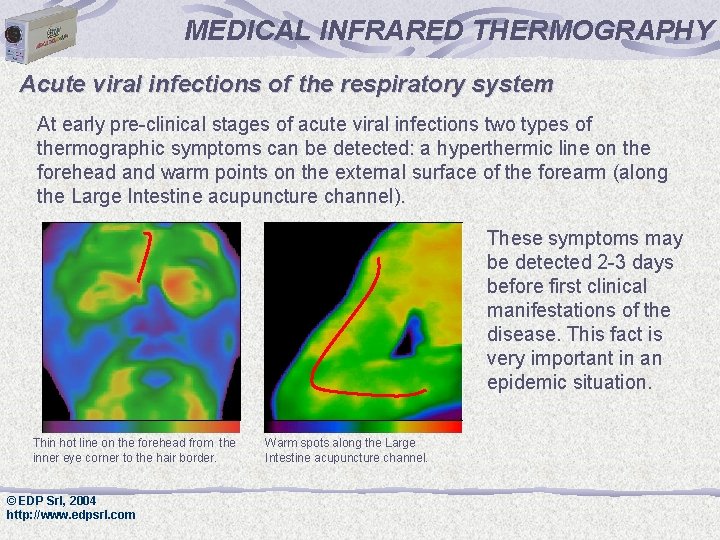
MEDICAL INFRARED THERMOGRAPHY Acute viral infections of the respiratory system At early pre-clinical stages of acute viral infections two types of thermographic symptoms can be detected: a hyperthermic line on the forehead and warm points on the external surface of the forearm (along the Large Intestine acupuncture channel). These symptoms may be detected 2 -3 days before first clinical manifestations of the disease. This fact is very important in an epidemic situation. Thin hot line on the forehead from the inner eye corner to the hair border. © EDP Srl, 2004 http: //www. edpsrl. com Warm spots along the Large Intestine acupuncture channel.
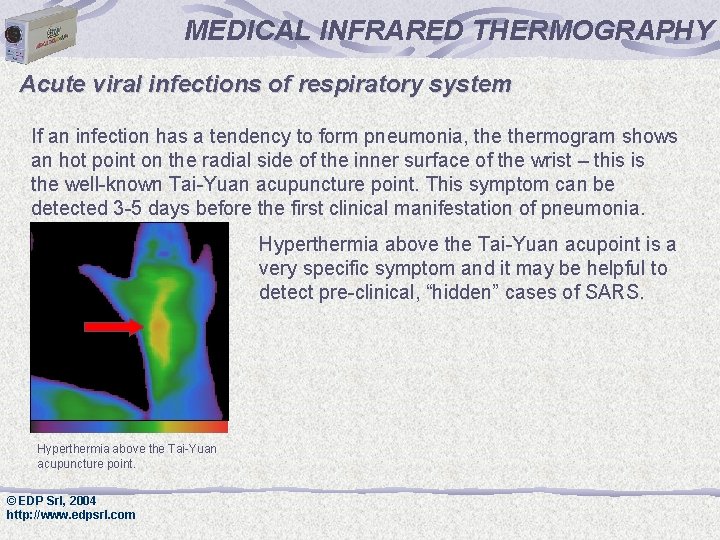
MEDICAL INFRARED THERMOGRAPHY Acute viral infections of respiratory system If an infection has a tendency to form pneumonia, thermogram shows an hot point on the radial side of the inner surface of the wrist – this is the well-known Tai-Yuan acupuncture point. This symptom can be detected 3 -5 days before the first clinical manifestation of pneumonia. Hyperthermia above the Tai-Yuan acupoint is a very specific symptom and it may be helpful to detect pre-clinical, “hidden” cases of SARS. Hyperthermia above the Tai-Yuan acupuncture point. © EDP Srl, 2004 http: //www. edpsrl. com
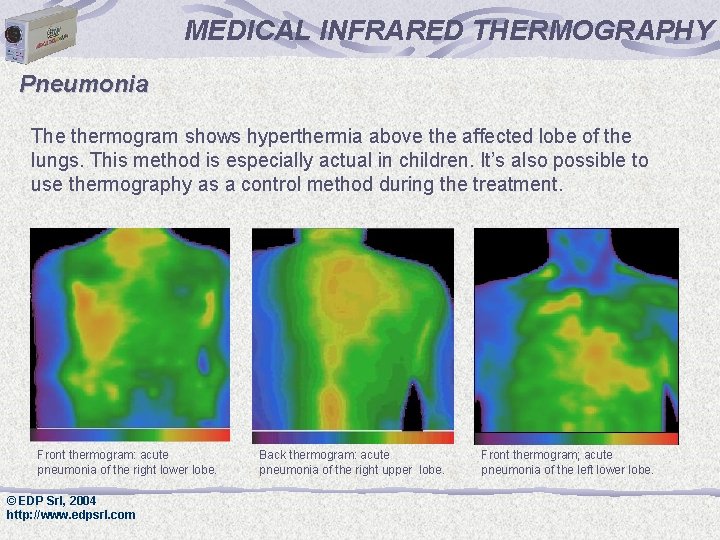
MEDICAL INFRARED THERMOGRAPHY Pneumonia The thermogram shows hyperthermia above the affected lobe of the lungs. This method is especially actual in children. It’s also possible to use thermography as a control method during the treatment. Front thermogram: acute pneumonia of the right lower lobe. © EDP Srl, 2004 http: //www. edpsrl. com Back thermogram: acute pneumonia of the right upper lobe. Front thermogram; acute pneumonia of the left lower lobe.
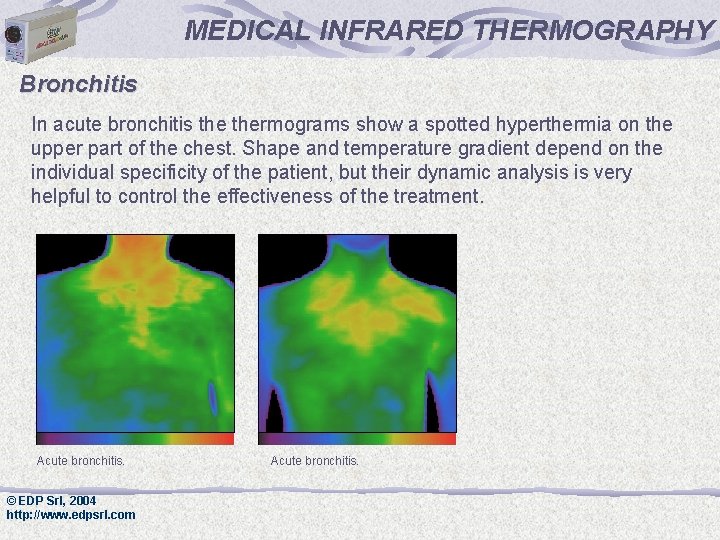
MEDICAL INFRARED THERMOGRAPHY Bronchitis In acute bronchitis thermograms show a spotted hyperthermia on the upper part of the chest. Shape and temperature gradient depend on the individual specificity of the patient, but their dynamic analysis is very helpful to control the effectiveness of the treatment. Acute bronchitis. © EDP Srl, 2004 http: //www. edpsrl. com Acute bronchitis.
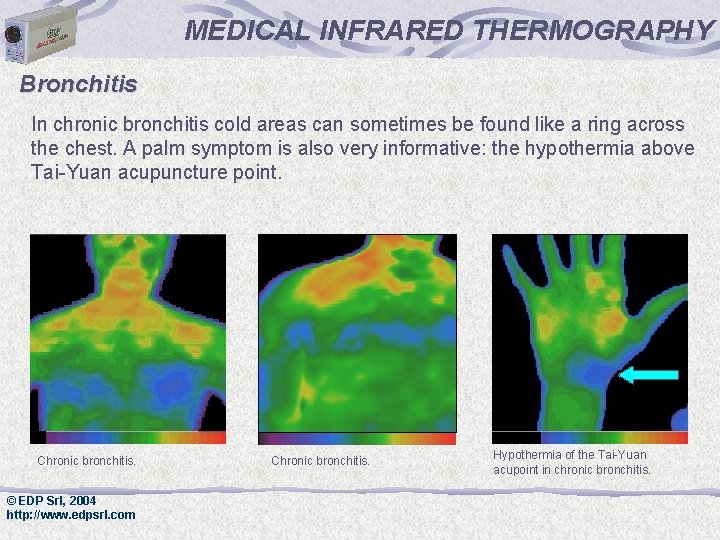
MEDICAL INFRARED THERMOGRAPHY Bronchitis In chronic bronchitis cold areas can sometimes be found like a ring across the chest. A palm symptom is also very informative: the hypothermia above Tai-Yuan acupuncture point. Chronic bronchitis. © EDP Srl, 2004 http: //www. edpsrl. com Chronic bronchitis. Hypothermia of the Tai-Yuan acupoint in chronic bronchitis.
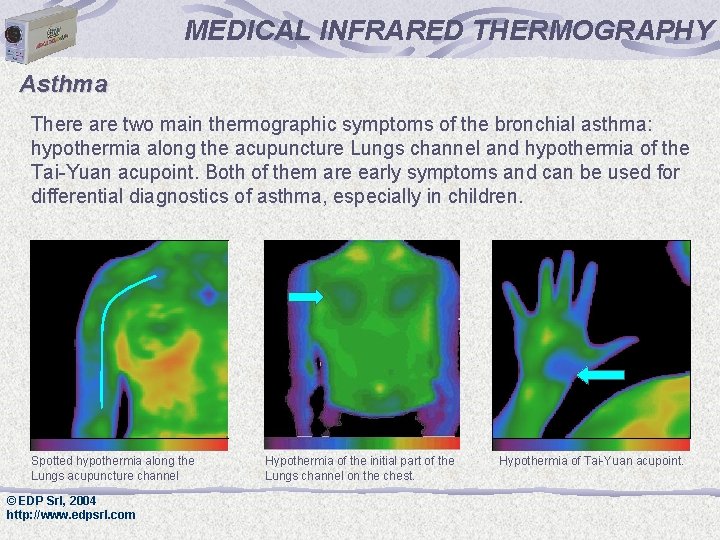
MEDICAL INFRARED THERMOGRAPHY Asthma There are two main thermographic symptoms of the bronchial asthma: hypothermia along the acupuncture Lungs channel and hypothermia of the Tai-Yuan acupoint. Both of them are early symptoms and can be used for differential diagnostics of asthma, especially in children. Spotted hypothermia along the Lungs acupuncture channel © EDP Srl, 2004 http: //www. edpsrl. com Hypothermia of the initial part of the Lungs channel on the chest. Hypothermia of Tai-Yuan acupoint.