
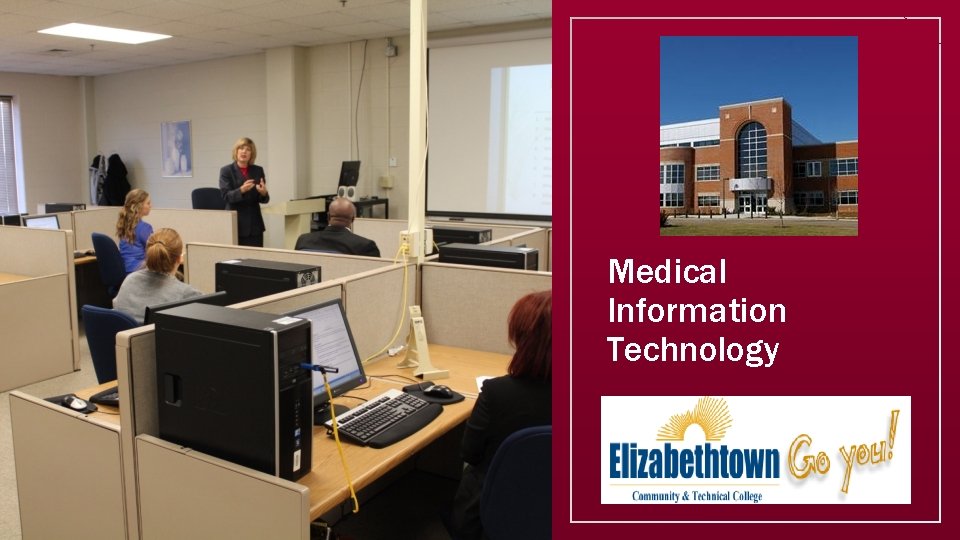
Medical Information Technology Key Points 1 What credentials


- Slides: 17
Medical Information Technology
Key Points 1. What credentials can you earn in the MIT program? 2. What potential jobs are available after completing the MIT program? 3. What national certifications can students take after graduating from the MIT program? 4. What four-year degree do most students pursue after completing the MIT program?
Credentials ▪ AAS (Associate of Applied Science) Degree in Medical Information Technology (Five Tracks Available) 1. Electronic Medical Records Track 2. Medical Administrative Track 3. Medical Coding Track 4. Medical Office Management Track 5. Medical Transcriptionist Track
Credentials (cont) ▪ Diplomas Available: 1. Medical Administrative Assistant (49 Credit Hours) 2. Medical Records Specialist (37 Credit Hours) ▪ These two diplomas qualify for 32 hours of free tuition under the Work Ready Kentucky program.
Credentials (cont) ▪ Certificates Available: 1. Electronic Health Records Specialist (28 -30 Credit Hours) 2. Hospital Admissions Specialist (30 Credit Hours) 3. Medical Coding (22 Credit Hours) 4. Medical Receptionist (15 Credit Hours) 5. Medical Scribe (28 Credit Hours) 6. Medical Transcriptionist (24 Credit Hours) 7. Medical Unit Coordinator (31 Credit Hours) ▪ These seven certificates qualify for 32 hours of free tuition under the Work Ready Kentucky program.
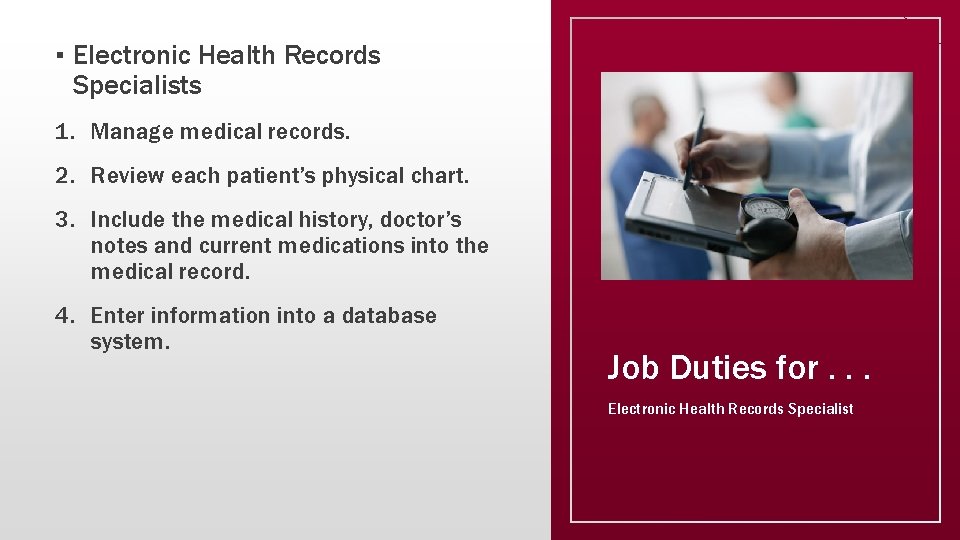
▪ Electronic Health Records Specialists 1. Manage medical records. 2. Review each patient’s physical chart. 3. Include the medical history, doctor’s notes and current medications into the medical record. 4. Enter information into a database system. Job Duties for. . . Electronic Health Records Specialist
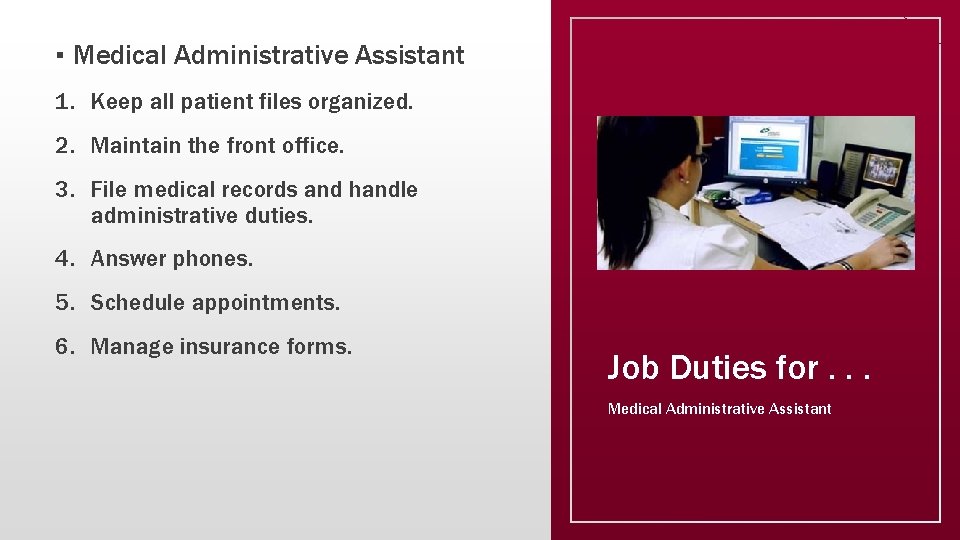
▪ Medical Administrative Assistant 1. Keep all patient files organized. 2. Maintain the front office. 3. File medical records and handle administrative duties. 4. Answer phones. 5. Schedule appointments. 6. Manage insurance forms. Job Duties for. . . Medical Administrative Assistant
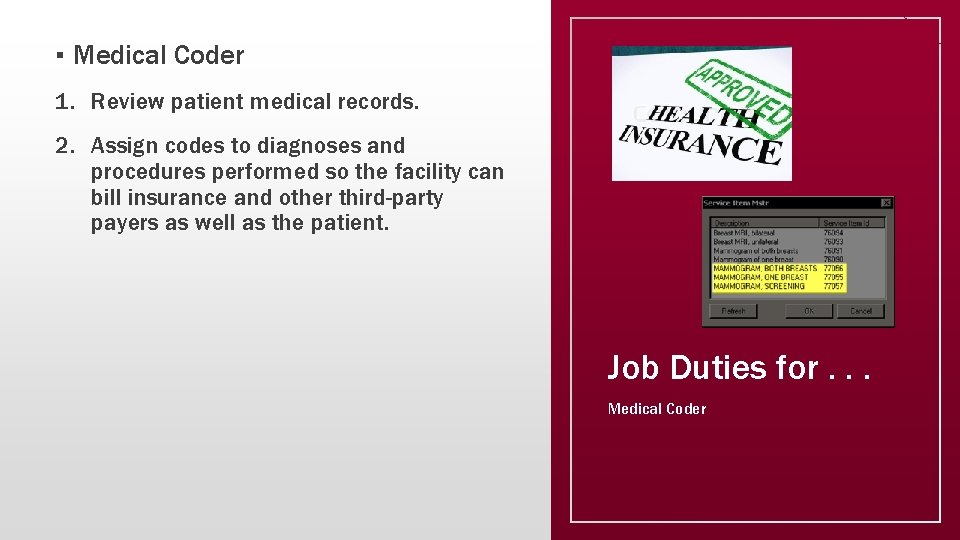
▪ Medical Coder 1. Review patient medical records. 2. Assign codes to diagnoses and procedures performed so the facility can bill insurance and other third-party payers as well as the patient. Job Duties for. . . Medical Coder
▪ Medical Office Manager 1. Hire, terminate, and train staff. 2. Supervise office staff. 3. Oversee billing, coding, and collections. 4. Maintain medical records. 5. Reconcile account information. 6. Pay medical bills. 7. Order medical and office supplies. 8. Arrange cleaning staff. 9. Assess employee performance. 10. Delegate responsibilities. Job Duties for. . . Medical Office Manager
▪ Medical Transcriptionist or Medical Scribe: 1. MTs listen to dictation and transcribe verbatim. 2. MTs must be well versed in medical terminology, anatomy/physiology, and English. 3. Scribes work under the demands of highly trained medical personnel. 4. Scribes must be on their feet all day, possess excellent communication skills, and knowledge of medical terminology and anatomy/physiology. 5. Scribe certification is not mandatory and not required by The Joint Commission. Job Duties for. . . Medical Transcriptionist/Medical Scribe
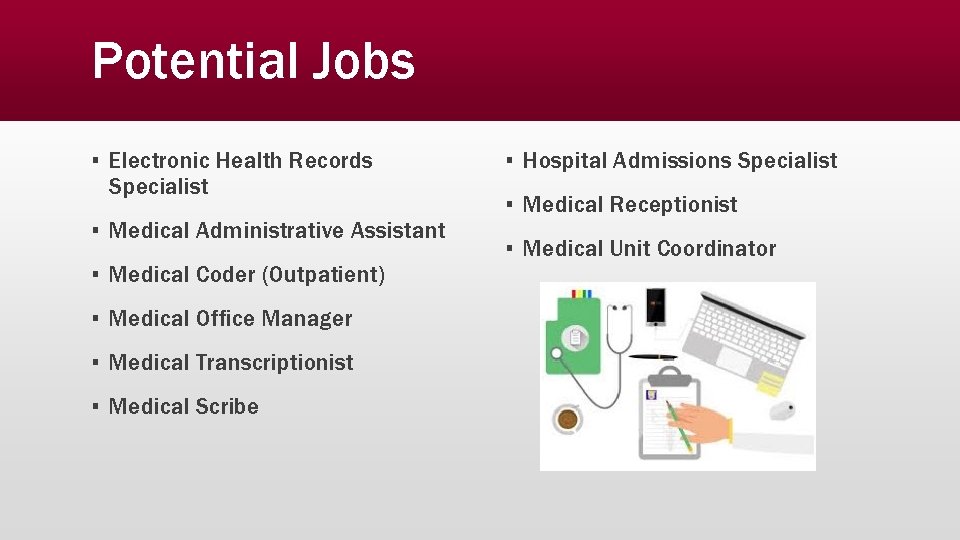
Potential Jobs ▪ Electronic Health Records Specialist ▪ Medical Administrative Assistant ▪ Medical Coder (Outpatient) ▪ Medical Office Manager ▪ Medical Transcriptionist ▪ Medical Scribe ▪ Hospital Admissions Specialist ▪ Medical Receptionist ▪ Medical Unit Coordinator
Examples of Some Courses Required in MIT Curriculum ▪ General Education Classes (19 hours): ▪ Technical Core (30 hours): 1. English 101 1. Introduction to Computers 2. Quantitative Reasoning (Math) 2. Document Formatting and Word Processing 3. Social/Behavioral Sciences 3. Medical Information Management 4. Heritage/Humanities 4. Electronic Medical Records 5. Oral Communications 5. Software Integration 6. Natural Science (Anatomy and Physiology with Lab) 6. Medical Office Terminology 7. Medical Insurance 8. Medical Office Procedures 9. Medical Practice Management ▪ Track Requirements (15 hours) 10. MIT 295—MIT Capstone (Internship) 120 hour practicum with 15 contact lecture hours
Salaries ▪ Salaries and benefit packages vary by employer, geographical region, experience, and training. ▪ Electronic Health Records Specialist (Average Salary $22, 894$39, 870) ▪ Medical Administrative Assistant (Average Salary $36, 000) ▪ Medical Office Manager (Average Salary $50, 000) ▪ Medical Scribe (Average Salary $25, 427 -$33, 580) ▪ Medical Transcriptionist (Average Salary $36, 000) ▪ Medical Coder (Average Salary $40, 000)
National Certifications ▪ CEHRS (Certified Electronic Health Record Specialist) thru NHA (National Healthcareer Association) ▪ CPC (Certified Professional Coder) thru the AAPC (American Association of Professional Coders) ▪ CMAS (Certified Medical Administrative Specialist) thru NHA (National Healthcareer Association) ▪ CCA (Certified Coding Associate) thru AHIMA (American Health Information Management Association) ▪ CBCS (Certified Billing and Coding Specialist) thru NHA (National Healthcareer Association)
National Certifications (cont) ▪ CPPM (Certified Physician Practice Management) thru the AAPC (American Association of Professional Coders) ▪ CMT (Certified Medical Transcriptionist) thru the AHDI (Association for Healthcare Documentation Integrity) ▪ CMSS (Certified Medical Scribe Specialist) thru the ACCIM (American College of Clinical Information Managers)
Four-Year Degree (Western Kentucky University) KCTCS AAS+AA to WKU BS in Health Science
Any Questions? ? ?