
Medical Image Synthesis via Monte Carlo Simulation An
- Slides: 19
Medical Image Synthesis via Monte Carlo Simulation An Application of Statistics in Geometry & Building a Geometric Model with Correspondence James Z. Chen, Stephen M. Pizer, Edward L. Chaney, Sarang Joshi, Joshua Stough Presented by: Joshua Stough Medical Image Display & Analysis Group, UNC midag. cs. unc. edu MIDAG@UNC
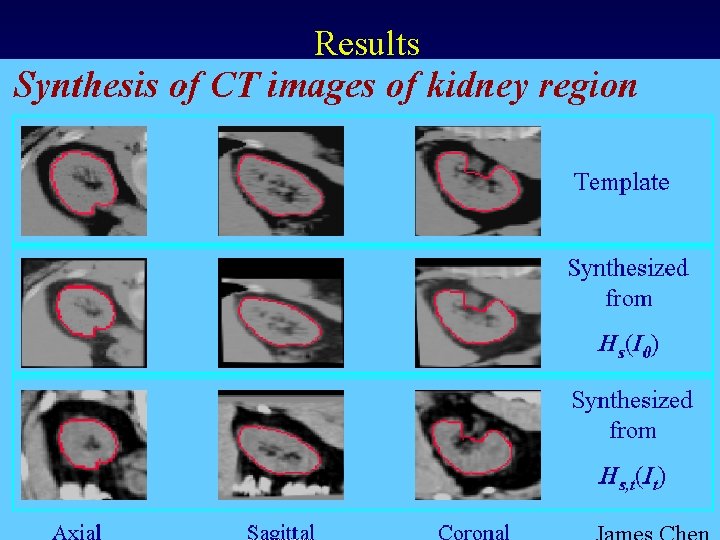
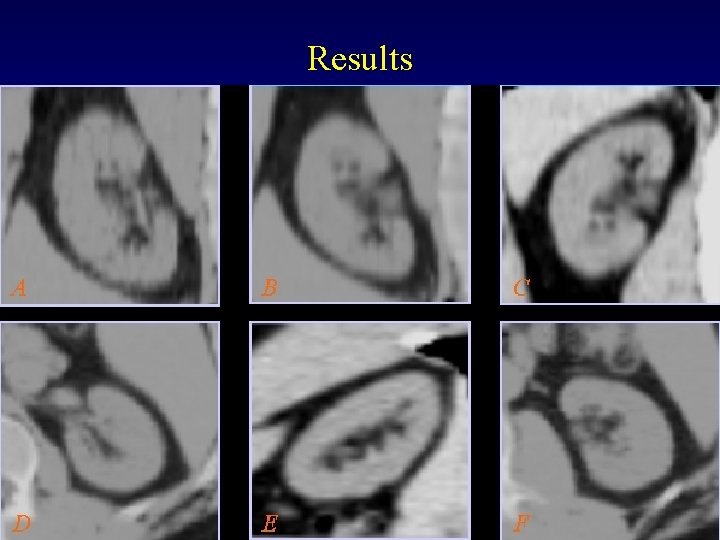
Population Simulation Requires Statistical Profiling of Shape Goal: Develop a methodology for generating realistic synthetic medical images AND the attendant “ground truth” segmentations for objects of interest. Why: Segmentation method evaluation. How: Build and sample probability distribution of shape. MIDAG@UNC
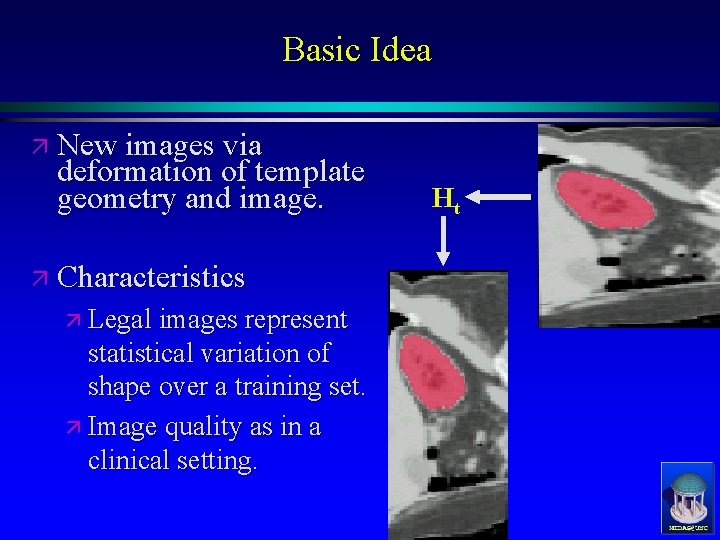
Basic Idea ä New images via deformation of template geometry and image. Ht ä Characteristics ä Legal images represent statistical variation of shape over a training set. ä Image quality as in a clinical setting. MIDAG@UNC
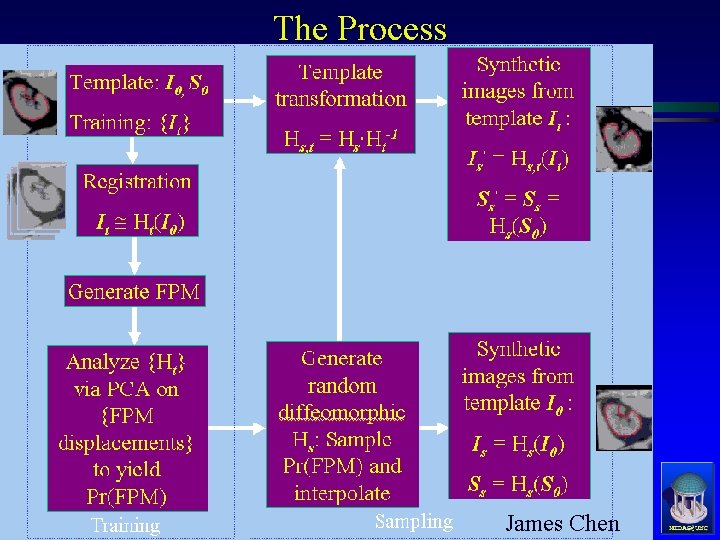
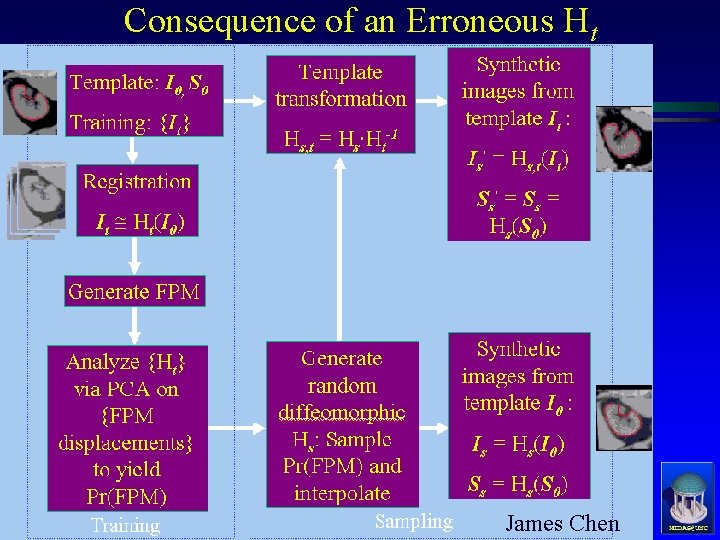
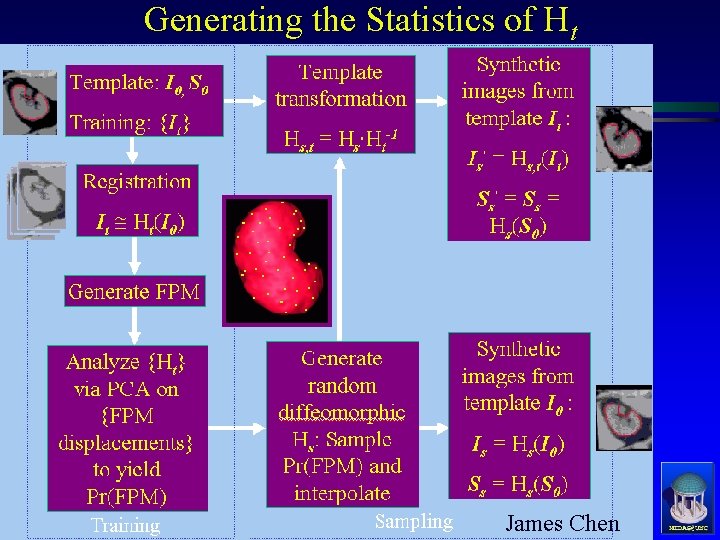
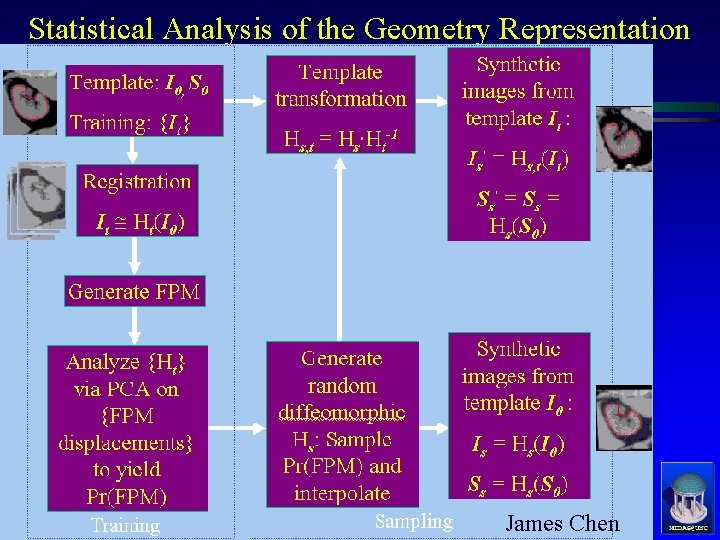
The Process James Chen MIDAG@UNC
Registration ä Registration – Composition of Two Transformations ä Linear – MIRIT, Frederik Maes ä Affine transformation, 12 dof ä Non-linear–Deformation Diffeomorphism, Joshi ä For all It , It Ht(I 0) and St Ht(S 0) MIDAG@UNC
Consequence of an Erroneous Ht James Chen MIDAG@UNC
Generating the Statistics of Ht James Chen MIDAG@UNC
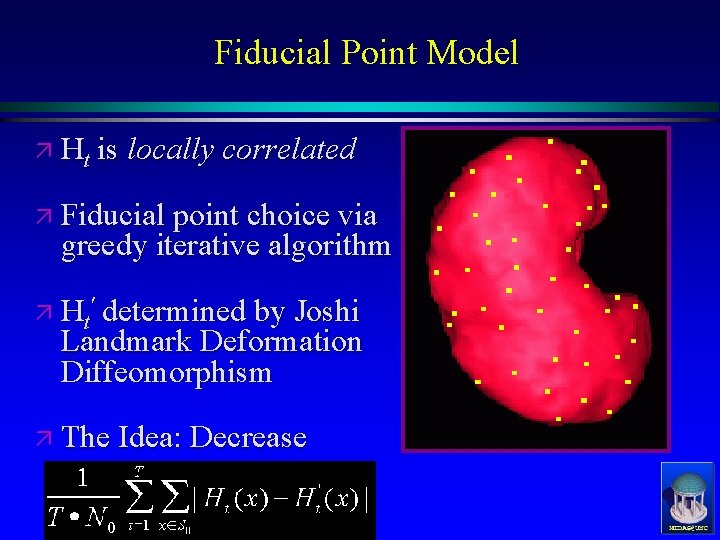
Fiducial Point Model ä Ht is locally correlated ä Fiducial point choice via greedy iterative algorithm ä Ht' determined by Joshi Landmark Deformation Diffeomorphism ä The Idea: Decrease MIDAG@UNC
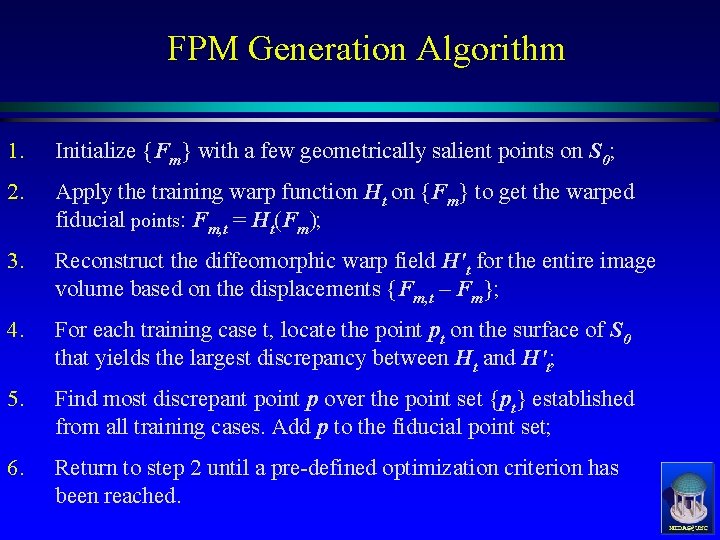
FPM Generation Algorithm 1. Initialize {Fm} with a few geometrically salient points on S 0; 2. Apply the training warp function Ht on {Fm} to get the warped fiducial points: Fm, t = Ht(Fm); 3. Reconstruct the diffeomorphic warp field H't for the entire image volume based on the displacements {Fm, t – Fm}; 4. For each training case t, locate the point pt on the surface of S 0 that yields the largest discrepancy between Ht and H't; 5. Find most discrepant point p over the point set {pt} established from all training cases. Add p to the fiducial point set; 6. Return to step 2 until a pre-defined optimization criterion has been reached. MIDAG@UNC
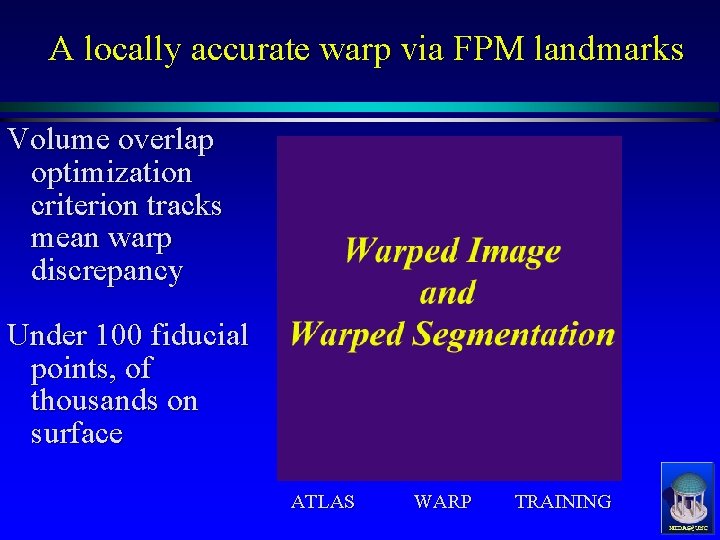
A locally accurate warp via FPM landmarks Volume overlap optimization criterion tracks mean warp discrepancy Under 100 fiducial points, of thousands on surface ATLAS WARP TRAINING MIDAG@UNC
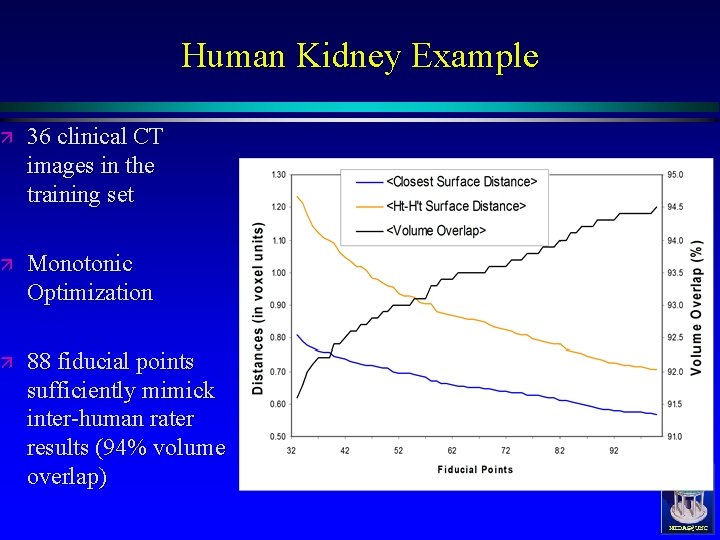
Human Kidney Example ä 36 clinical CT images in the training set ä Monotonic Optimization ä 88 fiducial points sufficiently mimick inter-human rater results (94% volume overlap) MIDAG@UNC
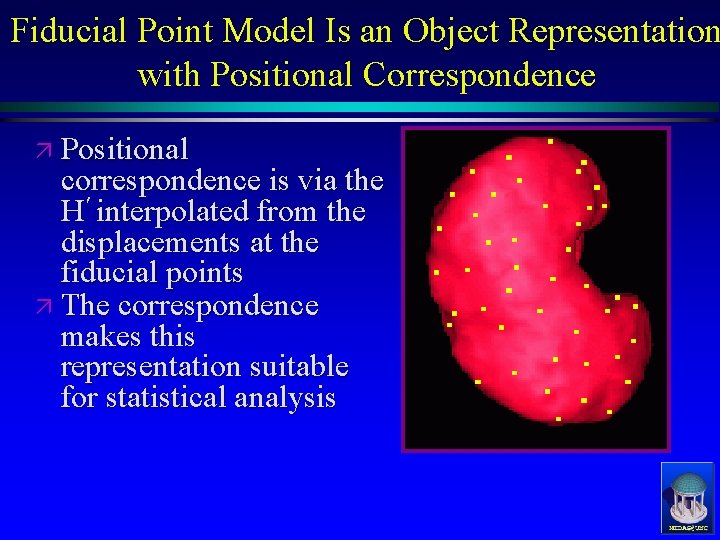
Fiducial Point Model Is an Object Representation with Positional Correspondence ä Positional correspondence is via the H' interpolated from the displacements at the fiducial points ä The correspondence makes this representation suitable for statistical analysis MIDAG@UNC
Statistical Analysis of the Geometry Representation James Chen MIDAG@UNC
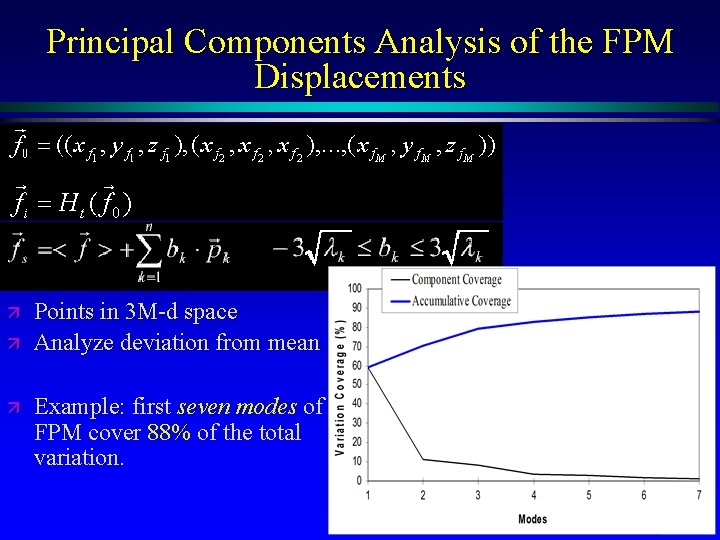
Principal Components Analysis of the FPM Displacements ä ä ä Points in 3 M-d space Analyze deviation from mean Example: first seven modes of FPM cover 88% of the total variation. MIDAG@UNC
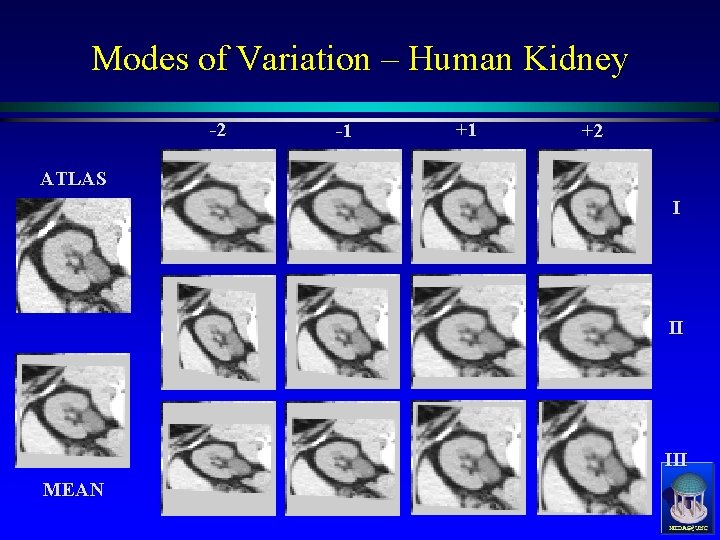
Modes of Variation – Human Kidney -2 -1 +1 +2 ATLAS I II III MEAN MIDAG@UNC
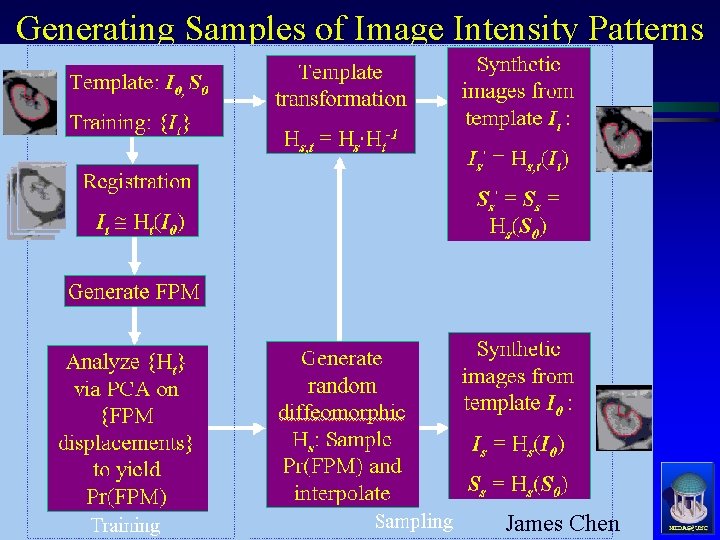
Generating Samples of Image Intensity Patterns James Chen MIDAG@UNC
Results MIDAG@UNC
Results MIDAG@UNC
Miscellaneous ä National Cancer Institute Grant P 01 CA 47982 References Gerig, G. , M. Jomier, M. Chakos (2001). “Valmet: A new validation tool for assessing and improving 3 D object segmentation. ” Proc. MICCAI 2001, Springer LNCS 2208: 516 -523. Cootes, T. F. , A. Hill, C. J. Taylor, J. Haslam (1994). “The Use of Active Shape Models for Locating Structures in Medical Images. ” Image and Vision Computing 12(6): 355 -366. Rueckert, D. , A. F. Frangi, and J. A. Schnabel (2001). “Automatic Construction of 3 D Statistical Deformation Models Using Non-rigid Registration. ” MICCAI 2001, Springer LNCS 2208: 77 -84. Christensen, G. E. , S. C. Joshi and M. I. Miller (1997). “Volumetric Transformation of Brain Anatomy. ” IEEE Transactions on Medical Imaging 16: 864 -877. Joshi, S. , M. I. Miller (2000). “Landmark Matching Via Large Deformation Diffeomorphisms. ” IEEETransactions on Image Processing. Maes, F. , A. Collignon, D. Vandermeulen, G. Marchal, P. Suetens (1997). “Multi-Modality Image Registration by Maximization of Mutual Information. ” IEEE-TMI 16: 187 -198. Pizer, S. M. , J. Z. Chen, T. Fletcher, Y. Fridman, D. S. Fritsch, G. Gash, J. Glotzer, S. Joshi, A. Thall, G. Tracton, P. Yushkevich, and E. Chaney (2001). “Deformable M-Reps for 3 D Medical Image Segmentation. ” IJCV, submitted. MIDAG@UNC