
Medical Experimentation during the Holocaust Dr Josef Mengele

- Slides: 20
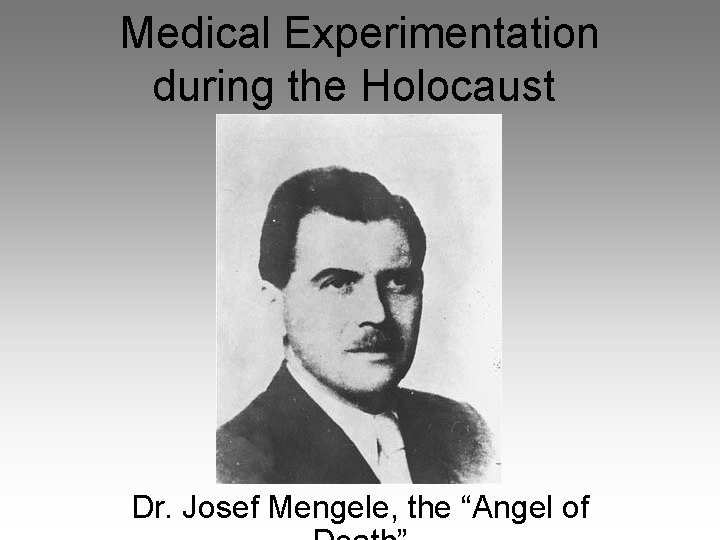
Medical Experimentation during the Holocaust Dr. Josef Mengele, the “Angel of
T 4 Program Eugenics poster entitled "The eradication of the sick and weak in nature" German quotation reads: "That which does not satisfy the demands of Being, collapses. "
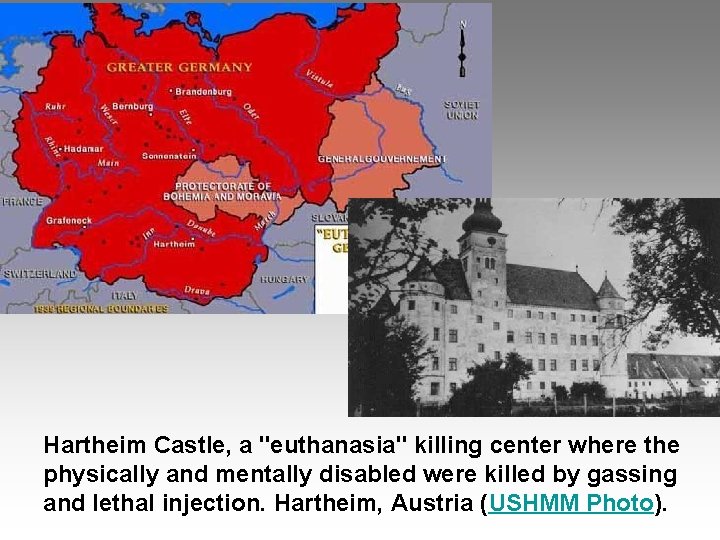
Hartheim Castle, a "euthanasia" killing center where the physically and mentally disabled were killed by gassing and lethal injection. Hartheim, Austria (USHMM Photo).
How could the doctors and nurses get to this point? • Nazification of Medicine – Changing of medical philosophy from healing the patient to healing the “volk” – State – endorsed programs centering around biological ideas → creating a stronger society • Use of medical field to persecute Jewish doctors
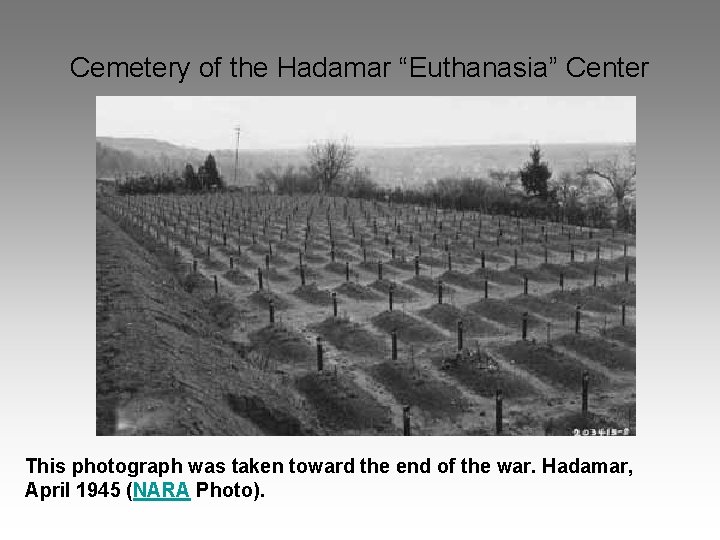
Cemetery of the Hadamar “Euthanasia” Center This photograph was taken toward the end of the war. Hadamar, April 1945 (NARA Photo).
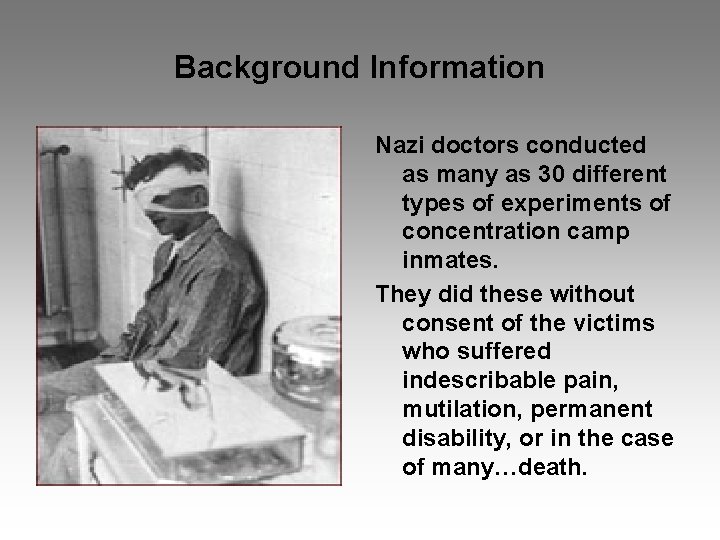
Background Information Nazi doctors conducted as many as 30 different types of experiments of concentration camp inmates. They did these without consent of the victims who suffered indescribable pain, mutilation, permanent disability, or in the case of many…death.
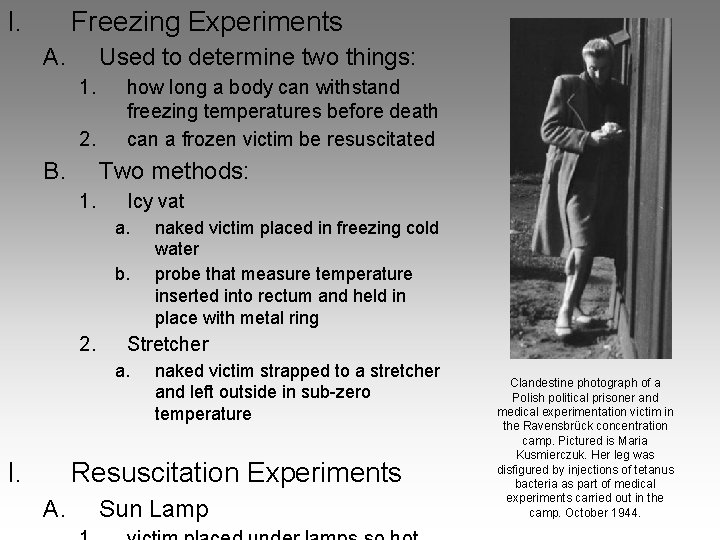
I. Freezing Experiments A. Used to determine two things: 1. 2. B. how long a body can withstand freezing temperatures before death can a frozen victim be resuscitated Two methods: 1. Icy vat a. b. 2. Stretcher a. I. naked victim placed in freezing cold water probe that measure temperature inserted into rectum and held in place with metal ring naked victim strapped to a stretcher and left outside in sub-zero temperature Resuscitation Experiments A. Sun Lamp Clandestine photograph of a Polish political prisoner and medical experimentation victim in the Ravensbrück concentration camp. Pictured is Maria Kusmierczuk. Her leg was disfigured by injections of tetanus bacteria as part of medical experiments carried out in the camp. October 1944.
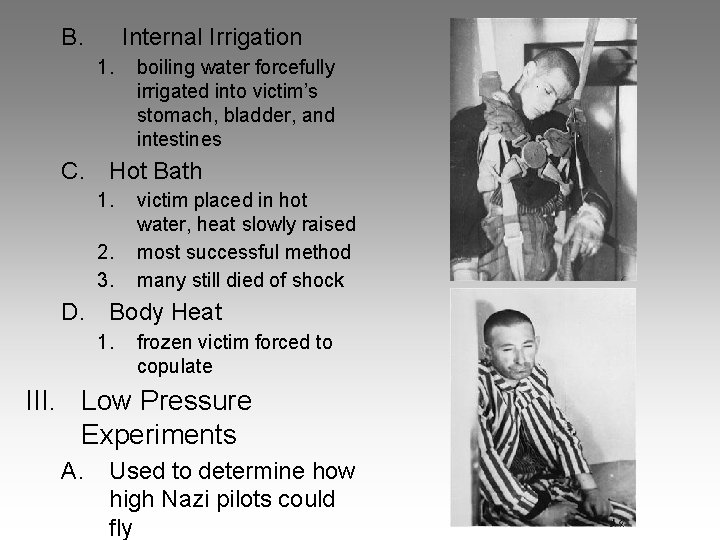
B. Internal Irrigation 1. boiling water forcefully irrigated into victim’s stomach, bladder, and intestines C. Hot Bath 1. 2. 3. victim placed in hot water, heat slowly raised most successful method many still died of shock D. Body Heat 1. frozen victim forced to copulate III. Low Pressure Experiments A. Used to determine how high Nazi pilots could fly
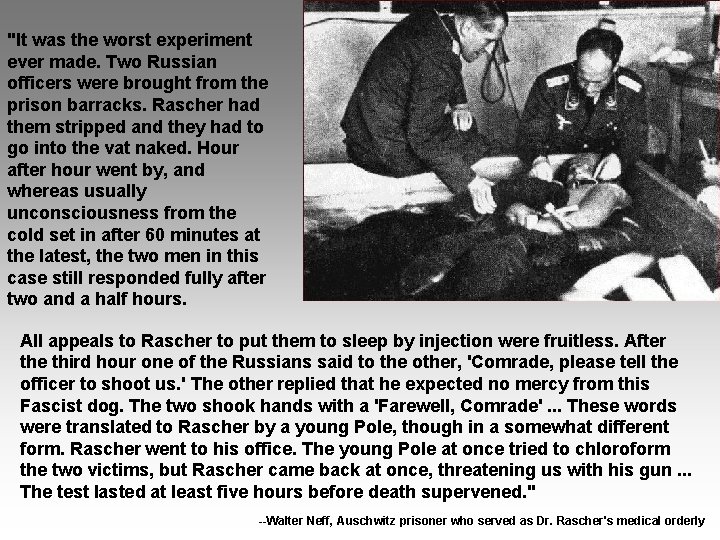
"It was the worst experiment ever made. Two Russian officers were brought from the prison barracks. Rascher had them stripped and they had to go into the vat naked. Hour after hour went by, and whereas usually unconsciousness from the cold set in after 60 minutes at the latest, the two men in this case still responded fully after two and a half hours. All appeals to Rascher to put them to sleep by injection were fruitless. After the third hour one of the Russians said to the other, 'Comrade, please tell the officer to shoot us. ' The other replied that he expected no mercy from this Fascist dog. The two shook hands with a 'Farewell, Comrade'. . . These words were translated to Rascher by a young Pole, though in a somewhat different form. Rascher went to his office. The young Pole at once tried to chloroform the two victims, but Rascher came back at once, threatening us with his gun. . . The test lasted at least five hours before death supervened. " --Walter Neff, Auschwitz prisoner who served as Dr. Rascher's medical orderly
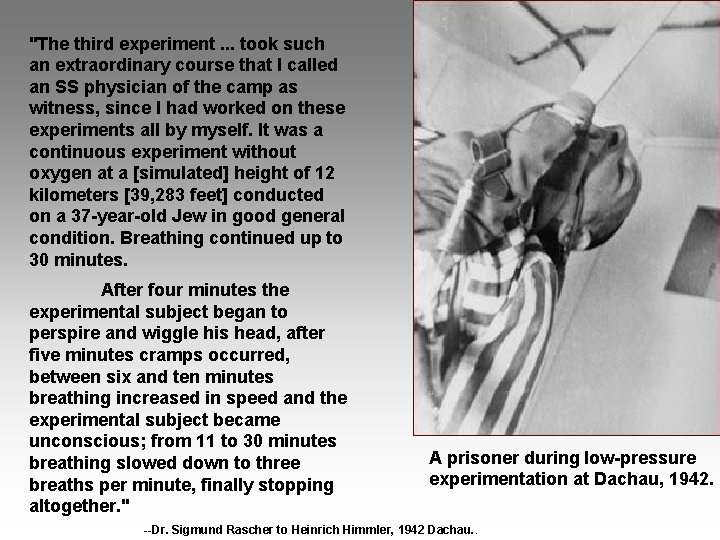
"The third experiment. . . took such an extraordinary course that I called an SS physician of the camp as witness, since I had worked on these experiments all by myself. It was a continuous experiment without oxygen at a [simulated] height of 12 kilometers [39, 283 feet] conducted on a 37 -year-old Jew in good general condition. Breathing continued up to 30 minutes. After four minutes the experimental subject began to perspire and wiggle his head, after five minutes cramps occurred, between six and ten minutes breathing increased in speed and the experimental subject became unconscious; from 11 to 30 minutes breathing slowed down to three breaths per minute, finally stopping altogether. " A prisoner during low-pressure experimentation at Dachau, 1942. --Dr. Sigmund Rascher to Heinrich Himmler, 1942 Dachau. .
Poison Researchers at Buchenwald concentration camp developed a method of individual execution by injecting Russian prisoners with phenol and cyanide. Experimenters also tested various poisons on the human body by secreting noxious chemicals in prisoners' food or shooting inmates with poison bullets. Victims who did not die during these experiments were killed to allow the experimenters to perform autopsies
Phosgene Fort Ney near Strasbourg, France An attempt to find an antidote to phosgene, a toxic gas used as a weapon during World War I Nazi doctors exposed 52 concentration-camp prisoners to the gas Phosgene gas causes extreme irritation to the lungs. Many of the prisoners, who according to German records were already weak and malnourished, suffered pulmonary edema after exposure, and four of them died from the experiments.
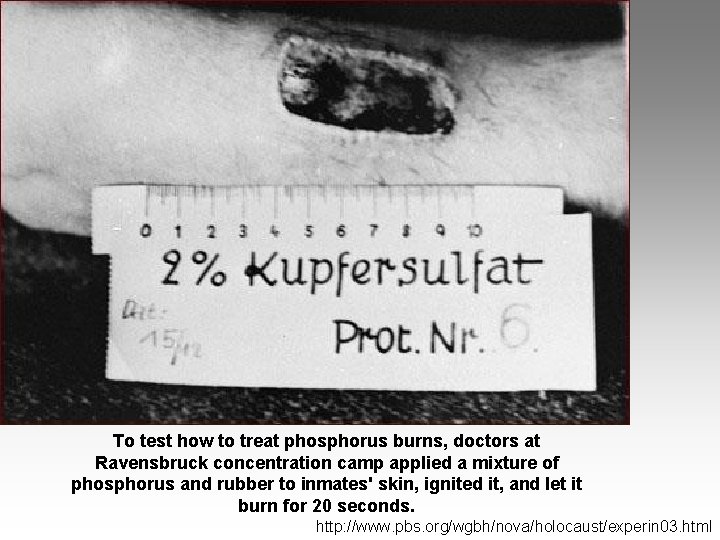
To test how to treat phosphorus burns, doctors at Ravensbruck concentration camp applied a mixture of phosphorus and rubber to inmates' skin, ignited it, and let it burn for 20 seconds. http: //www. pbs. org/wgbh/nova/holocaust/experin 03. html
Seawater Dr. Hans Eppinger and others at Dachau conducted experiments on how to make seawater drinkable. The doctors forced roughly 90 Gypsies to drink only seawater while also depriving them of food. Gypsies became so dehydrated that they reportedly licked floors after they had been mopped just to get a drop of fresh water. The experiments caused enormous pain and suffering and resulted in serious bodily injury.
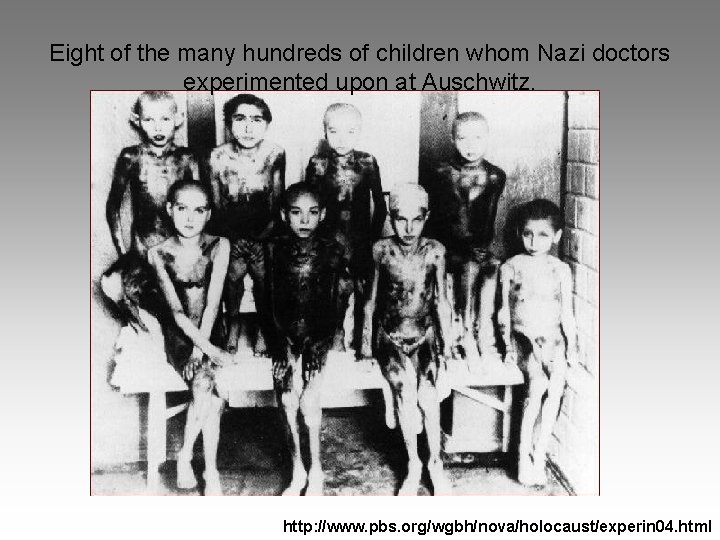
Eight of the many hundreds of children whom Nazi doctors experimented upon at Auschwitz. http: //www. pbs. org/wgbh/nova/holocaust/experin 04. html
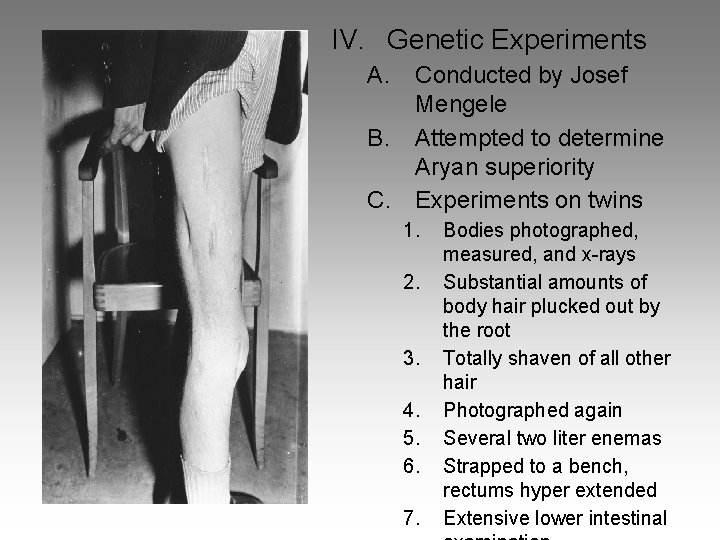
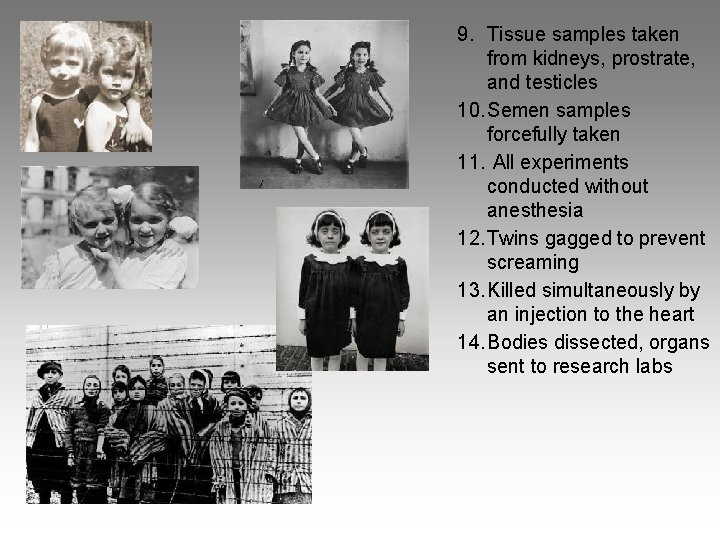
IV. Genetic Experiments A. Conducted by Josef Mengele B. Attempted to determine Aryan superiority C. Experiments on twins 1. 2. 3. 4. 5. 6. 7. Bodies photographed, measured, and x-rays Substantial amounts of body hair plucked out by the root Totally shaven of all other hair Photographed again Several two liter enemas Strapped to a bench, rectums hyper extended Extensive lower intestinal
9. Tissue samples taken from kidneys, prostrate, and testicles 10. Semen samples forcefully taken 11. All experiments conducted without anesthesia 12. Twins gagged to prevent screaming 13. Killed simultaneously by an injection to the heart 14. Bodies dissected, organs sent to research labs
"Fifteen girls aged 17 to 18 years old. The girls who survived the following operations are in German hands and little is known about them. The subjects were placed in an ultra-short-wave field. One electrode was placed on the abdomen and another on the vulva. The rays were focused on the ovaries. The ovaries were consequently burned up. Owing to faulty doses several had serious burns of the abdomen and vulva. One died as a result of these burns alone. The others were sent to another concentration camp where some were put in hospital and others made to work. After a month they returned to Auschwitz where control operations were performed. Sagittal and transverse sections of the ovaries were made. The girls altered entirely owing to hormonal changes. They looked just like old women. Often they were laid up for months owing to the wounds of the operations becoming septic. Several died as a result of sepsis. " --Sterilization experiment at Auschwitz, as described by two Dutch doctors who had been prisoners there.
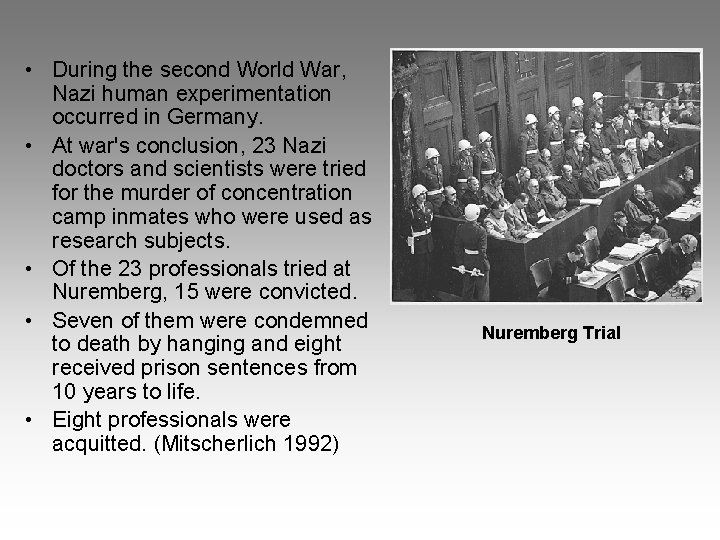
• During the second World War, Nazi human experimentation occurred in Germany. • At war's conclusion, 23 Nazi doctors and scientists were tried for the murder of concentration camp inmates who were used as research subjects. • Of the 23 professionals tried at Nuremberg, 15 were convicted. • Seven of them were condemned to death by hanging and eight received prison sentences from 10 years to life. • Eight professionals were acquitted. (Mitscherlich 1992) Nuremberg Trial
Nuremberg Code The result of the Nuremberg trial was the Nuremberg Code. It includes the following guidelines, among others, for researchers: • Informed consent is essential. • Research should be based on prior animal work. • The risks should be justified by the anticipated benefits. • Research must be conducted by qualified scientists. • Physical and mental suffering must be avoided. • Research in which death or disabling injury is expected should not be conducted.