
Medical Dosage Calculations A Dimensional Analysis Approach Eleventh
- Slides: 31
Medical Dosage Calculations A Dimensional Analysis Approach Eleventh Edition Chapter 4 The Household and Metric Systems Copyright © 2016, 2012, 2008 Pearson Education, Inc. All Rights Reserved
Learning Objectives 4. 1 Identify the units of measurement in the household and metric systems. 4. 2 Recognize the abbreviations for the units of measurement in the two systems. 4. 3 State the equivalents for the units of volume. 4. 4 State the equivalents for the units of weight. 4. 5 State the equivalents for the units of length. 4. 6 Convert from one unit to another within each of the two systems. Copyright © 2016, 2012, 2008 Pearson Education, Inc. All Rights Reserved
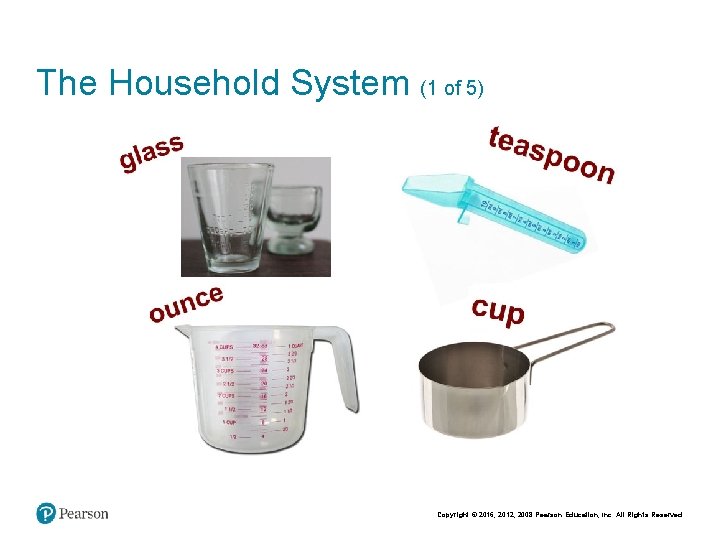
The Household System (1 of 5) Copyright © 2016, 2012, 2008 Pearson Education, Inc. All Rights Reserved
The Household System (2 of 5) Alert • Because the volume of ordinary household spoons, cups, or glasses may vary, some of the equivalences in the following Table are only approximate. Copyright © 2016, 2012, 2008 Pearson Education, Inc. All Rights Reserved
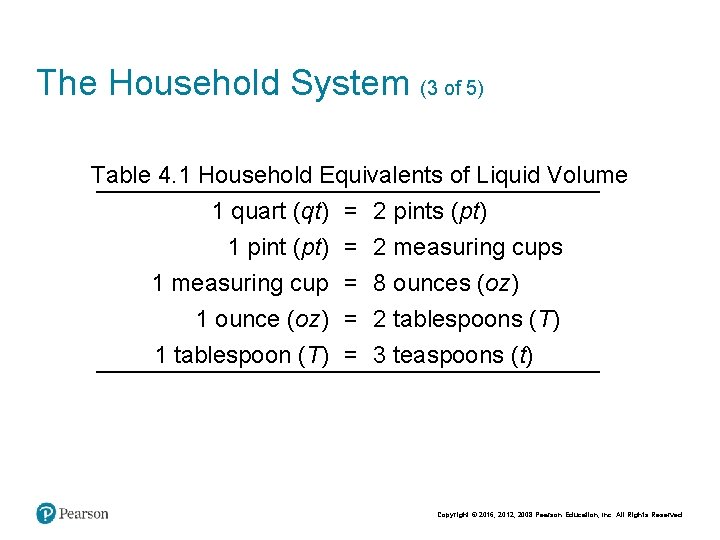
The Household System (3 of 5) Table 4. 1 Household Equivalents of Liquid Volume 1 quart (qt) = 2 pints (pt) 1 pint (pt) = 2 measuring cups 1 measuring cup = 8 ounces (oz) 1 ounce (oz) = 2 tablespoons (T) 1 tablespoon (T) = 3 teaspoons (t) Copyright © 2016, 2012, 2008 Pearson Education, Inc. All Rights Reserved
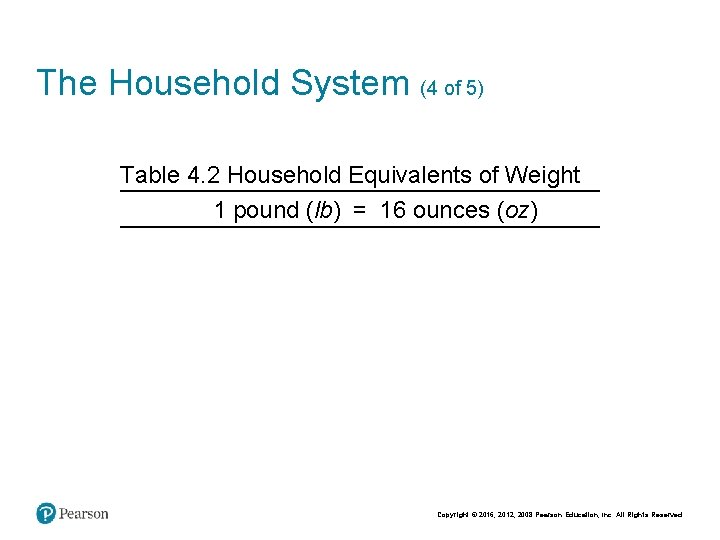
The Household System (4 of 5) Table 4. 2 Household Equivalents of Weight 1 pound (lb) = 16 ounces (oz) Copyright © 2016, 2012, 2008 Pearson Education, Inc. All Rights Reserved
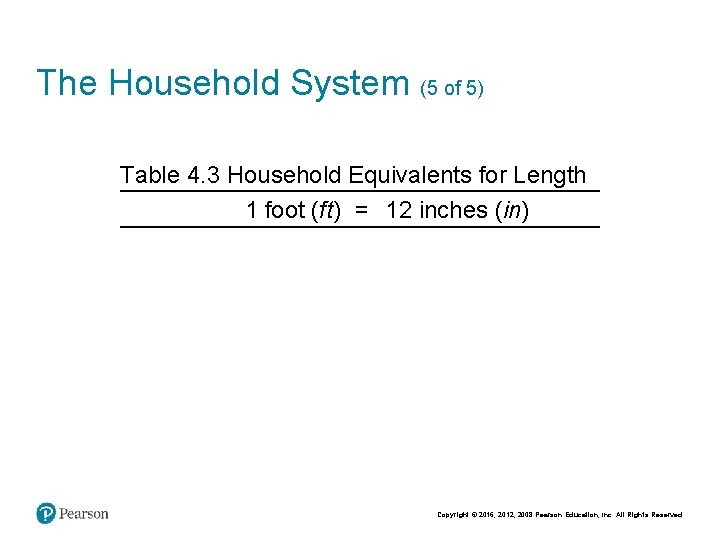
The Household System (5 of 5) Table 4. 3 Household Equivalents for Length 1 foot (ft) = 12 inches (in) Copyright © 2016, 2012, 2008 Pearson Education, Inc. All Rights Reserved
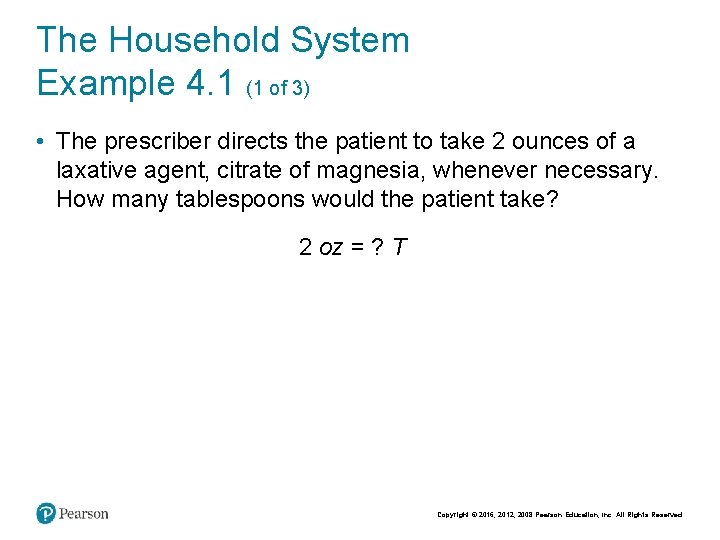
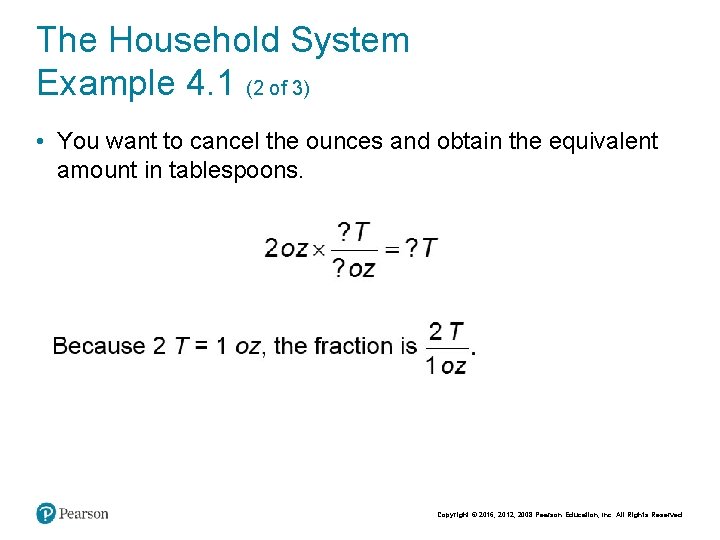
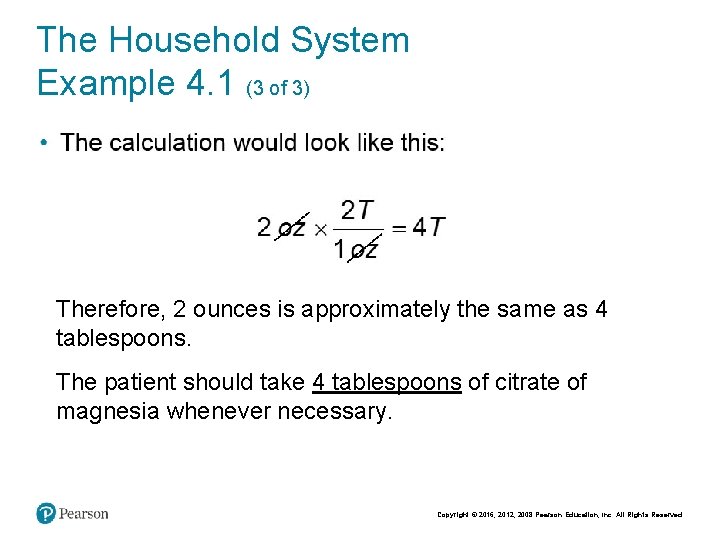
The Household System Example 4. 1 (1 of 3) • The prescriber directs the patient to take 2 ounces of a laxative agent, citrate of magnesia, whenever necessary. How many tablespoons would the patient take? 2 oz = ? T Copyright © 2016, 2012, 2008 Pearson Education, Inc. All Rights Reserved
The Household System Example 4. 1 (2 of 3) • You want to cancel the ounces and obtain the equivalent amount in tablespoons. Copyright © 2016, 2012, 2008 Pearson Education, Inc. All Rights Reserved
The Household System Example 4. 1 (3 of 3) Therefore, 2 ounces is approximately the same as 4 tablespoons. The patient should take 4 tablespoons of citrate of magnesia whenever necessary. Copyright © 2016, 2012, 2008 Pearson Education, Inc. All Rights Reserved
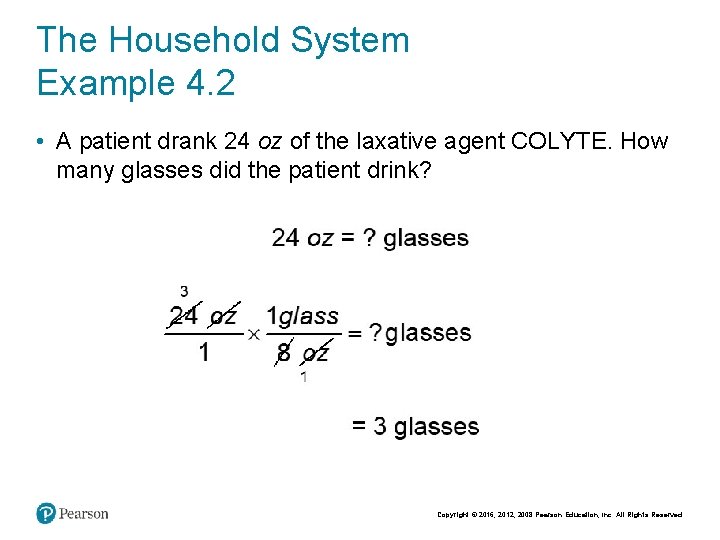
The Household System Example 4. 2 • A patient drank 24 oz of the laxative agent COLYTE. How many glasses did the patient drink? Copyright © 2016, 2012, 2008 Pearson Education, Inc. All Rights Reserved
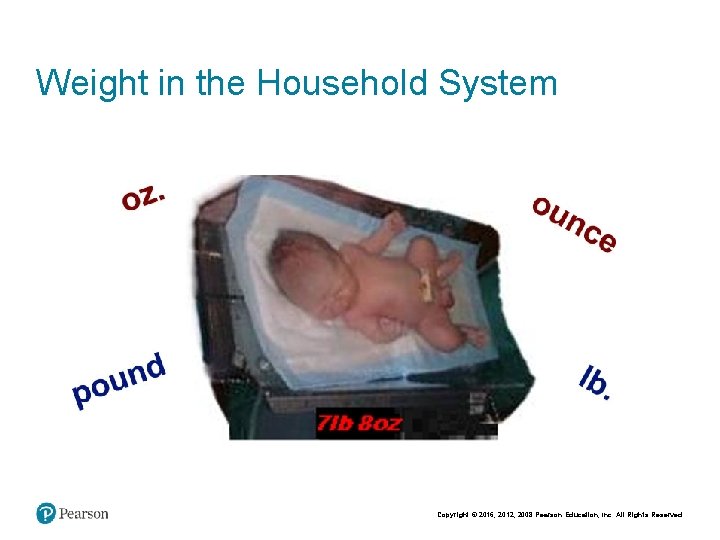
Weight in the Household System Copyright © 2016, 2012, 2008 Pearson Education, Inc. All Rights Reserved
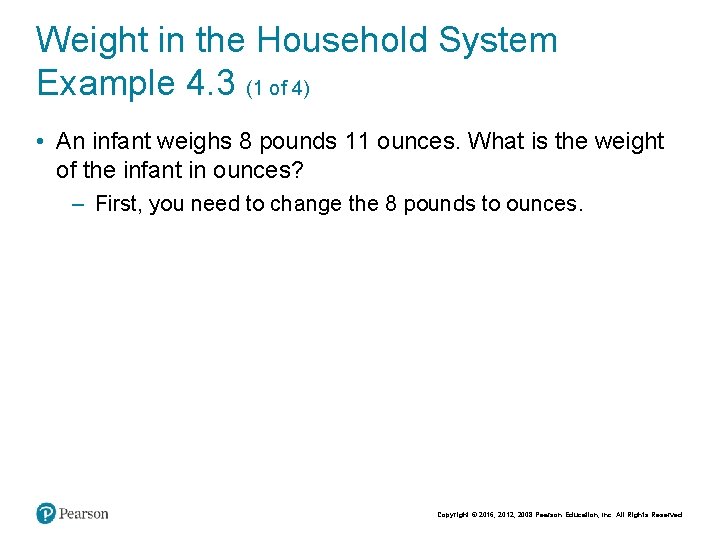
Weight in the Household System Example 4. 3 (1 of 4) • An infant weighs 8 pounds 11 ounces. What is the weight of the infant in ounces? – First, you need to change the 8 pounds to ounces. Copyright © 2016, 2012, 2008 Pearson Education, Inc. All Rights Reserved
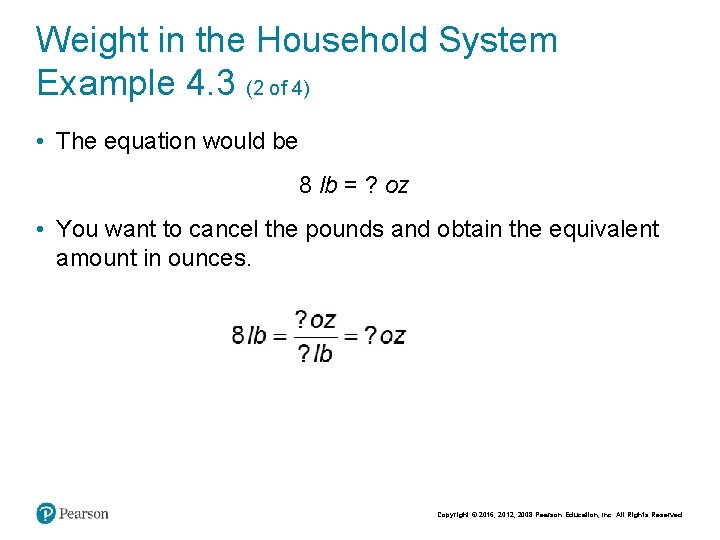
Weight in the Household System Example 4. 3 (2 of 4) • The equation would be 8 lb = ? oz • You want to cancel the pounds and obtain the equivalent amount in ounces. Copyright © 2016, 2012, 2008 Pearson Education, Inc. All Rights Reserved
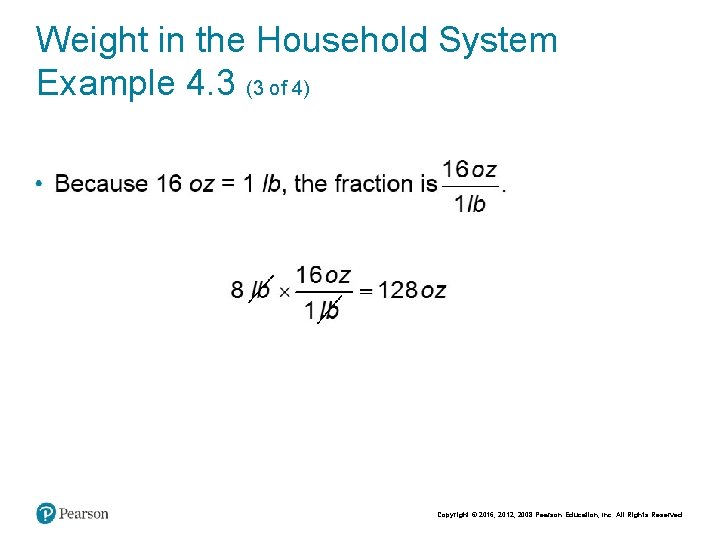
Weight in the Household System Example 4. 3 (3 of 4) Copyright © 2016, 2012, 2008 Pearson Education, Inc. All Rights Reserved
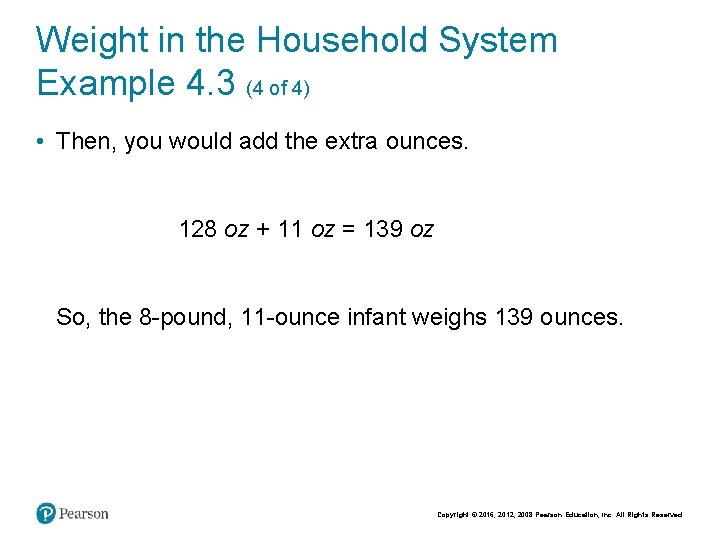
Weight in the Household System Example 4. 3 (4 of 4) • Then, you would add the extra ounces. 128 oz + 11 oz = 139 oz So, the 8 -pound, 11 -ounce infant weighs 139 ounces. Copyright © 2016, 2012, 2008 Pearson Education, Inc. All Rights Reserved
The Metric System (1 of 7) Copyright © 2016, 2012, 2008 Pearson Education, Inc. All Rights Reserved
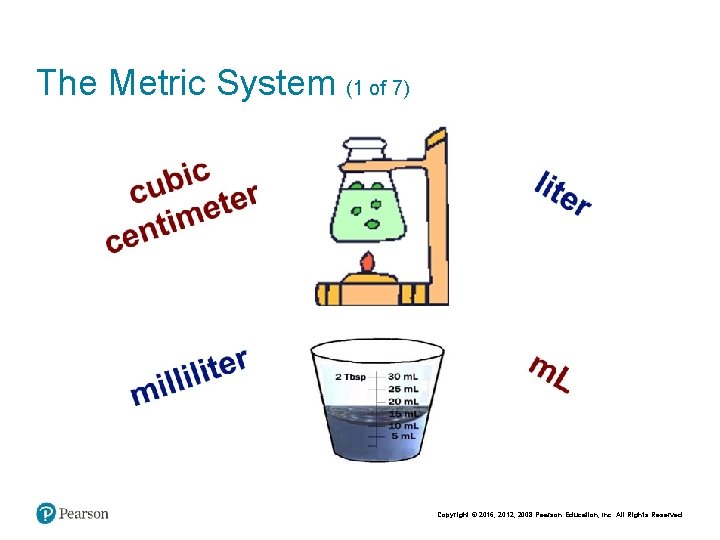
The Metric System (2 of 7) • The metric system is the most widely used system of measurement in medical dosage calculation. Copyright © 2016, 2012, 2008 Pearson Education, Inc. All Rights Reserved
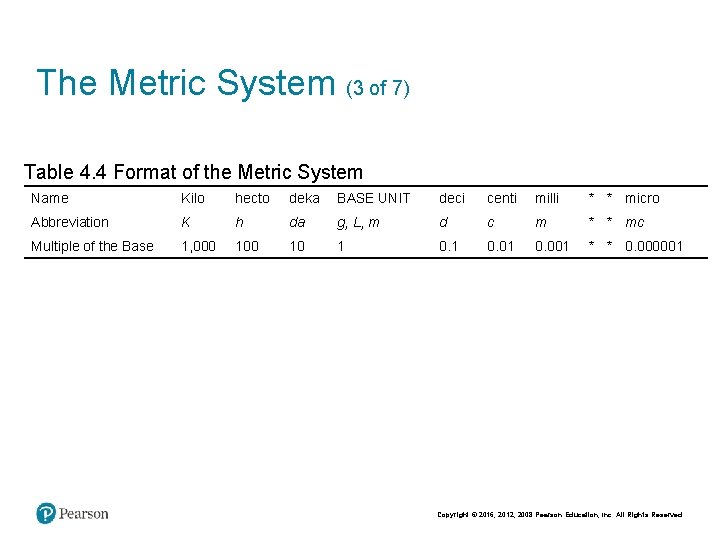
The Metric System (3 of 7) Table 4. 4 Format of the Metric System Name Kilo hecto deka BASE UNIT deci centi milli * * micro Abbreviation K h da g, L, m d c m * * mc Multiple of the Base 1, 000 10 1 0. 01 0. 001 * * 0. 000001 Copyright © 2016, 2012, 2008 Pearson Education, Inc. All Rights Reserved
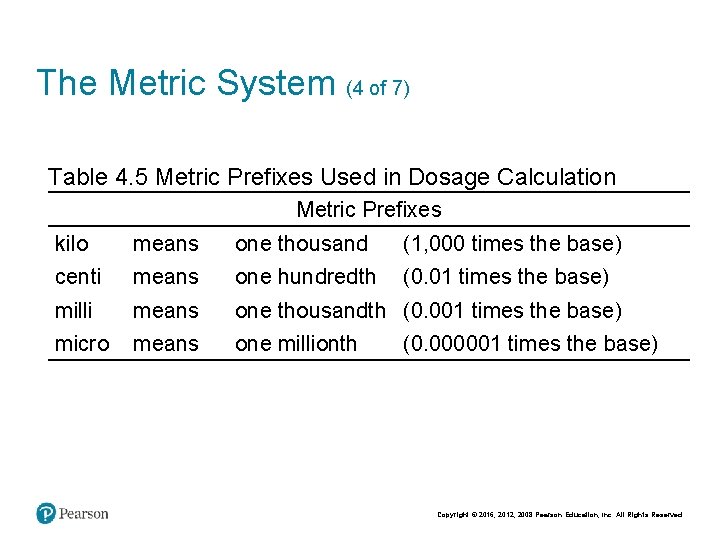
The Metric System (4 of 7) Table 4. 5 Metric Prefixes Used in Dosage Calculation Metric Prefixes kilo means one thousand (1, 000 times the base) centi means one hundredth (0. 01 times the base) milli means one thousandth (0. 001 times the base) micro means one millionth (0. 000001 times the base) Copyright © 2016, 2012, 2008 Pearson Education, Inc. All Rights Reserved
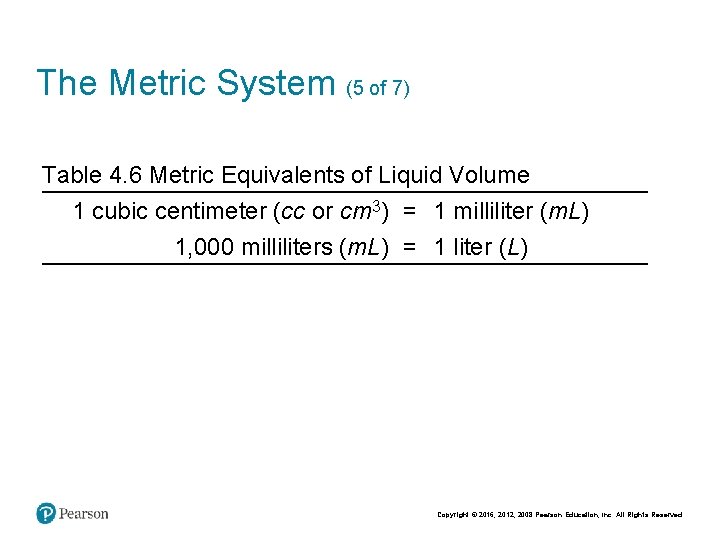
The Metric System (5 of 7) Table 4. 6 Metric Equivalents of Liquid Volume 1 cubic centimeter (cc or cm 3) = 1 milliliter (m. L) 1, 000 milliliters (m. L) = 1 liter (L) Copyright © 2016, 2012, 2008 Pearson Education, Inc. All Rights Reserved
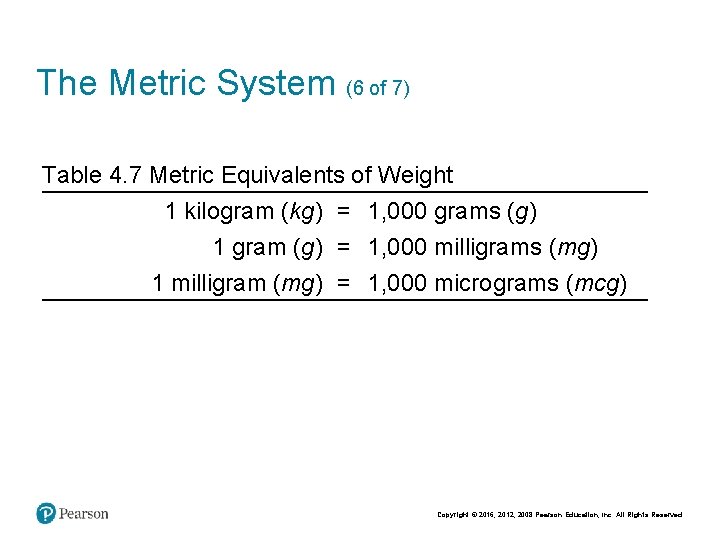
The Metric System (6 of 7) Table 4. 7 Metric Equivalents of Weight 1 kilogram (kg) = 1, 000 grams (g) 1 gram (g) = 1, 000 milligrams (mg) 1 milligram (mg) = 1, 000 micrograms (mcg) Copyright © 2016, 2012, 2008 Pearson Education, Inc. All Rights Reserved
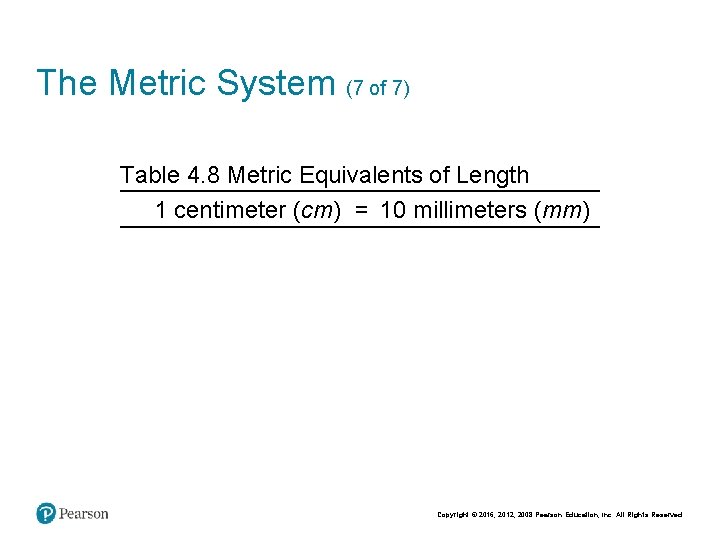
The Metric System (7 of 7) Table 4. 8 Metric Equivalents of Length 1 centimeter (cm) = 10 millimeters (mm) Copyright © 2016, 2012, 2008 Pearson Education, Inc. All Rights Reserved
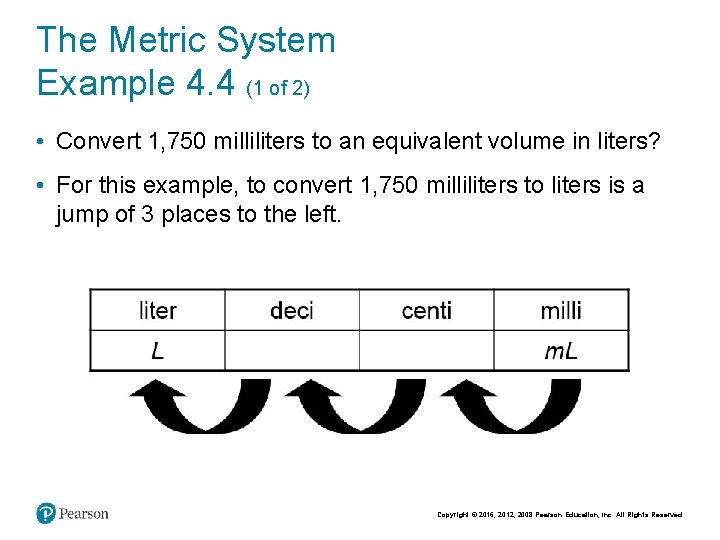
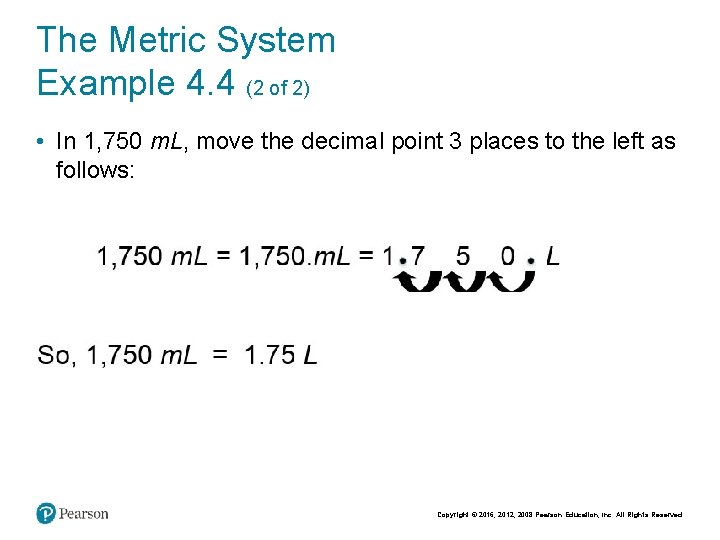
The Metric System Example 4. 4 (1 of 2) • Convert 1, 750 milliliters to an equivalent volume in liters? • For this example, to convert 1, 750 milliliters to liters is a jump of 3 places to the left. Copyright © 2016, 2012, 2008 Pearson Education, Inc. All Rights Reserved
The Metric System Example 4. 4 (2 of 2) • In 1, 750 m. L, move the decimal point 3 places to the left as follows: Copyright © 2016, 2012, 2008 Pearson Education, Inc. All Rights Reserved
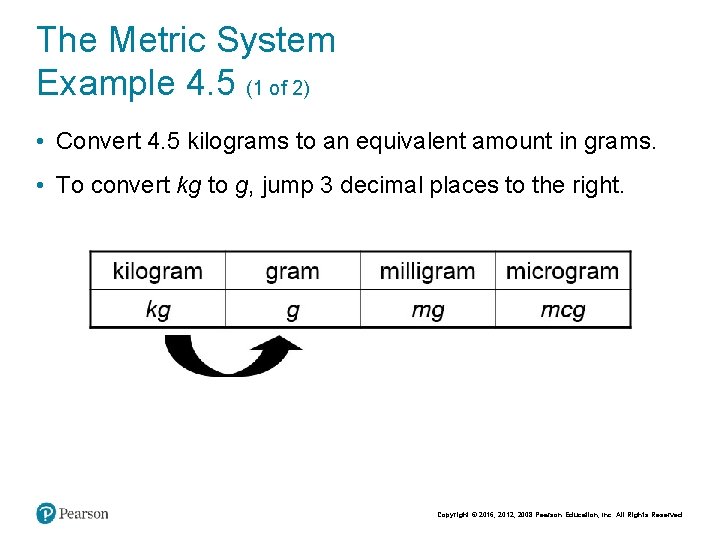
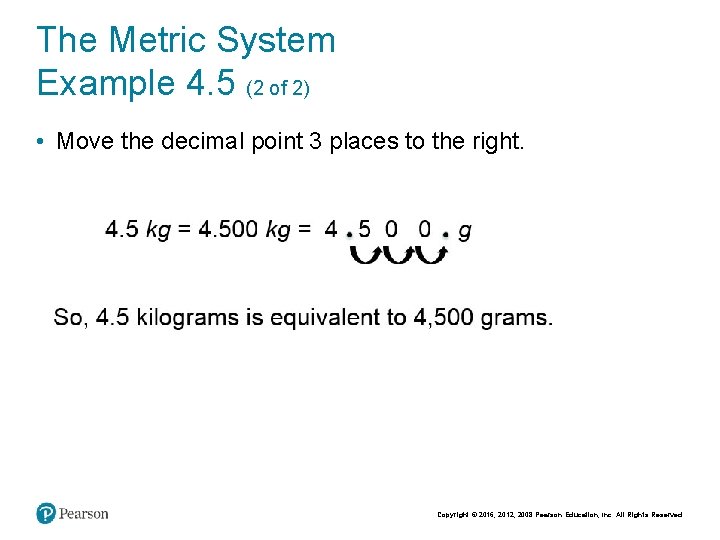
The Metric System Example 4. 5 (1 of 2) • Convert 4. 5 kilograms to an equivalent amount in grams. • To convert kg to g, jump 3 decimal places to the right. Copyright © 2016, 2012, 2008 Pearson Education, Inc. All Rights Reserved
The Metric System Example 4. 5 (2 of 2) • Move the decimal point 3 places to the right. Copyright © 2016, 2012, 2008 Pearson Education, Inc. All Rights Reserved
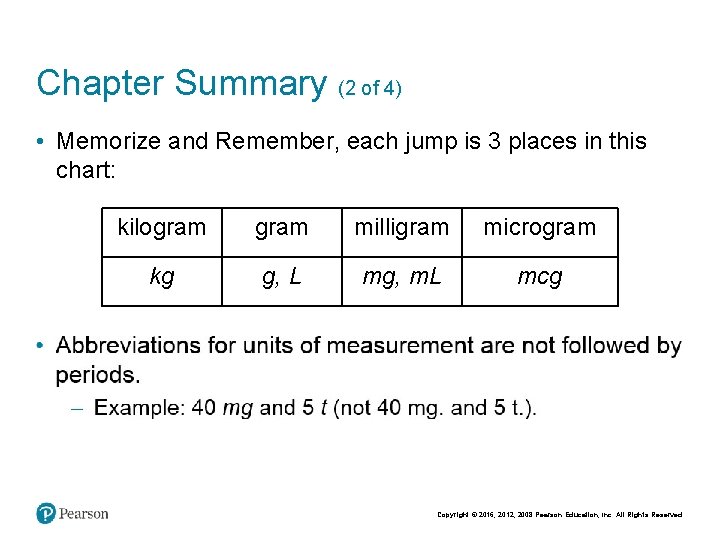
Chapter Summary (1 of 4) • The metric system is the dominant system used in health care. • It is important to memorize the equivalences between the various units of measurement of the household and metric systems. • It is important to memorize the abbreviations for the various units of measurement. • To convert units of measure in the metric system, use the shortcut method of moving the decimal point. Always jump 3 places except for cm-mm conversions, which use a 1 place jump. Copyright © 2016, 2012, 2008 Pearson Education, Inc. All Rights Reserved
Chapter Summary (2 of 4) • Memorize and Remember, each jump is 3 places in this chart: kilogram milligram microgram kg g, L mg, m. L mcg Copyright © 2016, 2012, 2008 Pearson Education, Inc. All Rights Reserved
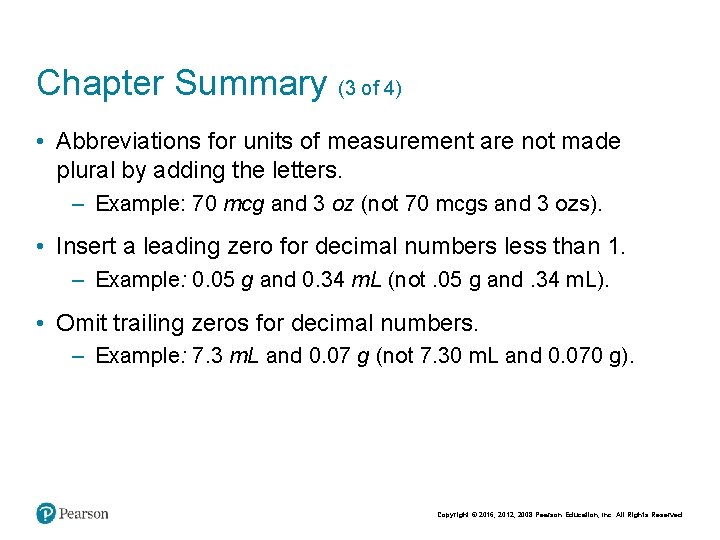
Chapter Summary (3 of 4) • Abbreviations for units of measurement are not made plural by adding the letters. – Example: 70 mcg and 3 oz (not 70 mcgs and 3 ozs). • Insert a leading zero for decimal numbers less than 1. – Example: 0. 05 g and 0. 34 m. L (not. 05 g and. 34 m. L). • Omit trailing zeros for decimal numbers. – Example: 7. 3 m. L and 0. 07 g (not 7. 30 m. L and 0. 070 g). Copyright © 2016, 2012, 2008 Pearson Education, Inc. All Rights Reserved
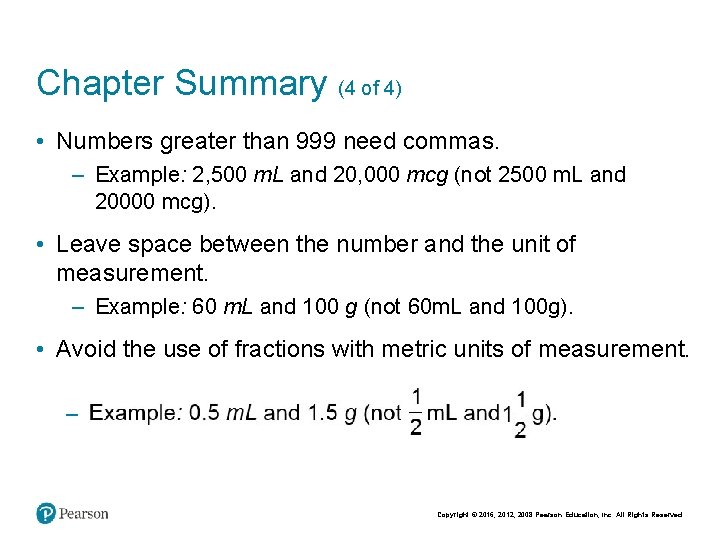
Chapter Summary (4 of 4) • Numbers greater than 999 need commas. – Example: 2, 500 m. L and 20, 000 mcg (not 2500 m. L and 20000 mcg). • Leave space between the number and the unit of measurement. – Example: 60 m. L and 100 g (not 60 m. L and 100 g). • Avoid the use of fractions with metric units of measurement. Copyright © 2016, 2012, 2008 Pearson Education, Inc. All Rights Reserved