
Medical Cannabis Prescribing When How Roland Halil Pharm
Medical Cannabis & Prescribing: When & How Roland Halil, Pharm. D, ACPR, BSc. Pharm, BSc(Hon) Assistant Professor, Dept of Family Medicine, UOttawa Clinical Pharmacist, Bruyère Academic Family Health Team Dept Family Medicine Retreat Calabogie, ON Oct 2018 Some slides adapted from Mike Boivin, BSc. Phm, CDE, CTH, (with permission)
Disclosures Relationships with Commercial Interests: – Consultant with the Foundation for Medical Education at Mc. Master University (PBSG module consultant & reviewer) – Occasional consultant with Rxfiles Disclosure of Commercial Support : None Potential for Conflict(s) of Interest: Invited speaker at: – Walmart conference in Toronto, ON (Apr 2017) – Costco conference in Toronto, ON (May 2017) 23 February 2018
Objectives Participants will be prepared to teach medical learners: 1. 2. 3. 4. 5. The regulatory framework around medical cannabis An approach to prescribing and managing its use Areas of therapeutics which may benefit from its use How to choose an appropriate cannabis formulation How to complete a medical cannabis authorization form
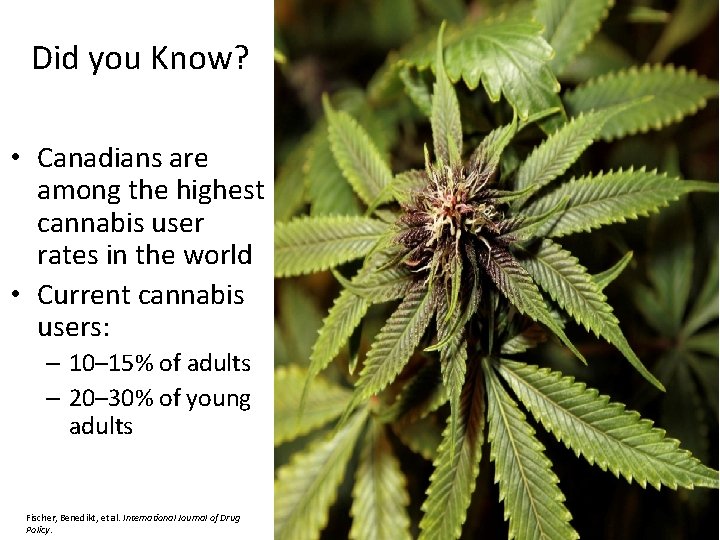
Did you Know? • Canadians are among the highest cannabis user rates in the world • Current cannabis users: – 10– 15% of adults – 20– 30% of young adults Fischer, Benedikt, et al. International Journal of Drug Policy.
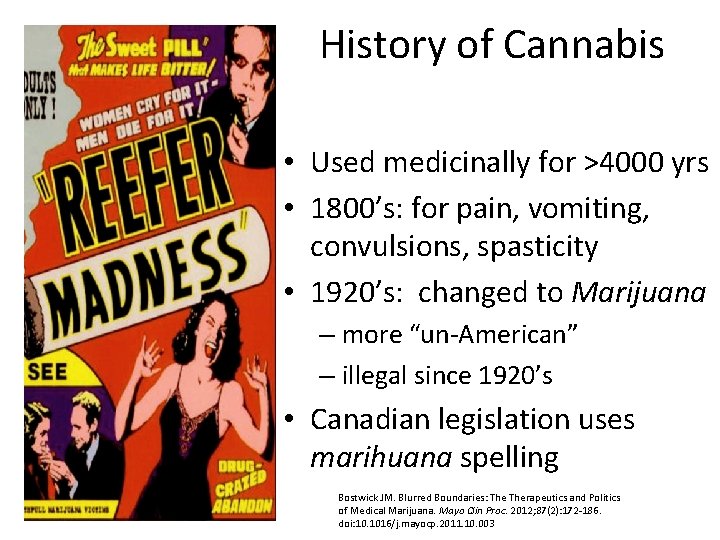
History of Cannabis • Used medicinally for >4000 yrs • 1800’s: for pain, vomiting, convulsions, spasticity • 1920’s: changed to Marijuana – more “un-American” – illegal since 1920’s • Canadian legislation uses marihuana spelling Bostwick JM. Blurred Boundaries: Therapeutics and Politics of Medical Marijuana. Mayo Clin Proc. 2012; 87(2): 172 -186. doi: 10. 1016/j. mayocp. 2011. 10. 003
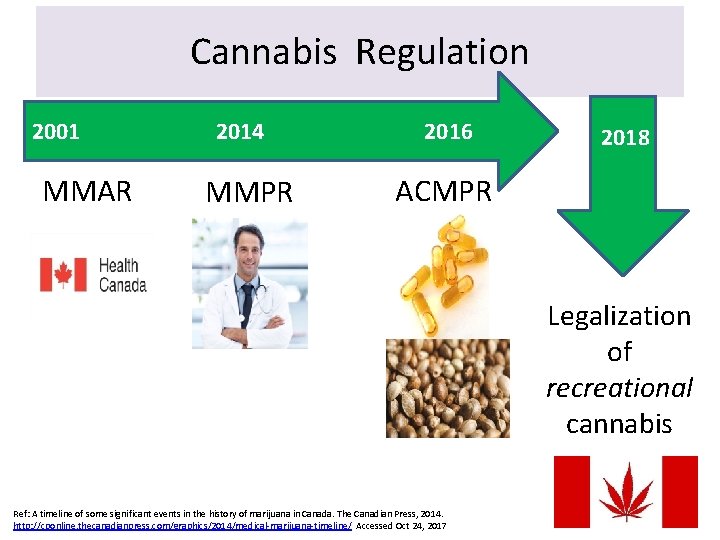
Cannabis Regulation 2001 2014 2016 MMAR MMPR 2018 ACMPR Legalization of recreational cannabis Ref: A timeline of some significant events in the history of marijuana in Canada. The Canadian Press, 2014. http: //cponline. thecanadianpress. com/graphics/2014/medical-marijuana-timeline/ Accessed Oct 24, 2017
2001 Medical Marihuana Access Regulations (MMAR) • Supreme court decision 2001 • Health Canada: – Determined who qualified – Distributed cannabis (government production) or the seeds to grow it – Few had access for only specific medical conditions Health Canada = Gatekeeper Ref: A timeline of some significant events in the history of marijuana in Canada. The Canadian Press, 2014. http: //cponline. thecanadianpress. com/graphics/2014/medical-marijuana-timeline/ Accessed Oct 24, 2017
2014 Marihuana for Medical Purposes Regulations (MMPR) • Health Canada: – No distribution of cannabis nor seeds – Obtained only via Licensed Producers (LP’s) • Corporate production – Illegal to grow own • Prescribers determine who gets cannabis – Eligibility is not determined by any one condition Prescriber = Gatekeeper Ref: A timeline of some significant events in the history of marijuana in Canada. The Canadian Press, 2014. http: //cponline. thecanadianpress. com/graphics/2014/medical-marijuana-timeline/ Accessed Oct 24, 2017
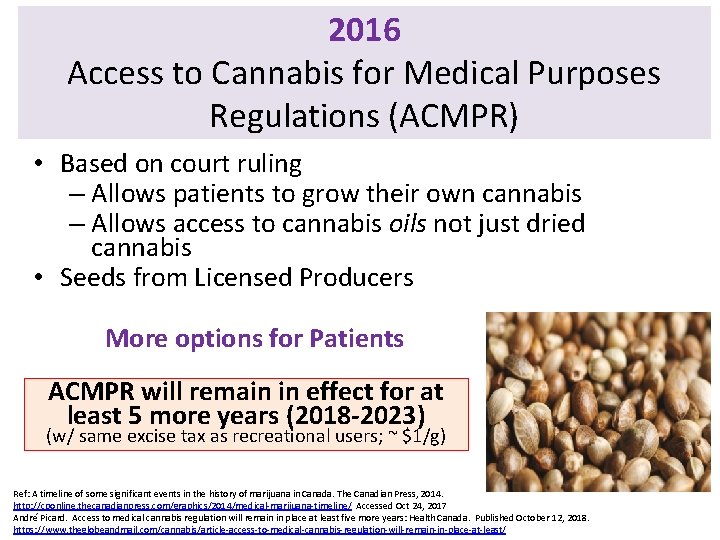
2016 Access to Cannabis for Medical Purposes Regulations (ACMPR) • Based on court ruling – Allows patients to grow their own cannabis – Allows access to cannabis oils not just dried cannabis • Seeds from Licensed Producers More options for Patients ACMPR will remain in effect for at least 5 more years (2018 -2023) (w/ same excise tax as recreational users; ~ $1/g) Ref: A timeline of some significant events in the history of marijuana in Canada. The Canadian Press, 2014. http: //cponline. thecanadianpress. com/graphics/2014/medical-marijuana-timeline/ Accessed Oct 24, 2017 André Picard. Access to medical cannabis regulation will remain in place at least five more years: Health Canada. Published October 12, 2018. https: //www. theglobeandmail. com/cannabis/article-access-to-medical-cannabis-regulation-will-remain-in-place-at-least/
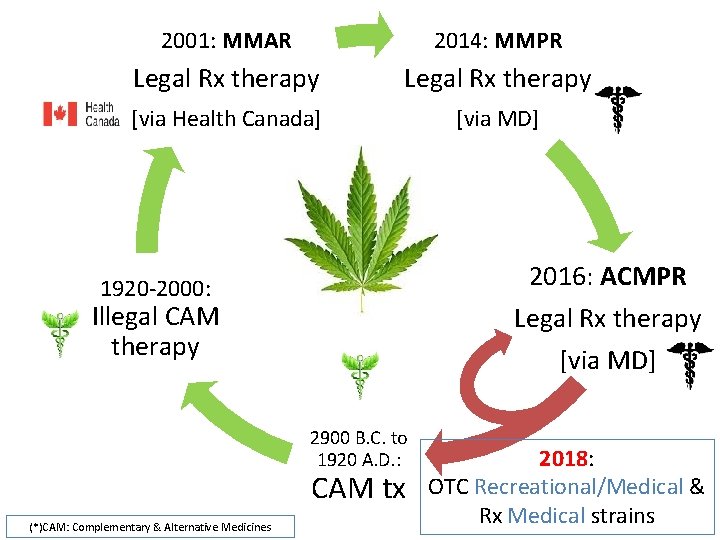
2001: MMAR 2014: MMPR Legal Rx therapy [via Health Canada] [via MD] 2016: ACMPR 1920 -2000: Illegal CAM therapy Legal Rx therapy [via MD] 2900 B. C. to 1920 A. D. : CAM tx (*)CAM: Complementary & Alternative Medicines 2018: OTC Recreational/Medical & Rx Medical strains
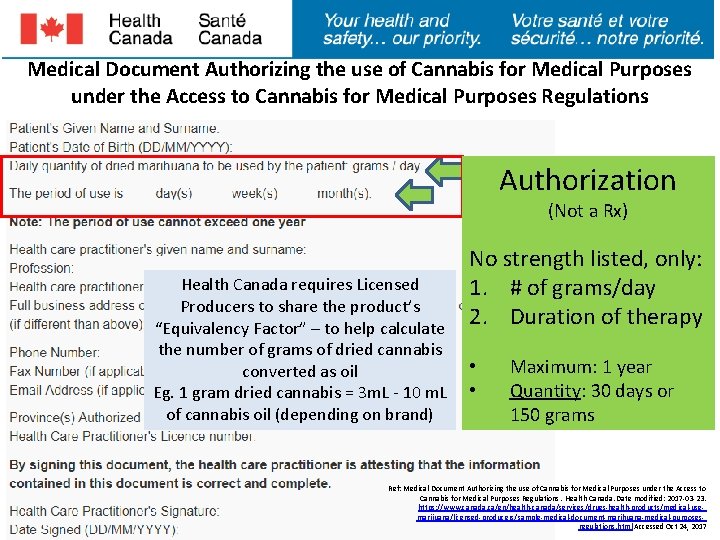
Medical Document Authorizing the use of Cannabis for Medical Purposes under the Access to Cannabis for Medical Purposes Regulations Authorization (Not a Rx) Health Canada requires Licensed Producers to share the product’s “Equivalency Factor” – to help calculate the number of grams of dried cannabis converted as oil Eg. 1 gram dried cannabis = 3 m. L - 10 m. L of cannabis oil (depending on brand) No strength listed, only: 1. # of grams/day 2. Duration of therapy • • Maximum: 1 year Quantity: 30 days or 150 grams Ref: Medical Document Authorizing the use of Cannabis for Medical Purposes under the Access to Cannabis for Medical Purposes Regulations. Health Canada. Date modified: 2017 -03 -23. https: //www. canada. ca/en/health-canada/services/drugs-health-products/medical-usemarijuana/licensed-producers/sample-medical-document-marihuana-medical-purposesregulations. html Accessed Oct 24, 2017
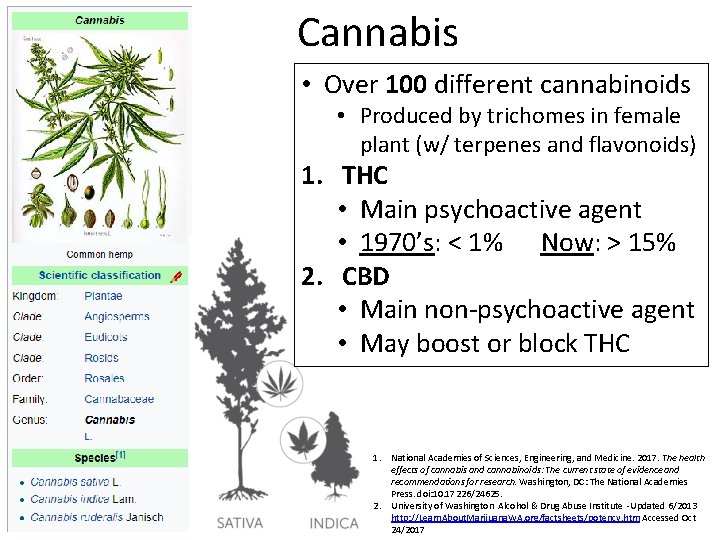
Cannabis • Over 100 different cannabinoids • Produced by trichomes in female plant (w/ terpenes and flavonoids) 1. THC • Main psychoactive agent • 1970’s: < 1% Now: > 15% 2. CBD • Main non-psychoactive agent • May boost or block THC 1. National Academies of Sciences, Engineering, and Medicine. 2017. The health effects of cannabis and cannabinoids: The current state of evidence and recommendations for research. Washington, DC: The National Academies Press. doi: 10. 17226/24625. 2. University of Washington Alcohol & Drug Abuse Institute · Updated 6/2013 http: //Learn. About. Marijuana. WA. org/factsheets/potency. htm Accessed Oct 24/2017
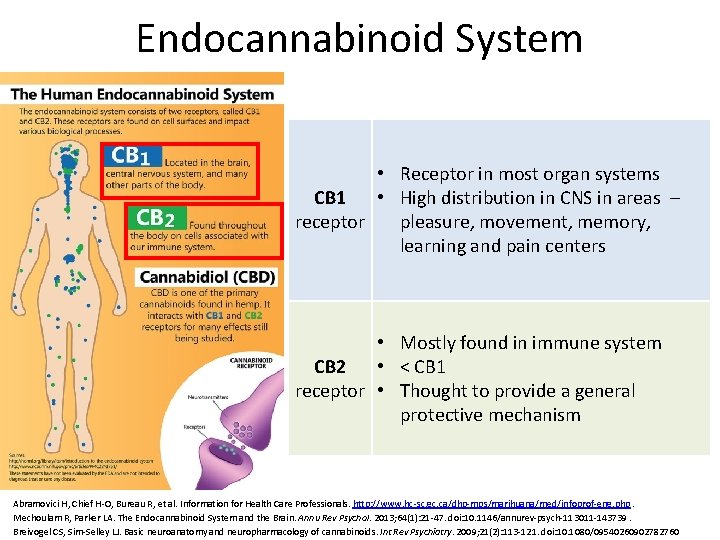
Endocannabinoid System • Receptor in most organ systems CB 1 • High distribution in CNS in areas – receptor pleasure, movement, memory, learning and pain centers • Mostly found in immune system CB 2 • < CB 1 receptor • Thought to provide a general protective mechanism Abramovici H, Chief H-O, Bureau R, et al. Information for Health Care Professionals. http: //www. hc-sc. gc. ca/dhp-mps/marihuana/med/infoprof-eng. php. Mechoulam R, Parker LA. The Endocannabinoid System and the Brain. Annu Rev Psychol. 2013; 64(1): 21 -47. doi: 10. 1146/annurev-psych-113011 -143739. Breivogel CS, Sim-Selley LJ. Basic neuroanatomy and neuropharmacology of cannabinoids. Int Rev Psychiatry. 2009; 21(2): 113 -121. doi: 10. 1080/09540260902782760

The Endocannabinoids function alongside adrenergic, cholinergic & dopaminergic System systems via retrograde signalling (Anandamide, 2 -arachidonoylglycerol (2 -AG)) Health Canada. Information for Health Care Professionals: Cannabis (marihuana, marijuana) and the cannabinoids [Health Canada, Feb 2013]. http: //www. hc-sc. gc. ca/dhpmps/marihuana/med/infoprof-eng. php. Accessed Oct 24, 2017
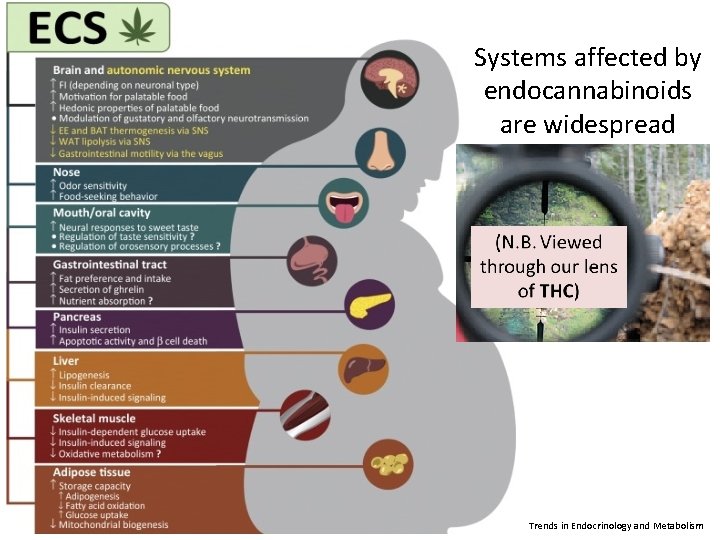
Systems affected by endocannabinoids are widespread Trends in Endocrinology and Metabolism
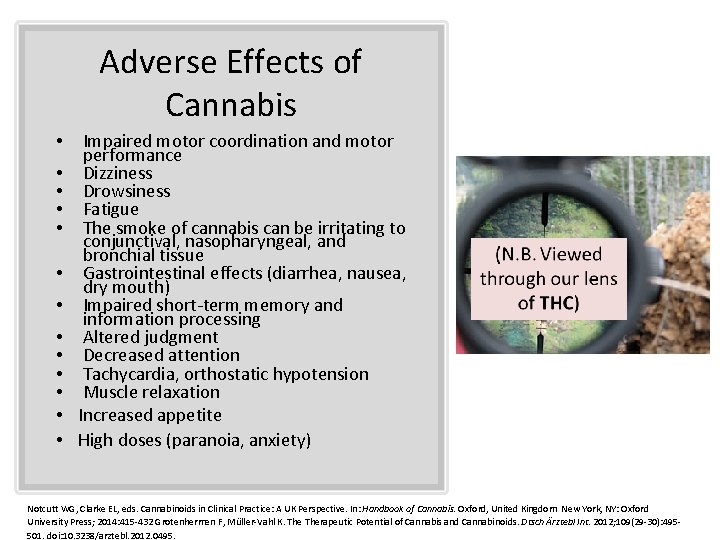
Adverse Effects of Cannabis • • • • Impaired motor coordination and motor performance Dizziness Drowsiness Fatigue The smoke of cannabis can be irritating to conjunctival, nasopharyngeal, and bronchial tissue Gastrointestinal effects (diarrhea, nausea, dry mouth) Impaired short-term memory and information processing Altered judgment Decreased attention Tachycardia, orthostatic hypotension Muscle relaxation Increased appetite High doses (paranoia, anxiety) Notcutt WG, Clarke EL, eds. Cannabinoids in Clinical Practice: A UK Perspective. In: Handbook of Cannabis. Oxford, United Kingdom New York, NY: Oxford University Press; 2014: 415 -432 Grotenhermen F, Müller-Vahl K. Therapeutic Potential of Cannabis and Cannabinoids. Dtsch Ärztebl Int. 2012; 109(29 -30): 495501. doi: 10. 3238/arztebl. 2012. 0495.
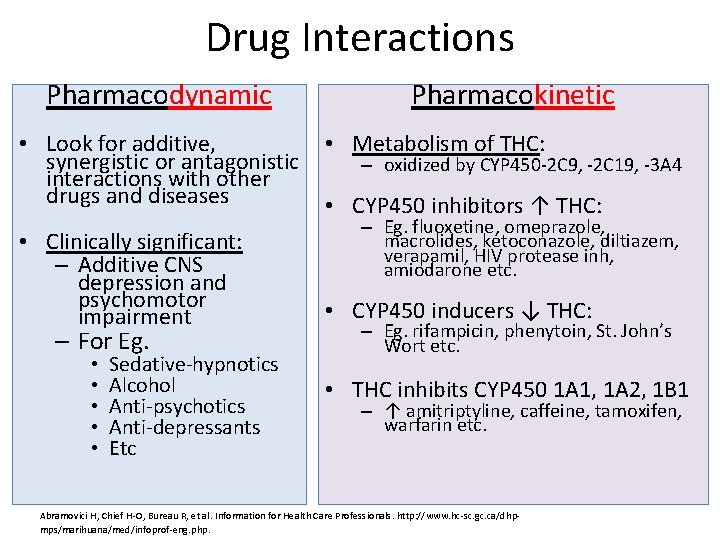
Drug Interactions Pharmacodynamic Pharmacokinetic • Look for additive, • Metabolism of THC: synergistic or antagonistic – oxidized by CYP 450 -2 C 9, -2 C 19, -3 A 4 interactions with other drugs and diseases • CYP 450 inhibitors ↑ THC: – Eg. fluoxetine, omeprazole, macrolides, ketoconazole, diltiazem, • Clinically significant: verapamil, HIV protease inh, – Additive CNS amiodarone etc. depression and psychomotor • CYP 450 inducers ↓ THC: impairment – For Eg. • • • Sedative-hypnotics Alcohol Anti-psychotics Anti-depressants Etc – Eg. rifampicin, phenytoin, St. John’s Wort etc. • THC inhibits CYP 450 1 A 1, 1 A 2, 1 B 1 – ↑ amitriptyline, caffeine, tamoxifen, warfarin etc. Abramovici H, Chief H-O, Bureau R, et al. Information for Health Care Professionals. http: //www. hc-sc. gc. ca/dhpmps/marihuana/med/infoprof-eng. php.
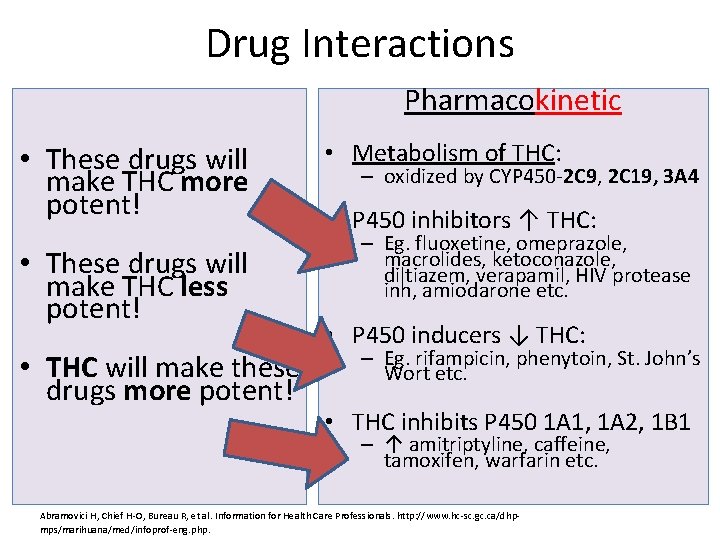
Drug Interactions Pharmacokinetic • These drugs will make THC more potent! • These drugs will make THC less potent! • THC will make these drugs more potent! • Metabolism of THC: – oxidized by CYP 450 -2 C 9, 2 C 19, 3 A 4 • P 450 inhibitors ↑ THC: – Eg. fluoxetine, omeprazole, macrolides, ketoconazole, diltiazem, verapamil, HIV protease inh, amiodarone etc. • P 450 inducers ↓ THC: – Eg. rifampicin, phenytoin, St. John’s Wort etc. • THC inhibits P 450 1 A 1, 1 A 2, 1 B 1 – ↑ amitriptyline, caffeine, tamoxifen, warfarin etc. Abramovici H, Chief H-O, Bureau R, et al. Information for Health Care Professionals. http: //www. hc-sc. gc. ca/dhpmps/marihuana/med/infoprof-eng. php.
When ? Rational Prescribing of Cannabis Ginseng anyone?
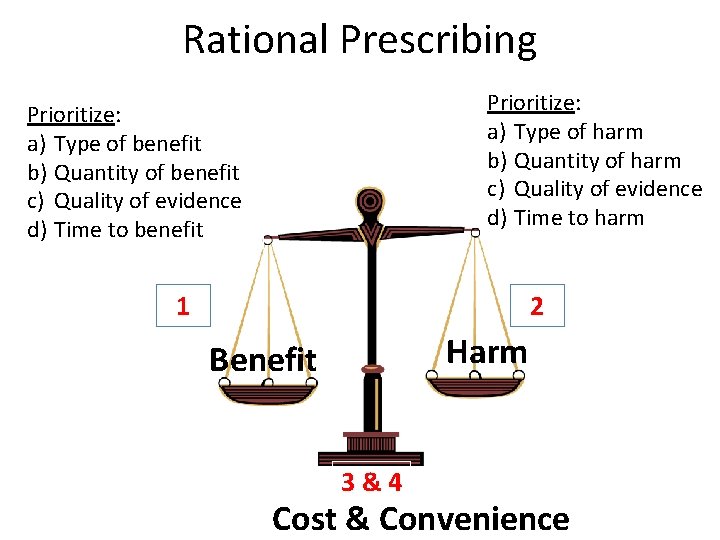
Rational Prescribing Prioritize: a) Type of harm b) Quantity of harm c) Quality of evidence d) Time to harm Prioritize: a) Type of benefit b) Quantity of benefit c) Quality of evidence d) Time to benefit 1 2 Harm Benefit 3 & 4 Cost & Convenience
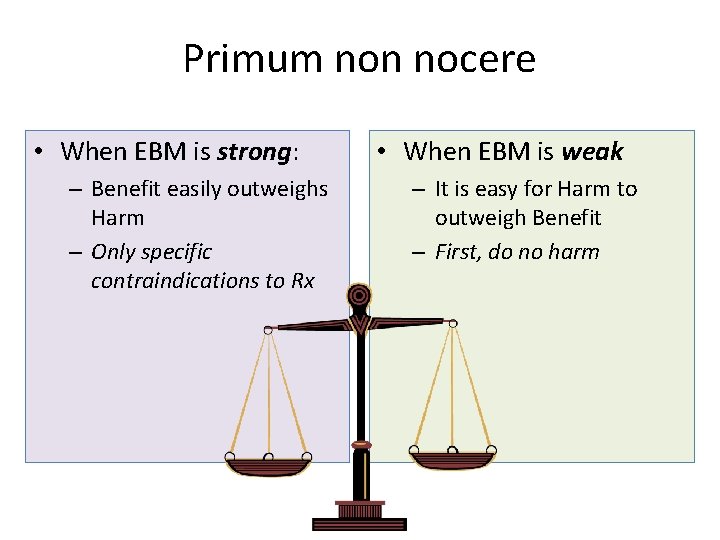
Primum non nocere • When EBM is strong: – Benefit easily outweighs Harm – Only specific contraindications to Rx • When EBM is weak – It is easy for Harm to outweigh Benefit – First, do no harm
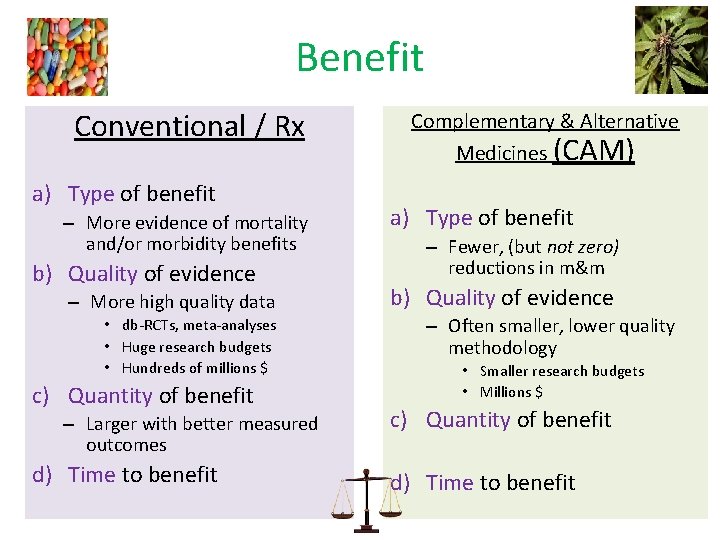
Benefit Conventional / Rx a) Type of benefit – More evidence of mortality and/or morbidity benefits b) Quality of evidence – More high quality data • db-RCTs, meta-analyses • Huge research budgets • Hundreds of millions $ c) Quantity of benefit – Larger with better measured outcomes d) Time to benefit Complementary & Alternative Medicines (CAM) a) Type of benefit – Fewer, (but not zero) reductions in m&m b) Quality of evidence – Often smaller, lower quality methodology • Smaller research budgets • Millions $ c) Quantity of benefit d) Time to benefit
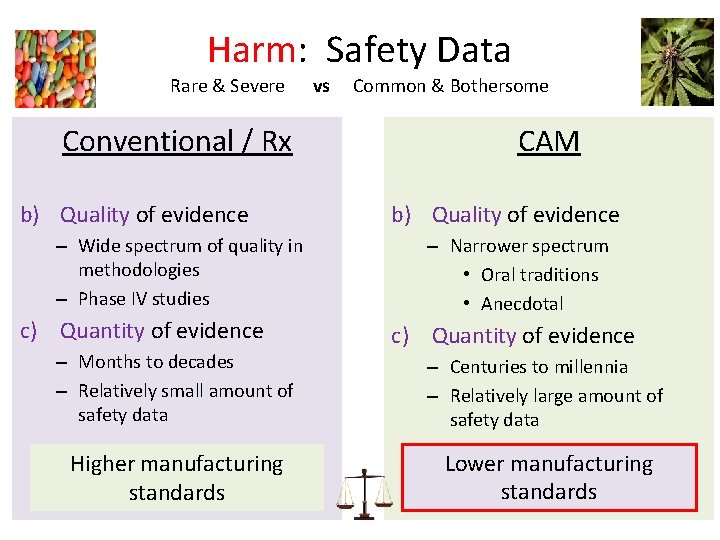
Harm: Safety Data Rare & Severe vs Common & Bothersome Conventional / Rx b) Quality of evidence – Wide spectrum of quality in methodologies – Phase IV studies c) Quantity of evidence – Months to decades – Relatively small amount of safety data Higher manufacturing standards CAM b) Quality of evidence – Narrower spectrum • Oral traditions • Anecdotal c) Quantity of evidence – Centuries to millennia – Relatively large amount of safety data Lower manufacturing standards
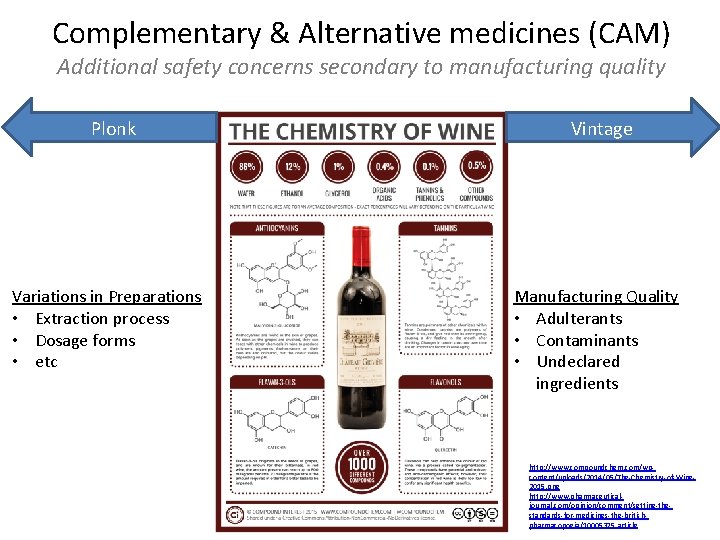
Complementary & Alternative medicines (CAM) Additional safety concerns secondary to manufacturing quality Plonk Variations in Preparations • Extraction process • Dosage forms • etc Vintage Manufacturing Quality • Adulterants • Contaminants • Undeclared ingredients http: //www. compoundchem. com/wpcontent/uploads/2014/05/The-Chemistry-of-Wine 2015. png http: //www. pharmaceuticaljournal. com/opinion/comment/setting-thestandards-for-medicines-the-britishpharmacopoeia/10005375. article
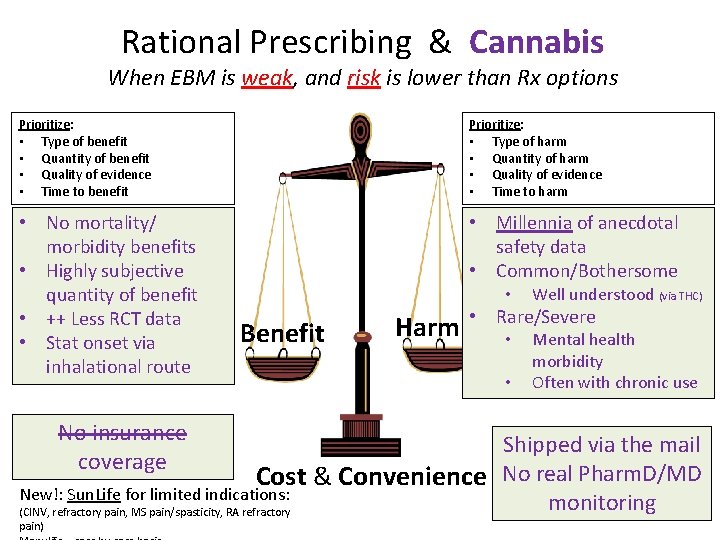
Rational Prescribing & Cannabis When EBM is weak, and risk is lower than Rx options Prioritize: • Type of benefit • Quantity of benefit • Quality of evidence • Time to benefit Prioritize: • Type of harm • Quantity of harm • Quality of evidence • Time to harm • No mortality/ morbidity benefits • Highly subjective quantity of benefit • ++ Less RCT data • Stat onset via inhalational route • Millennia of anecdotal safety data • Common/Bothersome No insurance coverage • Benefit Harm Well understood (via THC) • Rare/Severe • • Mental health morbidity Often with chronic use Shipped via the mail Cost & Convenience No real Pharm. D/MD New!: Sun. Life for limited indications: monitoring (CINV, refractory pain, MS pain/spasticity, RA refractory pain)
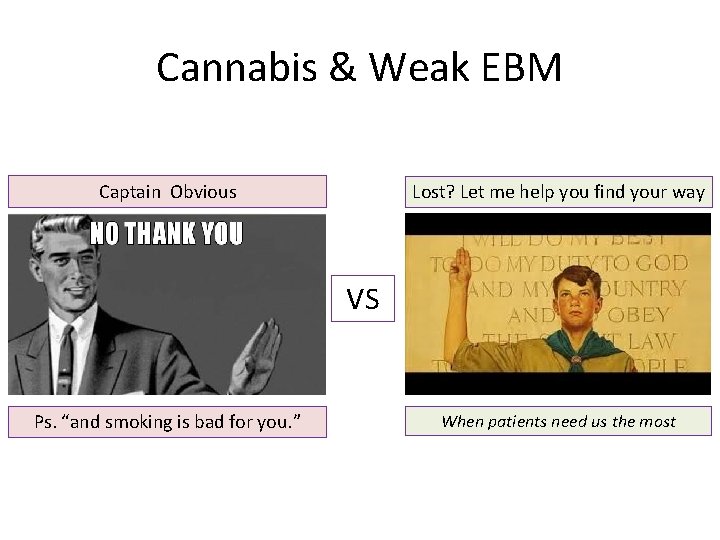
Cannabis & Weak EBM Captain Obvious Lost? Let me help you find your way VS Ps. “and smoking is bad for you. ” When patients need us the most
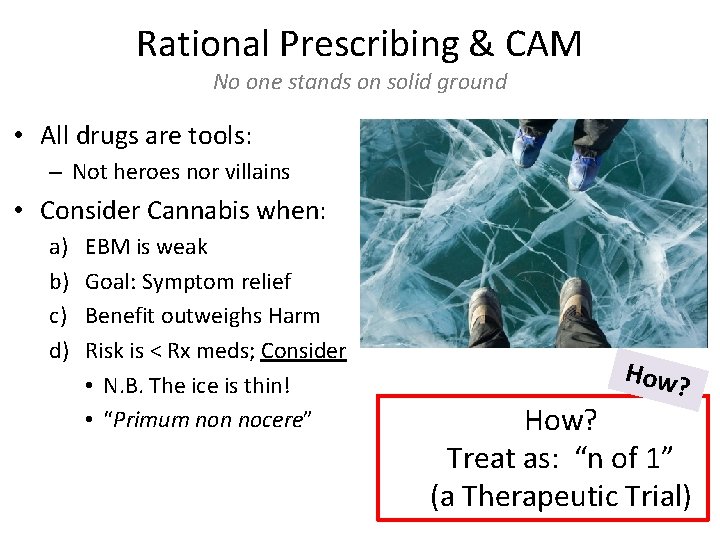
Rational Prescribing & CAM No one stands on solid ground • All drugs are tools: – Not heroes nor villains • Consider Cannabis when: a) b) c) d) EBM is weak Goal: Symptom relief Benefit outweighs Harm Risk is < Rx meds; Consider • N. B. The ice is thin! • “Primum non nocere” How? Treat as: “n of 1” (a Therapeutic Trial)
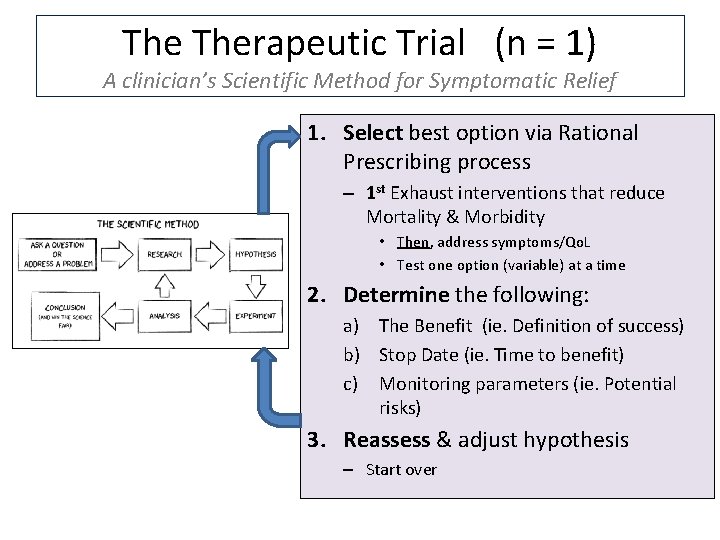
The Therapeutic Trial (n = 1) A clinician’s Scientific Method for Symptomatic Relief 1. Select best option via Rational Prescribing process – 1 st Exhaust interventions that reduce Mortality & Morbidity • Then, address symptoms/Qo. L • Test one option (variable) at a time 2. Determine the following: a) The Benefit (ie. Definition of success) b) Stop Date (ie. Time to benefit) c) Monitoring parameters (ie. Potential risks) 3. Reassess & adjust hypothesis – Start over
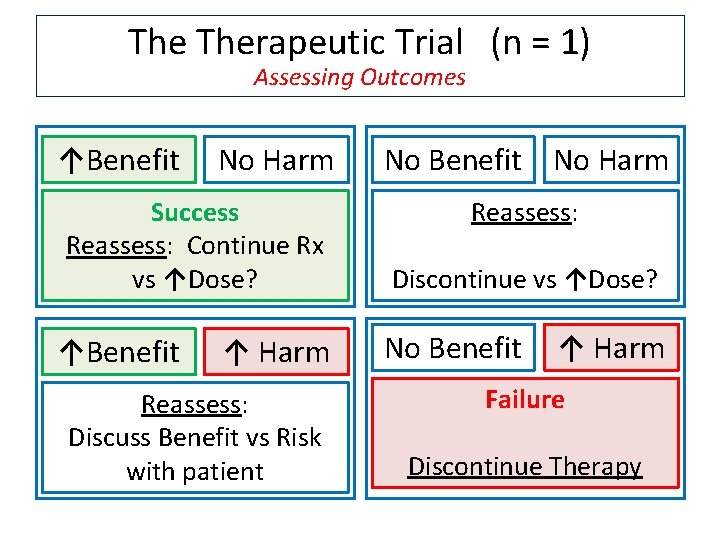
The Therapeutic Trial (n = 1) Assessing Outcomes ↑Benefit No Harm Success Reassess: Continue Rx vs ↑Dose? ↑Benefit ↑ Harm Reassess: Discuss Benefit vs Risk with patient No Benefit No Harm Reassess: Discontinue vs ↑Dose? No Benefit ↑ Harm Failure Discontinue Therapy
Why? Cannabis Therapeutics Summary of Current Evidence National Academies of Sciences, Engineering, and Medicine. 2017. The health effects of cannabis and cannabinoids: The current state of evidence and recommendations for research. Washington, DC: The National Academies Press. doi: 10. 17226/24625.
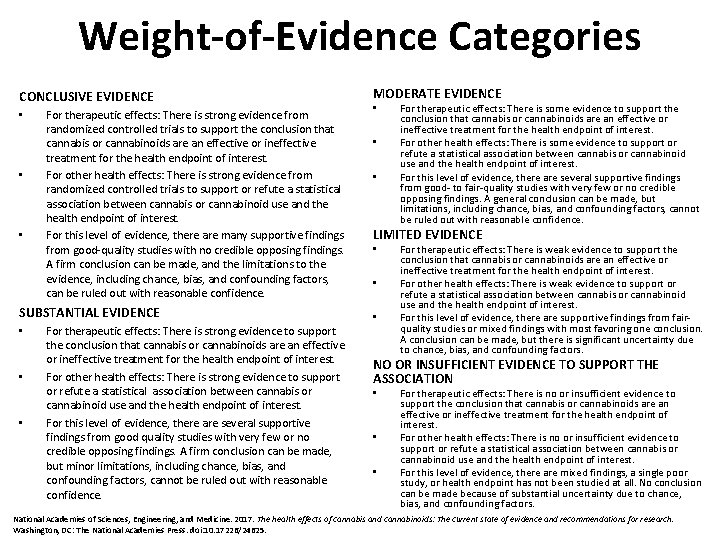
Weight-of-Evidence Categories CONCLUSIVE EVIDENCE • • • For therapeutic effects: There is strong evidence from randomized controlled trials to support the conclusion that cannabis or cannabinoids are an effective or ineffective treatment for the health endpoint of interest. For other health effects: There is strong evidence from randomized controlled trials to support or refute a statistical association between cannabis or cannabinoid use and the health endpoint of interest. For this level of evidence, there are many supportive findings from good-quality studies with no credible opposing findings. A firm conclusion can be made, and the limitations to the evidence, including chance, bias, and confounding factors, can be ruled out with reasonable confidence. SUBSTANTIAL EVIDENCE • • • For therapeutic effects: There is strong evidence to support the conclusion that cannabis or cannabinoids are an effective or ineffective treatment for the health endpoint of interest. For other health effects: There is strong evidence to support or refute a statistical association between cannabis or cannabinoid use and the health endpoint of interest. For this level of evidence, there are several supportive findings from good quality studies with very few or no credible opposing findings. A firm conclusion can be made, but minor limitations, including chance, bias, and confounding factors, cannot be ruled out with reasonable confidence. MODERATE EVIDENCE • • • For therapeutic effects: There is some evidence to support the conclusion that cannabis or cannabinoids are an effective or ineffective treatment for the health endpoint of interest. For other health effects: There is some evidence to support or refute a statistical association between cannabis or cannabinoid use and the health endpoint of interest. For this level of evidence, there are several supportive findings from good- to fair-quality studies with very few or no credible opposing findings. A general conclusion can be made, but limitations, including chance, bias, and confounding factors, cannot be ruled out with reasonable confidence. LIMITED EVIDENCE • • • For therapeutic effects: There is weak evidence to support the conclusion that cannabis or cannabinoids are an effective or ineffective treatment for the health endpoint of interest. For other health effects: There is weak evidence to support or refute a statistical association between cannabis or cannabinoid use and the health endpoint of interest. For this level of evidence, there are supportive findings from fairquality studies or mixed findings with most favoring one conclusion. A conclusion can be made, but there is significant uncertainty due to chance, bias, and confounding factors. NO OR INSUFFICIENT EVIDENCE TO SUPPORT THE ASSOCIATION • • • For therapeutic effects: There is no or insufficient evidence to support the conclusion that cannabis or cannabinoids are an effective or ineffective treatment for the health endpoint of interest. For other health effects: There is no or insufficient evidence to support or refute a statistical association between cannabis or cannabinoid use and the health endpoint of interest. For this level of evidence, there are mixed findings, a single poor study, or health endpoint has not been studied at all. No conclusion can be made because of substantial uncertainty due to chance, bias, and confounding factors. National Academies of Sciences, Engineering, and Medicine. 2017. The health effects of cannabis and cannabinoids: The current state of evidence and recommendations for research. Washington, DC: The National Academies Press. doi: 10. 17226/24625.
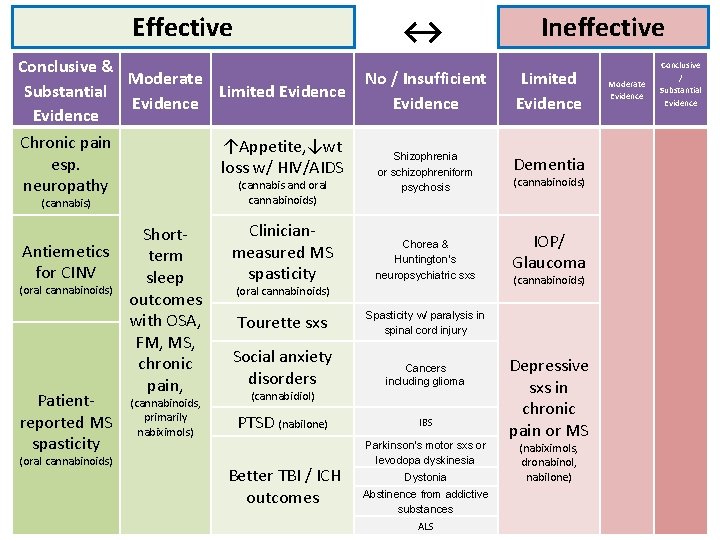
Effective ↔ Conclusive & Moderate No / Insufficient Substantial Limited Evidence Chronic pain ↑Appetite, ↓wt Shizophrenia esp. loss w/ HIV/AIDS or schizophreniform (cannabis and oral psychosis neuropathy (cannabis) Short. Antiemetics term for CINV sleep (oral cannabinoids) outcomes with OSA, FM, MS, chronic pain, Patient(cannabinoids, primarily reported MS nabiximols) spasticity (oral cannabinoids) Ineffective Limited Evidence Dementia (cannabinoids) Clinicianmeasured MS spasticity Chorea & Huntington’s neuropsychiatric sxs Tourette sxs Spasticity w/ paralysis in spinal cord injury Social anxiety disorders Cancers including glioma PTSD (nabilone) IBS (oral cannabinoids) (cannabidiol) Better TBI / ICH outcomes Parkinson’s motor sxs or levodopa dyskinesia Dystonia Abstinence from addictive substances ALS IOP/ Glaucoma (cannabinoids) Depressive sxs in chronic pain or MS (nabiximols, dronabinol, nabilone) Moderate Evidence Conclusive / Substantial Evidence
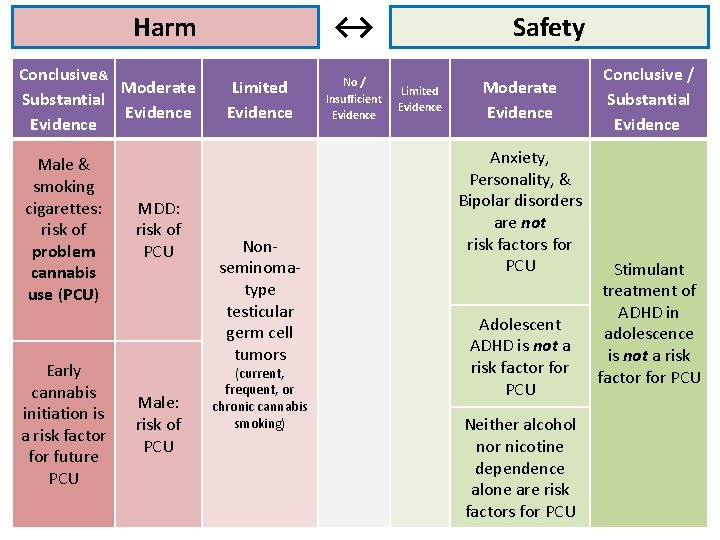
↔ Harm Conclusive& Moderate Substantial Evidence Male & smoking cigarettes: risk of problem cannabis use (PCU) Early cannabis initiation is a risk factor future PCU MDD: risk of PCU Male: risk of PCU Limited Evidence Nonseminomatype testicular germ cell tumors (current, frequent, or chronic cannabis smoking) No / Insufficient Evidence Safety Limited Evidence Moderate Evidence Anxiety, Personality, & Bipolar disorders are not risk factors for PCU Adolescent ADHD is not a risk factor for PCU Neither alcohol nor nicotine dependence alone are risk factors for PCU Conclusive / Substantial Evidence Stimulant treatment of ADHD in adolescence is not a risk factor for PCU
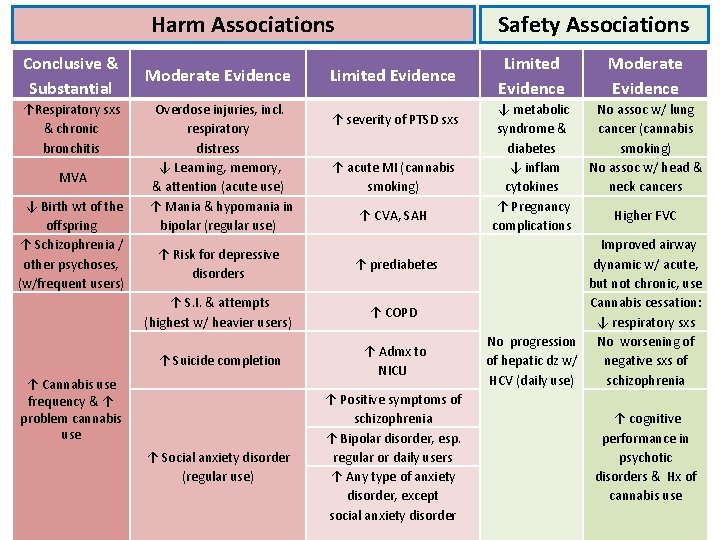
Harm Associations Conclusive & Substantial ↑Respiratory sxs & chronic bronchitis MVA ↓ Birth wt of the offspring ↑ Schizophrenia / other psychoses, (w/frequent users) Moderate Evidence Overdose injuries, incl. respiratory distress ↓ Learning, memory, & attention (acute use) ↑ Mania & hypomania in bipolar (regular use) Safety Associations Limited Evidence ↑ severity of PTSD sxs ↑ acute MI (cannabis smoking) ↑ CVA, SAH ↑ Risk for depressive disorders ↑ prediabetes ↑ S. I. & attempts (highest w/ heavier users) ↑ COPD ↑ Suicide completion ↑ Admx to NICU ↑ Social anxiety disorder (regular use) ↑ Positive symptoms of schizophrenia ↑ Bipolar disorder, esp. regular or daily users ↑ Any type of anxiety disorder, except social anxiety disorder ↑ Cannabis use frequency & ↑ problem cannabis use Limited Evidence Moderate Evidence ↓ metabolic syndrome & diabetes ↓ inflam cytokines ↑ Pregnancy complications No assoc w/ lung cancer (cannabis smoking) No assoc w/ head & neck cancers Higher FVC Improved airway dynamic w/ acute, but not chronic, use Cannabis cessation: ↓ respiratory sxs No progression No worsening of negative sxs of of hepatic dz w/ HCV (daily use) schizophrenia ↑ cognitive performance in psychotic disorders & Hx of cannabis use
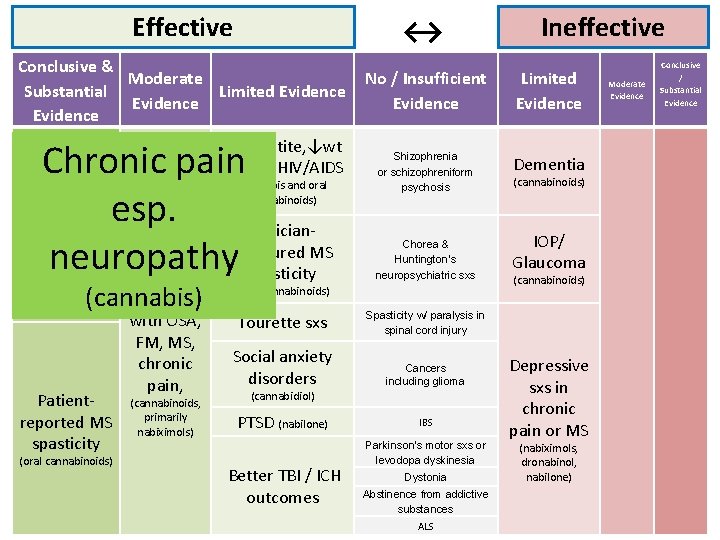
Effective ↔ Conclusive & Moderate No / Insufficient Substantial Limited Evidence Chronic pain ↑Appetite, ↓wt Shizophrenia esp. loss w/ HIV/AIDS or schizophreniform (cannabis and oral psychosis neuropathy Chronic pain esp. Clinician. Short. Antiemetics measured MS term neuropathy for CINV spasticity sleep outcomes (cannabis) (oral cannabinoids) Limited Evidence Dementia (cannabinoids) (cannabis) Patientreported MS spasticity Ineffective with OSA, FM, MS, chronic pain, (cannabinoids, primarily nabiximols) Chorea & Huntington’s neuropsychiatric sxs (oral cannabinoids) Tourette sxs Spasticity w/ paralysis in spinal cord injury Social anxiety disorders Cancers including glioma PTSD (nabilone) IBS (cannabidiol) Better TBI / ICH outcomes Parkinson’s motor sxs or levodopa dyskinesia Dystonia Abstinence from addictive substances ALS IOP/ Glaucoma (cannabinoids) Depressive sxs in chronic pain or MS (nabiximols, dronabinol, nabilone) Moderate Evidence Conclusive / Substantial Evidence
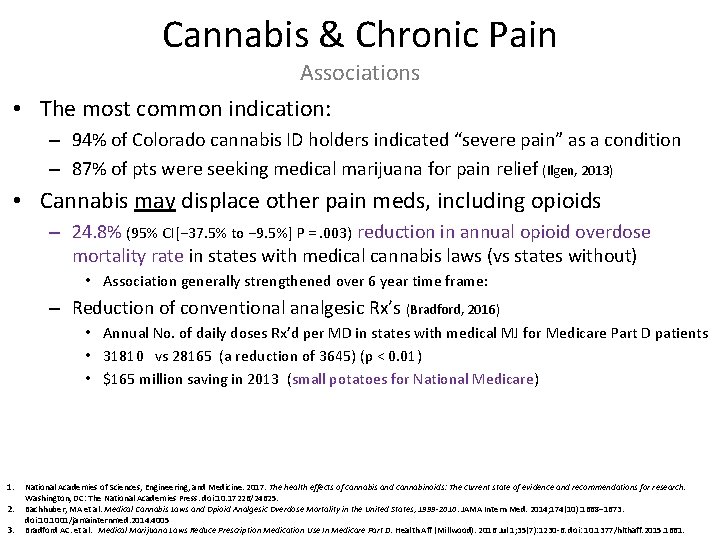
Cannabis & Chronic Pain Associations • The most common indication: – 94% of Colorado cannabis ID holders indicated “severe pain” as a condition – 87% of pts were seeking medical marijuana for pain relief (Ilgen, 2013) • Cannabis may displace other pain meds, including opioids – 24. 8% (95% CI[− 37. 5% to − 9. 5%] P = . 003) reduction in annual opioid overdose mortality rate in states with medical cannabis laws (vs states without) • Association generally strengthened over 6 year time frame: – Reduction of conventional analgesic Rx’s (Bradford, 2016) • Annual No. of daily doses Rx’d per MD in states with medical MJ for Medicare Part D patients • 31810 vs 28165 (a reduction of 3645) (p < 0. 01) • $165 million saving in 2013 (small potatoes for National Medicare) 1. 2. 3. National Academies of Sciences, Engineering, and Medicine. 2017. The health effects of cannabis and cannabinoids: The current state of evidence and recommendations for research. Washington, DC: The National Academies Press. doi: 10. 17226/24625. Bachhuber, MA et al. Medical Cannabis Laws and Opioid Analgesic Overdose Mortality in the United States, 1999 -2010. JAMA Intern Med. 2014; 174(10): 1668– 1673. doi: 10. 1001/jamainternmed. 2014. 4005 Bradford AC. et al. Medical Marijuana Laws Reduce Prescription Medication Use In Medicare Part D. Health Aff (Millwood). 2016 Jul 1; 35(7): 1230 -6. doi: 10. 1377/hlthaff. 2015. 1661.
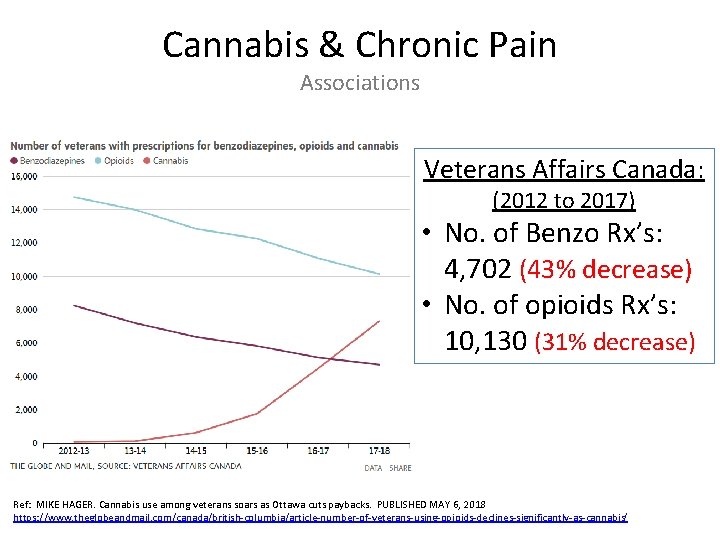
Cannabis & Chronic Pain Associations Veterans Affairs Canada: (2012 to 2017) • No. of Benzo Rx’s: 4, 702 (43% decrease) • No. of opioids Rx’s: 10, 130 (31% decrease) Ref: MIKE HAGER. Cannabis use among veterans soars as Ottawa cuts paybacks. PUBLISHED MAY 6, 2018 https: //www. theglobeandmail. com/canada/british-columbia/article-number-of-veterans-using-opioids-declines-significantly-as-cannabis/
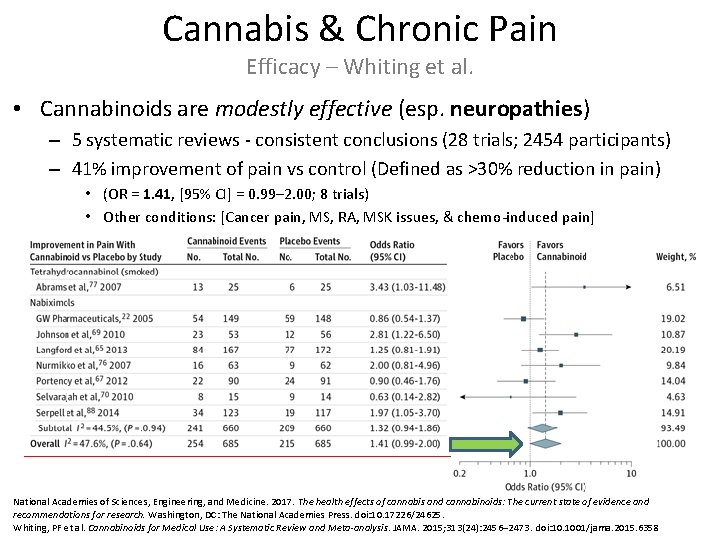
Cannabis & Chronic Pain Efficacy – Whiting et al. • Cannabinoids are modestly effective (esp. neuropathies) – 5 systematic reviews - consistent conclusions (28 trials; 2454 participants) – 41% improvement of pain vs control (Defined as >30% reduction in pain) • (OR = 1. 41, [95% CI] = 0. 99– 2. 00; 8 trials) • Other conditions: [Cancer pain, MS, RA, MSK issues, & chemo-induced pain] National Academies of Sciences, Engineering, and Medicine. 2017. The health effects of cannabis and cannabinoids: The current state of evidence and recommendations for research. Washington, DC: The National Academies Press. doi: 10. 17226/24625. Whiting, PF et al. Cannabinoids for Medical Use: A Systematic Review and Meta-analysis. JAMA. 2015; 313(24): 2456– 2473. doi: 10. 1001/jama. 2015. 6358
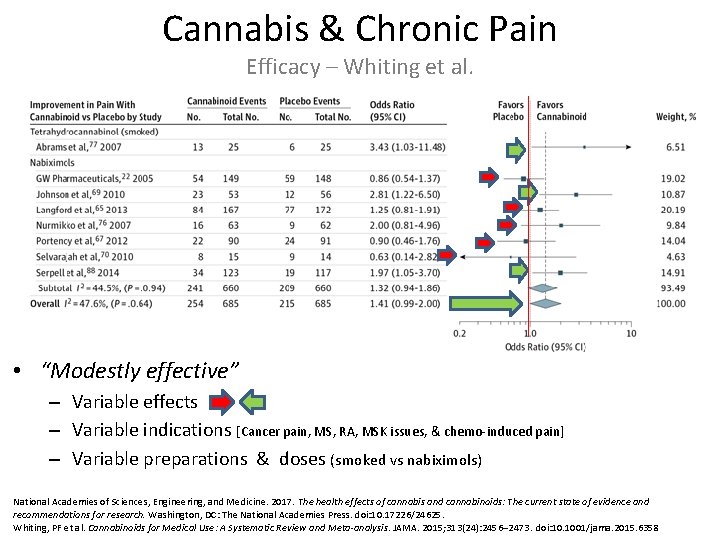
Cannabis & Chronic Pain Efficacy – Whiting et al. • “Modestly effective” – Variable effects – Variable indications [Cancer pain, MS, RA, MSK issues, & chemo-induced pain] – Variable preparations & doses (smoked vs nabiximols) National Academies of Sciences, Engineering, and Medicine. 2017. The health effects of cannabis and cannabinoids: The current state of evidence and recommendations for research. Washington, DC: The National Academies Press. doi: 10. 17226/24625. Whiting, PF et al. Cannabinoids for Medical Use: A Systematic Review and Meta-analysis. JAMA. 2015; 313(24): 2456– 2473. doi: 10. 1001/jama. 2015. 6358
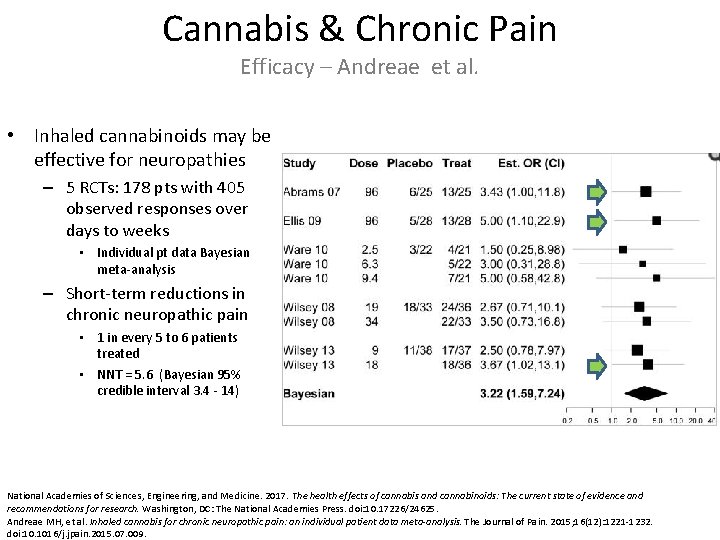
Cannabis & Chronic Pain Efficacy – Andreae et al. • Inhaled cannabinoids may be effective for neuropathies – 5 RCTs: 178 pts with 405 observed responses over days to weeks • Individual pt data Bayesian meta-analysis – Short-term reductions in chronic neuropathic pain • 1 in every 5 to 6 patients treated • NNT = 5. 6 (Bayesian 95% credible interval 3. 4 - 14) National Academies of Sciences, Engineering, and Medicine. 2017. The health effects of cannabis and cannabinoids: The current state of evidence and recommendations for research. Washington, DC: The National Academies Press. doi: 10. 17226/24625. Andreae MH, et al. Inhaled cannabis for chronic neuropathic pain: an individual patient data meta-analysis. The Journal of Pain. 2015; 16(12): 1221 -1232. doi: 10. 1016/j. jpain. 2015. 07. 009.
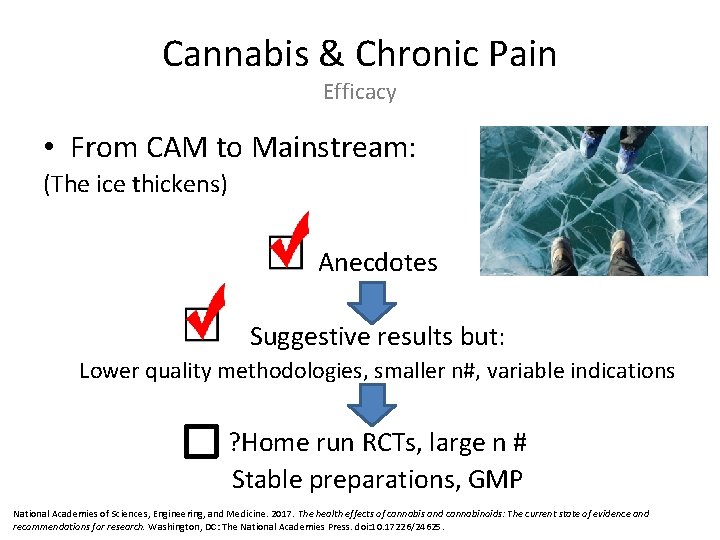
Cannabis & Chronic Pain Efficacy • From CAM to Mainstream: (The ice thickens) Anecdotes Suggestive results but: Lower quality methodologies, smaller n#, variable indications ? Home run RCTs, large n # Stable preparations, GMP National Academies of Sciences, Engineering, and Medicine. 2017. The health effects of cannabis and cannabinoids: The current state of evidence and recommendations for research. Washington, DC: The National Academies Press. doi: 10. 17226/24625.
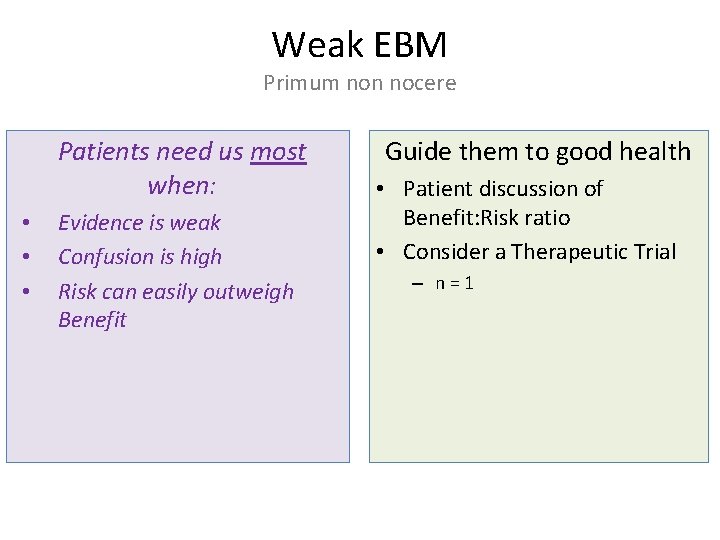
Weak EBM Primum non nocere Patients need us most when: • • • Evidence is weak Confusion is high Risk can easily outweigh Benefit Guide them to good health • Patient discussion of Benefit: Risk ratio • Consider a Therapeutic Trial – n = 1
Workshop Cannabis Management
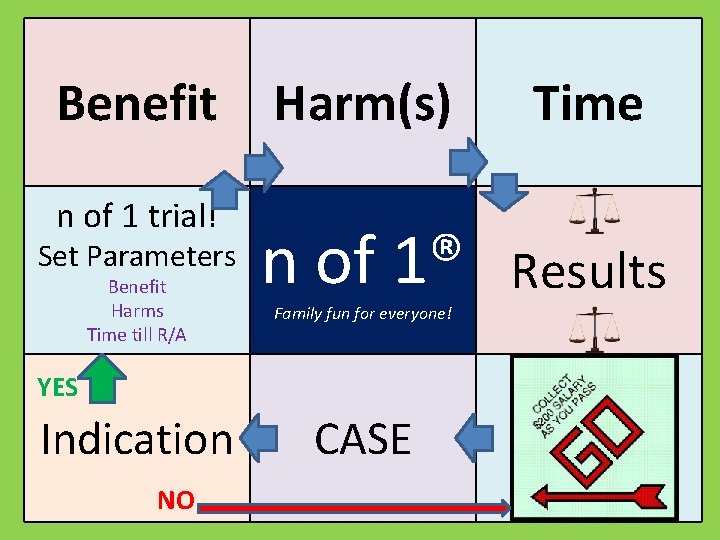
Benefit n of 1 trial! Set Parameters Benefit Harms Time till R/A Harm(s) Time n of 1® Results Family fun for everyone! YES Indication NO CASE
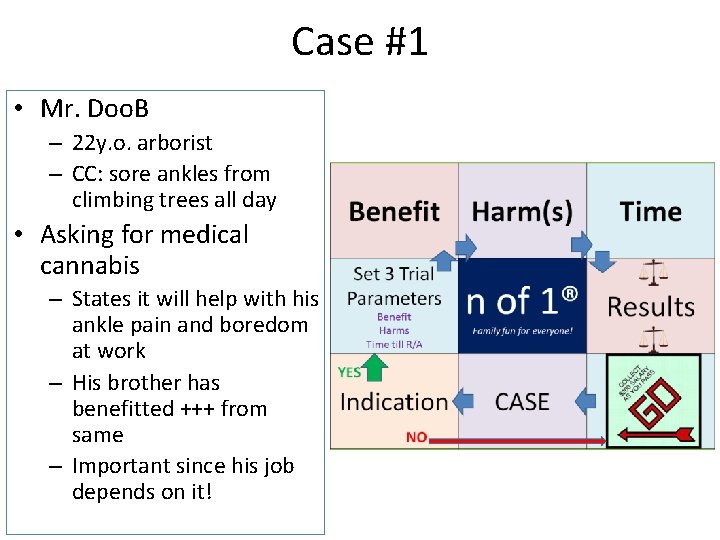
Case #1 • Mr. Doo. B – 22 y. o. arborist – CC: sore ankles from climbing trees all day • Asking for medical cannabis – States it will help with his ankle pain and boredom at work – His brother has benefitted +++ from same – Important since his job depends on it!
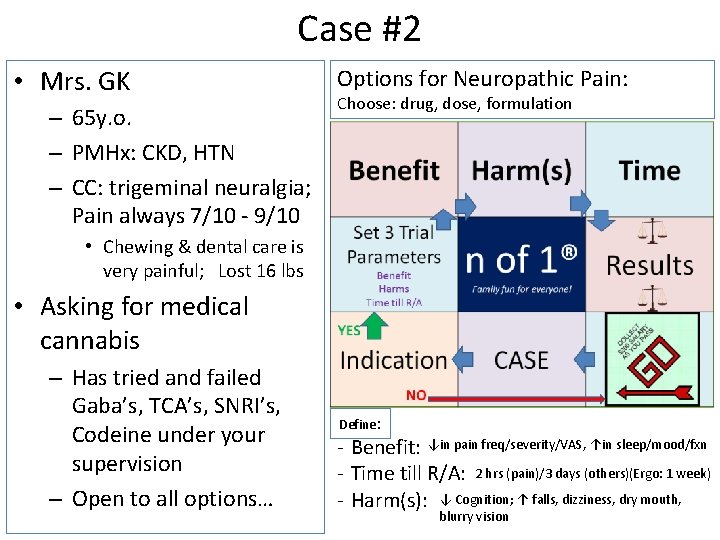
Case #2 • Mrs. GK – 65 y. o. – PMHx: CKD, HTN – CC: trigeminal neuralgia; Pain always 7/10 - 9/10 Options for Neuropathic Pain: Choose: drug, dose, formulation • Chewing & dental care is very painful; Lost 16 lbs • Asking for medical cannabis – Has tried and failed Gaba’s, TCA’s, SNRI’s, Codeine under your supervision – Open to all options… Define: - Benefit: ↓in pain freq/severity/VAS, ↑in sleep/mood/fxn - Time till R/A: 2 hrs (pain)/3 days (others)(Ergo: 1 week) - Harm(s): ↓ Cognition; ↑ falls, dizziness, dry mouth, blurry vision
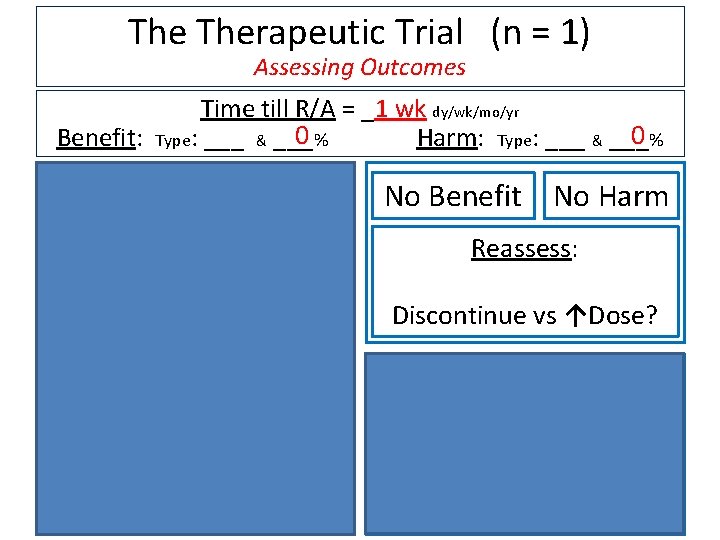
The Therapeutic Trial (n = 1) Assessing Outcomes Time till R/A = _1 wk dy/wk/mo/yr 0% 0 % Benefit: Type: ___ & ___ Harm: Type: ___ & ___ ↑Benefit No Harm Success Reassess: Continue Rx vs ↑Dose? ↑Benefit ↑ Harm Reassess: Discuss Benefit vs Risk with patient No Benefit No Harm Reassess: Discontinue vs ↑Dose? No Benefit ↑ Harm Failure Discontinue Therapy
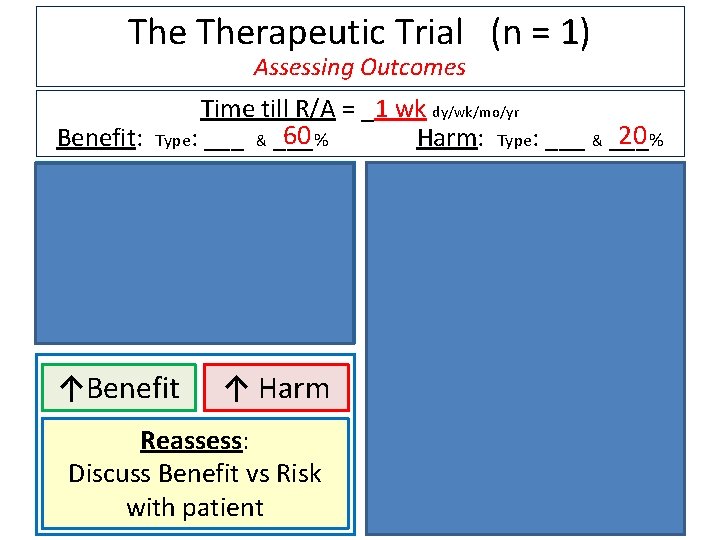
The Therapeutic Trial (n = 1) Assessing Outcomes Time till R/A = _1 wk dy/wk/mo/yr 20 % 60 % Benefit: Type: ___ & ___ Harm: Type: ___ & ___ ↑Benefit No Harm Success Reassess: Continue Rx vs ↑Dose? ↑Benefit ↑ Harm Reassess: Discuss Benefit vs Risk with patient No Benefit No Harm Reassess: Discontinue vs ↑Dose? No Benefit ↑ Harm Failure Discontinue Therapy
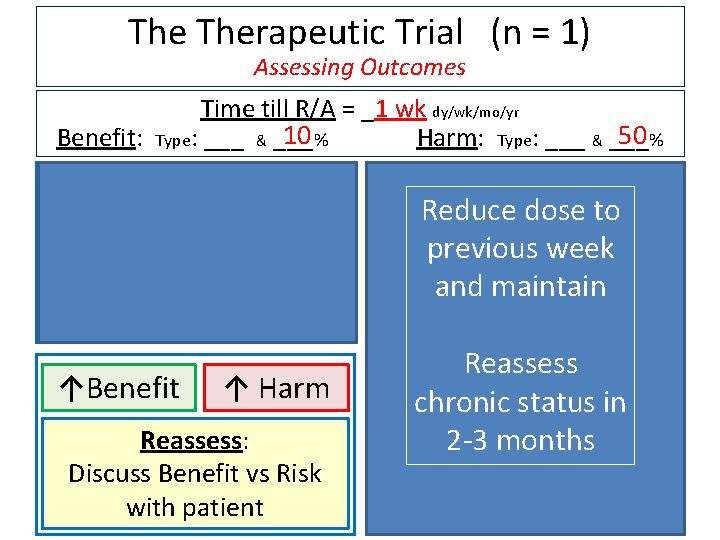
The Therapeutic Trial (n = 1) Assessing Outcomes Time till R/A = _1 wk dy/wk/mo/yr 50 % 10 % Benefit: Type: ___ & ___ Harm: Type: ___ & ___ ↑Benefit No Harm Success Reassess: Continue Rx vs ↑Dose? ↑Benefit ↑ Harm Reassess: Discuss Benefit vs Risk with patient No Harm No Benefit Reduce dose to Reassess: previous week and maintain Discontinue vs ↑Dose? Reassess No Benefit ↑ Harm chronic status in Failure 2 -3 months Discontinue Therapy
k n a Th g n i y a l P r o s f !
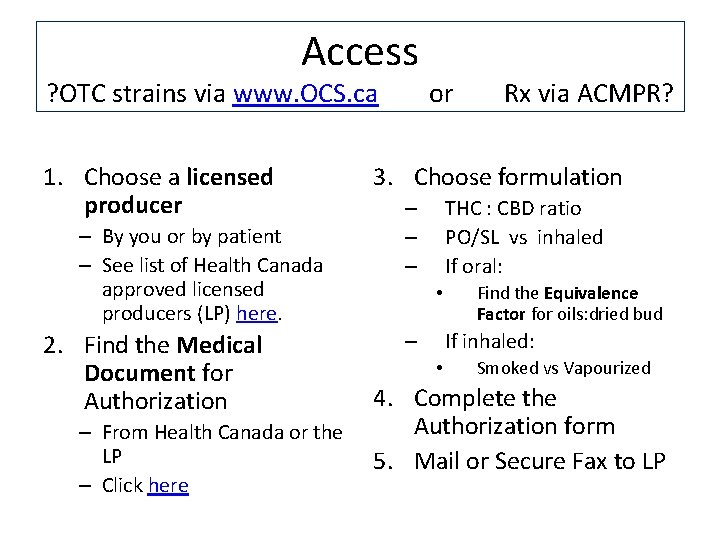
Access ? OTC strains via www. OCS. ca or Rx via ACMPR? 1. Choose a licensed producer – By you or by patient – See list of Health Canada approved licensed producers (LP) here. 2. Find the Medical Document for Authorization 3. Choose formulation THC : CBD ratio PO/SL vs inhaled If oral: – – – • Find the Equivalence Factor for oils: dried bud If inhaled: – • Smoked vs Vapourized 4. Complete the Authorization form – From Health Canada or the LP 5. Mail or Secure Fax to LP – Click here
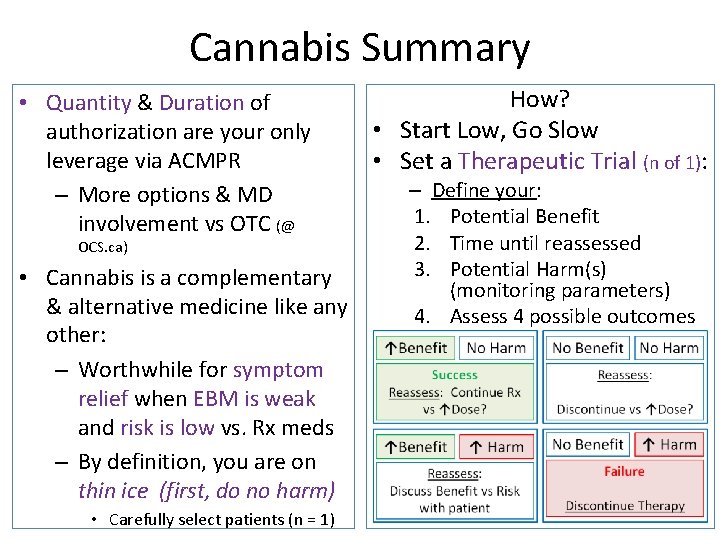
Cannabis Summary • Quantity & Duration of authorization are your only leverage via ACMPR – More options & MD involvement vs OTC (@ OCS. ca) How? • Start Low, Go Slow • Set a Therapeutic Trial (n of 1): – Define your: 1. Potential Benefit 2. Time until reassessed 3. Potential Harm(s) (monitoring parameters) 4. Assess 4 possible outcomes • Cannabis is a complementary & alternative medicine like any other: – Worthwhile for symptom relief when EBM is weak and risk is low vs. Rx meds – By definition, you are on . thin ice (first, do no harm) • Carefully select patients (n = 1)
Resources 1. National Academies of Sciences, Engineering, and Medicine. 2017. The health effects of cannabis and cannabinoids: The current state of evidence and recommendations for research. Washington, DC: The National Academies Press. doi: 10. 17226/24625. Click here 2. Health Canada. Information for Health Care Professionals: Cannabis (marihuana, marijuana) and the cannabinoids [Health Canada, Feb 2013]. http: //www. hc-sc. gc. ca/dhp-mps/marihuana/med/infoprof-eng. php. 3. Allan, Michael G. et al. Simplified guideline for prescribing medical cannabinoids in primary care. Canadian Family Physician. Feb 2018 Vol 64. Click: here (NEW!)
Questions? rhalil@bruyere. org Twitter: @Roland. Halil
- Slides: 54