
Medical breakthrough that sound like science fiction Mohamed
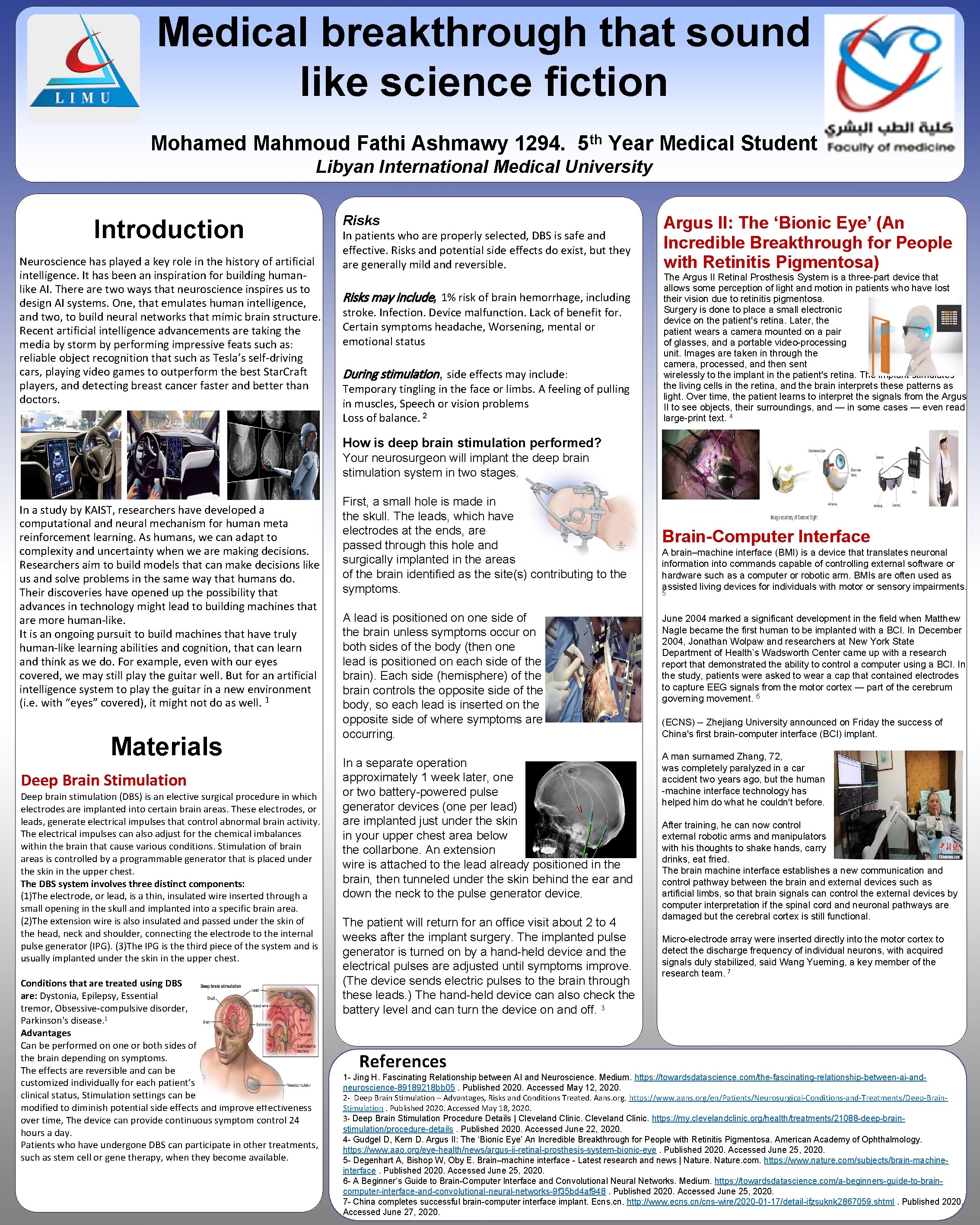
Medical breakthrough that sound like science fiction Mohamed Mahmoud Fathi Ashmawy 1294. 5 th Year Medical Student Libyan International Medical University Introduction Neuroscience has played a key role in the history of artificial intelligence. It has been an inspiration for building humanlike AI. There are two ways that neuroscience inspires us to design AI systems. One, that emulates human intelligence, and two, to build neural networks that mimic brain structure. Recent artificial intelligence advancements are taking the media by storm by performing impressive feats such as: reliable object recognition that such as Tesla’s self-driving cars, playing video games to outperform the best Star. Craft players, and detecting breast cancer faster and better than doctors. Risks In patients who are properly selected, DBS is safe and effective. Risks and potential side effects do exist, but they are generally mild and reversible. Risks may include, 1% risk of brain hemorrhage, including stroke. Infection. Device malfunction. Lack of benefit for. Certain symptoms headache, Worsening, mental or emotional status During stimulation, side effects may include: Temporary tingling in the face or limbs. A feeling of pulling in muscles, Speech or vision problems Loss of balance. 2 Argus II: The ‘Bionic Eye’ (An Incredible Breakthrough for People with Retinitis Pigmentosa) The Argus II Retinal Prosthesis System is a three-part device that allows some perception of light and motion in patients who have lost their vision due to retinitis pigmentosa. Surgery is done to place a small electronic device on the patient's retina. Later, the patient wears a camera mounted on a pair of glasses, and a portable video-processing unit. Images are taken in through the camera, processed, and then sent wirelessly to the implant in the patient's retina. The implant stimulates the living cells in the retina, and the brain interprets these patterns as light. Over time, the patient learns to interpret the signals from the Argus II to see objects, their surroundings, and — in some cases — even read large-print text. 4 How is deep brain stimulation performed? Your neurosurgeon will implant the deep brain stimulation system in two stages. In a study by KAIST, researchers have developed a computational and neural mechanism for human meta reinforcement learning. As humans, we can adapt to complexity and uncertainty when we are making decisions. Researchers aim to build models that can make decisions like us and solve problems in the same way that humans do. Their discoveries have opened up the possibility that advances in technology might lead to building machines that are more human-like. It is an ongoing pursuit to build machines that have truly human-like learning abilities and cognition, that can learn and think as we do. For example, even with our eyes covered, we may still play the guitar well. But for an artificial intelligence system to play the guitar in a new environment (i. e. with “eyes” covered), it might not do as well. 1 Materials Deep Brain Stimulation Deep brain stimulation (DBS) is an elective surgical procedure in which electrodes are implanted into certain brain areas. These electrodes, or leads, generate electrical impulses that control abnormal brain activity. The electrical impulses can also adjust for the chemical imbalances within the brain that cause various conditions. Stimulation of brain areas is controlled by a programmable generator that is placed under the skin in the upper chest. The DBS system involves three distinct components: (1)The electrode, or lead, is a thin, insulated wire inserted through a small opening in the skull and implanted into a specific brain area. (2)The extension wire is also insulated and passed under the skin of the head, neck and shoulder, connecting the electrode to the internal pulse generator (IPG). (3)The IPG is the third piece of the system and is usually implanted under the skin in the upper chest. Conditions that are treated using DBS are: Dystonia, Epilepsy, Essential tremor, Obsessive-compulsive disorder, Parkinson's disease. 1 Advantages Can be performed on one or both sides of the brain depending on symptoms. The effects are reversible and can be customized individually for each patient’s clinical status, Stimulation settings can be modified to diminish potential side effects and improve effectiveness over time, The device can provide continuous symptom control 24 hours a day. Patients who have undergone DBS can participate in other treatments, such as stem cell or gene therapy, when they become available. First, a small hole is made in the skull. The leads, which have electrodes at the ends, are passed through this hole and surgically implanted in the areas of the brain identified as the site(s) contributing to the symptoms. A lead is positioned on one side of the brain unless symptoms occur on both sides of the body (then one lead is positioned on each side of the brain). Each side (hemisphere) of the brain controls the opposite side of the body, so each lead is inserted on the opposite side of where symptoms are occurring. In a separate operation approximately 1 week later, one or two battery-powered pulse generator devices (one per lead) are implanted just under the skin in your upper chest area below the collarbone. An extension wire is attached to the lead already positioned in the brain, then tunneled under the skin behind the ear and down the neck to the pulse generator device. The patient will return for an office visit about 2 to 4 weeks after the implant surgery. The implanted pulse generator is turned on by a hand-held device and the electrical pulses are adjusted until symptoms improve. (The device sends electric pulses to the brain through these leads. ) The hand-held device can also check the battery level and can turn the device on and off. 3 Brain-Computer Interface A brain–machine interface (BMI) is a device that translates neuronal information into commands capable of controlling external software or hardware such as a computer or robotic arm. BMIs are often used as assisted living devices for individuals with motor or sensory impairments. 5 June 2004 marked a significant development in the field when Matthew Nagle became the first human to be implanted with a BCI. In December 2004, Jonathan Wolpaw and researchers at New York State Department of Health’s Wadsworth Center came up with a research report that demonstrated the ability to control a computer using a BCI. In the study, patients were asked to wear a cap that contained electrodes to capture EEG signals from the motor cortex — part of the cerebrum governing movement. 6 (ECNS) -- Zhejiang University announced on Friday the success of China's first brain-computer interface (BCI) implant. A man surnamed Zhang, 72, was completely paralyzed in a car accident two years ago, but the human -machine interface technology has helped him do what he couldn't before. After training, he can now control external robotic arms and manipulators with his thoughts to shake hands, carry drinks, eat fried. The brain machine interface establishes a new communication and control pathway between the brain and external devices such as artificial limbs, so that brain signals can control the external devices by computer interpretation if the spinal cord and neuronal pathways are damaged but the cerebral cortex is still functional. Micro-electrode array were inserted directly into the motor cortex to detect the discharge frequency of individual neurons, with acquired signals duly stabilized, said Wang Yueming, a key member of the research team. 7 References 1 - Jing H. Fascinating Relationship between AI and Neuroscience. Medium. https: //towardsdatascience. com/the-fascinating-relationship-between-ai-andneuroscience-89189218 bb 05. Published 2020. Accessed May 12, 2020. 2 - Deep Brain Stimulation – Advantages, Risks and Conditions Treated. Aans. org. https: //www. aans. org/en/Patients/Neurosurgical-Conditions-and-Treatments/Deep-Brain. Stimulation. Published 2020. Accessed May 18, 2020. 3 - Deep Brain Stimulation Procedure Details | Cleveland Clinic. https: //my. clevelandclinic. org/health/treatments/21088 -deep-brainstimulation/procedure-details. Published 2020. Accessed June 22, 2020. 4 - Gudgel D, Kern D. Argus II: The ‘Bionic Eye’ An Incredible Breakthrough for People with Retinitis Pigmentosa. American Academy of Ophthalmology. https: //www. aao. org/eye-health/news/argus-ii-retinal-prosthesis-system-bionic-eye. Published 2020. Accessed June 25, 2020. 5 - Degenhart A, Bishop W, Oby E. Brain–machine interface - Latest research and news | Nature. com. https: //www. nature. com/subjects/brain-machineinterface. Published 2020. Accessed June 25, 2020. 6 - A Beginner’s Guide to Brain-Computer Interface and Convolutional Neural Networks. Medium. https: //towardsdatascience. com/a-beginners-guide-to-braincomputer-interface-and-convolutional-neural-networks-9 f 35 bd 4 af 948. Published 2020. Accessed June 25, 2020. 7 - China completes successful brain-computer interface implant. Ecns. cn. http: //www. ecns. cn/cns-wire/2020 -01 -17/detail-ifzsuknk 2867059. shtml. Published 2020. Accessed June 27, 2020.
- Slides: 1