
Medical biology cytology lec 3 Cytoplasm and organelles
Medical biology cytology lec 3 Cytoplasm and organelles part 1 01/03/1439 Farah E. Ismaeel 1
01/03/1439 Farah E. Ismaeel 2

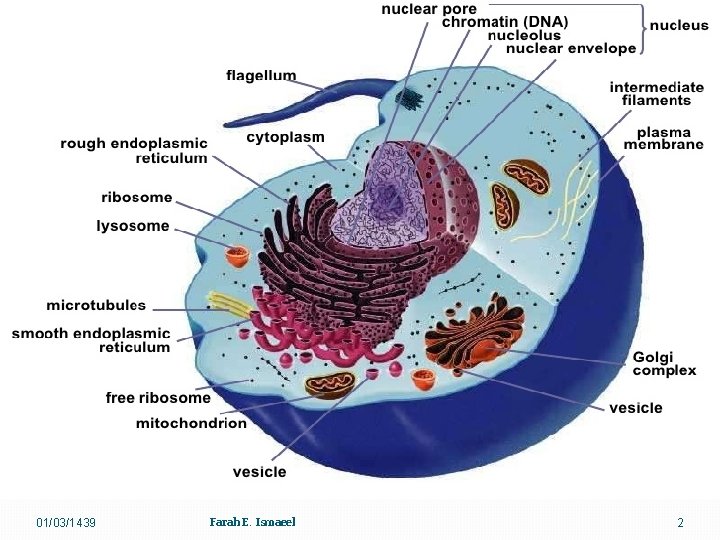
The Cytoplasm �The cytoplasm is the part of the cell located outside the nucleus full the space between nuclear envelop and plasma membrane consists of 1. cytosol is a larger fluid component. 2. Organelles (little organs) are bathing metabolically active structures. (living) 3. Cytoskeleton is protein components which determine the shape and motility of eukaryotic cells. 4. Inclusions are the minor cytoplasmic structures that are not usually surrounded by a plasma membrane. (non living) 01/03/1439 Farah E. Ismaeel 3
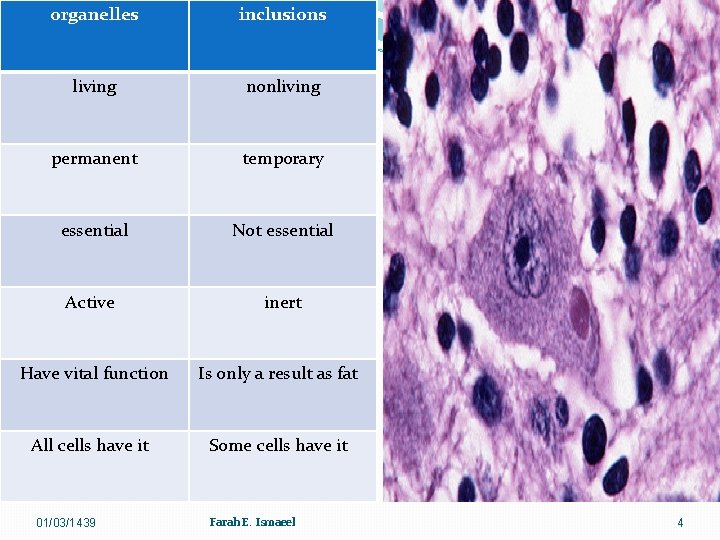
organelles inclusions living nonliving permanent temporary essential Not essential Active inert Have vital function Is only a result as fat All cells have it Some cells have it 01/03/1439 Farah E. Ismaeel 4

Cytosol � Cytosol is an aqueous gel called the cytoplasmic matrix. �The matrix consists of : 1. inorganic ions (Na, K, and Ca 2) 2. organic molecules such as intermediate metabolites, carbohydrates, lipids, proteins, and RNAs. 3. contains hundreds of enzymes, such as those of the glycolytic pathway. 4. m. RNA, transfer RNA, enzymes, and other factors. 5. oxygen, CO 2, electrolytic ions, low-molecularweight substrates, metabolites, and waste products 01/03/1439 Farah E. Ismaeel 5
Organelles �All cells have the same basic set of intracellular organelles, which can be classified into two groups: (1) Membranous organelles with plasma membranes that separate the internal environment of the organelle from the cytoplasm. (2) Non membranous organelles without plasma membranes. 01/03/1439 Farah E. Ismaeel 6
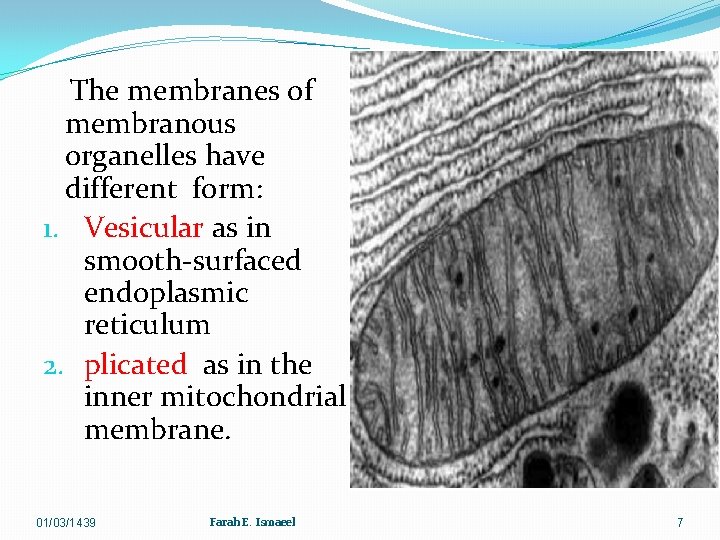
The membranes of membranous organelles have different form: 1. Vesicular as in smooth-surfaced endoplasmic reticulum 2. plicated as in the inner mitochondrial membrane. 01/03/1439 Farah E. Ismaeel 7

each type of organelle contains a set of unique proteins. 1. In membranous organelles, these proteins are either incorporated into their membranes or sequestered within their lumens. For example, the enzymes of lysosomes are separated by a specific enzyme resistant membrane from the cytoplasmic matrix because their hydrolytic activity would be detrimental to the cell. 2. In Non membranous organelles, the unique proteins usually self assemble into polymers that form the structural elements of the cytoskeleton. 01/03/1439 Farah E. Ismaeel 8

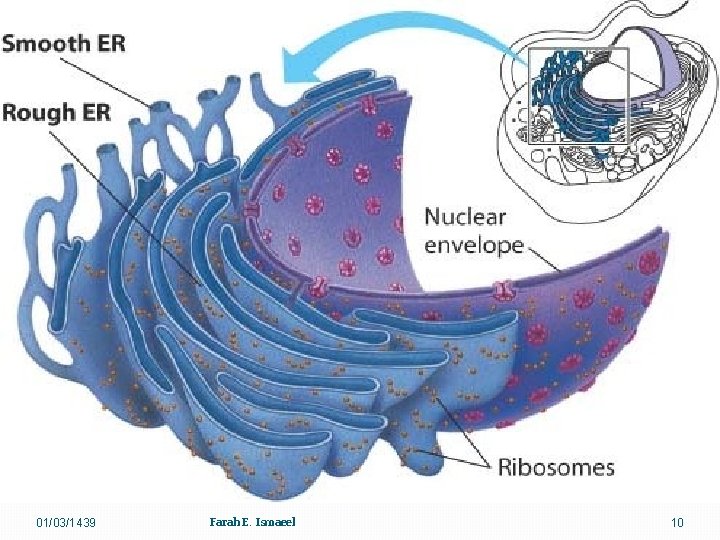
Membrane bounded organelles Endoplasmic reticulum (ER) �The largest organelle of most eukaryotic cells is ER. �ER is a network of intercommunicating channels and sacs formed by a continuous membrane which encloses a space called cisternae this network (reticulum) extends from the surface of the nucleus to the cell membrane. 01/03/1439 Farah E. Ismaeel 9
01/03/1439 Farah E. Ismaeel 10

01/03/1439 Farah E. Ismaeel 11
Endoplasmic reticulum (ER) �The main function of ER is the transport of materials by forms transport vesicles in which large molecules are transported to other parts of the cell. Often, these vesicles are on their way to the plasma membrane or the Golgi apparatus. �There are two types of ER according to the present of ribosome, Rough ER and Smooth ER 01/03/1439 Farah E. Ismaeel 12
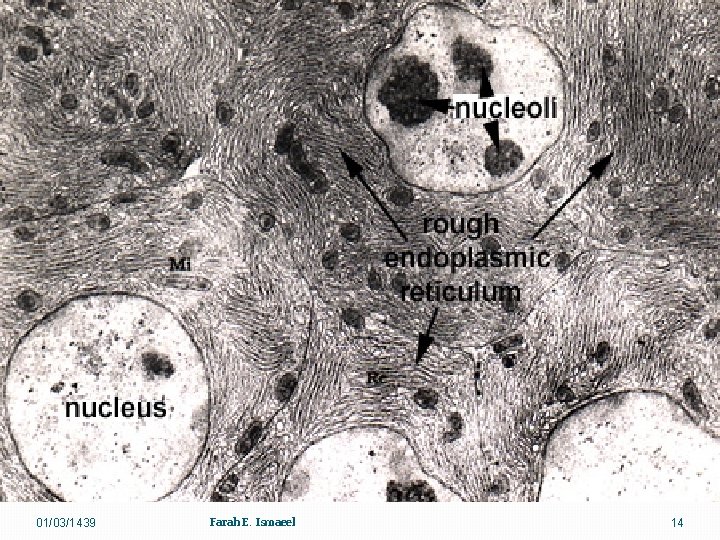
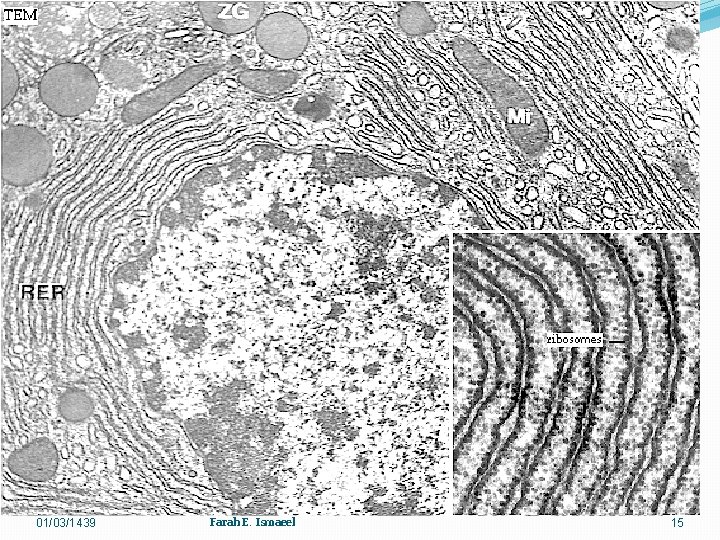
Rough ER (RER) �RER is studded with ribosomes on the side of the membrane that faces the cytoplasm. �Here, proteins are synthesized and enter the ER interior, where processing and modification begin. Some of these proteins are incorporated into membrane, and some are for export. � Is found in all cells except erythrocytes and is especially abundant in pancreas (pancreatic acinar cell that produce digestive enzymes), fibroblasts produce collagen and plasma cells that produce immunoglubins. 01/03/1439 Farah E. Ismaeel 13
01/03/1439 Farah E. Ismaeel 14
01/03/1439 Farah E. Ismaeel 15

Function of RER �Has role in the synthesis of protein to be exported outside the cell. �Modification of newly formed polypeptides. �Assembly of multichain protein. �Initial glycosylation of the glycoprotein which means addition of glucose to the protein. 01/03/1439 Farah E. Ismaeel 16
�RER has a highly regulated system to prevent nonfunctional proteins being forwarded to the pathway for secretion or to other organelles. �New proteins that cannot be folded or assembled properly by chaperones undergo ER-associated degradation (ERAD), in which unsalvageable proteins are translocated back into the cytosol, conjugated to ubiquitin, and then degraded by proteasomes. 01/03/1439 Farah E. Ismaeel 17
�Quality control during protein production in the RER and properly functioning ERAD to dispose of defective proteins are extremely important and several inherited diseases result from malfunctions in this system. �For example, in some forms of osteogenesis imperfect bone cells synthesize and secrete defective procollagen molecules which cannot assemble properly and produce very weak bone tissue. 01/03/1439 Farah E. Ismaeel 18
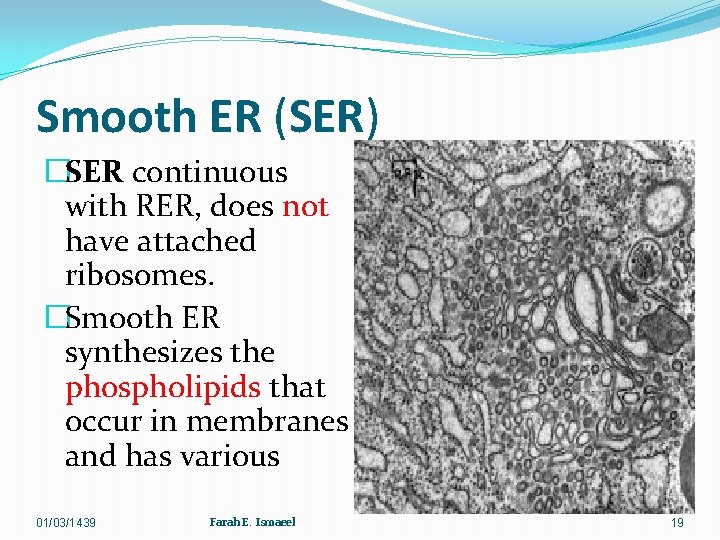
Smooth ER (SER) �SER continuous with RER, does not have attached ribosomes. �Smooth ER synthesizes the phospholipids that occur in membranes and has various 01/03/1439 Farah E. Ismaeel 19
other functions of SER depending on the particular cell. 1. SER in Testes is produce testosterone. 2. SER in liver is detoxified drugs, alcohol and toxin. Also have role in lipid and cholesterol synthesis. And glycogen breakdown. 3. SER in adrenal glands is produces steroid hormones 4. SER in muscle cells has role in contraction process (SER in muscle cells called sarcoplasmic reticulum). 5. SER Transport molecules to the Golgi body. 6. SER is metabolized lipid and cholesterol. 01/03/1439 Farah E. Ismaeel 20
MEDICAL APPLICATION ON SER �Jaundice denotes a yellowish discoloration of the skin and is caused by accumulation in extracellular fluid of bilirubin and other pigmented compounds, which are normally metabolized by SER enzymes in cells of the liver and excreted as bile. � A frequent cause of jaundice in newborn infants is an under developed state of SER in liver cells, with failure of bilirubin to be converted to a form that can be readily excreted. 01/03/1439 Farah E. Ismaeel 21
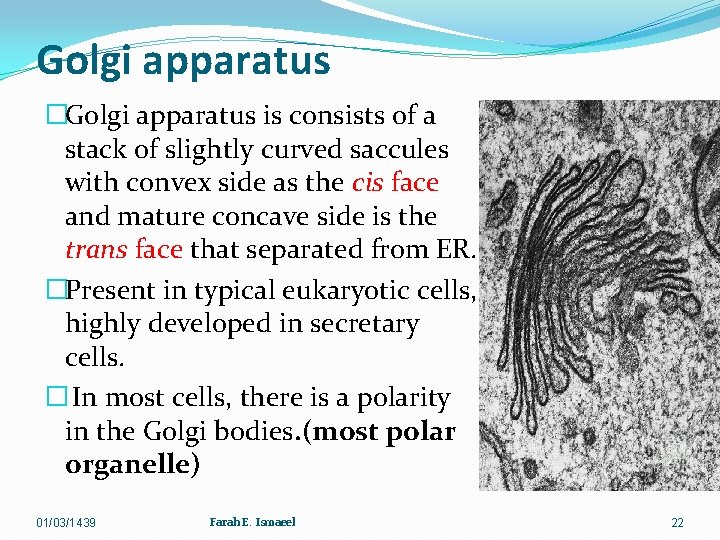
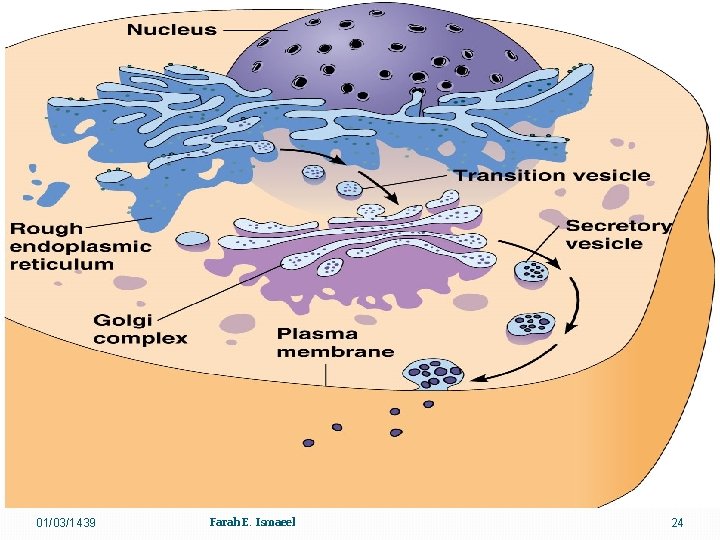
Golgi apparatus �Golgi apparatus is consists of a stack of slightly curved saccules with convex side as the cis face and mature concave side is the trans face that separated from ER. �Present in typical eukaryotic cells, highly developed in secretary cells. � In most cells, there is a polarity in the Golgi bodies. (most polar organelle) 01/03/1439 Farah E. Ismaeel 22
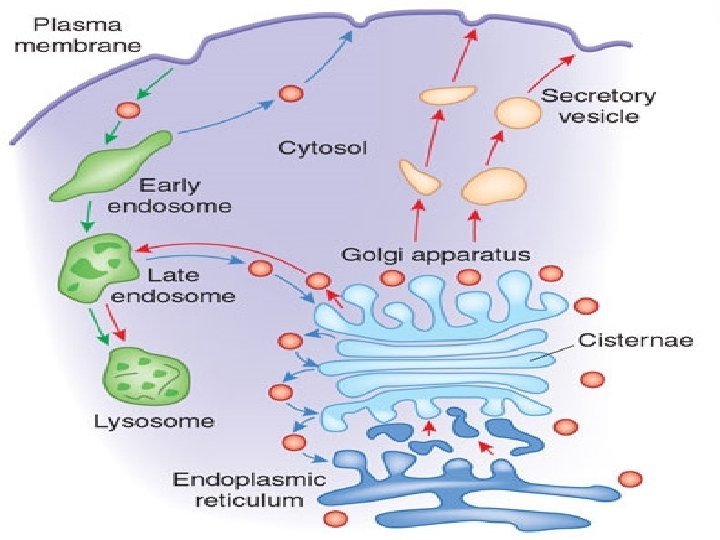
�Protein and lipid vesicle from ER fused with cis face of Golgi apparatus then subsequently progress through the stack to trans face of Golgi apparatus that contain cisternae enzyme. Cisternae enzyme modify, sort and package proteins also add sugar to protein and lipid to form glycoproteins, glycolipids and lipoproteins. These molecules packaged in membrane for export outside of cell or for lysosomes. 01/03/1439 Farah E. Ismaeel 23
01/03/1439 Farah E. Ismaeel 24
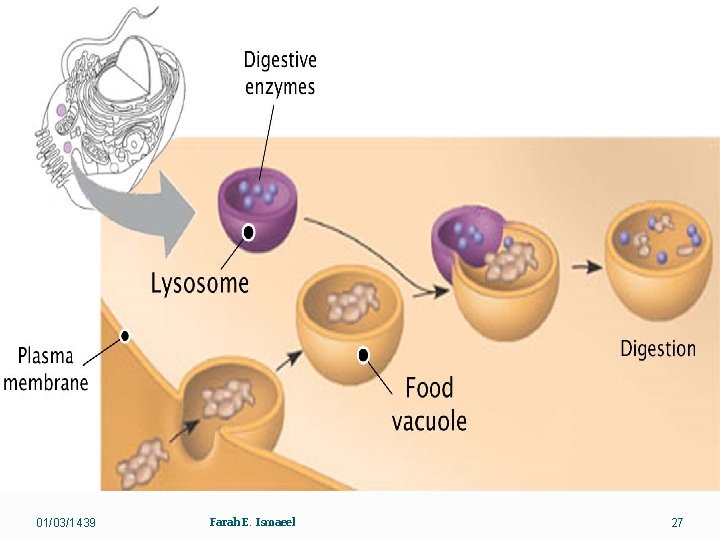
Lysosomes �Lysosomes are membrane bounded organelles that contain about 40 different hydrolytic enzymes �produced by the Golgi apparatus. �Lysosomal hydrolases are synthesized and segregated in the RER and then transferred to the Golgi apparatus, where the enzymes are further modified and packaged in vacuoles that form lysosomes. 01/03/1439 Farah E. Ismaeel 25
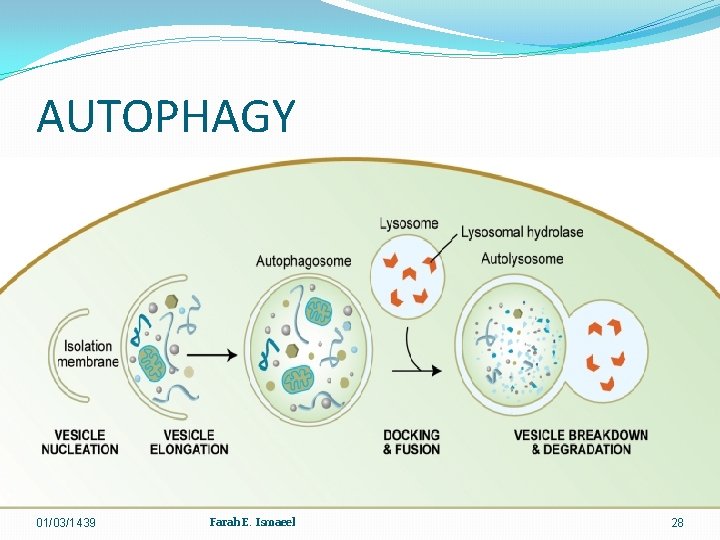
Lysosomes �Particularly abundant in cells with great phagocytic activity (eg, macrophages, neutrophils) because it digest any foreign substance by hydrolytic enzyme. �Have important role in post mortum autolysis. �Maintain cell health by remove all old endogenous macromolecules. 01/03/1439 Farah E. Ismaeel 26
01/03/1439 Farah E. Ismaeel 27
AUTOPHAGY 01/03/1439 Farah E. Ismaeel 28
01/03/1439 Farah E. Ismaeel 29
�Diseases categorized as lysosomal storage disorders (LSDs) stem from defects in one or more of the digestive enzymes present in lysosomes. �In cells that must digest the substrate of the missing or defective enzyme following autophagocytosis, the lysosomes cannot function properly. Such cells accumulate large secondary lysosomes or residual bodies filled with the indigestible macromolecule. The accumulation of these vacuoles may eventually interfere with normal cell or tissue function, producing symptoms of the disease. 01/03/1439 Farah E. Ismaeel 30

01/03/1439 Farah E. Ismaeel 31
- Slides: 31