
MEDICAL ASSISTANTS IN CALIFORNIA SCOPE OF PRACTICE Laws








![MA-team Model [rural] • Increase MA/Provider ratio to 3: 1 • • • Don’t](https://slidetodoc.com/presentation_image_h2/96e0e3956af3666c70f4d7f7c0731b05/image-32.jpg "MA-team Model [rural] • Increase MA/Provider ratio to 3: 1 • • • Don’t")
- Slides: 38
MEDICAL ASSISTANTS IN CALIFORNIA SCOPE OF PRACTICE: Laws, Regulations, ….
…and OPPORTUNITIES!
• Today, we’ll discuss…
THE “WHAT? ”
The Medical Assistant Scope of Practice
THE “WHAT? ” “SO WHAT? ? ”
What is the PROBLEM? . . . and what can we do about it?
and…
THE “WHAT? ” “SO WHAT? ? ” “NOW WHAT? ? ? ”
An Innovative program to address these issues.
SCOPE OF PRACTICE: WHERE TO GET QUESTIONS ANSWERED:
CA. MEDICAL ASSISTANTS SCOPE American Association of Medical Assistants: http: //www. aama-ntl. org/employers/laws. aspx California Medical Board: http: //www. mbc. ca. gov/Licensees/Physicians_and _Surgeons/Medical_Assistants/Medical_Assistan ts_FAQ. aspx
CA Medical Assistants Laws, Regulations and Governance • CA Business and Professions: (B&P) Code §§ (Sections) 2069 -2071 • CA Code of Regulations: Title 16 §§ 1366– 1366. 4; 1366. 31 -33 • Medical Board of California • (www. mbc. ca. gov/allied) • California Board of Registered Nursing
California Medical Assistants (MAs): • Unlicensed • Work in MD, podiatrist or optometrist offices; and clinics – (not for inpatient care in licensed general acute care hospitals) • Regulated by CA Board of Medicine • Must be over 18 • Must be trained • May be certified
MA Certification • Multiple national & state-based options • Usually states don’t require certification • CA requires certification of MAs who are training other MAs – (16 CA ADC § 1366. 3) • Employers may require certification
In a Community Health Center Provide technical support services … …Upon: the specific authorization and supervision of a licensed physician and surgeon or a licensed podiatrist, OR…
In a Community Health Center • …Upon the specific authorization of a physician assistant, a nurse practitioner, or a nursemidwife, with a physician maintaining supervisory function unless delegated in standardized procedure or protocol. • SO…Supervising MD/DO/podiatrist may provide in writing that NP or PA may assign MDauthorized tasks to the MA.
Technical Support Services CA MAs may perform: As authorized by supervising physician or designee: • Collect “anthropomorphic data” (VITAL SIGNS) • Collect basic information about the presenting conditions (HPI) and past history. • Perform simple laboratory and screening tests customarily performed in a medical office. • Provide patient information and instructions.
In a Community Health Center: A California Medical Assistant may: • Administer medication only by intradermal, subcutaneous, or intramuscular injections; • Perform skin tests; and…
Other Technical Support: • Electrocardiograms, • Pulmonary function testing, • Apply and remove bandages and dressings, • Apply orthopedic appliances such as knee immobilizers, envelope slings, orthotics, • Remove casts, splints and other external devices, • Obtain impressions for orthotics, padding and custom molded shoes, • Select and adjust crutches for patients, • Instruct patient in proper use of crutches.
Other Technical Support (cont. ): • Remove sutures or staples from superficial incisions or lacerations • Perform ear lavage • Collect by non-invasive techniques, and preserve specimens for testing • Assist patients in ambulation and transfers • Prepare patients for and assist the physician, podiatrist, PA or RN in exams or procedures including • positioning, draping, shaving, disinfecting treatment sites, prepare patients for gait analysis testing
MA’s Can’t: • Set I. V. s or given medication intravenously • Administer chemotherapy. • Interpret skin test results. (BUT, may measure the test). • Administer anesthetics, including medications containing local anesthetics, such as lidocaine.
Questions to ask yourselves • What are MAs doing now at your site? • (Or, how are you educating/training MAs? ) • What MA role changes do you want to see? • What is driving this need to change?
Questions to ask yourselves • What are you planning to do? • What challenges or barriers do you face? • How do you think they can be overcome? • What resources do you need to make the changes?
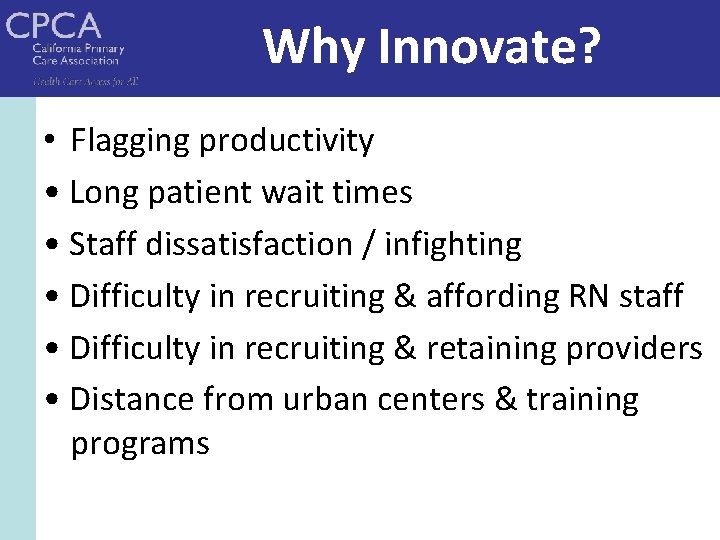
Why Innovate? • Flagging productivity • Long patient wait times • Staff dissatisfaction / infighting • Difficulty in recruiting & affording RN staff • Difficulty in recruiting & retaining providers • Distance from urban centers & training programs
Innovative Models THREE MODELS LEADING TO EXPANDED ROLES:
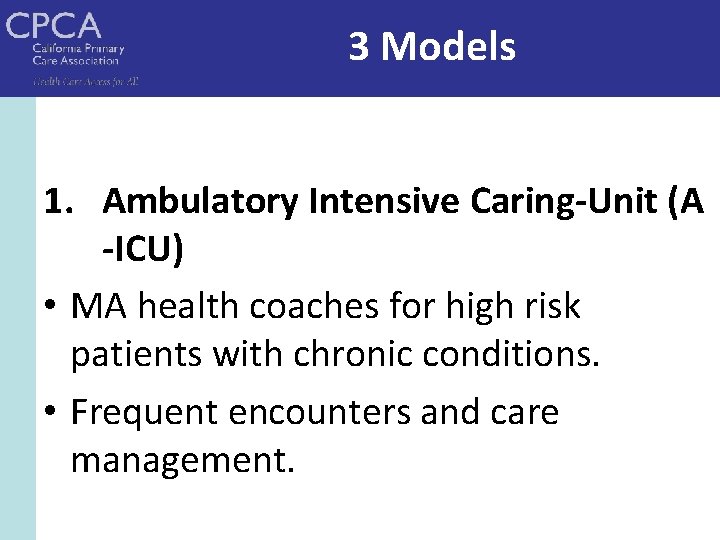
3 Models 1. Ambulatory Intensive Caring-Unit (A -ICU) • MA health coaches for high risk patients with chronic conditions. • Frequent encounters and care management.
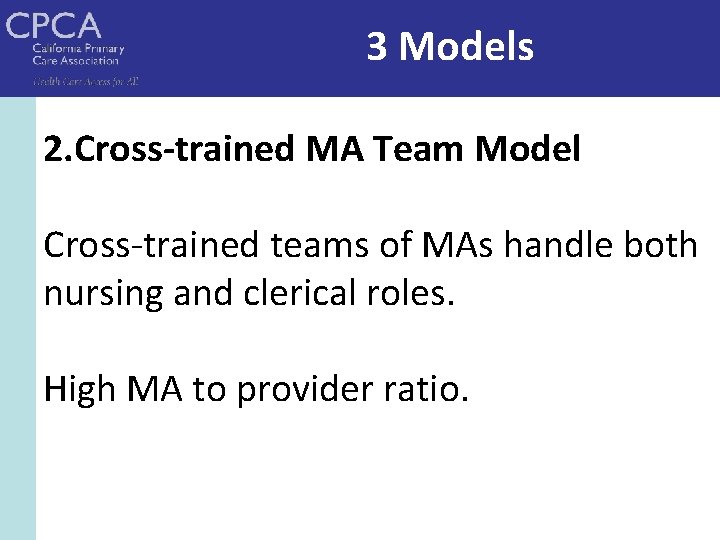
3 Models 2. Cross-trained MA Team Model Cross-trained teams of MAs handle both nursing and clerical roles. High MA to provider ratio.
3 Models 3. Integrated Multi-disciplinary Care Team (care coordination model) • Team-based model, • MAs conduct daily hands-on clinical tasks, • nurses serve as care coordinators.
Medical Assistant Selection and Training • “Hire for attitude; train for skill” • Relational skills and bilingual • competency BFOQ • Weekly core competency training • Active participation in plan of care for center • patient population (huddle) • Daily precepting with providers at each patient encounter - 12 encounters a day
Health Coach: Roles and Responsibilities • Help with individualized patient care plan • Continual follow-up by phone and email • Meet patients individually (panel of 80 -150) • Conduct health education classes • MA role to support provider visits/exams • Stay with patient through exam • – Call for lab results, schedule follow up visits, glucometer • readings, help with referrals, help document patient history, • follow up on medication adherence, etc.
MA-team Model [rural] • Increase MA/Provider ratio to 3: 1 • • • Don’t move the patient; move the care – MAs Take co-pay in the room – MAs conduct tests in-room – MAs print visit summary in-room --MAs as scribes with EMR.
Outcomes • New positions: Health Coach, CHW, Pharm Tech, • – Health Coaches earn approximately 42% more than MAs • Wait time reduced for patients • Provider productivity increased - 2000 to 2013 – From 1. 82 patients per hour to 2. 8 per hour • Cost savings– Up to $67 K per team per year
Changing Roles: RNs • Nurses challenged by MAs trained to roles they would traditionally have. • BUT • RNs have expertise and judgment to do higher level activities: • CARE MANAGEMENT and TRIAGE.
Changing Roles: Providers COMMON COMPLAINTS • “I am on a never-ending treadmill!” • “My colleagues and I are always at the edge of burn-out!” • “EMRs and population health add a ton more work!”
Changing Roles: Providers BUT— • Giving up work to the team is difficult!
Changing Roles: Providers AT FIRST: • “The responsibility is on me!” • “It’s MY license at stake!” • “No one else understands the work!”
AFTER TRAINING OF HEALTH COACHES: • “Many tasks can come off my plate!”: – Including: • Entering data-even having a scribe. • Many phone calls. • Preventive care and alerts. • Etc. !