
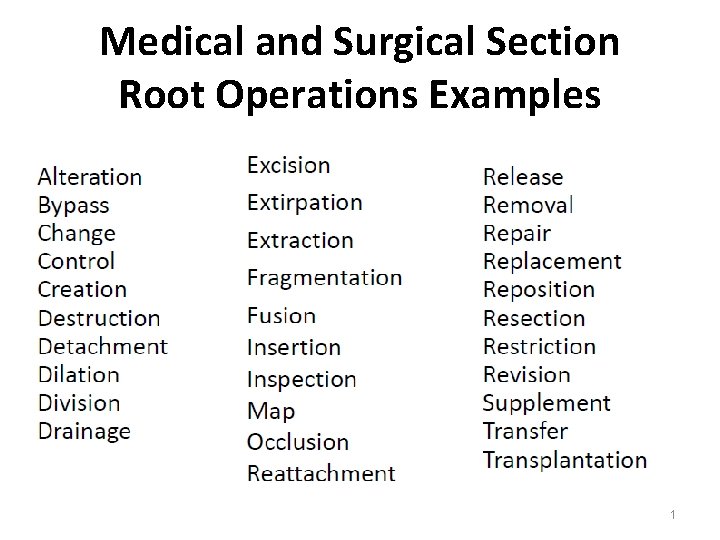
Medical and Surgical Section Root Operations Examples 1

- Slides: 72
Medical and Surgical Section Root Operations Examples 1
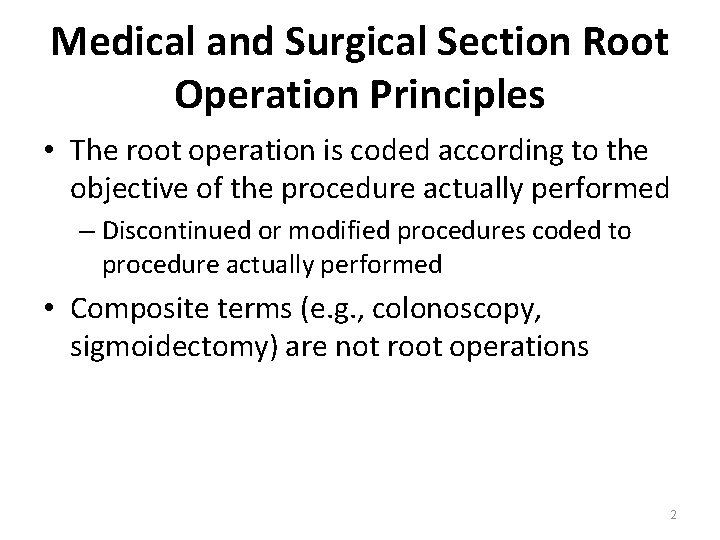
Medical and Surgical Section Root Operation Principles • The root operation is coded according to the objective of the procedure actually performed – Discontinued or modified procedures coded to procedure actually performed • Composite terms (e. g. , colonoscopy, sigmoidectomy) are not root operations 2
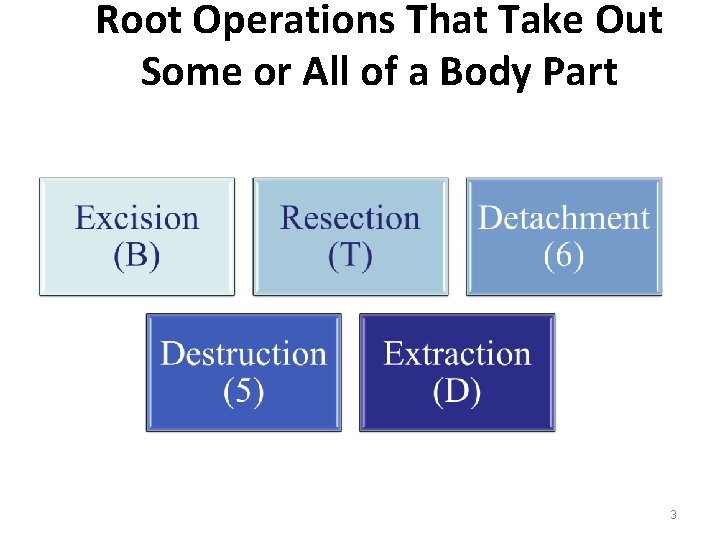
Root Operations That Take Out Some or All of a Body Part 3
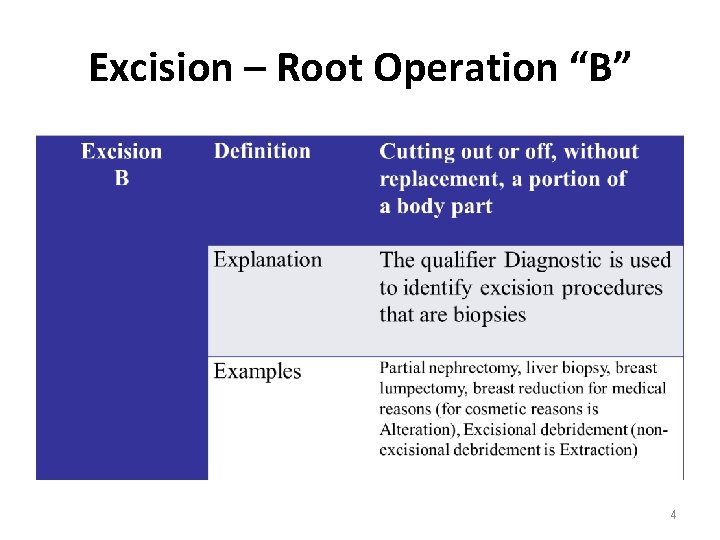
Excision – Root Operation “B” 4
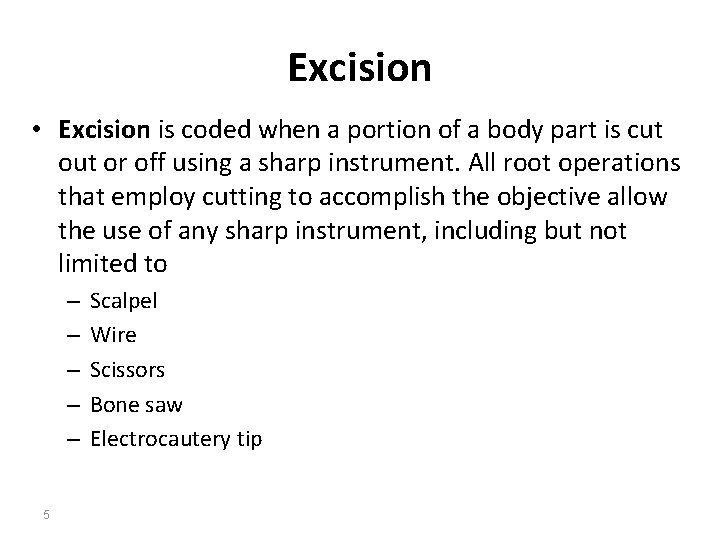
Excision • Excision is coded when a portion of a body part is cut or off using a sharp instrument. All root operations that employ cutting to accomplish the objective allow the use of any sharp instrument, including but not limited to – – – 5 Scalpel Wire Scissors Bone saw Electrocautery tip
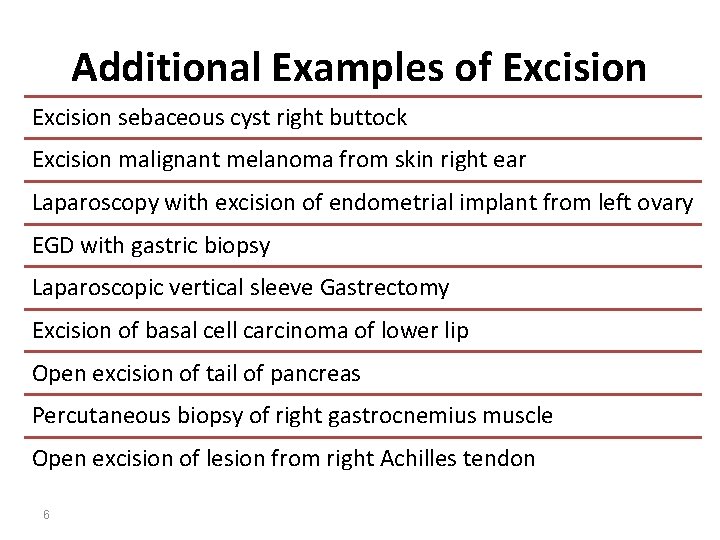
Additional Examples of Excision sebaceous cyst right buttock Excision malignant melanoma from skin right ear Laparoscopy with excision of endometrial implant from left ovary EGD with gastric biopsy Laparoscopic vertical sleeve Gastrectomy Excision of basal cell carcinoma of lower lip Open excision of tail of pancreas Percutaneous biopsy of right gastrocnemius muscle Open excision of lesion from right Achilles tendon 6
Please insert You. Tube videos of Excision examples from slides 7
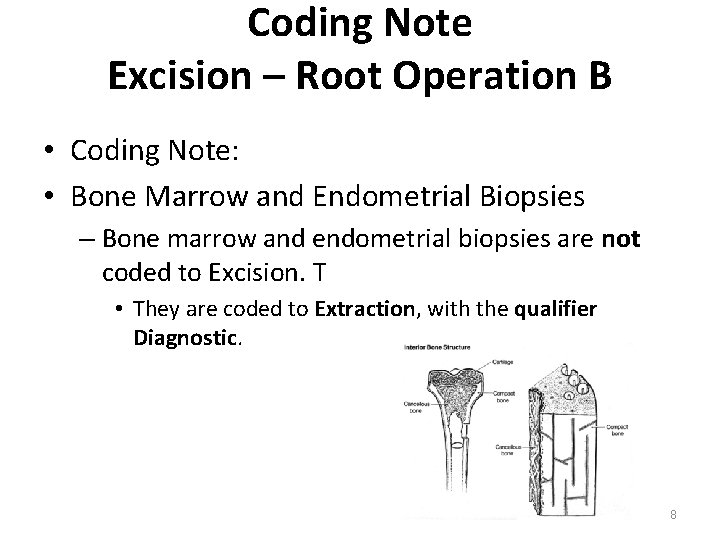
Coding Note Excision – Root Operation B • Coding Note: • Bone Marrow and Endometrial Biopsies – Bone marrow and endometrial biopsies are not coded to Excision. T • They are coded to Extraction, with the qualifier Diagnostic. 8
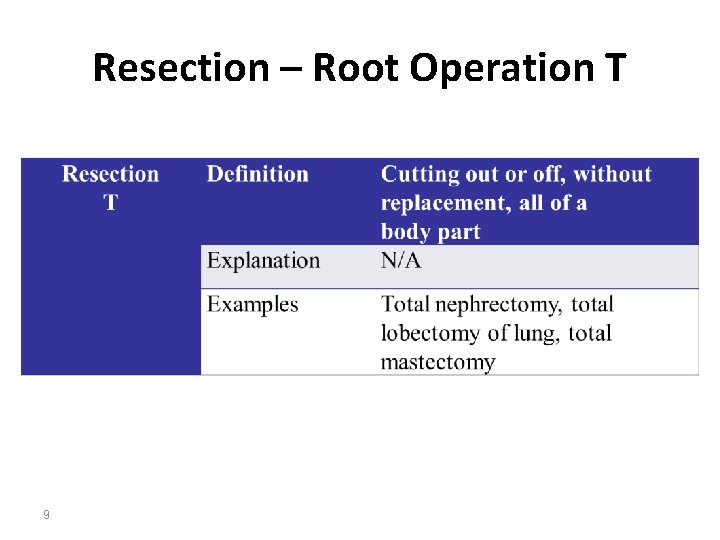
Resection – Root Operation T 9
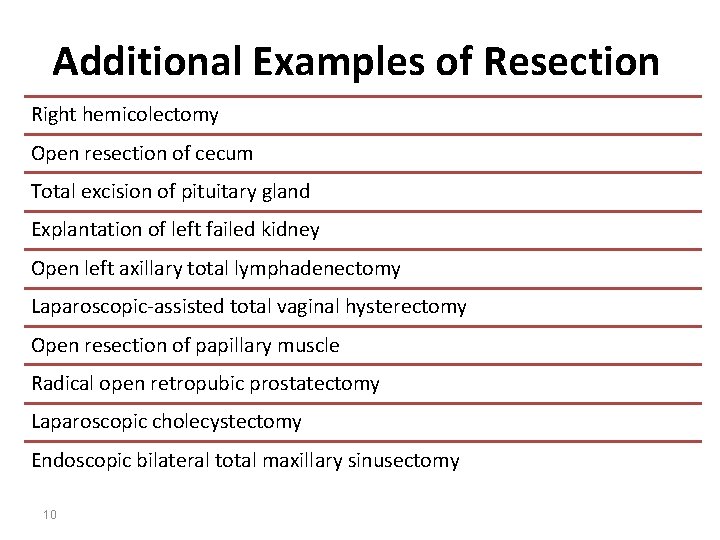
Additional Examples of Resection Right hemicolectomy Open resection of cecum Total excision of pituitary gland Explantation of left failed kidney Open left axillary total lymphadenectomy Laparoscopic-assisted total vaginal hysterectomy Open resection of papillary muscle Radical open retropubic prostatectomy Laparoscopic cholecystectomy Endoscopic bilateral total maxillary sinusectomy 10
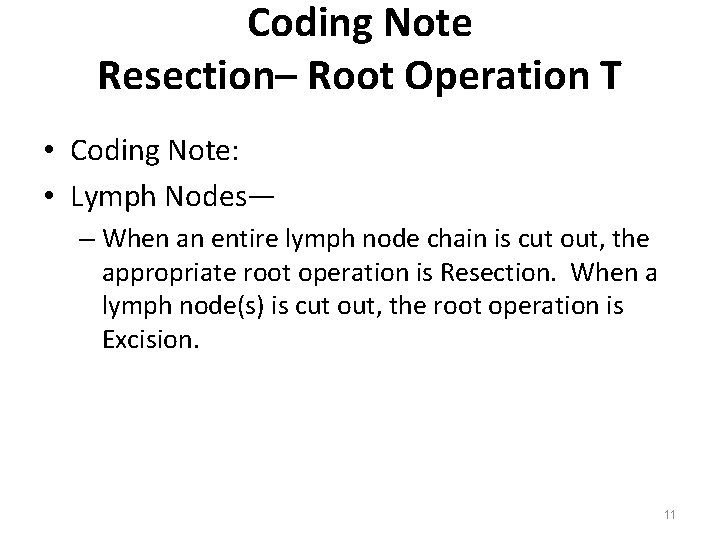
Coding Note Resection– Root Operation T • Coding Note: • Lymph Nodes— – When an entire lymph node chain is cut out, the appropriate root operation is Resection. When a lymph node(s) is cut out, the root operation is Excision. 11
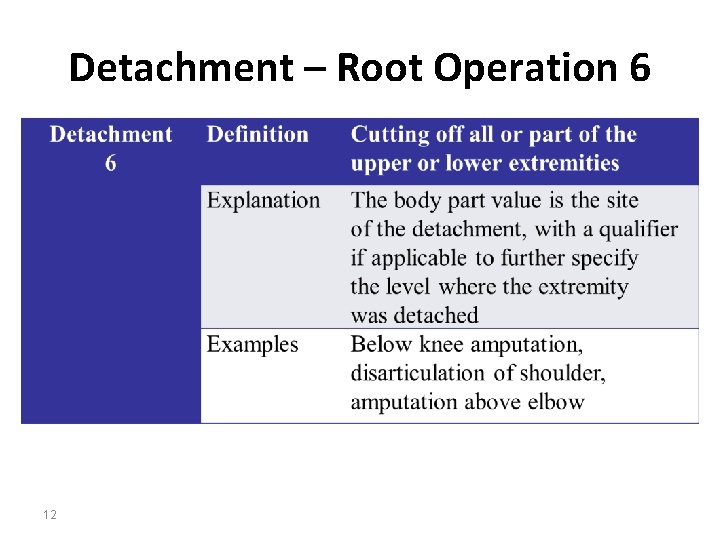
Detachment – Root Operation 6 12
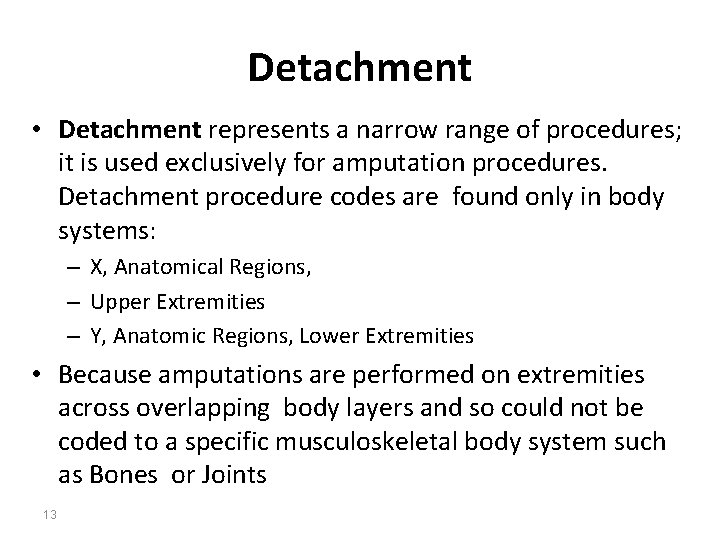
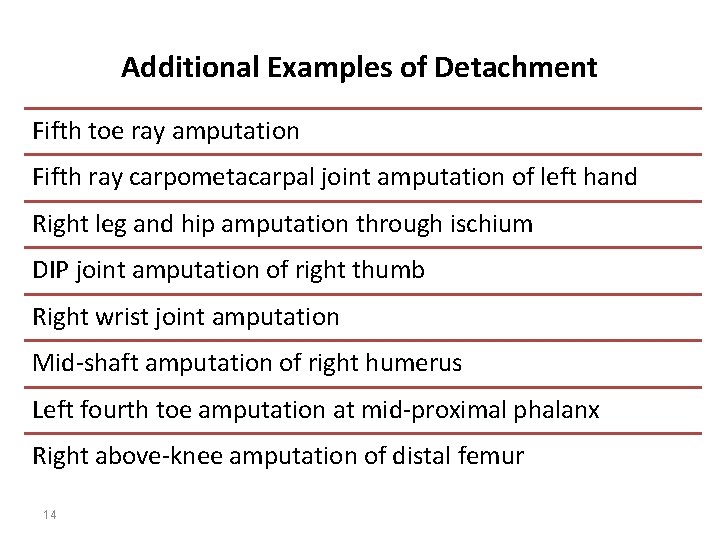
Detachment • Detachment represents a narrow range of procedures; it is used exclusively for amputation procedures. Detachment procedure codes are found only in body systems: – X, Anatomical Regions, – Upper Extremities – Y, Anatomic Regions, Lower Extremities • Because amputations are performed on extremities across overlapping body layers and so could not be coded to a specific musculoskeletal body system such as Bones or Joints 13
Additional Examples of Detachment Fifth toe ray amputation Fifth ray carpometacarpal joint amputation of left hand Right leg and hip amputation through ischium DIP joint amputation of right thumb Right wrist joint amputation Mid-shaft amputation of right humerus Left fourth toe amputation at mid-proximal phalanx Right above-knee amputation of distal femur 14
Insert You. Tube Video • Please insert You. Tube videos of Excision examples from Detachment • Below Knee Amputation 15
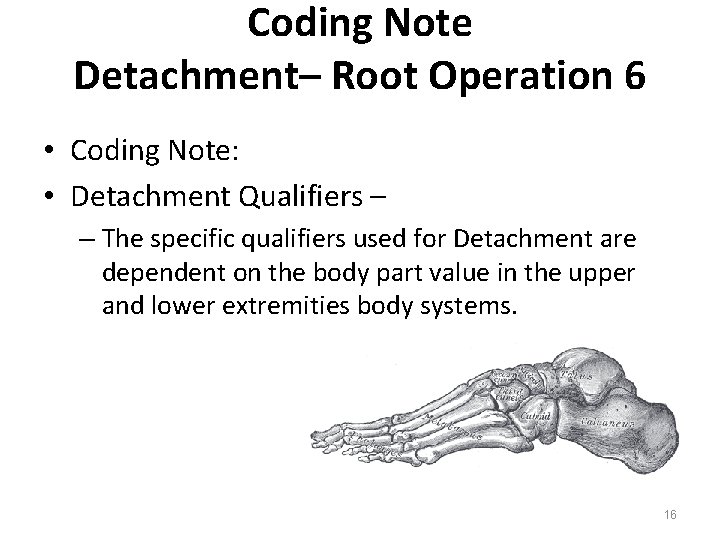
Coding Note Detachment– Root Operation 6 • Coding Note: • Detachment Qualifiers – – The specific qualifiers used for Detachment are dependent on the body part value in the upper and lower extremities body systems. 16
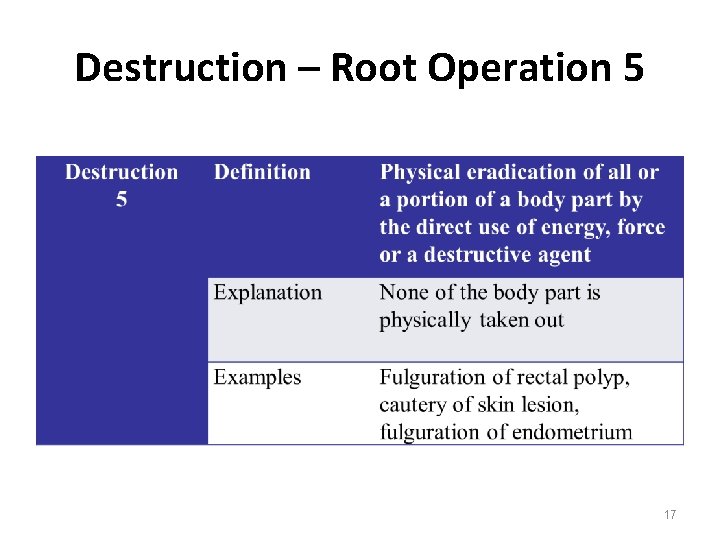
Destruction – Root Operation 5 17
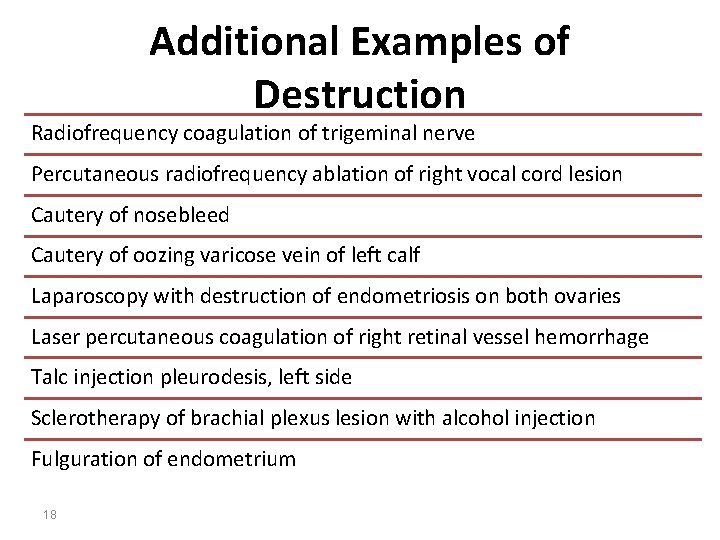
Additional Examples of Destruction Radiofrequency coagulation of trigeminal nerve Percutaneous radiofrequency ablation of right vocal cord lesion Cautery of nosebleed Cautery of oozing varicose vein of left calf Laparoscopy with destruction of endometriosis on both ovaries Laser percutaneous coagulation of right retinal vessel hemorrhage Talc injection pleurodesis, left side Sclerotherapy of brachial plexus lesion with alcohol injection Fulguration of endometrium 18
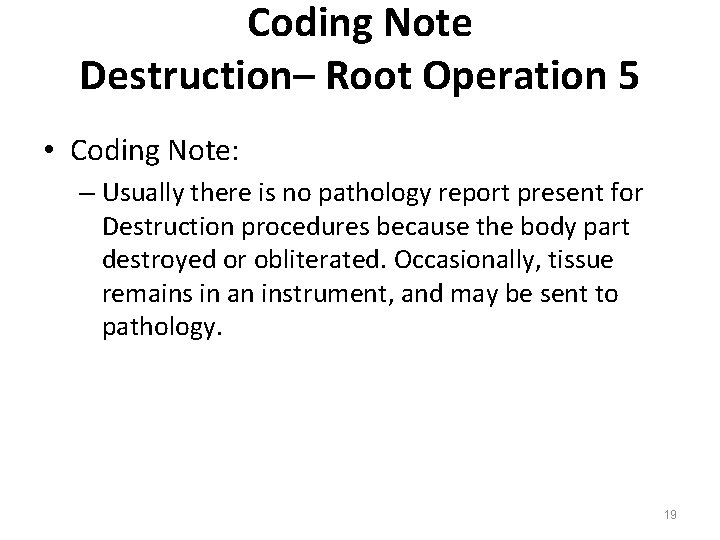
Coding Note Destruction– Root Operation 5 • Coding Note: – Usually there is no pathology report present for Destruction procedures because the body part destroyed or obliterated. Occasionally, tissue remains in an instrument, and may be sent to pathology. 19
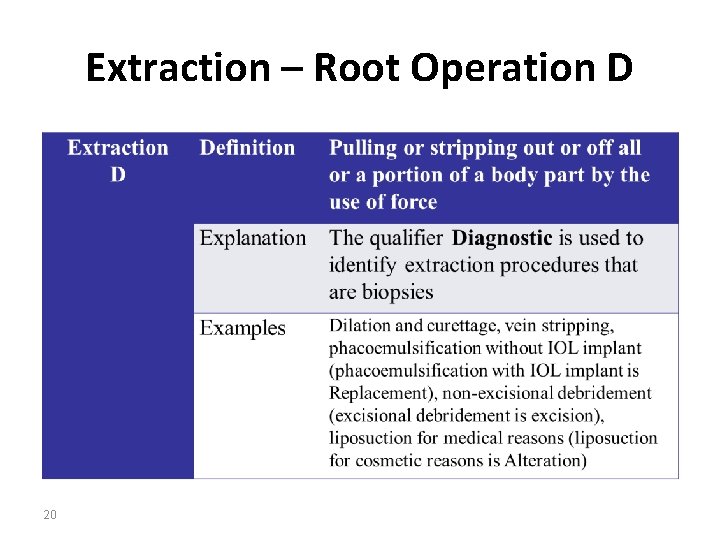
Extraction – Root Operation D 20
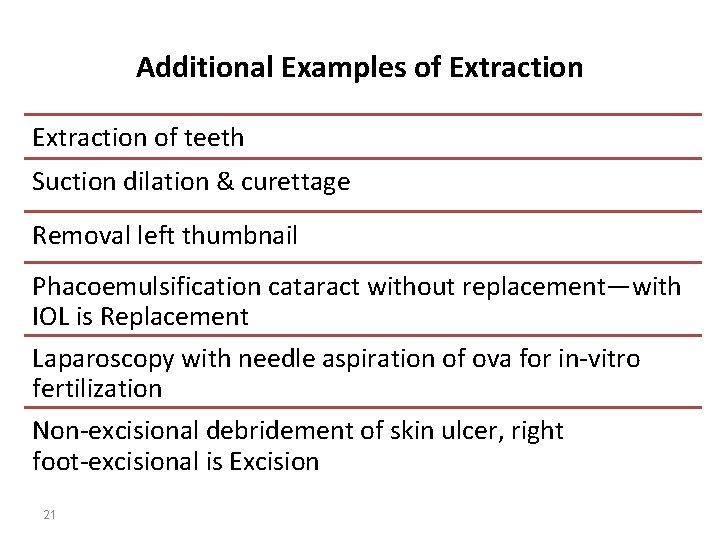
Additional Examples of Extraction of teeth Suction dilation & curettage Removal left thumbnail Phacoemulsification cataract without replacement—with IOL is Replacement Laparoscopy with needle aspiration of ova for in-vitro fertilization Non-excisional debridement of skin ulcer, right foot-excisional is Excision 21
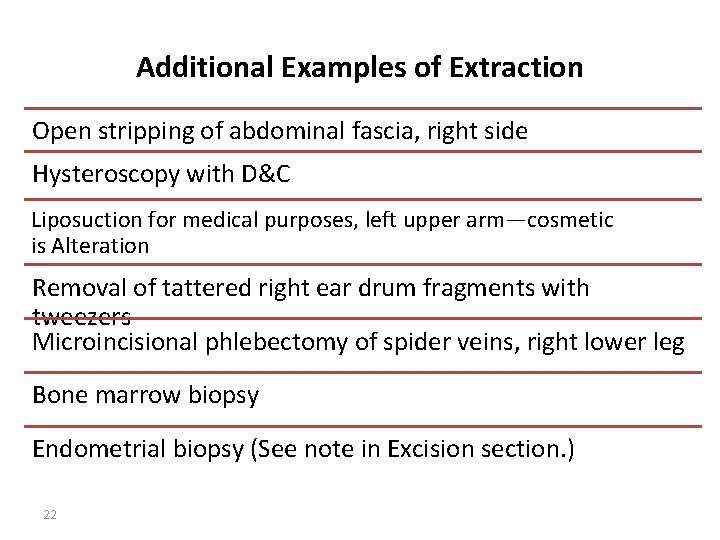
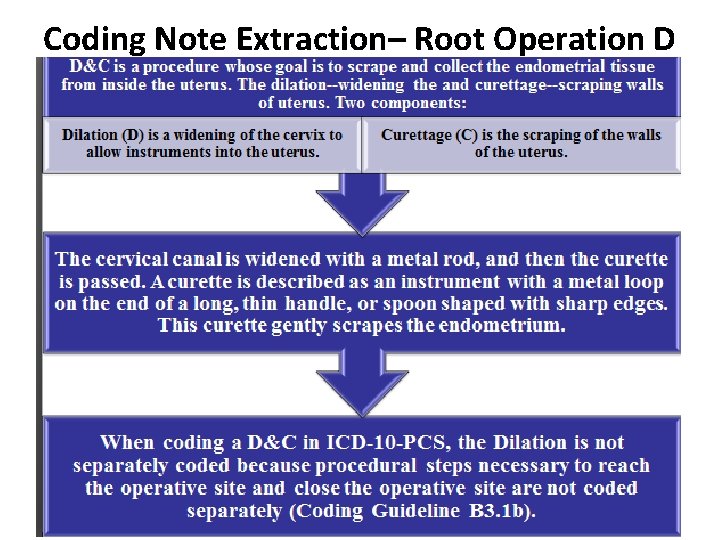
Additional Examples of Extraction Open stripping of abdominal fascia, right side Hysteroscopy with D&C Liposuction for medical purposes, left upper arm—cosmetic is Alteration Removal of tattered right ear drum fragments with tweezers Microincisional phlebectomy of spider veins, right lower leg Bone marrow biopsy Endometrial biopsy (See note in Excision section. ) 22
Coding Note Extraction– Root Operation D 23
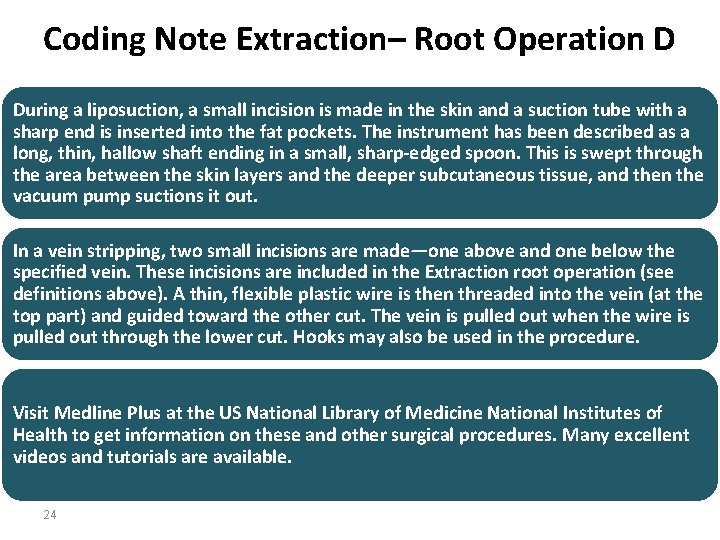
Coding Note Extraction– Root Operation D During a liposuction, a small incision is made in the skin and a suction tube with a sharp end is inserted into the fat pockets. The instrument has been described as a long, thin, hallow shaft ending in a small, sharp-edged spoon. This is swept through the area between the skin layers and the deeper subcutaneous tissue, and then the vacuum pump suctions it out. In a vein stripping, two small incisions are made—one above and one below the specified vein. These incisions are included in the Extraction root operation (see definitions above). A thin, flexible plastic wire is then threaded into the vein (at the top part) and guided toward the other cut. The vein is pulled out when the wire is pulled out through the lower cut. Hooks may also be used in the procedure. Visit Medline Plus at the US National Library of Medicine National Institutes of Health to get information on these and other surgical procedures. Many excellent videos and tutorials are available. 24
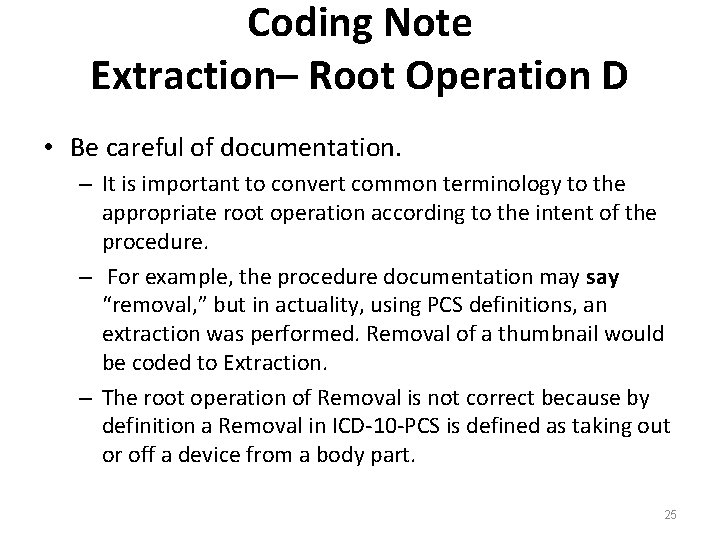
Coding Note Extraction– Root Operation D • Be careful of documentation. – It is important to convert common terminology to the appropriate root operation according to the intent of the procedure. – For example, the procedure documentation may say “removal, ” but in actuality, using PCS definitions, an extraction was performed. Removal of a thumbnail would be coded to Extraction. – The root operation of Removal is not correct because by definition a Removal in ICD-10 -PCS is defined as taking out or off a device from a body part. 25
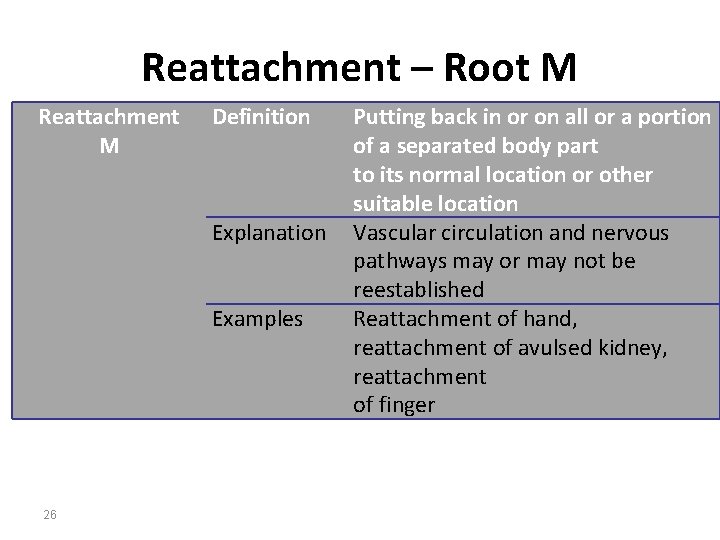
Reattachment – Root M Reattachment M Definition Explanation Examples 26 Putting back in or on all or a portion of a separated body part to its normal location or other suitable location Vascular circulation and nervous pathways may or may not be reestablished Reattachment of hand, reattachment of avulsed kidney, reattachment of finger
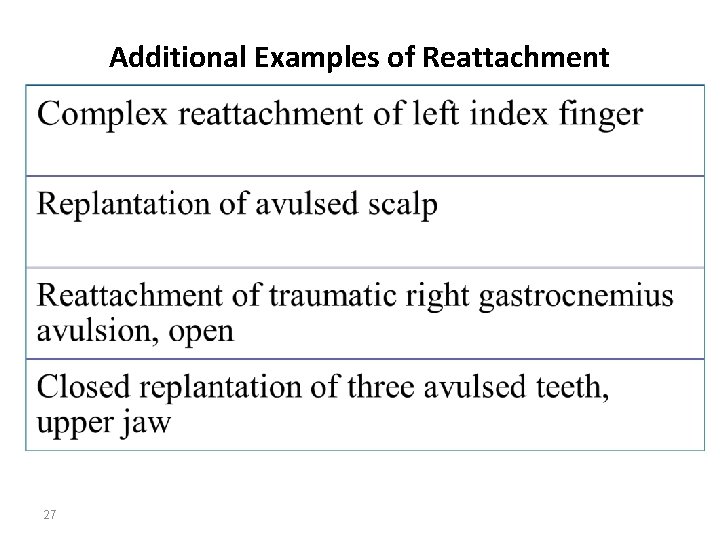
Additional Examples of Reattachment 27
Place Holder • Please insert You. Tube videos • Finger reattachment surgery 28
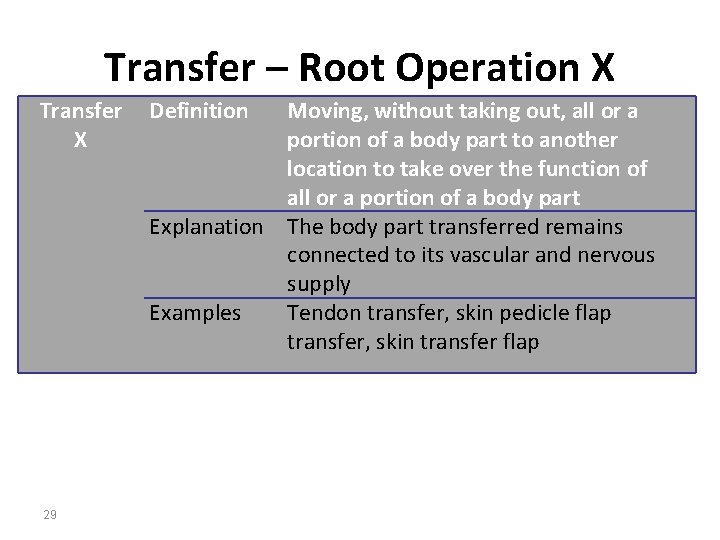
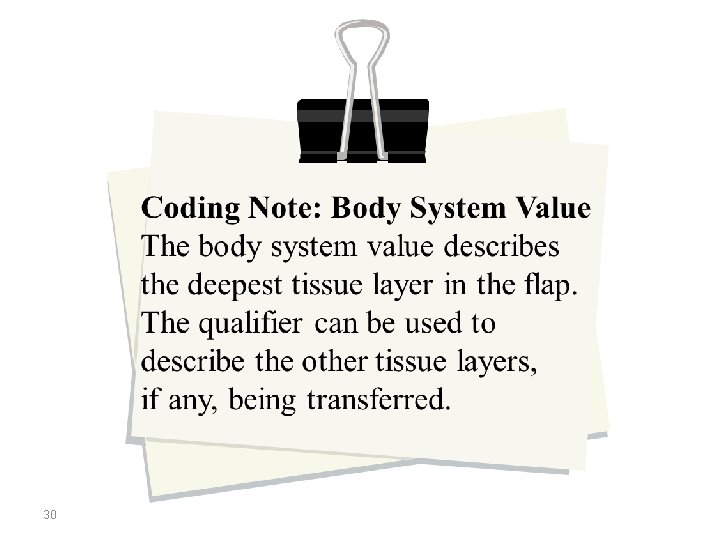
Transfer – Root Operation X Transfer X 29 Definition Moving, without taking out, all or a portion of a body part to another location to take over the function of all or a portion of a body part Explanation The body part transferred remains connected to its vascular and nervous supply Examples Tendon transfer, skin pedicle flap transfer, skin transfer flap
30
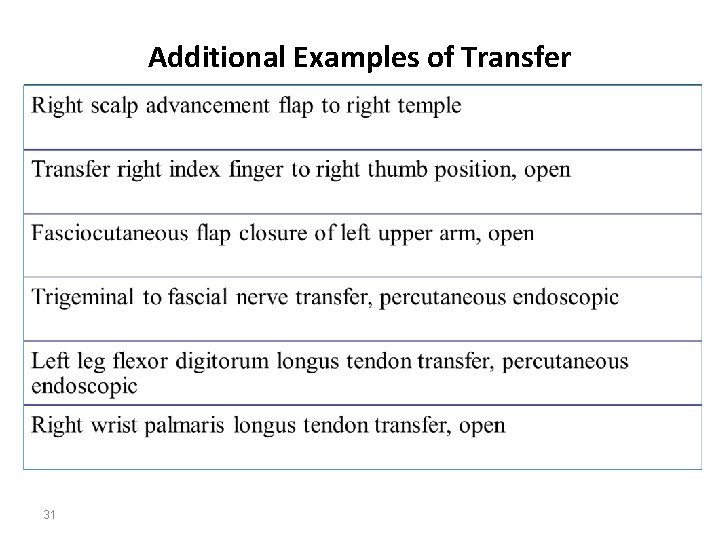
Additional Examples of Transfer 31
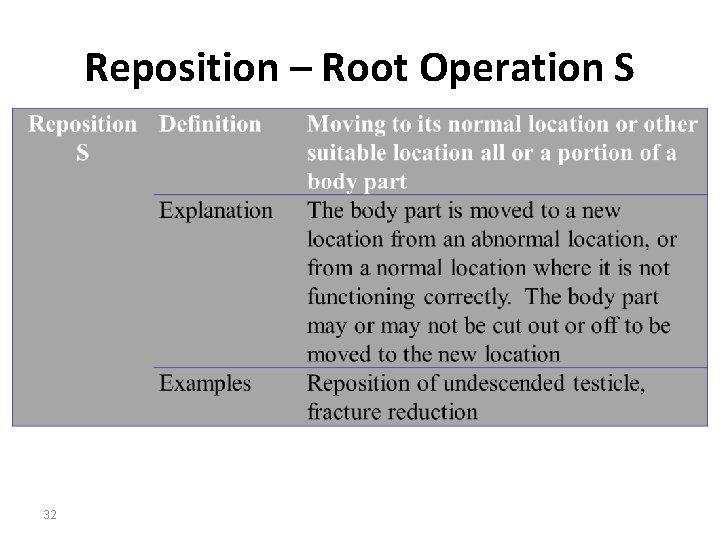
Reposition – Root Operation S 32
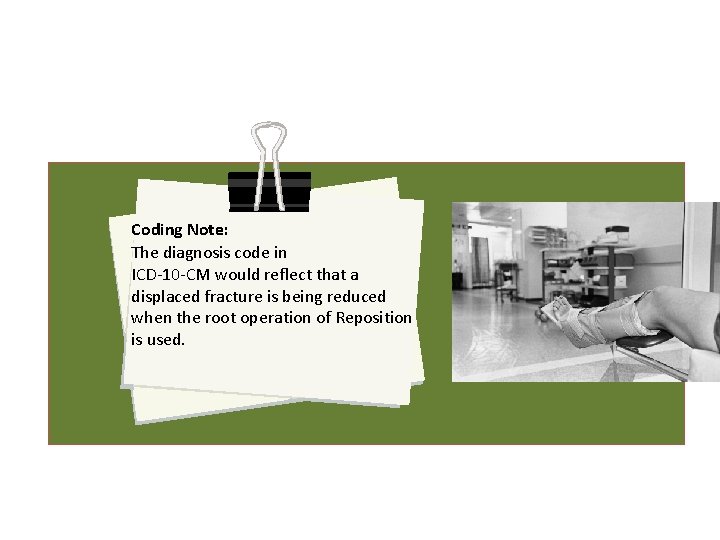
Coding Note: The diagnosis code in ICD-10 -CM would reflect that a displaced fracture is being reduced when the root operation of Reposition is used.
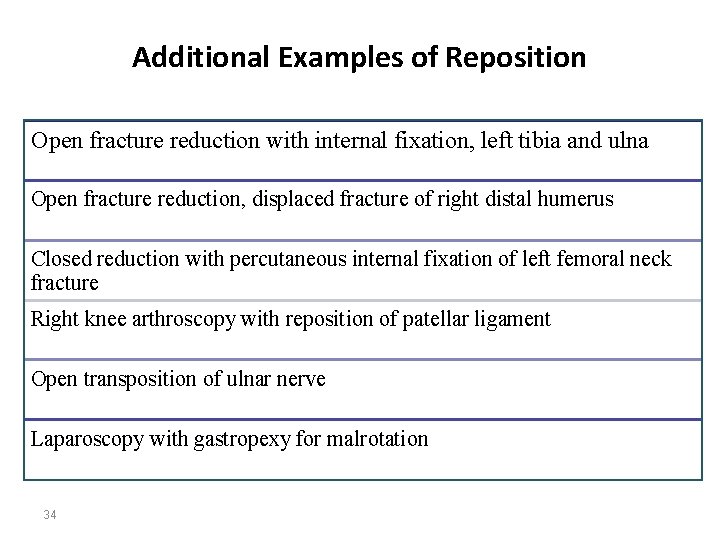
Additional Examples of Reposition Open fracture reduction with internal fixation, left tibia and ulna Open fracture reduction, displaced fracture of right distal humerus Closed reduction with percutaneous internal fixation of left femoral neck fracture Right knee arthroscopy with reposition of patellar ligament Open transposition of ulnar nerve Laparoscopy with gastropexy for malrotation 34
Place Holder • Please insert You. Tube videos • Anterior Transposition of the ulnar nerve • Laparoscopic Ladd surgery for intestinal Malrotation 35
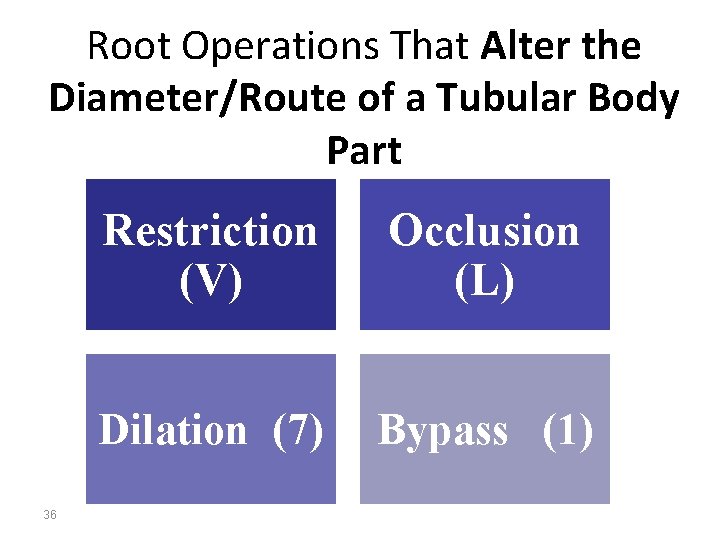
Root Operations That Alter the Diameter/Route of a Tubular Body Part 36 Restriction (V) Occlusion (L) Dilation (7) Bypass (1)
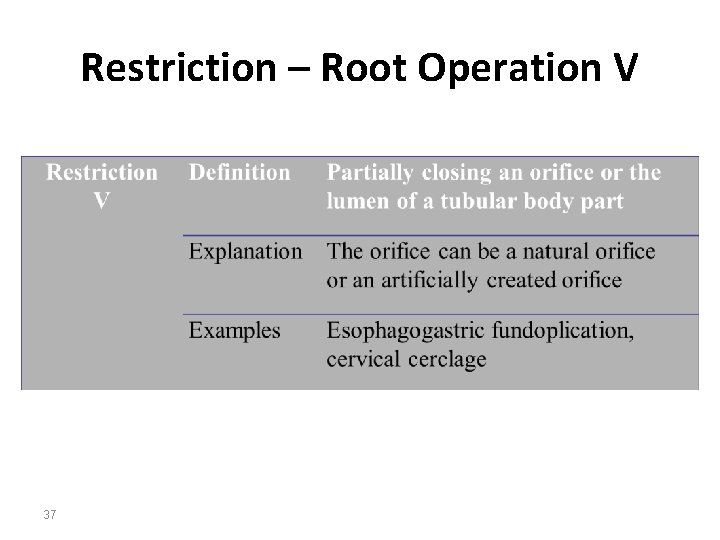
Restriction – Root Operation V 37
Coding Note: Since intraluminal or extraluminal clips are frequently used to accomplish the objectives of Restriction and Occlusion procedures, careful review of the operative report is required. Research on the procedure technique may also be helpful. 38
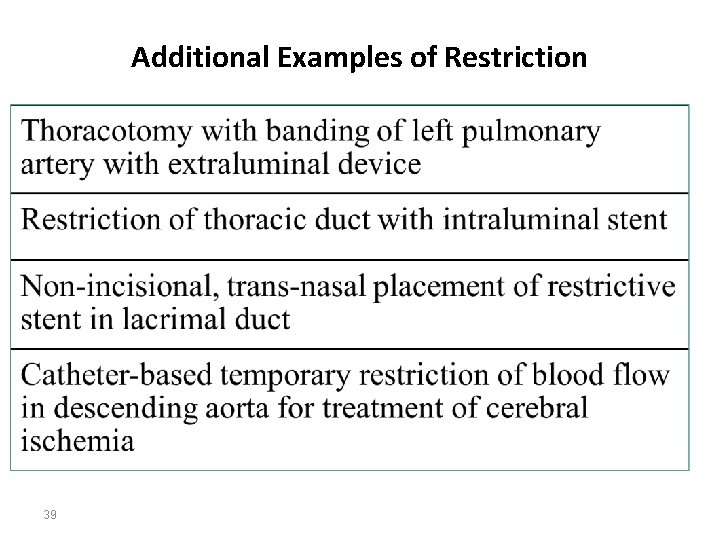
Additional Examples of Restriction 39
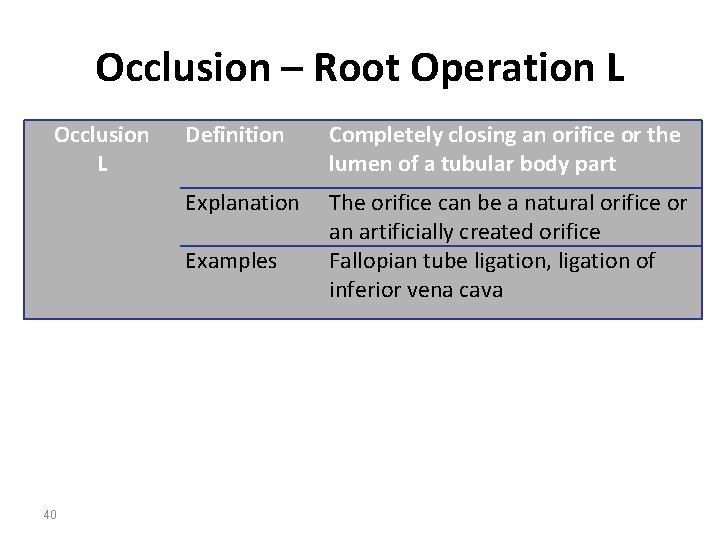
Occlusion – Root Operation L Occlusion L Definition Completely closing an orifice or the lumen of a tubular body part Explanation The orifice can be a natural orifice or an artificially created orifice Fallopian tube ligation, ligation of inferior vena cava Examples 40
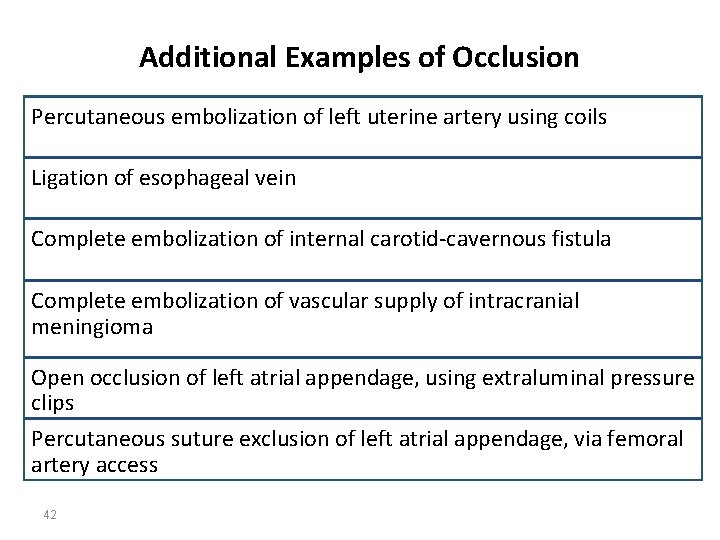
Coding Note: Since intraluminal or extraluminal clips are frequently used to accomplish the objectives of Restriction and Occlusion procedures, careful review of the operative report is required. Research on the procedure technique may also be helpful. 41
Additional Examples of Occlusion Percutaneous embolization of left uterine artery using coils Ligation of esophageal vein Complete embolization of internal carotid-cavernous fistula Complete embolization of vascular supply of intracranial meningioma Open occlusion of left atrial appendage, using extraluminal pressure clips Percutaneous suture exclusion of left atrial appendage, via femoral artery access 42
Place Holder • Please insert You. Tube videos • Tubal Ligation Video 43
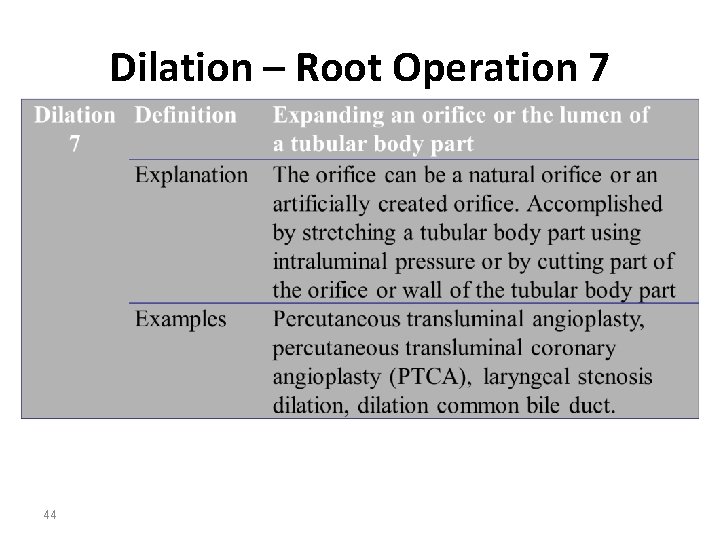
Dilation – Root Operation 7 44
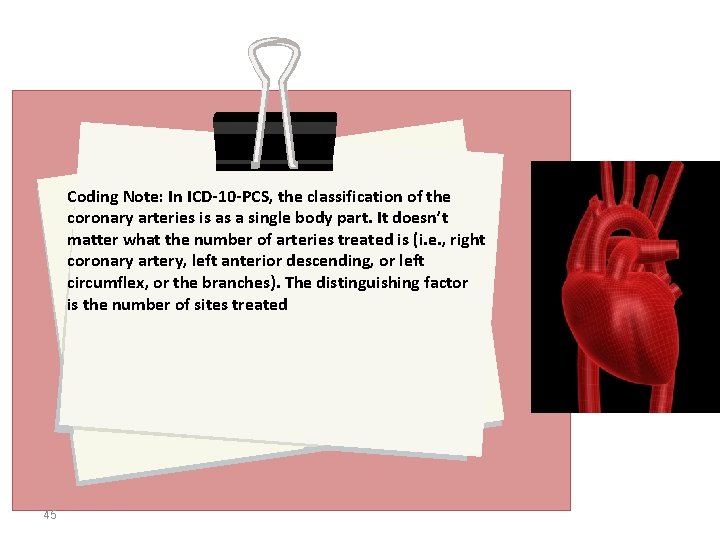
Coding Note: In ICD-10 -PCS, the classification of the coronary arteries is as a single body part. It doesn’t matter what the number of arteries treated is (i. e. , right coronary artery, left anterior descending, or left circumflex, or the branches). The distinguishing factor is the number of sites treated 45
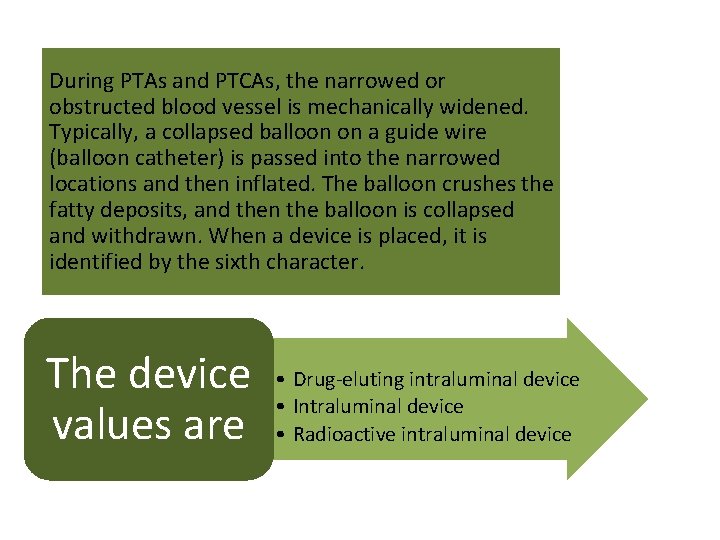
During PTAs and PTCAs, the narrowed or obstructed blood vessel is mechanically widened. Typically, a collapsed balloon on a guide wire (balloon catheter) is passed into the narrowed locations and then inflated. The balloon crushes the fatty deposits, and then the balloon is collapsed and withdrawn. When a device is placed, it is identified by the sixth character. The device values are • Drug-eluting intraluminal device • Intraluminal device • Radioactive intraluminal device
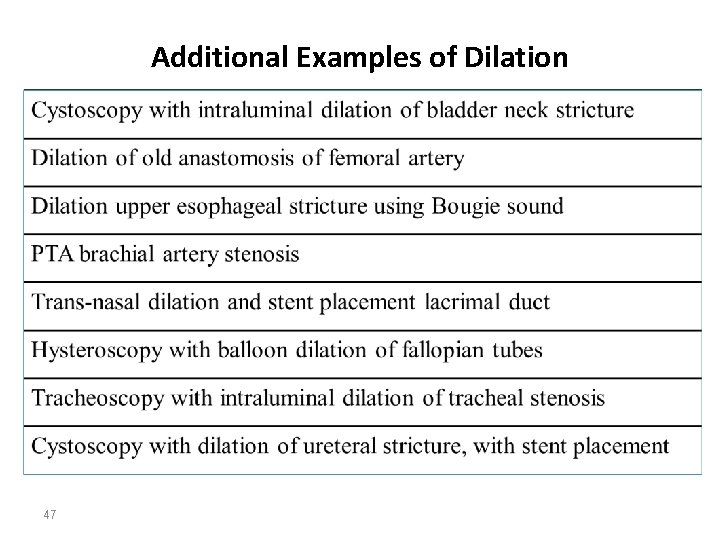
Additional Examples of Dilation 47
Place Holder • Please insert You. Tube videos • Cardiovascular Medicine: Percutaneous Transliminal Coronary Angioplasty 48
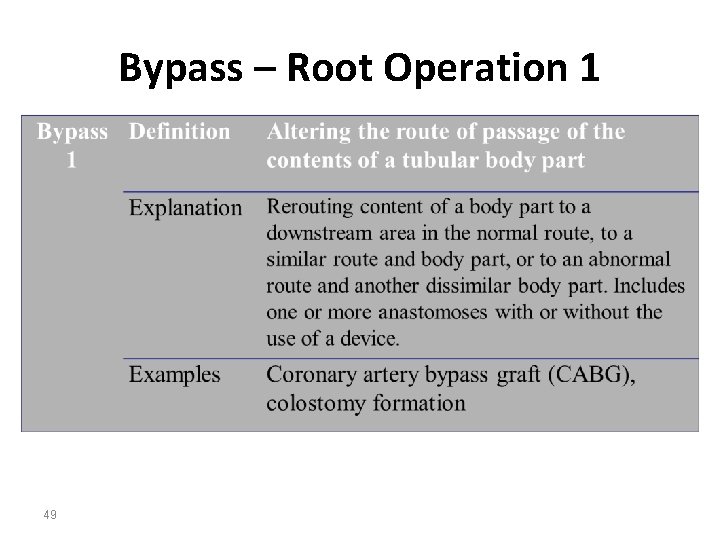
Bypass – Root Operation 1 49
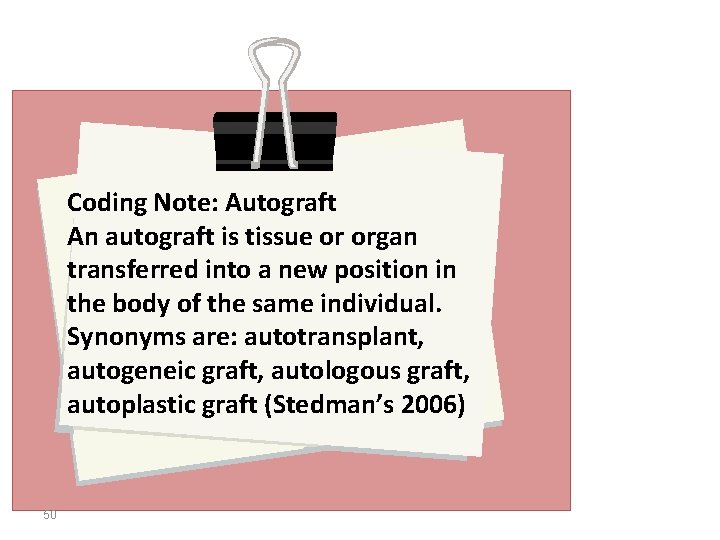
Coding Note: Autograft An autograft is tissue or organ transferred into a new position in the body of the same individual. Synonyms are: autotransplant, autogeneic graft, autologous graft, autoplastic graft (Stedman’s 2006) 50
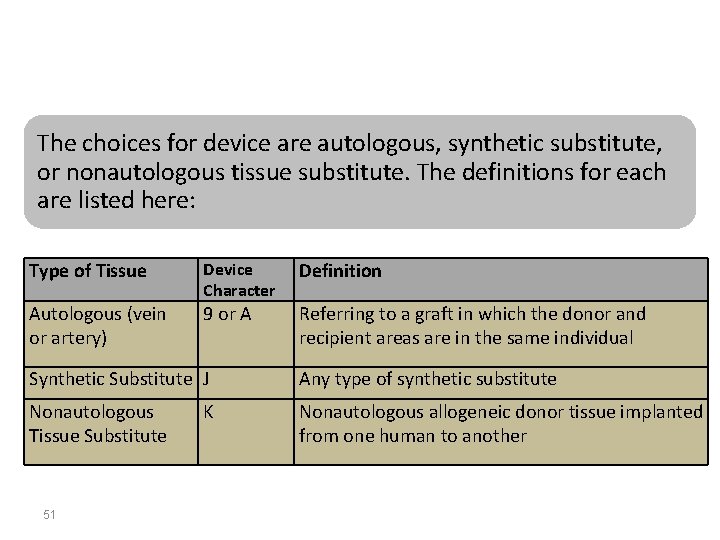
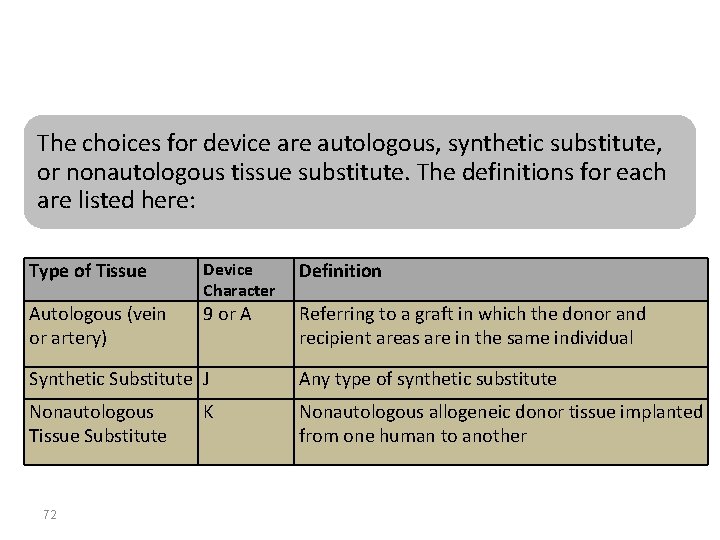
The choices for device are autologous, synthetic substitute, or nonautologous tissue substitute. The definitions for each are listed here: Type of Tissue Autologous (vein or artery) Device Character 9 or A Definition Referring to a graft in which the donor and recipient areas are in the same individual Synthetic Substitute J Any type of synthetic substitute Nonautologous Tissue Substitute Nonautologous allogeneic donor tissue implanted from one human to another 51 K
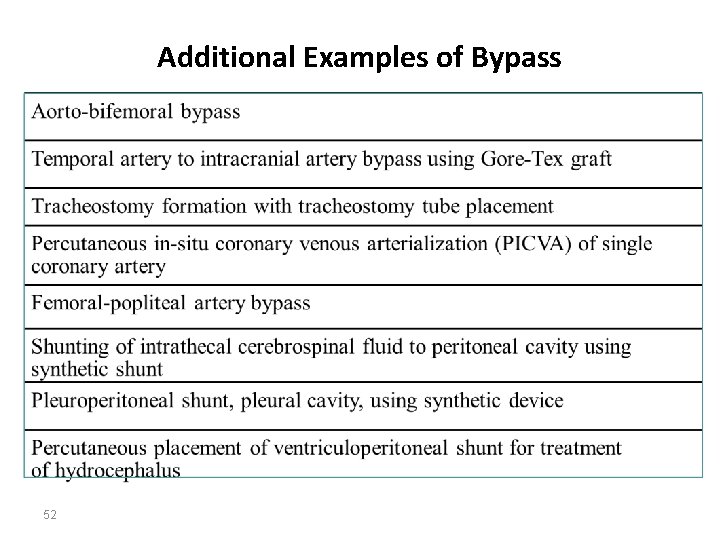
Additional Examples of Bypass 52
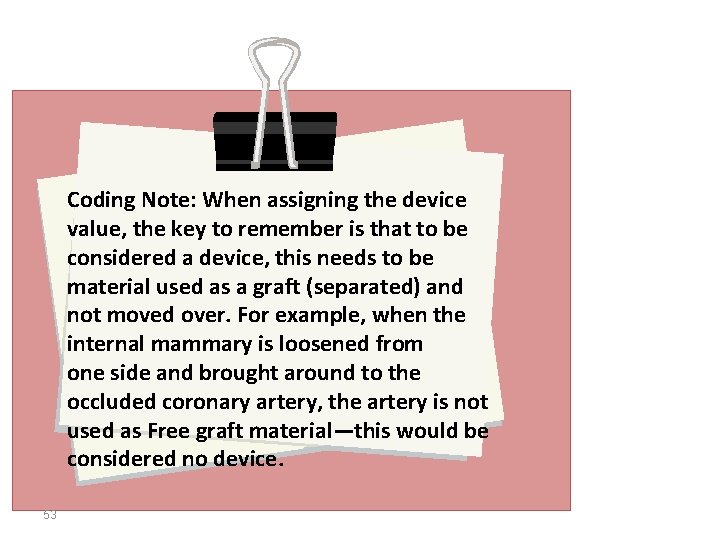
Coding Note: When assigning the device value, the key to remember is that to be considered a device, this needs to be material used as a graft (separated) and not moved over. For example, when the internal mammary is loosened from one side and brought around to the occluded coronary artery, the artery is not used as Free graft material—this would be considered no device. 53
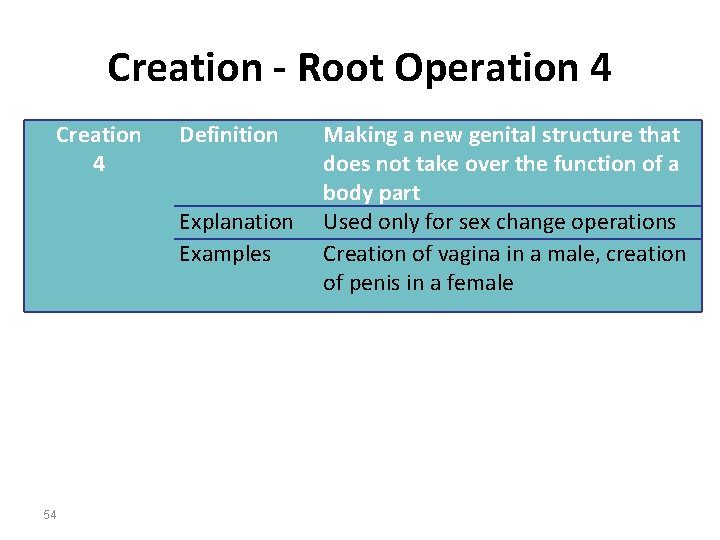
Creation - Root Operation 4 Creation 4 Definition Explanation Examples 54 Making a new genital structure that does not take over the function of a body part Used only for sex change operations Creation of vagina in a male, creation of penis in a female
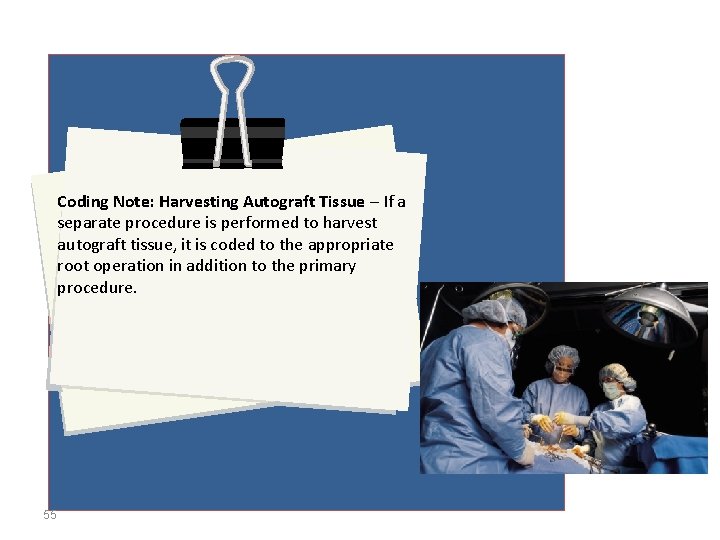
Coding Note: Harvesting Autograft Tissue – If a separate procedure is performed to harvest autograft tissue, it is coded to the appropriate root operation in addition to the primary procedure. 55
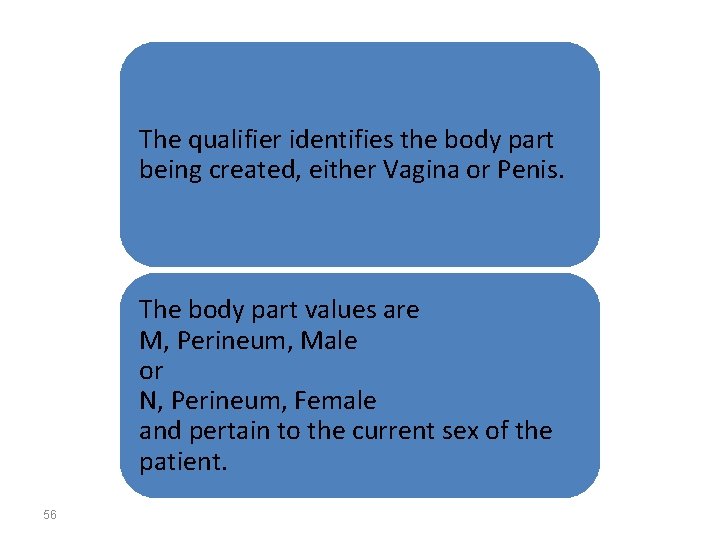
The qualifier identifies the body part being created, either Vagina or Penis. The body part values are M, Perineum, Male or N, Perineum, Female and pertain to the current sex of the patient. 56
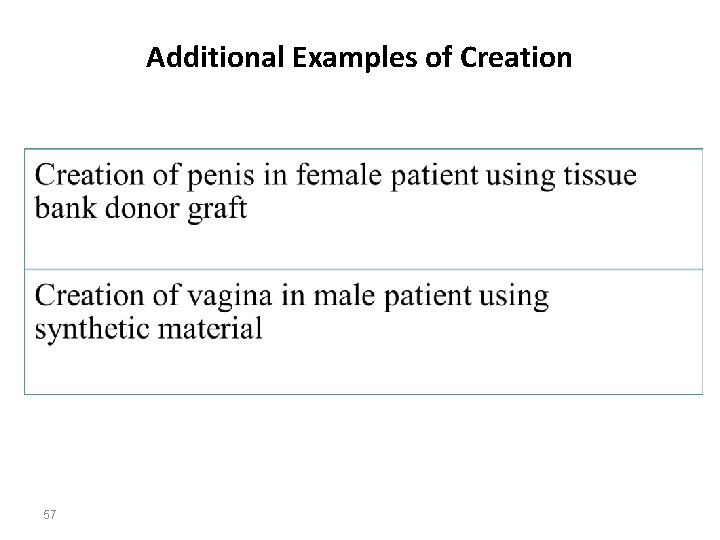
Additional Examples of Creation 57
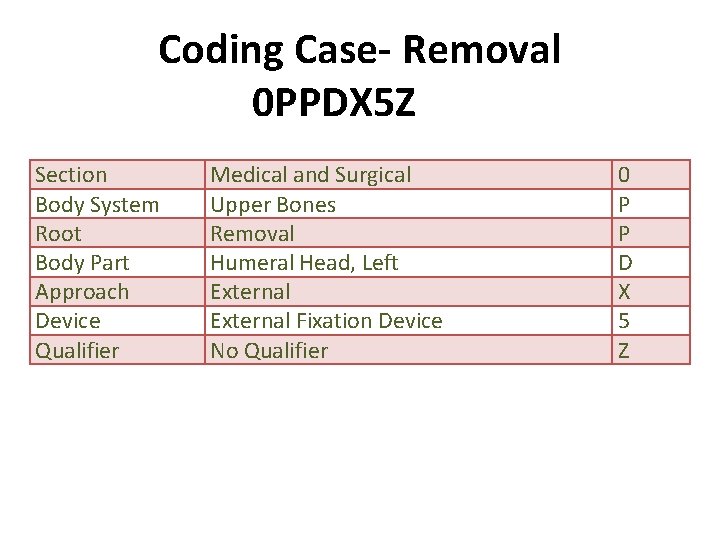
Activity Coding Removal Coding Case: Removal of external fixator, left humeral head fracture
Coding Case- Removal 0 PPDX 5 Z Section Body System Root Body Part Approach Device Qualifier Medical and Surgical Upper Bones Removal Humeral Head, Left External Fixation Device No Qualifier 0 P P D X 5 Z
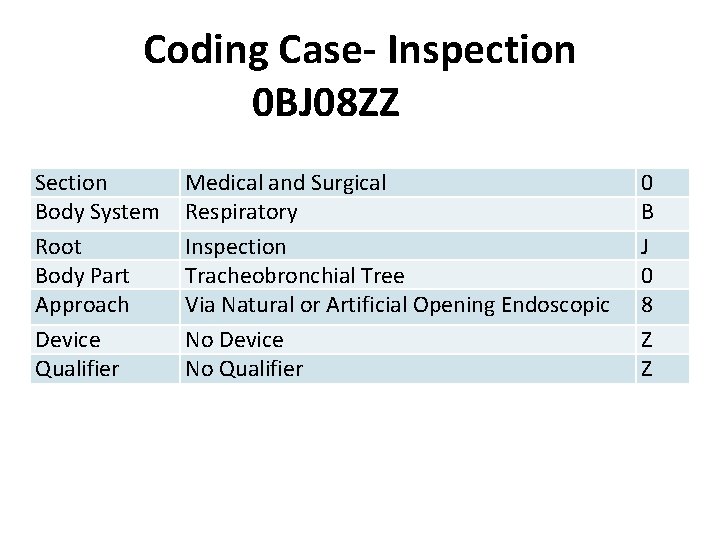
Activity Coding Inspection Coding Case: Diagnostic bronchoscopy of the left bronchus
Coding Case- Inspection 0 BJ 08 ZZ Section Body System Root Body Part Approach Device Qualifier Medical and Surgical Respiratory Inspection Tracheobronchial Tree Via Natural or Artificial Opening Endoscopic No Device No Qualifier 0 B J 0 8 Z Z
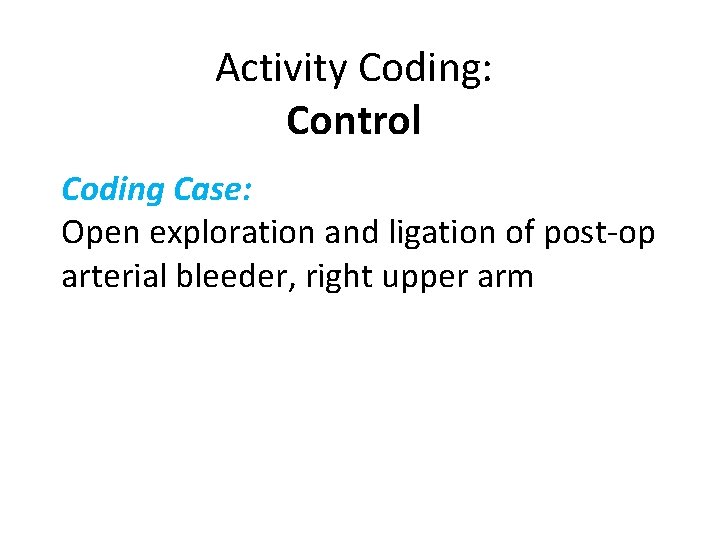
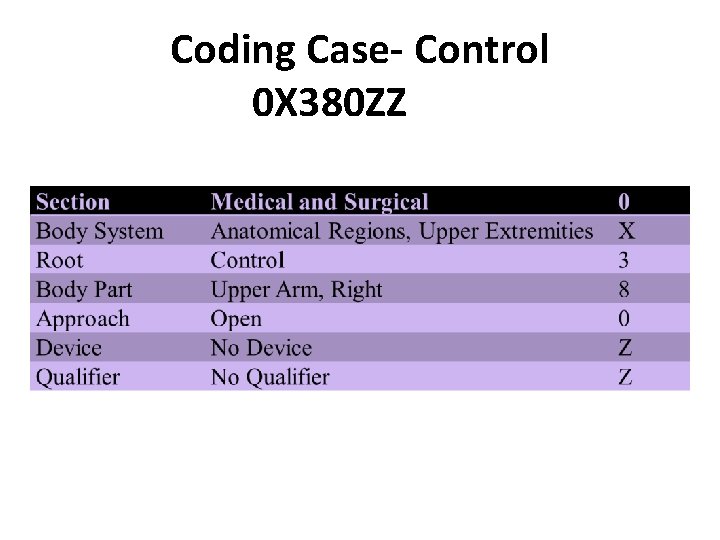
Activity Coding: Control Coding Case: Open exploration and ligation of post-op arterial bleeder, right upper arm
Coding Case- Control 0 X 380 ZZ
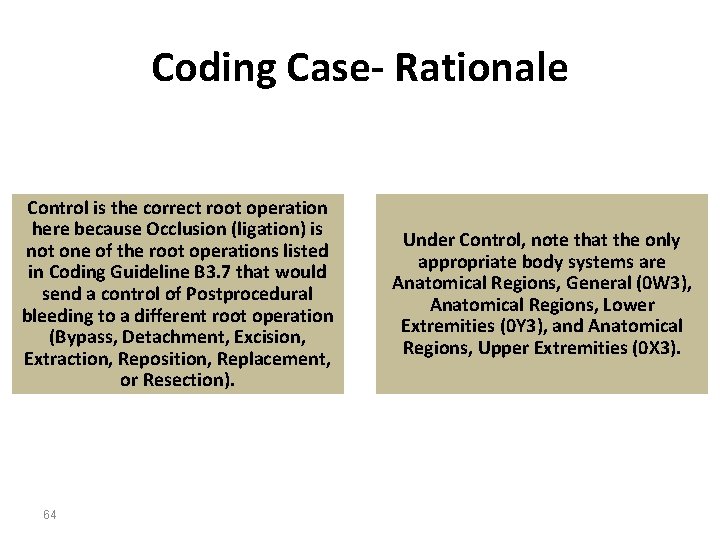
Coding Case- Rationale Control is the correct root operation here because Occlusion (ligation) is not one of the root operations listed in Coding Guideline B 3. 7 that would send a control of Postprocedural bleeding to a different root operation (Bypass, Detachment, Excision, Extraction, Reposition, Replacement, or Resection). 64 Under Control, note that the only appropriate body systems are Anatomical Regions, General (0 W 3), Anatomical Regions, Lower Extremities (0 Y 3), and Anatomical Regions, Upper Extremities (0 X 3).
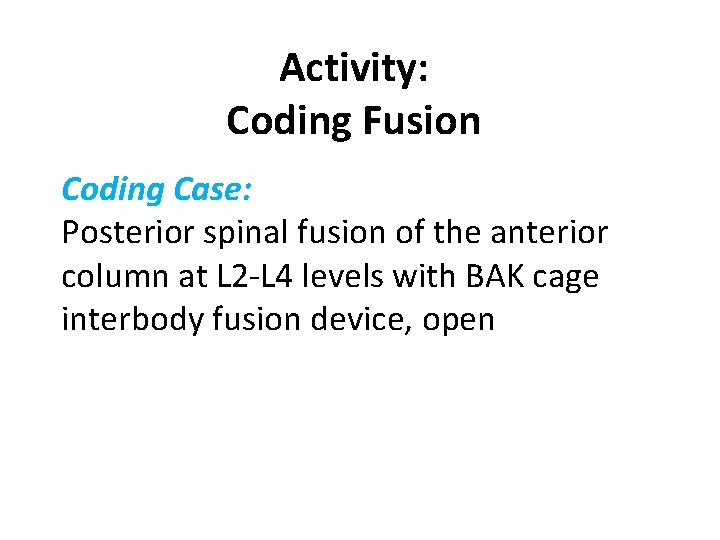
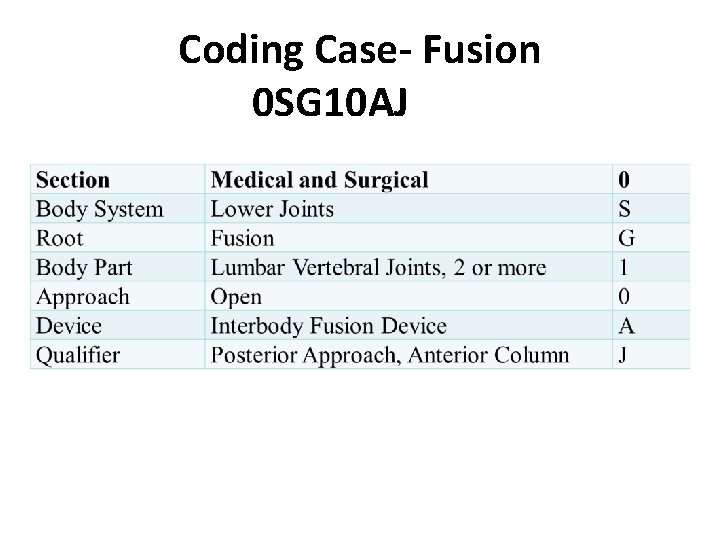
Activity: Coding Fusion Coding Case: Posterior spinal fusion of the anterior column at L 2 -L 4 levels with BAK cage interbody fusion device, open
Coding Case- Fusion 0 SG 10 AJ
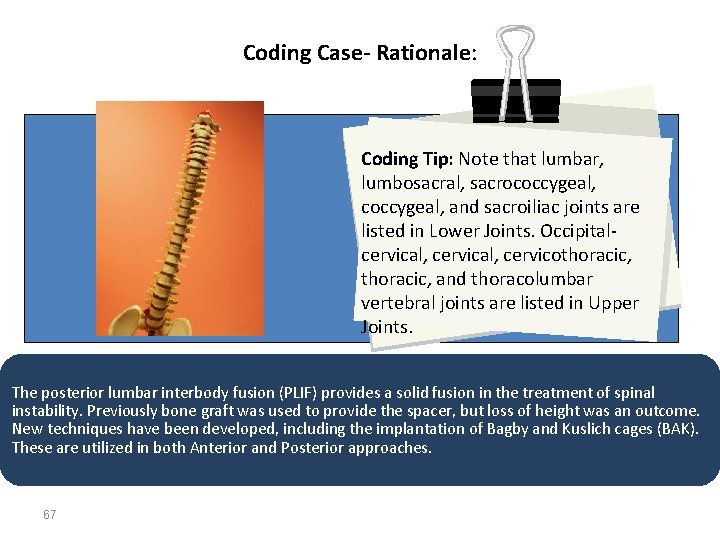
Coding Case- Rationale: Coding Tip: Note that lumbar, lumbosacral, sacrococcygeal, and sacroiliac joints are listed in Lower Joints. Occipitalcervical, cervicothoracic, and thoracolumbar vertebral joints are listed in Upper Joints. The posterior lumbar interbody fusion (PLIF) provides a solid fusion in the treatment of spinal instability. Previously bone graft was used to provide the spacer, but loss of height was an outcome. New techniques have been developed, including the implantation of Bagby and Kuslich cages (BAK). These are utilized in both Anterior and Posterior approaches. 67
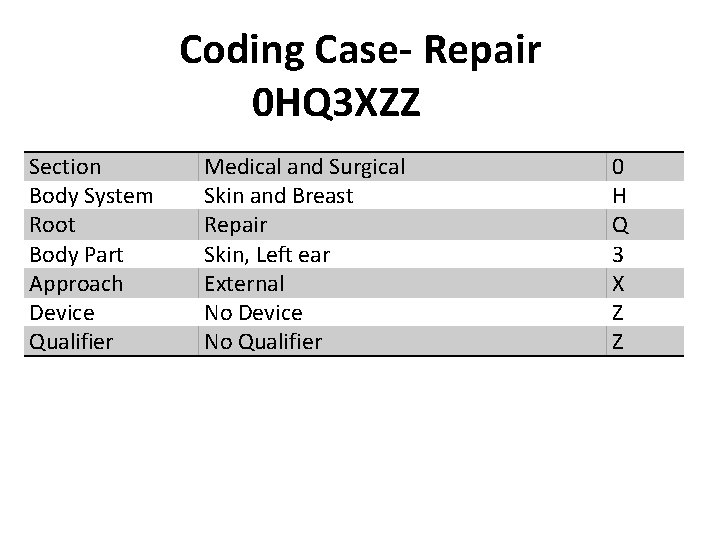
Activity Coding Repair Coding Case: Closure of skin laceration, left external ear
Coding Case- Repair 0 HQ 3 XZZ Section Body System Root Body Part Approach Device Qualifier Medical and Surgical Skin and Breast Repair Skin, Left ear External No Device No Qualifier 0 H Q 3 X Z Z
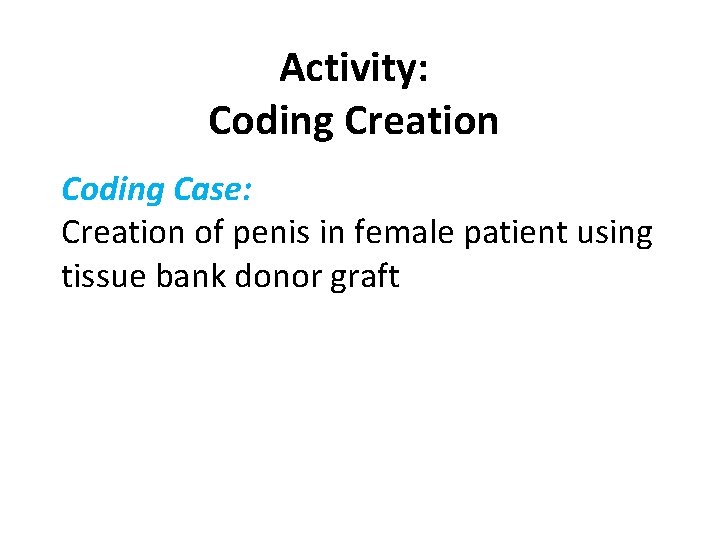
Activity: Coding Creation Coding Case: Creation of penis in female patient using tissue bank donor graft
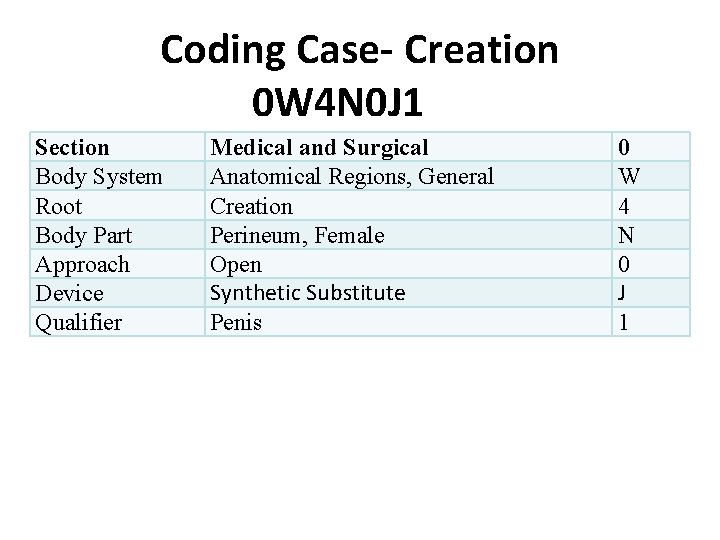
Coding Case- Creation 0 W 4 N 0 J 1 Section Body System Root Body Part Approach Device Qualifier Medical and Surgical Anatomical Regions, General Creation Perineum, Female Open Synthetic Substitute Penis 0 W 4 N 0 J 1
The choices for device are autologous, synthetic substitute, or nonautologous tissue substitute. The definitions for each are listed here: Type of Tissue Autologous (vein or artery) Device Character 9 or A Definition Referring to a graft in which the donor and recipient areas are in the same individual Synthetic Substitute J Any type of synthetic substitute Nonautologous Tissue Substitute Nonautologous allogeneic donor tissue implanted from one human to another 72 K