
MEDIC Algorithm for Evaluation of Suspected PE in

- Slides: 12
MEDIC Algorithm for Evaluation of Suspected PE in the ED Supplemental Material Last updated: 1/22/2020
What is MEDIC? • The Michigan Emergency Department Improvement Collaborative (MEDIC) was launched in 2015 as an emergency physician-led quality improvement Collaborative comprised of hospitals across Michigan. • MEDIC partners with emergency physicians who work together to collect and analyze data, identify best practices based on medical evidence, and improve collective performance. • Participating EDs submit data to a clinical registry maintained by the MEDIC Coordinating Center. • Support for MEDIC is provided by Blue Cross Blue Shield of Michigan and Blue Care Network within the BCBSM Value Partnerships program.
Why Standardize the ED Evaluation for Suspected PE? • Overuse of chest CT for PE in the ED • Cost, radiation exposure, overtreatment due to incidental findings • Mixed evidence for multiple clinical decision rules • No clear single “most effective” approach to evaluation for PE in the ED • Need to tailor testing strategy to pre-test probability of disease • Challenging diagnosis with non-specific symptoms • Symptoms are regularly encountered in the ED • Liability & risk associated with missing clinically significant PE • “Reasonable and prudent emergency care does not dictate that all patients with a sign or symptom of PE must be tested for PE. Nor does it dictate that a patient with one or more risk factors for PE must undergo testing for PE in the absence of a sign or symptom of PE. ” 1 1 Kline JA, Kabrhel C. Emergency Evaluation for Pulmonary Embolism, Part 2: Diagnostic Approach. The Journal of Emergency Medicine. 2015; 49(1): 104 -117. doi: 10. 1016/j. jemermed. 2014. 12. 041
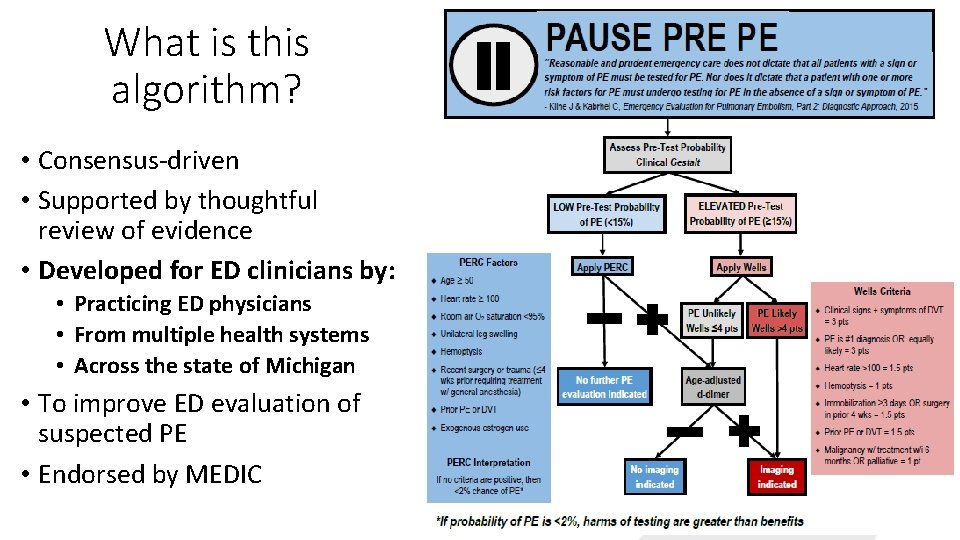
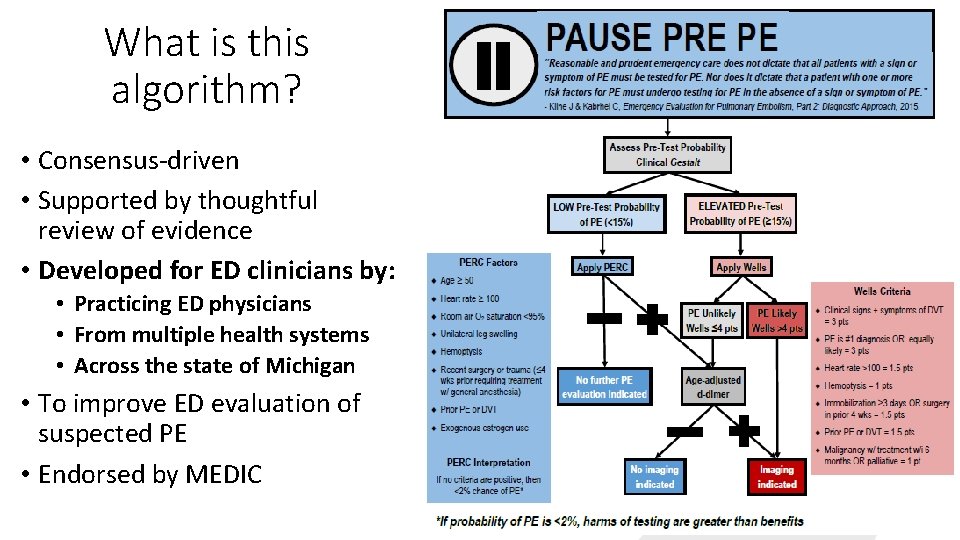
What is this algorithm? • Consensus-driven • Supported by thoughtful review of evidence • Developed for ED clinicians by: • Practicing ED physicians • From multiple health systems • Across the state of Michigan • To improve ED evaluation of suspected PE • Endorsed by MEDIC
Why “Pause Pre PE”? GOALS RATIONALE LITERATURE ED clinicians ONLY apply this algorithm when the available information supports a reasonable concern that the patient may have a PE as a cause of their symptoms. ED clinicians do NOT apply this algorithm for every patient with signs, symptoms, or risk factors for PE. The decision to initiate an evaluation for PE should be deliberate and calculated. For PE to enter the active differential diagnosis list for any patient, he or she must have at least one possible physiologic manifestation of PE. Kline JA, Kabrhel C. Emergency Evaluation for Pulmonary Embolism, Part 2: Diagnostic Approach. The Journal of Emergency Medicine. 2015; 49(1): 104 -117. doi: 10. 1016/j. jemermed. 2014. 12. 041
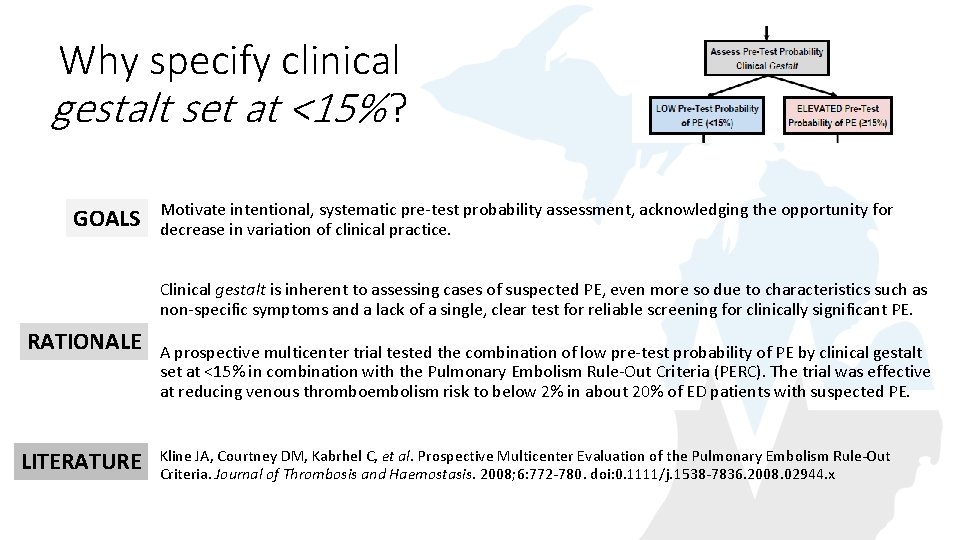
Why specify clinical gestalt set at <15% ? GOALS Motivate intentional, systematic pre-test probability assessment, acknowledging the opportunity for decrease in variation of clinical practice. Clinical gestalt is inherent to assessing cases of suspected PE, even more so due to characteristics such as non-specific symptoms and a lack of a single, clear test for reliable screening for clinically significant PE. RATIONALE LITERATURE A prospective multicenter trial tested the combination of low pre-test probability of PE by clinical gestalt set at <15% in combination with the Pulmonary Embolism Rule-Out Criteria (PERC). The trial was effective at reducing venous thromboembolism risk to below 2% in about 20% of ED patients with suspected PE. Kline JA, Courtney DM, Kabrhel C, et al. Prospective Multicenter Evaluation of the Pulmonary Embolism Rule-Out Criteria. Journal of Thrombosis and Haemostasis. 2008; 6: 772 -780. doi: 0. 1111/j. 1538 -7836. 2008. 02944. x
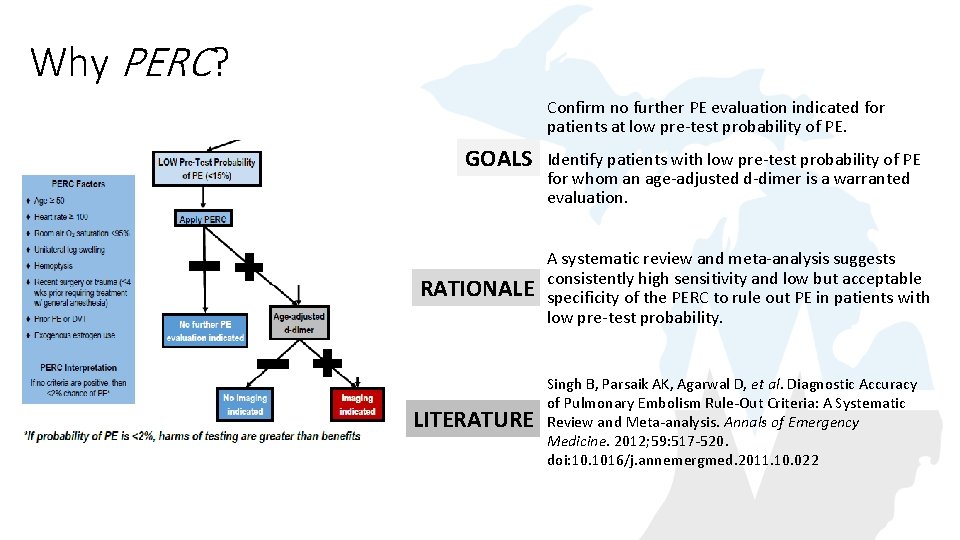
Why PERC? Confirm no further PE evaluation indicated for patients at low pre-test probability of PE. GOALS RATIONALE LITERATURE Identify patients with low pre-test probability of PE for whom an age-adjusted d-dimer is a warranted evaluation. A systematic review and meta-analysis suggests consistently high sensitivity and low but acceptable specificity of the PERC to rule out PE in patients with low pre-test probability. Singh B, Parsaik AK, Agarwal D, et al. Diagnostic Accuracy of Pulmonary Embolism Rule-Out Criteria: A Systematic Review and Meta-analysis. Annals of Emergency Medicine. 2012; 59: 517 -520. doi: 10. 1016/j. annemergmed. 2011. 10. 022
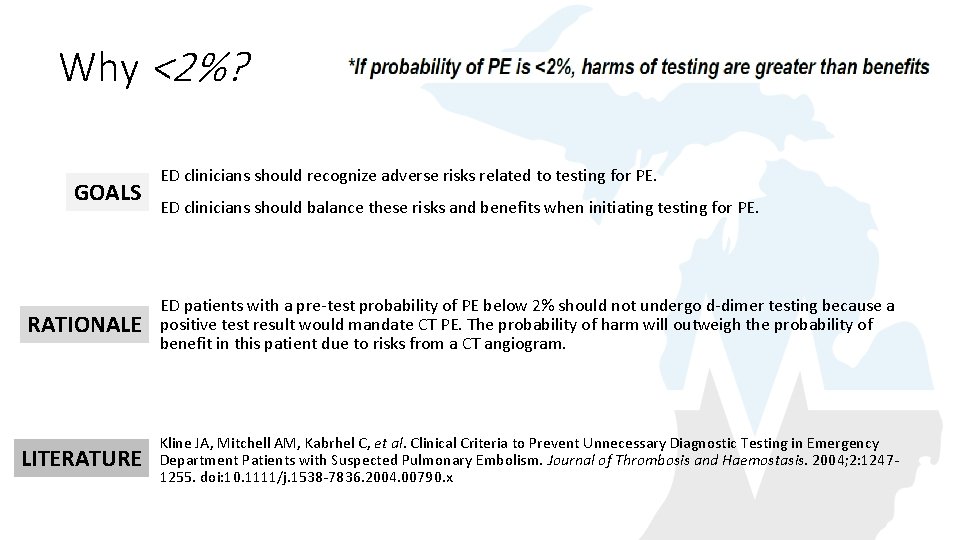
Why <2%? GOALS ED clinicians should recognize adverse risks related to testing for PE. ED clinicians should balance these risks and benefits when initiating testing for PE. RATIONALE ED patients with a pre-test probability of PE below 2% should not undergo d-dimer testing because a positive test result would mandate CT PE. The probability of harm will outweigh the probability of benefit in this patient due to risks from a CT angiogram. LITERATURE Kline JA, Mitchell AM, Kabrhel C, et al. Clinical Criteria to Prevent Unnecessary Diagnostic Testing in Emergency Department Patients with Suspected Pulmonary Embolism. Journal of Thrombosis and Haemostasis. 2004; 2: 12471255. doi: 10. 1111/j. 1538 -7836. 2004. 00790. x
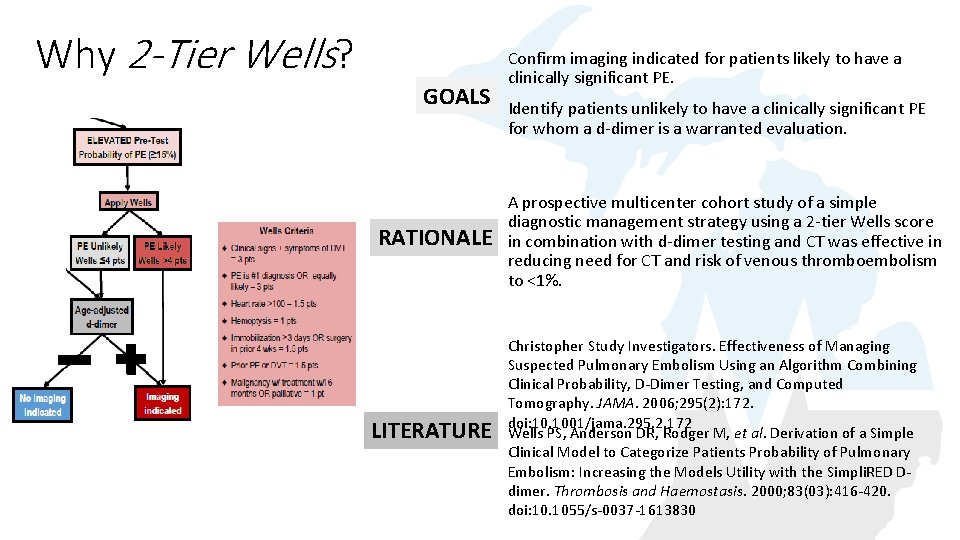
Why 2 -Tier Wells? GOALS RATIONALE LITERATURE Confirm imaging indicated for patients likely to have a clinically significant PE. Identify patients unlikely to have a clinically significant PE for whom a d-dimer is a warranted evaluation. A prospective multicenter cohort study of a simple diagnostic management strategy using a 2 -tier Wells score in combination with d-dimer testing and CT was effective in reducing need for CT and risk of venous thromboembolism to <1%. Christopher Study Investigators. Effectiveness of Managing Suspected Pulmonary Embolism Using an Algorithm Combining Clinical Probability, D-Dimer Testing, and Computed Tomography. JAMA. 2006; 295(2): 172. doi: 10. 1001/jama. 295. 2. 172 Wells PS, Anderson DR, Rodger M, et al. Derivation of a Simple Clinical Model to Categorize Patients Probability of Pulmonary Embolism: Increasing the Models Utility with the Simpli. RED Ddimer. Thrombosis and Haemostasis. 2000; 83(03): 416 -420. doi: 10. 1055/s-0037 -1613830
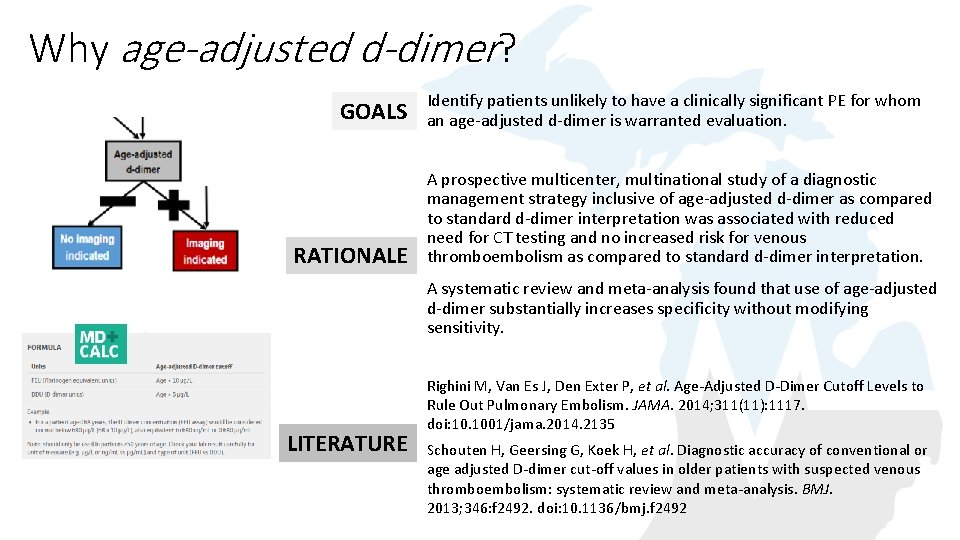
Why age-adjusted d-dimer? GOALS RATIONALE Identify patients unlikely to have a clinically significant PE for whom an age-adjusted d-dimer is warranted evaluation. A prospective multicenter, multinational study of a diagnostic management strategy inclusive of age-adjusted d-dimer as compared to standard d-dimer interpretation was associated with reduced need for CT testing and no increased risk for venous thromboembolism as compared to standard d-dimer interpretation. A systematic review and meta-analysis found that use of age-adjusted d-dimer substantially increases specificity without modifying sensitivity. LITERATURE Righini M, Van Es J, Den Exter P, et al. Age-Adjusted D-Dimer Cutoff Levels to Rule Out Pulmonary Embolism. JAMA. 2014; 311(11): 1117. doi: 10. 1001/jama. 2014. 2135 Schouten H, Geersing G, Koek H, et al. Diagnostic accuracy of conventional or age adjusted D-dimer cut-off values in older patients with suspected venous thromboembolism: systematic review and meta-analysis. BMJ. 2013; 346: f 2492. doi: 10. 1136/bmj. f 2492
What is this algorithm? • Consensus-driven • Supported by thoughtful review of evidence • Developed for ED clinicians by: • Practicing ED physicians • From multiple health systems • Across the state of Michigan • To improve ED evaluation of suspected PE • Endorsed by MEDIC
Key References • Christopher Study Investigators. Effectiveness of Managing Suspected Pulmonary Embolism Using an Algorithm Combining Clinical Probability, D-Dimer Testing, and Computed Tomography. JAMA. 2006; 295(2): 172. doi: 10. 1001/jama. 295. 2. 172 • Kline JA, Courtney DM, Kabrhel C, et al. Prospective Multicenter Evaluation of the Pulmonary Embolism Rule-Out Criteria. Journal of Thrombosis and Haemostasis. 2008; 6: 772 -780. doi: 0. 1111/j. 1538 -7836. 2008. 02944. x • Kline JA, Kabrhel C. Emergency Evaluation for Pulmonary Embolism, Part 2: Diagnostic Approach. The Journal of Emergency Medicine. 2015; 49(1): 104 -117. doi: 10. 1016/j. jemermed. 2014. 12. 041 • Kline JA, Mitchell AM, Kabrhel C, et al. Clinical Criteria to Prevent Unnecessary Diagnostic Testing in Emergency Department Patients with Suspected Pulmonary Embolism. Journal of Thrombosis and Haemostasis. 2004; 2: 1247 -1255. doi: 10. 1111/j. 1538 -7836. 2004. 00790. x • Righini M, Van Es J, Den Exter P, et al. Age-Adjusted D-Dimer Cutoff Levels to Rule Out Pulmonary Embolism. JAMA. 2014; 311(11): 1117. doi: 10. 1001/jama. 2014. 2135 • Schouten H, Geersing G, Koek H, et al. Diagnostic accuracy of conventional or age adjusted D-dimer cut-off values in older patients with suspected venous thromboembolism: systematic review and meta-analysis. BMJ. 2013; 346(may 03 1). doi: 10. 1136/bmj. f 2492 • Singh B, Parsaik AK, Agarwal D, et al. Diagnostic Accuracy of Pulmonary Embolism Rule-Out Criteria: A Systematic Review and Metaanalysis. Annals of Emergency Medicine. 2012; 59: 517 -520. doi: 10. 1016/j. annemergmed. 2011. 10. 022 • Wells PS, Anderson DR, Rodger M, et al. Derivation of a Simple Clinical Model to Categorize Patients Probability of Pulmonary Embolism: Increasing the Models Utility with the Simpli. RED D-dimer. Thrombosis and Haemostasis. 2000; 83(03): 416 -420. doi: 10. 1055/s-00371613830