
Medial axis computation of exact curves and surfaces

- Slides: 34
Medial axis computation of exact curves and surfaces M. Ramanathan Department of Engineering Design, IIT Madras http: //ed. iitm. ac. in/~raman Medial object workshop, Cambridge 0
Various skeletons Curve skeletons Mid-surface Chordal axis transform (CAT) Straight skeleton Medial object workshop, Cambridge 1
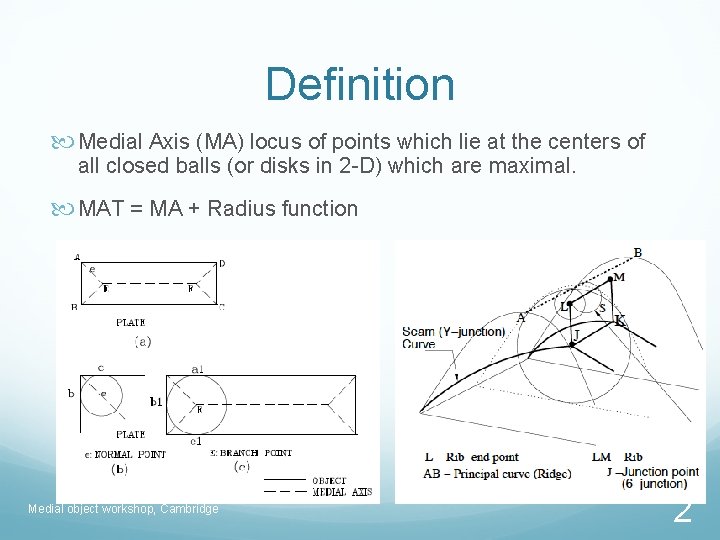
Definition Medial Axis (MA) locus of points which lie at the centers of all closed balls (or disks in 2 -D) which are maximal. MAT = MA + Radius function Medial object workshop, Cambridge 2
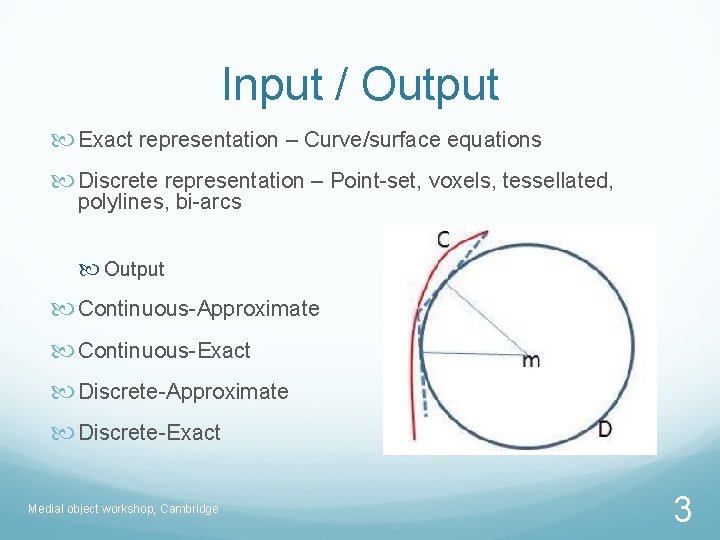
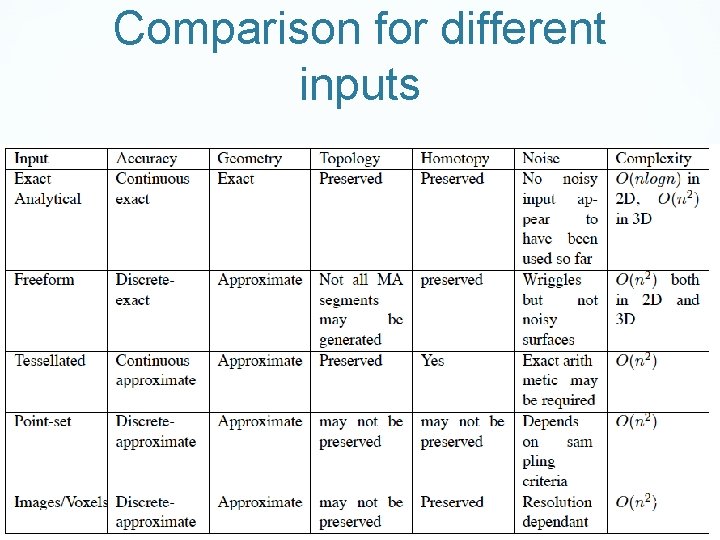
Input / Output Exact representation – Curve/surface equations Discrete representation – Point-set, voxels, tessellated, polylines, bi-arcs Output Continuous-Approximate Continuous-Exact Discrete-Approximate Discrete-Exact Medial object workshop, Cambridge 3
Approaches Wavefront propagation Divide and conquer Delaunay triangulation / Voronoi Numerical tracing Thinning Distance transform Bisector-based Medial object workshop, Cambridge 4
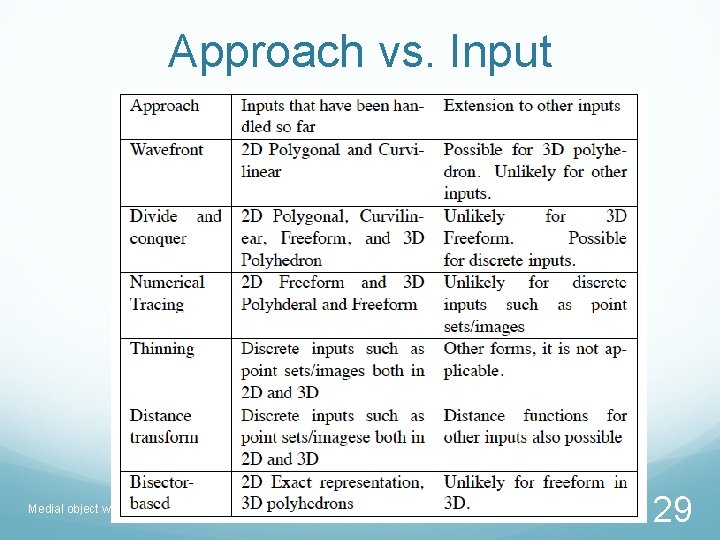
Approach and input Divide and conquer – Polygons, Polyhedra Wavefront – Polygons (Curvilinear) Delaunay/Voronoi – Point-set Thinning and distance transform - Images Medial object workshop, Cambridge 5
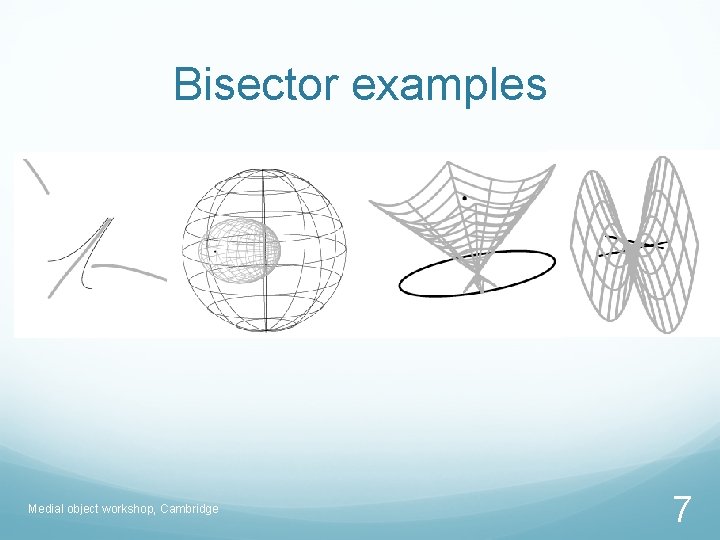
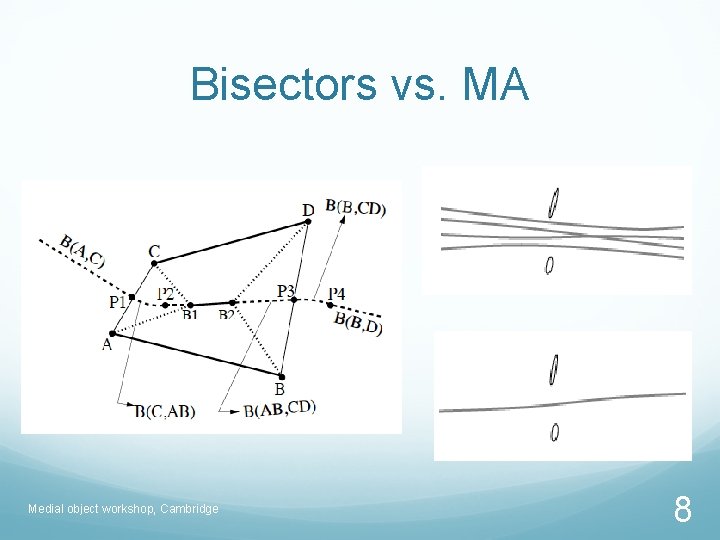
For exact representation Bisectors in closed form - point, lines, conic curves. Rational only for point-freeform curve, between two rational space curves. In general, bisector between two rational curves is nonrational. Bisectors, even between two simple geometries, need not be simple. Medial object workshop, Cambridge 6
Bisector examples Medial object workshop, Cambridge 7
Bisectors vs. MA Medial object workshop, Cambridge 8
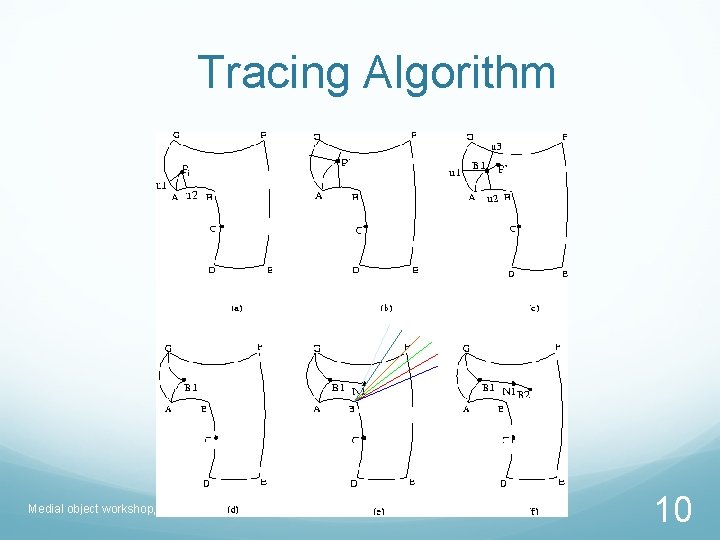
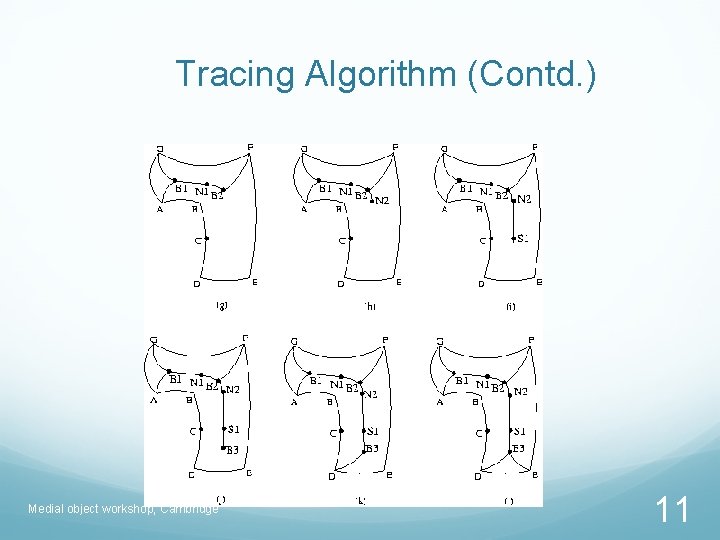
Divide and conquer looks to be too complex In a similar way, wavefront propagation also looks tedious. Either numerical tracing of MA segments or symbolic representation of bisectors. Medial object workshop, Cambridge 9
Tracing Algorithm Medial object workshop, Cambridge 10
Tracing Algorithm (Contd. ) Medial object workshop, Cambridge 11
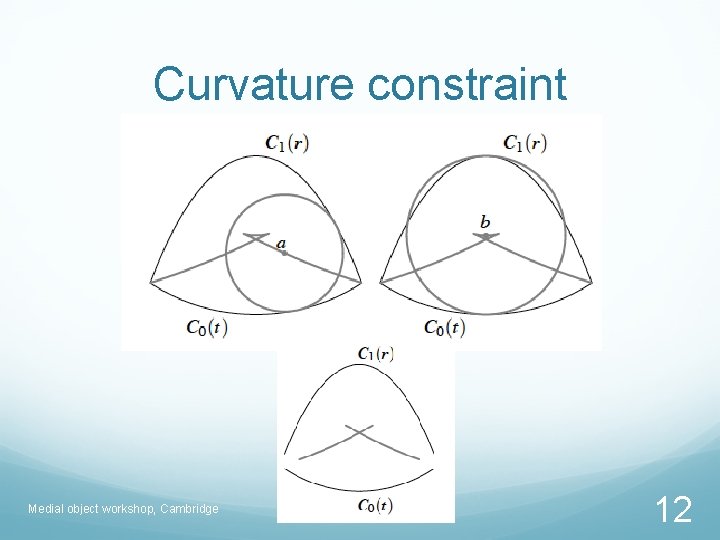
Curvature constraint Medial object workshop, Cambridge 12
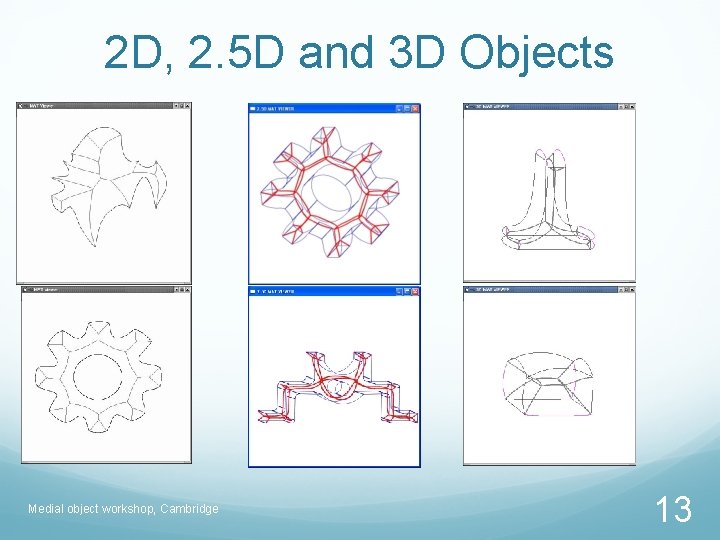
2 D, 2. 5 D and 3 D Objects Medial object workshop, Cambridge 13
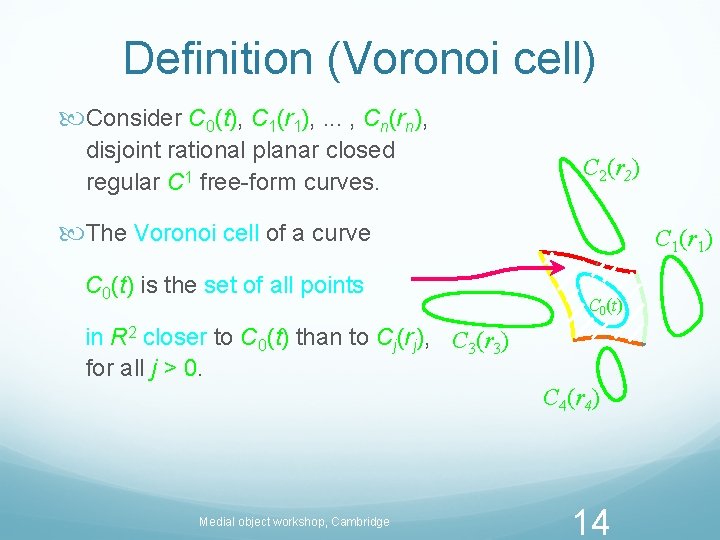
Definition (Voronoi cell) Consider C 0(t), C 1(r 1), . . . , Cn(rn), disjoint rational planar closed regular C 1 free-form curves. C 2(r 2) The Voronoi cell of a curve C 0(t) is the set of all points C 1(r 1) C 0(t) in R 2 closer to C 0(t) than to Cj(rj), C 3(r 3) for all j > 0. C 4(r 4) Medial object workshop, Cambridge 14
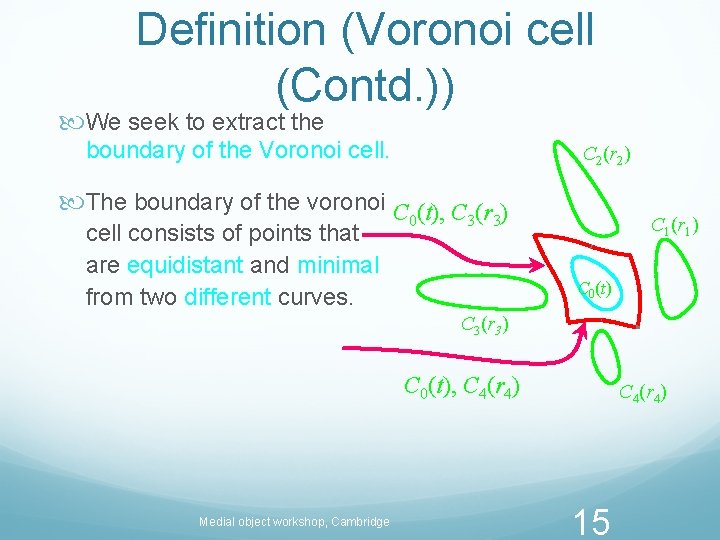
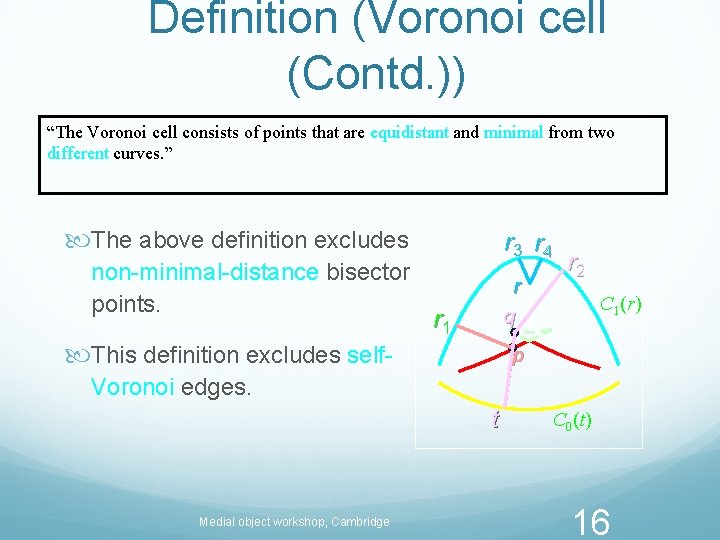
Definition (Voronoi cell (Contd. )) We seek to extract the boundary of the Voronoi cell. C 2(r 2) The boundary of the voronoi C (t), C (r ) cell consists of points that are equidistant and minimal from two different curves. 0 3 3 C 1(r 1) C 0(t) C 3(r 3) C 0(t), C 4(r 4) Medial object workshop, Cambridge C 4(r 4) 15
Definition (Voronoi cell (Contd. )) “The Voronoi cell consists of points that are equidistant and minimal from two different curves. ” The above definition excludes non-minimal-distance bisector points. r 3 r 4 r q r 1 This definition excludes self- r 2 C 1(r) p Voronoi edges. t Medial object workshop, Cambridge C 0(t) 16
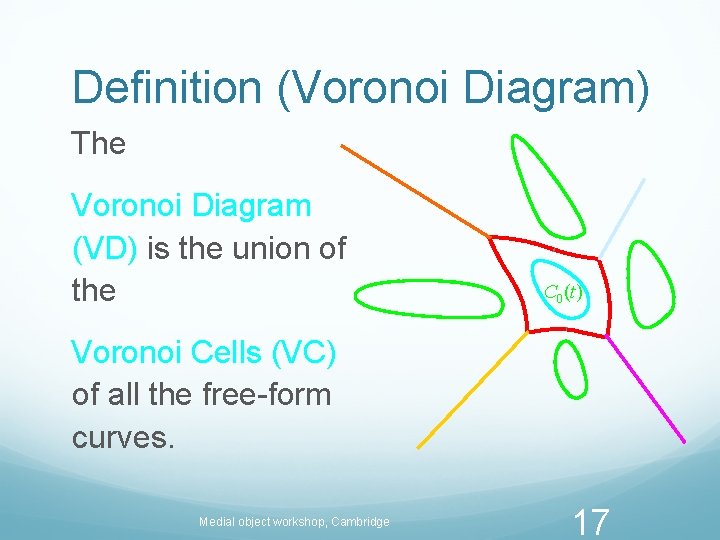
Definition (Voronoi Diagram) The Voronoi Diagram (VD) is the union of the C 0(t) Voronoi Cells (VC) of all the free-form curves. Medial object workshop, Cambridge 17
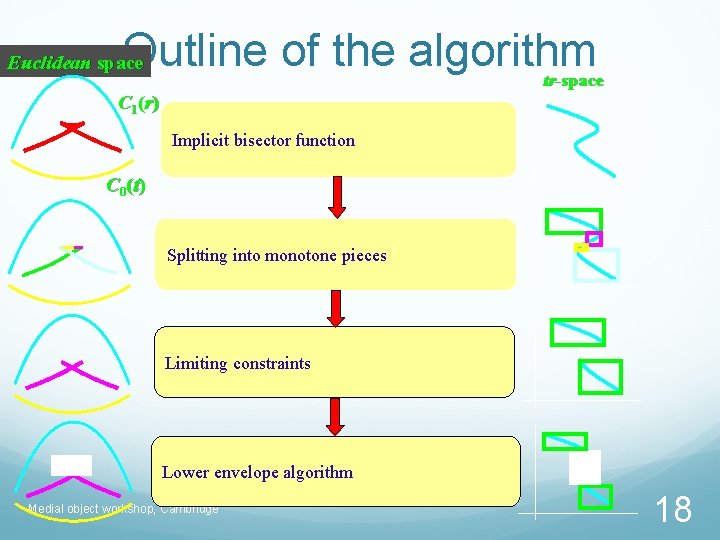
Outline of the algorithm Euclidean space tr-space C 1 (r ) Implicit bisector function C 0 (t ) Splitting into monotone pieces Limiting constraints Lower envelope algorithm Medial object workshop, Cambridge 18
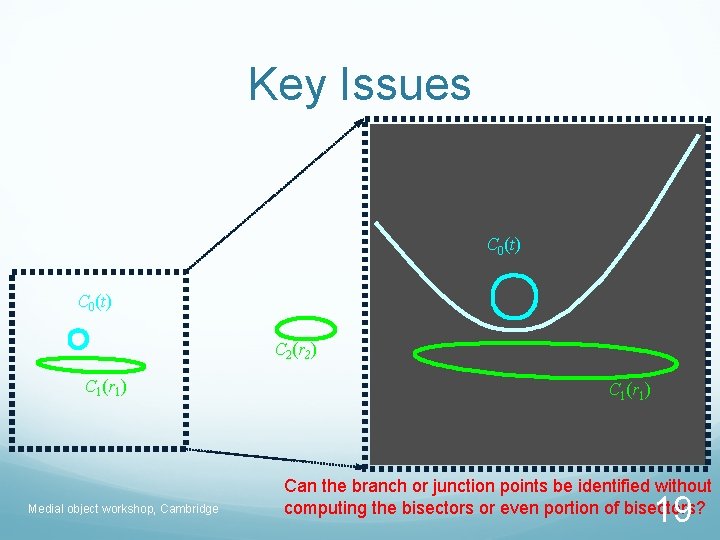
Key Issues C 0(t) C 2(r 2) C 1(r 1) Medial object workshop, Cambridge C 1(r 1) Can the branch or junction points be identified without computing the bisectors or even portion of bisectors? 19
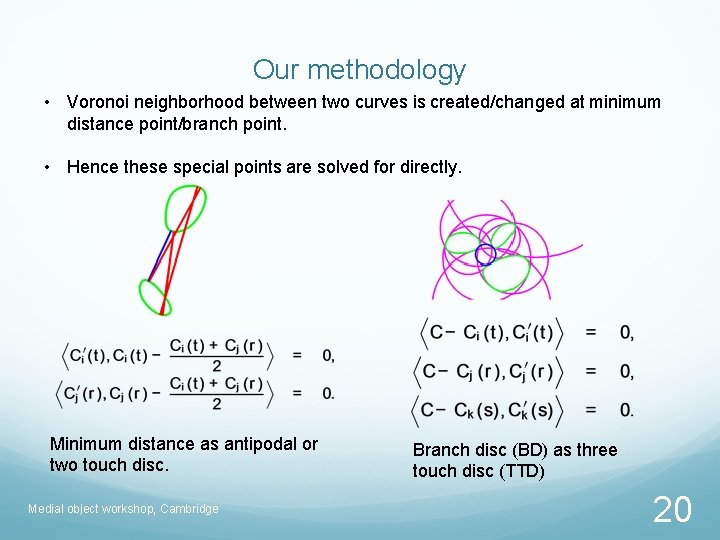
Our methodology • Voronoi neighborhood between two curves is created/changed at minimum distance point/branch point. • Hence these special points are solved for directly. Minimum distance as antipodal or two touch disc. Medial object workshop, Cambridge Branch disc (BD) as three touch disc (TTD) 20
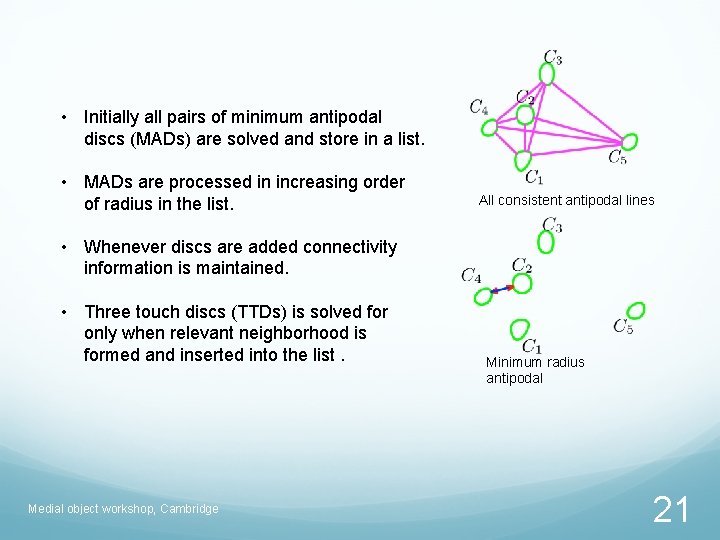
• Initially all pairs of minimum antipodal discs (MADs) are solved and store in a list. • MADs are processed in increasing order of radius in the list. All consistent antipodal lines • Whenever discs are added connectivity information is maintained. • Three touch discs (TTDs) is solved for only when relevant neighborhood is formed and inserted into the list. Medial object workshop, Cambridge Minimum radius antipodal 21
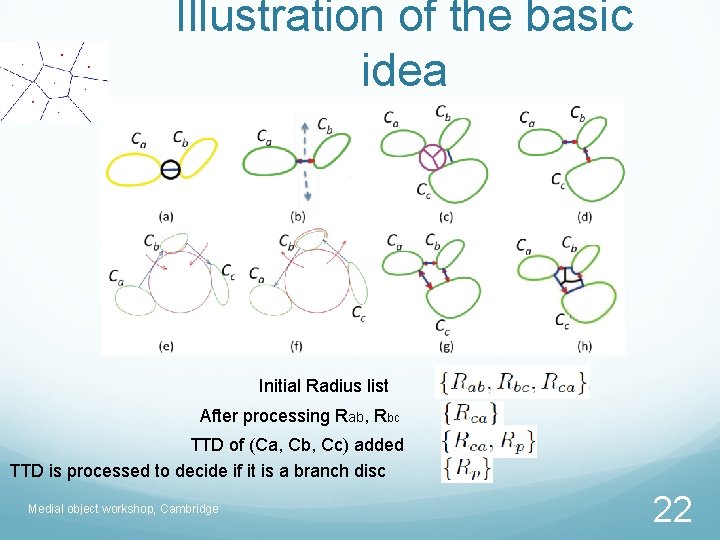
Illustration of the basic idea Initial Radius list After processing Rab, Rbc TTD of (Ca, Cb, Cc) added TTD is processed to decide if it is a branch disc Medial object workshop, Cambridge 22
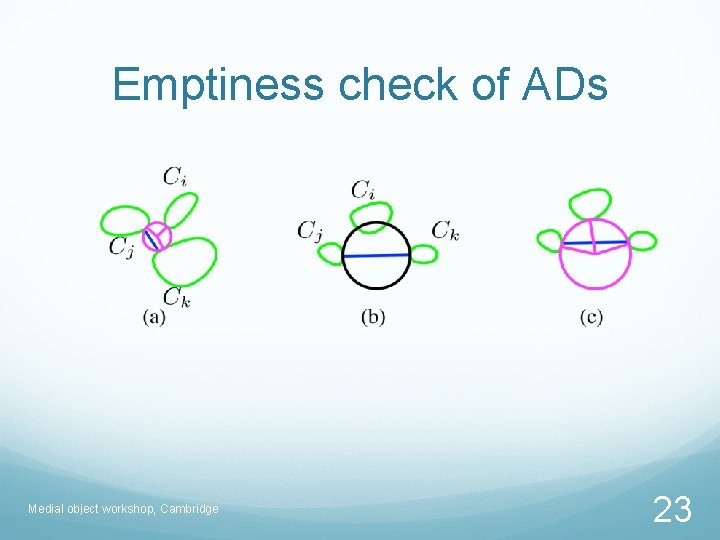
Emptiness check of ADs Medial object workshop, Cambridge 23
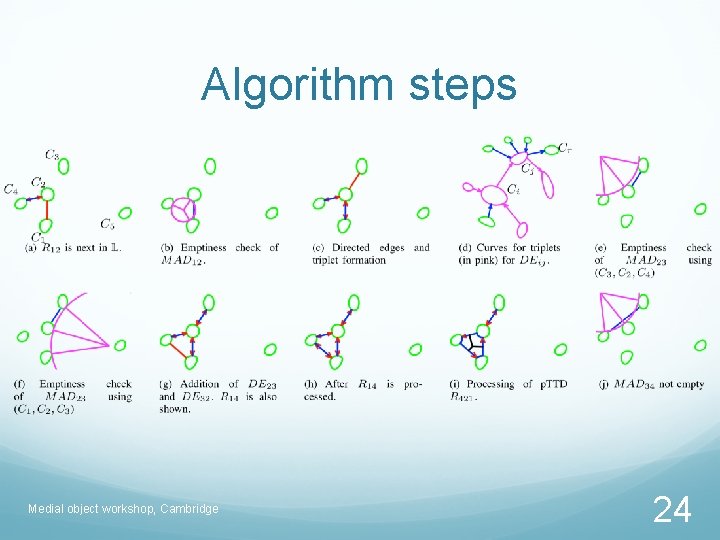
Algorithm steps Medial object workshop, Cambridge 24
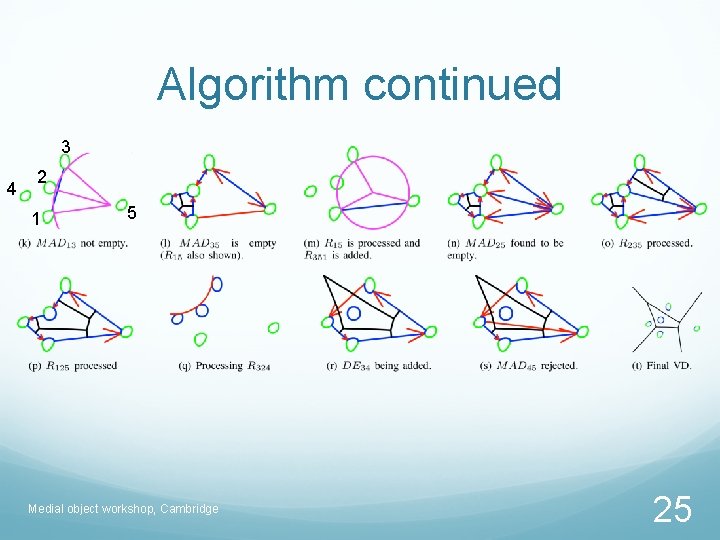
Algorithm continued 3 4 2 1 5 Medial object workshop, Cambridge 25
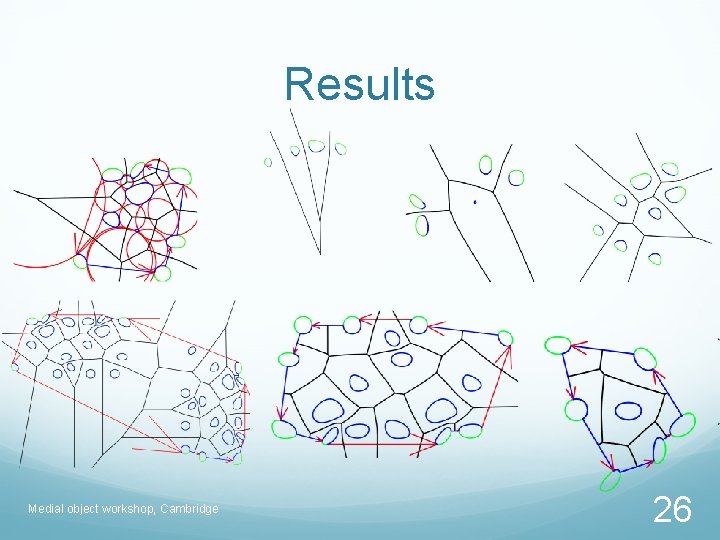
Results Medial object workshop, Cambridge 26
Salient features Given a curve of degree m, the degree of the bisector is 4 m − 2. Computing TTD or AD has a degree of m+(m− 1). Instead of step sizes or intersection of bisectors, a simple directed edge existence is used. Medial object workshop, Cambridge 27
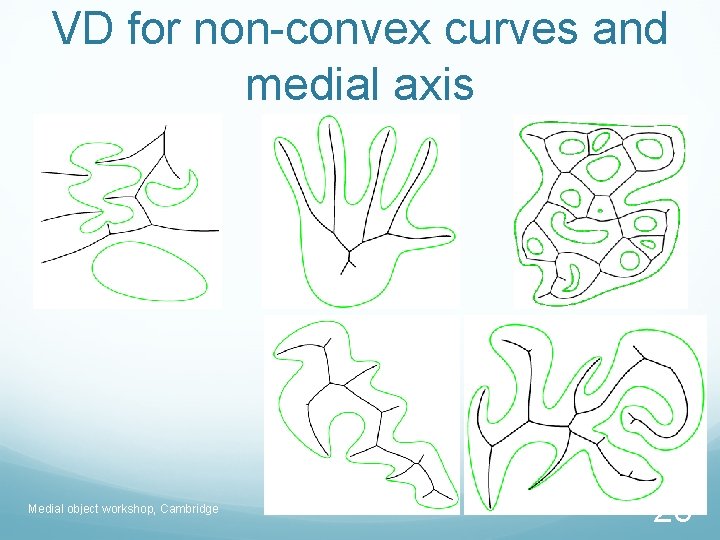
VD for non-convex curves and medial axis Medial object workshop, Cambridge 28
Approach vs. Input Medial object workshop, Cambridge 29
Comparison for different inputs Medial object workshop, Cambridge 30
What’s next Use bisector-less approach for 3 D freeform surfaces to compute Junction points Focus will be on reducing computational complexity. Speeding up of computation using utilities such as GPU. Relation between the elements in the MA to that of the object. Medial object workshop, Cambridge 31
References Ramanathan M. , and B. Gurumoorthy " Constructing Medial Axis Transform of Planar domains with curved boundaries, ", Computer-Aided Design, Volume 35, June 2003, pp 619 -632. Ramanathan M. and B. Gurumoorthy " Constructing Medial Axis Transform of extruded/revoloved 3 D objects with free-form boundaries ", Computer-Aided Design, Volume 37, Number 13, November 2005, pp 1370 -1387 Ramanathan M. , and Gurumoorthy B. , "Interior medial axis computation of 3 D objects bound by free-form surfaces" , Computer-Aided Design, 42(12), 2010, 1217 -1231 Iddo Hanniel, Ramanathan Muthuganapathy, Gershon Elber and Myugn-Soo Kim "Precise Voronoi Cell Extraction of Free-form Rational Planar Closed Curves ", Solid and Physical Modeling (SPM), 2005, MIT, USA, pp 51 -59 Bharath Ram Sundar and Ramanathan Muthuganapathy, " Computation of Voronoi diagram of planar freeform closed curves using touching discs " , Proceedings of CAD/Graphics 2013, Hong Kong. Medial object workshop, Cambridge 32
Discussions Q&A Medial object workshop, Cambridge 33