
Media Use and Identity Formation in Brazil a
Media Use and Identity Formation in Brazil - a tre-dimensional study of cultural globalisation By Thomas Tufte Roskilde University, Denmark ttufte@ruc. dk UT, Austin, Texas, 14 October 2008
Tv, family and identity - Porto Alegre ’fin de siecle’ l Turn of the millenium, globalization, resurgence of local, regional and national cultural identities l Media development in Brazil (cable, sattelite) In what ways do media influence identity formation amongst 4 families of different social and ethnic background?
Aims… l Studying processes of cultural globalization l Capturing social and cultural dynamics over time: historisizing the experience of 4 families over a century-long period l Connecting historical studies of cultural trajectories with contemporary lived lives – all contextualized in urban and media development
Cultural Fronts l. A tool to help us understand: ’the historical, the structural and the everyday ways in which a warp of relationships of hegemony in a given society are constructed (Gonzalez 1996) = three dimensions of analysis
Cultural Identity * ’The articulation of cultural identities becomes social constructed positionings, characterised by the navigation between different cultural fronts and a constant negotiation between powers’
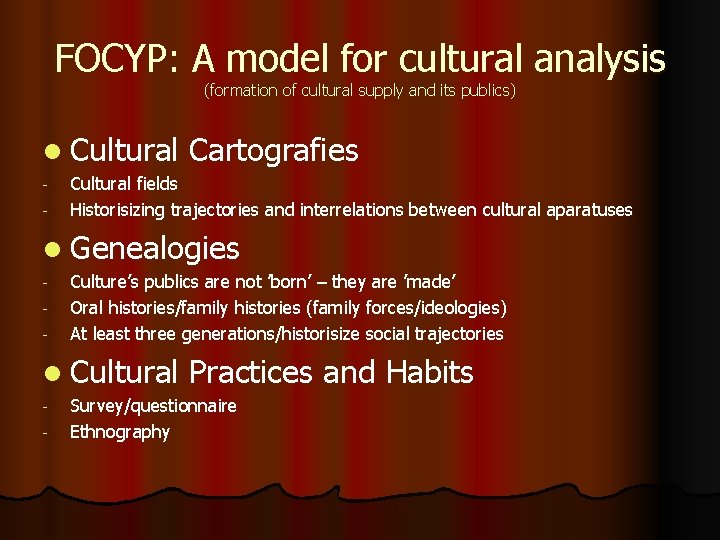
FOCYP: A model for cultural analysis (formation of cultural supply and its publics) l Cultural - Cartografies Cultural fields Historisizing trajectories and interrelations between cultural aparatuses l Genealogies - Culture’s publics are not ’born’ – they are ’made’ Oral histories/family histories (family forces/ideologies) At least three generations/historisize social trajectories l Cultural - Practices and Habits Survey/questionnaire Ethnography
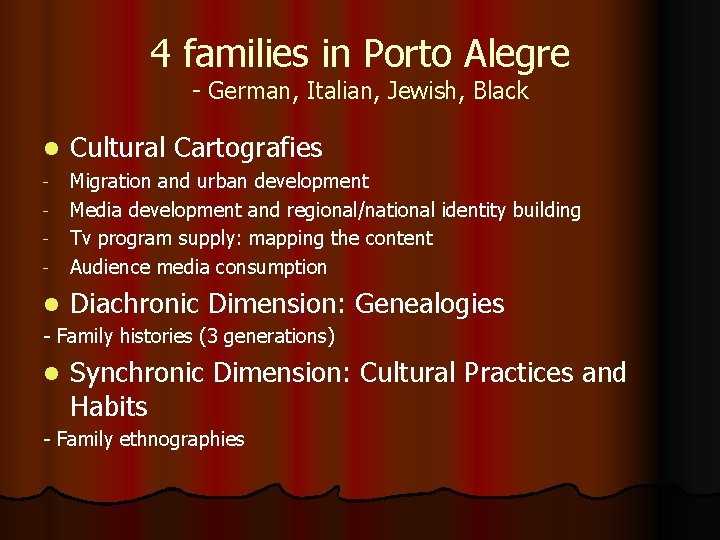
4 families in Porto Alegre - German, Italian, Jewish, Black l Cultural Cartografies - - Migration and urban development Media development and regional/national identity building Tv program supply: mapping the content Audience media consumption l Diachronic Dimension: Genealogies - - Family histories (3 generations) l Synchronic Dimension: Cultural Practices and Habits - Family ethnographies
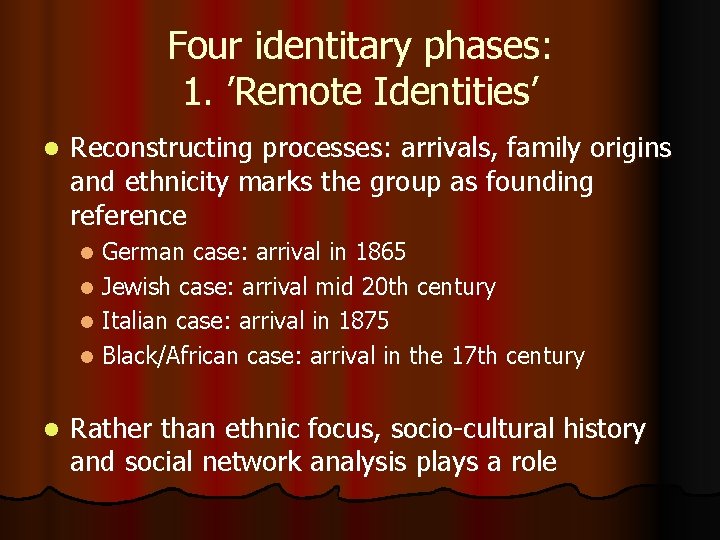
Four identitary phases: 1. ’Remote Identities’ l Reconstructing processes: arrivals, family origins and ethnicity marks the group as founding reference German case: arrival in 1865 l Jewish case: arrival mid 20 th century l Italian case: arrival in 1875 l Black/African case: arrival in the 17 th century l l Rather than ethnic focus, socio-cultural history and social network analysis plays a role
2. ’Traditional identities’ l Thre group and family identities began to develop referents within the new contexts, marked still, however, by cultural origins l Learning Portuguese, ’A colonia’ being the turning point in everyday life, marriage within the colonia, strong family nucleus l Black family fighting for survival Newspapers had a community building role. Radio entering…
3. ’Urban-Rural Identities’ (a) l The urbanisation and modernisation of Brazil plays a strong role. Migration, and an increased socialization between descendants of immigrants and surrounding society interethnic marriages, not interracial l Less religion l less cultivation of ethnic traditions l less family ideology/family companies less central) l
3. ’Urban-Rural Identities’ (b) l Media’s role increasing: national and regional media develop producing strong national and regional cultural references Huge national production of telenovelas (urban-rural dichotomies reworked continuously in telenovelas) l More fluid and multiple identitary constructions l Racism: the black family suffers in urban environment.
4. ’Fin de siecle identities’ l Beginning to live differentiated lives (within each ethnic group) in the way they organize and orient their lives, both in terms of time, space and social relations l l Strong re-articulation of family ideologies but also: increased travel for some, family company going broke, divorses. Black family: retirement and illness. Media playing an increasing role, along with macro-social developments + private family trajectories influence these identity processes
Summing up l Historisizing family trajectories: the challenge of the (traditional) family as core social nucleus l Urban and media development: increased complexity: stability + internationalisation, transnational connections… cosmopolitanism?
Summing up l The key prism to understand mediated experience and cultural globalisation is everyday life: l re-orientations l fragmentations l mediations l Beyond mediacentrism
- Slides: 14