
Media Representations of Place Learning Objectives To know
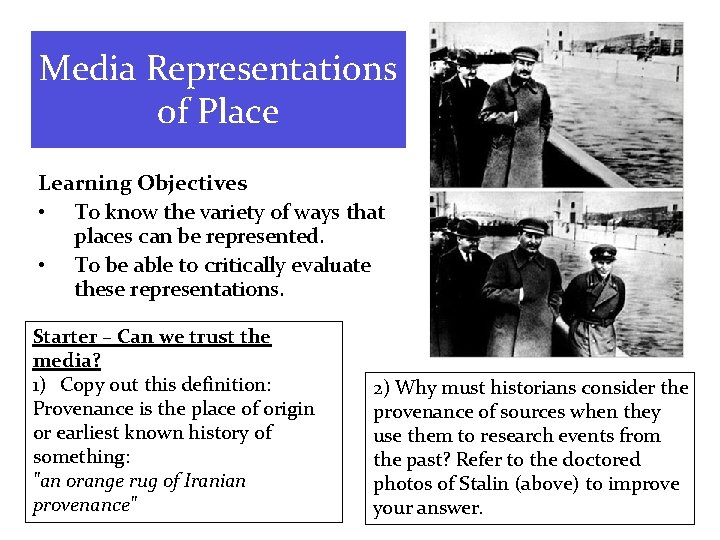
Media Representations of Place Learning Objectives • To know the variety of ways that places can be represented. • To be able to critically evaluate these representations. Starter – Can we trust the media? 1) Copy out this definition: Provenance is the place of origin or earliest known history of something: "an orange rug of Iranian provenance" 2) Why must historians consider the provenance of sources when they use them to research events from the past? Refer to the doctored photos of Stalin (above) to improve your answer.
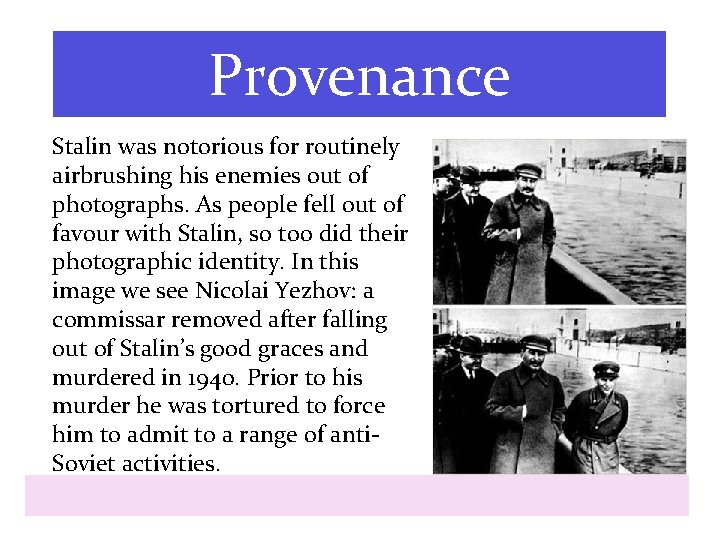
Provenance Stalin was notorious for routinely airbrushing his enemies out of photographs. As people fell out of favour with Stalin, so too did their photographic identity. In this image we see Nicolai Yezhov: a commissar removed after falling out of Stalin’s good graces and murdered in 1940. Prior to his murder he was tortured to force him to admit to a range of anti. Soviet activities.
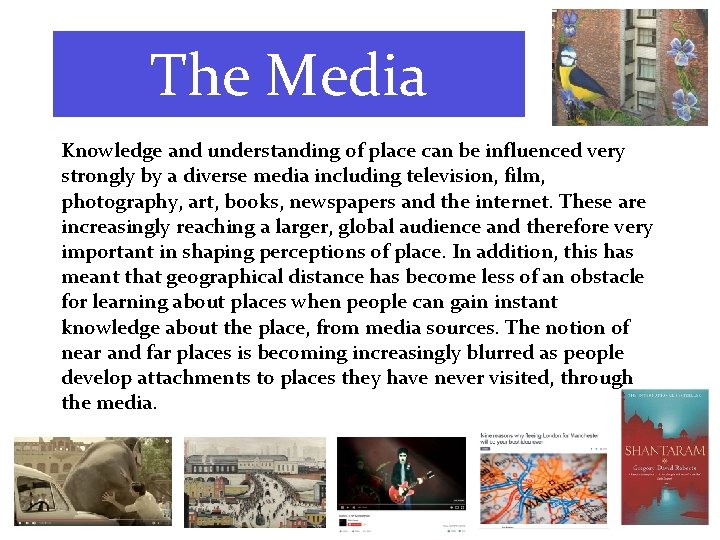
The Media Knowledge and understanding of place can be influenced very strongly by a diverse media including television, film, photography, art, books, newspapers and the internet. These are increasingly reaching a larger, global audience and therefore very important in shaping perceptions of place. In addition, this has meant that geographical distance has become less of an obstacle for learning about places when people can gain instant knowledge about the place, from media sources. The notion of near and far places is becoming increasingly blurred as people develop attachments to places they have never visited, through the media.
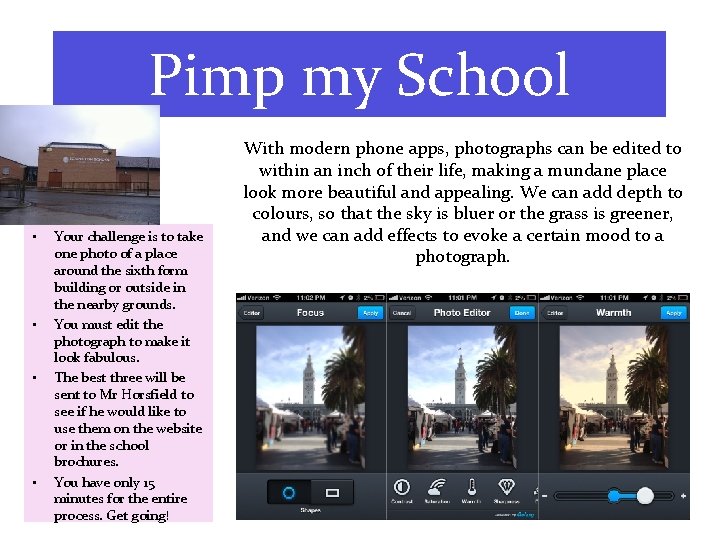
Pimp my School • • Your challenge is to take one photo of a place around the sixth form building or outside in the nearby grounds. You must edit the photograph to make it look fabulous. The best three will be sent to Mr Horsfield to see if he would like to use them on the website or in the school brochures. You have only 15 minutes for the entire process. Get going! With modern phone apps, photographs can be edited to within an inch of their life, making a mundane place look more beautiful and appealing. We can add depth to colours, so that the sky is bluer or the grass is greener, and we can add effects to evoke a certain mood to a photograph.
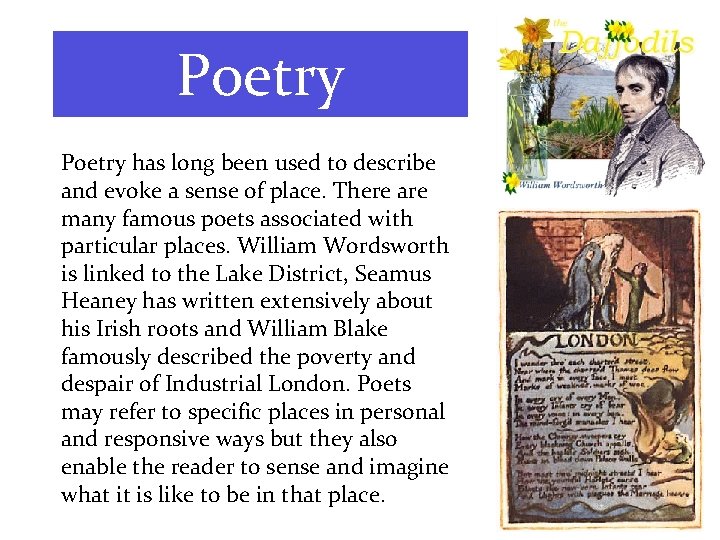
Poetry has long been used to describe and evoke a sense of place. There are many famous poets associated with particular places. William Wordsworth is linked to the Lake District, Seamus Heaney has written extensively about his Irish roots and William Blake famously described the poverty and despair of Industrial London. Poets may refer to specific places in personal and responsive ways but they also enable the reader to sense and imagine what it is like to be in that place.
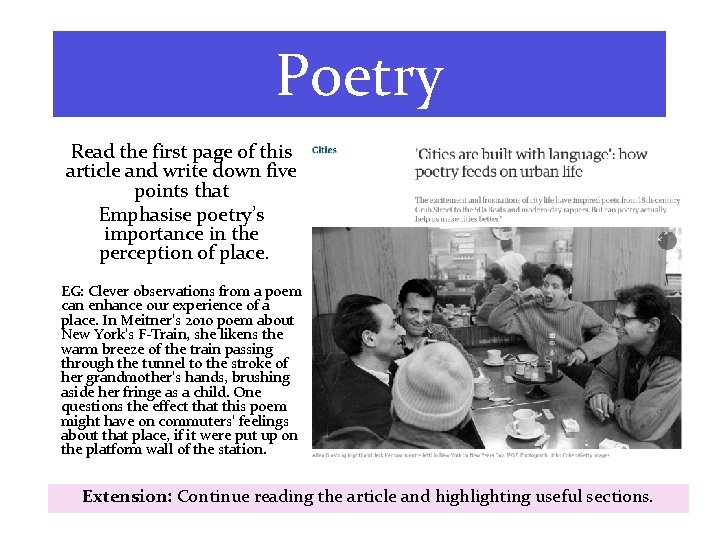
Poetry Read the first page of this article and write down five points that Emphasise poetry’s importance in the perception of place. EG: Clever observations from a poem can enhance our experience of a place. In Meitner’s 2010 poem about New York’s F-Train, she likens the warm breeze of the train passing through the tunnel to the stroke of her grandmother’s hands, brushing aside her fringe as a child. One questions the effect that this poem might have on commuters’ feelings about that place, if it were put up on the platform wall of the station. Extension: Continue reading the article and highlighting useful sections.

London by William Blake Same Place Different Perception To illustrate how the same place can be represented in different ways, compare Blake’s poem (right) with the more romantic idealised images described by Wordsworth. Consider the imagery, the choice of vocabulary and the overall mood of each poem. I wander thro' each charter'd street, Near where the charter'd Thames does flow. And mark in every face I meet Marks of weakness, marks of woe. In every cry of every Man, In every Infant’s cry of fear, In every voice: in every ban, The mind-forg'd manacles I hear How the Chimney-sweepers cry Every blackning Church appalls, And the hapless Soldiers sigh Runs in blood down Palace walls But most thro' midnight streets I hear How the youthful Harlots curse Blasts the new-born Infants tear And blights with plagues the Marriage hearse
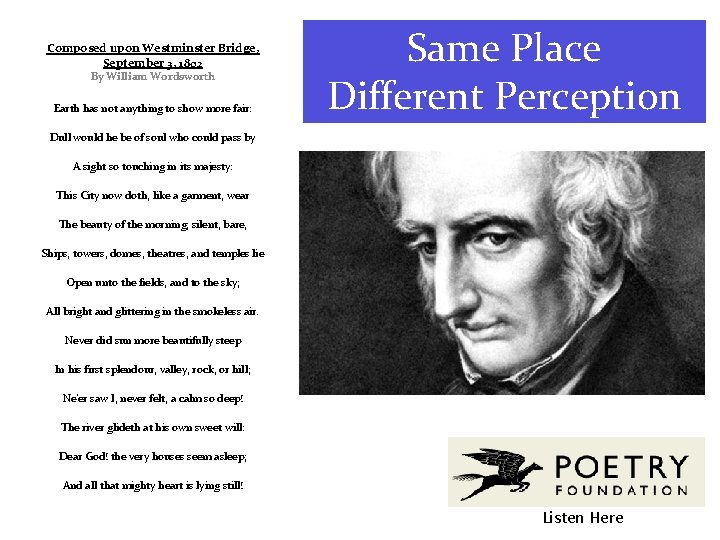
Composed upon Westminster Bridge, September 3, 1802 By William Wordsworth Earth has not anything to show more fair: Same Place Different Perception Dull would he be of soul who could pass by A sight so touching in its majesty: This City now doth, like a garment, wear The beauty of the morning; silent, bare, Ships, towers, domes, theatres, and temples lie Open unto the fields, and to the sky; All bright and glittering in the smokeless air. Never did sun more beautifully steep In his first splendour, valley, rock, or hill; Ne'er saw I, never felt, a calm so deep! The river glideth at his own sweet will: Dear God! the very houses seem asleep; And all that mighty heart is lying still! Listen Here
Plenary Write down: 5… things to look out for when assessing the reliability of a source. 4… ways in which place can be represented (EG music) 3… ways that photographers can alter a photo 2… examples of sources that historians might consider unreliable 1… poet who wrote about a place in the UK
- Slides: 9