
Media regulation accountability instruments actors and main areas
Media regulation & accountability: instruments, actors and main areas of focus IMCS Lecture 4/10 2012 Katarzyna Płaneta-Björnskär
Media regulation ”…the operation of specific , often legally binding, tools that are deployed on the media to achieve established policy goals” Freedman, page 14

Regulation and self regulation Regulation (command-control) - external regulation by statutory authorities � Self-regulation - voluntary association with monitoring organizations/bodies � Co-Regulation - the combination of self regulation and external regulation � Unregulated - an area where neither external regulation or selfregulation are to be found �
Regulation processes Regulation - a process when external and formal regulation by the political system is dominating � Deregulation - a process where external regulation is diminished and private interests and selfregulation becomes more important � Reregulation - a description of the regulation process as a change from an external to an internal, self regulatory or co-regulatory form �
Tools of regulation - examples Licensing and conditions of practice Monitoring and mechanisms of complaint Public ownership and ownership restrictions Subsidies Tax incentives Content rules Quotas Trade barriers and agreements Intellectual property rules Restrictions on speech right and information flows Codes and protocols
Three regulatory models Free press model - weak regulation in terms of both infrastructure and content, economic benefits include postal and tax concessions, loans and subsidies; may be subject to anticoncentration laws and rules against foreign ownership Common carrier model - strong regulation in terms of infrastructure but no or weak regulation of access and content Broadcasting model - strong regulation in terms of both infrastructure and content; includes the concept of public service
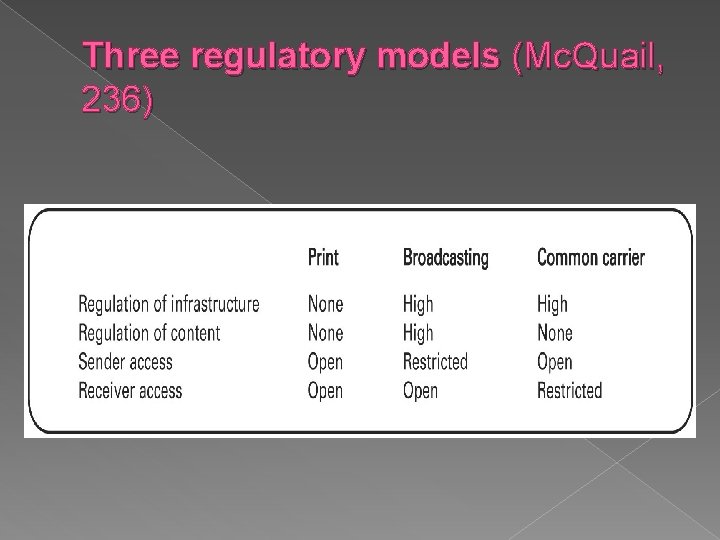
Three regulatory models (Mc. Quail, 236)
New regulation models Structural regulation - infrastructure - licensing and conditions of access to infrastructure Content regulation - how to present things: fairness, accuracy, etc - what to present: format requirements, e. g. news - issues: privacy, harm, moral and taste Competition/market regulation - market structure - market behaviour of companies - customer rights and protection
Regulating public service - BBC Service licences Public value tests New forms of competition regulation. Fair trading. Ex ante regulatory codes. The promotion of digital. Analogue switch-off/digital switchover. Independent production quotas. A further 25% of the BBC TV output should be open to external producers. BBC governance. A Trust + the Board. Licence fee.
European standards of public service (Council of Europe, 1994): 1). A common reference point for all members of the 2). A forum for broad public discussion 3). Impartial news coverage 4). Pluralistic, innovative and varied programming 5). Programming that is both of wide public interest and attentive to the needs of minorities 6). Reflection of the different ideas and beliefs in multi-ethnic and multicultural societies 7). A diversity of national and European cultural heritage 8). Original productions by independent producers 9). Extended viewer and listener choice by offering programmes not provided by the commercial sector
Swedish national broadcasting – an example of external regulation Constitutional protection - freedom of speech, editorial independence Broadcasting act - licensing parameters License terms - government - assignment - self-evaluation of company (SVT) Thematic reviews, fees and licences – Radio and TV Authority Individual complaints - RTVA
Sweden – national television From monopoly to fragmentation 1987 – 2006 - From two channels in Swedish to about 40 today Public service with two main channels - SVT 1, SVT 2 Commercial television - Non commercial content regulation: TV 4 - Only commercial content regulation: TV 3, TV 5, TV 6, TV 8 (in many cases not governed by Swedish regulators) Special Channels developing - SVT 24, Knowledge Channel, TV 4+, TV 9
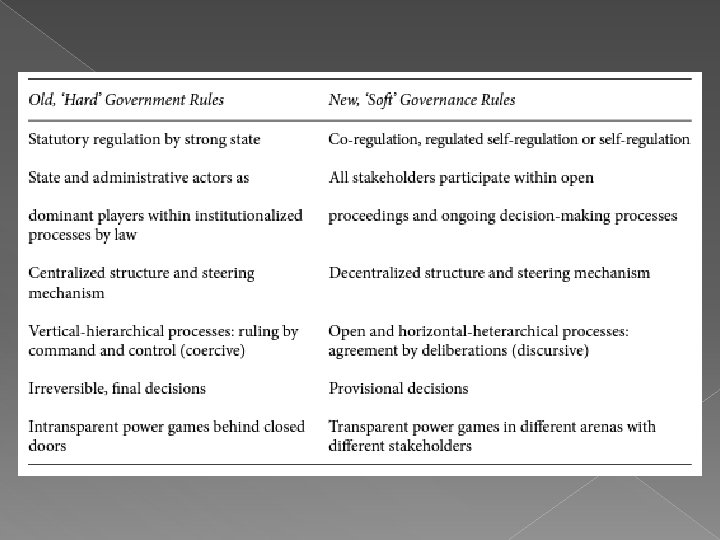
Towards a governance model “(…) media governance looks beyond government, market and corporate media management. Especially, media governance focuses on non-governmental modes of institutionalization and organization, on civil society organizations, as well as on the public. Media governance emphasizes the self- and co-regulation modes of media policy. ” (Media in Europe Today, 159) It is about bottom-up approaches and horizontal codetermination of political issues
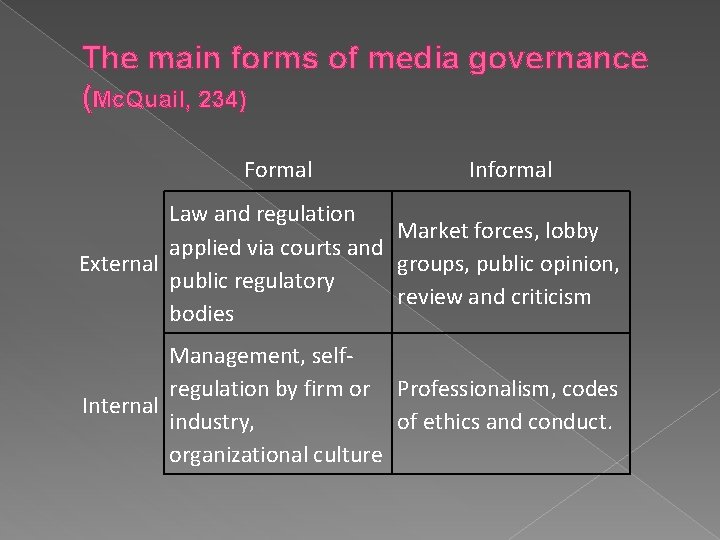
The main forms of media governance (Mc. Quail, 234) Formal Informal Law and regulation Market forces, lobby applied via courts and External groups, public opinion, public regulatory review and criticism bodies Management, selfregulation by firm or Professionalism, codes Internal industry, of ethics and conduct. organizational culture
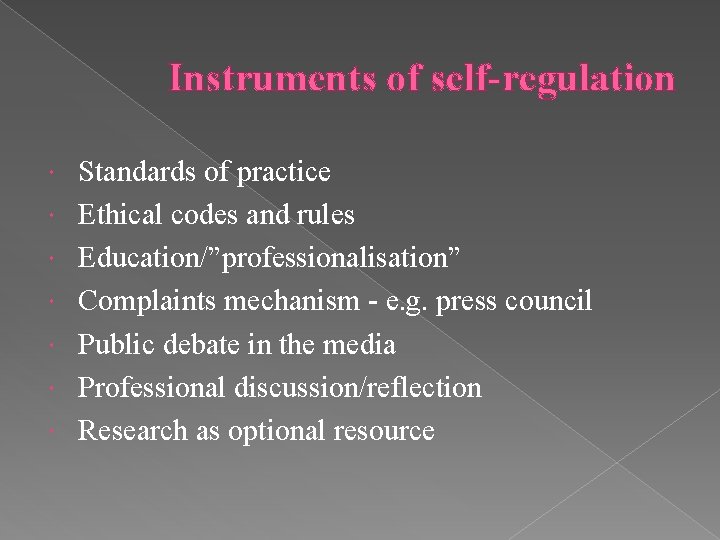
Instruments of self-regulation Standards of practice Ethical codes and rules Education/”professionalisation” Complaints mechanism - e. g. press council Public debate in the media Professional discussion/reflection Research as optional resource
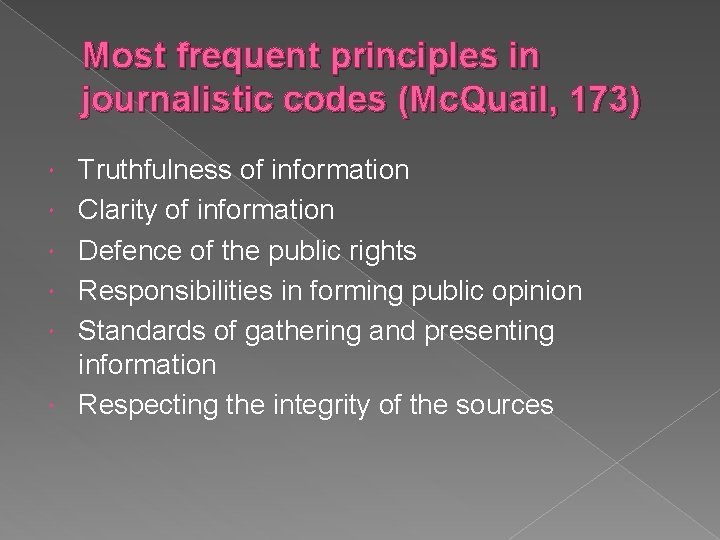
Most frequent principles in journalistic codes (Mc. Quail, 173) Truthfulness of information Clarity of information Defence of the public rights Responsibilities in forming public opinion Standards of gathering and presenting information Respecting the integrity of the sources
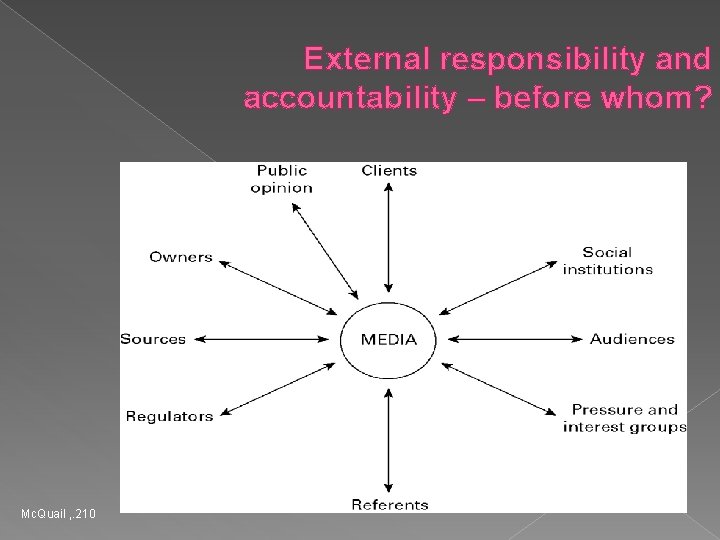
External responsibility and accountability – before whom? Mc. Quail , . 210
Responsibility and accountability Responsibility - assigned - contratced - self-imposed Obligations and expectations. ”To have responsibility” Accountability - as liablity - as answerability The process by which the media are called to account. ”To act responsible and to take responsibility”
Accountability ”Media accountability is all the voluntary or involuntary processes by which the media answer directly or indirectly to the society and those immediately affected for the quality and/or consequences of publication” ”A requirement to give an account of one’s actions, either directly to the public, or via public authorities” ”Being liable to sanction if found in breach of some requirement or expectation attaching to the excercise of power”
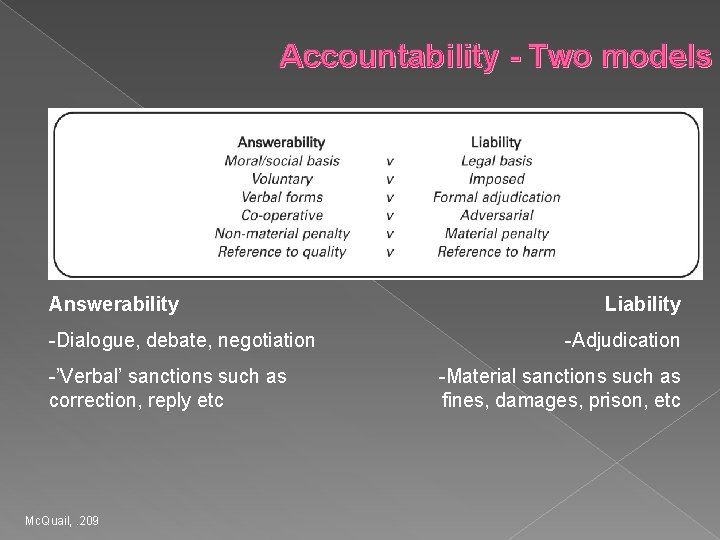
Accountability - Two models Answerability -Dialogue, debate, negotiation -’Verbal’ sanctions such as correction, reply etc Mc. Quail, . 209 Liability -Adjudication -Material sanctions such as fines, damages, prison, etc
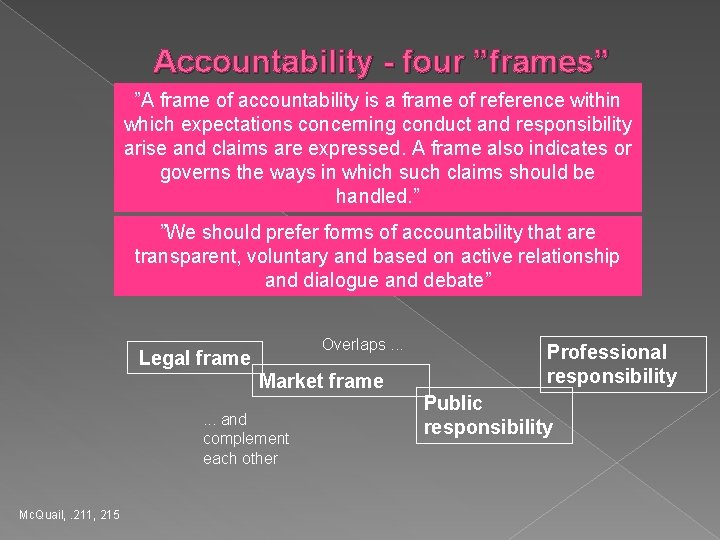
Accountability - four ”frames” ”A frame of accountability is a frame of reference within which expectations concerning conduct and responsibility arise and claims are expressed. A frame also indicates or governs the ways in which such claims should be handled. ” ”We should prefer forms of accountability that are transparent, voluntary and based on active relationship and dialogue and debate” Overlaps. . . Legal frame Market frame. . . and complement each other Mc. Quail, . 211, 215 Professional responsibility Public responsibility
Frames of accountabiltiy (Mc. Quail) Law and regulation - strong but may be at odds with freedom Market frame - self-correcting regulation of supply and demand, but not always responsive to policy goals Public responsibility - arenas for public discussion, lacking in power Professional responsibility - principles and codes of professions, but internal and with vested interest
- Slides: 23