
Media Prosocial Behaviour promote prosocial values behaviour Aim
Media & Prosocial Behaviour promote prosocial values & behaviour § Aim to influence viewer behaviour through social learning § Observation § Vicarious reinforcement § Imitation www. psychlotron. org. uk § Many children’s programmes deliberately

Media & Prosocial Behaviour towards diversity § Positive attitudes towards learning www. psychlotron. org. uk § Helping behaviour § Positive attitudes
Media & Prosocial Behaviour § Greenberg et al (1980) § Effect depends on developmental factors: § Empathy § Perspective taking § Moral reasoning § Adolescents most likely to be resistant www. psychlotron. org. uk § Children’s TV depicts pro & antisocial acts in similar numbers § Prosocial acts more likely to be rewarded
Media & Prosocial Behaviour § Some evidence that children will imitate § Poulos et al (1975) – ‘Lassie’ study § Friedrich & Stein (1973) – repeated exposure to prosocial content showed increased obedience & greater persistence § Higher number of friendly interactions observed with peers www. psychlotron. org. uk prosocial behaviour following exposure
Media & Prosocial Behaviour § Hearold (1986) – 230 studies; found significant positive effects § Mares (1996) – evidence lacking for strong effect; most noticeable effects on self-control § Difference in conclusions probably due to H focusing on lab studies, M on real TV www. psychlotron. org. uk § Large scale reviews of the literature
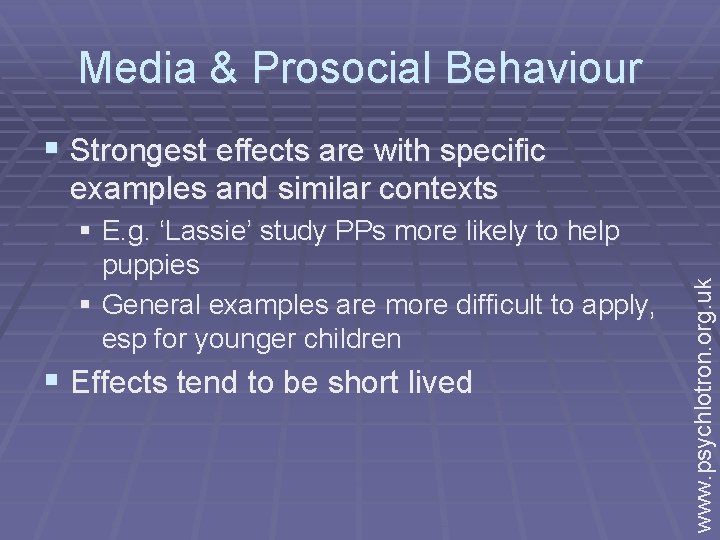
Media & Prosocial Behaviour § Strongest effects are with specific § E. g. ‘Lassie’ study PPs more likely to help puppies § General examples are more difficult to apply, esp for younger children § Effects tend to be short lived www. psychlotron. org. uk examples and similar contexts

Media & Prosocial Behaviour § In children from lower SES backgrounds § With repeated, sustained exposure § When real-life prosocial acts are depicted § When adults discuss prosocial viewing with children www. psychlotron. org. uk § Strongest effects are observed:
- Slides: 7