
Media Globalization Creating a Global Communication infrastructure Communication
Media Globalization Creating a Global Communication infrastructure
Communication & Media Industry 1980’s – 1990’s: ▫ Deregulation & Privatization coupled with ▫ New digital communication and information technology ▫ New Technology; Satellite industry ▫ Globalized Telecommunications ▫ Change of Ownership – from state to private control ▫ From Government to TNC’s ▫ Immense financial benefits to TNC’s
The Privatization of Telecom • State owned monopoly in past �Subsidized communication �Cheaper services �Criticized for not adopting innovations by TNC’s • By 2005 state-run communication services only 9%. • TNC’s opposed national monopolies & demanded reduced tariffs • Argued that competition would improve services and lower costs. • Privatization in West � 1984 - Reagan’s ‘open skies’ policy �Public monopoly broken �Europe and Japan followed suit
Free trade in communication products & services • General Agreement on Tariffs and Trade (GATT) Agenda: Free-flow of information ▫ Established 1947 - Uruguay Round (GATT) – tariff rates ▫ 1994 - Uruguay Round (GATT) – opening protected markets ▫ 1995 - WTO – legal mechanism for trade ▫ 1995 - GATT Annex – opening up markets in developing world
A Global Communication infrastructure • Impact of WTO on international communication ▫ 1997 - Elimination of import duties on IT’s ▫ Opening up of financial and service sector ▫ 1998 - Liberalization of telecommunication by countries ▫ West demands liberalization of communication technology products ▫ 2004 - Service trade becomes $2. 1 trillion ▫ US largest services exporting country
A Global Communication infrastructure • Implications of Liberalization ▫ Transfer of skills from North to South ▫ Widening of Rich/Poor gap ignored ▫ International communication discourse economic not political ▫ Tariff barriers applied unevenly ▫ More benefits for North in ‘borderless world’Southern interests ignored ▫ TNC’s benefit most
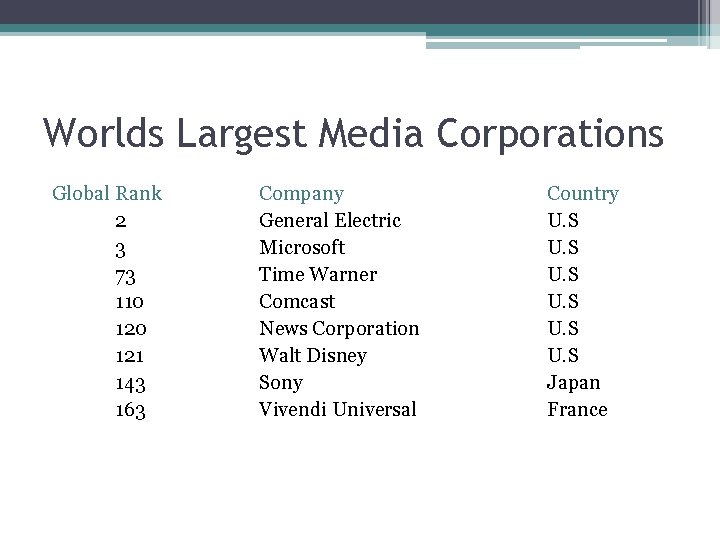
Worlds Largest Media Corporations Global Rank 2 3 73 110 121 143 163 Company General Electric Microsoft Time Warner Comcast News Corporation Walt Disney Sony Vivendi Universal Country U. S U. S Japan France
Media Monopoly thesis • U. S foremost in dominating the information & entertainment industry • Concentration of media ownership • Reduced competition, homogenous media content • Shift in balance of national political power • Reinforcement of economic and cultural dependency • Robert Mc Chesney; ▫ There exists a dynamic relationship between media globalization and the concentration and centralization of media ownership. Both these processes are inter-connected.
Creation & Effects of Globalization • • Internationalization of production, trade and finance International movement of people International communication flows The global circulation of ideas Establishment of international regimes in intellectual property Emergence of cultural, professional and standard bodies Shaping of international opinions by governments Globalization of War and conflict
Monopoly Capitalism • The New International Division of Labour (NIDL) Thesis; Frobel Heinrich & Kreye ▫ Explains the rise of foreign investment by multinational corporations. ▫ De-industrialization of West- stagnation of capital. ▫ Partial industrialization of Third World - new opportunities for western corporations. ▫ Advances in transport and communication technologies. ▫ Development of “free production zones” with minimal tax and labour regulation by developing governments. ▫ Opportunity for MNC’s to exploit low-wage labour, ▫ Endangering environmental and labour standards, as well as democracy.
Critical Political Economy of Media • Toby Miller (2001) applied the NIDL thesis to media globalization in his critique of ‘Global Hollywood’ and developed a new theory, NICL • The New International Division of Cultural Labour (NICL): ▫ Hollywood engineering new international distribution of labor tasks & production processes. ▫ Attract international talent ▫ Redistribute globally ▫ Lower costs ▫ Discipline US cultural labor & state (stop imposition of new taxes or labour laws) ▫ As a result national media policies serve the interests of the global media corporations instead of the public. ▫ Growing dominance of Western economic, values and norms worldwide due to the unfettered movement of US media products. ▫ Mergers between media and telecom companies demonstrates the colonization of the Internet.
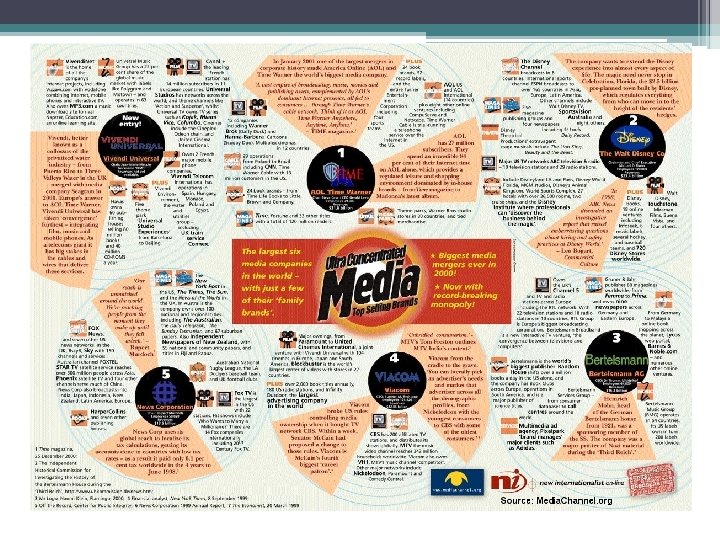
Media Globalization Critique • Too much concentration of media organizations eliminates competition. ▫ Shares of top 50 US media companies revenues over 19861999 comparable ▫ More regional competition in broadcast media ▫ Internet – added competition ▫ Conglomeration versus risk taking and losses ▫ Empirical facts on global businesses inflated ▫ Globalization of media result of Mergers & Acquisitions ▫ Developing states offering themselves to businesses ▫ Only one global media corporation - News Corp.
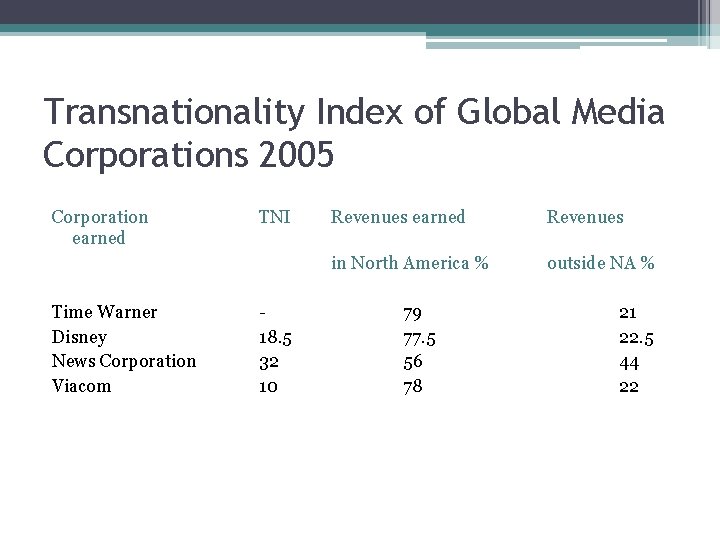
Transnationality Index of Global Media Corporations 2005 Corporation earned Time Warner Disney News Corporation Viacom TNI 18. 5 32 10 Revenues earned Revenues in North America % outside NA % 79 77. 5 56 78 21 22. 5 44 22
Assignment • • Intelsat WTO Liberalization & Privatization Rupert Murdochs – News Corp & News Corporation’s Globalization Strategies Time Warner Viacom & Disney BBC SITE
- Slides: 15