
Media Ethics Part 1 Classical ethical theory Guidelines


- Slides: 20
Media Ethics, Part 1 Classical ethical theory: Guidelines for decision making JAMM 100 1
Schedule Update This week: Media ethics (Chapter 14) n Next week: Media law (Chapter 13) n – Dec. 9: Study guide available for Exam 4 n Finals week – Tuesday, Dec. 14: Review session (time TBD) – Thursday, Dec. 16: Exam 4 (10 a. m. ) JAMM 100 2
Extra-credit opportunity #1 Living History: Examining the Pacific Northwest through the Lives and Work of Two 20 th Century Women n Tuesday, Nov. 30, 7: 30 p. m. Commons Whitewater room Prof. Katrine Barber – Portland State University n Paper due: Friday, Dec. 3 JAMM 100 3
Extra-credit opportunity #2 Social Justice Forum: What is Islam? What is Islamophobia? Where do we go from here? n Thursday, Dec. 2, 7: 30 p. m. n City Council chambers, Moscow City Hall – 3 rd & Washington n Sponsored by Human Rights Commission Paper due Monday, Dec. 6, in class n Refreshments provided n JAMM 100 4
Clicker Quiz #1 The data-linking feature that allows Internet users to go directly from a highlighted word to a related file on another Web page is called: a) Convergence b) Divergence c) Spamming d) URL e) Hypertext JAMM 100 5
Clicker Quiz #1 The data-linking feature that allows Internet users to go directly from a highlighted word to a related file on another Web page is called: e) Hypertext (http) JAMM 100 6
Morals vs. Ethics n Morals = An individual’s code of behavior based on religious or philosophical principles. – Morals define right and wrong in ways that may or may not be rational. n Ethics = A rational way of deciding what is good for individuals or society. – A way to chose between competing moral principles or when there is not a clear right or wrong answer.
What are ethics? n Framework for behavior n Guidelines for decision-making n Expected levels of performance as a media professional n Often higher standards than law – Legal conduct is not always ethical JAMM 100 8
Ethical theories 1. 2. 3. 4. 5. The Golden Mean Judeo-Christian Ethic Categorical Imperative Principle of Utility Veil of Ignorance JAMM 100 9
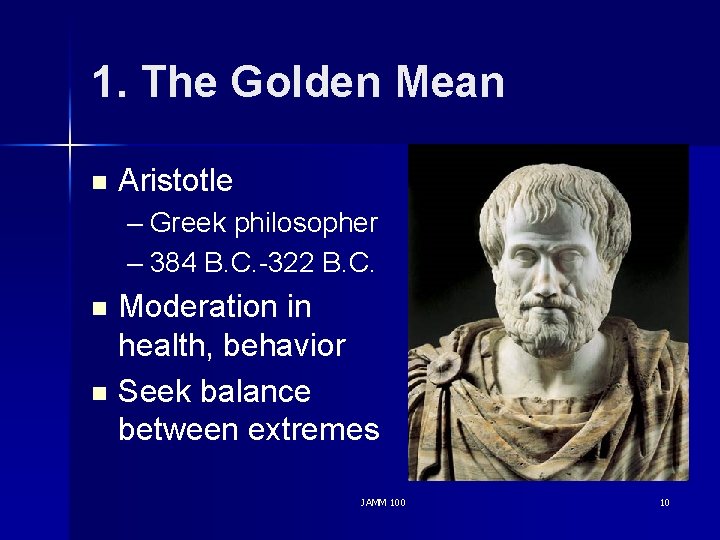
1. The Golden Mean n Aristotle – Greek philosopher – 384 B. C. -322 B. C. Moderation in health, behavior n Seek balance between extremes n JAMM 100 10
1. The Golden Mean n What does it mean for journalists? n David Martinson says: Moral virtue is appropriate location between two extremes. Journalists take overly simplistic view of Golden Mean, assume it values compromise rather than finding virtue.
1. The Golden Mean n “A virtuous journalist is one who communicates truthfully in a manner which will enable the reader or listener to better understand the reality of the community, nation and world. … The journalist will show respect for human dignity and individual circumstances. ” – David Martinson, media ethicist JAMM 100 12
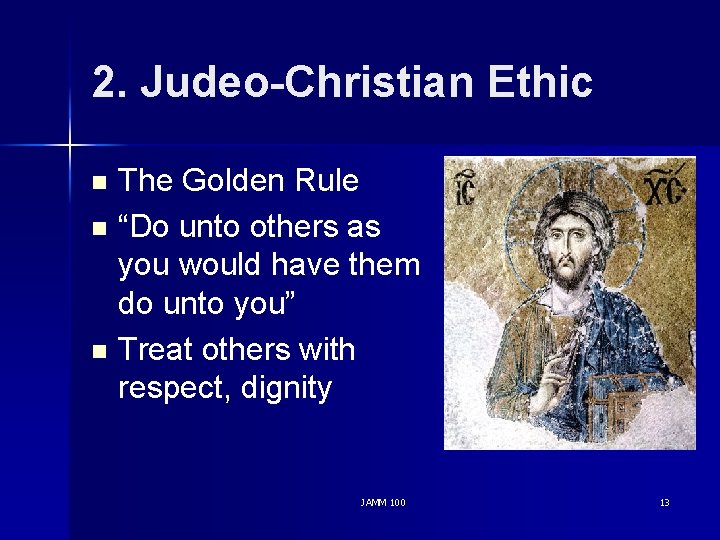
2. Judeo-Christian Ethic The Golden Rule n “Do unto others as you would have them do unto you” n Treat others with respect, dignity n JAMM 100 13
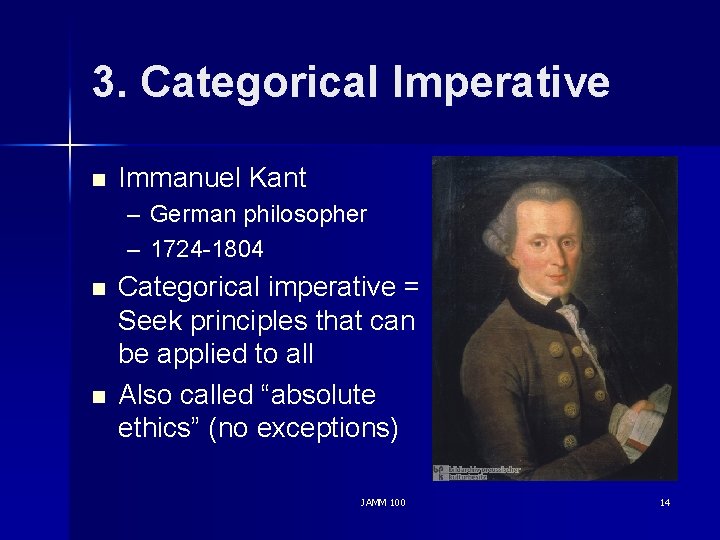
3. Categorical Imperative n Immanuel Kant – German philosopher – 1724 -1804 n n Categorical imperative = Seek principles that can be applied to all Also called “absolute ethics” (no exceptions) JAMM 100 14
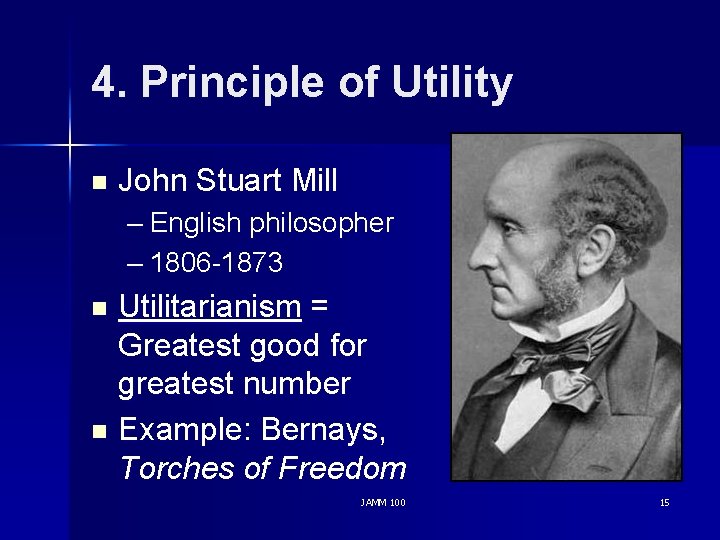
4. Principle of Utility n John Stuart Mill – English philosopher – 1806 -1873 Utilitarianism = Greatest good for greatest number n Example: Bernays, Torches of Freedom n JAMM 100 15
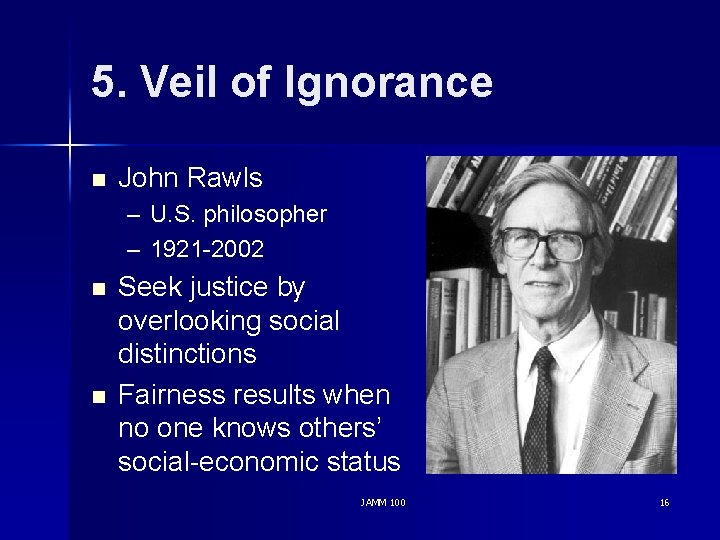
5. Veil of Ignorance n John Rawls – U. S. philosopher – 1921 -2002 n n Seek justice by overlooking social distinctions Fairness results when no one knows others’ social-economic status JAMM 100 16
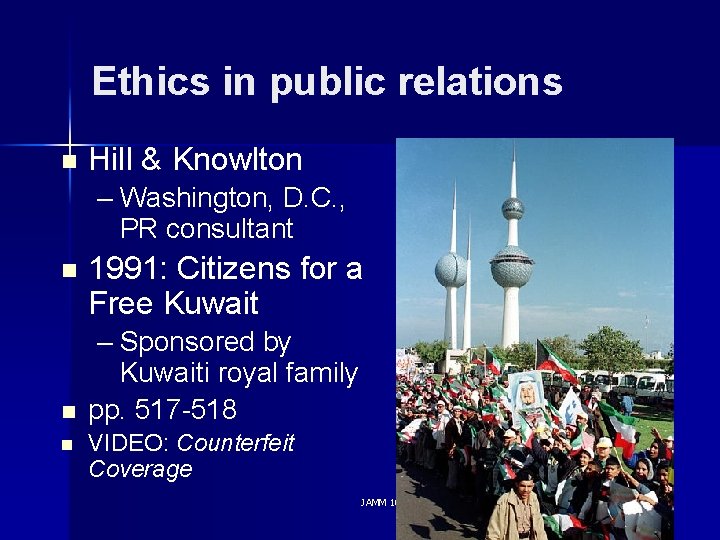
Ethics in public relations n Hill & Knowlton – Washington, D. C. , PR consultant n n n 1991: Citizens for a Free Kuwait – Sponsored by Kuwaiti royal family pp. 517 -518 VIDEO: Counterfeit Coverage JAMM 100
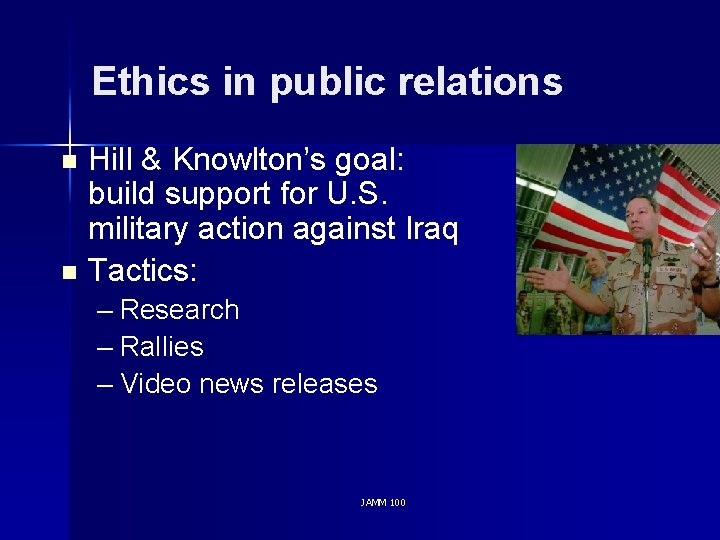
Ethics in public relations Hill & Knowlton’s goal: build support for U. S. military action against Iraq n Tactics: n – Research – Rallies – Video news releases JAMM 100
Ethics in public relations Are attempts to manipulate public opinion through PR ethical? n Should Hill & Knowlton have investigated woman’s claims before arranging her testimony? n Who should the PR agency have first loyalty to: the client or the public? n
Clicker Quiz #2 Which of the following ethical theorists is associated with the principle of utilitarianism, also known as “the greatest good for the greatest number”? a) Aristotle b) John Stuart Mill c) John Locke d) John Calvin e) Robert Maynard Hutchins JAMM 100 20