
Media effects How do the media influence us
- Slides: 13
Media effects How do the media influence us?
Effects studies • • • Early effects scholars “Powerful effects” theory Walter Lippmann, Public Opinion Harold Lasswell, WWII propaganda “Bullet” or “hypodermic needle” theory Assumes that people are passive, uncritical
Minimalist effects theory • • • Paul Lazarsfeld, 1948 “Two-step flow” model Status conferral Agenda setting Narcotizing dysfunction Media lull people into passivity
Cumulative effects theory • Elizabeth Noelle-Neumann • cumulative effects theory’spiral of silence model • dominant view can snowball through the media • dominant view not sufficiently challenged • people fear rejection
Uses and gratifications studies • • challenges to audience passivity reevaluation of scholarly assumptions “gratifications”--why people use media: “surveillance” function--scan environment for danger • “socialization” function--helps us maintain social relationships • “parasocial” relationships--artificial
Gratifications, con’t • • diversion function stimulation relaxation release
Consistency theory • individual selectivity • selective exposure – we choose our media • selective perception – Walter Lippmann: “We do not see first and then define; we define first and then see. ” • selective retention and recall – 1938 War of the Worlds broadcast
Socialization • Media’s initiating role – by age 18, US children have watched 18, 000 -20, 000 hours of TV – children learn prosocial behavior • Role models--big influence • Stereotyping--forms images in our mind • Erosion of boundaries that separate generations--children’s exposure
Media-depictions of violence • learning about violence • observational learning • media violence-– a catharsis? – prods socially positive action? – teaches us the world is a scary place
Media violence as negative • Aggressive stimulation theory – Albert Bandura’s studies in 1960 s – Zamora case – Bundy case – Deer Hunter cases • Catalytic theory-Schramm, Lyle, Parker – for some children under some conditions
George Gerbner’s “Mean World Syndrome” • Societally debilitating effects of violence – media world is more dangerous real world – desensitizing theory--more violence is necessary to make an impact – Gerbner Index since 1970 s – 30, 000 murders, 40, 000 attempted murders seen on TV by age 18 – give up freedom for personal safety
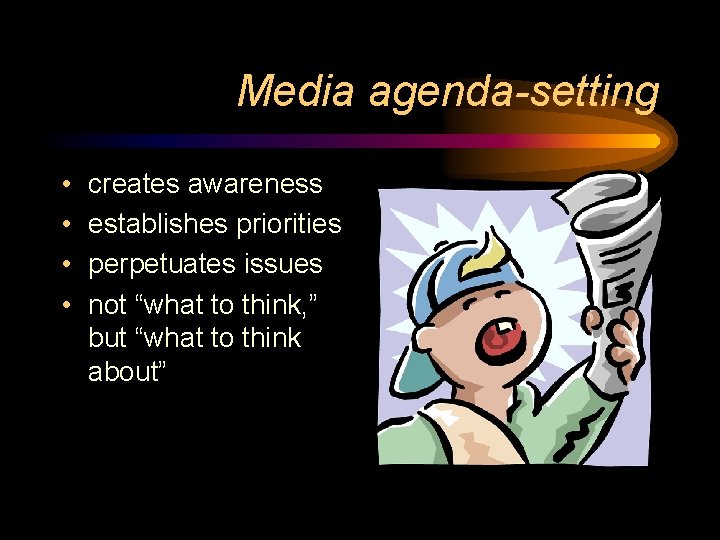
Media agenda-setting • • creates awareness establishes priorities perpetuates issues not “what to think, ” but “what to think about”
Media induced anxiety and apathy • information “overload” or “pollution” • New York Times--12 million words! More info in one day than in a 17 th century person’s lifetime! • media induce passivity--”couch potato” • we neglect sports, neighborhood & community activities • “well informed futility”