
MEDA Mars Environmental Dynamics Analyzer for NASAJPLs Mars
- Slides: 29
MEDA Mars Environmental Dynamics Analyzer for NASA/JPL’s Mars 2020 mission MEDA Wind Sensor Front End ASIC S. Espejo, J. Ceballos-Cáceres, A. Ragel-Morales, S. Sordo-Ibáñez, L. Carranza-González, J. M. Mora-Gutiérrez, M. A. Lagos-Florido, J. Ramos-Martos IMSE-CNM (CSIC/Universidad de Sevilla) Parque Científico y Tecnológico Cartuja, Calle Américo Vespucio s/n, 41092, Sevilla, SPAIN mailto: espejo@imse-cnm. csic. es AMICSA 2016, 12 -16 June 2016, Gothenburg, Sweden
MEDA Wind-Sensor Front-End ASIC, AMICSA 2016 Ø MEDA Instruments for Mars 2020 Ø The MEDA Wind Sensor Ø The MEDA WS Front-End ASIC Ø Circuitry description Ø Experimental results (example) Ø Summary 2
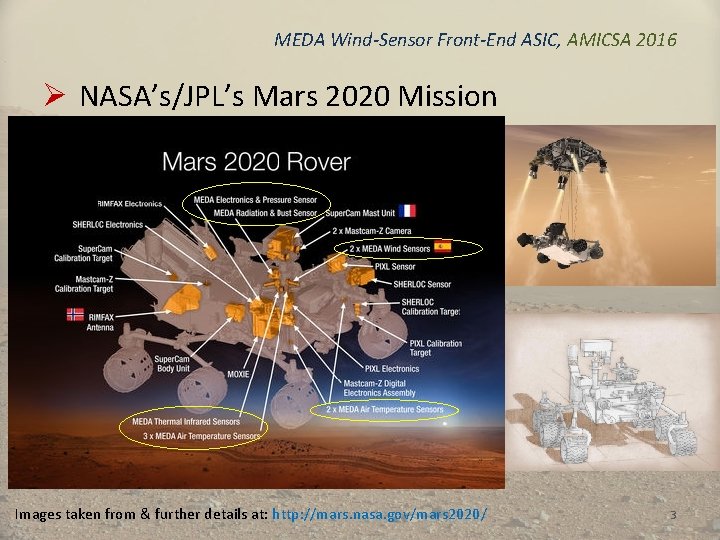
MEDA Wind-Sensor Front-End ASIC, AMICSA 2016 Ø NASA’s/JPL’s Mars 2020 Mission Images taken from & further details at: http: //mars. nasa. gov/mars 2020/ 3
MEDA Wind-Sensor Front-End ASIC, AMICSA 2016 Ø MEDA: Mars Environmental Dynamics Analyzer v A set of sensors that will provide measurements of: Ø Ø Ø Temperature Wind speed & direction Pressure Relative humidity Dust size & shape v Principal Investigator: José Antonio Rodríguez-Manfredi Centro de Astrobiología, Instituto Nacional de Técnica Aeroespacial, Spain Further details at: http: //mars. nasa. gov/mars 2020/mission/science/for-scientists/instruments/meda/ 4
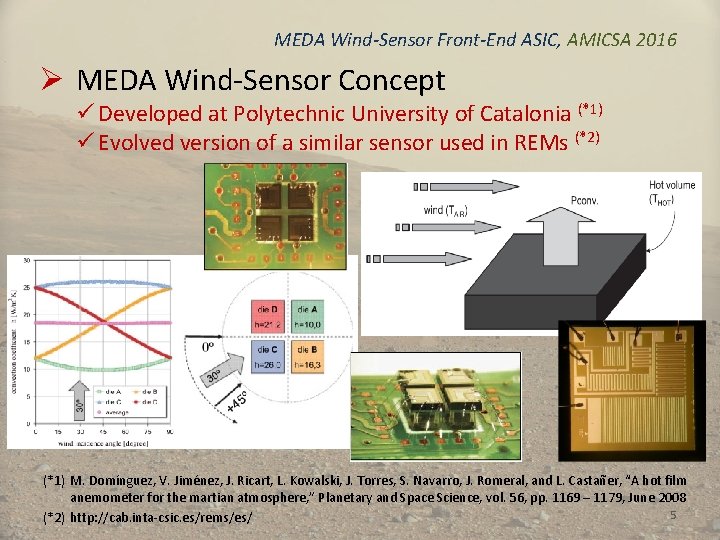
MEDA Wind-Sensor Front-End ASIC, AMICSA 2016 Ø MEDA Wind-Sensor Concept ü Developed at Polytechnic University of Catalonia (*1) ü Evolved version of a similar sensor used in REMs (*2) (*1) M. Domínguez, V. Jiménez, J. Ricart, L. Kowalski, J. Torres, S. Navarro, J. Romeral, and L. Castañer, “A hot film anemometer for the martian atmosphere, ” Planetary and Space Science, vol. 56, pp. 1169 – 1179, June 2008 5 (*2) http: //cab. inta-csic. es/rems/es/
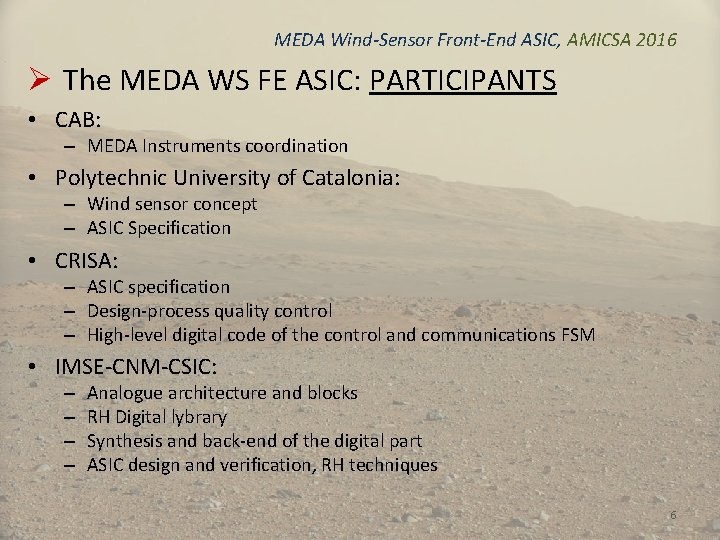
MEDA Wind-Sensor Front-End ASIC, AMICSA 2016 Ø The MEDA WS FE ASIC: PARTICIPANTS • CAB: – MEDA Instruments coordination • Polytechnic University of Catalonia: – Wind sensor concept – ASIC Specification • CRISA: – ASIC specification – Design-process quality control – High-level digital code of the control and communications FSM • IMSE-CNM-CSIC: – – Analogue architecture and blocks RH Digital lybrary Synthesis and back-end of the digital part ASIC design and verification, RH techniques 6
MEDA Wind-Sensor Front-End ASIC, AMICSA 2016 Ø The MEDA WS FE ASIC: Process Technology & Previous work • Standard 0. 35 mm CMOS technology, from AMS (Austria Micro Systems) • Only 3. 3 V transistors used along the chip • Builds on previous efforts by the authors in the past years: – Characterization of radiation and low-temperature effects on devices in this technology – Development and validation of a rad-hard library of digital cells – Previous development of several other mixed-signal space ASICs 7
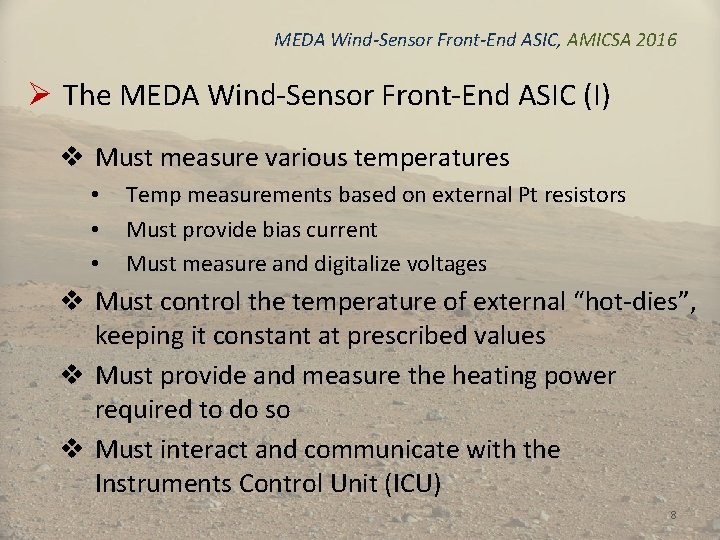
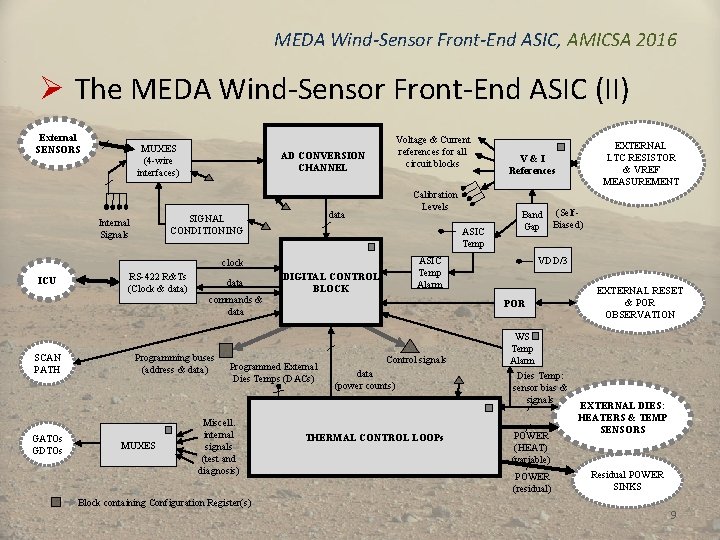
MEDA Wind-Sensor Front-End ASIC, AMICSA 2016 Ø The MEDA Wind-Sensor Front-End ASIC (I) v Must measure various temperatures • • • Temp measurements based on external Pt resistors Must provide bias current Must measure and digitalize voltages v Must control the temperature of external “hot-dies”, keeping it constant at prescribed values v Must provide and measure the heating power required to do so v Must interact and communicate with the Instruments Control Unit (ICU) 8
MEDA Wind-Sensor Front-End ASIC, AMICSA 2016 Ø The MEDA Wind-Sensor Front-End ASIC (II) External SENSORS MUXES (4 -wire interfaces) AD CONVERSION CHANNEL Calibration Levels data SIGNAL CONDITIONING Internal Signals Voltage & Current references for all circuit blocks ASIC Temp ICU RS-422 R&Ts (Clock & data) data DIGITAL CONTROL BLOCK commands & data SCAN PATH GATOs GDTOs Programming buses (address & data) MUXES Block containing Configuration Register(s) VDD/3 POR Programmed External Dies Temps (DACs) Miscell. internal signals (test and diagnosis) Band (Self. Gap Biased) ASIC Temp Alarm clock Control signals data (power counts) THERMAL CONTROL LOOPs EXTERNAL LTC RESISTOR & VREF MEASUREMENT V&I References EXTERNAL RESET & POR OBSERVATION WS Temp Alarm Dies Temp: sensor bias & signals POWER (HEAT) (variable) POWER (residual) EXTERNAL DIES: HEATERS & TEMP SENSORS Residual POWER SINKS 9
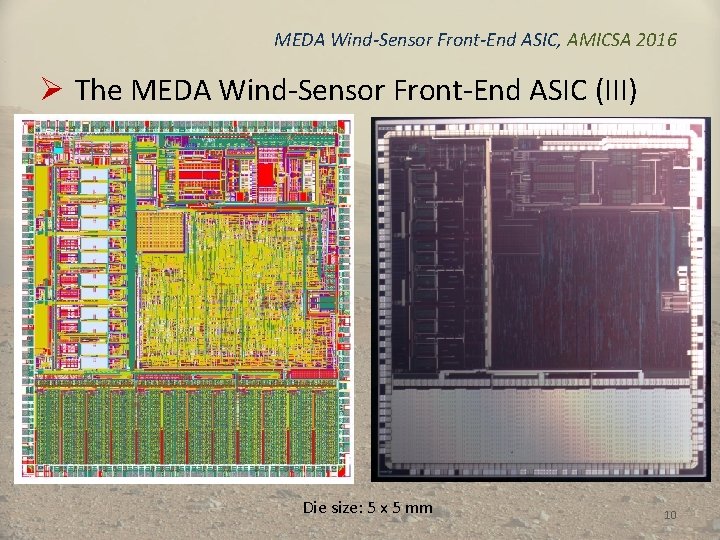
MEDA Wind-Sensor Front-End ASIC, AMICSA 2016 Ø The MEDA Wind-Sensor Front-End ASIC (III) Die size: 5 x 5 mm 10
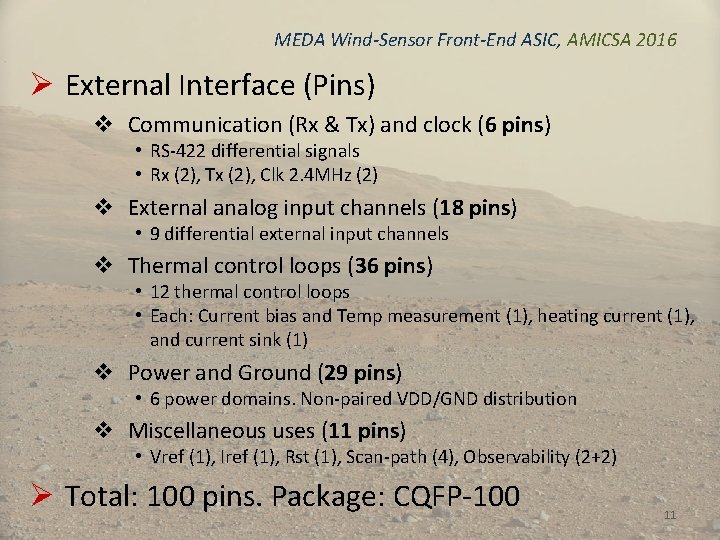
MEDA Wind-Sensor Front-End ASIC, AMICSA 2016 Ø External Interface (Pins) v Communication (Rx & Tx) and clock (6 pins) • RS-422 differential signals • Rx (2), Tx (2), Clk 2. 4 MHz (2) v External analog input channels (18 pins) • 9 differential external input channels v Thermal control loops (36 pins) • 12 thermal control loops • Each: Current bias and Temp measurement (1), heating current (1), and current sink (1) v Power and Ground (29 pins) • 6 power domains. Non-paired VDD/GND distribution v Miscellaneous uses (11 pins) • Vref (1), Iref (1), Rst (1), Scan-path (4), Observability (2+2) Ø Total: 100 pins. Package: CQFP-100 11
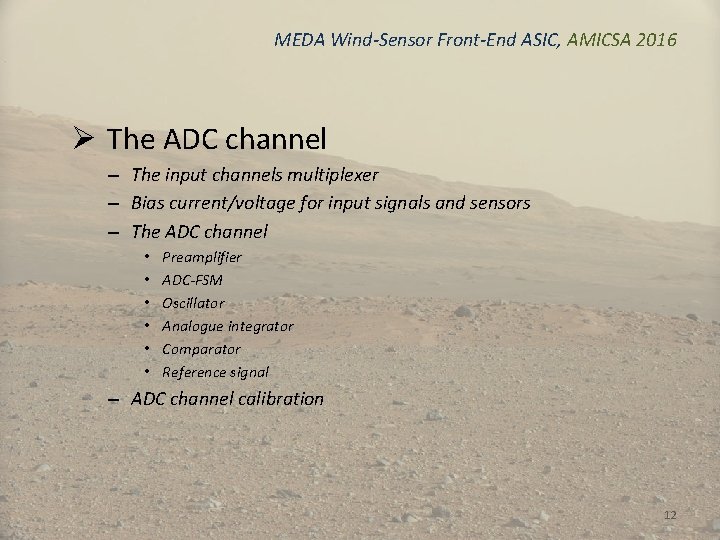
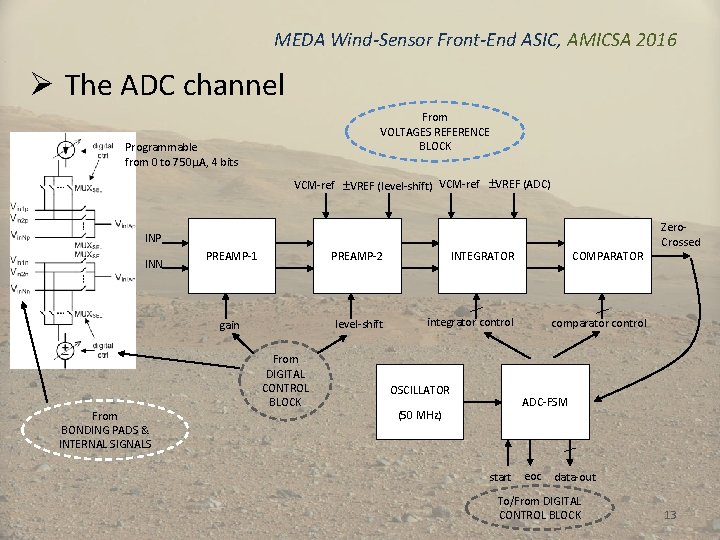
MEDA Wind-Sensor Front-End ASIC, AMICSA 2016 Ø The ADC channel – The input channels multiplexer – Bias current/voltage for input signals and sensors – The ADC channel • • • Preamplifier ADC-FSM Oscillator Analogue integrator Comparator Reference signal – ADC channel calibration 12
MEDA Wind-Sensor Front-End ASIC, AMICSA 2016 Ø The ADC channel From VOLTAGES REFERENCE BLOCK Programmable from 0 to 750 m. A, 4 bits VCM-ref VREF (level-shift) VCM-ref VREF (ADC) INP INN From BONDING PADS & INTERNAL SIGNALS PREAMP-1 PREAMP-2 INTEGRATOR COMPARATOR gain level-shift integrator control comparator control From DIGITAL CONTROL BLOCK OSCILLATOR Zero. Crossed ADC-FSM (50 MHz) start eoc data-out To/From DIGITAL CONTROL BLOCK 13
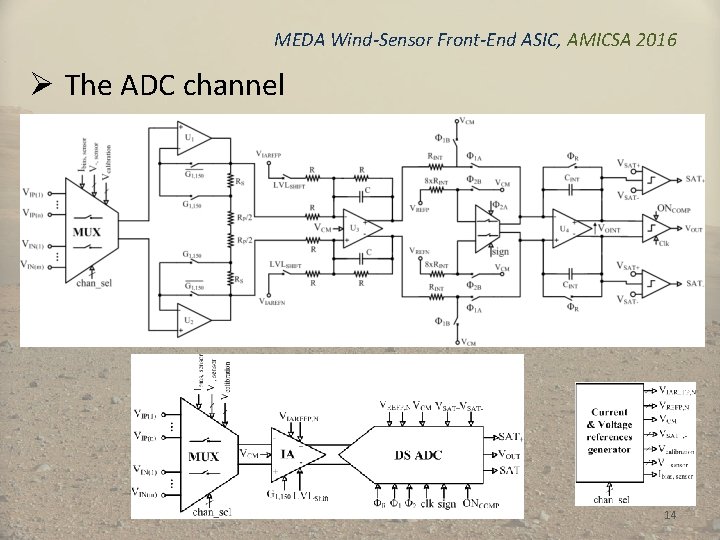
MEDA Wind-Sensor Front-End ASIC, AMICSA 2016 Ø The ADC channel 14
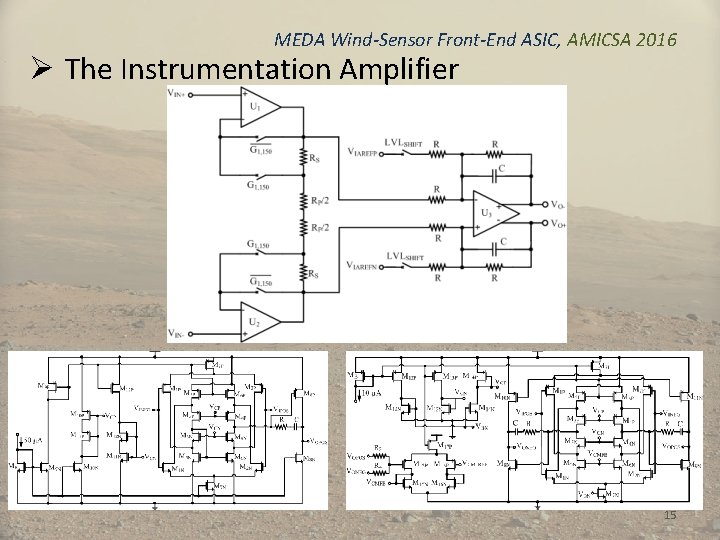
MEDA Wind-Sensor Front-End ASIC, AMICSA 2016 Ø The Instrumentation Amplifier 15
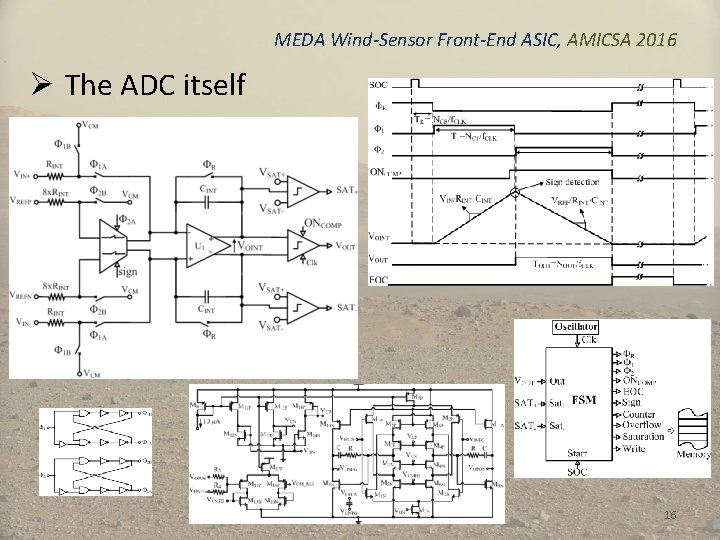
MEDA Wind-Sensor Front-End ASIC, AMICSA 2016 Ø The ADC itself 16
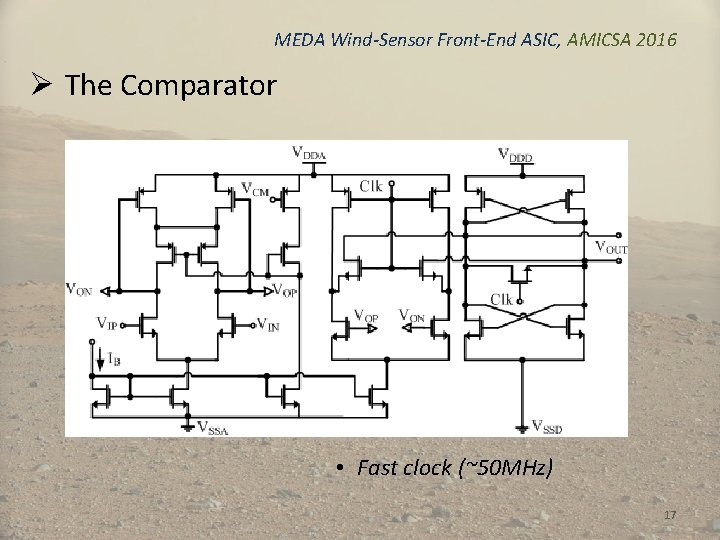
MEDA Wind-Sensor Front-End ASIC, AMICSA 2016 Ø The Comparator • Fast clock (~50 MHz) 17
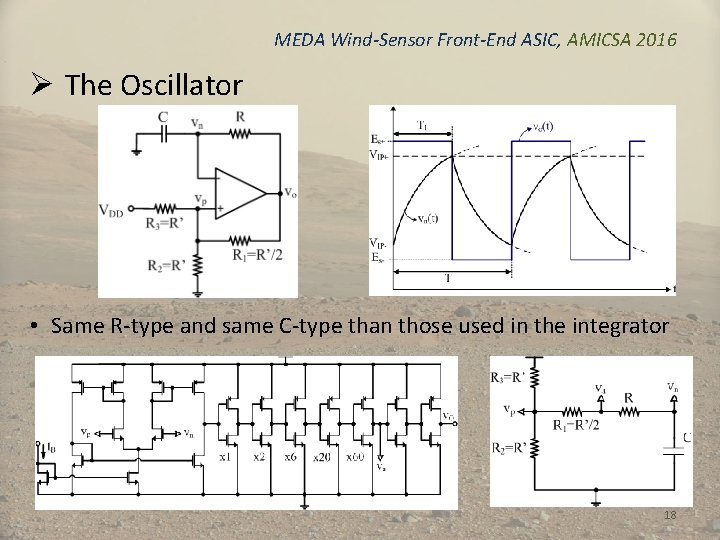
MEDA Wind-Sensor Front-End ASIC, AMICSA 2016 Ø The Oscillator • Same R-type and same C-type than those used in the integrator 18
MEDA Wind-Sensor Front-End ASIC, AMICSA 2016 Ø Reference voltage: • From band-gap and scaling amplifier • Set of DC input levels used for real time on-line calibration: ü Offset error ü Gain error 19
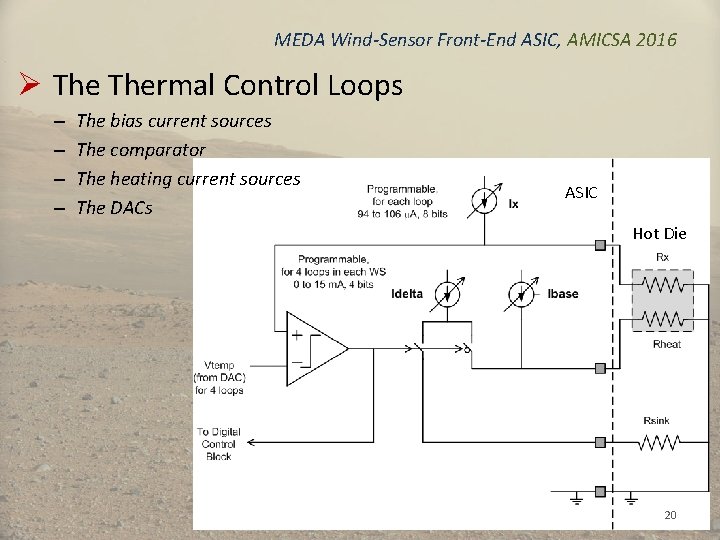
MEDA Wind-Sensor Front-End ASIC, AMICSA 2016 Ø Thermal Control Loops – – The bias current sources The comparator The heating current sources The DACs ASIC Hot Die 20
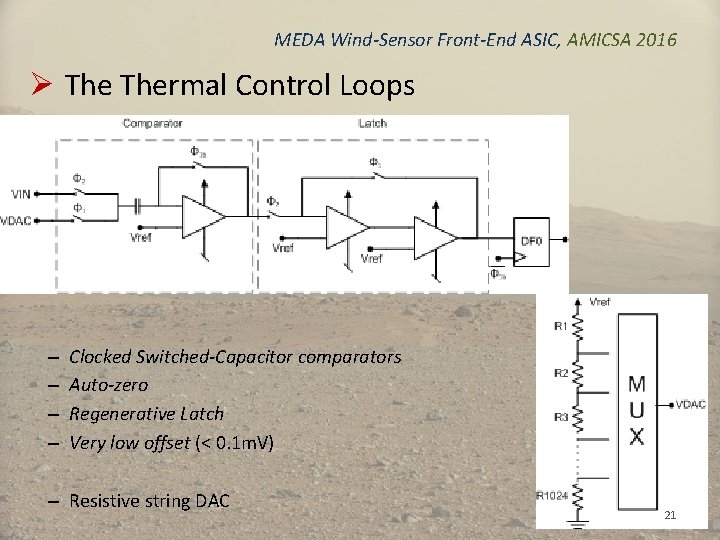
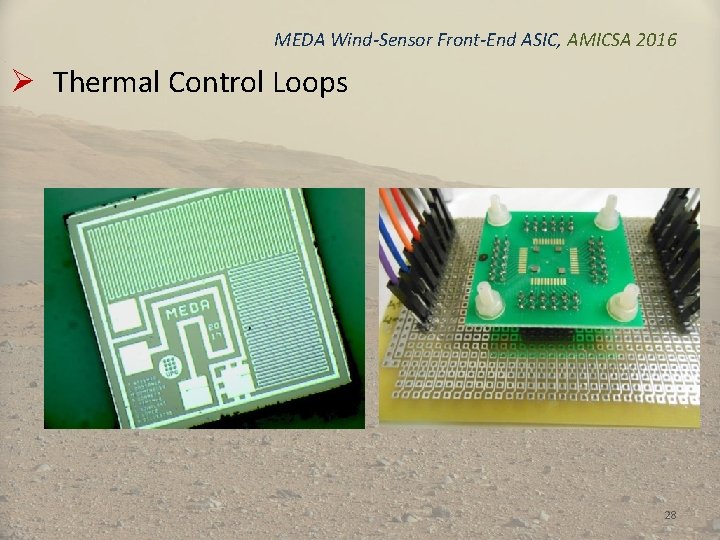
MEDA Wind-Sensor Front-End ASIC, AMICSA 2016 Ø Thermal Control Loops – – Clocked Switched-Capacitor comparators Auto-zero Regenerative Latch Very low offset (< 0. 1 m. V) – Resistive string DAC 21
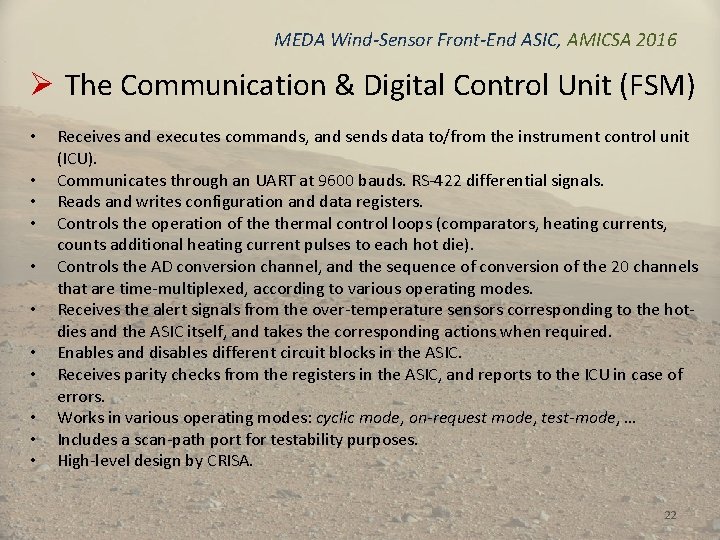
MEDA Wind-Sensor Front-End ASIC, AMICSA 2016 Ø The Communication & Digital Control Unit (FSM) • • • Receives and executes commands, and sends data to/from the instrument control unit (ICU). Communicates through an UART at 9600 bauds. RS-422 differential signals. Reads and writes configuration and data registers. Controls the operation of thermal control loops (comparators, heating currents, counts additional heating current pulses to each hot die). Controls the AD conversion channel, and the sequence of conversion of the 20 channels that are time-multiplexed, according to various operating modes. Receives the alert signals from the over-temperature sensors corresponding to the hotdies and the ASIC itself, and takes the corresponding actions when required. Enables and disables different circuit blocks in the ASIC. Receives parity checks from the registers in the ASIC, and reports to the ICU in case of errors. Works in various operating modes: cyclic mode, on-request mode, test-mode, … Includes a scan-path port for testability purposes. High-level design by CRISA. 22
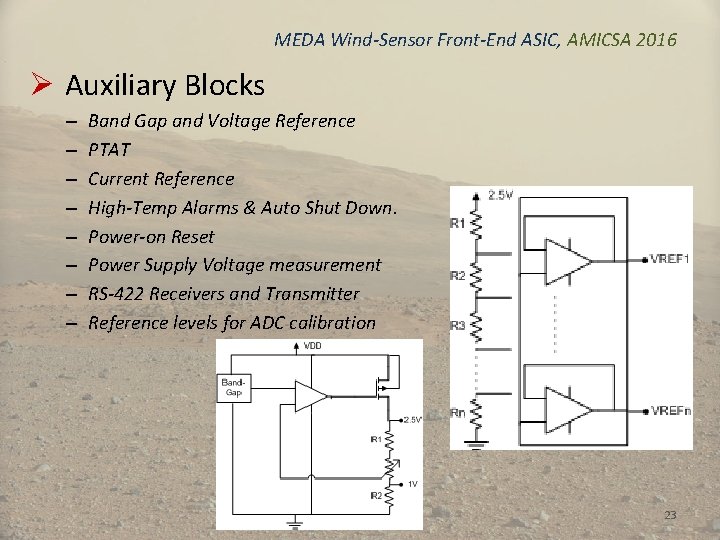
MEDA Wind-Sensor Front-End ASIC, AMICSA 2016 Ø Auxiliary Blocks – – – – Band Gap and Voltage Reference PTAT Current Reference High-Temp Alarms & Auto Shut Down. Power-on Reset Power Supply Voltage measurement RS-422 Receivers and Transmitter Reference levels for ADC calibration 23
MEDA Wind-Sensor Front-End ASIC, AMICSA 2016 Ø RHBD Techniques and Low-Temp issues (I) • Known techniques available in the literature • Builds on previous work by the authors in the characterization of radiation and low temperature effects on this specific CMOS technology [7], [8]. • Analogue circuitry: full-custom, enclosed-layout transistors (ELTs) for nmos, regular layout for pmos (TID) • Guard-rings around nmos and pmos devices (SEEs). • Specific type of converter, size of capacitors (SET). • Role of the ASIC: allows sporadic wrong behaviour. • Similar mixed-signal ASICs designed and tested using the same procedures in the same technology have been shown to be latch-up free up to at least 80 Me. V·cm 2/mg. Same result is expected. • Digital sections: semi-custom. RHBD digital cells library developed. Same RHBD techniques than in analogue circuitry. • All registers in the ASIC include parity-check. Parity errors are reported to the digital control unit, which in turn reports this events to the ICU. 24
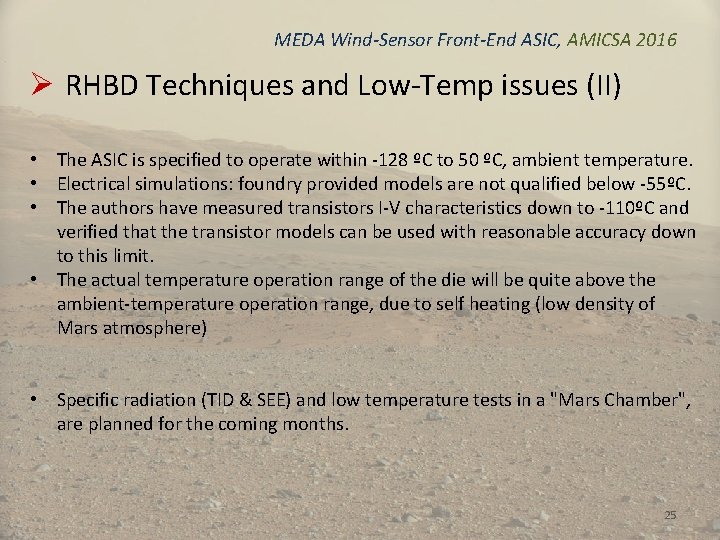
MEDA Wind-Sensor Front-End ASIC, AMICSA 2016 Ø RHBD Techniques and Low-Temp issues (II) • The ASIC is specified to operate within -128 ºC to 50 ºC, ambient temperature. • Electrical simulations: foundry provided models are not qualified below -55ºC. • The authors have measured transistors I-V characteristics down to -110ºC and verified that the transistor models can be used with reasonable accuracy down to this limit. • The actual temperature operation range of the die will be quite above the ambient-temperature operation range, due to self heating (low density of Mars atmosphere) • Specific radiation (TID & SEE) and low temperature tests in a "Mars Chamber", are planned for the coming months. 25
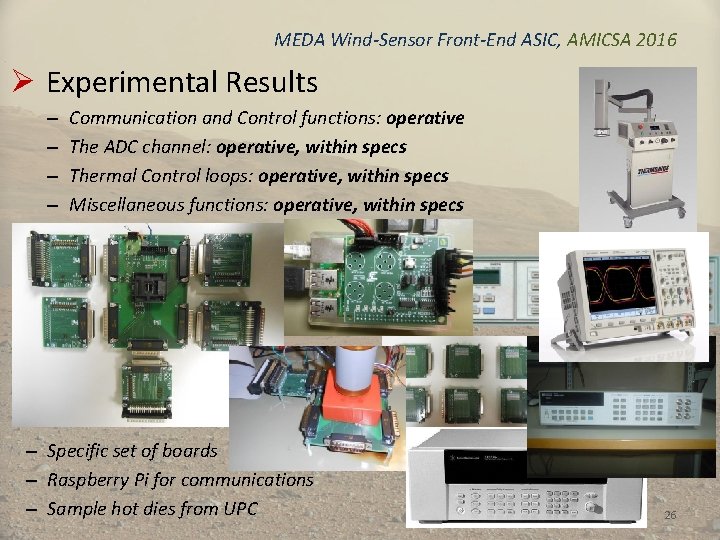
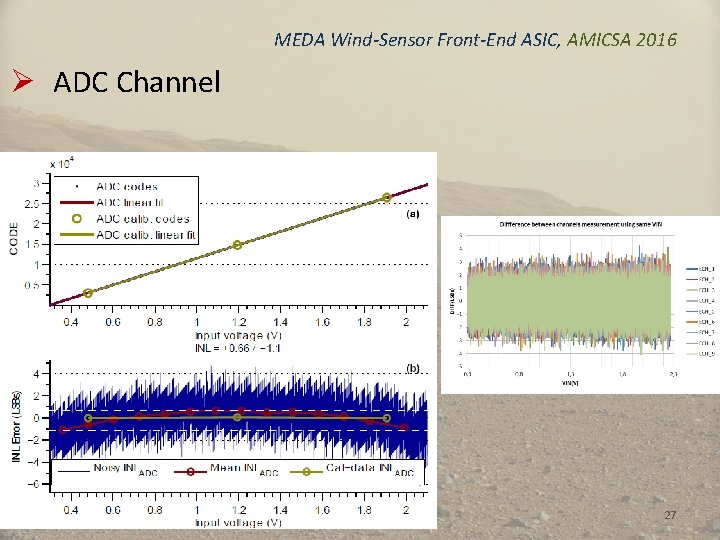
MEDA Wind-Sensor Front-End ASIC, AMICSA 2016 Ø Experimental Results – – Communication and Control functions: operative The ADC channel: operative, within specs Thermal Control loops: operative, within specs Miscellaneous functions: operative, within specs – Specific set of boards – Raspberry Pi for communications – Sample hot dies from UPC 26
MEDA Wind-Sensor Front-End ASIC, AMICSA 2016 Ø ADC Channel 27
MEDA Wind-Sensor Front-End ASIC, AMICSA 2016 Ø Thermal Control Loops 28
MEDA Wind-Sensor Front-End ASIC, AMICSA 2016 Ø Summary ü A rad-hard, mixed-signal ASIC in a standard 0. 35 mm CMOS technology has been designed, fabricated and functionally tested. ü The ASIC is an analogue front-end for the MEDA wind sensor for NASA's Mars 2020 mission ü Additional radiation and low temperature measurements are underway. Expected to be satisfactory based on previous ASICs designed in the same technology using the same RHBD techniques and the same rad-hard digital library. 29