
MECHANOTECHNOLOGY N 3 MALUTI TVET COLLEGE LECTURER MT

- Slides: 9
MECHANOTECHNOLOGY N 3 MALUTI TVET COLLEGE LECTURER : MT MPHAGO ITEMOHELENG CAMPUS
MODULE 12 MATERIAL AND MATERIAL PROCESS LO : Explain and understand the difference between ferrous and nonferrous metals, iron and alloy and discuss the general behaviour of specific materials during specific workshop process. ITEMOHELENG CAMPUS
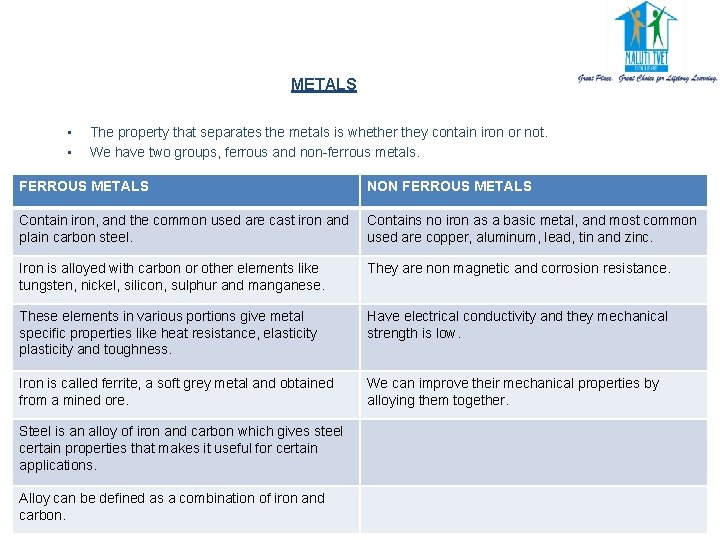
METALS • • The property that separates the metals is whether they contain iron or not. We have two groups, ferrous and non-ferrous metals. FERROUS METALS NON FERROUS METALS Contain iron, and the common used are cast iron and plain carbon steel. Contains no iron as a basic metal, and most common used are copper, aluminum, lead, tin and zinc. Iron is alloyed with carbon or other elements like tungsten, nickel, silicon, sulphur and manganese. They are non magnetic and corrosion resistance. These elements in various portions give metal specific properties like heat resistance, elasticity plasticity and toughness. Have electrical conductivity and they mechanical strength is low. Iron is called ferrite, a soft grey metal and obtained from a mined ore. We can improve their mechanical properties by alloying them together. Steel is an alloy of iron and carbon which gives steel certain properties that makes it useful for certain applications. Alloy can be defined as a combination of iron and carbon. ITEMOHELENG CAMPUS
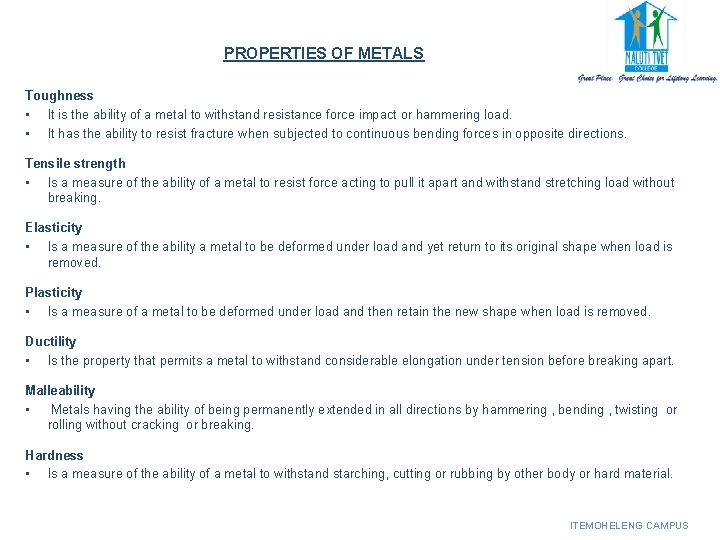
PROPERTIES OF METALS Toughness • It is the ability of a metal to withstand resistance force impact or hammering load. • It has the ability to resist fracture when subjected to continuous bending forces in opposite directions. Tensile strength • Is a measure of the ability of a metal to resist force acting to pull it apart and withstand stretching load without breaking. Elasticity • Is a measure of the ability a metal to be deformed under load and yet return to its original shape when load is removed. Plasticity • Is a measure of a metal to be deformed under load and then retain the new shape when load is removed. Ductility • Is the property that permits a metal to withstand considerable elongation under tension before breaking apart. Malleability • Metals having the ability of being permanently extended in all directions by hammering , bending , twisting or rolling without cracking or breaking. Hardness • Is a measure of the ability of a metal to withstand starching, cutting or rubbing by other body or hard material. ITEMOHELENG CAMPUS
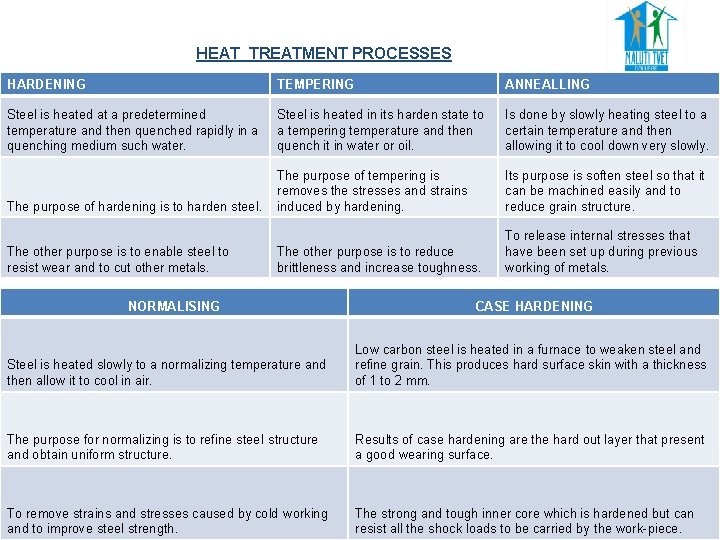
HEAT TREATMENT PROCESSES HARDENING TEMPERING ANNEALLING • Heat treatment is the process whereby the physical properties of a metal usually steel are changed by heating up to aatcertain temperature and then cooling down. Toughness wear by areslowly someheating of the steel to a Steel isitheated a predetermined Steel isit heated in its harden, hardness state to and Is done properties that can be improved various heat treatment processes. temperature and then quenched rapidlyby in a a tempering temperature and then certain temperature and then • Below is processes and purposes of each. quenching medium such water. quench it in water or oil. allowing it to cool down very slowly. The purpose of hardening is to harden steel. The other purpose is to enable steel to resist wear and to cut other metals. The purpose of tempering is removes the stresses and strains induced by hardening. Its purpose is soften steel so that it can be machined easily and to reduce grain structure. The other purpose is to reduce brittleness and increase toughness. To release internal stresses that have been set up during previous working of metals. NORMALISING CASE HARDENING Steel is heated slowly to a normalizing temperature and then allow it to cool in air. Low carbon steel is heated in a furnace to weaken steel and refine grain. This produces hard surface skin with a thickness of 1 to 2 mm. The purpose for normalizing is to refine steel structure and obtain uniform structure. Results of case hardening are the hard out layer that present a good wearing surface. To remove strains and stresses caused by cold working and to improve steel strength. The strong and tough inner core which is hardened but can CAMPUS resist all the shock loads to be carried. ITEMOHELENG by the work-piece.
COLOUR CODING OF METALS METAL COLOUR Low carbon steel Orange High carbon steel Brown Case hardened steel Orange Low alloy steel Light purple Structural steel Red Steel for pressure containers White Stainless steel Black Carbon and alloy spring steel Black Silicon chrome steel Black Cast steel Blue Pipeline steel Grey Steel for lifting machines Green ITEMOHELENG CAMPUS
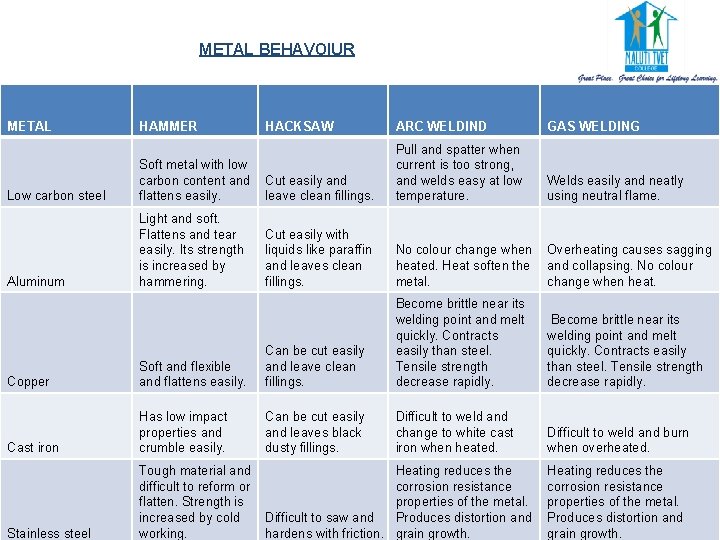
METAL BEHAVOIUR METAL HAMMER HACKSAW ARC WELDIND GAS WELDING Low carbon steel Soft metal with low carbon content and flattens easily. Cut easily and leave clean fillings. Pull and spatter when current is too strong, and welds easy at low temperature. Welds easily and neatly using neutral flame. Aluminum Light and soft. Flattens and tear easily. Its strength is increased by hammering. Cut easily with liquids like paraffin and leaves clean fillings. No colour change when heated. Heat soften the metal. Overheating causes sagging and collapsing. No colour change when heat. Copper Soft and flexible and flattens easily. Can be cut easily and leave clean fillings. Become brittle near its welding point and melt quickly. Contracts easily than steel. Tensile strength decrease rapidly. Cast iron Has low impact properties and crumble easily. Can be cut easily and leaves black dusty fillings. Difficult to weld and change to white cast iron when heated. Difficult to weld and burn when overheated. Stainless steel Tough material and difficult to reform or flatten. Strength is increased by cold working. Heating reduces the corrosion resistance properties of the metal. Difficult to saw and Produces distortion and hardens with friction. grain growth. Heating reduces the corrosion resistance properties of the metal. Produces distortion and ITEMOHELENG CAMPUS grain growth.
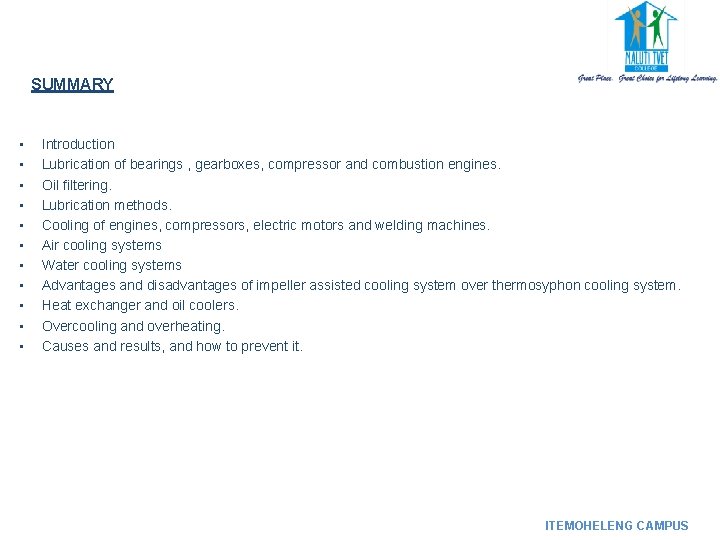
SUMMARY • • • Introduction Lubrication of bearings , gearboxes, compressor and combustion engines. Oil filtering. Lubrication methods. Cooling of engines, compressors, electric motors and welding machines. Air cooling systems Water cooling systems Advantages and disadvantages of impeller assisted cooling system over thermosyphon cooling system. Heat exchanger and oil coolers. Overcooling and overheating. Causes and results, and how to prevent it. ITEMOHELENG CAMPUS
ASSESSMENT On page 240 & 241 of the textbook supplied by the college. “Mechanotechnology N 3 second edition. ” by FM GOUWS. 1, 4, 6, 9 & 10. . CONTACT ME ON WHATSUP FOR ANY QUESTIONS THAT YOU MAY HAVE. MY NUMBER IS 073 215 7689 THANK YOU. ITEMOHELENG CAMPUS