
Mechanisms of Homologous Recombination Mark Slayton Ohio University
Mechanisms of Homologous Recombination Mark Slayton Ohio University - MCB 7200 December 3 rd, 2013 Dr. Frank Horodyski
Overview • Background Information • What is Homologous Recombination? ▫ DNA double-strand break repair ▫ Chromosomal crossover ▫ Horizontal gene transfer • The Rec. BCD Pathway • Homologous Recombination in Eukaryotes • Practical Applications
Overview • Background Information • What is Homologous Recombination? ▫ DNA double-strand break repair ▫ Chromosomal crossover ▫ Horizontal gene transfer • The Rec. BCD Pathway • Homologous Recombination in Eukaryotes • Practical Applications
Background Information • The term ‘homologous recombination’ was developed over a series of discoveries demonstrating “non. Mendelian” genetics �Early 1900’s – traits can be genetically linked � 1911 – “crossing-over” can occur between chromosomes � 1931 – chromosomal crossover in gametes (meiosis) and in somatic cells (mitosis)
Background Information � 1947 –prokaryotic genetic recombination, establishes E. coli as a model organism � 1964 – meiotic recombination, Holliday junction � 1983 – double-strand break repair (DSBR) pathway �Additional research leads to discovery of a multitude of different pathways for homologous recombination in organisms from all three domains – bacteria, archaea, and eukarya – as well as in viruses
Overview • Background Information • What is Homologous Recombination? ▫ DNA double-strand break repair ▫ Chromosomal crossover ▫ Horizontal gene transfer • The Rec. BCD Pathway • Homologous Recombination in Eukaryotes • Practical Applications
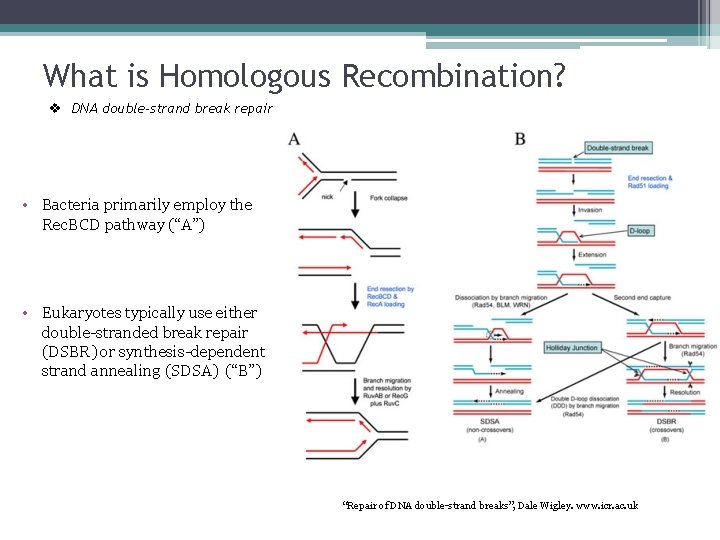
What is Homologous Recombination? v DNA double-strand break repair • Bacteria primarily employ the Rec. BCD pathway (“A”) • Eukaryotes typically use either double-stranded break repair (DSBR) or synthesis-dependent strand annealing (SDSA) (“B”) “Repair of DNA double-strand breaks”, Dale Wigley. www. icr. ac. uk
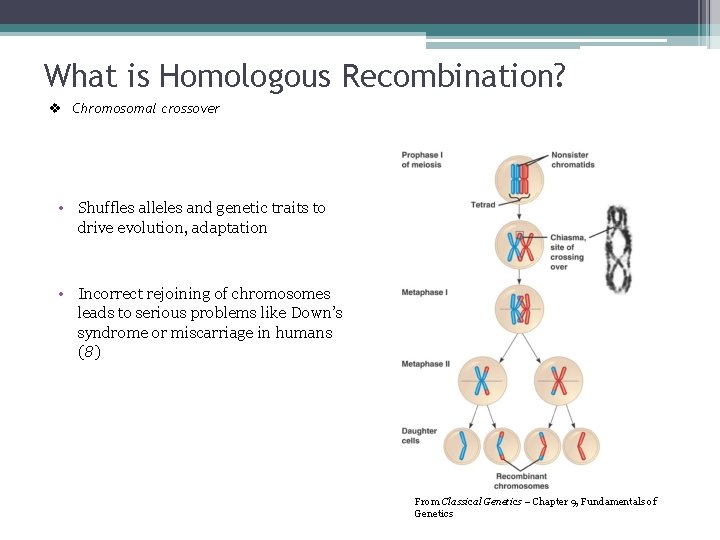
What is Homologous Recombination? v Chromosomal crossover • Shuffles alleles and genetic traits to drive evolution, adaptation • Incorrect rejoining of chromosomes leads to serious problems like Down’s syndrome or miscarriage in humans (8) From Classical Genetics – Chapter 9, Fundamentals of Genetics
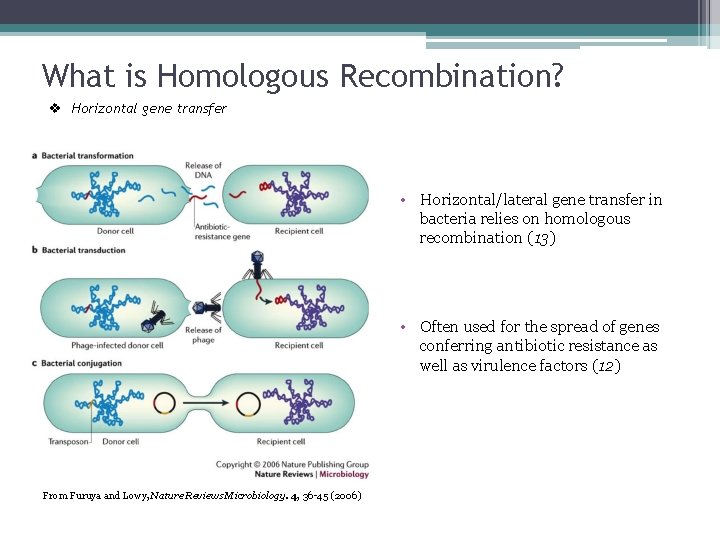
What is Homologous Recombination? v Horizontal gene transfer • Horizontal/lateral gene transfer in bacteria relies on homologous recombination (13) • Often used for the spread of genes conferring antibiotic resistance as well as virulence factors (12) From Furuya and Lowy, Nature Reviews Microbiology. 4, 36 -45 (2006)
Overview • Background Information • What is Homologous Recombination? ▫ DNA double-strand break repair ▫ Chromosomal crossover ▫ Horizontal gene transfer • The Rec. BCD Pathway • Homologous Recombination in Eukaryotes • Practical Applications
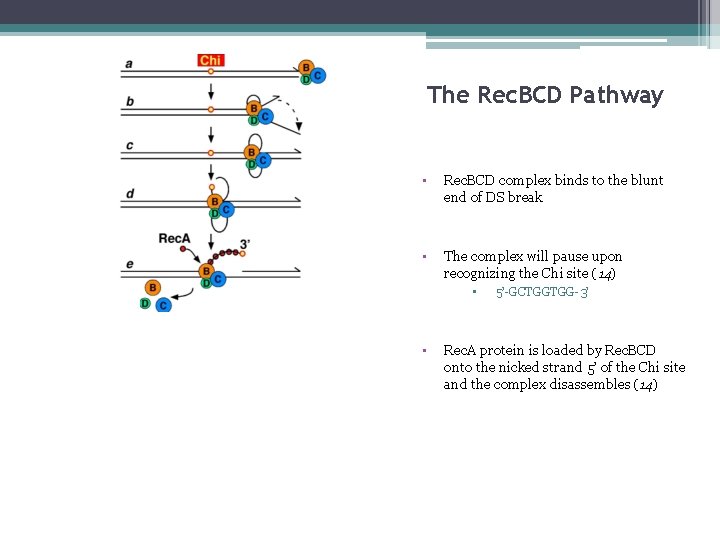
The Rec. BCD Pathway • Rec. BCD complex binds to the blunt end of DS break • The complex will pause upon recognizing the Chi site (14) • • From Cold Spring Harbor Laboratory Press, © 2007. 5’-GCTGGTGG-3’ Rec. A protein is loaded by Rec. BCD onto the nicked strand 5’ of the Chi site and the complex disassembles (14)
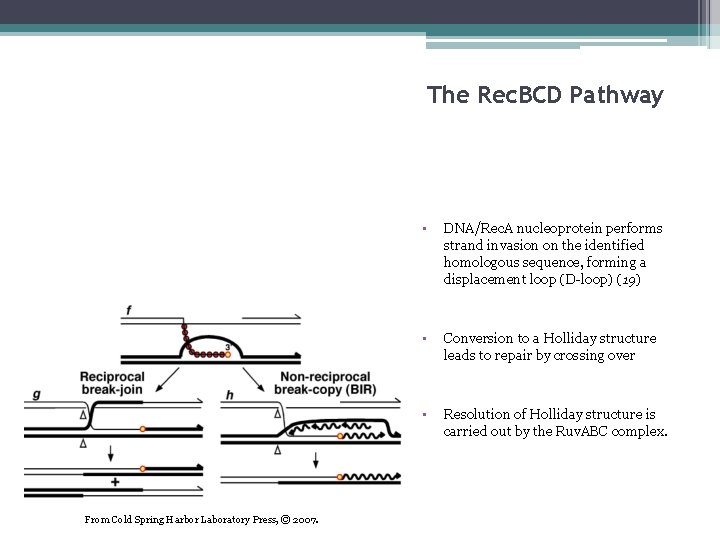
The Rec. BCD Pathway From Cold Spring Harbor Laboratory Press, © 2007. • DNA/Rec. A nucleoprotein performs strand invasion on the identified homologous sequence, forming a displacement loop (D-loop) (19) • Conversion to a Holliday structure leads to repair by crossing over • Resolution of Holliday structure is carried out by the Ruv. ABC complex.
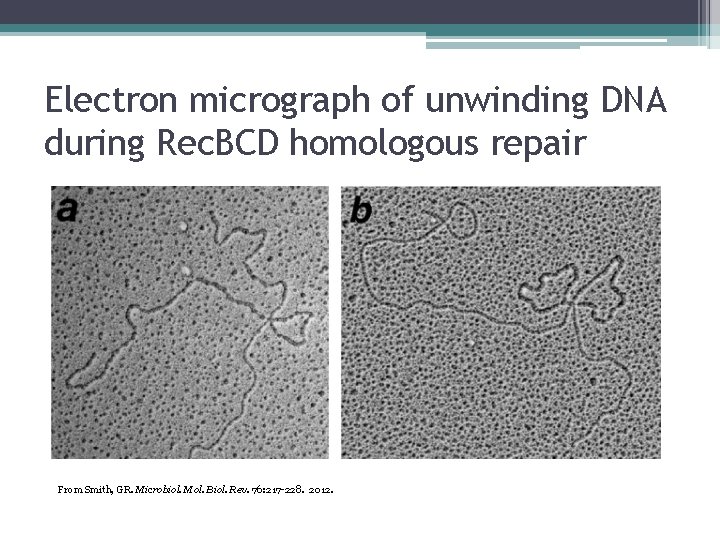
Electron micrograph of unwinding DNA during Rec. BCD homologous repair From Smith, GR. Microbiol. Mol. Biol. Rev. 76: 217 -228. 2012.
Overview • Background Information • What is Homologous Recombination? ▫ DNA double-strand break repair ▫ Chromosomal crossover ▫ Horizontal gene transfer • The Rec. BCD Pathway • Homologous Recombination in Eukaryotes • Practical Applications
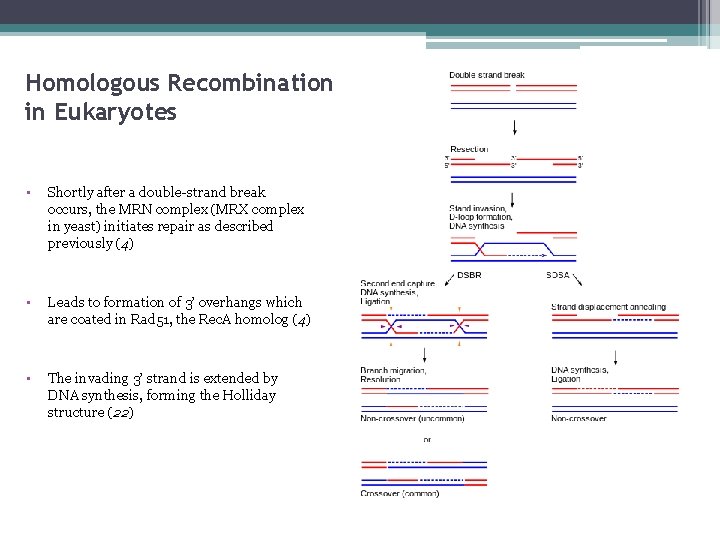
Homologous Recombination in Eukaryotes • Shortly after a double-strand break occurs, the MRN complex (MRX complex in yeast) initiates repair as described previously (4) • Leads to formation of 3’ overhangs which are coated in Rad 51, the Rec. A homolog (4) • The invading 3’ strand is extended by DNA synthesis, forming the Holliday structure (22)
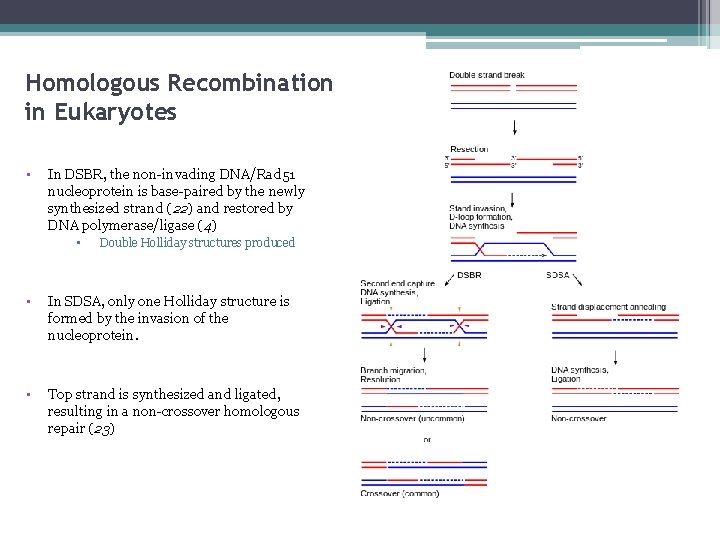
Homologous Recombination in Eukaryotes • In DSBR, the non-invading DNA/Rad 51 nucleoprotein is base-paired by the newly synthesized strand (22) and restored by DNA polymerase/ligase (4) • Double Holliday structures produced • In SDSA, only one Holliday structure is formed by the invasion of the nucleoprotein. • Top strand is synthesized and ligated, resulting in a non-crossover homologous repair (23)
Overview • Background Information • What is Homologous Recombination? ▫ DNA double-strand break repair ▫ Chromosomal crossover ▫ Horizontal gene transfer • The Rec. BCD Pathway • Homologous Recombination in Eukaryotes • Practical Applications
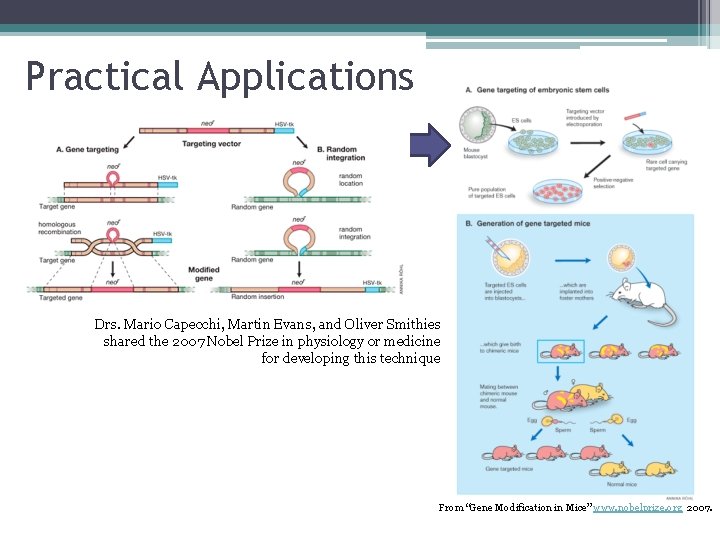
Practical Applications Drs. Mario Capecchi, Martin Evans, and Oliver Smithies shared the 2007 Nobel Prize in physiology or medicine for developing this technique From “Gene Modification in Mice” www. nobelprize. org 2007.
References 1. 2. 3. 4. 5. 6. 7. 8. 9. 10. 11. 12. Li, X. Heyer W. D. Homologous recombination in DNA repair and DNA damage tolerance. Cell Research. 18: 99 -113. 2008. Hong, Soogil et al. The Logic and Mechanism of Homologous Recombination Partner Choice. Molecular Cell. 51: 440 -453. 2013. Van Gent, Dik et al. Chromosomal stability and the DNA double-stranded break connection. Nature Reviews Genetics. 2: 196 -206. 2001. Horodyski, Frank. MCB 7200 Lecture. Ohio University, Fall 2013. Alberts, Bruce. “Chapter 6: Homologous Recombination” Essential Cell Biology, 3 rd edition. Filippo, Joseph, Patrick Sung, and Hannah Klein. Mechanism of Eukaryotic Homologous Recombination. Annual Reviews in Biochemistry. 77: 229 -257. 2008. Haber, James E. , Gregorz Ira, Anna Malkova, and Neal Sugawara. Repairing a double-stranded chromosome break by homologus recombination: revisiting Robin Holliday’s model. Phil. Trans. R. Soc. Lond. 359: 79 -86. 2004. Thomas-Zucker, Julie. “Chromosomal Crossover how Genetic Exchange Increases Variation” Sciences 360. March 21, 2012. www. sciences 360. com Francone, Frank D. , Markus Conrads, Wolfgang Banzhaf, and Peter Nordin. Homologous Crossover in Genetic Programming. Andersson, J. O. Lateral Gene Transfer in Eukaryotes. Cellular and Molecular Life Sciences. 62: 1182 -1197. 2005. Lawrence, Jeffrey G. and Adam C. Retchless. The Interplay of Homologous Recombination and Horizontal Gene Transfer in Bacterial Speciation. Methods of Molecular Biology. 532: 29 -53. 2009. Krzywinska, Elzbieta, Jaroslaw Krzywinski and Jeffrey S. Schorey. Naturally occuring horizontal gene transfer and homologous recombination in Mycobacterium. Microbiology. 150: 1707 -1712. 2004.
References 13. 14. 15. 16. 17. 18. 19. 20. 21. 22. 23. Thomas, Christopher M. and Kaare M. Nielsen. Mechanisms of, and Barriers to, Horizontal Gene Transfer between Bacteria. Nature Reviews Microbiology. 3: 711 -721. 2005. Dillingham, Mark S. and Stephen C. Kowalczykowski. Rec. BCD Enzyme and the Repair of Double-Stranded DNA Breaks. Microbiology and Molecular Biology Reviews. 72: 642 -671. 2008. Claverys, JP, B. Martin and P. Polard. The genetic transformation machinery: composition, localization, and mechanism. FEMS Micriobiology Reviews. 33: 643 -656. 2009. Arbuckle, Jesse H. and Peter G. Medveczky. The molecular biology of human herpesvirus-6 latency and telomere integration. Microbes and Infection. 13: 731 -741. 2011. Singleton et al. Crystal structure of Rec. BCD enzyme reveals a machine for processing DNA breaks. Nature. 432: 187 -193. 2004. Savir, Y. and T. Tlusty. Rec. A-mediated homology search as a nearly optimal signal detection system. Molecular Cell. 40: 388 -396. 2010. Smith, GR. How Rec. BCD enzyme and Chi promote DNA break repair and recombination: a molecular biologist’s view. Microbiological Molecular Biology Reviews. 76: 217 -228. 2012. West, S. C. Molecular views of recombination proteins and their control. Nature Reviews Molecular and Cellular Biology. 4: 435 -445. 2003. Shrivastav, M. , L. P. De Haro and J. A. Nickoloff. Regulation of DNA double-strand break repair pathway choice. Cell Research. 18: 134 -147. 2008. Sung, P. and H. Klein. Mechanism of homologous recombination: mediators and helicases take on regulatory functions. Nature Reviews Molecular and Cellular Biology. 7: 739 -750. 2006. Helleday, T. , J. Lo, D. C. van Gent and B. P. Engelward. DNA double-strand break repair: from mechanistic understanding to cancer treatment. DNA Repair. 6: 923 -935. 2007.
- Slides: 20