
Mechanisms of Evolution Part 1 Genetic Variation In
- Slides: 26
Mechanisms of Evolution Part 1
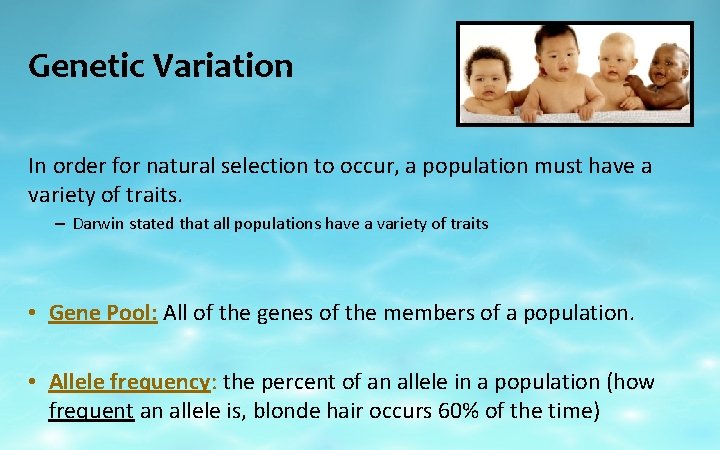
Genetic Variation In order for natural selection to occur, a population must have a variety of traits. – Darwin stated that all populations have a variety of traits • Gene Pool: All of the genes of the members of a population. • Allele frequency: the percent of an allele in a population (how frequent an allele is, blonde hair occurs 60% of the time)
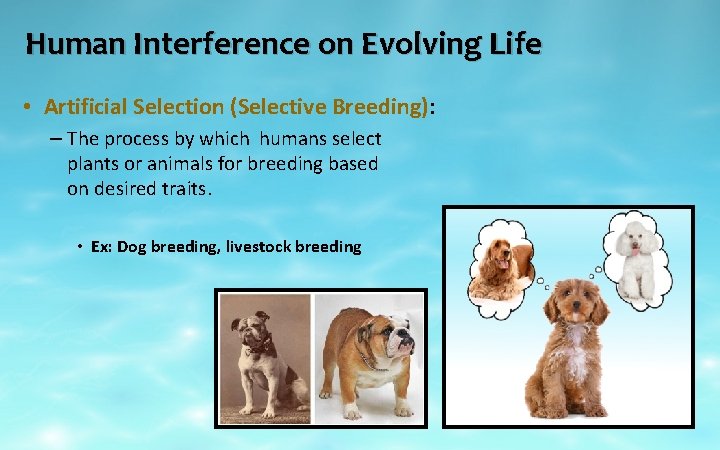
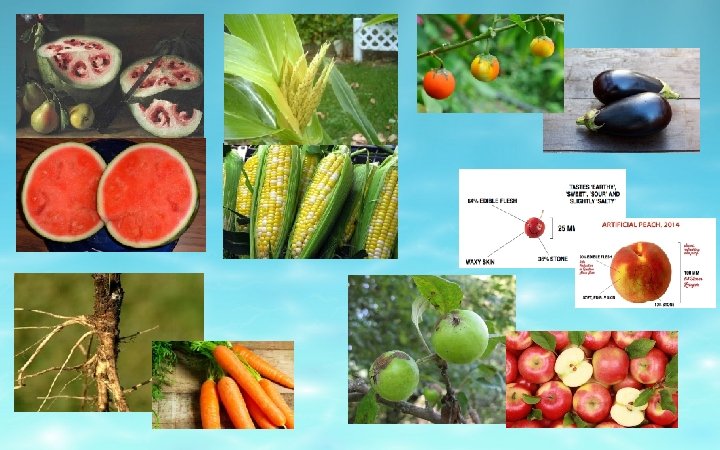
Human Interference on Evolving Life • Artificial Selection (Selective Breeding): – The process by which humans select plants or animals for breeding based on desired traits. • Ex: Dog breeding, livestock breeding
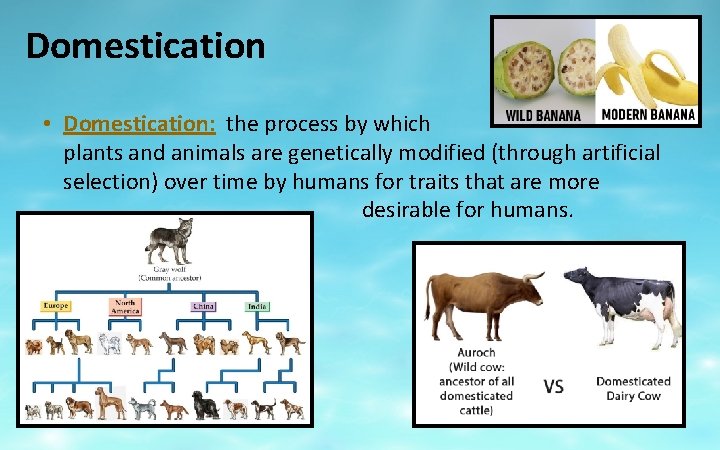
Domestication • Domestication: the process by which plants and animals are genetically modified (through artificial selection) over time by humans for traits that are more desirable for humans.
When does evolution occur? Evolution occurs when there is a change in the gene pool of a population. • Mutations • Emigration/Immigration of new individuals with new genes • Mating Changes in the gene pool creates new alleles (characteristics), sometimes these characteristics may make an organism more “fit” for the environment, and they can be more successful.
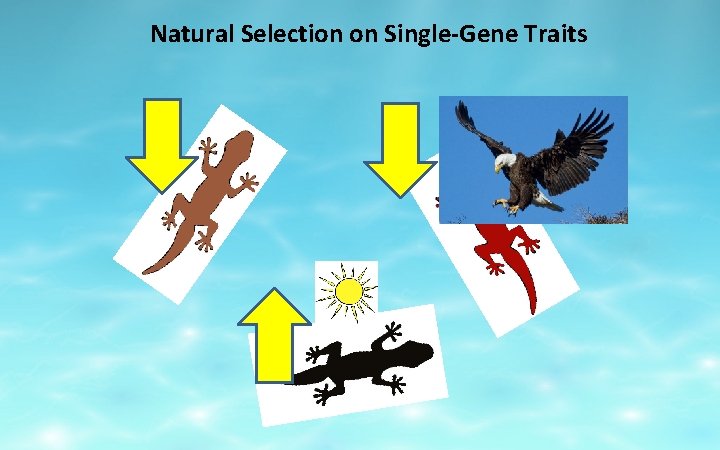
Natural Selection on Single-Gene Traits
What if the gene pool never changes? • Genetic Equilibrium: When the allele frequency remains the same over generations (no evolution) Genetic Equilibrium is only possible under the Hardy-Weinberg Principle. The Hardy-Weinberg Principle: Allele frequencies in a population will remain constant (equilibrium) as long as 5 things are true….
1. There is random mating – Everyone gets an equal chance to pass on alleles. 2. The population is large – Lessen the chance of genetic drift. 3. No movement into or out of the population 4. No mutations are occurring – No new alleles in the population 5. No natural selection is occurring. • If these things are in place, evolution will not occur--the gene pool frequencies will remain unchanged. • However, since it is highly unlikely that any of these five conditions, let alone all of them, will happen in the real world, evolution is the inevitable result.
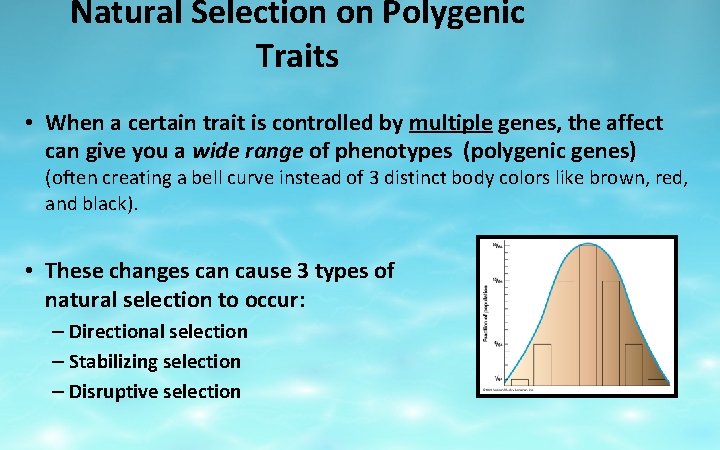
Natural Selection on Polygenic Traits • When a certain trait is controlled by multiple genes, the affect can give you a wide range of phenotypes (polygenic genes) (often creating a bell curve instead of 3 distinct body colors like brown, red, and black). • These changes can cause 3 types of natural selection to occur: – Directional selection – Stabilizing selection – Disruptive selection
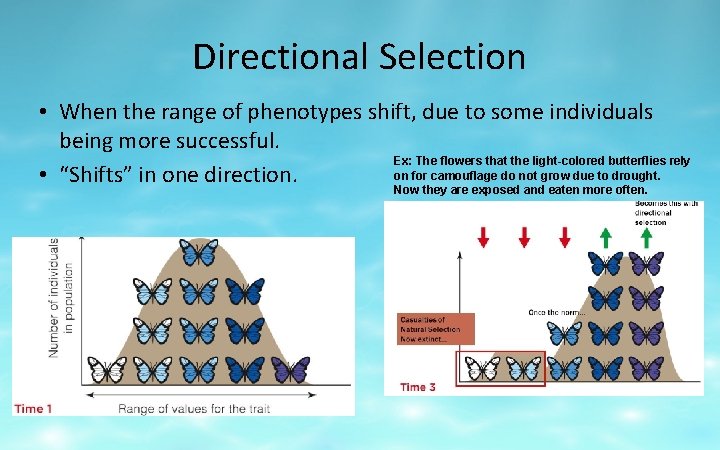
Directional Selection • When the range of phenotypes shift, due to some individuals being more successful. Ex: The flowers that the light-colored butterflies rely on for camouflage do not grow due to drought. • “Shifts” in one direction. Now they are exposed and eaten more often.
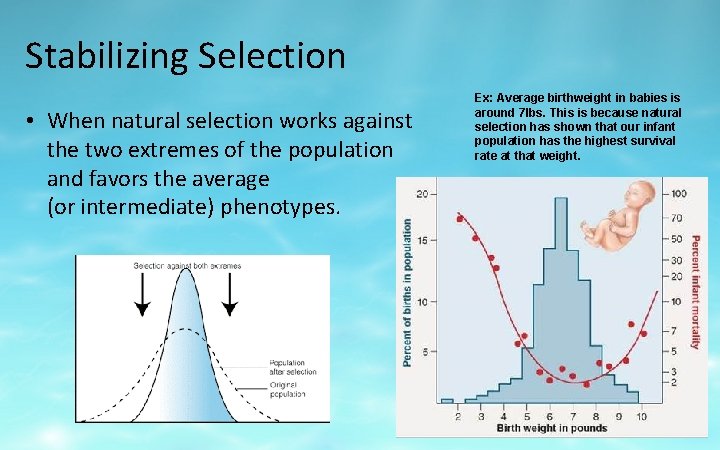
Stabilizing Selection • When natural selection works against the two extremes of the population and favors the average (or intermediate) phenotypes. Ex: Average birthweight in babies is around 7 lbs. This is because natural selection has shown that our infant population has the highest survival rate at that weight.
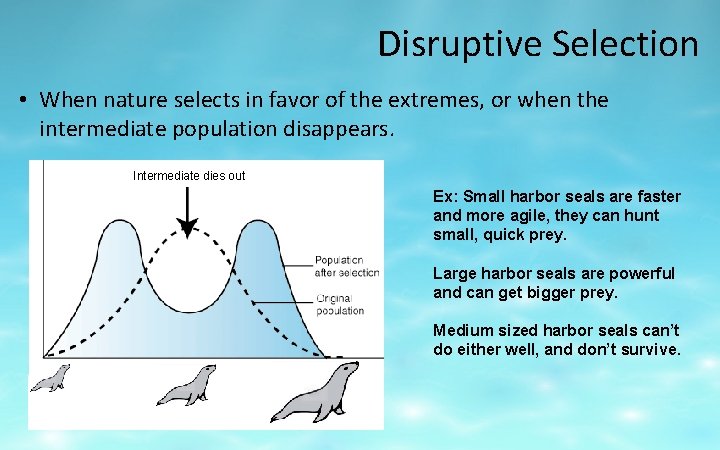
Disruptive Selection • When nature selects in favor of the extremes, or when the intermediate population disappears. Intermediate dies out Ex: Small harbor seals are faster and more agile, they can hunt small, quick prey. Large harbor seals are powerful and can get bigger prey. Medium sized harbor seals can’t do either well, and don’t survive.
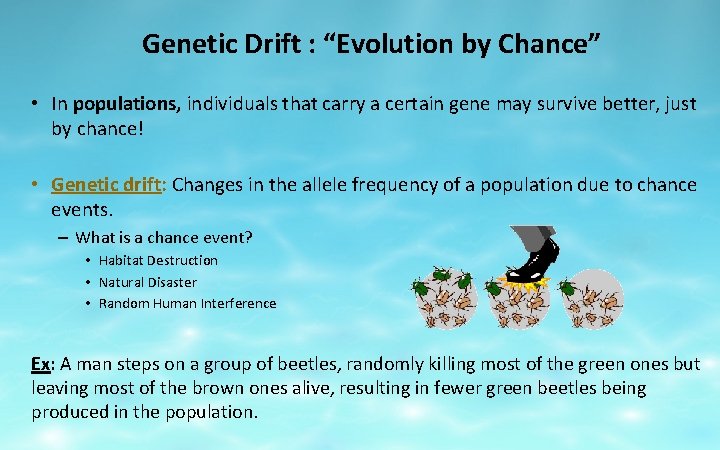
Genetic Drift : “Evolution by Chance” • In populations, individuals that carry a certain gene may survive better, just by chance! • Genetic drift: Changes in the allele frequency of a population due to chance events. – What is a chance event? • Habitat Destruction • Natural Disaster • Random Human Interference Ex: A man steps on a group of beetles, randomly killing most of the green ones but leaving most of the brown ones alive, resulting in fewer green beetles being produced in the population.
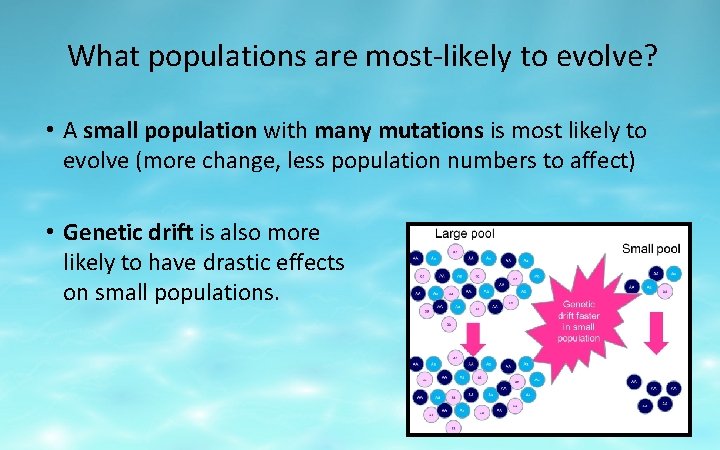
What populations are most-likely to evolve? • A small population with many mutations is most likely to evolve (more change, less population numbers to affect) • Genetic drift is also more likely to have drastic effects on small populations.
Mechanisms of Evolution Part 2
Forming New Species When a group of individuals is separated from the rest of their species for a long time, the individuals can evolve different traits. The longer the group is isolated from the rest of the species, the more likely it will evolve into a new species. Speciation: formation of a new species. This displays divergent evolution.
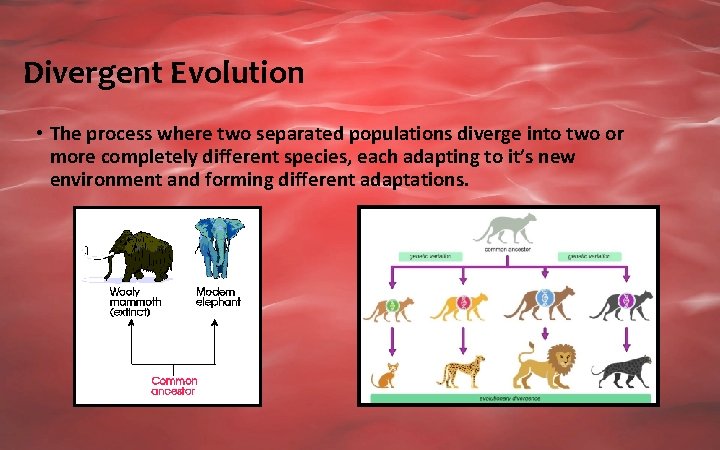
Divergent Evolution • The process where two separated populations diverge into two or more completely different species, each adapting to it’s new environment and forming different adaptations.
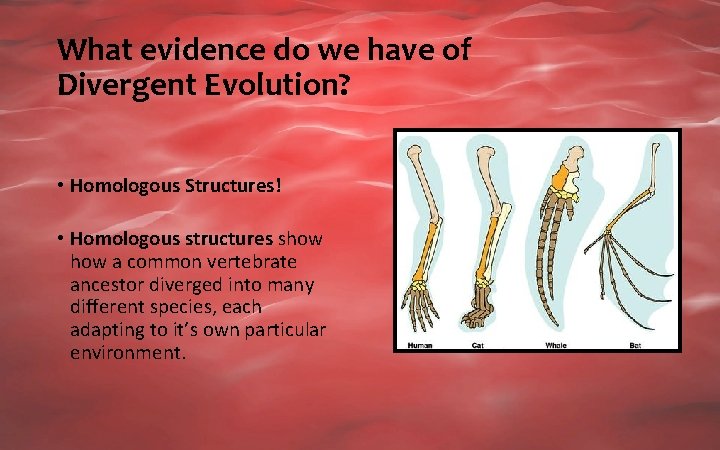
What evidence do we have of Divergent Evolution? • Homologous Structures! • Homologous structures show a common vertebrate ancestor diverged into many different species, each adapting to it’s own particular environment.
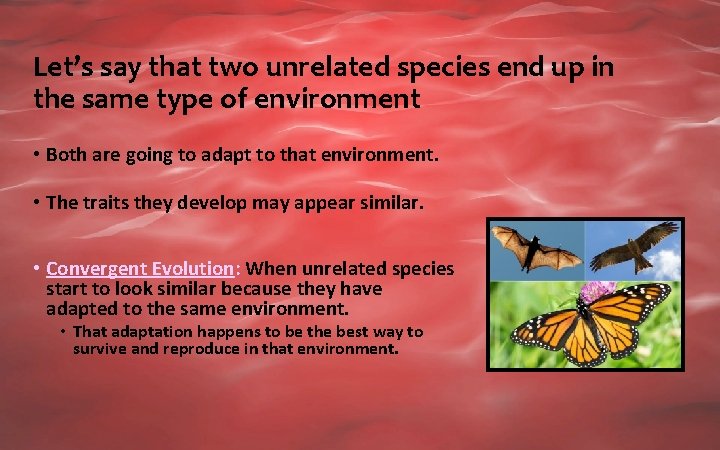
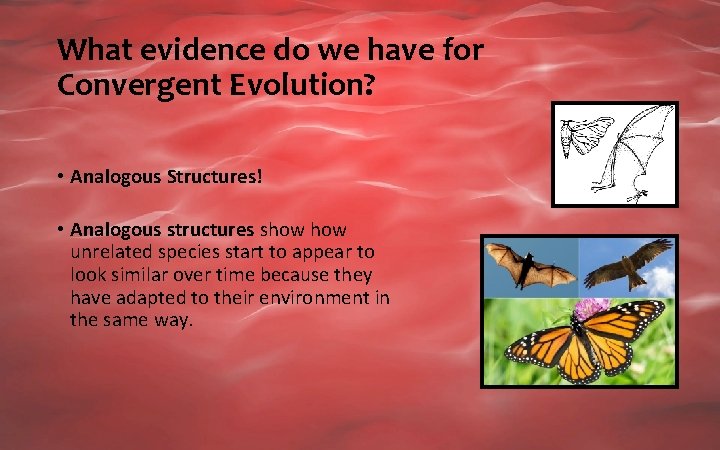
Let’s say that two unrelated species end up in the same type of environment • Both are going to adapt to that environment. • The traits they develop may appear similar. • Convergent Evolution: When unrelated species start to look similar because they have adapted to the same environment. • That adaptation happens to be the best way to survive and reproduce in that environment.
What evidence do we have for Convergent Evolution? • Analogous Structures! • Analogous structures show unrelated species start to appear to look similar over time because they have adapted to their environment in the same way.
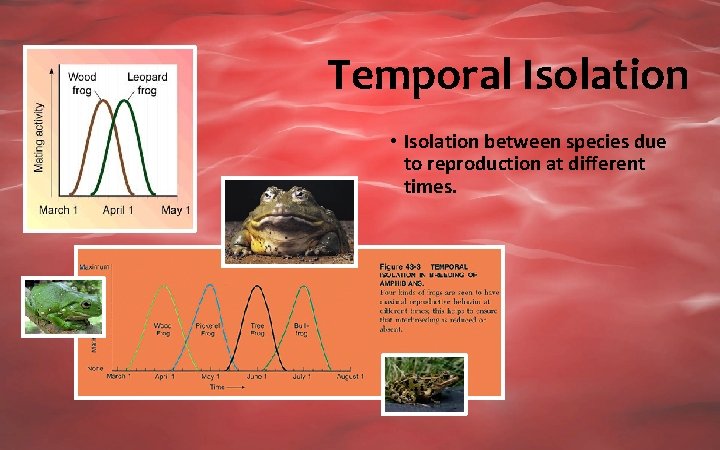
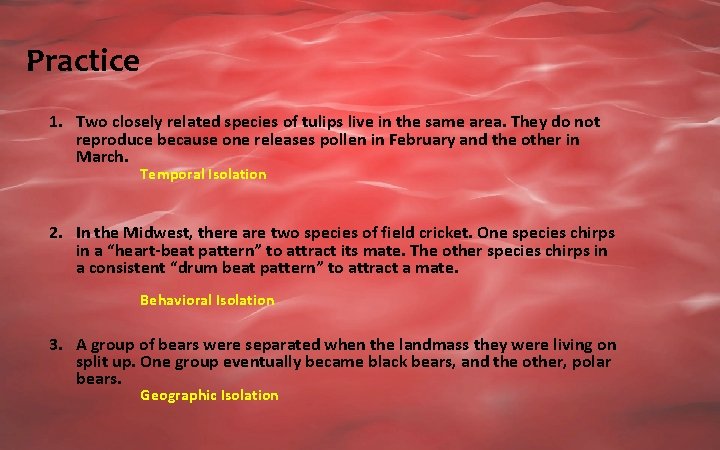
So…how do individuals become seaparted from the rest of the population? When individuals separate from the main population, they no longer reproduce with the main population. Ø Geographic Isolation Ø Behavioral Isolation • Reproductive Isolation: when members of a population stop reproducing with other members of that population, becoming isolated, and only reproducing within themselves. Ø Temporal Isolation
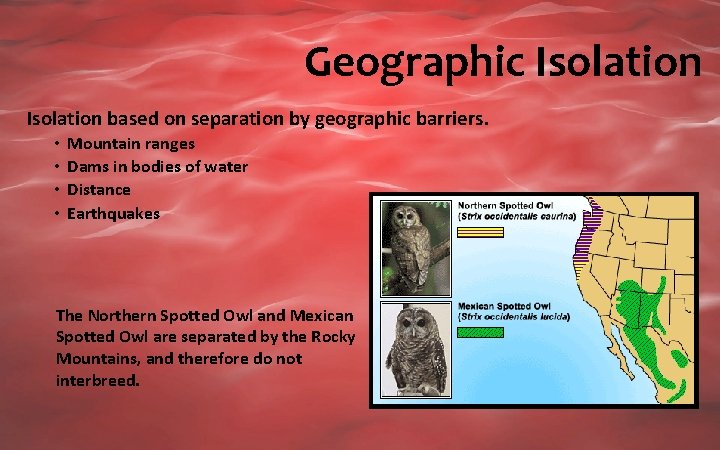
Geographic Isolation based on separation by geographic barriers. • • Mountain ranges Dams in bodies of water Distance Earthquakes The Northern Spotted Owl and Mexican Spotted Owl are separated by the Rocky Mountains, and therefore do not interbreed.
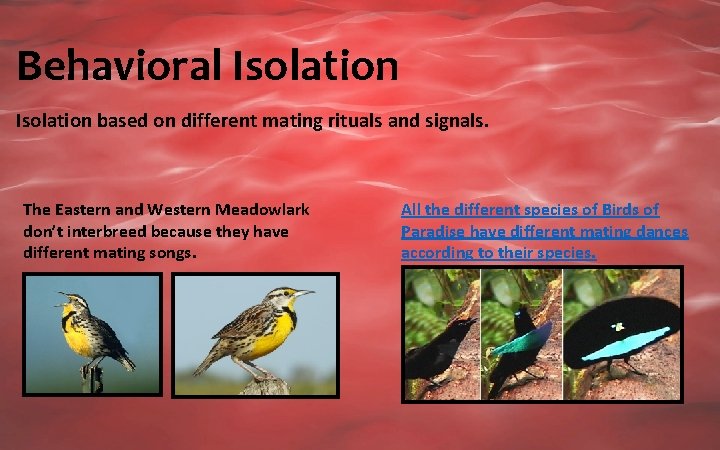
Behavioral Isolation based on different mating rituals and signals. The Eastern and Western Meadowlark don’t interbreed because they have different mating songs. All the different species of Birds of Paradise have different mating dances according to their species.
Temporal Isolation • Isolation between species due to reproduction at different times.
Practice 1. Two closely related species of tulips live in the same area. They do not reproduce because one releases pollen in February and the other in March. Temporal Isolation 2. In the Midwest, there are two species of field cricket. One species chirps in a “heart-beat pattern” to attract its mate. The other species chirps in a consistent “drum beat pattern” to attract a mate. Behavioral Isolation 3. A group of bears were separated when the landmass they were living on split up. One group eventually became black bears, and the other, polar bears. Geographic Isolation