
Mechanisms of Evolution Headings Vocabulary Important Info What
Mechanisms of Evolution Headings Vocabulary Important Info
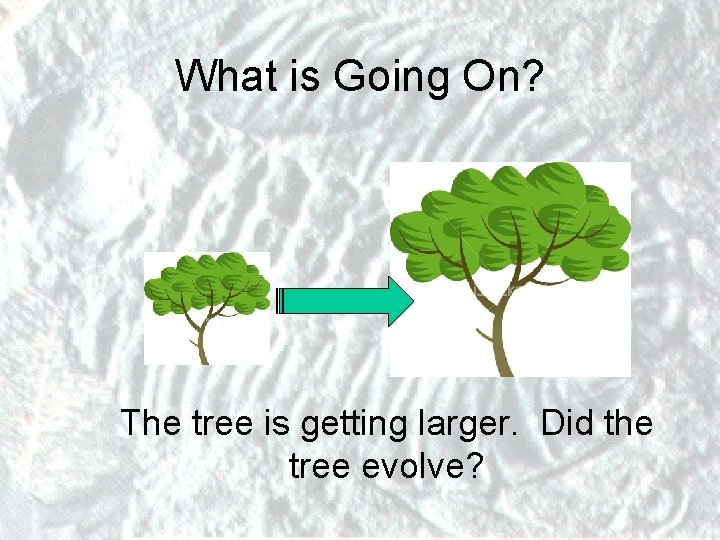
What is Going On? The tree is getting larger. Did the tree evolve?
Can Individuals Evolve? • Individuals CANNOT change their genes and evolve! • Populations, not individuals, evolve • Unfit individuals may not survive and reproduce (pass on their genes) • Natural selection acts on the “gene pool”: all the genes in the population
Changes in Genes Lead to Evolution 1. Mutations: caused by environmental factors or by chance • If the change is beneficial, becomes part of the gene pool 2. Genetic Drift: random events affect numbers of genes in pool • Weather; natural disaster 3. Gene Flow: individuals leave a population

Small vs. Large Gene Pools • All these changes affect small populations much more than larger ones
Natural Selection Acts on Differences in Populations There are 3 types of natural selection patterns:
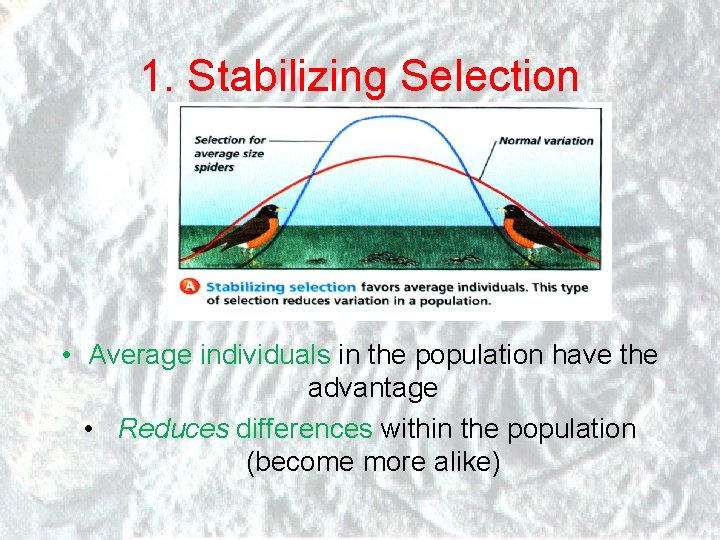
1. Stabilizing Selection • Average individuals in the population have the advantage • Reduces differences within the population (become more alike)
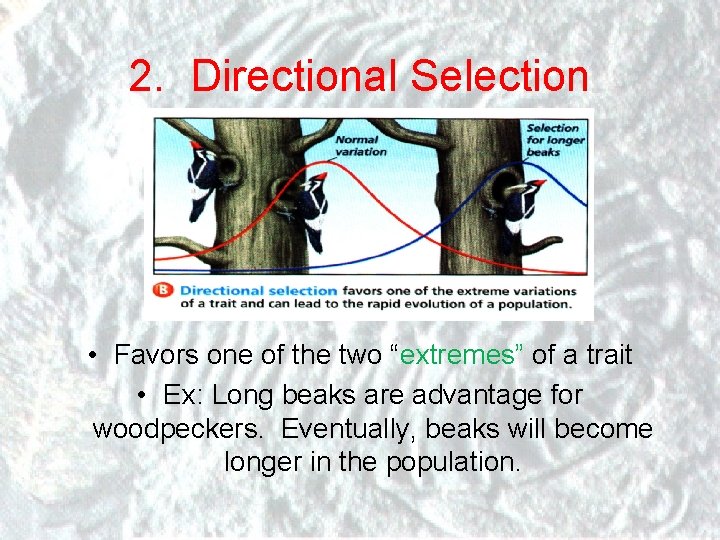
2. Directional Selection • Favors one of the two “extremes” of a trait • Ex: Long beaks are advantage for woodpeckers. Eventually, beaks will become longer in the population.
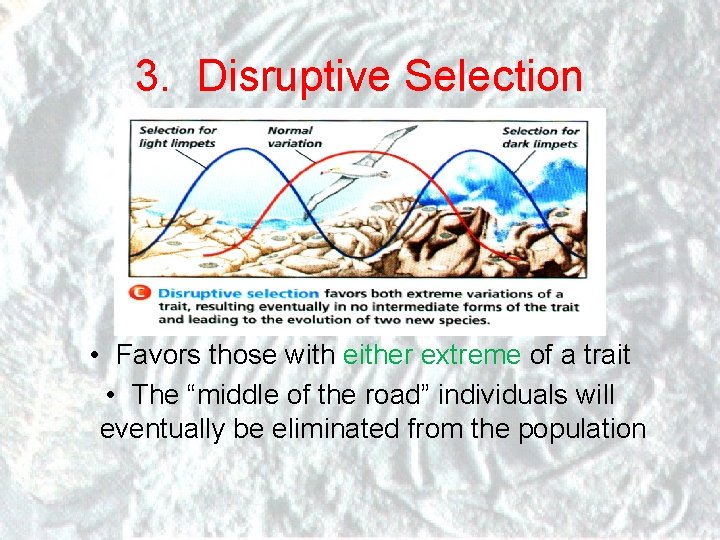
3. Disruptive Selection • Favors those with either extreme of a trait • The “middle of the road” individuals will eventually be eliminated from the population
Evolution of a New Species • This is called “speciation” • Populations can no longer interbreed and produce fertile offspring
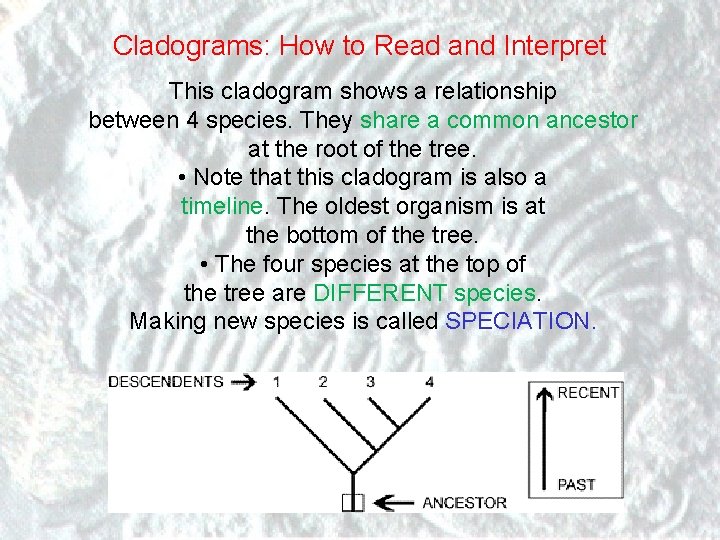
Cladograms: How to Read and Interpret This cladogram shows a relationship between 4 species. They share a common ancestor at the root of the tree. • Note that this cladogram is also a timeline. The oldest organism is at the bottom of the tree. • The four species at the top of the tree are DIFFERENT species. Making new species is called SPECIATION.
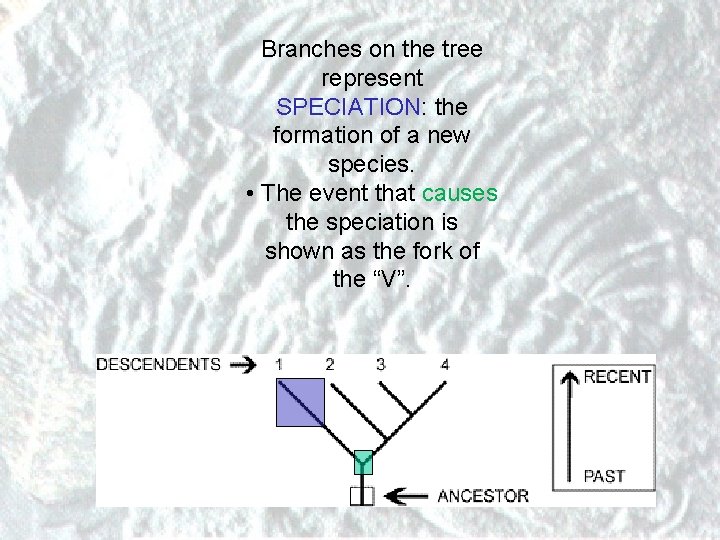
Branches on the tree represent SPECIATION: the formation of a new species. • The event that causes the speciation is shown as the fork of the “V”.
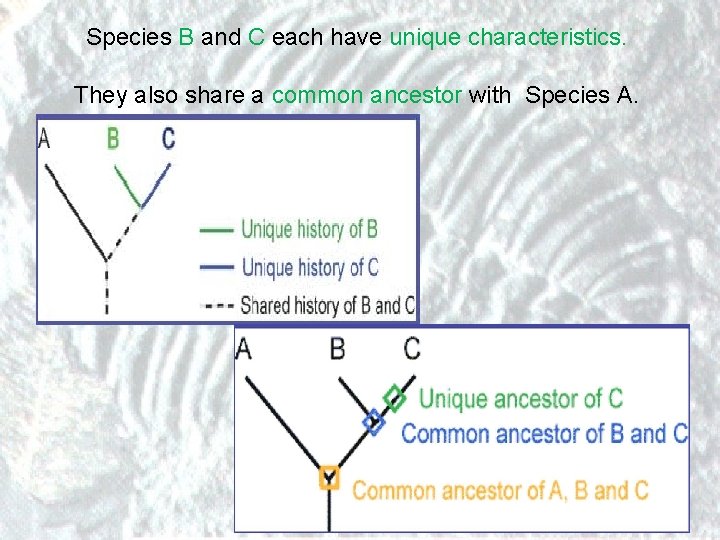
Species B and C each have unique characteristics. They also share a common ancestor with Species A.
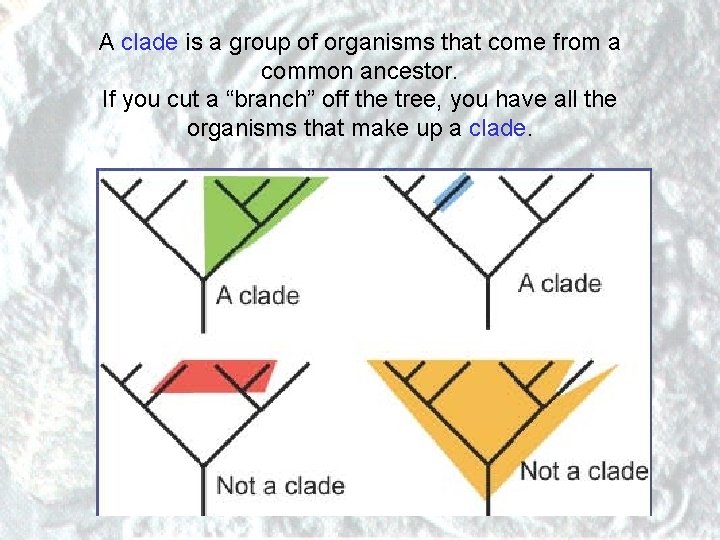
A clade is a group of organisms that come from a common ancestor. If you cut a “branch” off the tree, you have all the organisms that make up a clade.
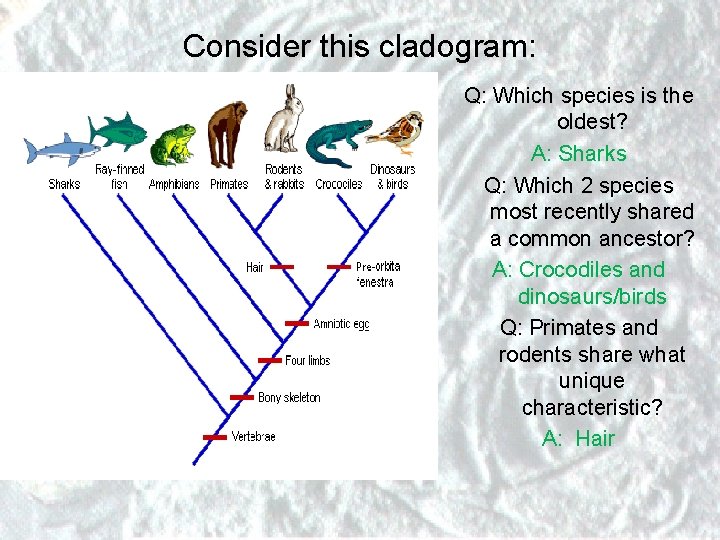
Consider this cladogram: Q: Which species is the oldest? A: Sharks Q: Which 2 species most recently shared a common ancestor? A: Crocodiles and dinosaurs/birds Q: Primates and rodents share what unique characteristic? A: Hair
- Slides: 15