
mechanisms of chemical reactions and the design of
- Slides: 24
mechanisms of chemical reactions and the design of the reactors in which they take place. H. S. Fogler Edition 2 Non Elementary Reactions: Enzymatic Reactions Contents: �Enzymes �Michealis-Menten Kinetics �Lineweaver-Burk Plot 1 Dr. S. M. Mhatre
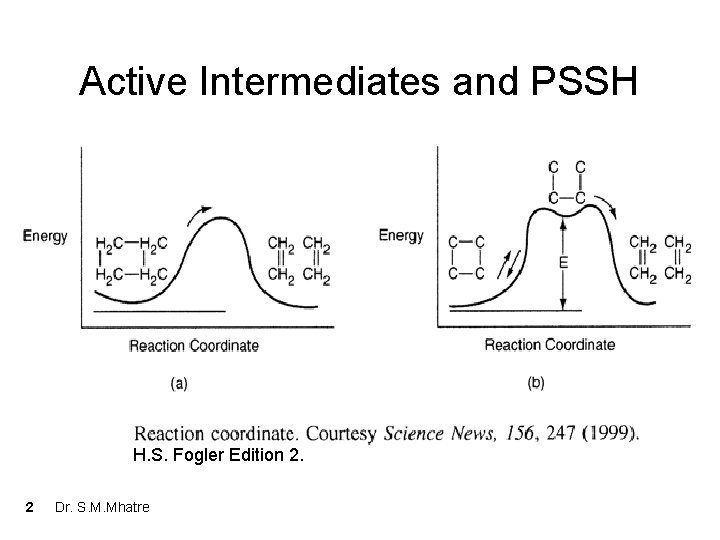
Active Intermediates and PSSH H. S. Fogler Edition 2. 2 Dr. S. M. Mhatre
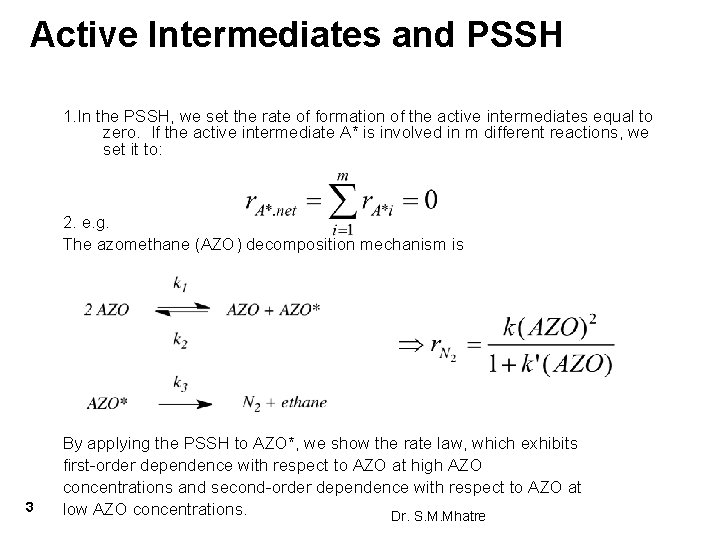
Active Intermediates and PSSH 1. In the PSSH, we set the rate of formation of the active intermediates equal to zero. If the active intermediate A* is involved in m different reactions, we set it to: 2. e. g. The azomethane (AZO) decomposition mechanism is 3 By applying the PSSH to AZO*, we show the rate law, which exhibits first-order dependence with respect to AZO at high AZO concentrations and second-order dependence with respect to AZO at low AZO concentrations. Dr. S. M. Mhatre
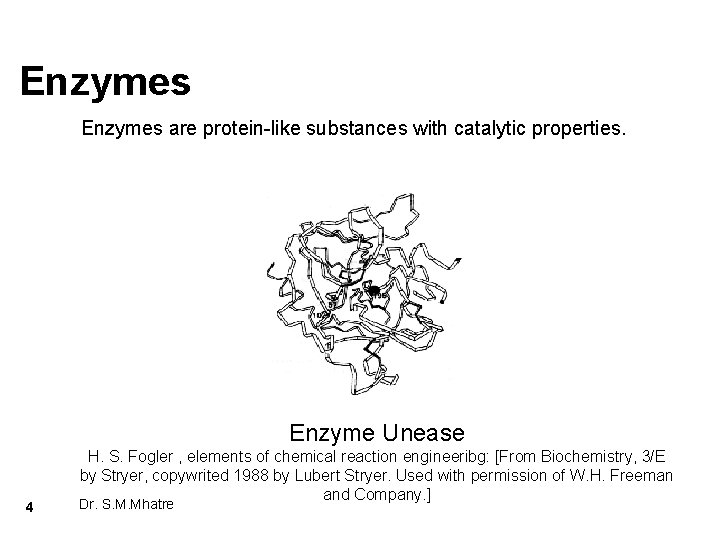
Enzymes are protein-like substances with catalytic properties. Enzyme Unease 4 H. S. Fogler , elements of chemical reaction engineeribg: [From Biochemistry, 3/E by Stryer, copywrited 1988 by Lubert Stryer. Used with permission of W. H. Freeman and Company. ] Dr. S. M. Mhatre
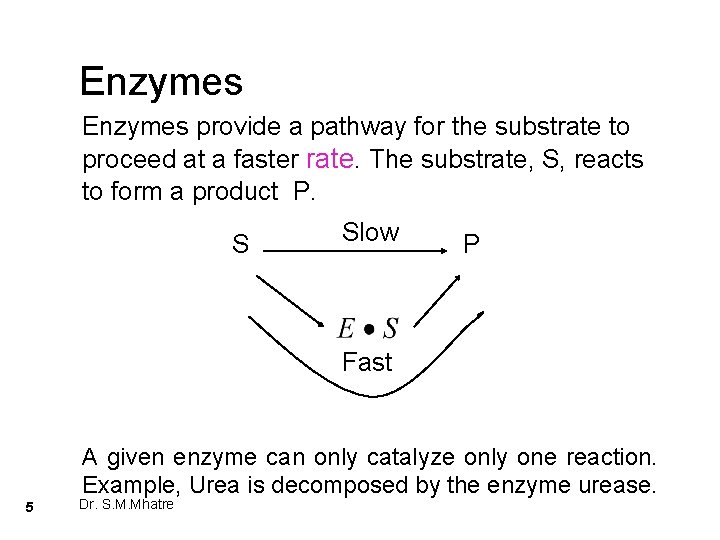
Enzymes provide a pathway for the substrate to proceed at a faster rate. The substrate, S, reacts to form a product P. S Slow P Fast A given enzyme can only catalyze only one reaction. Example, Urea is decomposed by the enzyme urease. 5 Dr. S. M. Mhatre
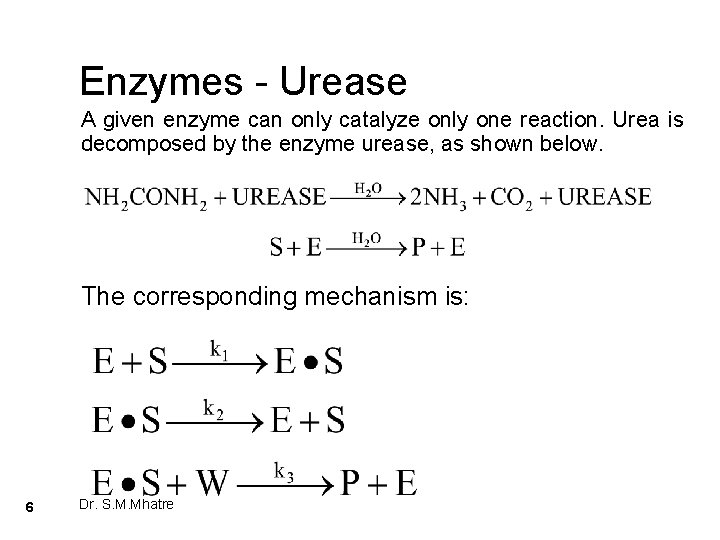
Enzymes - Urease A given enzyme can only catalyze only one reaction. Urea is decomposed by the enzyme urease, as shown below. The corresponding mechanism is: 6 Dr. S. M. Mhatre
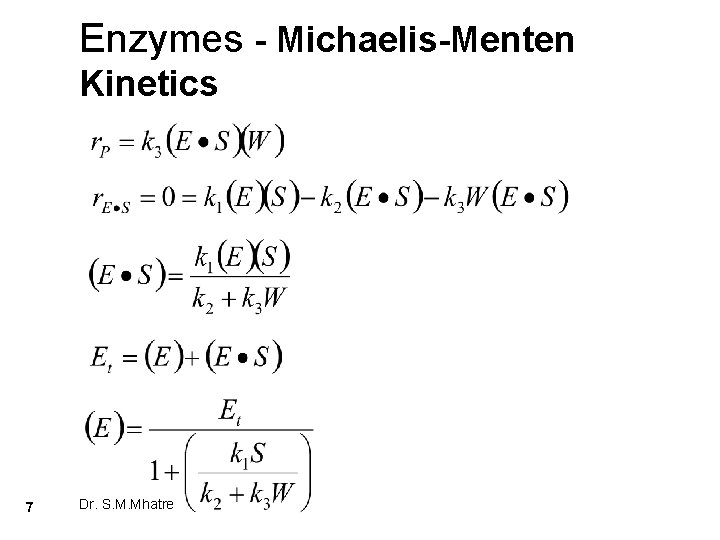
Enzymes - Michaelis-Menten Kinetics 7 Dr. S. M. Mhatre
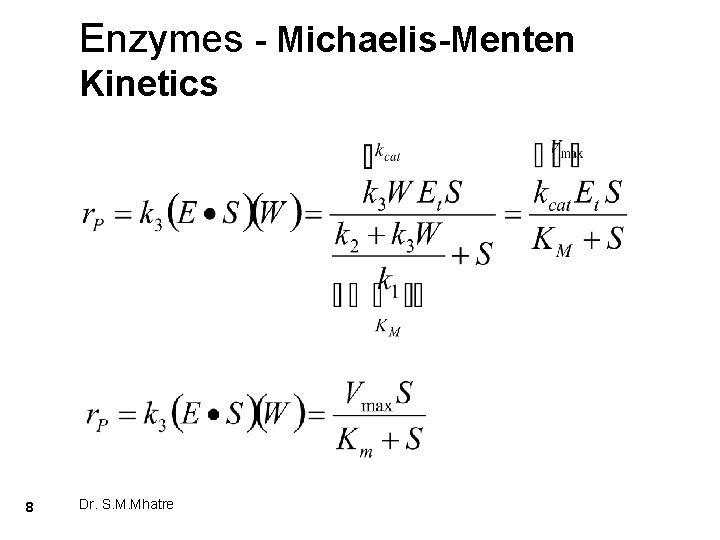
Enzymes - Michaelis-Menten Kinetics 8 Dr. S. M. Mhatre
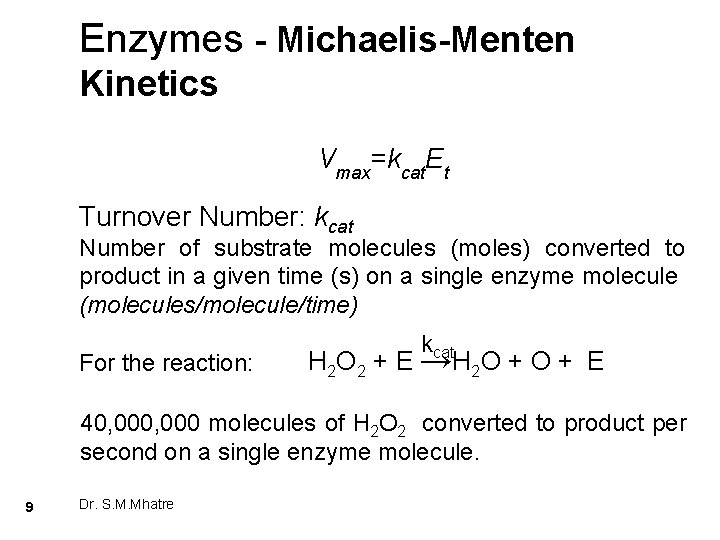
Enzymes - Michaelis-Menten Kinetics Vmax=kcat. Et Turnover Number: kcat Number of substrate molecules (moles) converted to product in a given time (s) on a single enzyme molecule (molecules/molecule/time) For the reaction: kcat H 2 O 2 + E →H 2 O + E 40, 000 molecules of H 2 O 2 converted to product per second on a single enzyme molecule. 9 Dr. S. M. Mhatre
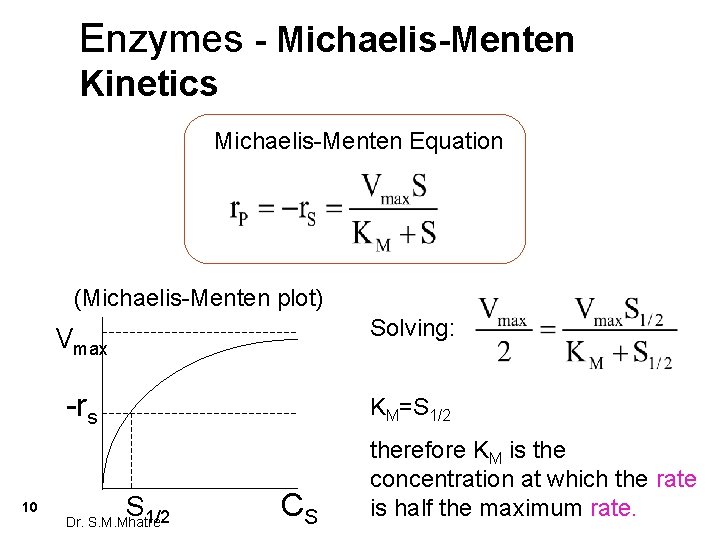
Enzymes - Michaelis-Menten Kinetics Michaelis-Menten Equation (Michaelis-Menten plot) 10 Vmax Solving: -rs KM=S 1/2 Dr. S. M. Mhatre therefore KM is the concentration at which the rate is half the maximum rate. S CS
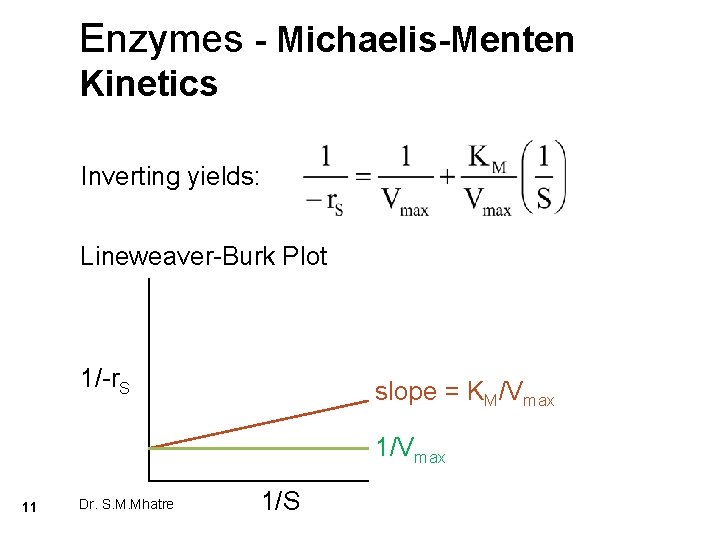
Enzymes - Michaelis-Menten Kinetics Inverting yields: Lineweaver-Burk Plot 1/-r. S slope = KM/Vmax 11 Dr. S. M. Mhatre 1/S
Bioreactors 12 Dr. S. M. Mhatre
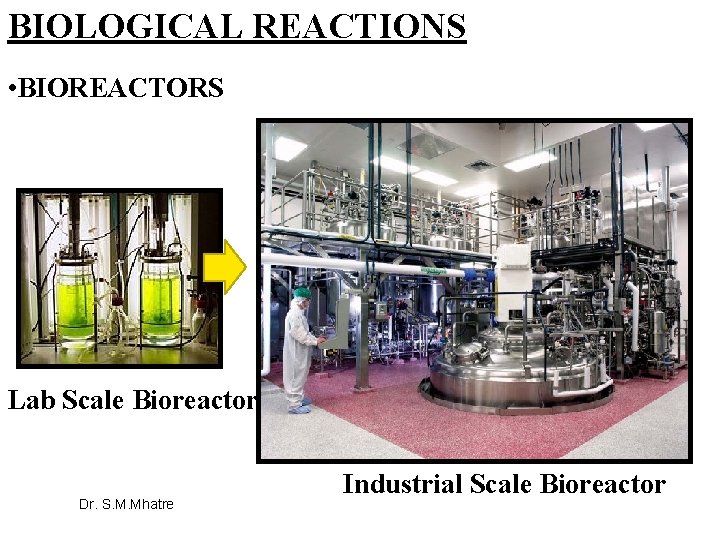
BIOLOGICAL REACTIONS • BIOREACTORS Lab Scale Bioreactor 13 Dr. S. M. Mhatre Industrial Scale Bioreactor
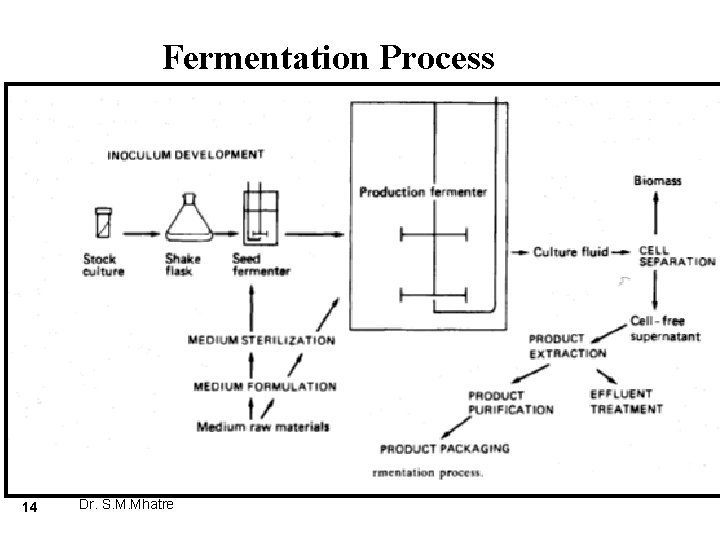
Fermentation Process 14 Dr. S. M. Mhatre
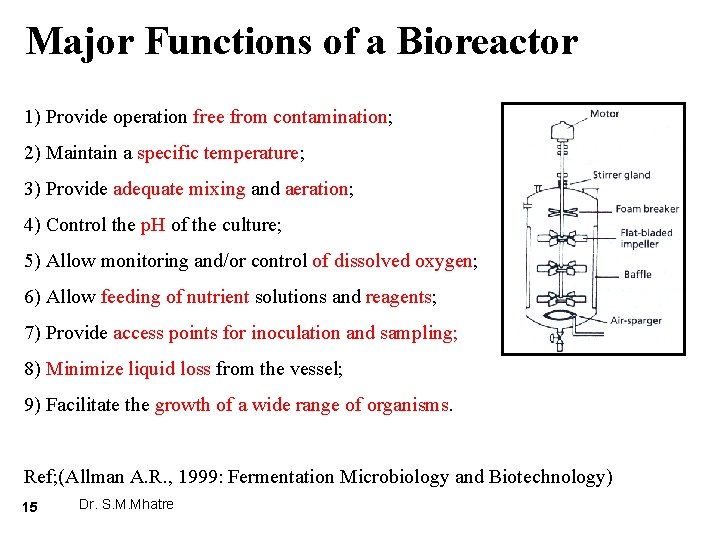
Major Functions of a Bioreactor 1) Provide operation free from contamination; 2) Maintain a specific temperature; 3) Provide adequate mixing and aeration; 4) Control the p. H of the culture; 5) Allow monitoring and/or control of dissolved oxygen; 6) Allow feeding of nutrient solutions and reagents; 7) Provide access points for inoculation and sampling; 8) Minimize liquid loss from the vessel; 9) Facilitate the growth of a wide range of organisms. Ref; (Allman A. R. , 1999: Fermentation Microbiology and Biotechnology) 15 Dr. S. M. Mhatre
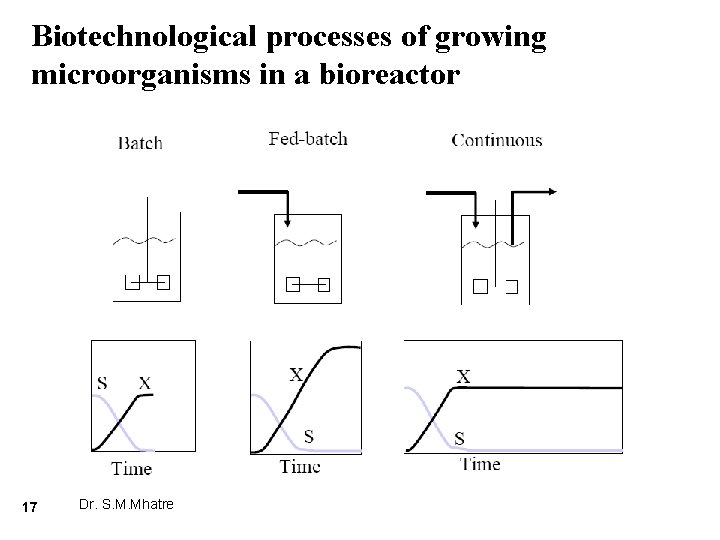
Biotechnological Processes Of Growing Microorganisms In A Bioreactor 1) Batch culture: microorganisms are inoculated into a fixed volume of medium and as growth takes place nutrients are consumed and products of growth (biomass, metabolites) accumulate. 2) Semi-continuous: fed batch-gradual addition of concentrated nutrients so that the culture volume and product amount are increased (e. g. industrial production of baker’s yeast); Perfusion-addition of medium to the culture and withdrawal of an equal volume of used cell-free medium (e. g. animal cell cultivations). 3) Continuous: fresh medium is added to the bioreactor at the exponential phase of growth with a corresponding withdrawal of medium and cells. Cells will grow at a constant rate under a constant condition. 16 Dr. S. M. Mhatre
Biotechnological processes of growing microorganisms in a bioreactor 17 Dr. S. M. Mhatre
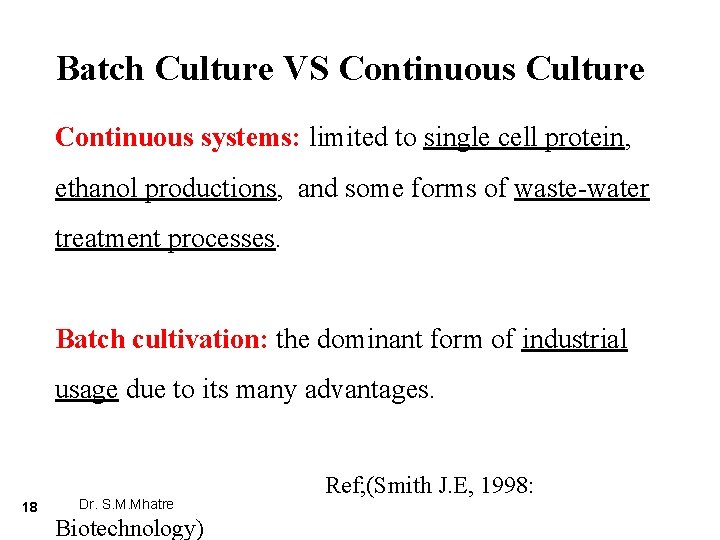
Batch Culture VS Continuous Culture Continuous systems: limited to single cell protein, ethanol productions, and some forms of waste-water treatment processes. Batch cultivation: the dominant form of industrial usage due to its many advantages. 18 Dr. S. M. Mhatre Biotechnology) Ref; (Smith J. E, 1998:
Advantages of Batch Culture VS Continuous Culture 1) 2) 3) 4) Products may be required only in a small quantities at any given time. Market needs may be intermittent. Shelf-life of certain products is short. High product concentration is required in broth for optimizing downstream processes. 5) Some metabolic products are produced only during the stationary phase of the growth cycle. 6) Instability of some production strains require their regular renewal. 7) Compared to continuous processes, the technical requirements for batch culture is much easier 19 Dr. S. M. Mhatre
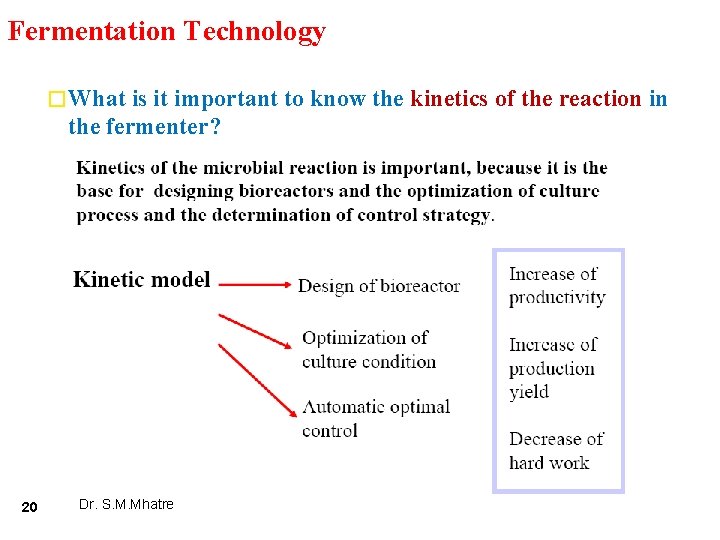
Fermentation Technology � What is it important to know the kinetics of the reaction in the fermenter? 20 Dr. S. M. Mhatre
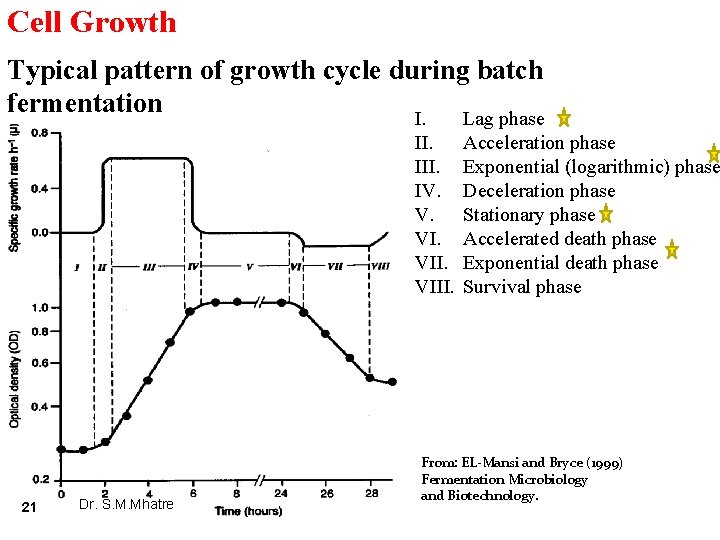
Cell Growth Typical pattern of growth cycle during batch fermentation I. Lag phase II. IV. V. VIII. 21 Dr. S. M. Mhatre Acceleration phase Exponential (logarithmic) phase Deceleration phase Stationary phase Accelerated death phase Exponential death phase Survival phase From: EL-Mansi and Bryce (1999) Fermentation Microbiology and Biotechnology.
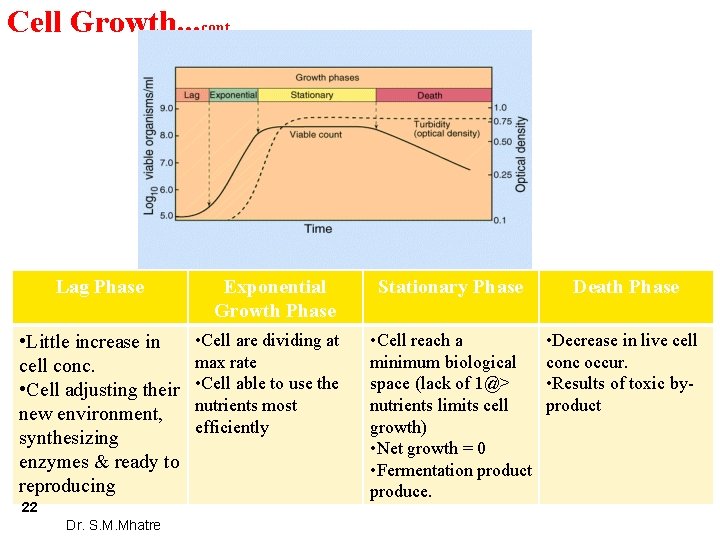
Cell Growth. . . cont. . . Lag Phase • Little increase in cell conc. • Cell adjusting their new environment, synthesizing enzymes & ready to reproducing 22 Dr. S. M. Mhatre Exponential Growth Phase • Cell are dividing at max rate • Cell able to use the nutrients most efficiently Stationary Phase Death Phase • Cell reach a minimum biological space (lack of 1@> nutrients limits cell growth) • Net growth = 0 • Fermentation product produce. • Decrease in live cell conc occur. • Results of toxic byproduct
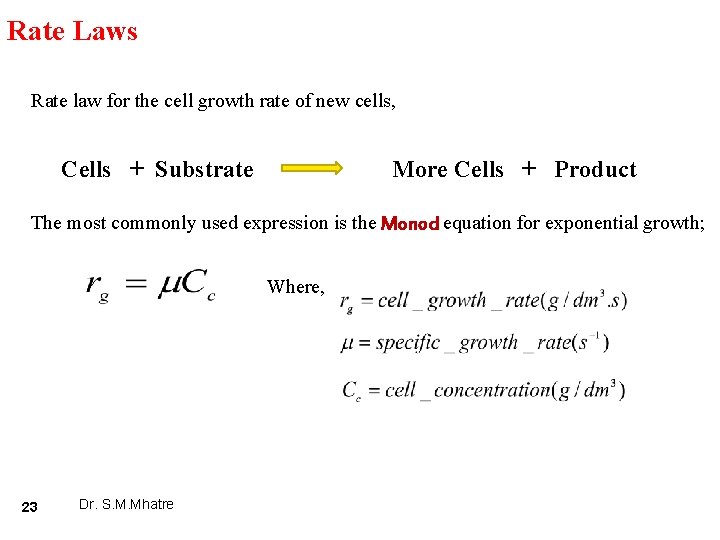
Rate Laws Rate law for the cell growth rate of new cells, Cells + Substrate More Cells + Product The most commonly used expression is the Monod equation for exponential growth; Where, 23 Dr. S. M. Mhatre
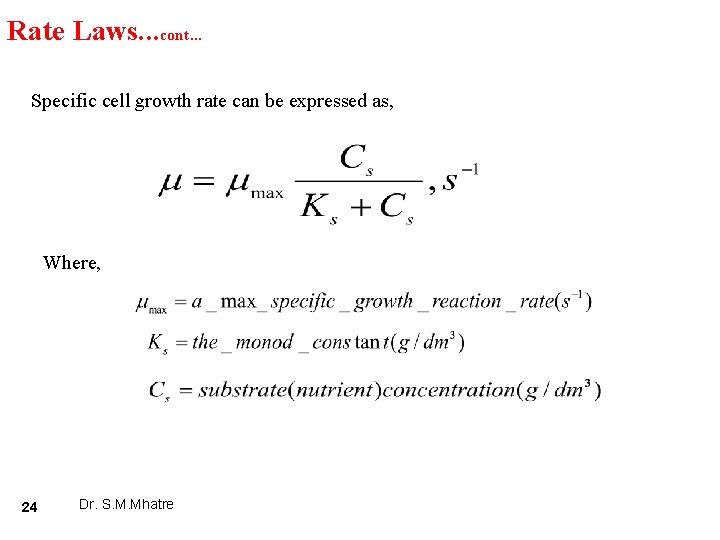
Rate Laws. . . cont. . . Specific cell growth rate can be expressed as, Where, 24 Dr. S. M. Mhatre