
MECHANISM OF SECOND DENTITION Diphyodont and Heterodont humans
- Slides: 24
MECHANISM OF SECOND DENTITION
Diphyodont and Heterodont humans § homodont: all tooth are alike; § heterodont: teeth have diferent shapes; § poliphyodont: changing of teeth for the whole lifetime § diphyodont : 2 sets of teeth – mammals;
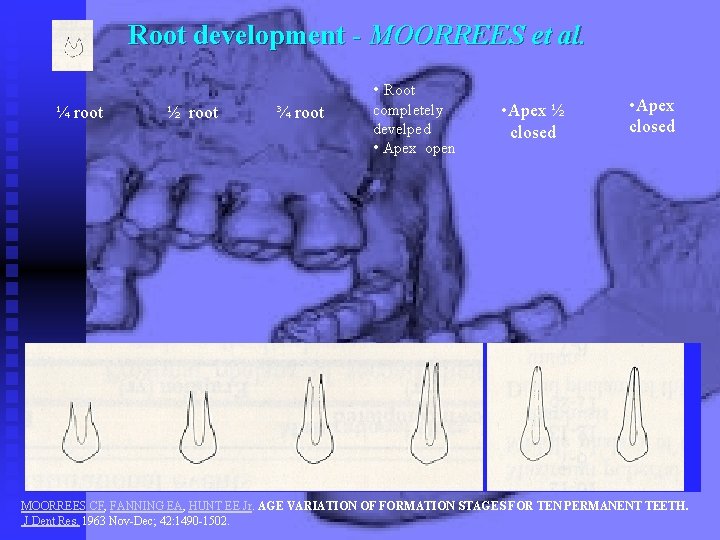
Root development - MOORREES et al. • Root ¼ root ½ root ¾ root completely develped • Apex open • Apex ½ closed • Apex closed MOORREES CF, FANNING EA, HUNT EE Jr. AGE VARIATION OF FORMATION STAGES FOR TEN PERMANENT TEETH. J Dent Res. 1963 Nov-Dec; 42: 1490 -1502.
SECON DENTITION MECHANISM § Mechanism – several factors responsible for normal second dentition process • Primary teeth period, after development of primary teeth – transitory period: maxillary bones are preparing for the permanent teeth arrival.
SECOND DENTITION § Physiological developmental phenomenon; § Dynamic process: root development, periodontal development, functional occlusion.
SECOND DENTITION IMPORTANCE § Normal develpment of the craniofacial complex; § Treatment planing, timing - orthodontics; § Cariology.
6 years: M 1 § First permanent molars: at the end of the line; • „Sechsjahrmolaren”; • There are no changing of teeth, so it goes often unnoticed by the parents!
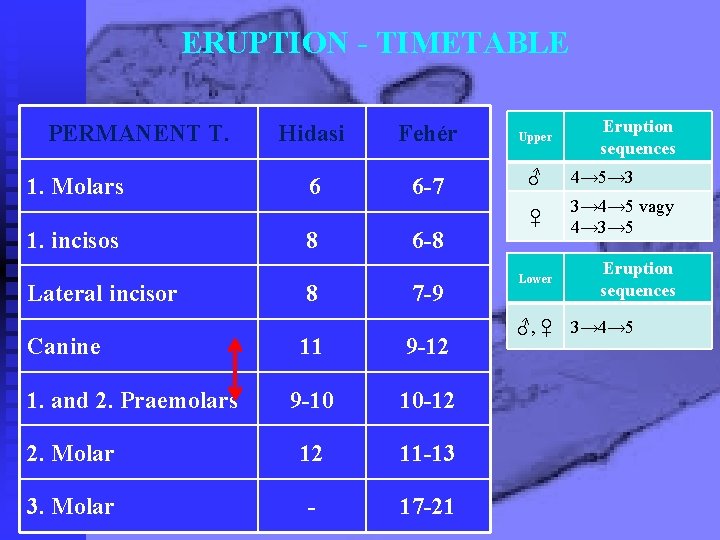
ERUPTION - TIMETABLE PERMANENT T. 1. Molars 1. incisos Lateral incisor Canine Hidasi Fehér 6 6 -7 8 8 6 -8 7 -9 11 9 -12 9 -10 10 -12 2. Molar 12 11 -13 3. Molar - 17 -21 1. and 2. Praemolars Upper Eruption sequences ♂ 4→ 5→ 3 ♀ 3→ 4→ 5 vagy 4→ 3→ 5 Lower Eruption sequences ♂, ♀ 3→ 4→ 5
CHARACTERISTICE §Percentil presence of permanent teeth: prevalence of a particular tooth at a given moment in the population. Ø dierences between the arches; Ø sexual dimorfizm; ØDental age determination!; Ø dental status or the given age.
CHARACTERISTICS § Average eruption time: the age when the percentil presence of the tooth is 50%. IMPORTANCE: Ø describes the second dentition process; Ø comparative studies between populations; Ø acceleratio: comparison with older data!; ü Percenti presence: tooth type 15 -40% ü Average eruotion time: tooth type 1 -1, 5 years.
BONE MATURATION § Second dentition is paralell with bone maturation: • Tanner-Whitehouse method TW 2 (Tanner et al. 1975); § Orthodontic diagnostic value!
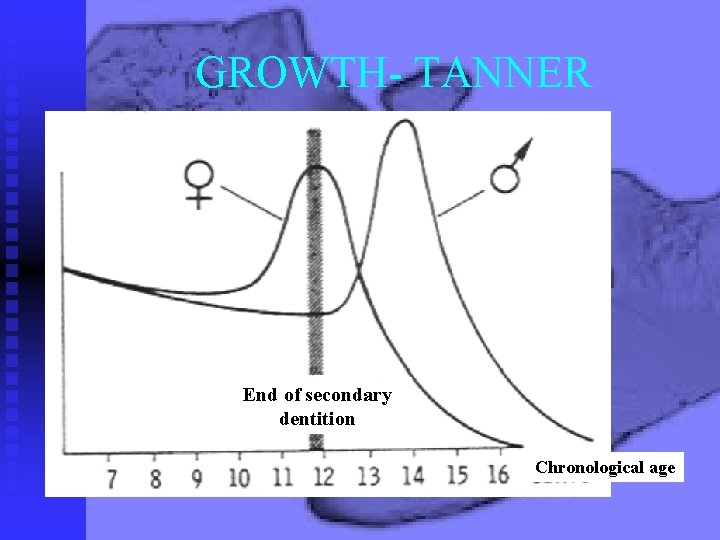
GROWTH- TANNER End of secondary dentition Chronological age
SECOND DENTITION CRITERIA n n Presence of the permanent toothgerm Optimal position of the toothgerm Sufficient space Physiological root resorption
PRESENCE OF THE PERMANENT TOOTH GERM n n Aplasia prevalence: 3 -4%; Gábris et al. : I 2˃pm 2˃ PM 2˃i 1 Persisting primary teeth Bolk’s terminal reduction theory
APLASIA: 35; 31; 45. n n Persisting primary teeth: 75; 71; 72; 85 Bolk’s terminal reduction theory: EXEPTION LOWER PERMANENT FIRST INCISORS 15
OPTIMAL POSITION OF THE PERMANENT TOOTHGERM Lower incidors: lingual eruption, erupting often in the presence o the primary incisors; n Extraction of the primary teeth; Upper canines: n Ectopia; n Retentio/Impactio
MESIODENS • DENS SUPERNUMERARIUS • DENS SUPPLEMENTARIUS 17
Early primary teeth extraction
Physiological root resorption § Genetical code!
PATHOLOGY TIME n SPACE n n THE PATHOLOGICAL TRIAS: Ø Ø Ø Perturbance of the rootresoption; Persisting primary models; Retained permanent teeth.
PATHOLOGY DENTITIO PRAECOX n DENTITIO TARDA n DENTITIO DIFFICILIS n
INFRAOCCLUSIO SECUNDARIA Partialis retentio; reinclusio; n Submergentia; n „Halbretention” n „submerged deciduous teeth” n
Eruption cyst/haematoma
Importance of the distal plane in primary dentition