
Mechanism of Disease Prevention and Control n n
- Slides: 10
Mechanism of Disease
Prevention and Control n n Prevent them from entering the body Pathogens can spread by: q q Person to person contact - viruses Environmental contact – food, water, soil Opportunistic invasion – moist skin/fungus Transmission by a vector- ex. Deer tick/lyme
Prevention q aseptic technique – kill/disable pathogens on surface before they can spread to others n q q q Examples: sterilization, disinfection, antisepsis, isolation Avoiding contact with certain materials Maintaining safe sanitation practices Avoid changes in p. H, moisture, temperature of skin and mucous membranes Reduce number of vectors and reduce contact with vectors Vaccine – dead or weakened pathogen given to stimulate immunity
Treatment n n Antibiotics – penicillin, streptomycin Synthetic antiviral agents – acyclovir, efavirenz
Tumors and Cancer n Neoplasm = tumor = abnormal growth of cells q Benign n q remain localized, grow slow, cells well differentiated, cells stay together, often surrounded by dense tissue or capsule, usually not life threatening Malignant – spread to other regions = CANCER n Not encapsulated, do not stay in one place (metastasis), undifferentiated
3 types of benign tumors n Epithelial tissue q q q n Papilloma – fingerlike projections, wart Adenoma – glandular Nevus – small, pigmented tumors of the skin, mole Connective tissue q q q Lipoma – arise from adipose tissue Osteoma – bone tissues Chondroma – cartilage tissue
Malignant tumors n Epithelial – called carcinomas q q n Melanoma – melanocytes Adenocarcinoma – glandular epithelium Connective - called sarcomas q q Lymphoma – lymphatic tissue Osteosarcoma – bone tissue Myeloma – bone marrow tumor Fibrosarcoma – fibrous connective tissue
Miscellaneous tumors n n n Adenofibroma – benign tumor from epithelial and connective tissues Neuroblastoma – malignant tumor of nerve tissue Cancers can further be classified by location (stomach, skin…)
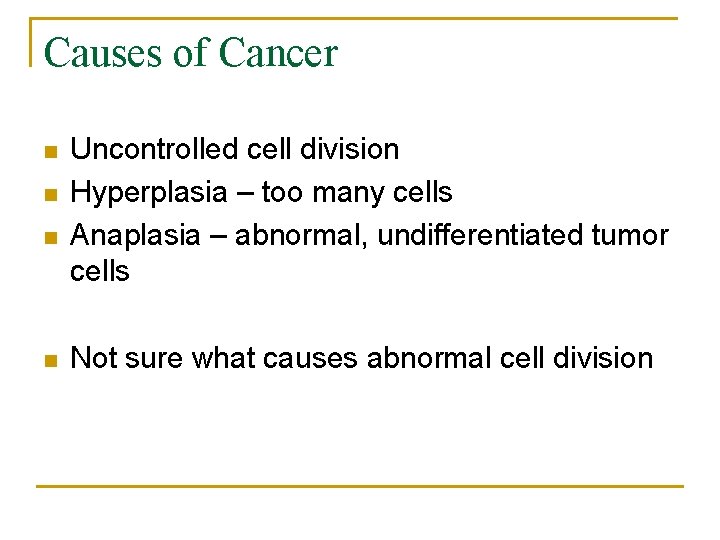
Causes of Cancer n n Uncontrolled cell division Hyperplasia – too many cells Anaplasia – abnormal, undifferentiated tumor cells Not sure what causes abnormal cell division
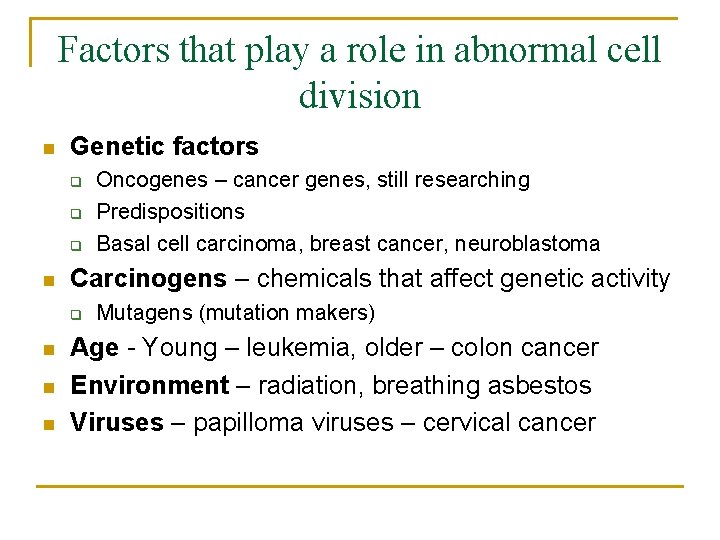
Factors that play a role in abnormal cell division n Genetic factors q q q n Carcinogens – chemicals that affect genetic activity q n n n Oncogenes – cancer genes, still researching Predispositions Basal cell carcinoma, breast cancer, neuroblastoma Mutagens (mutation makers) Age - Young – leukemia, older – colon cancer Environment – radiation, breathing asbestos Viruses – papilloma viruses – cervical cancer