
Mechanism for the Partial Synchronization in Coupled Logistic
- Slides: 9
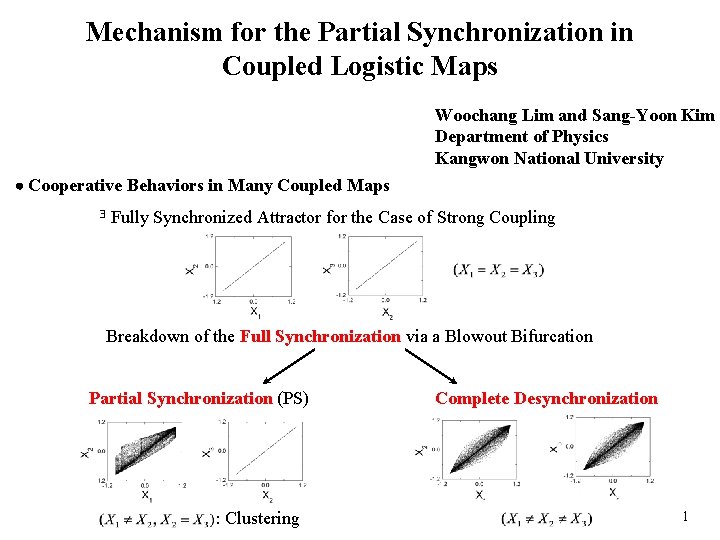
Mechanism for the Partial Synchronization in Coupled Logistic Maps Woochang Lim and Sang-Yoon Kim Department of Physics Kangwon National University Cooperative Behaviors in Many Coupled Maps Fully Synchronized Attractor for the Case of Strong Coupling Breakdown of the Full Synchronization via a Blowout Bifurcation Partial Synchronization (PS) : Clustering Complete Desynchronization 1
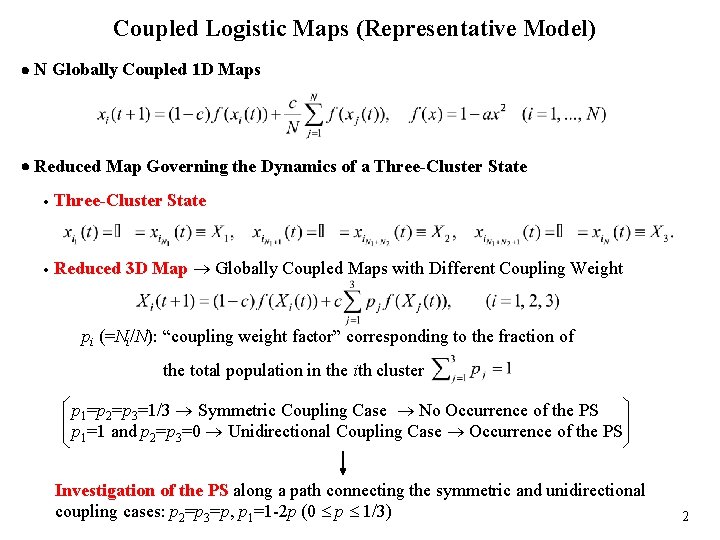
Coupled Logistic Maps (Representative Model) N Globally Coupled 1 D Maps Reduced Map Governing the Dynamics of a Three-Cluster State Reduced 3 D Map Globally Coupled Maps with Different Coupling Weight pi (=Ni/N): “coupling weight factor” corresponding to the fraction of the total population in the ith cluster p 1=p 2=p 3=1/3 Symmetric Coupling Case No Occurrence of the PS p 1=1 and p 2=p 3=0 Unidirectional Coupling Case Occurrence of the PS Investigation of the PS along a path connecting the symmetric and unidirectional coupling cases: p 2=p 3=p, p 1=1 -2 p (0 p 1/3) 2
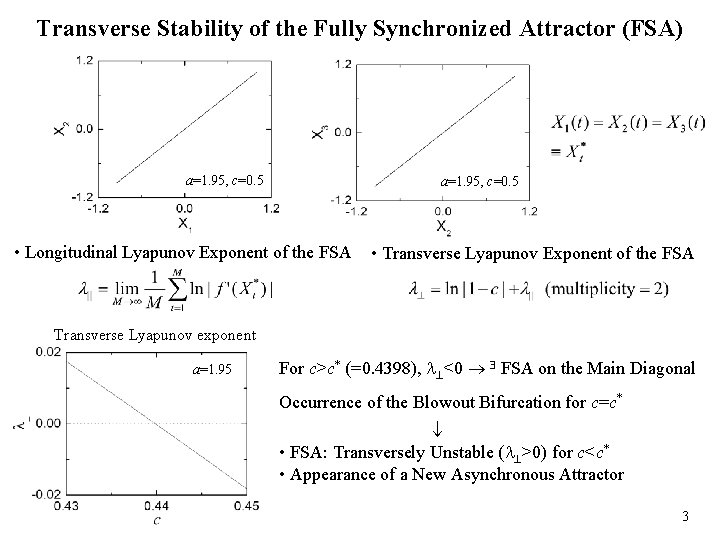
Transverse Stability of the Fully Synchronized Attractor (FSA) a=1. 95, c=0. 5 • Longitudinal Lyapunov Exponent of the FSA • Transverse Lyapunov Exponent of the FSA Transverse Lyapunov exponent a=1. 95 For c>c* (=0. 4398), <0 FSA on the Main Diagonal Occurrence of the Blowout Bifurcation for c=c* • FSA: Transversely Unstable ( >0) for c<c* • Appearance of a New Asynchronous Attractor 3
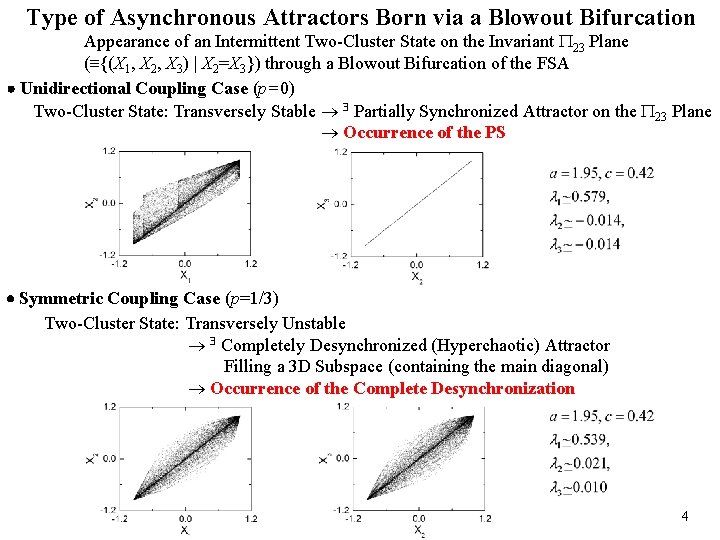
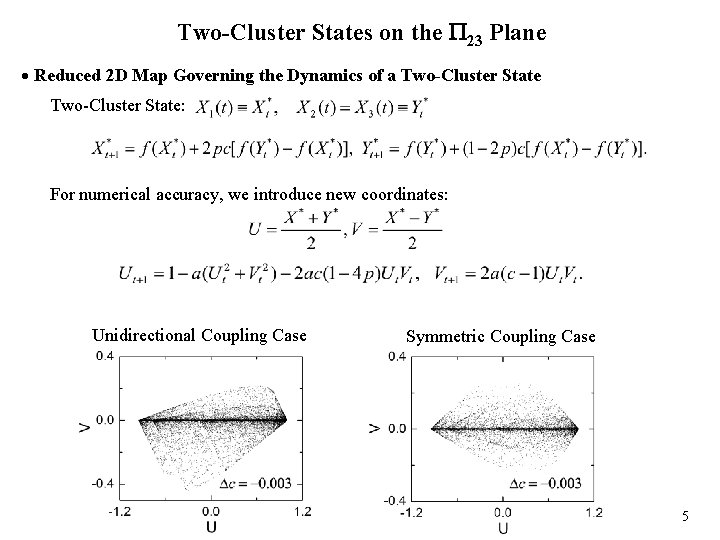
Type of Asynchronous Attractors Born via a Blowout Bifurcation Appearance of an Intermittent Two-Cluster State on the Invariant 23 Plane ( {(X 1, X 2, X 3) | X 2=X 3}) through a Blowout Bifurcation of the FSA Unidirectional Coupling Case (p=0) Two-Cluster State: Transversely Stable Partially Synchronized Attractor on the 23 Plane Occurrence of the PS Symmetric Coupling Case (p=1/3) Two-Cluster State: Transversely Unstable Completely Desynchronized (Hyperchaotic) Attractor Filling a 3 D Subspace (containing the main diagonal) Occurrence of the Complete Desynchronization 4
Two-Cluster States on the 23 Plane Reduced 2 D Map Governing the Dynamics of a Two-Cluster State: For numerical accuracy, we introduce new coordinates: Unidirectional Coupling Case Symmetric Coupling Case 5
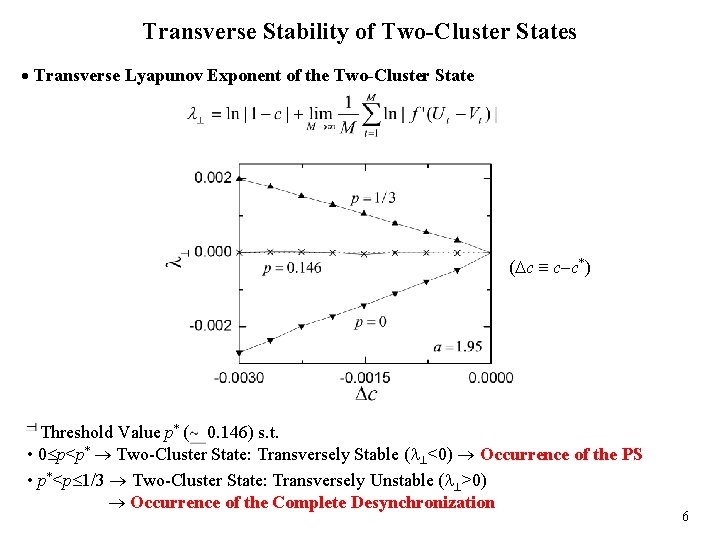
Transverse Stability of Two-Cluster States Transverse Lyapunov Exponent of the Two-Cluster State ( c c-c*) Threshold Value p* ( 0. 146) s. t. • 0 p<p* Two-Cluster State: Transversely Stable ( <0) Occurrence of the PS • p*<p 1/3 Two-Cluster State: Transversely Unstable ( >0) Occurrence of the Complete Desynchronization 6
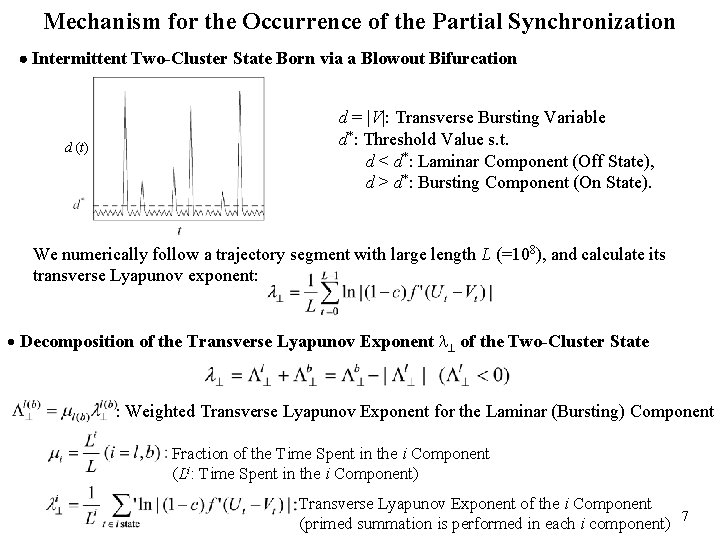
Mechanism for the Occurrence of the Partial Synchronization Intermittent Two-Cluster State Born via a Blowout Bifurcation d (t) d = |V|: Transverse Bursting Variable d*: Threshold Value s. t. d < d*: Laminar Component (Off State), d > d*: Bursting Component (On State). We numerically follow a trajectory segment with large length L (=108), and calculate its transverse Lyapunov exponent: Decomposition of the Transverse Lyapunov Exponent of the Two-Cluster State : Weighted Transverse Lyapunov Exponent for the Laminar (Bursting) Component Fraction of the Time Spent in the i Component (Li: Time Spent in the i Component) Transverse Lyapunov Exponent of the i Component (primed summation is performed in each i component) 7
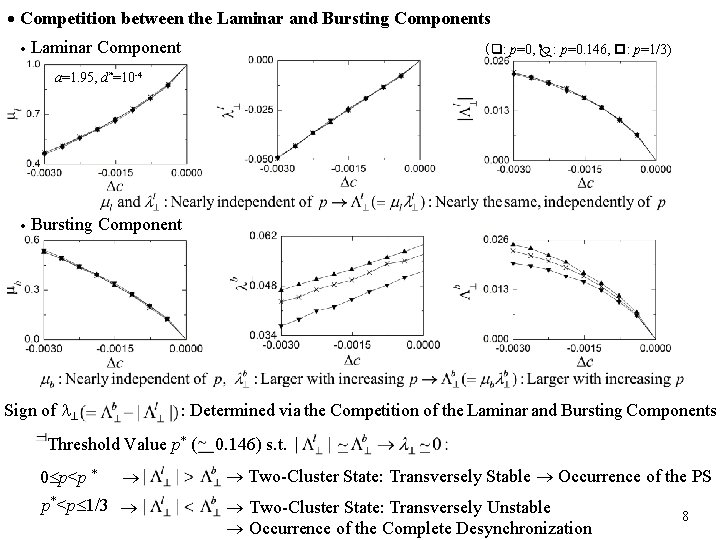
Competition between the Laminar and Bursting Components Laminar Component ( : p=0, : p=0. 146, : p=1/3) a=1. 95, d*=10 -4 Bursting Component Sign of : Determined via the Competition of the Laminar and Bursting Components Threshold Value p* ( 0. 146) s. t. 0 p<p * p*<p 1/3 Two-Cluster State: Transversely Stable Occurrence of the PS Two-Cluster State: Transversely Unstable Occurrence of the Complete Desynchronization 8
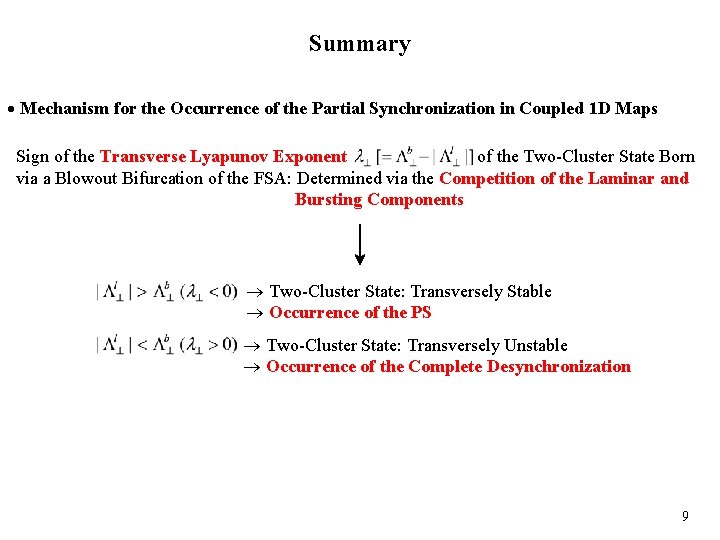
Summary Mechanism for the Occurrence of the Partial Synchronization in Coupled 1 D Maps Sign of the Transverse Lyapunov Exponent of the Two-Cluster State Born via a Blowout Bifurcation of the FSA: Determined via the Competition of the Laminar and Bursting Components Two-Cluster State: Transversely Stable Occurrence of the PS Two-Cluster State: Transversely Unstable Occurrence of the Complete Desynchronization 9