
Mechanism by which insulin regulates pyruvate dehydrogenase activity
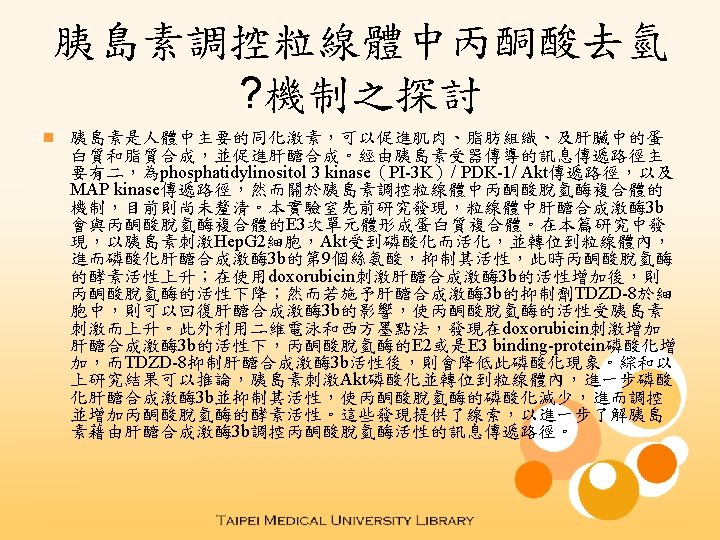

Mechanism by which insulin regulates pyruvate dehydrogenase activity in mitochondria n Insulin is a major anabolic hormone that stimulates synthesis of protein, lipid and glycogen in liver, adipose tissue and muscles. Two main signal transduction pathways downstream of insulin receptor are the phosphatidylinositol 3 kinase/ PDK-1/ Akt pathway and the MAP kinase pathway. How insulin might regulate pyruvate dehydrogenase (PDH) activity in mitochondria is not completely known. Our laboratory has previously found that mitochondrial GSK 3 b was associated with PDH E 3 subunit as a complex. In the present study, we demonstrated that? n. Akt was translocated to mitochondria upon insulin stimulation, and the mitochondrial Akt was in its phosphorylated and active state. Activation of Akt is known to phosphorylate and inhibit its downstream enzyme, GSK 3 b? nat Ser 9. Inhibitory phosphorylation of GSK 3 b maintains PDH at its non-phosphorylated and active state. Consistently, treatment of Hep G 2 cells with insulin increased phosphorylation of mitochondrial GSK-3 b, which was associated with an increase of PDH activity. Activation of GSK 3 b by doxorubicin suppressed the PDH activity, and this effect was reversed by pretreatment of cells with TDZD-8, a GSK 3 b-specific inhibitor? |? n Furthermore, treatment of Hep G 2 cells with doxorubicin increased phosphorylation of PDH E 3 binding-protein as revealed by 2 D-immunoblotting, and the inhibition of GSK 3 b? n? nby TDZD-8 abolished this phosphorylation. Taken together, our results suggest that translocation of Akt to mitochondria and subsequent GSK 3 b? nphosphorylation may regulate PDH activity in mitochondria by phosphorylating the PDH E 2 or E 3 binding-protein? |? n These findings might provide clues to understand the mechanism by which insulin regulates mitochondrial pyruvate dehydrogenase activity through GSK 3 b? |
- Slides: 2