
Mechanised Blending and Laying of Blanketing Material with
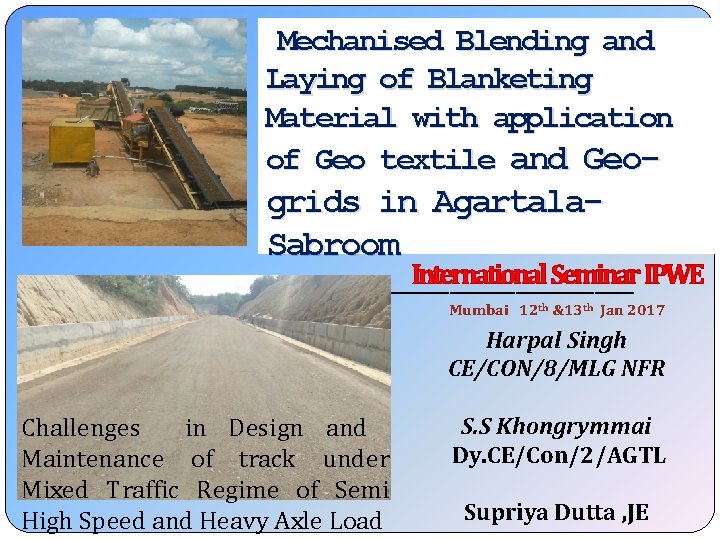
Mechanised Blending and Laying of Blanketing Material with application of Geo textile and Geo- grids in Agartala. Sabroom International Seminar IPWE ___________ Mumbai 12 th &13 th Jan 2017 Harpal Singh CE/CON/8/MLG NFR Challenges in Design and Maintenance of track under Mixed Traffic Regime of Semi High Speed and Heavy Axle Load S. S Khongrymmai Dy. CE/Con/2/AGTL Supriya Dutta , JE
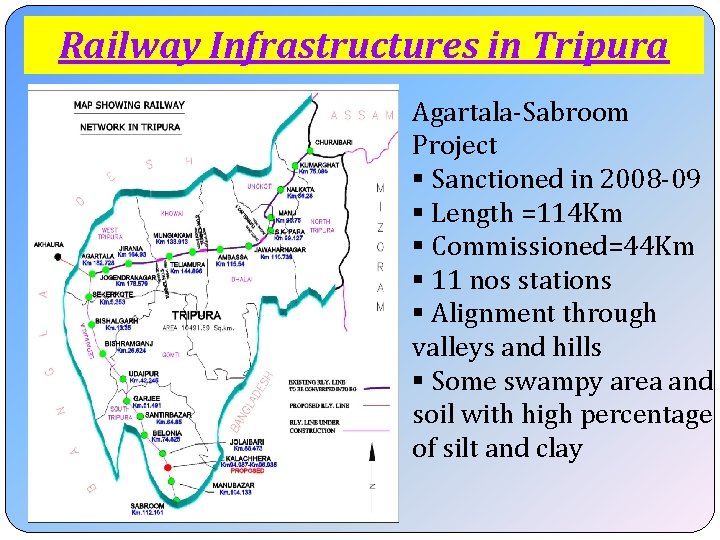
Railway Infrastructures in Tripura Agartala-Sabroom Project § Sanctioned in 2008 -09 § Length =114 Km § Commissioned=44 Km § 11 nos stations § Alignment through valleys and hills § Some swampy area and soil with high percentage of silt and clay
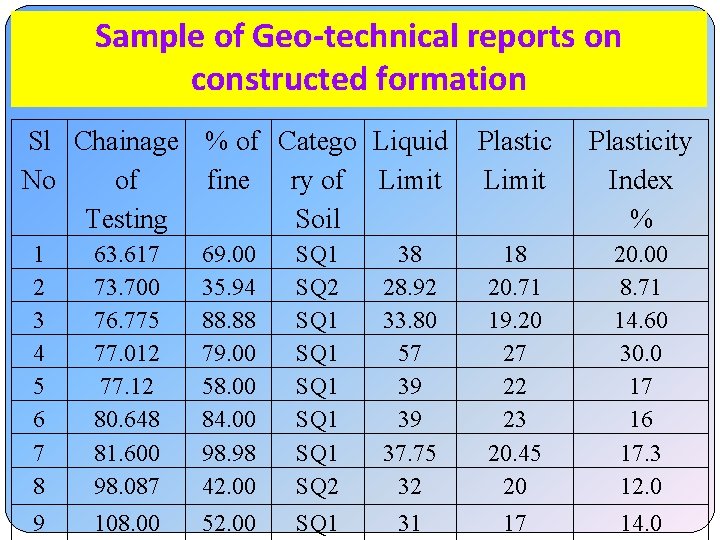
Sample of Geo-technical reports on constructed formation Sl Chainage % of Catego Liquid No of fine ry of Limit Testing Soil Plastic Limit Plasticity Index % 1 2 3 4 5 6 7 8 63. 617 73. 700 76. 775 77. 012 77. 12 80. 648 81. 600 98. 087 69. 00 35. 94 88. 88 79. 00 58. 00 84. 00 98. 98 42. 00 SQ 1 SQ 2 SQ 1 SQ 1 SQ 2 38 28. 92 33. 80 57 39 39 37. 75 32 18 20. 71 19. 20 27 22 23 20. 45 20 20. 00 8. 71 14. 60 30. 0 17 16 17. 3 12. 0 9 108. 00 52. 00 SQ 1 31 17 14. 0
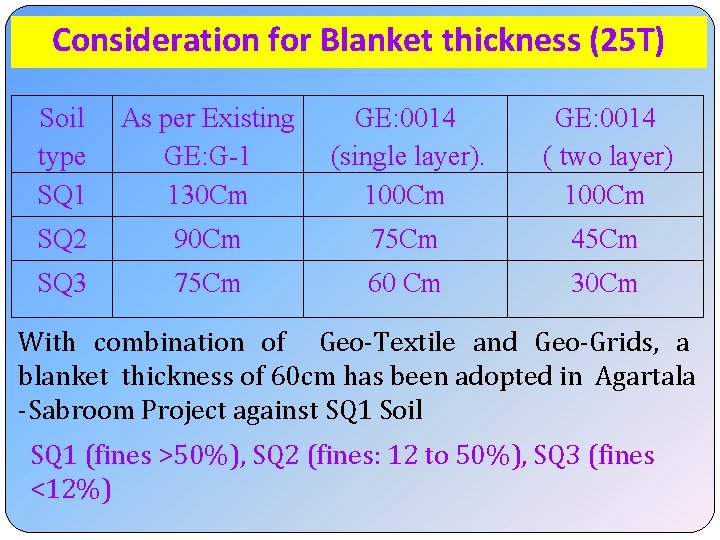
Consideration for Blanket thickness (25 T) Soil type SQ 1 As per Existing GE: G-1 130 Cm GE: 0014 (single layer). 100 Cm GE: 0014 ( two layer) 100 Cm SQ 2 90 Cm 75 Cm 45 Cm SQ 3 75 Cm 60 Cm 30 Cm With combination of Geo-Textile and Geo-Grids, a blanket thickness of 60 cm has been adopted in Agartala -Sabroom Project against SQ 1 Soil SQ 1 (fines >50%), SQ 2 (fines: 12 to 50%), SQ 3 (fines <12%)
Blanket and its Functions Blanket is a quality soil between the ballast and the subgrade with main functions 1) It reduces stress to sub-grade to a tolerable limits 2) It increases track modulus through out and thereby reduces track deformation. 3) It prevents ballast penetration in sub-grade and hence mud-pumping 4) It prevents upward sub-grade fines migration 5) It facilitates drainage of surface water from above 6) It ensures dissipation of pore water pressure in subgrade.
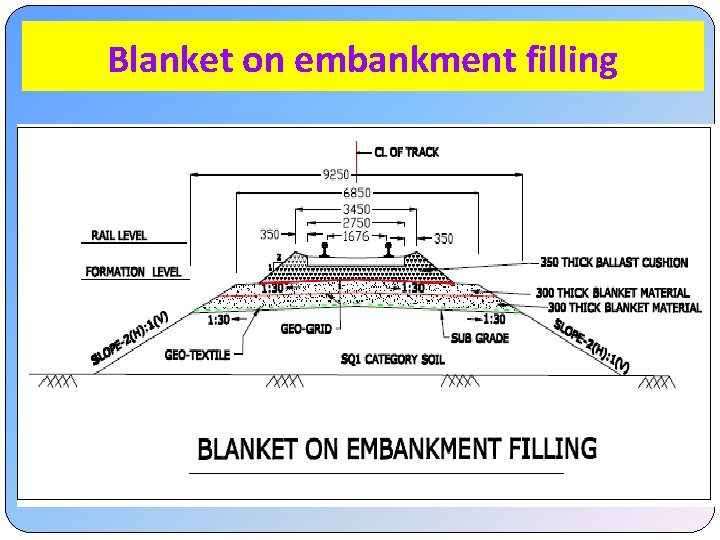
Blanket on embankment filling
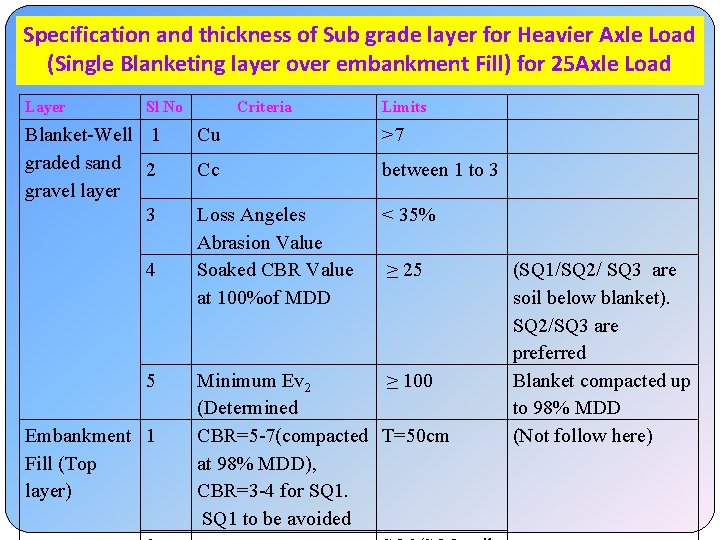
Specification and thickness of Sub grade layer for Heavier Axle Load (Single Blanketing layer over embankment Fill) for 25 Axle Load Layer Sl No Blanket-Well 1 graded sand 2 gravel layer 3 4 5 Embankment 1 Fill (Top layer) Criteria Limits Cu >7 Cc between 1 to 3 Loss Angeles Abrasion Value Soaked CBR Value at 100%of MDD < 35% ≥ 25 Minimum Ev 2 ≥ 100 (Determined CBR=5 -7(compacted T=50 cm at 98% MDD), CBR=3 -4 for SQ 1 to be avoided (SQ 1/SQ 2/ SQ 3 are soil below blanket). SQ 2/SQ 3 are preferred Blanket compacted up to 98% MDD (Not follow here)
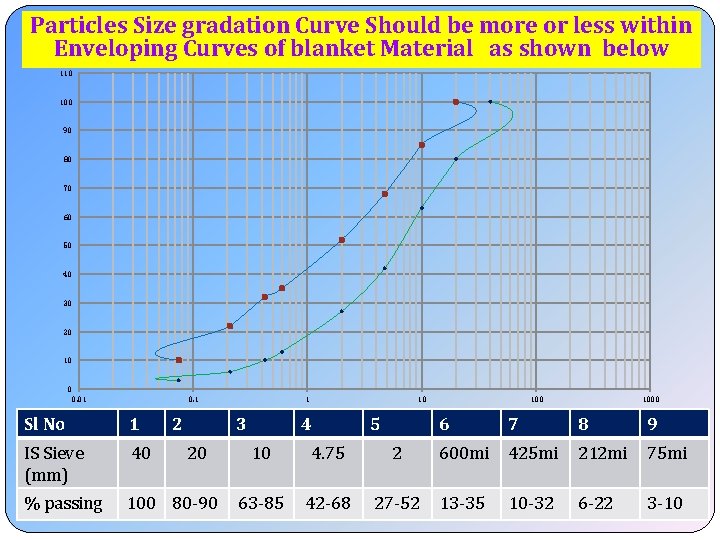
Particles Size gradation Curve Should be more or less within. Enveloping Curves of blanket Material as shown below 110 100 90 80 70 60 50 40 30 20 10 0 0. 01 0. 1 Sl No 1 2 IS Sieve (mm) 40 % passing 100 80 -90 1 3 20 10 4 5 1000 6 7 8 9 10 4. 75 2 600 mi 425 mi 212 mi 75 mi 63 -85 42 -68 27 -52 13 -35 10 -32 6 -22 3 -10
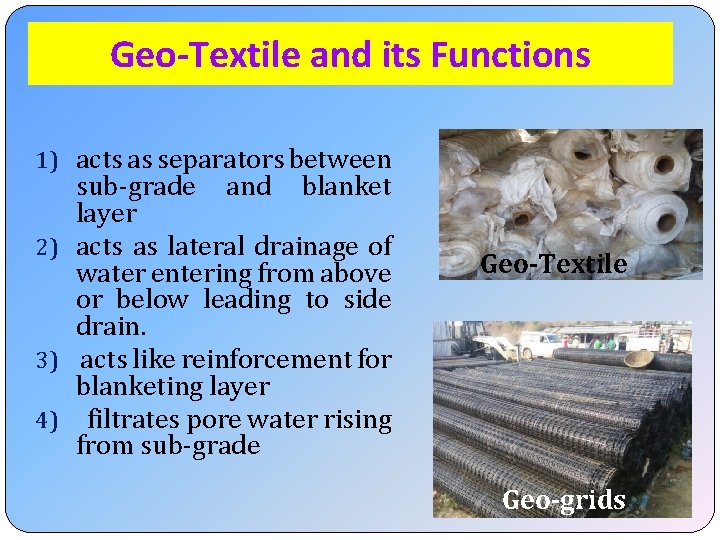
Geo-Textile and its Functions 1) acts as separators between sub-grade and blanket layer 2) acts as lateral drainage of water entering from above or below leading to side drain. 3) acts like reinforcement for blanketing layer 4) filtrates pore water rising from sub-grade Geo-Textile Geo-grids
Geo-Grid and its Functions Geo-grids stabilize the formation by improving lateral confinement and bearing capacity, increasing resilient modulus and decreasing differential settlement. Ø Stabilizing effect is achieved through two mechanisms a) Lateral restrain of the ballast and formation through interlocking (between aggregate and geo-grids) and friction (between soil and the geo-grid) b) Sub grade restraint/increase in the system bearing capacity Ø Specifications as per IR Unified Standard Specifications
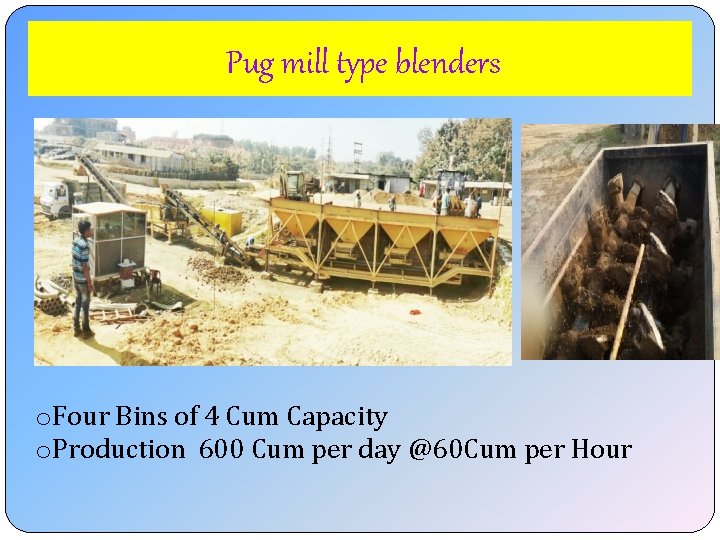
Pug mill type blenders o. Four Bins of 4 Cum Capacity o. Production 600 Cum per day @60 Cum per Hour
Trial Mix of Blanket �Identify of the useable materials/soils. �Take equal weight of the materials for sieve analysis. �Write down the weight retained at each stage for all the soils. �Apportion of percentage component to each material and work out theoretical mix. �Draw particles size distribution curve of mix to find out desirability of gradation of blanket materials, as per guideline vide RDSO/2007/GE: 0014 Vide page -28. Of heavy axle load 25 T. �If not successful, then make another trail, and so on.
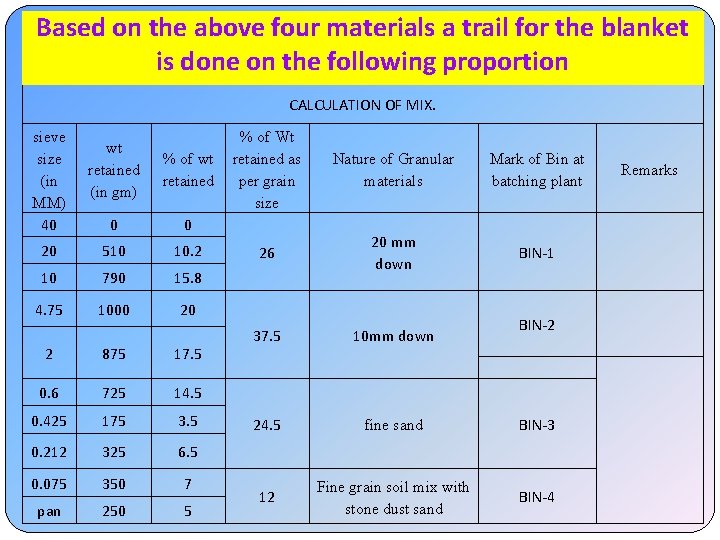
Based on the above four materials a trail for the blanket is done on the following proportion CALCULATION OF MIX. sieve size (in MM) 40 wt retained (in gm) % of wt retained 0 0 20 510 10. 2 10 790 15. 8 4. 75 1000 20 2 875 17. 5 0. 6 725 14. 5 0. 425 175 3. 5 0. 212 325 6. 5 0. 075 350 7 pan 250 5 % of Wt retained as per grain size Nature of Granular materials Mark of Bin at batching plant 26 20 mm down BIN-1 37. 5 10 mm down 24. 5 fine sand BIN-3 12 Fine grain soil mix with stone dust sand BIN-4 BIN-2 Remarks
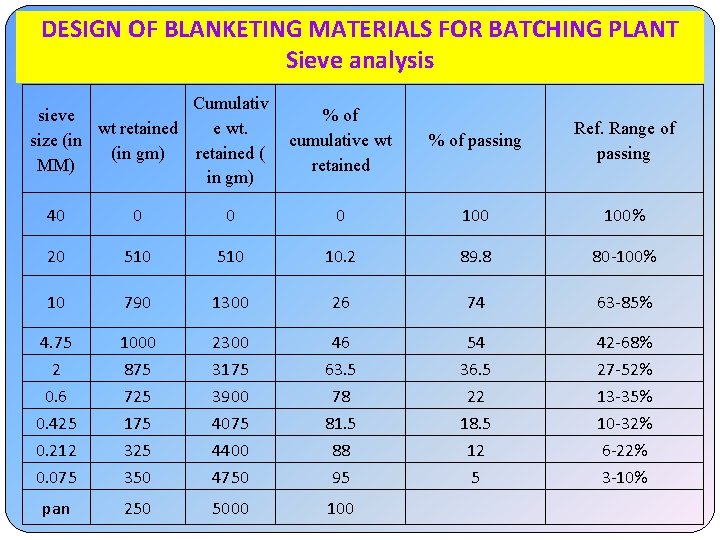
DESIGN OF BLANKETING MATERIALS FOR BATCHING PLANT Sieve analysis sieve wt retained size (in gm) MM) Cumulativ e wt. retained ( in gm) % of cumulative wt retained % of passing Ref. Range of passing 40 0 100 100% 20 510 10. 2 89. 8 80 -100% 10 790 1300 26 74 63 -85% 4. 75 1000 2300 46 54 42 -68% 2 875 3175 63. 5 36. 5 27 -52% 0. 6 725 3900 78 22 13 -35% 0. 425 175 4075 81. 5 18. 5 10 -32% 0. 212 325 4400 88 12 6 -22% 0. 075 350 4750 95 5 3 -10% pan 250 5000 100
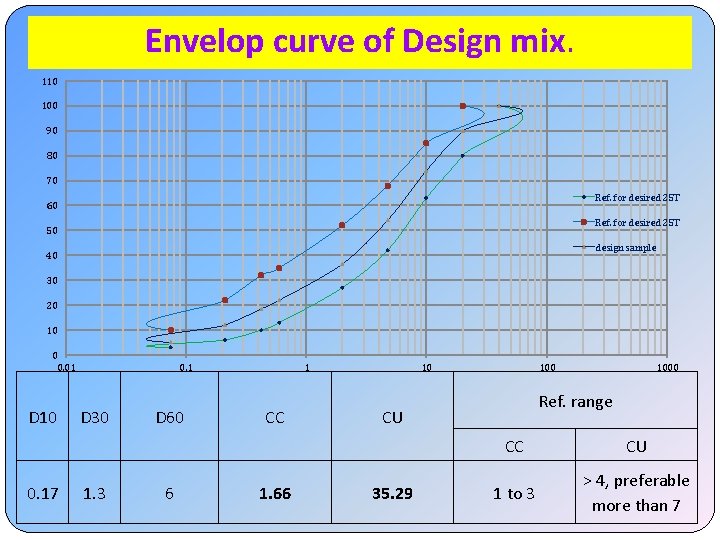
Envelop curve of Design mix. 110 100 90 80 70 Ref. for desired 25 T 60 Ref. for desired 25 T 50 design sample 40 30 20 10 0 0. 01 D 10 0. 17 0. 1 D 30 1. 3 D 60 6 1 CC 1. 66 10 100 Ref. range CU 35. 29 1000 CC CU 1 to 3 > 4, preferable more than 7
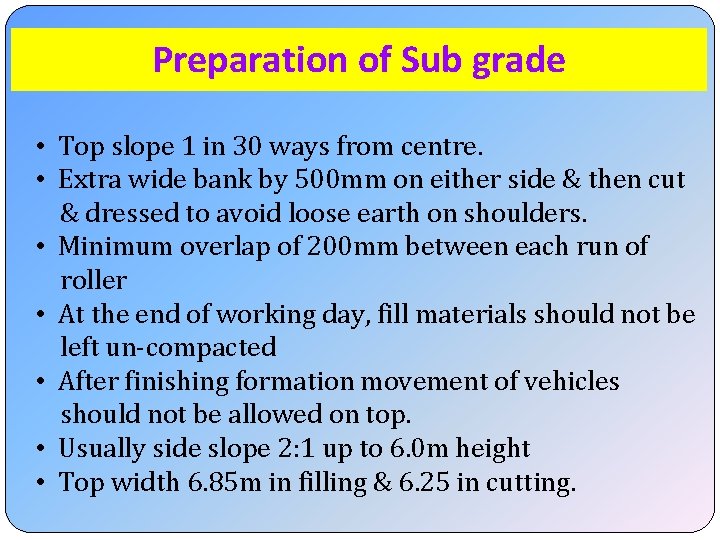
Preparation of Sub grade • Top slope 1 in 30 ways from centre. • Extra wide bank by 500 mm on either side & then cut & dressed to avoid loose earth on shoulders. • Minimum overlap of 200 mm between each run of roller • At the end of working day, fill materials should not be left un-compacted • After finishing formation movement of vehicles should not be allowed on top. • Usually side slope 2: 1 up to 6. 0 m height • Top width 6. 85 m in filling & 6. 25 in cutting.
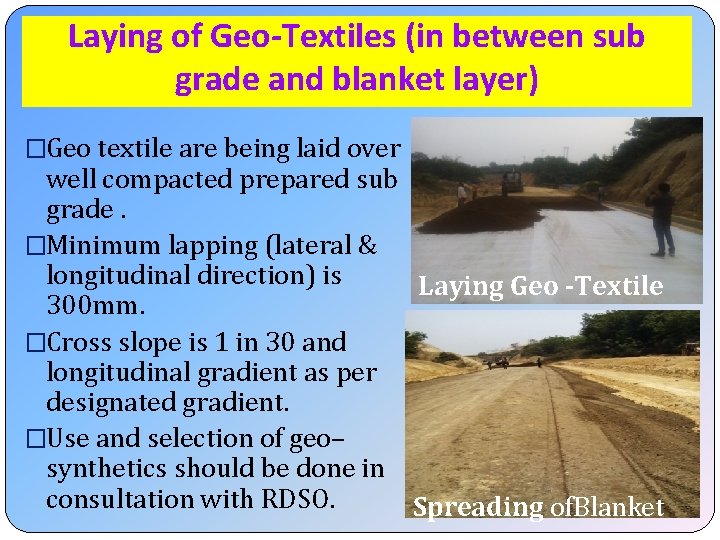
Laying of Geo-Textiles (in between sub grade and blanket layer) �Geo textile are being laid over well compacted prepared sub grade. �Minimum lapping (lateral & longitudinal direction) is Laying Geo -Textile 300 mm. �Cross slope is 1 in 30 and longitudinal gradient as per designated gradient. �Use and selection of geo– synthetics should be done in consultation with RDSO. Spreading of. Blanket
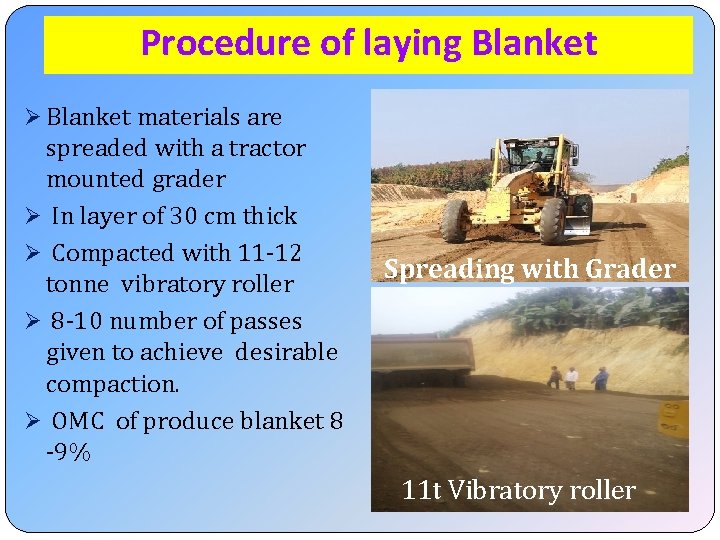
Procedure of laying Blanket Ø Blanket materials are spreaded with a tractor mounted grader Ø In layer of 30 cm thick Ø Compacted with 11 -12 tonne vibratory roller Ø 8 -10 number of passes given to achieve desirable compaction. Ø OMC of produce blanket 8 -9% Spreading with Grader 11 t Vibratory roller
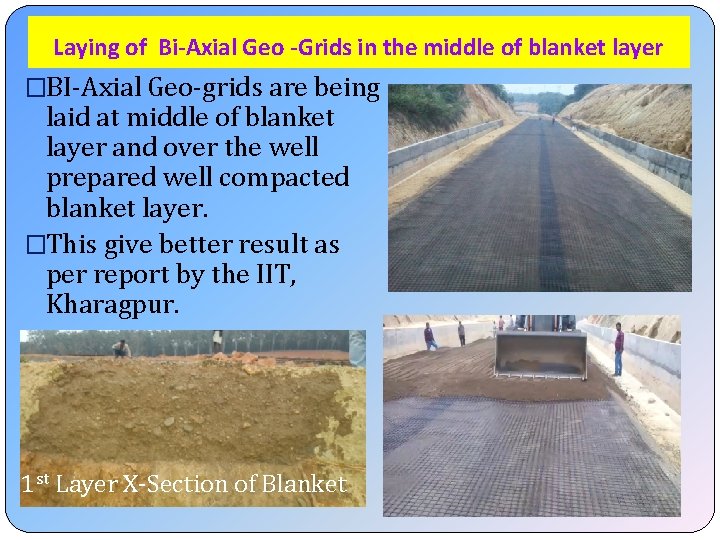
Laying of Bi-Axial Geo -Grids in the middle of blanket layer �BI-Axial Geo-grids are being laid at middle of blanket layer and over the well prepared well compacted blanket layer. �This give better result as per report by the IIT, Kharagpur. 1 st Layer X-Section of Blanket
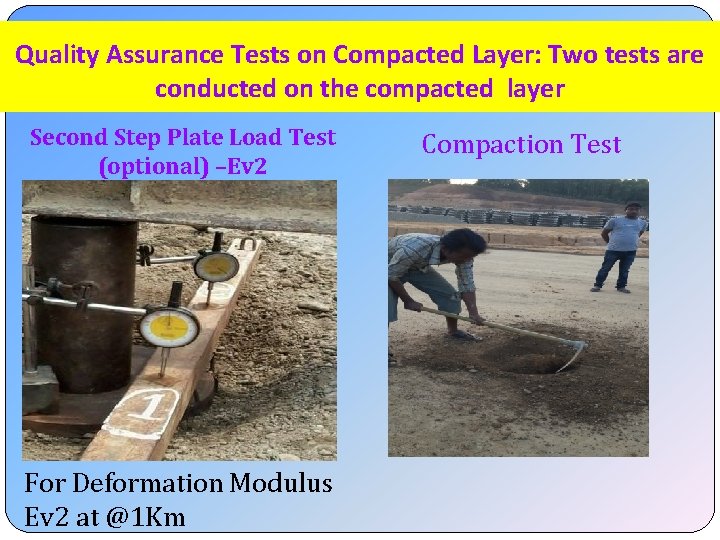
Quality Assurance Tests on Compacted Layer: Two tests are conducted on the compacted layer Second Step Plate Load Test (optional) –Ev 2 For Deformation Modulus Ev 2 at @1 Km Compaction Test
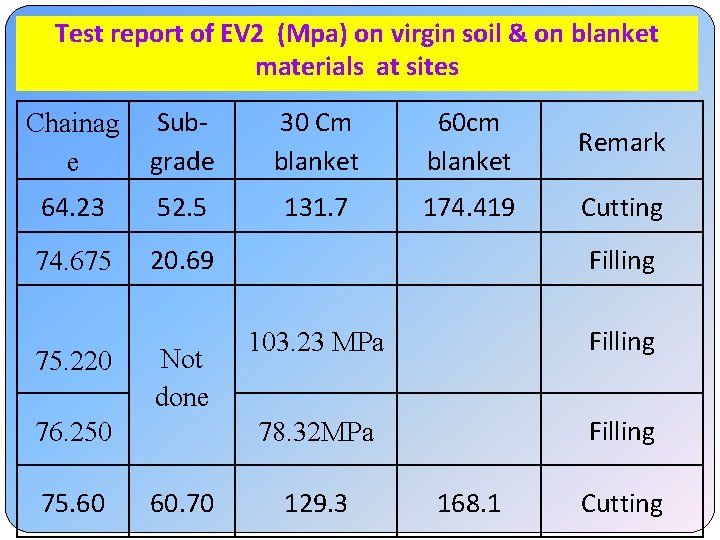
Test report of EV 2 (Mpa) on virgin soil & on blanket materials at sites Chainag e Subgrade 30 Cm blanket 60 cm blanket Remark 64. 23 52. 5 131. 7 174. 419 Cutting 74. 675 20. 69 75. 220 Not done 76. 250 75. 60 60. 70 Filling 103. 23 MPa Filling 78. 32 MPa Filling 129. 3 168. 1 Cutting
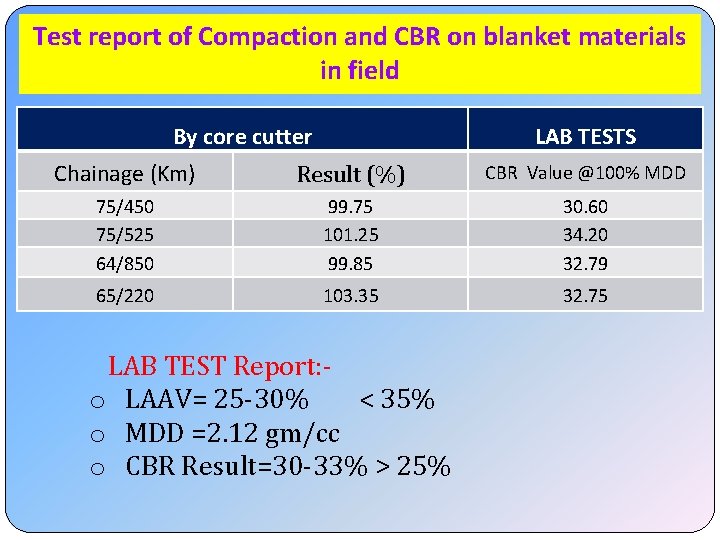
Test report of Compaction and CBR on blanket materials in field By core cutter LAB TESTS Chainage (Km) Result (%) CBR Value @100% MDD 75/450 75/525 64/850 99. 75 101. 25 99. 85 30. 60 34. 20 32. 79 65/220 103. 35 32. 75 LAB TEST Report: o LAAV= 25 -30% ˂ 35% o MDD =2. 12 gm/cc o CBR Result=30 -33% > 25%
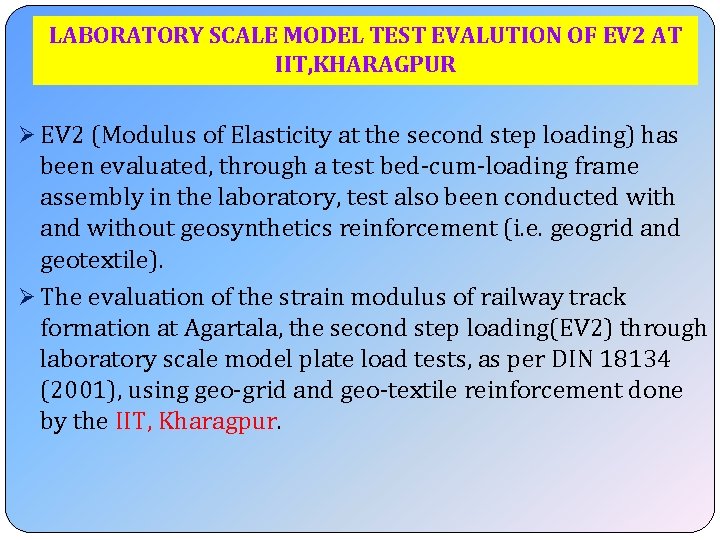
LABORATORY SCALE MODEL TEST EVALUTION OF EV 2 AT IIT, KHARAGPUR Ø EV 2 (Modulus of Elasticity at the second step loading) has been evaluated, through a test bed-cum-loading frame assembly in the laboratory, test also been conducted with and without geosynthetics reinforcement (i. e. geogrid and geotextile). Ø The evaluation of the strain modulus of railway track formation at Agartala, the second step loading(EV 2) through laboratory scale model plate load tests, as per DIN 18134 (2001), using geo-grid and geo-textile reinforcement done by the IIT, Kharagpur.
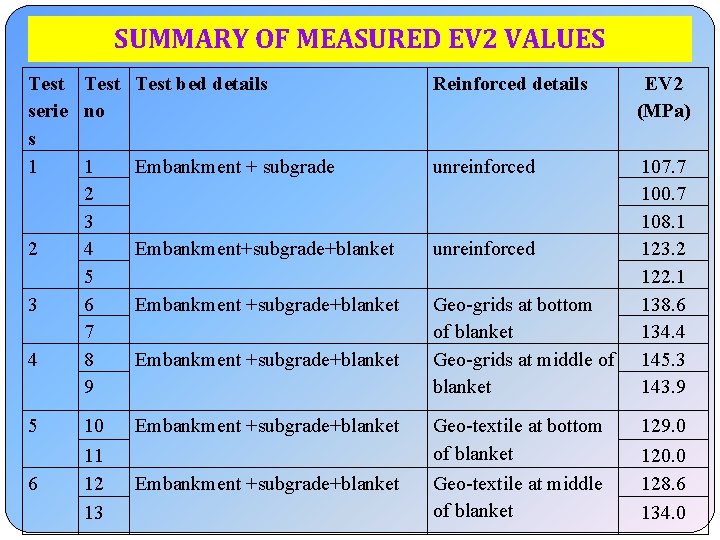
SUMMARY OF MEASURED EV 2 VALUES Test bed details serie no s 1 1 Embankment + subgrade 2 3 2 4 Embankment+subgrade+blanket 5 3 6 Embankment +subgrade+blanket 7 4 8 Embankment +subgrade+blanket 9 Reinforced details EV 2 (MPa) unreinforced Geo-grids at bottom of blanket Geo-grids at middle of blanket 107. 7 100. 7 108. 1 123. 2 122. 1 138. 6 134. 4 145. 3 143. 9 5 Geo-textile at bottom of blanket Geo-textile at middle of blanket 129. 0 120. 0 128. 6 134. 0 6 10 11 12 13 Embankment +subgrade+blanket unreinforced
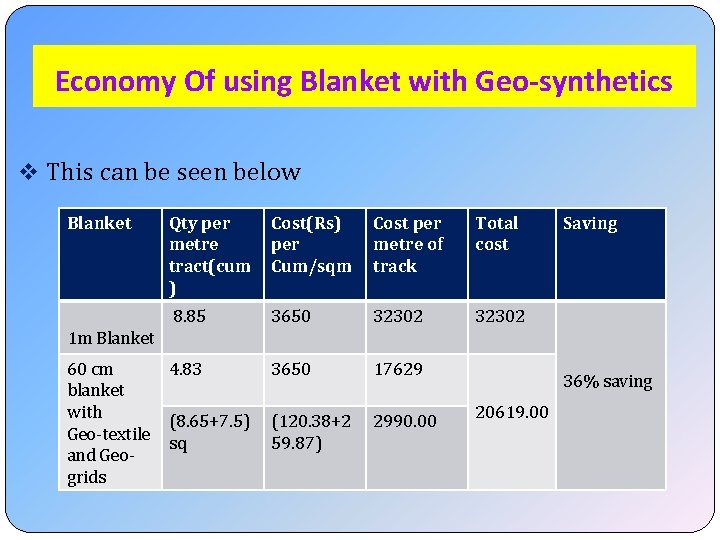
Economy Of using Blanket with Geo-synthetics v This can be seen below Blanket Qty per metre tract(cum ) Cost(Rs) per Cum/sqm Cost per metre of track Total cost 8. 85 3650 32302 4. 83 3650 17629 (8. 65+7. 5) sq (120. 38+2 59. 87) 2990. 00 Saving 1 m Blanket 60 cm blanket with Geo-textile and Geogrids 36% saving 20619. 00
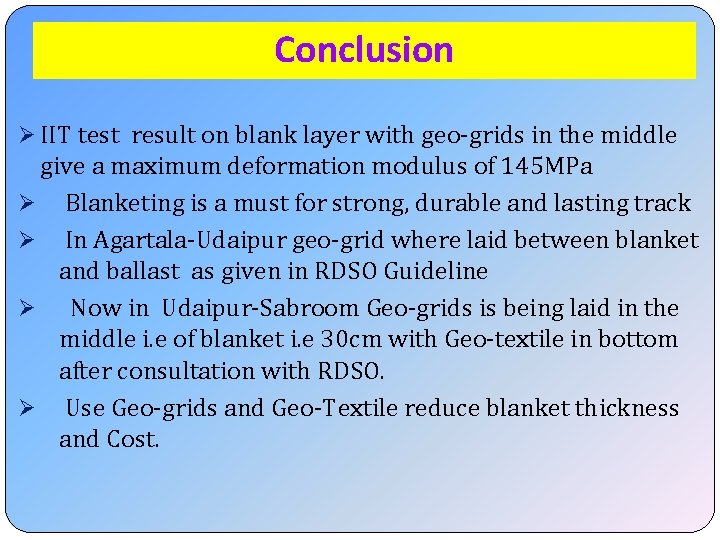
Conclusion Ø IIT test result on blank layer with geo-grids in the middle give a maximum deformation modulus of 145 MPa Ø Blanketing is a must for strong, durable and lasting track Ø In Agartala-Udaipur geo-grid where laid between blanket and ballast as given in RDSO Guideline Ø Now in Udaipur-Sabroom Geo-grids is being laid in the middle i. e of blanket i. e 30 cm with Geo-textile in bottom after consultation with RDSO. Ø Use Geo-grids and Geo-Textile reduce blanket thickness and Cost.
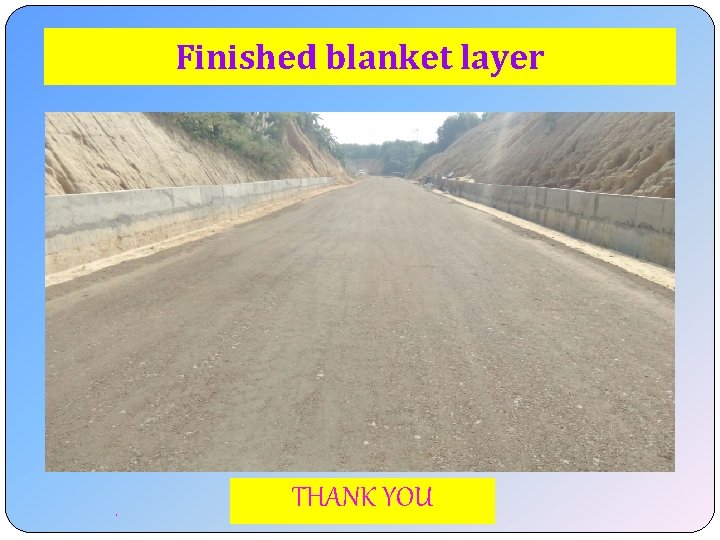
Finished blanket layer . THANK YOU
- Slides: 27