
Mechanics of Movement I Muscle Force and Action
- Slides: 18
Mechanics of Movement I: Muscle Force and Action Across Joints ® Review muscle force generation ® Muscle Mechanics ® --force versus cross section ® --length versus strain ® Lever mechanics and agonist/antagonists ® Stabilizing the joint—isometric and eccentric ® contraction Frolich, Human Anatomy, Mechanics of Movement
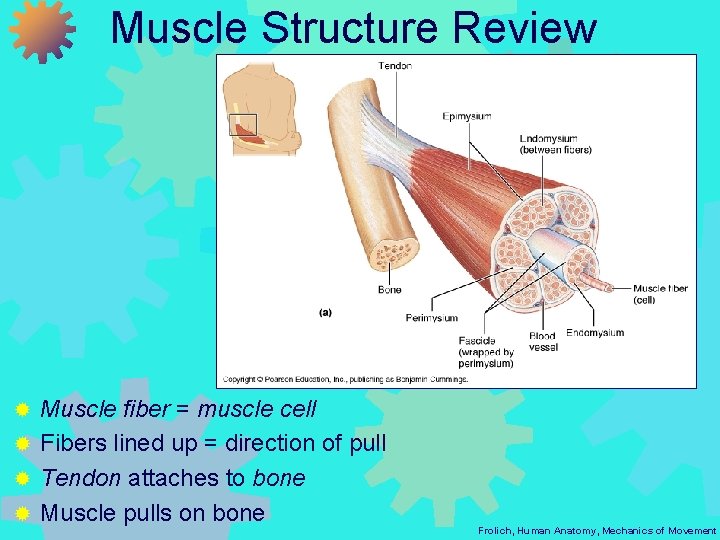
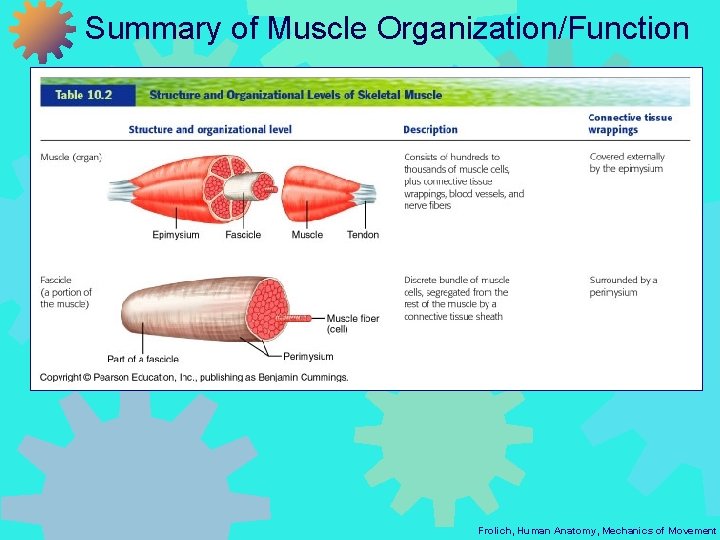
Muscle Structure Review Muscle fiber = muscle cell ® Fibers lined up = direction of pull ® Tendon attaches to bone ® Muscle pulls on bone ® Frolich, Human Anatomy, Mechanics of Movement
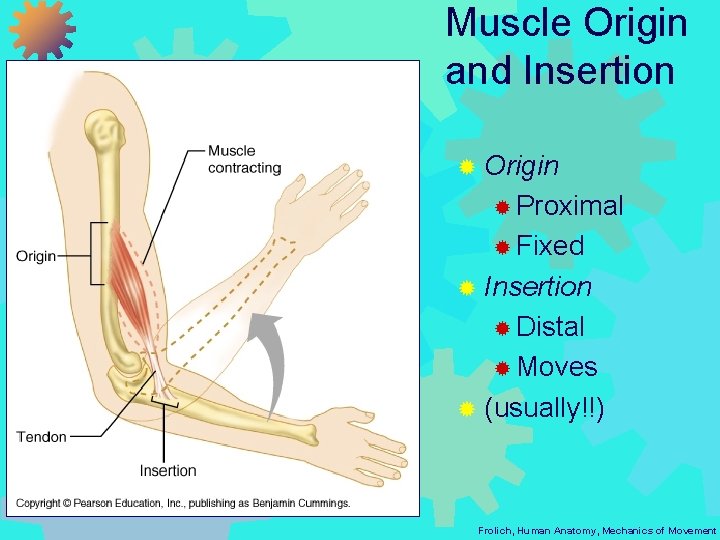
Muscle Origin and Insertion ® Origin ® Proximal ® Fixed ® Insertion ® Distal ® Moves ® (usually!!) Frolich, Human Anatomy, Mechanics of Movement
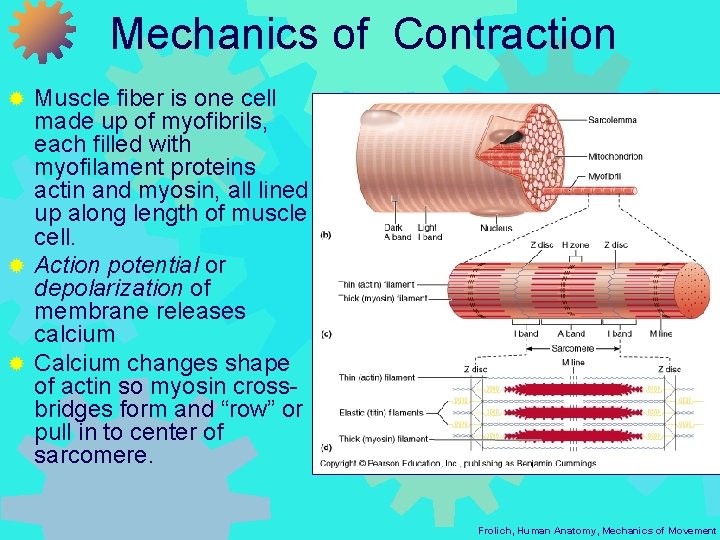
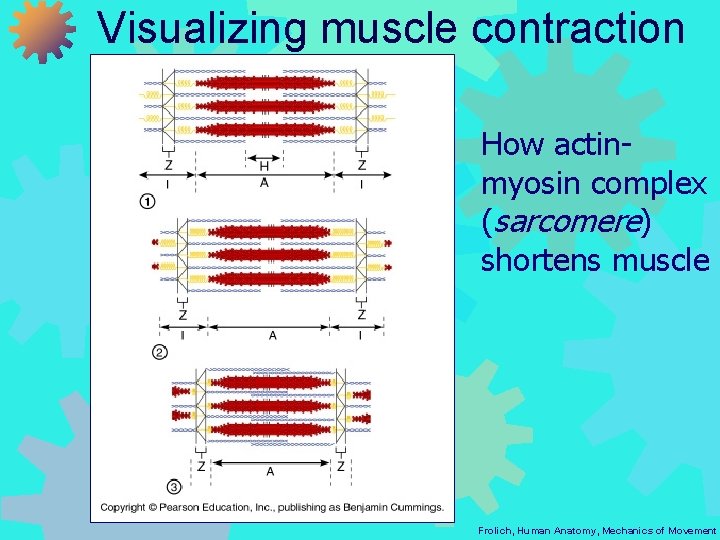
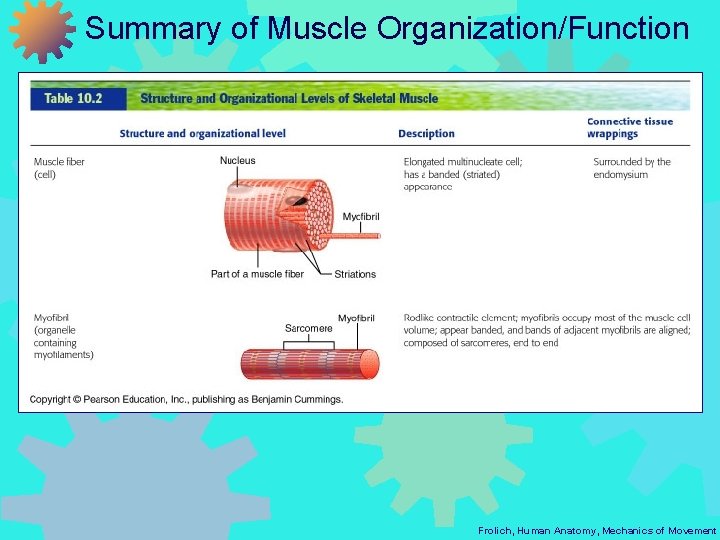
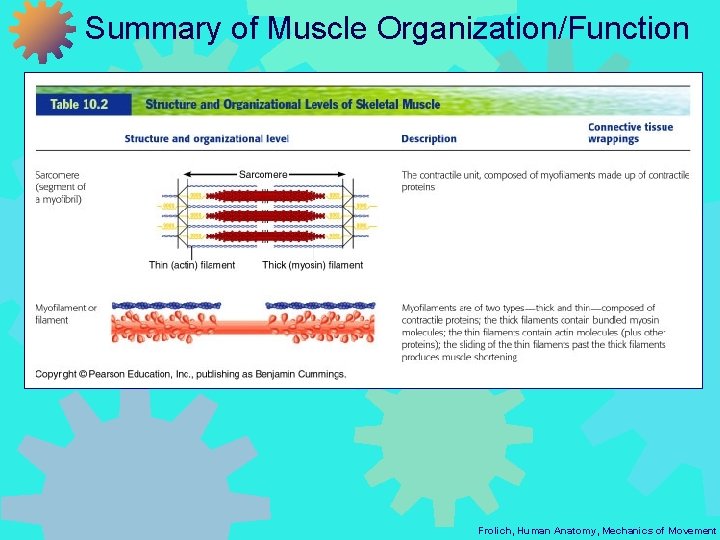
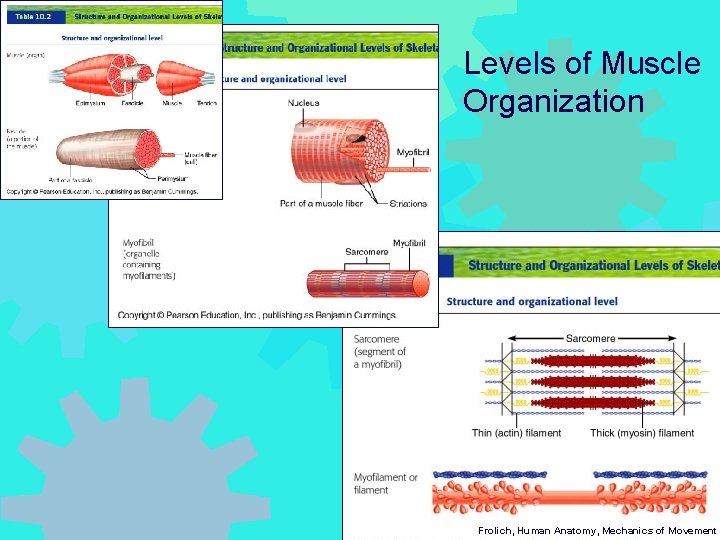
Mechanics of Contraction Muscle fiber is one cell made up of myofibrils, each filled with myofilament proteins actin and myosin, all lined up along length of muscle cell. ® Action potential or depolarization of membrane releases calcium ® Calcium changes shape of actin so myosin crossbridges form and “row” or pull in to center of sarcomere. ® Frolich, Human Anatomy, Mechanics of Movement
Visualizing muscle contraction How actinmyosin complex (sarcomere) shortens muscle Frolich, Human Anatomy, Mechanics of Movement
Summary of Muscle Organization/Function Frolich, Human Anatomy, Mechanics of Movement
Summary of Muscle Organization/Function Frolich, Human Anatomy, Mechanics of Movement
Summary of Muscle Organization/Function Frolich, Human Anatomy, Mechanics of Movement
Levels of Muscle Organization Frolich, Human Anatomy, Mechanics of Movement
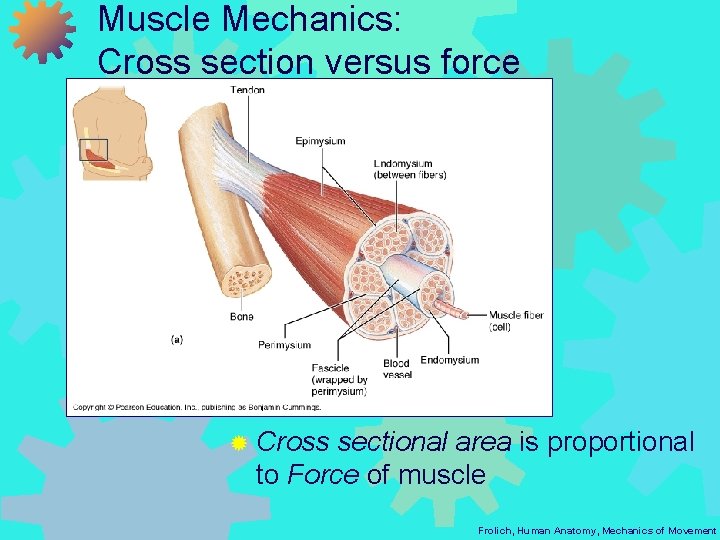
Muscle Mechanics: Cross section versus force ® Cross sectional area is proportional to Force of muscle Frolich, Human Anatomy, Mechanics of Movement
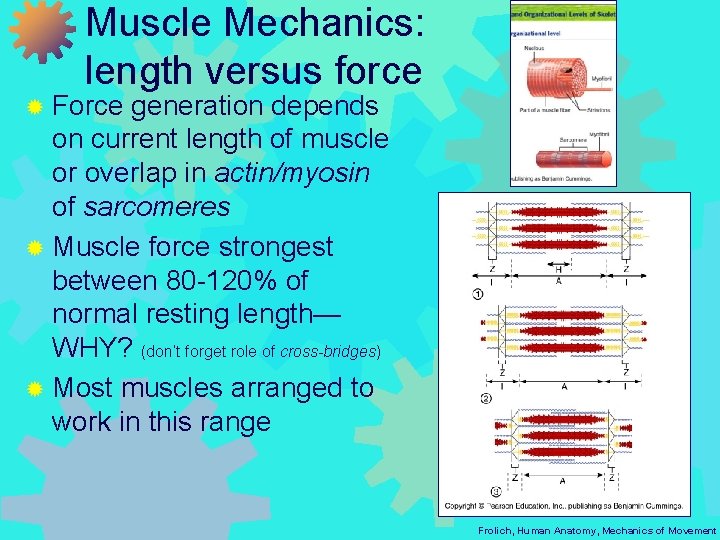
Muscle Mechanics: length versus force ® Force generation depends on current length of muscle or overlap in actin/myosin of sarcomeres ® Muscle force strongest between 80 -120% of normal resting length— WHY? (don’t forget role of cross-bridges) ® Most muscles arranged to work in this range Frolich, Human Anatomy, Mechanics of Movement
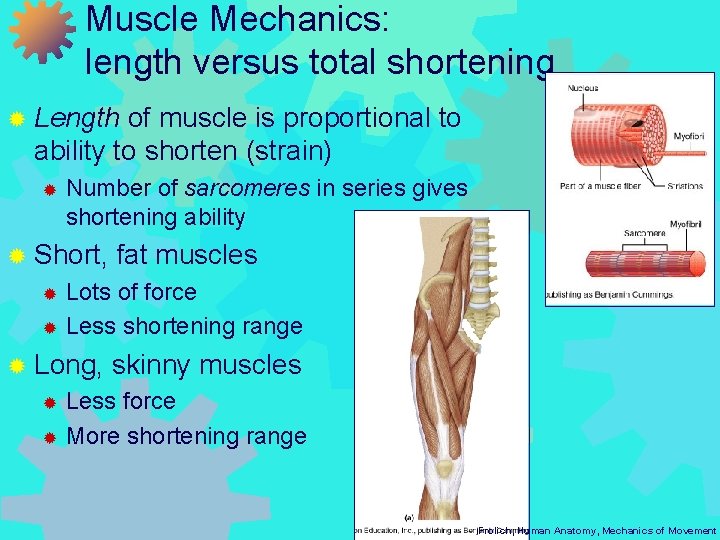
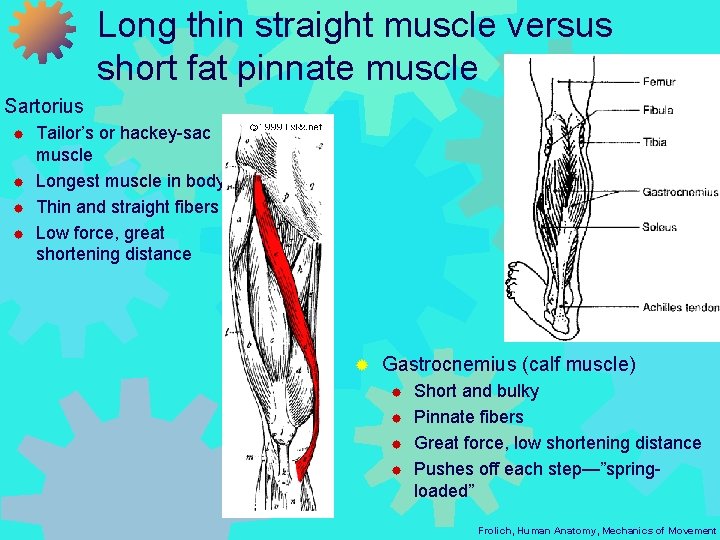
Muscle Mechanics: length versus total shortening ® Length of muscle is proportional to ability to shorten (strain) ® Number of sarcomeres in series gives shortening ability ® Short, fat muscles Lots of force ® Less shortening range ® ® Long, skinny muscles Less force ® More shortening range ® Frolich, Human Anatomy, Mechanics of Movement
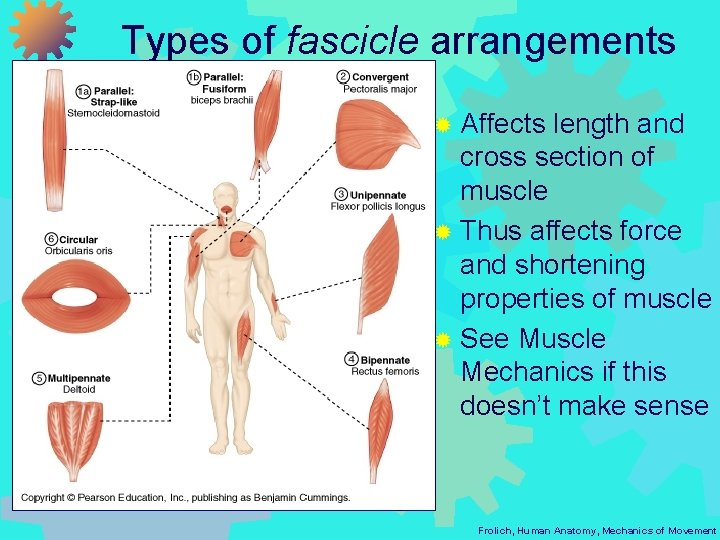
Types of fascicle arrangements ® Affects length and cross section of muscle ® Thus affects force and shortening properties of muscle ® See Muscle Mechanics if this doesn’t make sense Frolich, Human Anatomy, Mechanics of Movement
Long thin straight muscle versus short fat pinnate muscle Sartorius ® ® Tailor’s or hackey-sac muscle Longest muscle in body’ Thin and straight fibers Low force, great shortening distance ® Gastrocnemius (calf muscle) ® ® Short and bulky Pinnate fibers Great force, low shortening distance Pushes off each step—”springloaded” Frolich, Human Anatomy, Mechanics of Movement
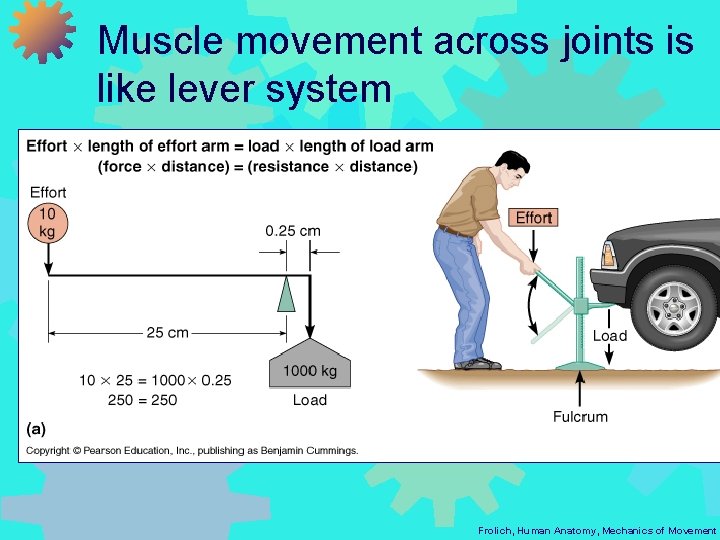
Muscle movement across joints is like lever system Frolich, Human Anatomy, Mechanics of Movement
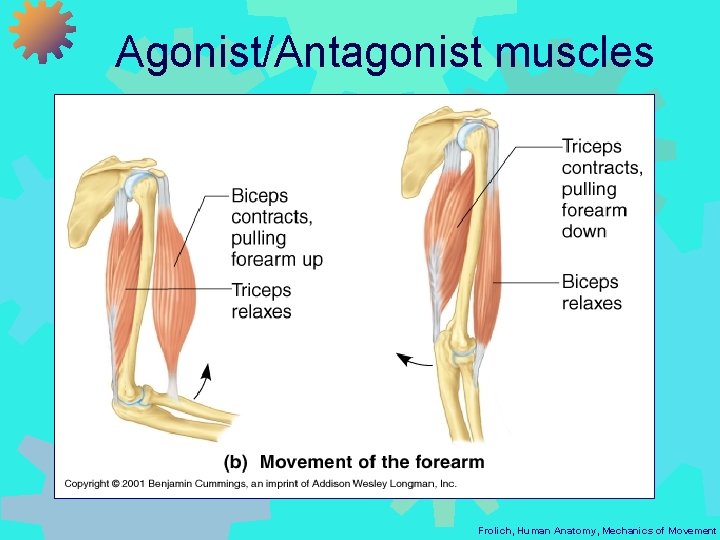
Agonist/Antagonist muscles Frolich, Human Anatomy, Mechanics of Movement
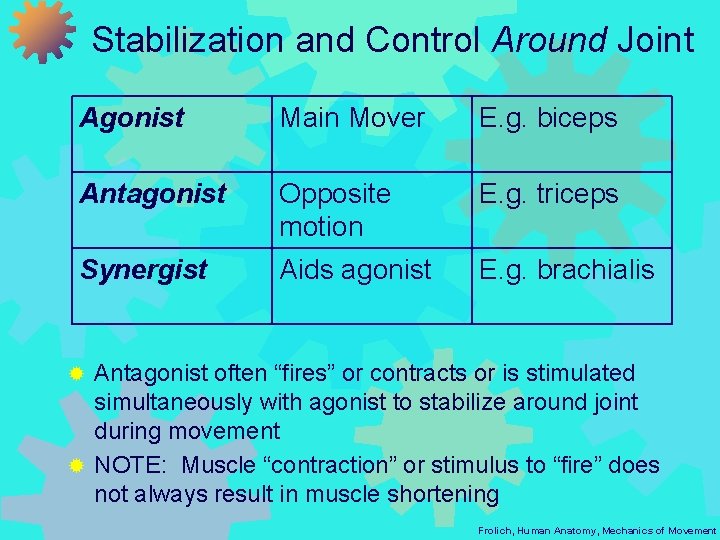
Stabilization and Control Around Joint Agonist Main Mover E. g. biceps Antagonist Opposite motion E. g. triceps Synergist Aids agonist E. g. brachialis Antagonist often “fires” or contracts or is stimulated simultaneously with agonist to stabilize around joint during movement ® NOTE: Muscle “contraction” or stimulus to “fire” does not always result in muscle shortening ® Frolich, Human Anatomy, Mechanics of Movement
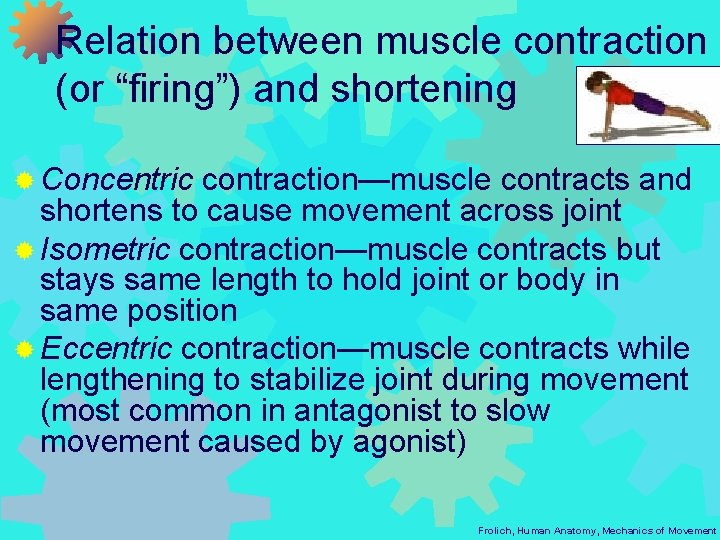
Relation between muscle contraction (or “firing”) and shortening ® Concentric contraction—muscle contracts and shortens to cause movement across joint ® Isometric contraction—muscle contracts but stays same length to hold joint or body in same position ® Eccentric contraction—muscle contracts while lengthening to stabilize joint during movement (most common in antagonist to slow movement caused by agonist) Frolich, Human Anatomy, Mechanics of Movement