
Mechanics Loadings 3 Basic Types of Loadings n
Mechanics

Loadings 3 Basic Types of Loadings n n n Static Dynamic Environmental

Static Loadings Classifications n n Dead Loads Live Loads Applied Stress 1. Slowly applied 2. Sustained for period of time 3. Slowly removed Constant t
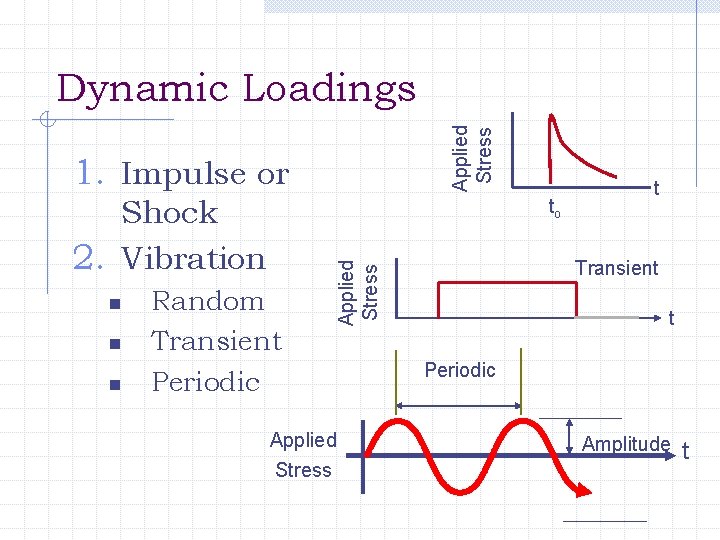
Applied Stress Dynamic Loadings 1. Impulse or Shock 2. Vibration n n Random Transient Periodic Transient Applied Stress n to Applied Stress t t Periodic Amplitude t
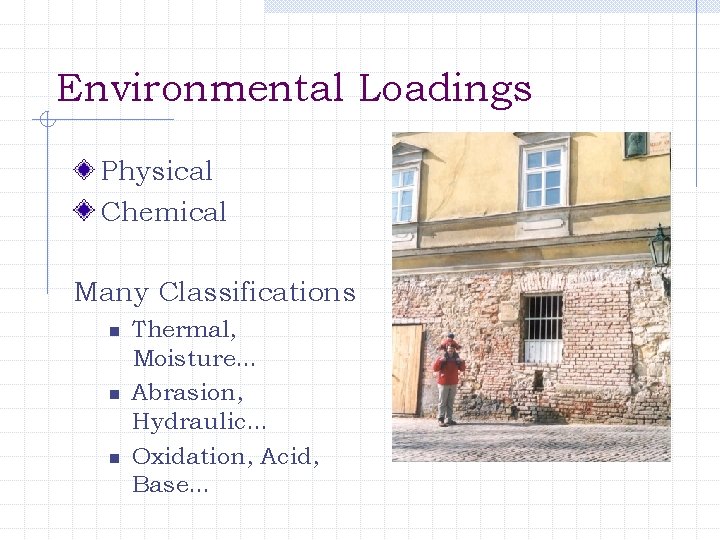
Environmental Loadings Physical Chemical Many Classifications n n n Thermal, Moisture… Abrasion, Hydraulic… Oxidation, Acid, Base…
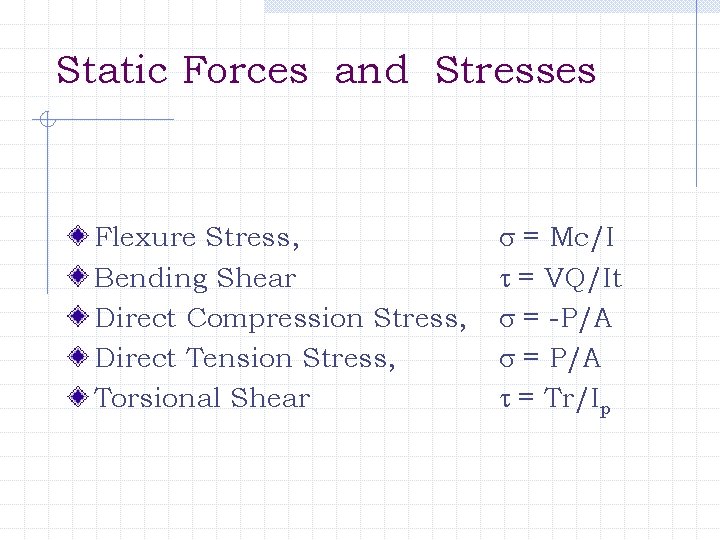
Static Forces and Stresses Flexure Stress, Bending Shear Direct Compression Stress, Direct Tension Stress, Torsional Shear = Mc/I = VQ/It = -P/A = Tr/Ip
Review of Mechanics Equilibrium (internal vs. external) n Combined Stresses Yield, (0. 2% offset) n n Elastic Limit, Proportional Limit, Limitations of elastic theory
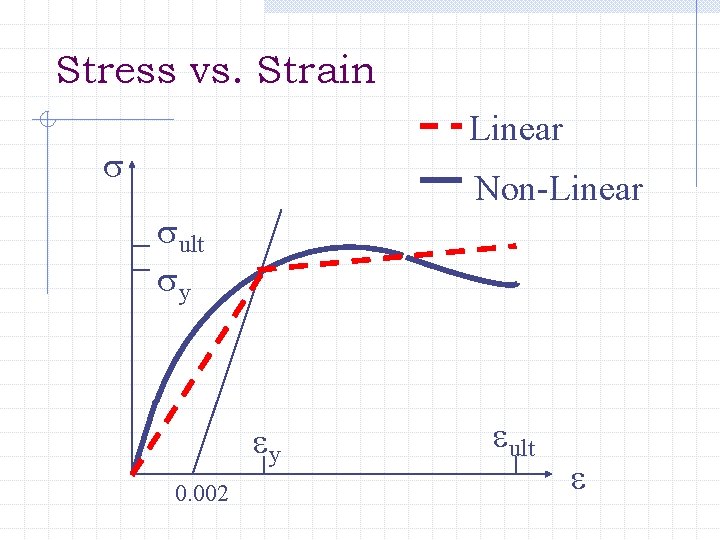
Stress vs. Strain Linear Non-Linear ult y y 0. 002 ult

Overview of Mechanics Modulus of Elasticity n tangent n secant n chord Shear Modulus
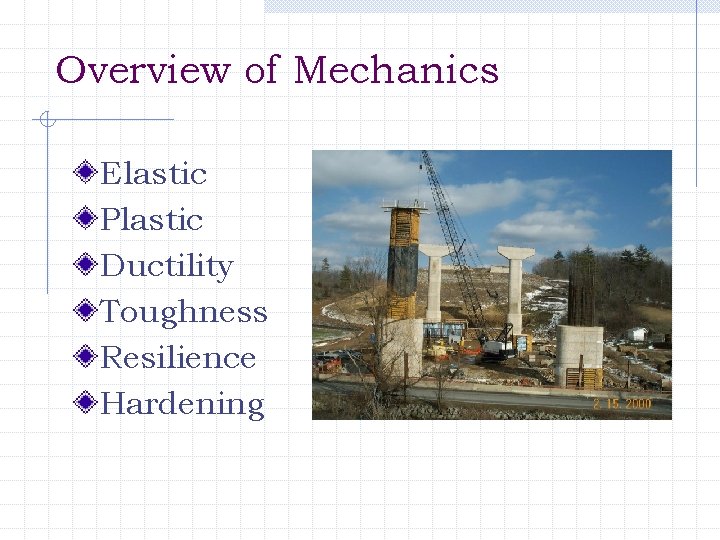
Overview of Mechanics Elastic Plastic Ductility Toughness Resilience Hardening
Elasticity Ability to store energy and recover strain when unloaded Perfectly elastic materials return to their original geometry when fully unloaded.
Plasticity Ability to absorb energy upon loading Perfectly plastic materials maintain the deflected shape after loading is removed.
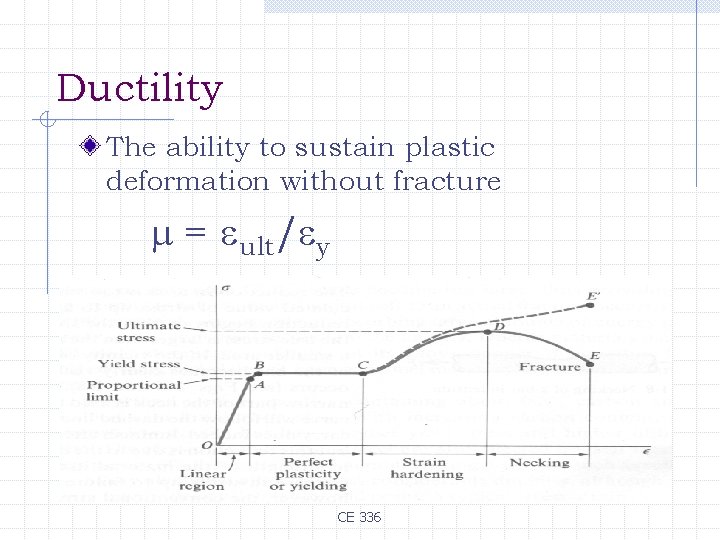
Ductility The ability to sustain plastic deformation without fracture = ult/ y CE 336
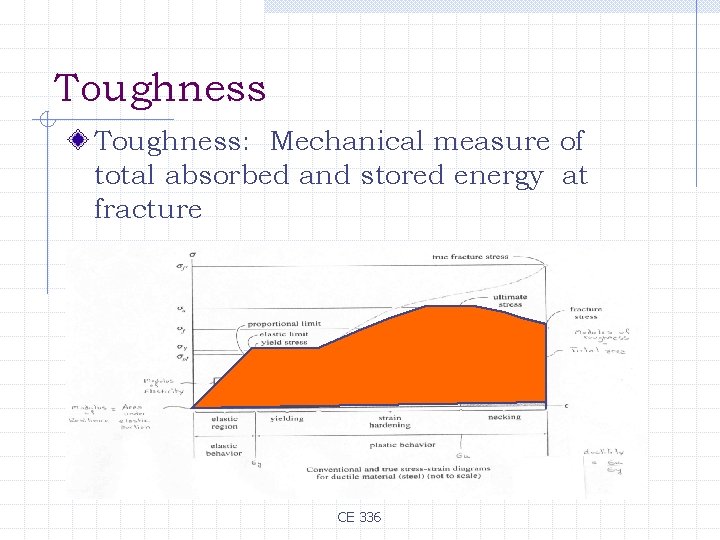
Toughness: Mechanical measure of total absorbed and stored energy at fracture CE 336
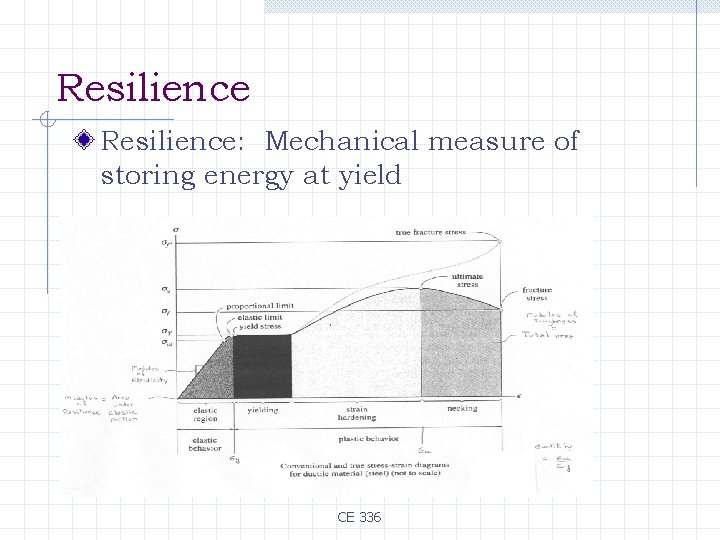
Resilience: Mechanical measure of storing energy at yield CE 336
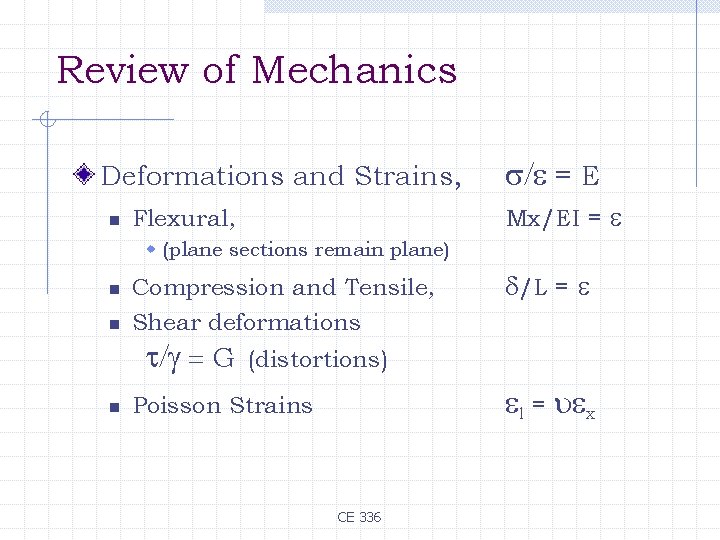
Review of Mechanics Deformations and Strains, n = E Mx/EI = Flexural, w (plane sections remain plane) n n Compression and Tensile, Shear deformations /L = Poisson Strains l = x G (distortions) n CE 336
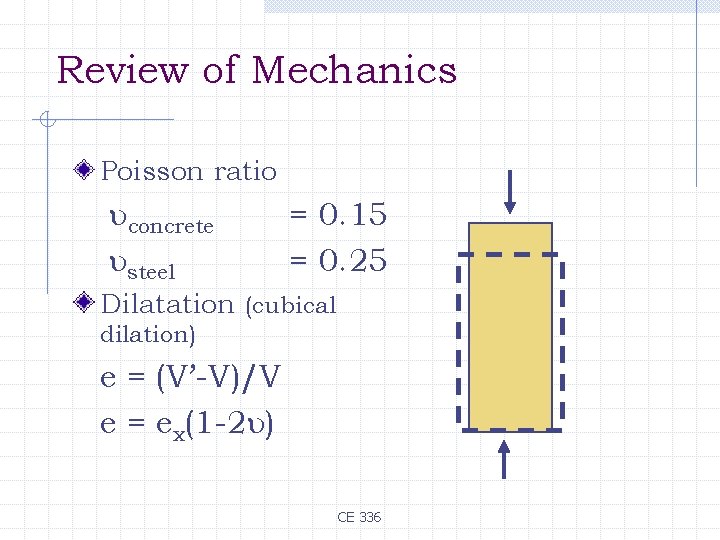
Review of Mechanics Poisson ratio concrete steel = 0. 15 = 0. 25 Dilatation (cubical dilation) e = (V’-V)/V e = ex(1 -2 ) CE 336
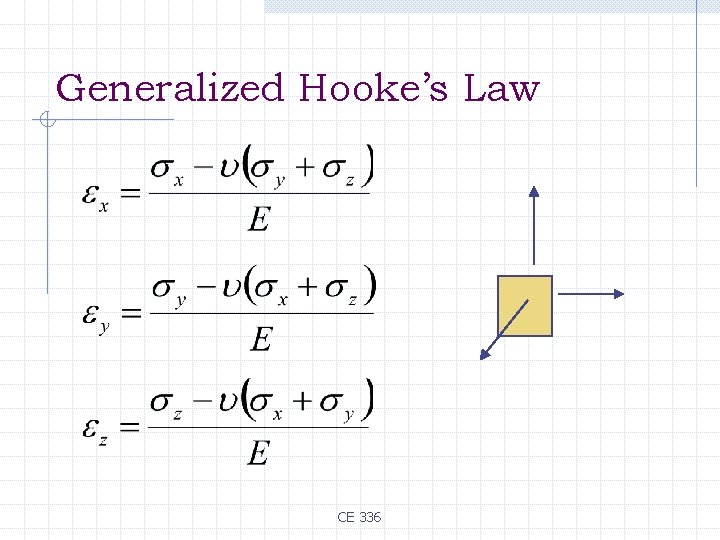
Generalized Hooke’s Law CE 336
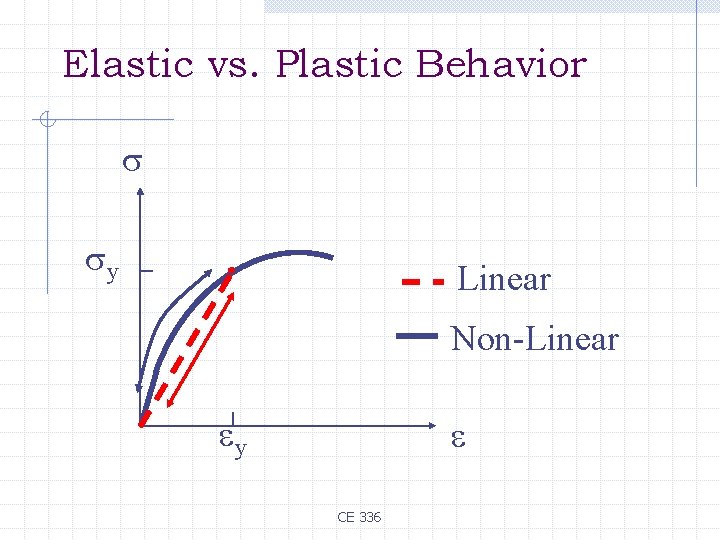
Elastic vs. Plastic Behavior y Linear Non-Linear y CE 336
Environmental/Mechanical Strain Coefficient of Thermal Expansion Creep, Shrinkage, Relaxation Chemical Resistance CE 336
Review of Mechanics Stiffness: Load necessary to cause a unit deformation n Modulus Shape, I, J, L, e. g. EI/L or AG Restrain Conditions Distribution of Forces according to Stiffness CE 336
Review of Mechanics Material Compatibility in composite Material Compatibility in environments CE 336
Ductility and Fracture Characteristics Ductile Behavior Advantages and Disadvantages Brittle Behavior Advantages and Disadvantages CE 336
- Slides: 23