
Mechanics Chapter 5 Friction 5 1 Basic Properties
Mechanics Chapter 5 Friction
5. 1 Basic Properties of Friction resists an object being moved against another object. If an object is at rest, there is NO friction. Friction only exists when you apply a force. The more force applied, the more friction is created, up to a limit.
5. 1 Basic Properties of Friction Three Properties about Friction - When part of the surface of an object is in contact with a fixed surface, and forces are tending to move the object across the surface, these forces will be opposed by a frictional force. Its direction is opposite to the direction of motion, or possible motion.
5. 1 Basic Properties of Friction Three Properties about Friction - The frictional force cannot exceed a certain magnitude, called the limiting friction. If the object is at rest and equilibrium is possible with a frictional force less that this limiting friction, the object remains at equilibrium
5. 1 Basic Properties of Friction Three Properties about Friction - If the object is at rest and the forces are in equilibrium with the limiting friction, the object is said to be in limiting equilibrium and to be “on the point of moving”.
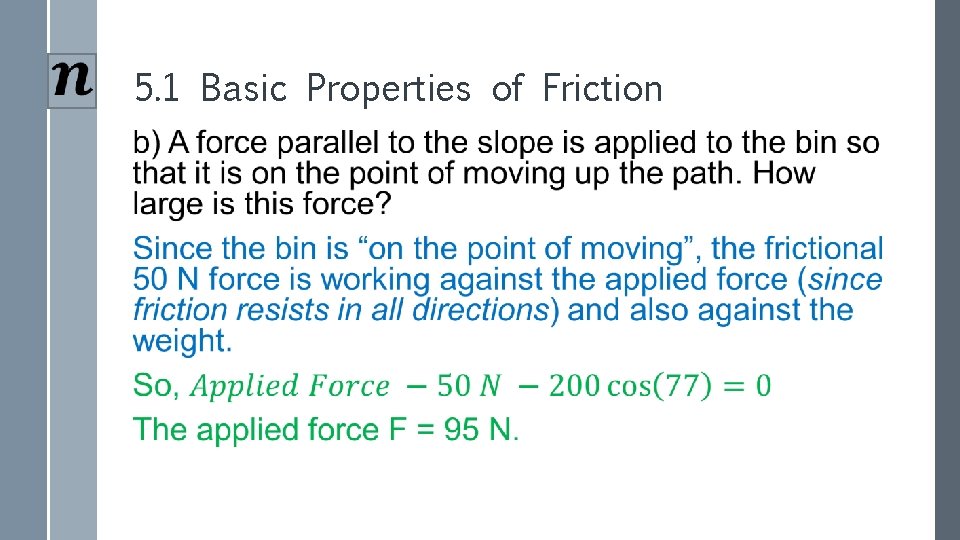
5. 1 Basic Properties of Friction ›
5. 2 Limiting Friction What determines the magnitude of the limiting Friction? - The material of the surfaces in contact - The shape of the area in contact - Other forces acting on the object
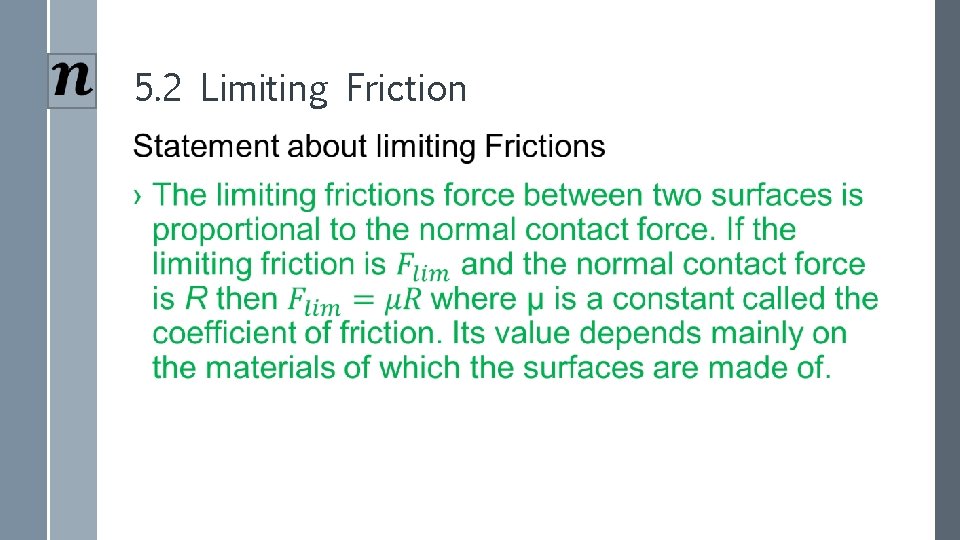
5. 2 Limiting Friction ›
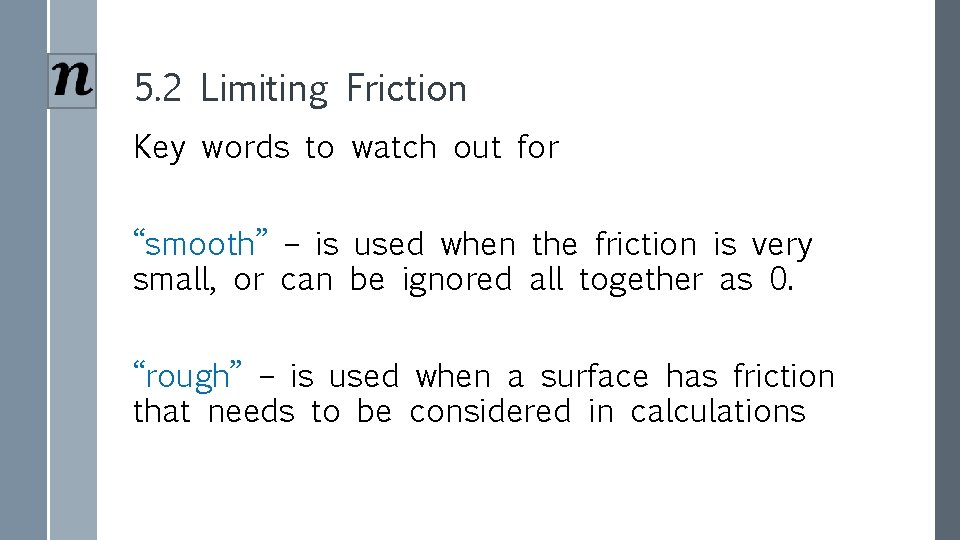
5. 2 Limiting Friction Key words to watch out for “smooth” – is used when the friction is very small, or can be ignored all together as 0. “rough” – is used when a surface has friction that needs to be considered in calculations
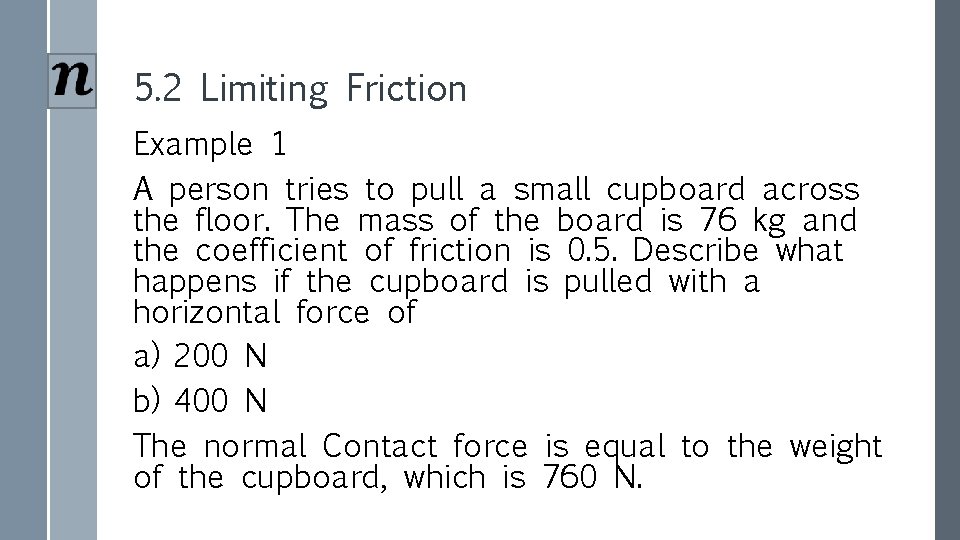
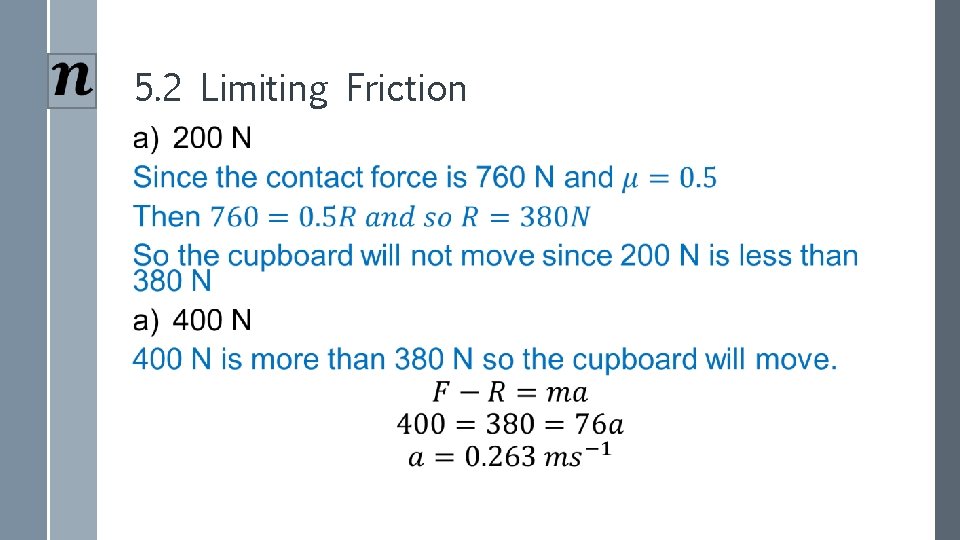
5. 2 Limiting Friction Example 1 A person tries to pull a small cupboard across the floor. The mass of the board is 76 kg and the coefficient of friction is 0. 5. Describe what happens if the cupboard is pulled with a horizontal force of a) 200 N b) 400 N The normal Contact force is equal to the weight of the cupboard, which is 760 N.
5. 2 Limiting Friction ›
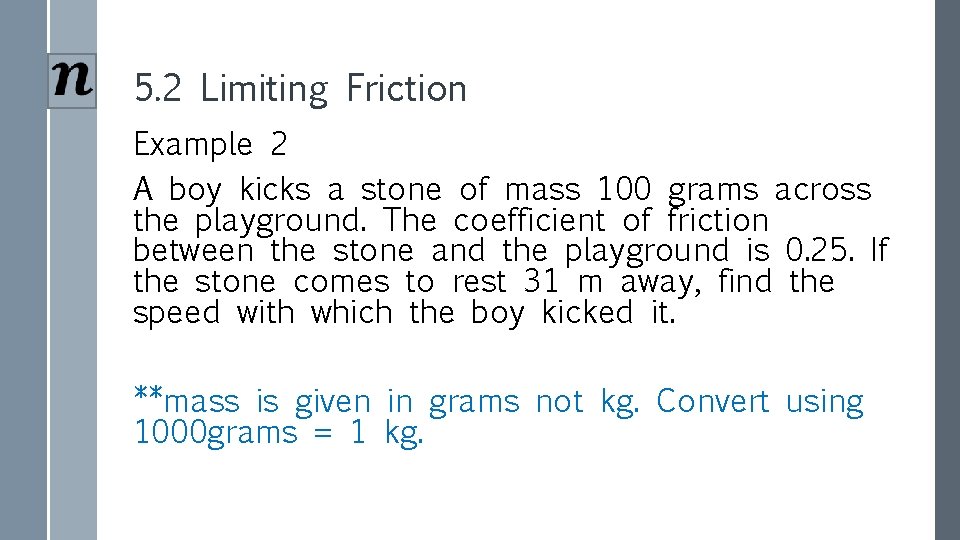
5. 2 Limiting Friction Example 2 A boy kicks a stone of mass 100 grams across the playground. The coefficient of friction between the stone and the playground is 0. 25. If the stone comes to rest 31 m away, find the speed with which the boy kicked it. **mass is given in grams not kg. Convert using 1000 grams = 1 kg.
5. 4 Friction and Motion Friction can be a good thing or bad thing. Friction in a car engine is not good, hence why it needs oil. Friction from the tires is good, hence why the car moves on the road.
5. 5 More problems involving Friction Example 1 A block of weight 20 N is at rest on a horizontal surface. When a force of magnitude 12 N is applied to the block at an angle of 30 degrees above the horizontal it is on the point of moving. Find the coefficient of friction between the block and the surface.
5. 5 More problems involving Friction Example 2 A snow covered hill is at an angle of 13 degrees to the horizontal. A sledge of weight 75 N is placed on the hill. Given that the coefficient of friction between the sledge and the hill is 0. 15, find whether the sledge will slide down by itself.
5. 5 More problems involving Friction Example 3 Part of an army assault course consists of a taut cable 24 meters long fixed at 35 degrees to the horizontal. A light rope ring is placed around the cable at its upper end. A soldier of mass 80 kg grabs hold of the ring and slides down the cable. If the coefficient of friction between the ring and cable is 0. 4, find how fact the soldier is moving when he reaches the bottom.
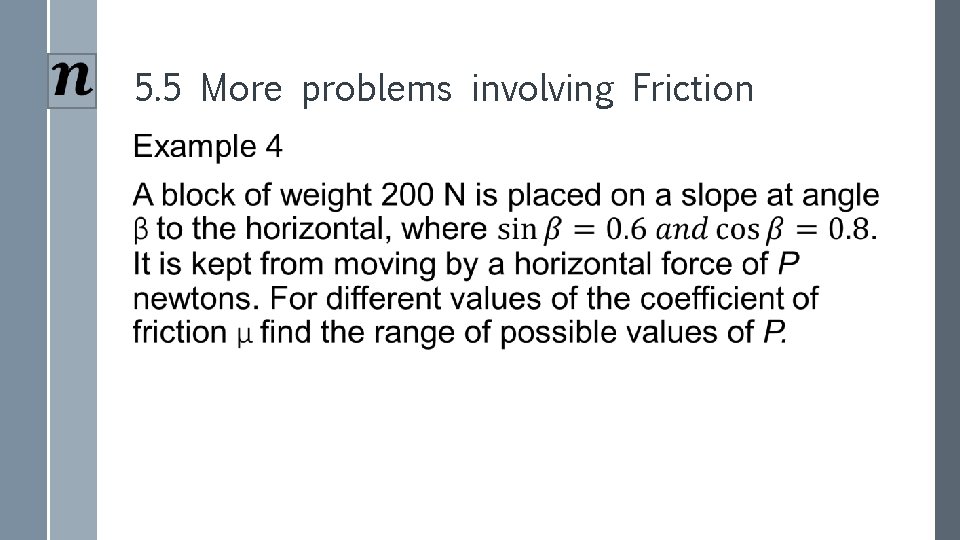
5. 5 More problems involving Friction ›
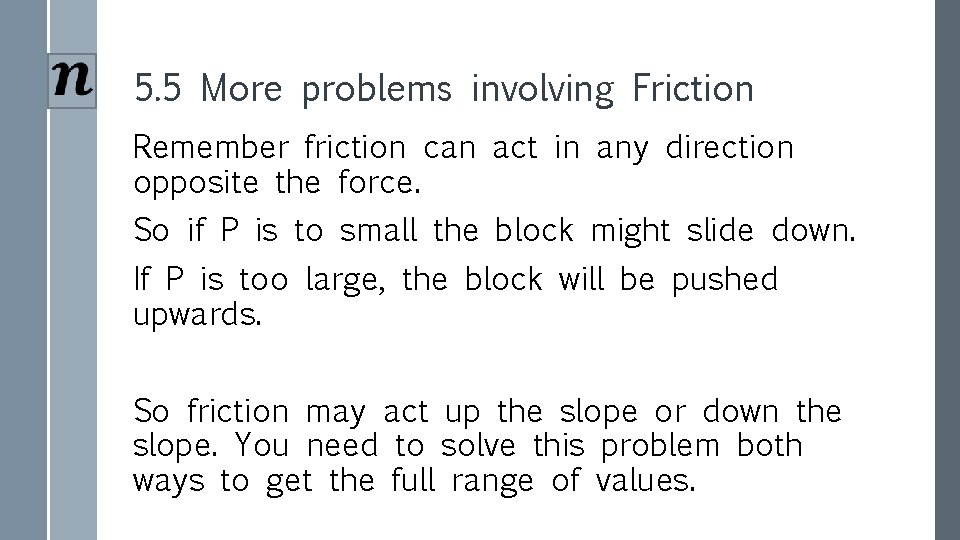
5. 5 More problems involving Friction Remember friction can act in any direction opposite the force. So if P is to small the block might slide down. If P is too large, the block will be pushed upwards. So friction may act up the slope or down the slope. You need to solve this problem both ways to get the full range of values.
- Slides: 18